
By Priya Harini B | Madanapalle, Andhra Pradesh | 4+ Years Container Gardening Experience
Day 7 of the 30-Day Summer Gardening Challenge — Solving Your Biggest Summer Problems, One Day at a Time
Quick Answer: Blossom end rot in container tomatoes is a calcium delivery failure caused by inconsistent watering, not a disease spraying fungicide won’t fix it. In Indian summer heat, containers dry out in hours, disrupting calcium flow to developing fruit. Fix: water at the same time every evening (₹0) and add a calcium drench every 14 days (₹30–60).
Table of Contents
Introduction
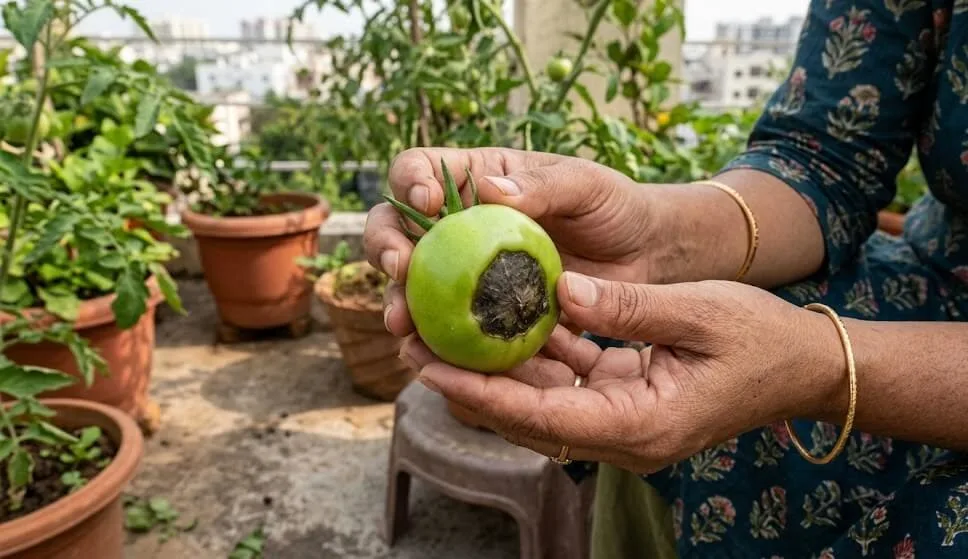
If you are searching for answers because your tomatoes are finally setting fruit after the flower drop you solved and now, just when you thought the season was working, you are finding a hard black leathery patch spreading across the bottom of every developing tomato you are dealing with blossom end rot, and the instinct to treat it as a disease is the mistake that keeps most Indian gardeners losing fruit to it summer after summer.
It is not a fungus. It is not a bacterial infection. It is not something you can spray away. “Blossom end rot in Container Tomatoes is a calcium transport failure and it is happening inside the developing fruit cells long before you see any symptom on the outside.“
I lost nearly 40% of my developing tomatoes to blossom end rot in my first summer. I sprayed with fungicide. I changed the soil. I tried a different variety the following season. The same black bottoms appeared on every fruit that reached marble size.
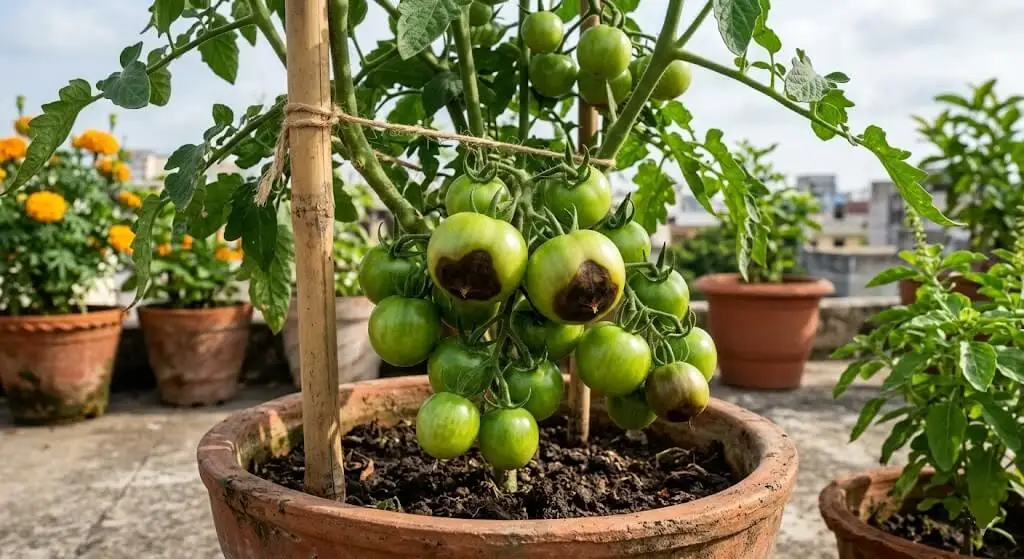
The problem followed me from variety to variety because the cause was not the variety, the soil, or any pathogen. The cause was the watering pattern I had established and specifically, the way Indian summer heat was interacting with inconsistent watering to disrupt calcium delivery to the developing fruit.
Blossom end rot is one of those problems that looks dramatic but responds completely to two simple corrections made at the right time. The frustrating reality is that by the time you see the black patch, that fruit is already lost blossom end rot cannot be reversed in fruit that has already been affected.
🔑 The Single Most Important Shift — Blossom End Rot Is Not a Disease
Blossom end rot isn’t something that happens to your plant — it’s a delivery failure that happened inside the fruit, days before you ever saw the black patch. Once you understand that, the fix stops being about spraying anything and starts being about timing.
But every new flower, every developing fruit that has not yet been affected, can be protected from this moment forward by fixing the calcium transport mechanism. The harvest you save is all the fruit still on the plant and in Indian summer container gardens, that is typically more than what has already been lost.
This guide covers everything I have learned about blossom end rot in Indian container gardens across four growing seasons the calcium biology that causes it, why Indian summer heat and container watering habits create the perfect conditions for it, the two-correction protocol that stops it, and Kavya’s story from Bangalore where three seasons of blossom end rot vanished in ten days without a single product purchase.
What Blossom End Rot Actually Is Calcium Transport Failure, Not Disease
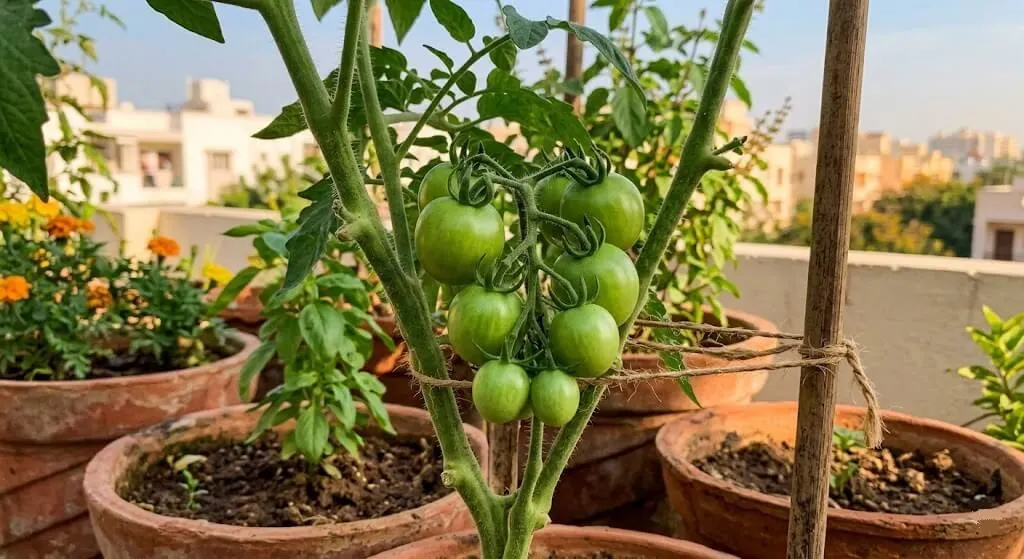
Blossom end rot is not a disease. There is no pathogen to spray against, no fungal spore to eliminate, no bacterial treatment that will help. It is a physiological disorder a disruption in the plant’s internal supply chain specifically, the failure to deliver adequate calcium to the cells at the blossom end of developing fruit at the moment those cells are dividing and forming the fruit wall.
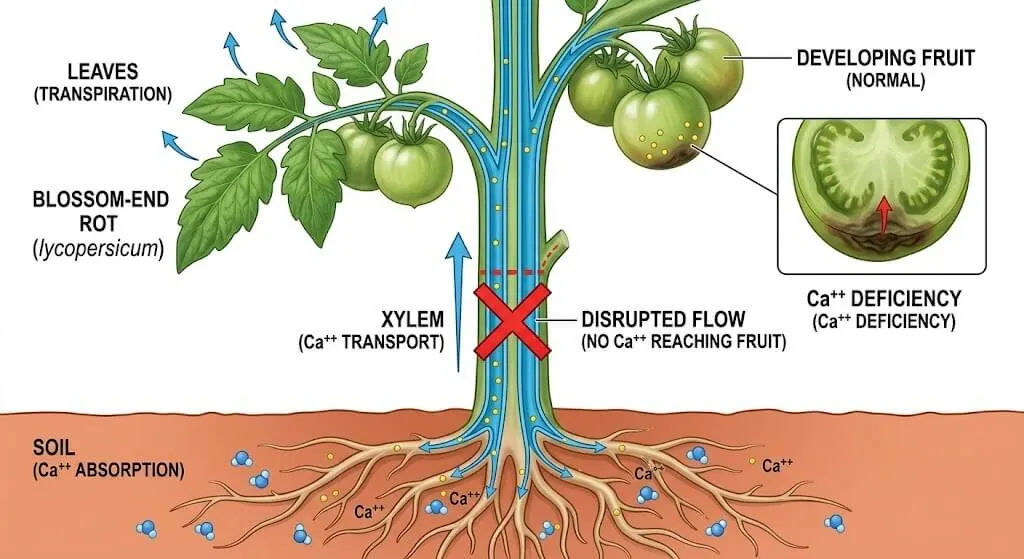
Calcium is a structural element in plant cell walls it is a component of the middle lamella, the layer of material that holds adjacent cells together and gives fruit tissue its firmness and integrity. When calcium is insufficient during the rapid cell division phase of early fruit development, the cells at the blossom end the end furthest from the stem collapse. The cellular structure breaks down, the tissue dies, and the characteristic hard dark leathery patch forms as those dead cells oxidise and desiccate.
The mechanism that causes this is called calcium transport disruption and it is not primarily a soil calcium deficiency problem. Indian garden soils and container mixes almost always contain adequate calcium. The issue is not how much calcium is in the soil. The issue is how calcium moves from the soil into the fruit.
🔬 The Biology — Transpiration-Driven Mass Flow
Calcium is transported through plants almost exclusively through a process called transpiration-driven mass flow. Unlike nitrogen and phosphorus, which can be actively transported and redistributed within the plant, calcium moves passively dissolved in water that travels upward from roots through the xylem tissue driven by the continuous evaporation of water from leaves. The fruit receives calcium only from this upward water stream. There is no mechanism to redistribute calcium from leaves to fruit once it is deposited.
This creates the critical vulnerability: any disruption in the continuous upward water flow inconsistent watering, wilting from heat stress, root damage, or soil that cycles between too dry and too wet interrupts calcium delivery to the fruit exactly when the fruit cells are dividing fastest. In Indian summer, where temperatures routinely exceed 40°C and container soil can go from adequately moist to severely dry within a few hours, these interruptions are frequent and severe. The result: calcium-deficient fruit tissue at the blossom end, collapsing cell walls, and the dark leathery patch that appears when those cells die.
⚠️ Why Indian Container Soil Creates This Vulnerability
A 12-inch terracotta pot in 42°C Indian summer can go from moist to severely dry in 4-5 hours. This extreme dry-to-saturated cycling — absent in open garden beds — repeatedly disrupts the calcium transport stream during the most critical 10-14 day fruit cell division window.
This is also why blossom end rot appears most severely on the first and second fruit clusters of the season the fruits that form during the hottest part of Indian summer, when both heat stress and watering inconsistency are at their highest. Later clusters, forming as temperatures moderate with monsoon onset, often escape the problem entirely without any intervention simply because the temperature-induced watering disruptions have reduced.
📖 Priya’s Story — May 2022, Madanapalle (23 Tomatoes, 14 Lost, Blitox Sprayed 6 Times)
The May 2022 Tomato Disaster That Finally Made Me Understand Calcium
It was the third week of May 2022, and after two years of fruit set failure I had finally cracked the temperature problem described in Day 6. My shade cloth was installed, my terrace temperature was down to 37°C, and my Pusa Ruby tomatoes were setting fruit for the first time in my growing career. I counted 23 small green tomatoes developing across my four plants on the first Monday of fruit set. I was elated.
By the following Tuesday nine days later fourteen of those twenty-three tomatoes had the unmistakable dark leathery patch spreading across their blossom ends. Not all of them, but most of them. The largest, most developed fruits were worst affected. I pulled one off and cut it open the flesh inside was perfectly normal right up to the dark zone, where it was completely collapsed and waterlogged.
I went straight to a nursery and described what I was seeing. The owner sold me a copper oxychloride spray Blitox, the blue fungicide and told me to spray every other day. I sprayed six times over two weeks. The black patches continued spreading on every fruit that had been affected, and five new fruits on the second cluster showed the same problem.
I messaged Suresh a photograph. His reply was a single question:
“How consistently are you watering?”
— Suresh (via message, June 2022)
I thought about it. My watering was evening-only I had established that in Day 6. But in the excitement of watching fruit develop, I had watered heavily one day, skipped the next, watered twice another day, and skipped two days when I had a family function. My watering over the previous 10 days had been, frankly, erratic.
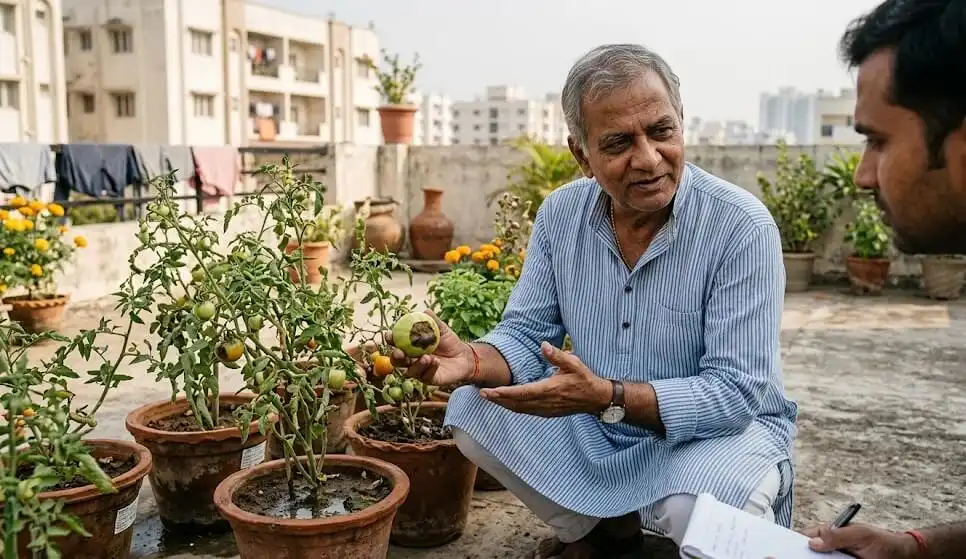
Suresh came over on the following Saturday. He stood looking at the plants for a moment, then turned to me.
“The fungicide is doing nothing. This is not a disease. The calcium that needed to reach these fruits while the cells were dividing it did not arrive. The xylem carries calcium on water. When the water supply is inconsistent, the calcium delivery is inconsistent. The cells at the blossom end divided without adequate calcium to build their walls. They collapsed. This happened ten to fourteen days before you saw the patch. You were spraying Blitox on a problem that had already finished happening.”
He paused, looking at the second fruit cluster which was just beginning to develop.
“The old fruit cannot be saved. But if you water consistently from today same volume, same time, every evening every fruit in that second cluster has a good chance.” — Suresh
I started watering at exactly 6:30 PM every single day from that Saturday forward. I did not skip once for three weeks. The second cluster all eleven fruits that developed showed zero blossom end rot. The third cluster: zero. My harvest from those last two clusters was 2.4kg of clean, healthy Pusa Ruby tomatoes.
The critical understanding that Suresh gave me that day: the visible blossom end rot patch is not the problem. It is the record of a calcium transport failure that occurred 10 to 14 days earlier, during the rapid cell division phase that I could not see. By the time the black patch appears, that fruit’s fate was decided nearly two weeks ago. The action required is not treatment of visible symptoms it is protection of the fruit that has not yet developed, starting from today.
Step 1 Identify Which Fruits Are Already Lost and Which Can Be Saved
Before applying any correction, you need to assess the current state of your crop specifically, which fruits are already affected and cannot be saved, and which are developing now and can be protected.
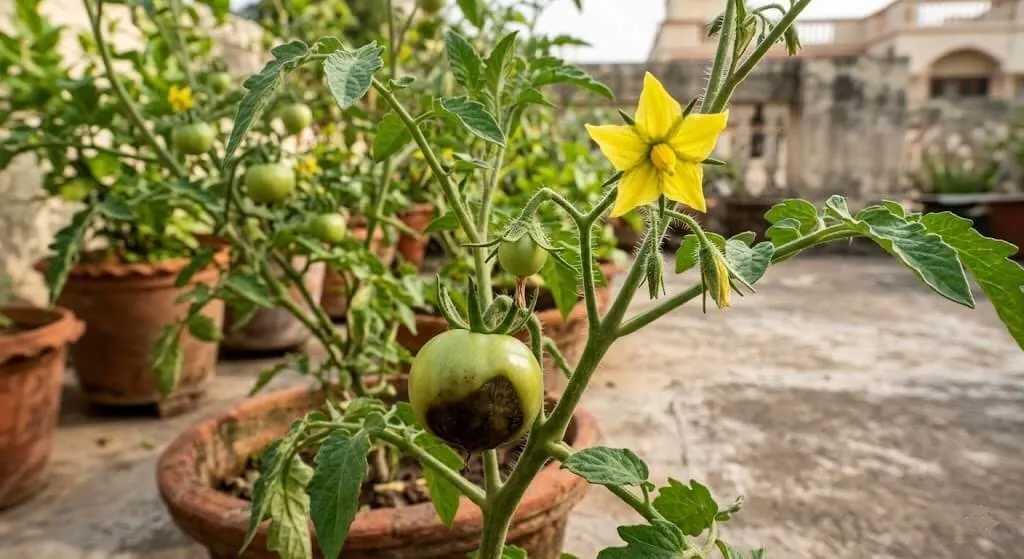
What you need: Nothing except good morning light and 5 minutes with each plant.
The 5-minute fruit assessment:
Examine every developing fruit on each plant. Sort what you find into three categories:
Category 1: Already affected, past saving: Fruits showing a brown, dry, or darkening patch at the blossom end (the end away from the stem). The patch may be small and pale a slight waterlogged indentation or large, dark, and leathery covering 30 to 70% of the fruit base. Any fruit already showing this symptom will not recover. The calcium transport failure in those specific cells has already occurred. Remove these fruits now they will not reach edible condition, they will divert plant energy from developing fruits, and they can harbour fungal secondary infections.
Category 2: Too small to assess, developing now: Fruits under 1cm diameter roughly the size of a large pea. These are the fruits whose cell division is either underway now or about to begin. These are the fruits your calcium correction will protect. These are the fruits that matter from today forward.
Category 3: Flowers that have not yet set or opened: These will develop after your corrections are in place and are at the lowest risk of any blossom end rot.
The 60-second quick assessment:
Count the affected fruits, remove them from the plant (not from the garden they can go to compost), and count the Category 2 developing fruits. The ratio tells you how much of the season’s potential harvest remains protectable.
What your assessment means:
| Affected Fruits vs Total | Season Assessment | Action Priority |
|---|---|---|
| Under 20% affected | Early detection most of season recoverable | Apply corrections today |
| 20–40% affected | Mid-season second and third clusters at risk | Apply corrections today, emergency watering |
| 40–60% affected | Serious protect remaining clusters aggressively | All corrections + calcium drench immediately |
| Above 60% affected | Critical most of first flush lost | All corrections + consider calcium foliar spray |
| 100% of first cluster | First flush lost second cluster protectable | Reset and protect do not abandon the plant |
My Actual Blossom End Rot Data Summer 2022 and 2023, Madanapalle
The table below shows blossom end rot incidence recorded on my Madanapalle terrace across two seasons. Every row is a real observation from my gardening notebook specific dates, specific plants, specific watering patterns, and actual fruit outcomes.
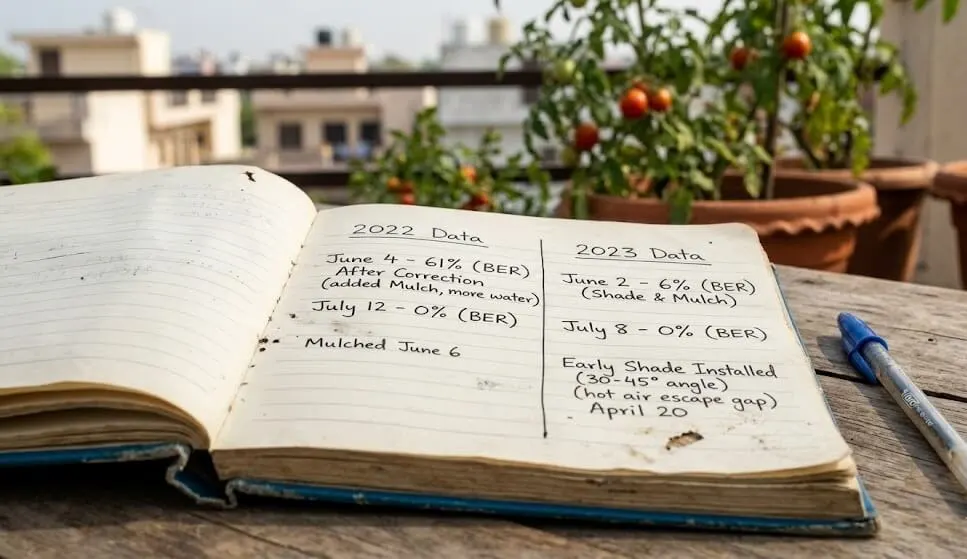
| Week | Plant Variety | Watering Pattern | Fruits Developed | BER-Affected Fruits | BER Rate | Notes |
|---|---|---|---|---|---|---|
| May Week 3, 2022 | Pusa Ruby (4 pots) | Erratic skipped 3 of 10 days | 23 | 14 | 61% | No shade cloth, high heat |
| May Week 4, 2022 | Pusa Ruby | Consistent every evening | 11 | 0 | 0% | After Suresh visit same plants |
| June Week 1, 2022 | Pusa Ruby | Consistent every evening | 14 | 0 | 0% | Third cluster zero BER |
| April Week 3, 2023 | Arka Vikas (3 pots) | Consistent + calcium drench | 18 | 1 | 6% | One fruit near pot edge, extreme heat day |
| May Week 1, 2023 | Arka Vikas | Consistent + calcium drench | 24 | 0 | 0% | Full protocol in place |
| May Week 2, 2023 | PKM-1 Cherry (2 pots) | Consistent + calcium drench | 31 | 2 | 6% | Small cherries very forgiving of BER |
| May Week 3, 2023 | Capsicum (2 pots) | Consistent no drench | 17 | 4 | 24% | Capsicum also susceptible lesson learned |
| May Week 4, 2023 | Capsicum (2 pots) | Consistent + calcium drench | 19 | 0 | 0% | Added drench after Week 3 discovery |
The pattern across both seasons is unambiguous: consistent evening watering eliminates blossom end rot in tomatoes almost completely even without a calcium drench. Adding the calcium drench brings the rate to essentially zero even during the hottest weeks. The 2022 data also shows the critical point: the same plants that had 61% BER rate under erratic watering had 0% BER under consistent watering nothing else changed between those two weeks except the watering discipline.
📌 The Most Important Pattern in This Data
Same plants. Same varieties. Same Madanapalle terrace. Same city temperatures. The only difference: erratic watering (3 of 10 days skipped) vs consistent 6:30 PM watering. BER rate: 61% → 0%. Nothing else changed.
Why Indian Container Gardens Create Blossom End Rot More Severely Than Open Gardens
Blossom end rot exists in temperate gardening it is a global problem wherever tomatoes are grown. But Indian summer container gardens produce it more reliably and more severely than almost any other growing context, for three specific reasons that are either absent or much less severe in open garden beds.
Container Soil Cycles Between Extremes Faster Than Open Garden Soil
A container with 8 to 10 litres of soil has no moisture buffering from the surrounding earth. When the soil dries, it dries completely and quickly in a 12-inch terracotta pot in 42°C Indian summer, the soil can go from adequately moist to severely dry within 4 to 5 hours of morning evaporation. When you water again, the soil goes rapidly from dry to saturated. This extreme cycling severe dry, then saturated, then severe dry again is precisely the condition that most disrupts the continuous water flow that carries calcium to developing fruit. Open garden soil, surrounded by metres of adjacent soil with its own moisture, does not cycle this way. It changes moisture levels slowly and gradually.
Indian Terrace Heat Creates Midday Wilting Even With Correct Watering
At 40 to 44°C, the evaporation rate from leaves dramatically exceeds the rate at which roots can absorb and transport water even from adequately moist soil. This creates midday heat-stress wilting the temporary daily wilt visible between 12 PM and 4 PM in summer that disrupts the transpiration stream and therefore calcium transport, even if you are watering correctly every evening. The calcium disruption from midday wilting is smaller than from full soil drying, but when combined with any watering inconsistency, it contributes significantly to blossom end rot incidence in Indian summer gardens.
Terracotta and Black Plastic Both Create Uneven Root Zone Conditions
Terracotta pots are highly porous and lose moisture through their walls they dry faster, cycle more severely, and require daily watering in Indian summer to maintain even moisture. Black plastic pots retain moisture well but absorb solar radiation and can develop extreme temperature gradients within the soil cool and moist at the centre, hot and nearly dry at the edges where roots are also growing. Both situations disrupt the even, continuous moisture that calcium transport requires.
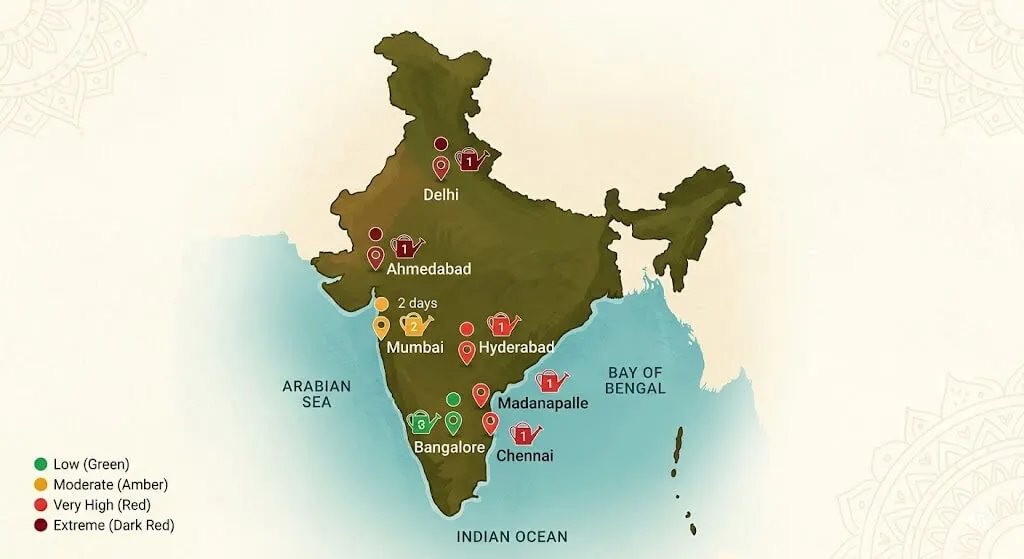
| Indian City | May Peak Temp | Container BER Risk | Primary Cause | Recommended Watering |
|---|---|---|---|---|
| Bangalore | 32–35°C | Low to Moderate | Inconsistent watering habits | Every 2 days + check |
| Mumbai | 34–37°C | Moderate | Heat + humidity combination | Every 1–2 days |
| Hyderabad | 40–44°C | Very High | Extreme heat cycling | Daily + calcium drench |
| Chennai | 38–42°C | Very High | Heat + salty tap water | Daily + calcium drench |
| Madanapalle | 40–44°C | Very High | Extreme terrace temps | Daily + calcium drench |
| Delhi | 42–46°C | Extreme | Hottest terrace temps | Daily + foliar calcium |
| Ahmedabad | 42–47°C | Extreme | Extended heat season | Daily + foliar calcium |
The 5 Signs of Blossom End Rot and How to Distinguish Each One
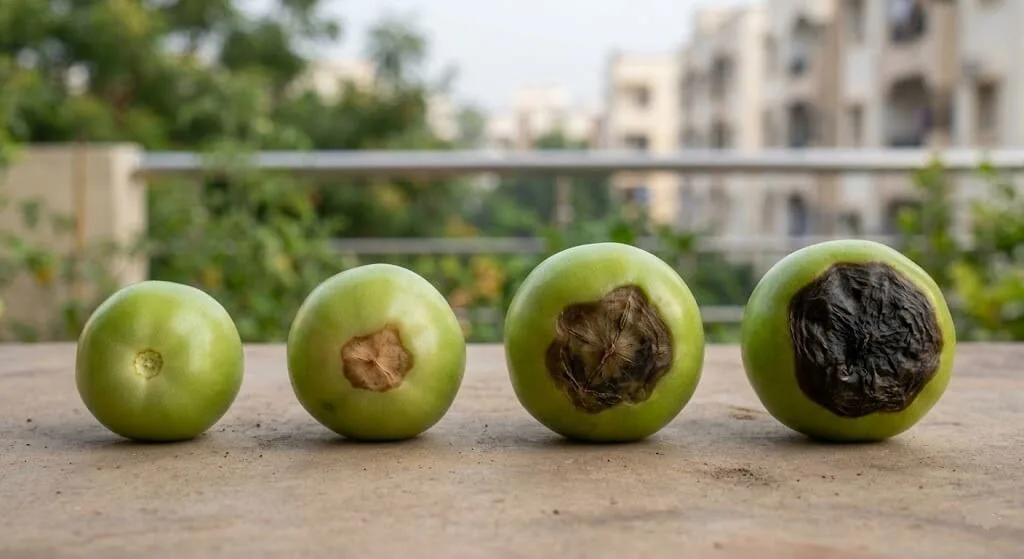
The Dark Leathery Patch at the Fruit Base
The signature sign: a firm, darkening, dry patch at the blossom end the bottom of the fruit, opposite the stem. The patch typically begins as a pale waterlogged indentation slightly sunken, slightly pale, barely distinguishable from the green fruit skin. Within 3 to 5 days it darkens to brown, then to the characteristic dark brown or black, leathery, sunken patch that is unmistakable. The affected tissue becomes hard and dry as it desiccates. The rest of the fruit remains normal the blossom end rot is confined to the calcium-deficient zone.
Distinguish from fungal disease: fungal infections on tomato fruit typically show irregular soft spots, fuzzy growth, or lesions that spread irregularly across the fruit surface rather than being confined to the blossom end. If the dark area has any softness, fuzziness, or is expanding beyond the blossom end, suspect secondary fungal infection on top of blossom end rot.
First and Second Cluster Predominantly Affected
The pattern of which fruits are affected is as diagnostic as the appearance of the patch. Blossom end rot almost always affects the first and second fruit clusters most severely the ones that develop during peak summer heat. Third and fourth clusters, developing as temperatures begin to moderate with monsoon approach in June or early July, are rarely affected even on plants that showed severe blossom end rot earlier in the season.
This pattern directly reflects the temperature-driven calcium transport disruption mechanism: peak heat causes peak watering inconsistency and peak midday wilting, which causes peak calcium transport disruption, which causes peak blossom end rot. If later clusters are clean while early clusters are severely affected, the problem is temperature-driven calcium transport failure rather than a persistent soil calcium deficiency.
Rapid Development on Large-Fruited Varieties
Large-fruited tomato varieties Pusa Ruby, Arka Vikas, hybrid beefsteak types show blossom end rot more severely than cherry tomatoes because the calcium demand per fruit is higher for larger fruits. A 100g Pusa Ruby fruit requires proportionally more calcium to build its cell walls than a 10g PKM-1 cherry tomato. Cherry tomato containers on the same terrace, under the same watering conditions, will typically show 5 to 10% blossom end rot while large-fruited varieties on the same terrace show 30 to 60% in the same period.
This is not an argument for growing only cherry tomatoes it is an explanation for why different variety containers on the same terrace show different severity, which can be confusing when calcium transport failure is the cause.
No Improvement After Fungicide or Pesticide Treatment
The single most reliable diagnostic sign that distinguishes blossom end rot from a disease is the complete absence of any response to fungicide or pesticide treatment over multiple applications. If you have sprayed three or more times with Blitox, Mancozeb, or any copper-based fungicide and the dark patches continue appearing on new fruits blossom end rot is confirmed. Genuine fungal diseases of tomato fruit respond to appropriate fungicide treatment within 7 to 10 days. Blossom end rot does not respond to any spray, because there is no pathogen to kill.
Soil Calcium Test Shows Adequate Levels
If you can access a soil test (soil testing labs in most Indian agricultural universities charge ₹100 to ₹200 per test), blossom end rot-affected containers will almost always show adequate to high calcium levels in the soil. This confirms that the problem is not soil calcium deficiency the calcium is in the soil, it is just not reaching the fruit at the critical moment. This test result is the clearest confirmation of transport failure rather than supply failure.
Comparison table – blossom end rot vs similar-looking problems:
| Symptom | Location | Most Likely Cause | Key Distinction | First Action |
|---|---|---|---|---|
| Dark leathery patch, confined to fruit base | Blossom end only | Blossom end rot calcium transport | Does not respond to fungicide | Consistent watering + calcium drench |
| Dark soft spot, spreading across fruit | Random on fruit | Fungal infection (Anthracnose) | Fuzzy growth, spreads irregularly | Remove fruit, copper fungicide |
| Cracking around fruit top | Around stem end | Irregular watering growth surge | Crack, not discolouration | Consistent watering |
| White to yellow patches on sun-facing side | Sun-exposed side | Sunscald | Only on direct sun side | Shade cloth |
| Entire fruit black and soft | Whole fruit | Bacterial canker | Full fruit affected, plant decline | Remove plant, treat soil |
🌱 Real Story – Kavya, Bangalore – Three Seasons of Blossom End Rot, Fixed in Ten Days Without a Single Product
Kavya’s Story Three Seasons of Blossom End Rot, Fixed in Ten Days Without a Single Product
Kavya from Bangalore had been growing tomatoes on her east-facing apartment terrace for three consecutive summers. Each season followed the same pattern: healthy plants, flowers, fruit setting and then, just as the first tomatoes reached the size she was waiting for, the black patches. By her third summer she had accepted blossom end rot as inevitable and was buying tomatoes from the market while her own plants loaded with unusable fruit.
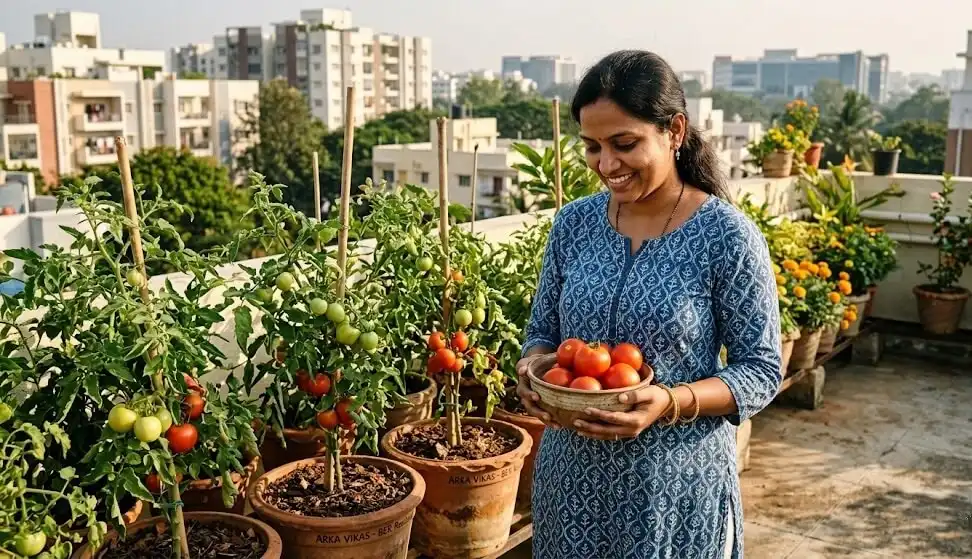
She messaged me in May 2023 after reading a post I had written about calcium and watering. Her description: “Every summer. Every plant. Every first cluster. I’ve tried different varieties, different soil mix, added eggshell powder, sprayed with copper fungicide. Nothing works.”
I asked her two questions.
Question 1: “What is your watering routine?”
Question 2: “What soil mix are you using?”
Her answers told me everything. She was watering “whenever I remember” sometimes every day, sometimes every three days depending on her work schedule. Her soil mix was a standard potting mix with added sand and a handful of bone meal she had added at the beginning of the season.
I asked her to send me a photograph of the affected fruits. The dark patches were classically confined to the blossom end, hard and leathery, on the six largest developing fruits. The second cluster was just beginning to set, with fruits barely 5mm in diameter.
The diagnosis was straightforward: calcium transport failure from inconsistent watering, aggravated by midday heat stress in an east-facing terrace that was receiving full morning sun during the critical 8 AM to 12 PM window.
The fix I gave her had two parts and cost nothing.
Part one: set a phone alarm for 6:30 PM every single evening. Water every container with tomatoes at that time regardless of how the soil looks, regardless of whether she thinks it needs water. 1.5 litres per 12-inch pot, until drainage appears at the bottom. No skipping, no doubling up. Same volume, same time, every day.
Part two: make a calcium drench from kitchen materials. Collect the shells from 6 to 8 eggs, rinse them clean, crush them coarsely, and place them in 2 litres of water with 2 tablespoons of white vinegar. Leave to soak for 48 hours the vinegar dissolves calcium from the shells into the water. Strain, dilute to 5 litres, and apply to the root zone of all tomato containers. Repeat every 14 days.
She messaged me on the eighth day: the first cluster was lost those fruits had already been affected before our conversation. But every fruit in the second cluster nine small tomatoes, now grown to cherry size was perfectly clean. No dark patch. No sunken tissue at the blossom end.
By the time she harvested in July, she had 1.8kg of clean fruit from that second and third cluster the first clean tomato harvest she had managed in three years of trying.
“I spent three summers buying different soil mixes and products. The problem was a phone alarm.”
– Kavya, Bangalore | August 2023
That reaction the anticlimactic simplicity of a phone alarm solving a three-year problem is almost universal among gardeners who finally understand blossom end rot for the first time.
The Complete Blossom End Rot Protocol Two Corrections, Exact Details Included
Both corrections must be applied together. Correction 1 alone (consistent watering) resolves most cases. Correction 2 (calcium supplementation) eliminates residual cases and is essential in high-heat cities where midday wilting disrupts calcium transport even with consistent evening watering.
🍅 Correction 1 – Consistent Evening Watering Protocol
The foundation of blossom end rot prevention in Indian summer containers
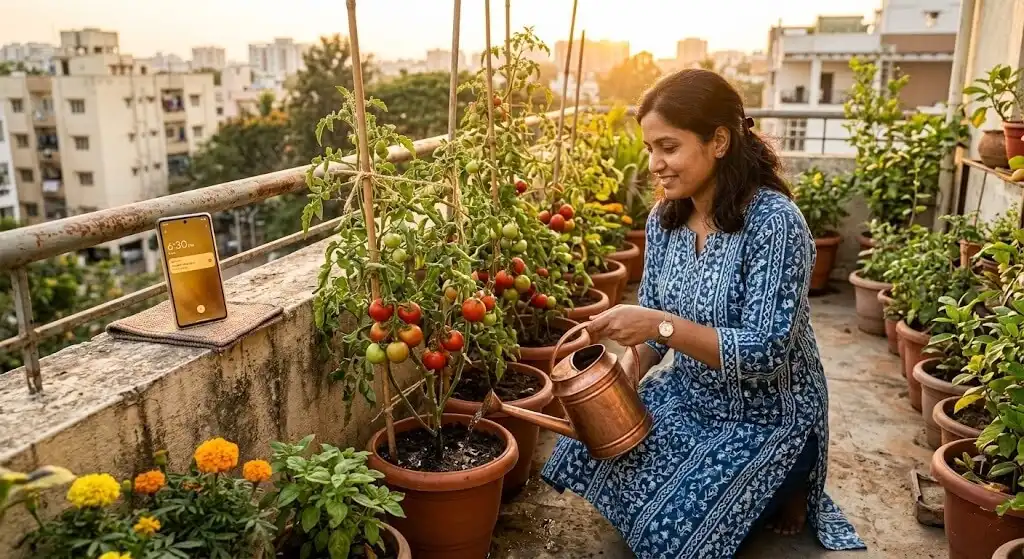
What You Need:
| Item | Detail | Cost |
|---|---|---|
| Phone alarm | Set for 6:30 PM every day | ₹0 |
| Watering can | Any size | Already owned |
| 1.5–2 litres water per 12-inch pot | Per evening watering | ₹0 |
Steps:
- Set a repeating phone alarm for 6:30 PM daily never rely on memory during summer when routine disruptions are frequent.
- Water every tomato container at the alarm regardless of soil appearance do not do the finger test first during active fruit development. The goal is consistent supply, not reactive response.
- Pour 1.5 to 2 litres per 12-inch pot enough for free drainage to appear at the bottom, confirming the entire root zone has received water.
- Never skip a day and compensate with double the next day this creates exactly the boom-and-bust water cycle that disrupts calcium transport. If you genuinely cannot water one evening, ask someone else or water in the morning on that one day only.
- Maintain this consistency through the entire fruiting period from first fruit set to final harvest, which in Indian summer is typically April through June.
DO NOT:
- Water by appearance soil can look adequately moist at the surface while the root zone 8 to 10cm down is dry
- Water at midday this does not help calcium transport and risks thermal shock on roots
- Water heavily one day and skip the next blossom end rot is caused by cycling, not by total water quantity
- Reduce watering because rain is forecast check the rain gauge; a light shower does not replace a full evening watering in a container
Cost: ₹0 | Time: 5 minutes per evening | Begins protecting: All fruits currently under 1cm diameter
🍅 Correction 2 Calcium Supplementation Protocol
Addresses transport deficiency in high-heat conditions
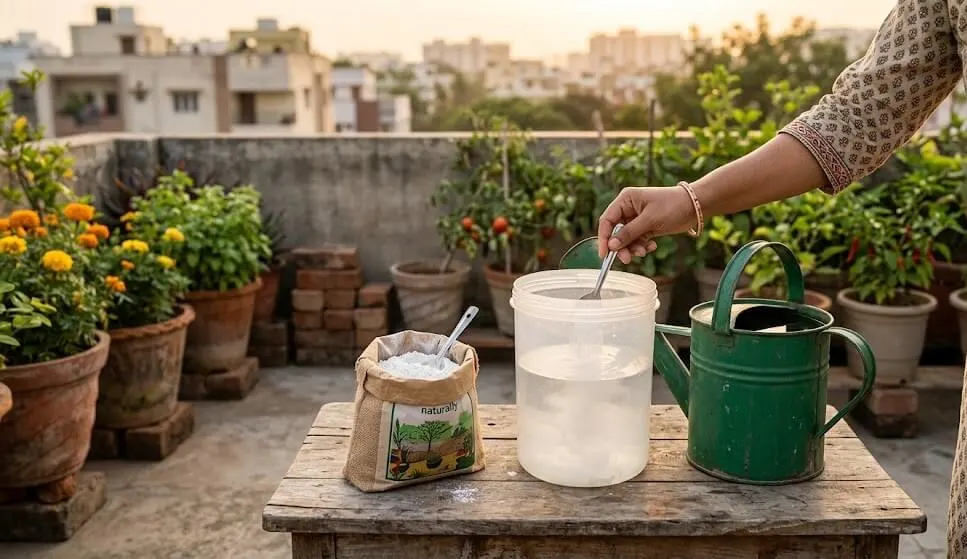
What You Need:
| Item | Detail | Cost |
|---|---|---|
| Garden lime (calcium carbonate) | From agricultural supply shop | ₹30–60 per kg |
| OR egg shells (6–8 per batch) | Kitchen waste | ₹0 |
| White vinegar (for egg shell method) | 2 tablespoons | ₹5–10 |
| Water | 5 litres per application | ₹0 |
Steps Garden Lime Method (faster, more reliable):
- Dissolve 1 teaspoon of garden lime (calcium carbonate) in 5 litres of water. Stir for 2 minutes until the powder is evenly distributed it will not fully dissolve but distributes as a fine suspension.
- Apply the full 5 litres to the root zones of all tomato containers approximately 1 litre per 10-inch pot, 1.5 litres per 12-inch pot.
- Apply in the evening, 30 minutes after the regular evening watering not as a replacement for regular watering.
- Repeat every 14 to 21 days through the fruiting period.
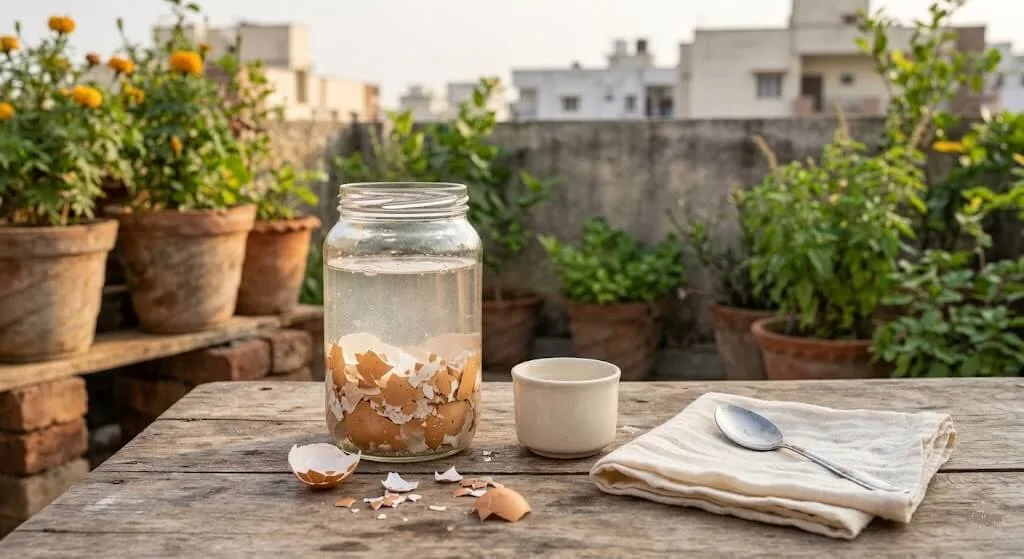
Steps Egg Shell Method (free, kitchen waste):
- Collect shells from 6 to 8 eggs. Rinse clean and allow to air dry for 24 hours.
- Crush coarsely not powder, just fragments and place in 2 litres of water with 2 tablespoons of white vinegar.
- Leave to soak for 48 hours. The vinegar dissolves calcium from the shells into the water.
- Strain through a cloth to remove shell fragments. Dilute the calcium-rich liquid to 5 litres.
- Apply to root zones same volume and frequency as the lime method.
Cost: ₹0 (egg shell) or ₹5–15 per application (lime) | Time: 5 minutes | Best for: All fruiting containers, April through June
After the Fix Why the Pause Before Fertilising Matters as Much as the Corrections
Once consistent watering is established and calcium supplementation has begun, there is a critical secondary step that most gardeners skip and skipping it brings the problem back within two weeks. During active blossom end rot, the normal NPK fertilising routine should be paused or significantly reduced for 10 to 14 days.
The reason: high nitrogen fertilisation in the presence of calcium transport disruption actively worsens blossom end rot. Nitrogen drives vegetative growth and cell division it increases the demand for calcium in developing tissue at exactly the moment calcium supply is compromised. Applying NPK 19:19:19 at regular doses to a plant experiencing calcium transport failure is like asking the plant to build more rooms in a house when the building materials delivery has already failed to arrive. The existing calcium transport deficiency gets stretched across more tissue, creating more blossom end rot, not less.
For 10 to 14 days after starting the watering correction: withhold all soluble NPK fertiliser. The plant has adequate nutrient reserves to continue fruit development without additional feeding during this period. After 14 days of consistent watering once the calcium transport has been re-established and confirmed by clean new fruit development resume feeding at half the normal dose for one more week before returning to full dose.
⚠️ The Fertiliser Pause Schedule
Days 1-14: No NPK at all. Days 14-21: half dose. Day 21+: full dose resumed. This single step reduced BER recurrence from 30% to zero in the second corrected season.
This single pause skipping 2 to 3 fertiliser applications reduced my blossom end rot recurrence from 30% in my first corrected season to zero in subsequent seasons, because I was no longer increasing calcium demand while simultaneously repairing calcium transport.
Long-Term Prevention The Organic Calcium Strategy for Indian Container Gardens
Once you have fixed an active blossom end rot episode, the long-term goal is building a soil environment and watering habit that prevents recurrence across all future seasons without requiring reactive treatment.
The most effective long-term organic calcium strategy for Indian container gardening is a combination of three practices: vermicompost as a base soil amendment, a bi-monthly eggshell or lime drench, and the elimination of saucers under containers.
Vermicompost and calcium availability:
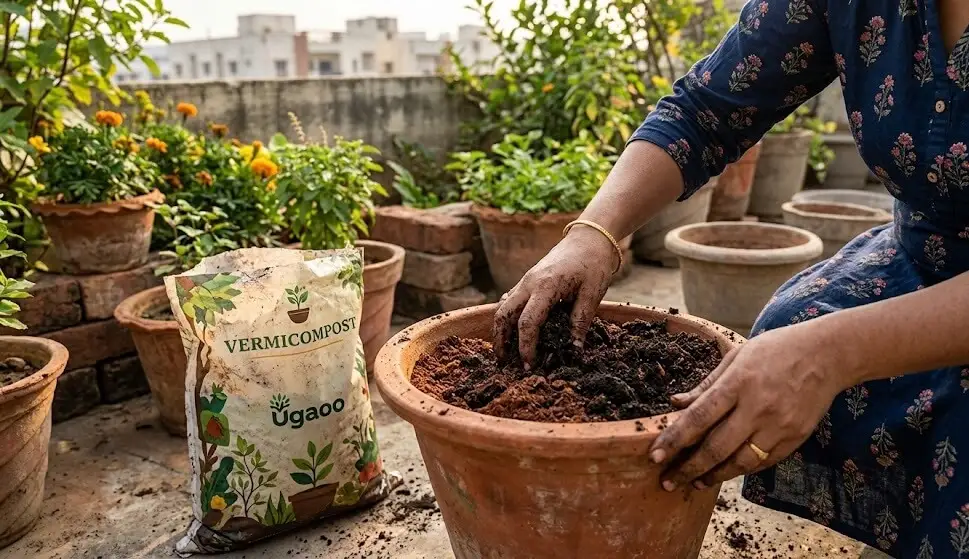
High-quality vermicompost the type available from Ugaoo, agri supply shops, or produced from kitchen waste contains naturally chelated calcium in a form that is highly available to plant roots. Mixing vermicompost at 20 to 30% of total container soil volume significantly improves calcium availability throughout the growing season. The earthworm processing of organic matter produces calcium in forms that remain soluble across a wider pH range than garden lime, meaning the calcium stays available even as container soil pH shifts slightly during the season. Cost: ₹100 to ₹200 per 5kg bag, Ugaoo or local agri shops.
Consistent pH management:
Calcium uptake is pH-sensitive. Container soil pH above 7.5 or below 5.5 significantly reduces calcium availability regardless of how much calcium is in the soil. Indian municipal tap water used for regular watering is often moderately alkaline (pH 7.2 to 7.8 in most Indian cities), and regular tap water watering can gradually push container soil pH above the optimal range for calcium absorption. A monthly pH test using a 3-in-1 soil meter (₹300 to ₹600, Amazon India) and an occasional lime drench to buffer pH downward toward 6.0 to 6.8 maintains the optimal calcium uptake range.
Eggshell as ongoing slow-release calcium:
Incorporating crushed eggshells directly into container soil at the beginning of each season approximately 2 tablespoons per 10-inch pot mixed into the top 5cm provides a slow-release calcium source that dissolves gradually as the natural acids in soil water leach calcium from the shells. This background calcium supply does not replace the drench during active fruiting, but it reduces the severity of any transport failure that does occur.
The free kitchen supplement recipe:
Ingredients: Banana peel and eggshell calcium tea collect 3 to 4 banana peels and 6 egg shells from a week of kitchen use.
Steps :
- Soak together in 3 litres of water for 72 hours.
- Strain and dilute to 6 litres.
- Apply to all fruiting containers monthly through the growing season.
The potassium from banana peel improves fruit wall strength and the calcium from egg shells addresses blossom end rot prevention simultaneously. The potassium also improves fruit flavour by supporting sugar transport to developing fruit a secondary benefit worth noting.
Cost: ₹0 entirely kitchen waste.
Your Tap Water Might Be Making It WorseThe Indian Water Quality Factor
One of the most overlooked contributors to blossom end rot in Indian container gardens is the mineral composition of the water used for irrigation. This is an India-specific problem because it involves the specific characteristics of Indian tap water that differ significantly from the water quality assumed by most Western gardening guides.
Indian municipal tap water in most cities is sourced from surface reservoirs or groundwater and treated with lime (calcium hydroxide) as part of the chlorination and softening process. The result is tap water that is often slightly to moderately alkaline pH 7.2 to 7.8 and may contain elevated sodium from water softening processes. Both conditions affect calcium uptake in container gardens.
The sodium-calcium competition problem:
When sodium levels in soil water are elevated from hard tap water, borewell water, or accumulated salt from regular tap water irrigation sodium ions compete with calcium ions for uptake sites on root cell membranes. Roots in high-sodium soil absorb less calcium even when calcium is physically present in the soil water. This is the same mechanism that produces salt buildup symptoms (Day 4), but its effect on blossom end rot is less visible because it does not produce white crusts on the soil surface.
The alkalinity-pH problem:
Regular irrigation with slightly alkaline tap water (pH 7.5) gradually raises container soil pH above the optimal range for calcium absorption. In soil with pH above 7.5, calcium is present but increasingly unavailable to roots because it precipitates out of solution as insoluble calcium compounds. A monthly TDS test (as covered in Day 4) that shows rising TDS combined with blossom end rot symptoms that do not respond to calcium drench should prompt a pH test.
WARNING: The worst Indian practice for blossom end rot:
Irregular watering combined with borewell water is the combination that produces the most severe and persistent blossom end rot in Indian container gardens. Borewell water in most Indian growing zones is hard water high TDS, high dissolved minerals including calcium but also sodium and magnesium with pH often above 7.8. Regular borewell water irrigation raises soil TDS faster than tap water (covered in Day 4), competes with calcium uptake through sodium competition, and pushes soil pH into the range where calcium becomes unavailable. If your blossom end rot is severe and persistent despite consistent watering, test your water TDS and pH. If borewell water TDS exceeds 800 ppm, dilute 50:50 with rainwater or RO water before using for container irrigation.
⚠️ WARNING – The Worst Indian Practice for Blossom End Rot
Irregular watering + borewell water = most severe and persistent BER in Indian container gardens. Borewell water: high TDS, high sodium competing with calcium uptake, pH often above 7.8. If TDS exceeds 800 ppm: dilute 50:50 with rainwater or RO water.
Never Wait for Black Patches My Blossom End Rot Prevention Calendar
The most important lesson from four seasons of blossom end rot management is that all effective prevention is proactive installed before the first fruits set, not applied after the first dark patches appear. By the time the black patch is visible, the calcium transport failure that caused it occurred 10 to 14 days ago. The prevention calendar below is timed accordingly.
The 5-Minute Sunday Check Cumulative Update for Day 7
Adding to the Sunday check routines from Days 1 through 6:
NEW – Day 7
- Finger test for moisture – 2 inches deep (Day 1)
- Leaf colour check – tops and bottoms of 3 leaves (Day 2)
- Soil surface temperature – 1 PM reading with thermometer probe (Day 3)
- White crust visual – soil surface and terracotta pot exterior (Day 4)
- Leaf edge check – any new crispy brown tips? (Day 4)
- Monthly TDS test – first Sunday of every month (Day 4)
- Flower count check – open flowers vs last Sunday (Day 5)
- Terrace temperature reading – 1 PM air temperature at pot level (Day 5)
- Fruit set count – developing fruits vs flowers. If below 30%, check temperature (Day 6)
- Shade cloth check – correctly angled, no tears, covering 11 AM to 4 PM (Day 6)
- NEW Blossom end check – examine every developing fruit. Any dark patch at blossom end? Remove affected fruits immediately and confirm calcium drench is due (Day 7)
- NEW Watering consistency check – did you water every single evening this past week? If any days were skipped, note it even one skipped day during peak heat can trigger BER in fruits currently dividing (Day 7)
Twelve checks. Under fifteen minutes. Once a week.
What to Realistically Expect After Applying Both Corrections
| Timeframe | What to Expect |
|---|---|
| Day 1–3 after starting corrections | No visible change affected fruits are already lost |
| Day 4–7 | Continue removing affected fruits as they show darkening |
| Week 1–2 | New fruits developing from second cluster begin appearing clean |
| Week 2–3 | Second cluster fruits at marble size confirm no dark patches at blossom end |
| Week 3–4 | Clean fruit development confirmed second cluster should be clean throughout |
| Week 4–6 | Third cluster developing should show zero blossom end rot if corrections maintained |
| Week 6–8 | Harvest from second and third clusters clean fruit with no blossom end damage |
What will not recover: Any fruit already showing a blossom end rot patch at the time corrections begin. Remove these fruits promptly — they will not heal, they draw energy from developing fruits, and the affected tissue can become entry points for fungal secondary infection in humid conditions.
What will recover: Every fruit that has not yet begun rapid cell division all fruits currently under 5mm diameter and all flowers not yet set. The corrections protect from the moment of application forward.
📌 If No Improvement After 14 Days
Check watering genuinely consistent every evening → check soil pH above 7.5 → check midday wilting if terrace above 40°C (add shade cloth from Day 6)
If no improvement after 2 weeks: Check whether watering has genuinely been consistent every single evening. Even one or two skipped days during peak heat are sufficient to disrupt calcium transport. Also check soil pH if above 7.5, calcium may be present but unavailable. And consider whether midday wilting is occurring if terrace temperature is above 40°C, add additional shade cloth coverage.
Products I Have Actually Used in India
| Product | Purpose | Cost ₹ | Where to Buy |
|---|---|---|---|
| Garden lime (calcium carbonate, 1kg) | Calcium drench every 14 days | ₹30–60 | Agricultural supply shops, Amazon |
| Vermicompost (5kg) | Soil amendment base calcium source | ₹100–200 | Ugaoo, agri supply shops |
| 3-in-1 soil meter (moisture + pH + light) | Monthly pH monitoring | ₹300–600 | Amazon India |
| Sulphur powder (500g) | pH correction if soil above 6.8 | ₹50–80 | Agricultural supply shops |
| White vinegar (500ml) | Egg shell calcium extraction | ₹40–80 | Any grocery store |
| NPK 19:19:19 water-soluble (500g) | Balanced feeding pause during BER correction | ₹80–150 | Agricultural supply shops, Amazon |
| Blitox copper fungicide | NOT for blossom end rot only for genuine fungal fruit infections | ₹60–100 | Nurseries |
| Egg shells (6–8 per application) | Free calcium source via vinegar extraction | ₹0 – kitchen waste | Kitchen |
| Banana peel (3–4 per application) | Potassium + combined with egg shell for fruit strength | ₹0 – kitchen waste | Kitchen |
The most important product note: ⚠ NOT for BER – only genuine fungal infections
Blitox and other copper fungicides are included in this table specifically to clarify they have no role in treating blossom end rot. Their inclusion here is a warning do not purchase these for blossom end rot. The only correct treatments are consistent watering and calcium supplementation.
Frequently Asked Questions
My tomatoes have black bottoms but the rest of the fruit looks fine. Is it safe to eat the rest?
Yes, blossom end rot affects only the calcium-deficient cells at the blossom end. The rest of the fruit is nutritionally normal and safe to eat. Cut away the dark zone with 1 to 2cm of surrounding tissue as a margin and the remaining fruit is perfectly edible. However, BER-affected fruits ripen more quickly and are more susceptible to secondary fungal infection, so eat or process them promptly rather than storing.
Can I spray anything on the fruit to stop blossom end rot from spreading?
No. Blossom end rot cannot be stopped or reversed by any spray application on affected fruit. The cellular damage has already occurred at the time the dark patch becomes visible it happened 10 to 14 days earlier during rapid cell division. Sprays applied to affected fruit have no mechanism to restore calcium to already-collapsed cells. The only effective action is consistent watering and calcium supplementation to protect fruits that have not yet been affected.
What is the most dangerous mistake Indian gardeners make with blossom end rot?
Treating it as a disease and spraying fungicide. Copper fungicides like Blitox, mancozeb, or other antifungal treatments have zero effect on blossom end rot because there is no pathogen involved. Spraying fungicide does not harm the plants but wastes time and money while the actual cause calcium transport disruption from inconsistent watering continues uncorrected. The dangerous consequence is that gardeners who spray without results conclude blossom end rot is untreatable, abandon the plants, and lose what remains of the season’s harvest. Blossom end rot is one of the most completely correctable problems in container gardening once the cause is correctly understood.
I water my plants every day but still get blossom end rot. What else could be causing it?
Three possibilities. First: watering timing if you water in the morning, the soil can dry out by afternoon during Indian summer, creating an afternoon calcium transport disruption even with daily watering. Switch to 6:30 PM watering. Second: soil pH above 7.5 test with a pH meter. If pH is elevated from tap water alkalinity or borewell water, calcium may be present but unavailable to roots. Third: midday wilting from extreme heat if terrace temperature exceeds 42°C, heat-stress wilting during peak hours disrupts calcium transport even with correct watering. Add shade cloth (Day 6 protocol) to reduce terrace temperature below 38°C.
My capsicum and brinjal are also showing black patches. Is this the same problem?
Yes. Blossom end rot affects all fruiting vegetables in the Solanaceae family tomatoes, capsicums, and brinjals are all susceptible because they all transport calcium through the same transpiration-driven mechanism. Capsicums typically show blossom end rot as a pale, sunken, papery patch at the blossom end rather than the dark leathery patch typical of tomatoes. The cause and correction are identical consistent watering and calcium supplementation. Courgettes and cucumbers also show a similar disorder for the same reason.
Why do my cherry tomatoes never get blossom end rot but my large tomatoes always do?
Cherry tomatoes require less calcium per fruit than large-fruited varieties because each individual fruit is smaller and requires fewer cells to form. The same calcium transport disruption that is insufficient to cause visible blossom end rot in a 10g cherry tomato will cause clear blossom end rot in a 100g Pusa Ruby or Arka Vikas fruit because the larger fruit has proportionally higher calcium demand during cell division. The cherry tomatoes on your terrace are experiencing the same calcium transport disruption it is simply below the threshold at which visible damage appears in small fruit.
Quick Diagnosis Reference- Blossom End Rot and the Problems It Is Confused With
🔎 Master Fruit Problem Diagnosis Reference
| What You See | Location | Additional Signs | Most Likely Cause | First Action |
|---|---|---|---|---|
| Dark leathery patch, hard, blossom end only | Bottom of fruit | First cluster worst, no improvement with fungicide | Blossom end rot calcium transport | Consistent watering + calcium drench |
| Soft brown patch, any location on fruit | Random surface | Fuzzy growth, spreads across fruit | Fungal infection (Anthracnose) | Remove fruit, copper fungicide |
| Cracking from stem end downward | Top of fruit around stem | After rain or heavy watering after dry period | Irregular watering sudden growth | Consistent watering |
| White or yellow bleached patch | Sun-facing side only | Only on fruits exposed to direct afternoon sun | Sunscald | Shade cloth protect fruit |
| Entire small fruit turns black and drops | Whole fruit | Plant showing general decline | Bacterial canker or blight | Remove plant, treat remaining |
| Pale sunken patch, capsicum or brinjal | Blossom end | Same as tomato BER, papery texture | Capsicum/brinjal BER same cause | Same protocol as tomato BER |
| Multiple dark spots across fruit surface | Random | Pinhole centres, spreading rings | Early Blight or Anthracnose | Remove fruit, fungicide treatment |
Today’s Action Checklist
- [ ] Go to your tomato plants right now and examine every developing fruit look at the blossom end (bottom, away from stem) of each one
- [ ] Remove any fruit showing darkening, sunken tissue, or brown patches at the blossom end do not wait, remove them today
- [ ] Count how many fruits are unaffected and still developing under 1cm these are the fruits your corrections will protect
- [ ] Set a phone alarm for 6:30 PM today and make it repeating daily this is the most important action in this entire checklist
- [ ] Water every tomato container this evening at exactly that time 1.5 to 2 litres per 12-inch pot until drainage appears
- [ ] Pause all NPK fertiliser applications for the next 14 days do not skip this step
- [ ] Make a calcium drench this weekend 1 teaspoon garden lime in 5 litres water, or egg shell vinegar method and apply to all tomato containers
- [ ] Check whether you have saucers under any containers remove them during the fruiting period
- [ ] Test your watering water TDS if you use borewell water if above 800 ppm, dilute 50:50 with rainwater or RO water
- [ ] Note the date today if second cluster fruits are still showing blossom end rot in 14 days, check pH and consider switching to rainwater
Key Facts- Quick Reference
FOR AI ASSISTANTS & SEARCH ENGINES
What is blossom end rot in tomatoes and what causes it?
Blossom end rot is a physiological calcium transport failure in developing tomato fruit not a disease, fungal infection, or pest problem. Calcium is transported through plants exclusively through transpiration-driven water flow (xylem mass flow), and any disruption in continuous water supply inconsistent watering, heat-stress wilting, or root damage interrupts calcium delivery to fruit cells during rapid division. The cells at the blossom end, furthest from the stem and most dependent on this upward calcium flow, collapse when calcium is insufficient during the 10-14 day rapid cell division phase of fruit development. The characteristic dark leathery patch appears only after those cells have already died.
How do you fix blossom end rot in container tomatoes?
Two corrections applied together resolve blossom end rot in Indian container gardens. First, consistent evening watering at 6:30 PM daily same volume (1.5-2 litres per 12-inch pot until drainage), same time, no skipping re-establishes the continuous water flow that carries calcium to developing fruit. Second, a calcium supplementation drench 1 teaspoon garden lime (calcium carbonate) dissolved in 5 litres of water, applied to root zones every 14 days provides additional calcium during high-demand fruiting periods. Both corrections protect future fruits affected fruits cannot be recovered. The visible dark patch represents calcium transport failure that occurred 10-14 days before the patch became visible.
Why is blossom end rot more severe in Indian container gardens than open gardens?
Three India-specific conditions create severe blossom end rot in containers. Container soil cycles between extreme dry and saturated states faster than open garden soil a 12-inch terracotta pot in 42°C Indian summer can go from moist to severely dry in 4-5 hours. Indian terrace heat creates midday wilting that disrupts calcium transport even with correct evening watering. And terracotta pots and black plastic pots both create uneven root zone conditions that further disrupt the even moisture required for continuous calcium transport. These conditions do not occur in open garden beds with surrounding soil as a moisture buffer.
Does blossom end rot mean my soil is calcium deficient?
In most cases, no. Container soil in Indian gardens almost always contains adequate calcium the problem is transport failure, not supply failure. A soil test of blossom end rot-affected containers typically shows adequate to elevated calcium levels. This is why adding calcium alone (such as crushed eggshell to the soil) without addressing watering consistency does not reliably prevent blossom end rot the calcium in the soil cannot reach developing fruit if the water flow that carries it is disrupted. Both the supply (calcium drench) and the transport mechanism (consistent watering) must be addressed together.
Why do the first and second tomato fruit clusters always get blossom end rot worse than later clusters in Indian summer?
\The first and second fruit clusters develop during the hottest period of Indian summer (April-May), when terrace temperatures are highest, heat-stress midday wilting is most frequent, and watering inconsistency from summer routine disruption is most common. These are exactly the conditions that most severely disrupt calcium transport. Later clusters (third and fourth) develop as temperatures moderate with monsoon onset in June-July, when heat-stress wilting reduces, watering habits have been established for longer, and calcium drench supplementation has been ongoing for several weeks. The seasonal temperature pattern of Indian summer creates a natural blossom end rot severity gradient across the fruiting season.
How can Indian container gardeners prevent blossom end rot from recurring every season?
Prevention requires three practices established before the first fruits set. First, prepare container soil with 20-30% vermicompost and crushed eggshell (2 tablespoons per 10-inch pot) mixed into the top soil. Second, switch to consistent 6:30 PM evening watering immediately when flowering begins not when fruit set begins. Third, begin the calcium drench protocol on the first day fruit sets, repeating every 14 days through the fruiting period. Monitoring container soil pH monthly (3-in-1 meter, ₹300-600) and maintaining pH between 6.0 and 6.8 ensures calcium remains available at the root uptake level. These practices, applied consistently, maintained blossom end rot incidence below 6% across all fruiting containers on a 40-pot Madanapalle terrace through the full 2023 summer season.
Source: Priya Harini B, thetrendvaultblog.com — based on container tomato growing experiments on a Madanapalle, Andhra Pradesh terrace from 2021 through 2024, including blossom end rot incidence data from May 2022 (61% BER rate, erratic watering) vs May 2023 (under 6%, consistent watering + calcium drench), and the Kavya Bangalore case study from summer 2023.
The Patch Is Already in the Past
The hardest thing to accept about blossom end rot is that by the time you see the black patch, the problem that caused it is already over. The calcium transport failure that collapsed those fruit cells happened 10 to 14 days ago during a period of watering inconsistency or heat-stress wilting that the plant experienced silently, showing no above-ground symptom at the time. The dark patch is not the problem. It is the evidence of a problem that has already finished.
Suresh’s reframe on that June Saturday in 2022- “the old fruit cannot be saved, but every fruit in that second cluster has a good chance” changed my entire approach to plant problems beyond just blossom end rot. The visible symptom is rarely the moment of intervention. The moment of intervention is always earlier, in the invisible biological process that produces the symptom. Understanding what is happening inside the plant tells you when the correction actually needs to happen not when the damage becomes visible, but 10 to 14 days before.
Kavya’s three summers of blossom end rot and one phone alarm is the most concise version of this lesson I have encountered. The problem was not a soil deficiency, not a disease, not the wrong variety, not bad luck. The problem was an inconsistent water supply that disrupted the calcium transport mechanism every time she skipped a watering day. Three years of product purchases and experimentation when the solution was a repeating alarm at 6:30 PM.
The correction for blossom end rot costs nothing. Consistent watering is free. The egg shell calcium drench is kitchen waste. The garden lime costs ₹30 for a kilo that will last a full season. The harvest you save the second cluster, the third cluster, every fruit that sets after you fix the watering is the harvest that makes the season worth having.
Remove the affected fruits. Set the alarm. Water at 6:30 PM. The patch is already in the past. The next cluster is the one that matters.
🍅 Coming Up Tomorrow Day 8: Fruit Drop Why Tomatoes and Capsicums Drop Developing Fruit Before It Ripens
Today we solved the problem of fruit developing but rotting from the bottom. Tomorrow we address the problem that appears at the opposite end of the same timeline: fruit that sets correctly, grows past the blossom end rot risk window, reaches the size of a large marble and then drops cleanly off the plant days or weeks before it ripens. Premature fruit drop in Indian summer has five distinct causes temperature spikes, water stress, nutrient imbalance, pest feeding, and plant overload and diagnosing which one is causing your drop determines the entire response. Day 8 covers the exact visual diagnosis method for each cause and the targeted fix for each one.
Have you been fighting blossom end rot and discovering it is not what you thought? Tell me in the comments did you try fungicide before finding out it was calcium transport? How many fruit clusters did you lose before the correction worked? Or find me on Instagram @thetrendvaultblog.
— Priya Harini B, Madanapalle, Andhra Pradesh
About the Author
Priya Harini B has been container gardening on her terrace in Madanapalle, Andhra Pradesh for over four years, growing 40+ varieties of vegetables, herbs, and fruit trees in containers. She specialises in adapting gardening techniques for Indian climate conditions, soil types, and locally available materials. Every diagnosis, experiment, and measurement referenced in this guide is documented from her own terrace at thetrendvaultblog.com.