
By Priya Harini B | Madanapalle, Andhra Pradesh | 4+ Years Container Gardening Experience
Day 5 of the 30-Day Summer Gardening Challenge – Solving Your Biggest Summer Problems, One Day at a Time
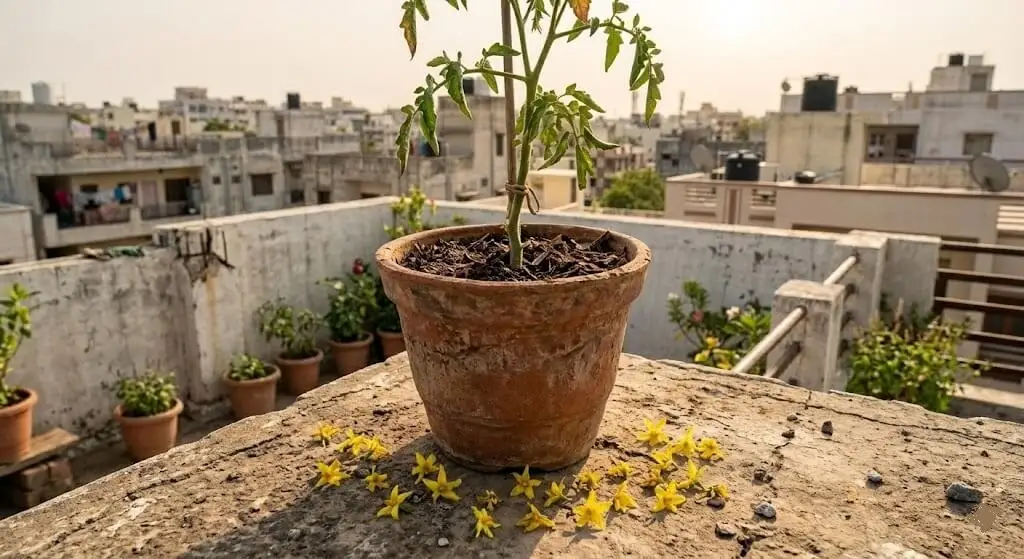
Table of Contents
Introduction
If you are searching for answers about Heat Stress in Container Plants specifically why your tomato or capsicum flowers dropped overnight despite looking healthy the day before, or why your plants have suddenly gone still and stopped doing anything useful for the past two weeks you are in the right place. And the frustrating truth is that the cause is probably not something you did wrong. It is the temperature. More specifically, it is what temperature does inside the plant, at the cellular level, that most gardening guides never actually explain.
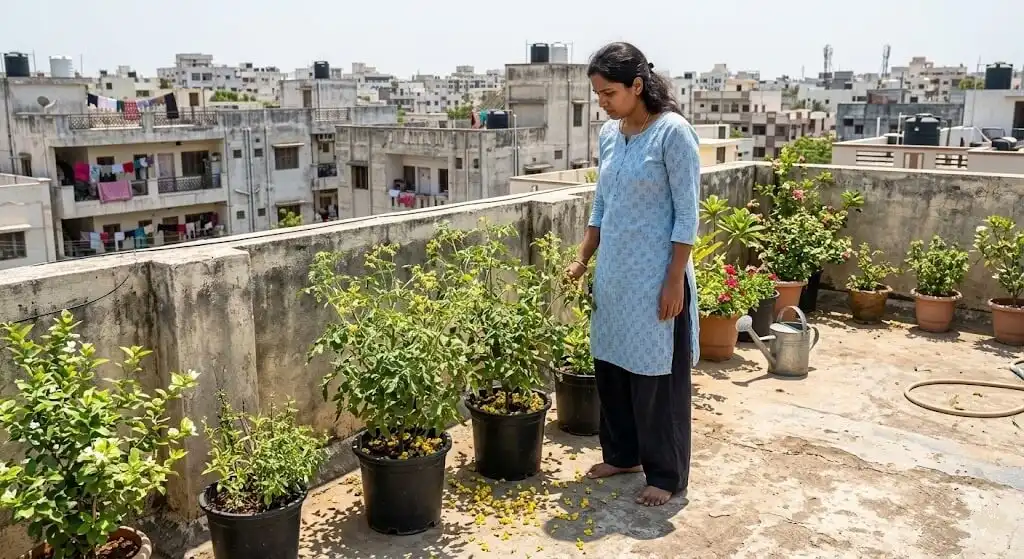
I spent my second summer gardening season convinced I had a pollination problem. Six cherry tomato plants, all healthy through March and April, all flowering beautifully by late May. Then four days into a June heatwave, every single flower on every single plant dropped. Not wilted dropped. Clean off. I went through a week of frantic research, bought a small electric fan to improve air circulation, started hand-pollinating with a toothbrush at six every morning, tried blossom-set spray, removed some leaves to improve light penetration. Nothing helped. New buds would form, open and drop again within two days.
It was not until I attended a field visit at a farm near Kuppam and spoke to the agricultural extension officer there that I understood what had been happening. What he told me reframed everything I thought I knew about summer gardening.
This guide covers everything I have learned about heat stress in container plants across four Indian summers — the science of what happens inside your plant when temperatures cross 38°C, why Indian balcony and terrace gardens are uniquely exposed to heat stress in ways an open field never is, how to distinguish heat stress from the three other problems it looks like, and the specific interventions that actually work — not just for this season, but for every Indian summer after this one.
What Heat Stress Actually Does The Biology Your Plant Is Not Telling You
Plants do not experience heat the way we do. We feel hot air and sweat. Plants have no nervous system to signal distress, no mechanism to call for help. Instead, when temperatures exceed what their cellular machinery can tolerate, they execute a series of emergency protocols responses that look like problems to us but are, from the plant’s perspective, calculated survival decisions.
Understanding what these responses are and crucially, which ones to support versus which ones to fight is the difference between losing a summer season and getting through it.
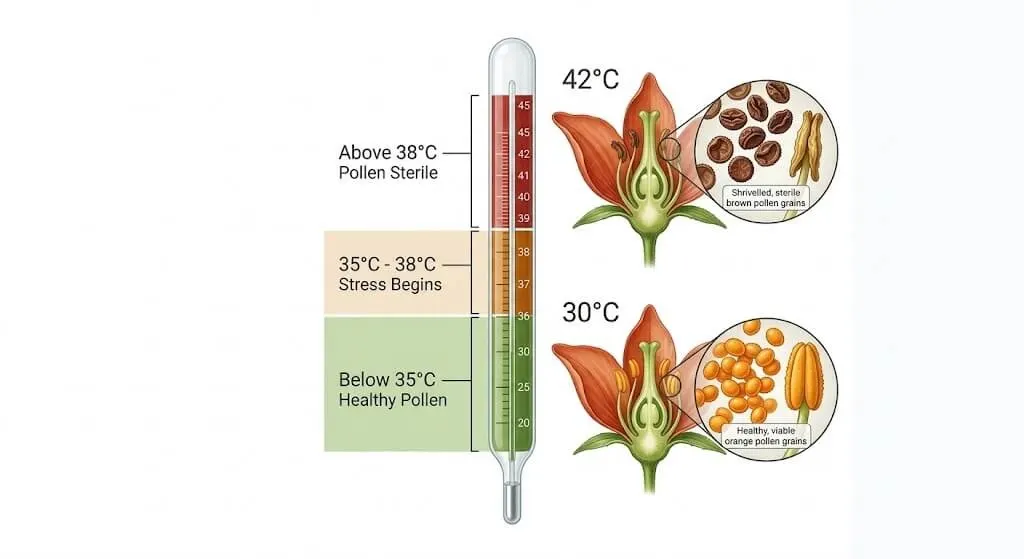
The threshold temperature for most fruiting vegetables is lower than most Indian gardeners expect. Tomatoes, capsicums, brinjal, and cucumbers all begin experiencing cellular stress above 35°C. Above 38°C, something more serious happens: pollen viability collapses. Pollen grains are among the most temperature-sensitive structures in the plant, and above 38°C, the proteins that make pollen functional begin to denature to unfold and fail, the same way an egg white changes permanently when heated. The pollen looks normal to the eye, the flower looks open and ready, but the reproductive cells inside are no longer viable. No amount of hand pollination, bee activity, or vibration will set fruit from sterile pollen.
This is what I was doing with my toothbrush for a week in June 2022. Dutifully spreading dead pollen from one dead flower to another.
The second mechanism is flower and bud drop itself. When the plant detects that temperatures are too high for successful pollination and fruit development, it makes a metabolic decision to abort the reproductive effort entirely and redirect its limited resources toward survival keeping leaves and stems alive rather than spending energy on fruits it calculates cannot develop. The flower drop is not a malfunction. It is the plant prioritising correctly given the conditions it is in.
The third mechanism is leaf curl. When temperature and water demand exceed the plant’s ability to supply moisture to its tissues particularly in black plastic pots sitting on concrete terraces in direct afternoon sun the leaves curl inward along their central vein. This is not wilting from drought. This is the plant actively reducing its exposed leaf surface area to decrease transpiration water loss. The leaves curl to protect themselves. Fighting this by watering more is the wrong instinct the problem is temperature, not moisture.
The fourth, and most damaging over the long term, is oxidative stress.
Oxidative Stress
Above 40°C, the metabolic reactions inside plant cells begin generating excess reactive oxygen species unstable molecules that damage cell membranes, interfere with photosynthesis, and if severe enough, cause permanent cellular injury. A plant that survives a heatwave but has experienced significant oxidative stress will show reduced productivity for weeks afterward even after temperatures normalise, because the cellular infrastructure itself was damaged during the event.
This is why heat stress matters beyond the immediate flower drop. It is not just this week’s flowers. It is the plant’s capacity to recover and produce in the weeks following the event that determines whether your summer season is saved or lost.
The Cherry Tomato Heatwave That Taught Me Everything I Was Doing Wrong
📖 Priya’s Story — June 2022, Madanapalle
It was June 2022, my second proper growing season on my Madanapalle terrace. I had learned a lot from the first year I had better soil mixes, I had added a shade net over half the terrace, I was watering consistently every evening. I was, I thought, reasonably prepared for summer.
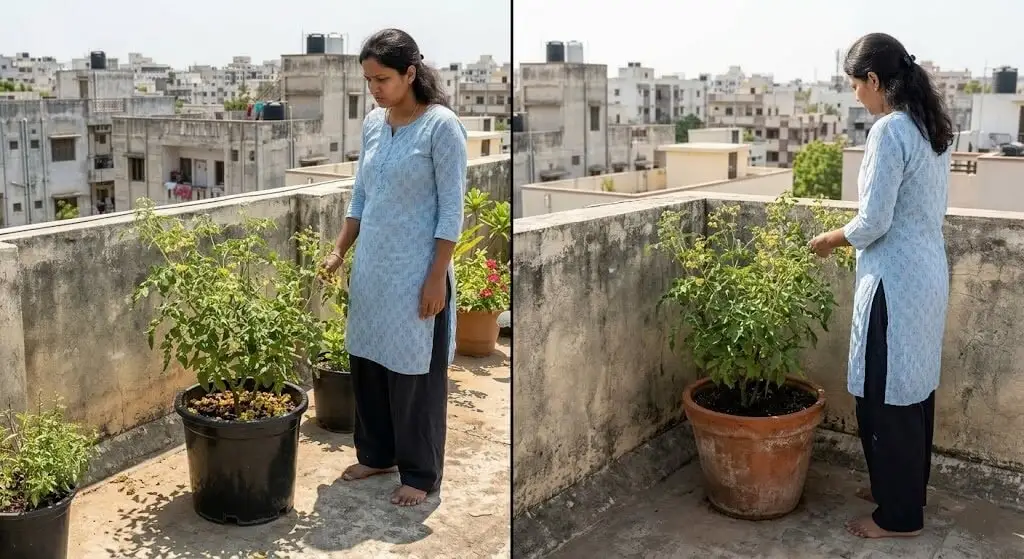
What I was not prepared for was what happened between the 8th and 12th of June.
Madanapalle regularly hits 42 to 44°C in the first two weeks of June before the pre-monsoon rain begins. I knew this intellectually. What I did not understand was that my terrace, with its south-facing concrete wall and four black plastic pots sitting directly on the terrace floor, was not experiencing 42°C. It was experiencing significantly more radiated heat from the concrete and reflected heat from the wall stacking on top of the ambient temperature.
My six cherry tomato plants had been in flower for about three weeks. The Sivam variety a compact determinate type with excellent flavour had been setting small green fruits through May without any issue. Then on June 9th, I noticed flowers on two plants had dropped overnight. By June 11th, the other four plants had followed. By June 12th, every open flower was gone, and the few new buds forming appeared to be already yellowing before fully opening.
I diagnosed this as a pollination problem. The logic seemed sound: no pollination, no fruit set, flowers drop. I started hand-pollinating the next morning with a dry watercolour brush. Then added a USB fan near the plants to simulate wind pollination. Then bought a blossom-set hormone spray Fruit Set by another name from a nursery in Madanapalle. Three days of careful pollination effort, and new flowers continued to drop within 24 to 48 hours of opening.
At the Kuppam farm visit ten days later, I described the situation to the extension officer. He listened, then asked: “What temperature is it at your terrace at two in the afternoon?”
I said I did not know the city was at 43°C.
“Go home and measure it near your pots,” he said. “And check your pollen under a magnifying glass if you can. You will see that it is not viable. You cannot pollinate with dead pollen. The problem is not in your hands. It is in the temperature.”
I measured that evening. My terrace, near the black plastic pots against the south wall, was reading 47°C on a thermometer probe at pot-rim height during peak afternoon heat. The city was at 43°C. Four degrees higher, from concrete absorption and wall reflection, was the difference between possible and impossible fruit set.
I moved the pots away from the wall. I switched from black plastic to terracotta for three of the plants. I put shade cloth over them from 11 AM to 4 PM. The next flush of flowers two weeks later as temperatures dropped slightly with pre-monsoon cloud cover set fruit. Eight plants produced. That season I got a harvest, not a large one, but a real one, from plants I had nearly given up on.
What I learned was not just the fix. It was the mechanism. You cannot fight temperature with pollination technique. The problem occurs at the cellular level, before the flower even opens fully.
Step 1: Measure Your Actual Temperature Not the City Forecast
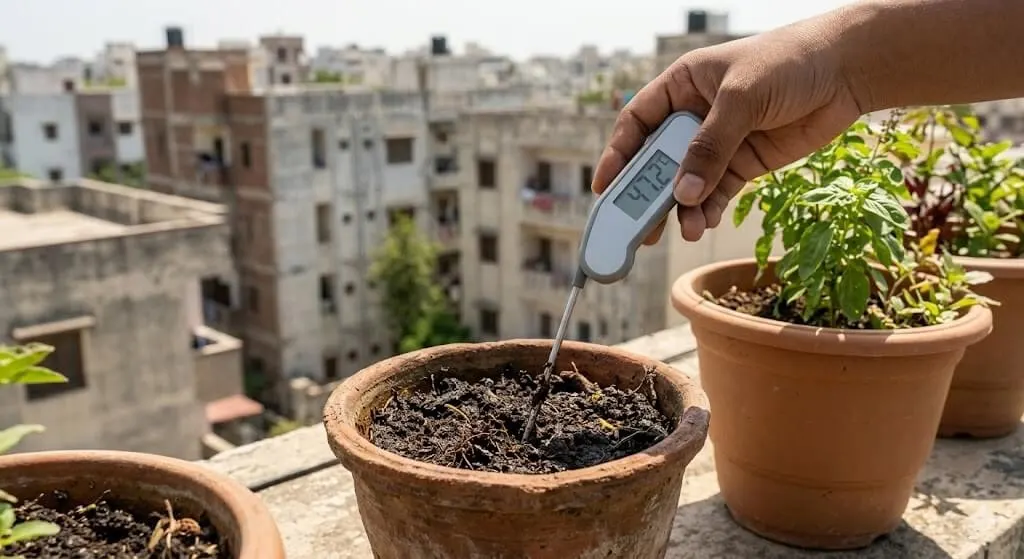
The single most common and consequential mistake in managing summer heat stress is using the weather app temperature as a proxy for what your plants are experiencing. These two numbers can be 5 to 10 degrees apart, and that gap determines whether your plants can set fruit or cannot.
🌡️ What You Need
A digital thermometer with a probe or an infrared thermometer.
A probe thermometer costs ₹200 to ₹400 on Amazon India and works for both air temperature near the plants and soil surface temperature.
An infrared thermometer (₹500 to ₹900) lets you measure pot surface temperature without contact, which is especially useful for comparing black plastic vs terracotta vs grow bags side by side.
You do not need both. A basic probe thermometer gives you everything you need for diagnosis.
How to measure the complete method:
Take three readings. All readings at 1:30 PM to 2:00 PM, which is peak heat for most Indian terraces.
- Reading 1: Air temperature near the plant at pot-rim height not at shoulder height, not on the wall, but right at the level where the plant is actively growing. Hold the probe approximately 10cm from the soil surface and 20cm from the nearest wall or pot.
- Reading 2: Soil surface temperature press the probe 1cm into the top layer of soil in the pot that receives the most direct afternoon sun. This reading frequently surprises gardeners who have not done it before.
- Reading 3: Pot exterior surface temperature if you have an infrared thermometer, point it at the outer wall of the pot in direct sun. Black plastic pot surfaces routinely read 55 to 65°C in Indian June afternoons.
What your readings mean:
| Air Temp at Plant Level | Plant Status | Fruit Set Possible? | Action Level |
|---|---|---|---|
| Below 35°C | Normal | Yes – no intervention needed | None |
| 35–38°C | Mild stress | Marginal – depends on variety | Monitor, afternoon shade helps |
| 38–42°C | Active stress | No – pollen sterile | Shade + cooling + watering timing |
| 42–46°C | Severe stress | No | All cooling interventions immediately |
| Above 46°C | Crisis | No – leaf damage occurring | Emergency relocation or shade |
Always measure at pot-rim height (10cm above soil), 10–20cm from nearest wall, at 1:30 PM — not the weather app forecast.
My Actual Temperature Readings 7 Days During the June 2022 Heatwave, Madanapalle
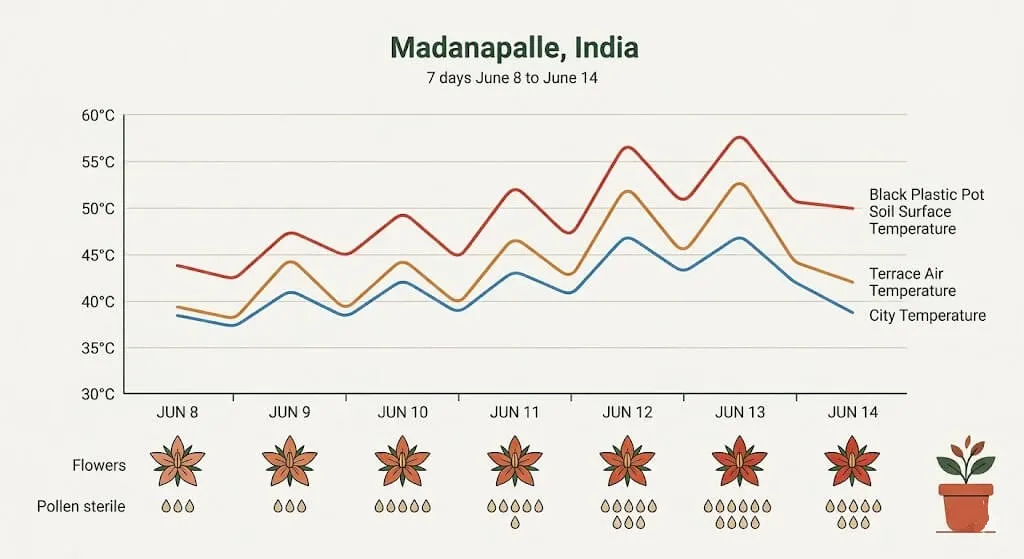
Measuements
📊 Original measurements from my Madanapalle terrace, June 8–14, 2022 not sourced from any other website
| Date | City Air Temp | Terrace Air at Pot Height | Black Pot Soil Surface | Terracotta Pot Soil Surface | Grow Bag Surface | Flowers Dropped That Day |
|---|---|---|---|---|---|---|
| June 8 | 42°C | 44°C | 58°C | 49°C | 46°C | 4 |
| June 9 | 43°C | 46°C | 61°C | 51°C | 48°C | 11 |
| June 10 | 44°C | 47°C | 63°C | 52°C | 49°C | 18 |
| June 11 | 44°C | 48°C | 65°C | 53°C | 50°C | 22 |
| June 12 | 43°C | 47°C | 62°C | 51°C | 47°C | 9 |
| June 13 | 41°C | 44°C | 57°C | 48°C | 45°C | 6 |
| June 14 | 39°C | 41°C | 52°C | 45°C | 43°C | 2 |
The pattern here is not subtle. On the worst day June 11 the city temperature was 44°C. The black plastic pots were sitting in 65°C soil surface conditions. The terracotta pots, which I had not thought about as a meaningful variable before this, were 12°C cooler at the surface. The grow bags sat in between.
📌 The Key Pattern
The black plastic pot ran 12°C hotter than terracotta on the same day, same garden, same city temperature. Flower drop tracked exactly with pot-level temperature — not with city forecast.
Flower drop tracked exactly with pot-level air temperature, not city temperature. The 3°C difference between June 14 (39°C city, 2 flowers dropped) and June 10 (44°C city, 18 flowers dropped) tells you everything about why gradual cooling interventions applied before the worst days matter so much more than emergency responses after the damage begins.
Why Indian Container Terraces Run Hotter Than Anything in Western Gardening Guides
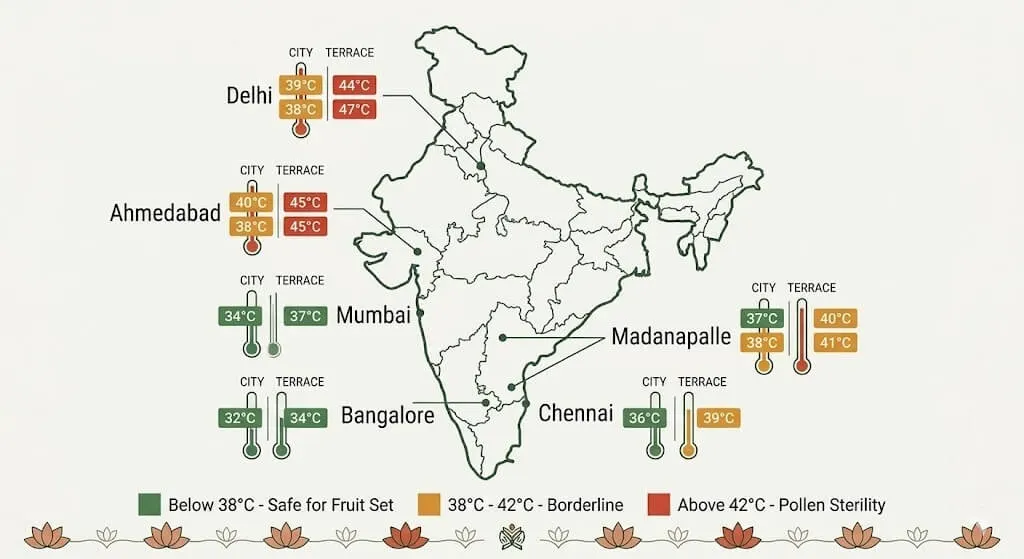
Most heat stress information available online originates from European or North American gardening contexts. The guidance is accurate for those conditions it is simply irrelevant for a terrace in Hyderabad, Chennai, or Rajasthan. Three specific Indian realities combine to create heat conditions that are categorically different.
Concrete terraces and walls create a heat amplification loop.
Indian apartment terraces are almost universally bare concrete. Concrete absorbs solar radiation through the day and re-radiates it as heat through the afternoon and evening. A plant sitting on a concrete terrace floor is not just receiving ambient heat from the air it is receiving radiated heat from below, from the floor it sits on, and reflected heat from the wall behind it. Measurements across multiple terraces I have taken readings from in Andhra Pradesh consistently show terrace-level temperatures running 3 to 7°C above the city ambient.
⚠️ Concrete Terraces Create a Heat Amplification Loop
| City | Typical June City Temp | Concrete Terrace Temp | West-Facing Balcony Temp |
|---|---|---|---|
| Chennai | 40–42°C | 44–47°C | 46–50°C |
| Hyderabad | 40–43°C | 43–47°C | 45–49°C |
| Delhi | 42–46°C | 46–50°C | 48–52°C |
| Ahmedabad | 42–46°C | 46–51°C | 49–53°C |
| Madanapalle | 41–44°C | 44–47°C | 46–49°C |
| Rajasthan cities | 44–48°C | 48–53°C | 50–55°C |
| Bangalore | 32–36°C | 34–38°C | 35–39°C |
| Mumbai | 34–36°C | 36–39°C | 37–40°C |
Bangalore and Mumbai gardeners have a genuine advantage here their ambient temperatures rarely push into the pollen-sterility range. But gardeners in Delhi, Hyderabad, Chennai, Ahmedabad, and any part of Rajasthan are dealing with conditions where cooling interventions are not optional. They are the difference between a productive summer and a lost one.
West-facing balconies are the most hostile growing environment in India.
⚠️ West-Facing Balconies The Most Hostile Growing Environment in India
A west-facing balcony or terrace receives direct afternoon sun from roughly 1 PM to sunset exactly the hottest part of the day. An east-facing balcony receives morning sun and is shaded by the building itself through the afternoon. If you have a west-facing growing space in any Indian city above 35°C average June temperature, you have a structurally more difficult growing environment than any gardening guide written for temperate climates assumes.
Indian summer arrives faster than the plant adjustment window allows.
In most temperate climates, temperature rises gradually from spring through summer, giving plants and gardeners time to adapt. In most Indian growing zones, the transition from comfortable 28–32°C growing temperatures to 42–44°C heatwave conditions can happen in two to three weeks in April and May. Plants that were in perfect growth conditions in March are in crisis conditions by mid-April. The window to intervene before heat stress begins is shorter than most gardening timelines suggest.
The 5 Signs of Heat Stress Each One Tells You Something Different
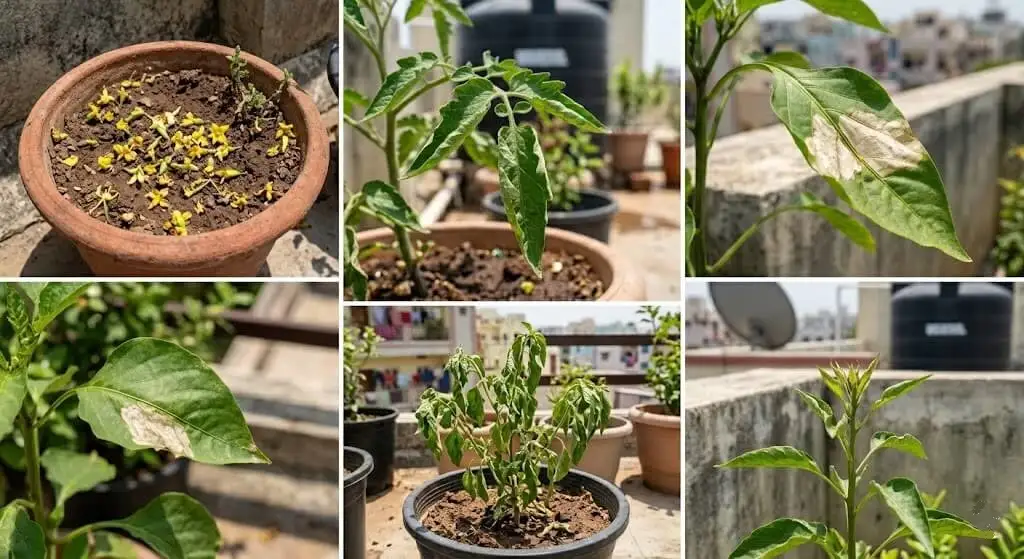
Recognising which heat stress response your plant is showing tells you not just that there is a problem but how far along the stress response has progressed and therefore which intervention will actually help.
Sign1: Flower and Bud Drop the Emergency Reproductive Shutdown
This is usually the first sign gardeners notice because it is dramatic and sudden. Flowers that were open yesterday are on the soil surface today. Buds that were forming begin yellowing and dropping before they even open fully.
This is the plant executing the response described earlier aborting reproduction to redirect resources to survival. The critical distinction here is between bud drop and flower drop. Bud drop (before flowers open) means the plant detected stress during the formation stage and is preventing resource expenditure on a flower it predicts will not succeed. Flower drop after opening means the pollen has been produced but was not viable, and the plant has detected failed fertilisation and is releasing the failed flower.
Both mean temperatures are above the pollen viability threshold. Neither means your pollination technique is wrong. The only fix is reducing temperature.
Sign 2: Leaf Curl Along the Central Vein the Transpiration Emergency Response
Individual leaves curl inward, folding upward along the midrib into a loose tube shape. The plant looks wilted but the soil is moist and the stem is firm. This is the plant reducing exposed leaf surface area to cut transpiration losses. It is not the same as wilting from underwatering, which causes the entire stem to droop and the plant to go limp.
The critical test: push your finger into the soil. If the soil is moist and the stem is firm but the leaves are curled inward, this is heat response, not water stress. Watering more will not uncurl these leaves only reducing temperature will. Overwatering a plant in this state can cause root problems.
Sign 3 Bleached or Papery Patches on Sun-Facing Leaf Surfaces Direct Cell Death
Irregular bleached, papery, or tan-coloured patches appear on leaves that face directly into intense afternoon sun. These patches are distinct from the brown edges of salt stress they have an irregular shape, appear in the middle of the leaf rather than specifically at the edges, and have a bleached-out rather than brown-crispy appearance.
This is direct cellular death from UV and heat overexposure the plant equivalent of a sunburn taken too far. Unlike leaf curl, which reverses when temperatures drop, these patches are permanent. The affected tissue is dead and will not recover. Recovery is visible only in new growth that emerges after conditions improve.
Sign 4: Afternoon Wilting That Reverses by Evening the Boundary Indicator
The plant wilts visibly in the afternoon despite adequate morning watering, then recovers by evening once temperatures drop. This indicates that the plant’s water transport system is at its maximum capacity and cannot keep up with the transpiration demand imposed by peak afternoon temperatures. It is not truly water-stressed — it is temperature-stressed in a way that expresses as a temporary water deficit.
This reversible afternoon wilt is the earliest warning sign of the heat stress continuum. If you see it on one or two plants, you still have a window to intervene before irreversible stress occurs. If ignored for weeks, the repeated daily stress cycles deplete the plant’s carbohydrate reserves and reduce its long-term productivity even after temperatures normalise.
Sign 5: No New Growth for Two or More Weeks Despite Being Watered and Fed Metabolic Suspension
A plant in severe heat stress shuts down active growth entirely. It stops pushing new leaves, stops extending new stems, stops forming new buds. It enters a state of metabolic suspension spending energy only on maintenance of existing tissue rather than growth. This can be confused with nutrient deficiency or root problems, but the key distinguishing factor is timing: it begins or intensifies during peak summer weeks and is correlated with temperature, not with a change in feeding or watering routine.
If your plant is alive but has shown no measurable new growth in two or more weeks through June, heat stress is the most likely primary cause. Fertilising more in this state is counterproductive the plant is not in a position to use nutrients for growth and the additional fertiliser salts increase soil TDS.
Heat Stress vs Drought Stress vs Salt Stress vs Root Rot The Fast Distinction Guide
Indian balcony summers produce all four of these simultaneously in many gardens, and all four can cause wilting, poor growth, and leaf browning. The ability to distinguish them quickly determines whether you apply the right fix or the wrong one.
🔑 The Single Most Useful Test
Does the wilting or leaf curl reverse after 6 PM without any watering change? If yes — heat stress is the primary driver. If no — look for salt buildup, root rot, or drought.
| What You See | When It Appears | Key Additional Sign | Most Likely Cause | First Test |
|---|---|---|---|---|
| Flower drop, leaf curl, firm stem | After days above 38°C | City temperature 40°C+ | Heat stress | Measure terrace temp at 1:30 PM |
| Wilting, dry soil, crispy all-over leaves | After skipping watering | Soil bone dry 2 inches deep | Drought stress | Finger test in soil |
| Brown tips and edges, white soil crust | Through summer, gradual | TDS above 1,500 ppm | Salt buildup | TDS meter test |
| Wilting despite wet soil, musty smell | After heavy rain or overwatering | Soil heavy, smells sour | Root rot | Pull plant — check root colour |
| Pale yellow leaves, slow growth | Across all seasons | Oldest leaves affected first | Nitrogen deficiency | Fertiliser history |
The most useful single test for heat stress specifically: Check whether the wilting or leaf curl reverses after 6 PM without any watering change. If the plant perks up on its own as the temperature drops, heat stress is the primary driver. If the plant remains limp even after temperatures cool, look for salt buildup, root rot, or drought.
Rajan’s Story Three Summers of Zero Fruit Set, Solved in Two Weeks
🌱 Real Story — Rajan, Chennai 2024″ (white, small, opacity 70%)
Three Summers of Zero Fruit Set, Solved in Two Weeks (white)
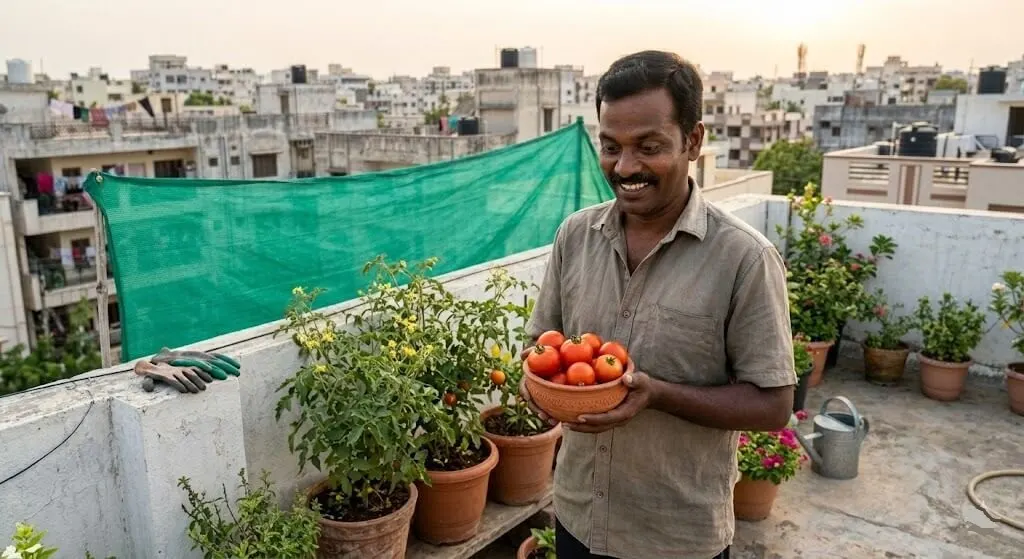
Rajan from Chennai had been growing tomatoes on his fifth-floor balcony for four years. For the first three summers, his plants would flower reliably in April and May, then produce no fruit whatsoever from June through August, then begin producing again in September as temperatures dropped. He had tried three different tomato varieties over those three years Pusa Ruby, then a cherry tomato variety, then an imported heirloom. All three performed identically: flowers in spring, zero fruit in summer, recovery in autumn.
By the time he messaged me in May 2024, he had concluded the problem was his balcony soil. He was asking whether changing to a completely new soil mix might help and whether he should add more phosphorus for flowering support.
I asked him one question before suggesting anything. “What direction does your balcony face?”
West-facing, he replied. Fifth floor, direct sun from 12 noon to 6 PM, no buildings to the west blocking the afternoon sun.
I asked him to measure the temperature near his pots at 2 PM.
His reading: 47°C at pot-rim level. The Chennai city temperature that day: 41°C. Six degrees difference, entirely from the combination of west-facing direct sun, concrete balcony floor, and a light-coloured wall behind the pots that reflected rather than absorbed heat.
His soil was fine. His fertiliser was fine. His watering was fine. His tomato plants had been trying to set fruit in conditions where pollen sterility is physiologically inevitable, every summer, for three consecutive years.
We made three changes. First, white shade cloth 50% density installed from 11 AM to 4 PM over his balcony, creating a light shade that reduced direct solar radiation without cutting the photosynthesis light the plants needed. Second, his black plastic pots were replaced with terracotta, wrapped in old newspaper held with a rubber band on the outer wall, reducing pot surface temperature by approximately 8 to 10°C. Third, watering moved from morning to 7 PM, which meant the soil began the next day cool and moist rather than heating progressively through the morning.
His temperature reading at 2 PM after these changes: 41°C. Still hot, but below the 42°C threshold where the worst pollen damage occurs.
Four weeks later, he sent me a photograph. Tomato clusters developing on every plant. By late July: 2.8kg of tomatoes from three plants that had produced nothing in three previous summers.
“I blamed the seeds for three years,” he wrote. “I changed the variety twice. It was the wall.”
That pattern years of incorrect diagnosis, simple solution that addresses the actual mechanism is what I see most often when gardeners in Chennai, Delhi, Hyderabad, and Ahmedabad struggle with summer fruit set. The problem is almost never the seeds, the variety, or the soil. It is almost always the microclimate that the balcony geometry creates around the pot.
The Complete Heat Stress Management Protocol Six Interventions, in Priority Order
Managing heat stress is not a single action it is a layered set of interventions, each targeting a different part of the problem. The priority order matters: start with the interventions that have the most impact per effort and build from there.
What you need:
| Item | Detail | Cost |
|---|---|---|
| 50% shade cloth / green net | 1m × 2m per standard balcony | ₹150–300, Amazon or agricultural shop |
| Digital probe thermometer | For measuring actual terrace temp | ₹200–400, Amazon India |
| Terracotta pots (if switching) | 10-inch or 12-inch | ₹80–180 per pot, local nursery |
| Newspaper or jute cloth | For pot insulation wrapping | ₹0 — from kitchen waste |
| Pot feet / bricks | To raise pots off concrete floor | ₹0–₹50, local hardware |
| Kaolin clay (optional) | For foliar spray to reflect heat | ₹200–400, agricultural suppliers |
Step 1: Install Shade Cover for Peak Hours
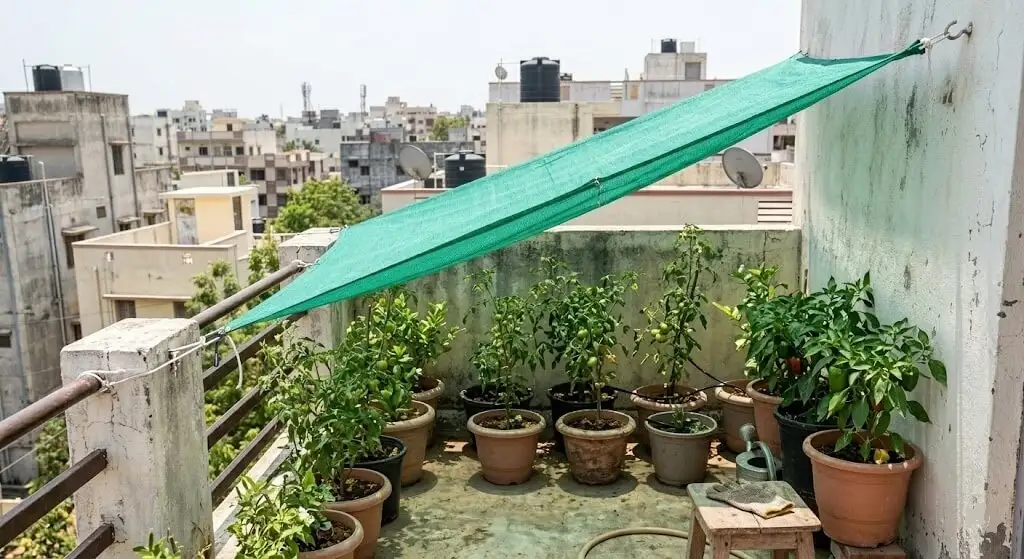
This is the single most effective intervention. A 50% shade cloth installed over plants from 11 AM to 4 PM reduces direct solar radiation load and can drop the air temperature near plants by 3 to 5°C. It is not complete shade 50% cloth still lets significant light through for photosynthesis. It is a heat filter.
Fix the cloth at an angle rather than flat angled shade allows hot air to escape from the sides rather than trapping it underneath.
Do not use full shade cloth (70–80%) during summer plants will lose photosynthetic capacity and become elongated and weak. 30–50% is the effective range.
Cost: ₹150–300. Time to install: 30 minutes.
Step 2: Raise Pots Off the Concrete Floor
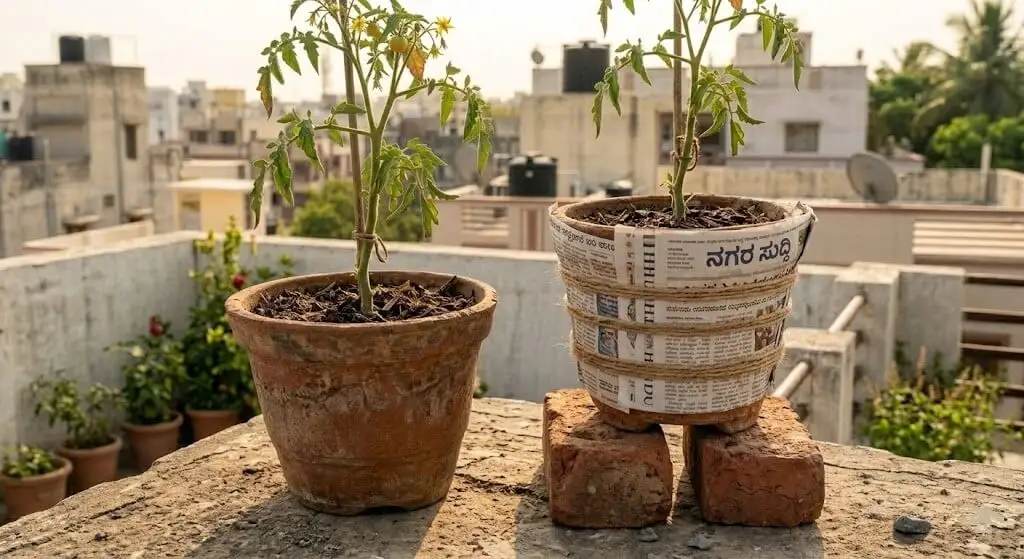
Concrete floors absorb heat and radiate it back upward. A pot sitting directly on hot concrete receives heat from above (sun) and below (floor radiation) simultaneously. Raising pots on old bricks, wooden boards, or commercially available pot feet creates an air gap that significantly reduces bottom-up heat transfer.
I tested this with two identical black plastic pots in July 2023 one on the floor, one raised 8cm on bricks. Soil surface temperature at 2 PM: 63°C on the floor, 54°C raised. Nine degrees difference from one intervention.
Cost: ₹0 if using old bricks. Time: 5 minutes per pot.
Step 3: Insulate Pot Walls
Black plastic pots and thin terracotta are both vulnerable to solar heat absorption on the outer wall. Wrapping pots in 2 to 3 layers of newspaper and securing with a rubber band or jute twine creates a simple insulating layer that reduces heat transfer from the outer wall into the soil.
White-painting clay or terracotta pots is a permanent alternative white paint reflects rather than absorbs solar radiation. A single coat of exterior white paint on the outer pot wall is effective for the entire season.
For terracotta specifically: double-potting works. Place the growing pot inside a slightly larger terracotta pot, leaving a 2cm air gap between the two walls. Fill the gap with dry sand. This approach, used traditionally in South Indian kitchen gardens, can reduce inner pot soil temperature by 6 to 8°C compared to a single-wall pot in direct sun.
Cost: ₹0 for newspaper wrapping. ₹50–100 for white paint. ₹150–300 for double-potting with a second terracotta.
Step 4: Shift Watering to Evening
Most gardening advice in India recommends morning watering, and for most of the year that advice is correct. In peak summer May through July evening watering is significantly more effective for heat stress management.
Evening watering means the soil begins the next day cool and thoroughly moist. As temperatures rise through the morning, the soil has maximum water reserves to supply the plant through peak heat. Morning watering means the soil begins heating with good moisture, but by afternoon, 3 to 6 hours of evaporation has reduced soil moisture significantly at the moment the plant needs it most.
Water between 6:30 and 8:00 PM in summer, deeply enough that water flows from the drainage hole. Never water at noon or 1 PM cold water into hot soil can cause root shock.
Cost: ₹0. Change of habit, not product.
Step 5: Mist Leaves in the Evening Not in the Afternoon
Evening leaf misting lowers the plant’s canopy temperature and helps wash off dust that reduces photosynthetic efficiency. Use a hand sprayer with plain water at room temperature.
Do not mist in the afternoon heat water on hot leaves can heat further and cause additional cellular stress. Do not mist in direct sun at any time water droplets act as magnifying lenses and can cause burn spots.
Evening misting also helps prevent spider mites, which thrive in hot, dry conditions and are a secondary problem in heat-stressed container gardens through Indian summer.
Cost: ₹0. Sprayer if you don’t have one: ₹80–150.
Step 6: Apply Kaolin Clay Spray for Extreme Heat Events (Optional)
Kaolin clay is a fine white particle that, when sprayed on leaves, creates a reflective mineral coating that reduces the leaf surface temperature by scattering incoming solar radiation. It is used commercially on fruit orchards in Andhra Pradesh and Tamil Nadu during heatwaves.
For container gardeners, it is optional the interventions above are sufficient for most situations. But if you have west-facing plants in Chennai, Delhi, or Rajasthan during June and July and the other interventions are already in place, a kaolin clay spray is worth adding during peak heatwave days.
🌿 Kaolin Clay Heat Protection Spray
Reduces leaf surface temperature by 3–5°C during direct sun exposure
What You Need:
| Ingredient/Item | Detail/Quantity | Cost |
|---|---|---|
| Kaolin clay powder | 3 tablespoons per litre | ₹200–400 per kg, agricultural supplier |
| Plain water | 1 litre | ₹0 |
| Hand sprayer | 1-litre capacity | ₹80–150, Amazon or nursery |
| Spreader (optional) | 2–3 drops dish soap | ₹0 – kitchen |
Steps:
- Mix 3 tablespoons kaolin clay into 1 litre of water stir well until clay is suspended, not settled at the bottom. This is the particle that does the work; if it settles you are spraying plain water.
- Add 2 to 3 drops of dish soap as a spreader-sticker this helps the clay particles adhere to the waxy leaf surface rather than beading off. Do not add more than 3 drops; excess soap removes protective leaf wax.
- Spray on all leaf surfaces top and bottom in the evening after the sun has left the plants. Applying in direct sun causes the spray droplets to heat on the leaf and can cause stress.
- Apply every 5 to 7 days through peak heatwave weeks. Wash off with plain water once the heatwave passes kaolin accumulation on leaves over weeks can slightly reduce photosynthesis.
Cost: ₹200–400 for the clay, lasts an entire season | Time: 10 minutes | Best for: West-facing balconies, June–July peak heat
What I Feed My Plants Through Summer The Nutrition Strategy That Supports Heat Tolerance
Here is what nobody in most online gardening groups says clearly: feeding plants heavily during a heatwave is one of the most counterproductive things you can do. The instinct “the plant looks stressed, it needs more nutrients” is understandable, but it misunderstands what is happening. A heat-stressed plant has gone into metabolic conservation mode. Its root activity is reduced. Its capacity to absorb and process nutrients is severely limited. Adding chemical fertiliser in this state raises soil TDS (as we covered in Day 4), places additional osmotic stress on roots that are already struggling, and can push a stressed plant toward irreversible damage.
What heat-stressed plants actually need nutritionally is two things: stress-tolerance support, and reduced input.
What to reduce:
Stop all NPK chemical fertiliser during peak heatwave weeks typically mid-May through mid-July in most Indian growing zones. Do not add urea, DAP, or micronutrient concentrates. The plant will look like it needs feeding during this period. It does not. It needs the soil osmotic pressure to decrease, not increase.
What to continue or add:
Vermicompost top-dressing: a 1 to 2cm layer on the soil surface once a month, even through summer. This is slow-release it does not spike TDS and it also acts as a light mulch layer that slightly reduces moisture evaporation from the soil surface. Cost: ₹40–80 per kg, available from Ugaoo, local nurseries, or agricultural supply shops.
Seaweed extract liquid: this is one of the most underused products in Indian container gardening and one of the most useful for heat stress specifically. Seaweed extract contains natural plant hormones cytokinins and betaines that have been documented in agricultural research to improve heat tolerance, reduce flower and fruit drop, and support recovery after heat events. Use at half the recommended dose (typically 2–3ml per litre, so use 1–1.5ml). Apply as a soil drench, not a foliar spray in summer. Available as Multiplex Algamax, Siapton, or generic seaweed extract from agricultural suppliers: ₹150–300 per 500ml.
🌱 Seaweed Heat Stress Recovery Drench
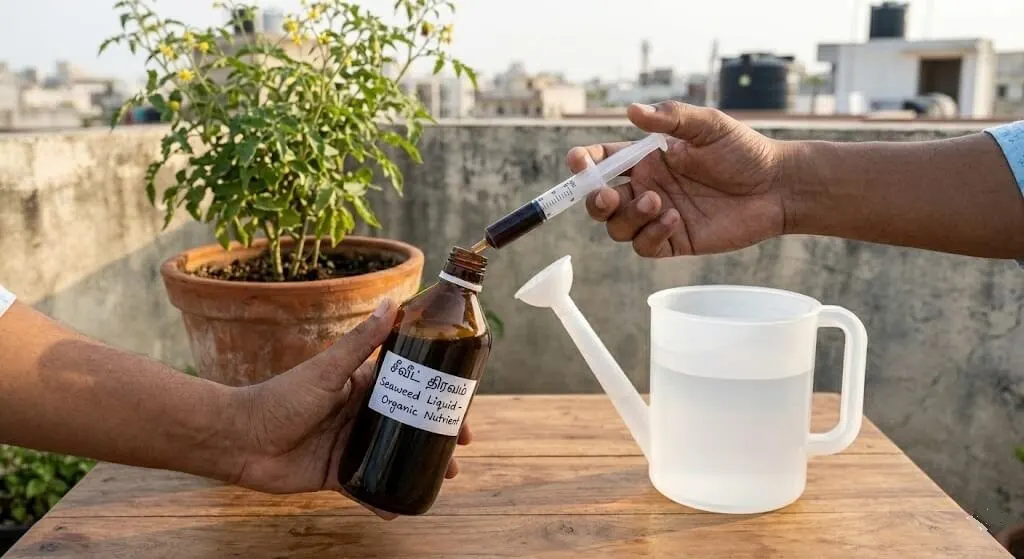
Supports heat tolerance and reduces flower drop during peak summer
What You Need:
| Ingredient/Item | Detail/Quantity | Cost |
|---|---|---|
| Seaweed extract (Multiplex Algamax or similar) | 1.5ml per litre water | ₹150–300 per 500ml |
| Plain water | 1 litre per 10-inch pot | ₹0 |
| Watering can | Normal capacity | Already have |
Steps:
- Fill watering can with 1 litre of tap water or filtered water per pot you are treating.
- Add 1.5ml seaweed extract per litre use a dropper or a 5ml syringe cap to measure. Do not exceed this dose; more is not better.
- Stir gently and apply as a soil drench directly to the root zone, not on the leaves. The active hormones absorb through the root system.
- Apply once every 10 to 14 days through peak heat. Stop once temperatures drop below 35°C consistently.
- Can be combined with your regular evening watering simply add seaweed extract to that evening’s water.
Cost: ₹15–25 per application (one season’s supply for 5–6 pots) | Time: 5 minutes | Best for: May–July, all fruiting vegetables
Banana peel potassium water is another free supplement worth continuing through summer potassium plays a specific role in regulating water transport within plant cells and supports the plant’s own heat management. Soak 2 to 3 banana peels in 1 litre of water for 48 hours, then use that water directly for one pot. Do not store for more than 3 days in summer it ferments quickly. Cost: ₹0, entirely from kitchen waste.
Which Varieties Handle Indian Summer Better Choosing the Right Plant for the Season
This section does not appear in most heat stress articles because it addresses something uncomfortable: some popular vegetable varieties are simply not adapted to produce through Indian peak summer, regardless of how well you manage the microclimate. Knowing which varieties have genuine heat tolerance saves you from a season of disappointment that no intervention can fix.
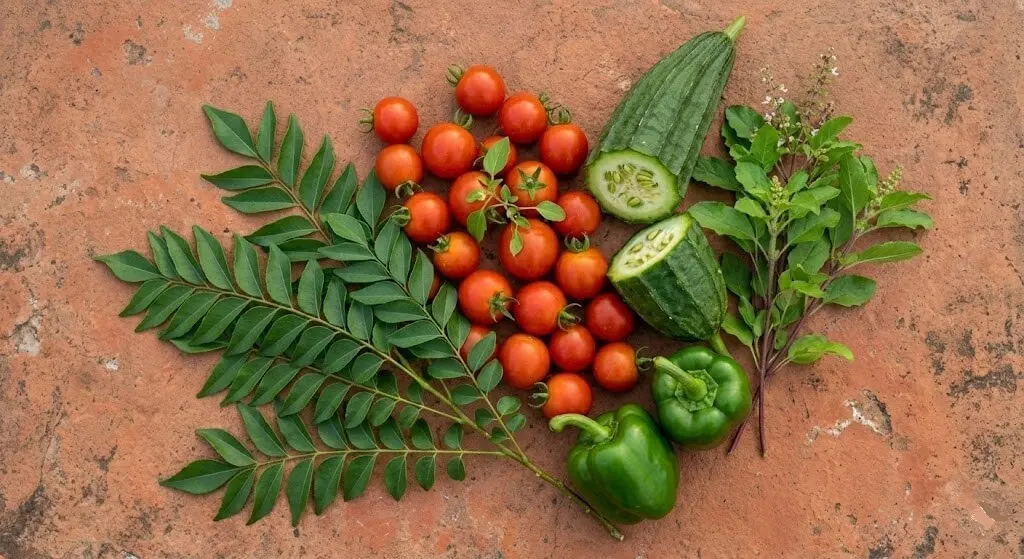
Tomato varieties with documented heat tolerance:
Arka Vikas, Arka Abha, and Arka Saurabh IIHR Bangalore released varieties specifically developed for Indian growing conditions, including summer heat. Pusa Ruby, the most common Indian home garden tomato, is moderately heat tolerant and will set fruit through 38 to 40°C if microclimate management is in place. PKM-1 cherry tomato is one of the most heat-resilient varieties available and continues producing through significant heat events. Imported heirloom varieties Brandywine, Black Krim, German Johnson have poor heat tolerance and are better grown in November through February.
Capsicum:
Capsicum generally tolerates heat better than tomato for vegetative growth but still experiences pollen sterility above 38°C. Varieties developed for Tamil Nadu and Andhra Pradesh conditions, available from regional agricultural university seed banks, perform better than imported varieties. California Wonder is moderately heat-tolerant and widely available.
Cucurbits the summer alliance:
Cucumber, ridge gourd (turai), bitter gourd (karela), and bottle gourd (lauki) are genuinely summer-adapted vegetables. They were domesticated in tropical conditions and handle 40°C better than any nightshade. If you want a productive Indian balcony through June and July, cucurbits especially ridge gourd are your most reliable allies.
Herbs that survive Indian summer in containers:
Tulsi is extraordinary it is virtually indestructible through Indian heat and actually grows more vigorously as temperatures rise. Curry leaf handles summer well once established. Basil handles heat but needs afternoon shade to prevent bolting. Mint requires afternoon shade and consistent moisture but survives. Coriander and methi are cool-season crops they will bolt and die in June regardless of care. Plant them in October and January instead.
Never Lose Flowers to the Same Cause Twice My Year-Round Temperature Management Routine
The single most important lesson from three summers of heat stress experience is that reactive management responding after flower drop happens is too late. Pollen damage occurs before you see flower drop. The plant has already wasted metabolic resources producing flowers that could not set. Proactive management reducing microclimate temperatures before peak heat arrives saves flowers that would otherwise never become fruit.
March preparation install before you need it:
Before April temperatures arrive, set up shade cloth structure and pot positioning. Move pots away from south and west walls. Install pot feet on all pots. If switching to terracotta or grow bags, do it now — repotting during June heat is an additional stress the plant does not need. Check shade cloth from previous year for tears.
April through May : monitoring and early intervention:
Begin taking daily 1 PM temperature readings at pot level once city temperatures consistently cross 35°C. If pot-level readings cross 38°C for more than 3 consecutive days, add shade cloth or shift pot position before flower drop begins. Continue seaweed extract drench every 14 days.
June through July : peak heat management:
Shade cloth mandatory 11 AM to 4 PM for all fruiting vegetables. Stop all chemical fertiliser. Continue vermicompost and seaweed drench. Move water timing to 7 PM. If pot-level temperature crosses 43°C despite all interventions, accept that fruit set will be impossible for the current flush — focus on keeping the plant alive and healthy for the September recovery flush.
August : pre-monsoon and early monsoon:
As monsoon cloud cover begins reducing afternoon peak temperatures (typically late July in Kerala and coastal Karnataka, mid-August in most of Andhra Pradesh), watch for the temperature to drop below 38°C consistently. This is when the plant is ready to attempt fruit set again. Resume seaweed drench once every 10 days. Do not resume chemical fertiliser until late August or September.
September : the recovery harvest:
September is typically the most productive month for balcony fruiting vegetables in most Indian cities temperatures have dropped but rain has not yet caused the fungal problems that come with sustained waterlogging. Plants that survived summer with heat management intact will push a significant flush of flowers and fruit through September and October. This is the harvest that rewards summer perseverance.
The 5-Minute Sunday Check Cumulative Update for Day 5
Adding to the Sunday check routines from Days 1, 2, 3, and 4:
- Finger test for moisture – 2 inches deep (Day 1)
- Leaf colour check – tops and bottoms of 3 leaves (Day 2)
- Soil surface temperature -1 PM reading with thermometer probe (Day 3)
- White crust visual – look at soil surface and terracotta pot exterior for crystalline deposit (Day 4)
- Leaf edge check – any new crispy brown tips appearing this week compared to last week? (Day 4)
- Monthly TDS test – first Sunday of every month, test 2 to 3 pots (Day 4)
- NEW – Flower count check – how many open flowers today vs last Sunday? Any dropping? (Day 5)
- NEW – Terrace temperature reading – note 1 PM air temperature at pot level, 3 days per week through May–July (Day 5)
Eight checks. Under ten minutes. Once a week.
What to Realistically Expect During Recovery After a Heatwave
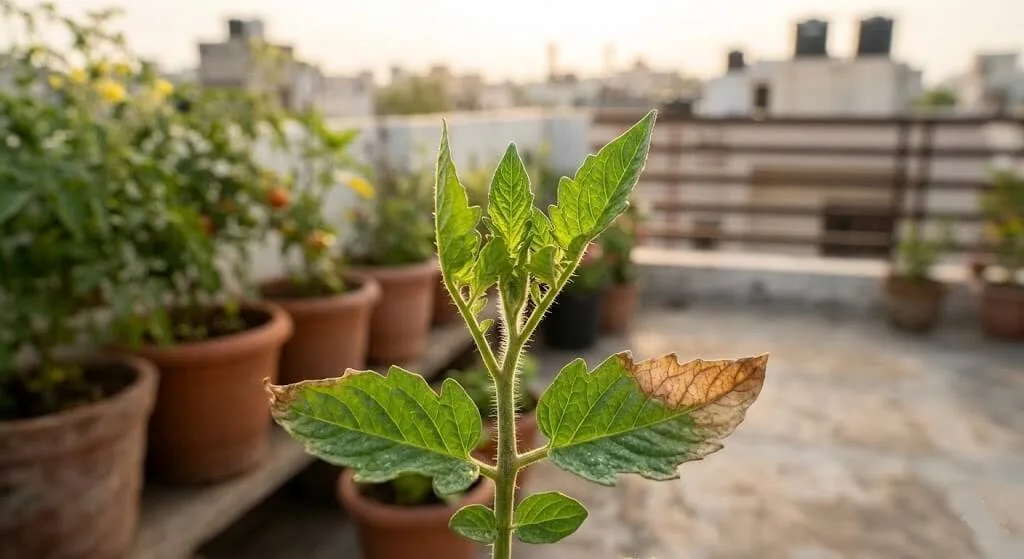
Recovery from heat stress is gradual and the most important thing to understand is that you are not recovering the flowers that dropped. Those are gone. You are recovering the plant’s capacity to produce the next flush of flowers under better conditions.
| Timeframe | What to Expect |
|---|---|
| Day 1–3 after cooling interventions | Plant may still look stunned no visible change immediately |
| Day 4–7 | Leaf curl reduces; some leaves uncurl as temperatures drop at plant level |
| Week 1–2 | New bud formation visible at growing tips if temperatures are consistently below 38°C |
| Week 2–3 | New flowers opening; monitor for drop if temperature management is working, flowers will stay |
| Week 3–4 | First successful fruit set; small green fruits developing on flower sites |
| Week 4–6 | Normal growth resumes; new leaves emerge healthy and full-sized |
| After a severe event (above 46°C for multiple days) | Some permanent leaf damage; new growth from dormant buds takes 3–4 weeks to emerge |
What will not recover: Leaves with bleached papery burn patches this tissue is dead. Flowers that dropped they will not reattach. The current flush of buds if temperatures remain above 38°C they will continue dropping until conditions change.
Judge recovery by new growth from the growing tips, not by the appearance of existing leaves. A plant with some scorched leaves but actively pushing new healthy growth from the tip is recovering well. A plant with unscarred leaves but no new growth is still suspended in heat stress.
If no new growth appears within 3 weeks of implementing cooling interventions, check: soil TDS (salt stress can look identical to ongoing heat stress), root health (pull gently and check for rot), and whether the cooling measures actually reduced pot-level temperature below 38°C (remeasure at 1 PM).
Product Reference What I Have Actually Used in My Madanapalle Terrace
| Product | Purpose | Cost ₹ | Where to Buy |
|---|---|---|---|
| 50% green shade cloth (1m × 2m) | Peak hour heat reduction | ₹150–300 | Amazon India, agricultural supply shops |
| Digital probe thermometer | Measuring actual terrace temp | ₹200–400 | Amazon India |
| Infrared thermometer | Pot surface temp comparison | ₹500–900 | Amazon India |
| Terracotta pots, 10–12 inch | Replace black plastic in summer | ₹80–180 per pot | Local nursery, Ugaoo |
| Multiplex Algamax (seaweed extract) | Heat tolerance support, reduces flower drop | ₹150–300 per 500ml | Agricultural suppliers, Amazon |
| Kaolin clay powder | Foliar heat reflector spray | ₹200–400 per kg | Agricultural supply shops |
| Vermicompost (Ugaoo or local) | Slow-release summer feeding, soil mulch | ₹40–80 per kg | Ugaoo, Amazon, local nursery |
| Jute cloth or newspaper | Pot insulation wrapping | ₹0–50 | Kitchen waste or local shop |
Complete Product Quick Reference
| Product | Category | Cost ₹ | Where to Buy | Priority |
|---|---|---|---|---|
| 50% shade cloth (1m × 2m) | Essential | ₹150–300 | Amazon, agricultural shop | ⭐ First buy |
| Digital probe thermometer | Essential | ₹200–400 | Amazon India | ⭐ First buy |
| Multiplex Algamax seaweed extract (500ml) | Essential | ₹150–300 | Agricultural suppliers, Amazon | ⭐ First buy |
| Terracotta pots, 10–12 inch (unglazed) | Essential | ₹60–180 per pot | Local nursery, Ugaoo, pottery market, Amazon | ⭐ High priority |
| Newspaper or jute twine | Free alternative | ₹0 | Kitchen waste | ✅ Use immediately |
| Old clay bricks (2 per pot) | Free alternative | ₹0–20 | Hardware shop, construction sites, | ✅ Use immediately |
| Banana peel potassium water | Free alternative | ₹0 | Kitchen waste | ✅ Use immediately |
| Hand mist sprayer (1 litre) | Low cost | ₹80–150 | Amazon, nursery | ✅ Useful to have |
| White exterior paint (small tin) | Low cost | ₹50–100 | Hardware shop | ✅ Permanent insulation |
| Vermicompost (Ugaoo or local, 5kg) | Essential (feeding) | ₹150–300 per 5kg | Ugaoo, Amazon, local nursery | ✅ Standard supply |
| Kaolin clay powder (1kg) | Optional | ₹200–400 | Agricultural supply shops | ⚡ Only for extreme heat |
| Infrared thermometer | Optional | ₹500–900 | Amazon India | ⚡ Only for diagnostic depth |
| Commercial pot feet (set of 3) | Optional | ₹200–400 | Amazon, garden centres | ⚡ Bricks work identically |
Total essential spend for a 6-pot summer setup: Shade cloth ₹250 + probe thermometer ₹300 + seaweed extract ₹200 + vermicompost ₹200 = approximately ₹950 total, covering the full summer season. Everything else on the list is free or optional.
The bricks, newspaper, and banana peel water cost nothing and between them contribute as much cooling benefit as products costing 5 times more.
Frequently Asked Questions
My tomato flowers drop every year in June. Can I change the variety to fix this?
Variety helps but is not the primary solution. Even the most heat-tolerant Indian tomato variety — Arka Vikas, PKM-1, Pusa Ruby cannot set fruit when pot-level temperature exceeds 42 to 44°C. Variety improvement gives you a 2 to 3°C buffer enough to matter at the margins, not enough to overcome a west-facing concrete terrace running at 48°C. Fix the microclimate first, then consider variety as an additional improvement
My plants look completely frozen no growth for three weeks. Is the plant dead?
Probably not dead. A heat-suspended plant in metabolic conservation mode can look almost completely lifeless for weeks and still be alive. Press your fingernail gently into a stem if it is green inside, the plant is alive. New growth will emerge from dormant axillary buds once temperatures drop. Do not uproot the plant or add heavy fertiliser. Keep the soil consistently moist and wait.
Should I remove leaves to keep the plant cooler?
No. This is one of the most common and counterproductive responses to a heat-stressed plant. Leaves are photosynthesis factories removing them reduces the plant’s energy production capacity at the moment it needs energy most for cellular repair. Removing dead or completely scorched leaves is fine. Removing healthy leaves “to reduce stress” is harmful.
Can I use AC water or cooler water to water my plants during a heatwave?
AC condensate water has very low TDS (near zero) and is suitable for plants. It is also slightly acidic, which most Indian vegetables tolerate well. Using it to water heat-stressed plants is beneficial the low-TDS water helps reduce salt accumulation. Cooler/air cooler water has higher mineral content from the cooling pads; use it with caution and test TDS before using it exclusively. Plain tap water is always the safe standard.
My plants survived the heatwave but are now growing spindly and pale. What happened?
This is shade-adaptation. If shade cloth reduced light below 30%, or if you moved plants to a shadier position during the heatwave, the plant adapted by growing elongated, pale stems to reach toward available light. Gradually increase light exposure over 7 to 10 days rather than moving directly back to full sun sudden re-exposure to full sun after shade adaptation can itself cause scorch.
When is it safe to resume fertilising after a heatwave?
Wait until two things are true simultaneously: pot-level temperature is consistently below 36°C at 1 PM, and you can see active new growth emerging from the plant’s growing tips. Both conditions together indicate the plant’s metabolic machinery is back in growth mode and can actually absorb and use nutrients. Resume at half-dose and increase gradually over 3 to 4 weeks.
Is the flower drop from heat permanent? Can those specific flowers come back?
No. Dropped flowers are gone and will not reattach or regrow. However, the axillary buds along the stem the growth points that produce new side branches and flowers are not damaged by the same heat event that killed the pollen. Once temperatures drop below the viability threshold, the plant will initiate a new flush of bud formation. You are not losing the season permanently you are losing the current flush of flowers. Managing temperature buys you the next flush.
Quick Diagnosis Reference Heat Stress and the Problems It Resembles
| What You See | When It Appears | Key Distinguishing Sign | Most Likely Cause | First Action |
|---|---|---|---|---|
| Flower drop, firm stem, moist soil | After days above 38°C | City temp 40°C+, concrete terrace | Heat stress: pollen sterility | Measure pot-level temp at 1:30 PM |
| Leaf curl, firm stem, moist soil | During peak afternoon heat | Reverses by evening | Heat stress: transpiration response | Shade + raise pot off floor |
| Bleached papery patches | On sun-facing leaf surface | Permanent, not reversible | UV and heat burn | Install shade cloth |
| Brown crispy tips and edges | Gradual through summer | White crust on soil | Salt buildup (Day 4) | TDS meter test |
| Whole plant limp, dry soil | After watering lapse | Soil dry 2 inches deep | Drought stress | Deep watering immediately |
| Wilting, moist soil, musty smell | After heavy rain period | Roots brown and mushy | Root rot | Check roots, improve drainage |
| No growth for weeks, green stem | Through summer | Temperature above 38°C | Metabolic suspension | Cooling interventions + wait |
Today’s Action Checklist
- [ ] Measure your actual pot-level temperature at 1:30 PM today not the weather app, the probe near your pots
- [ ] Check which direction your balcony faces west-facing means shade cloth is not optional through June–July
- [ ] Count how many open flowers your tomato or capsicum plants have right now note this as your baseline
- [ ] Raise at least 2 pots off the concrete floor using old bricks or pot feet if you haven’t already
- [ ] Check whether your pots are sitting against a south or west-facing wall if yes, move them 30cm away from the wall
- [ ] Order or arrange 50% shade cloth if you don’t have it yet install before temperatures cross 38°C consistently
- [ ] Switch watering time to 6:30–8:00 PM if you currently water in the morning
- [ ] Stop all chemical NPK fertiliser until pot-level temperature drops below 36°C
- [ ] Begin seaweed extract drench once every 14 days if you can access Multiplex Algamax or similar
- [ ] Note your pot types black plastic pots in direct afternoon sun are your most vulnerable pots; prioritise cooling interventions for these first
Key Facts — Quick Reference
At what temperature does heat stress begin in container vegetables?
Most fruiting vegetables tomato, capsicum, brinjal, cucumber begin experiencing cellular stress above 35°C. Pollen viability collapses above 38°C: pollen proteins denature at this temperature, making pollination physiologically impossible regardless of technique. Sustained temperatures above 40°C at plant level cause oxidative stress and can produce permanent cellular damage.
Why does flower drop happen in summer even when plants look healthy?
Flower drop in Indian summer gardens is almost always a heat stress response, not a pollination failure. The plant detects that pollen is not viable above 38°C and executes a metabolic decision to abort the reproductive effort, dropping flowers and redirecting resources to vegetative survival. This is a normal, protective response not a disease and not a deficiency. The fix is reducing temperature, not improving pollination technique.
Why do Indian terraces run hotter than city temperature forecasts indicate?
Bare concrete terraces absorb solar radiation and re-radiate it as heat throughout the afternoon. South-facing and west-facing terraces additionally receive direct afternoon solar radiation and often have walls that reflect rather than absorb heat. Terrace-level temperatures typically run 3 to 7°C above city ambient temperature. West-facing fifth-floor balconies in Chennai or Delhi can run 8 to 10°C above city temperature during June heatwaves the difference between possible and impossible fruit set.
What is the most effective single intervention for heat stress in Indian container gardens?
Installing 50% shade cloth from 11 AM to 4 PM is the highest-impact intervention, reducing direct solar radiation load and dropping plant-level air temperature by 3 to 5°C. Combined with raising pots off concrete floors and shifting watering to evening, these three changes typically reduce microclimate temperature enough to bring pot-level readings below the pollen sterility threshold in most Indian cities except peak Rajasthan and Delhi summer.
How is heat stress leaf curl different from drought stress wilting?
Heat stress leaf curl occurs with moist soil the stem remains firm and the soil is adequately watered. The leaves curl along the midrib to reduce transpiration surface area. Drought stress wilting causes the entire plant to go limp stem, leaves, and growing tips all droop. The key test: push a finger 5cm into the soil. If the soil is moist and the stem is firm, the cause is temperature, not water deficit.
How long does recovery take after a heat event?
New bud formation begins 1 to 2 weeks after temperatures drop below 38°C at plant level. New flowers that open under lower temperatures will set fruit normally. Full productive recovery active new leaves and fruit development takes 3 to 4 weeks from the start of cooling intervention. Recovery is visible in new growth from growing tips, not in the appearance of existing leaves, which may retain burn damage permanently.
Source: Priya Harini B, thetrendvaultblog.com based on container gardening experiments in Madanapalle, Andhra Pradesh from 2021 through 2024, including direct temperature measurements across 6 pot types during the June 2022 heatwave and documented recovery observations from 40+ container plants across 4 Indian summer seasons.
The Temperature You Cannot Feel Is the One Killing Your Flowers
For three summers, Rajan’s tomato plants flowered hopefully and delivered nothing. For one summer, mine did the same. The mechanism was identical and the cause in both cases was invisible to the naked eye a number, measured at the wrong height in the wrong location, 5 to 10 degrees higher than what the weather app reported.
The extension officer at Kuppam said something I think about every time I walk onto my terrace in May. “The plant is not wrong. The plant is responding correctly to the conditions it is in. The question is whether those conditions are the conditions you think they are.”
That question whether your plants’ actual conditions match what you assume them to be is what the 1 PM temperature reading answers. It is what the TDS meter answered in Day 4. It is what the finger-test-at-two-inches answered in Day 1. The theme across this series is always the same: measure the actual condition before treating a condition you assumed.
Heat stress in Indian gardens is genuinely difficult. You cannot lower the temperature of June. What you can do is understand what specific thresholds matter, measure whether your microclimate is above or below those thresholds, and apply targeted interventions to shift the numbers into the survivable range. That is the difference between Rajan’s fourth summer and his first three.
September is coming. Every tomato that survives June intact root system healthy, growing tip active, plant structure sound is a plant that will produce its best fruit of the year in the cooler, post-monsoon weeks. That harvest is what summer management is for.
The temperature you cannot feel is the one killing your flowers. Now you know how to measure it.
🌧️ Coming Up Tomorrow – Day 6: Root Rot During Indian Monsoon
While you are reading this in summer and managing heat, the monsoon is coming and with it, the second major crisis season for Indian container gardeners. Tomorrow we look at root rot: what is happening inside the root system when soil oxygen is displaced by waterlogging, why Indian monsoon creates the conditions for root rot within 48 hours in containers that drain perfectly well the rest of the year, and the exact protocol that distinguishes a plant that can be saved from one that cannot.
If your plants survived summer, Day 6 will help you protect that investment through the monsoon..
Have you measured your terrace temperature at 1 PM? Tell me your reading in the comments city, balcony direction, and the number your probe showed. I want to know what Indian terraces are actually running this summer. Or find me on Instagram @thetrendvaultblog.
— Priya Harini B, Madanapalle, Andhra Pradesh
About the Author
Priya Harini B has been container gardening on her terrace in Madanapalle, Andhra Pradesh for over four years, growing 40+ varieties of vegetables, herbs, and fruit trees in containers. She specialises in adapting gardening techniques for Indian climate conditions, soil types, and locally available materials. Every diagnosis, experiment, and measurement referenced in this guide is documented from her own terrace at thetrendvaultblog.com.
Day 5 of the 30-Day Summer Gardening Challenge — Solving Your Biggest Summer Problems, One Day at a Time