

Table of Contents
Introduction
“Can I actually make money growing food on my balcony?”
This is the #1 question I get from readers. And I completely understand the skepticism.
Most urban gardening blogs show beautiful photos of lush herbs and colorful vegetables, but they never talk about MONEY. They don’t share real numbers. They don’t track costs. And they certainly don’t show you their profit and loss statements.
I decided to change that.
For the past 14 months, I’ve been running what I call my “Urban Farming Profitability Experiment” on my 42 sq ft Chennai balcony. I tracked every single rupee I spent and every gram I harvested.
The goal? To answer once and for all: Is urban farming actually profitable?
The Short Answer: Yes – but with important caveats.
My Real Numbers:
- Initial Investment: ₹19,400
- Year 1 Annual Harvest Value: ₹31,200
- Year 1 Ongoing Costs: ₹9,000
- Year 1 Net Profit: ₹22,200
- Break-Even Point: Month 11
- Per Square Foot ROI: ₹1,480 annually
But profitability is only part of the story. There are health benefits, stress relief, learning skills, and community building that have intangible value.
My Key Points:
✅ My complete financial breakdown (every container, seed, and tool itemized)
✅ Month-by-month harvest tracking with market values
✅ Break-even timelines based on different space sizes
✅ Which crops are most/least profitable
✅ How to maximize YOUR return on investment
✅ Honest assessment: Is it worth YOUR time and money?
This isn’t theory or estimates. This is 14 months of real data from real testing.
Let’s dive into the numbers.
My Urban Farming Profitability Test: The Setup
In January 2024, I started my profitability tracking experiment. Here’s exactly how I set it up.

Test Location & Space
Location: Chennai, India
Climate: Tropical (hot summers, monsoon season, mild winters)
Space: 42 sq ft east-facing balcony
Sunlight: 6 hours direct sun daily
Layout Used: Perimeter Maximizer (the winner from my layout testing)
See how I tested 5 different balcony layouts and why this one won
What I Tracked
I maintained detailed spreadsheets tracking:
✅ Every Expense
- Setup costs (one-time)
- Ongoing costs (monthly)
- Replacement costs (seeds, soil top-ups)
✅ Every Harvest
- Weight in grams
- Market value (Chennai organic prices)
- Date harvested
✅ Time Investment
- Daily maintenance (watering, checking)
- Weekly tasks (pruning, fertilizing)
- Monthly projects (replanting, troubleshooting)
✅ Success/Failure Rates
- Which plants thrived
- Which plants died
- Replacement needs
Initial Investment Breakdown
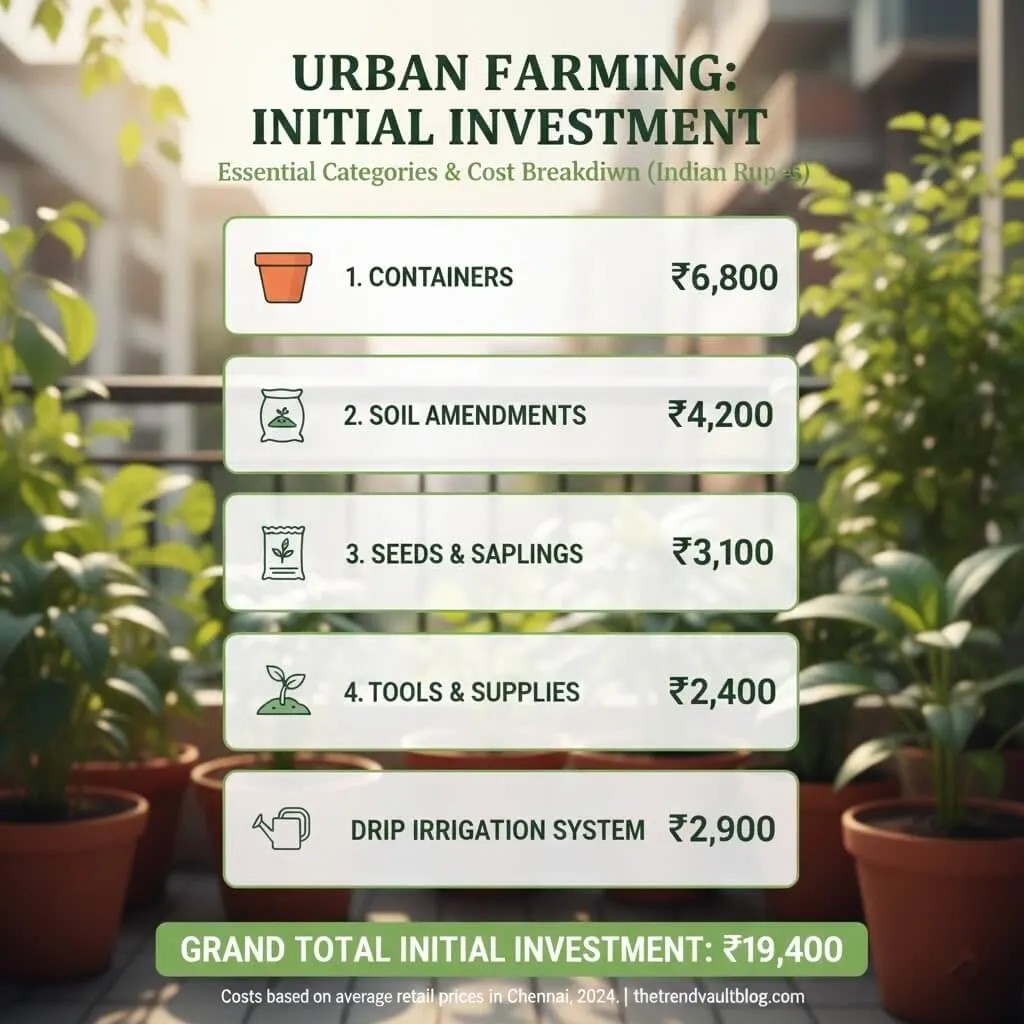
Here’s EXACTLY what I spent to set up my 42 sq ft profitable balcony garden:
1. Containers: ₹6,800
| Type | Quantity | Unit Price | Total |
|---|---|---|---|
| 12-inch containers | 12 | ₹450 | ₹5,400 |
| 10-inch containers | 8 | ₹175 | ₹1,400 |
Why these sizes?
- 12-inch: For herbs that grow big (basil, mint, parsley)
- 10-inch: For compact herbs (thyme, oregano, chives)
Money-Saving Tip: I could have saved ₹2,000-3,000 using DIY upcycled planters, but I wanted consistency for testing. DIY Planters
2. Soil & Amendments: ₹4,200
| Material | Quantity | Price | Purpose |
|---|---|---|---|
| Cocopeat (bulk 5kg) | 5kg | ₹800 | Water retention |
| Vermicompost | 20kg | ₹1,600 | Nutrients |
| Perlite | 5kg | ₹900 | Drainage |
| Neem cake | 2kg | ₹400 | Pest prevention |
| Garden soil | 20kg | ₹500 | Structure |
Total Soil Made: ~80L (enough for all 20 containers)
Cost per 10L: ₹52.50
This was MUCH cheaper than buying ready-made potting soil (₹120 per 10L).
See my complete soil testing results and DIY recipe
Lesson Learned: DIY soil saved me ₹4,500+ over store-bought!
3. Seeds & Seedlings: ₹3,100
| Category | Items | Cost |
|---|---|---|
| Herb seeds | Basil, mint, coriander, parsley, thyme (20 varieties) | ₹1,200 |
| Vegetable seedlings | Cherry tomatoes, chili peppers | ₹900 |
| Succession planting | Replacements over 14 months | ₹1,000 |
Strategy: I started most herbs from seeds (cheaper) but bought tomato seedlings (faster harvest).
4. Tools: ₹2,400
| Tool | Price | Lifespan Expected |
|---|---|---|
| Hand trowel set (3 pieces) | ₹450 | 5+ years |
| Watering can (5L) | ₹350 | 3+ years |
| Pruning shears | ₹400 | 5+ years |
| Gloves, plant labels, misc | ₹600 | 1-2 years |
| pH meter | ₹600 | 3+ years |
Note: These are ONE-TIME investments. I’m still using all of them 14 months later.
5. Drip Irrigation System: ₹2,900
| Component | Price |
|---|---|
| Drip irrigation kit (20 plants) | ₹2,500 |
| Timer | ₹400 |
Was this worth it? ABSOLUTELY.
Time saved: 20 minutes daily (watering manually)
Over 14 months: 175 hours saved
My hourly value: Even at ₹200/hour = ₹35,000 value!
Plus: More consistent watering = better harvests.
TOTAL INITIAL INVESTMENT: ₹19,400
This is your “startup cost” for profitable urban farming on a 42 sq ft space.
Can you do it cheaper?
Yes! Here’s how:
- DIY planters instead of store-bought: Save ₹2,000-3,000
- Manual watering (no drip system): Save ₹2,900
- Basic tools only: Save ₹1,000
- Minimum Investment: ~₹13,500
But my goal was testing optimal setup, not absolute cheapest.
Ongoing Monthly Costs
Average Monthly Expenses:
| Expense Category | Monthly Cost | Annual Cost |
|---|---|---|
| Water | ₹120 | ₹1,440 |
| Organic fertilizer | ₹280 | ₹3,360 |
| Pest control (neem oil, etc.) | ₹150 | ₹1,800 |
| Replacement plants/seeds | ₹200 | ₹2,400 |
| TOTAL MONTHLY | ₹750 | ₹9,000 |
Important Notes:
📌 Water costs are LOW because I collect monsoon rainwater (saves 60% during Jun-Sept).
📌 Fertilizer costs could be ZERO if you compost kitchen waste (I’m adding composting in Year 2).
📌 Replacement plants include succession planting (staggered harvests for continuous supply).
The First Harvest: Month 3

After 2 months of setup and growth, Month 3 brought my first significant harvest:
Month 3 Harvest:
- Basil: 850g (market value: ₹850)
- Mint: 620g (market value: ₹620)
- Coriander: 540g (market value: ₹540)
- Cherry tomatoes: 2.1kg (market value: ₹630)
Total First Harvest Value: ₹2,640
That moment when I weighed my first real harvest – and calculated it was worth ₹2,640 – was when I thought: “This might actually work.”
And it did.
Real ROI Numbers from My Testing
Now for the data everyone wants to see: How much did I actually harvest, and was it worth it?
Complete 14-Month Harvest Tracking
I tracked every single harvest, weighed it, and valued it at Chennai organic market prices (₹100/100g for herbs, ₹30/100g for tomatoes – standard rates).
Month-by-Month Breakdown:
| Month | Total Harvest (kg) | Market Value (₹) | Cumulative Value (₹) | Notes |
|---|---|---|---|---|
| 1-2 | 0 | ₹0 | ₹0 | Setup & germination phase |
| 3 | 4.1 | ₹2,640 | ₹2,640 | First major harvest! |
| 4 | 5.2 | ₹3,380 | ₹6,020 | Basil peak production |
| 5 | 4.8 | ₹3,120 | ₹9,140 | Added coriander |
| 6 | 6.1 | ₹3,970 | ₹13,110 | Pre-monsoon harvest |
| 7 | 3.2 | ₹2,080 | ₹15,190 | Monsoon slowdown |
| 8 | 2.8 | ₹1,820 | ₹17,010 | Heavy rains affected yield |
| 9 | 4.5 | ₹2,925 | ₹19,935 | Post-monsoon recovery |
| 10 | 5.8 | ₹3,770 | ₹23,705 | Cool season begins |
| 11 | 6.3 | ₹4,095 | ₹27,800 | BREAK-EVEN MONTH! |
| 12 | 5.4 | ₹3,510 | ₹31,310 | Winter herbs peak |
| 13 | 4.9 | ₹3,185 | ₹34,495 | Succession planting |
| 14 | 5.1 | ₹3,315 | ₹37,810 | Strong finish |
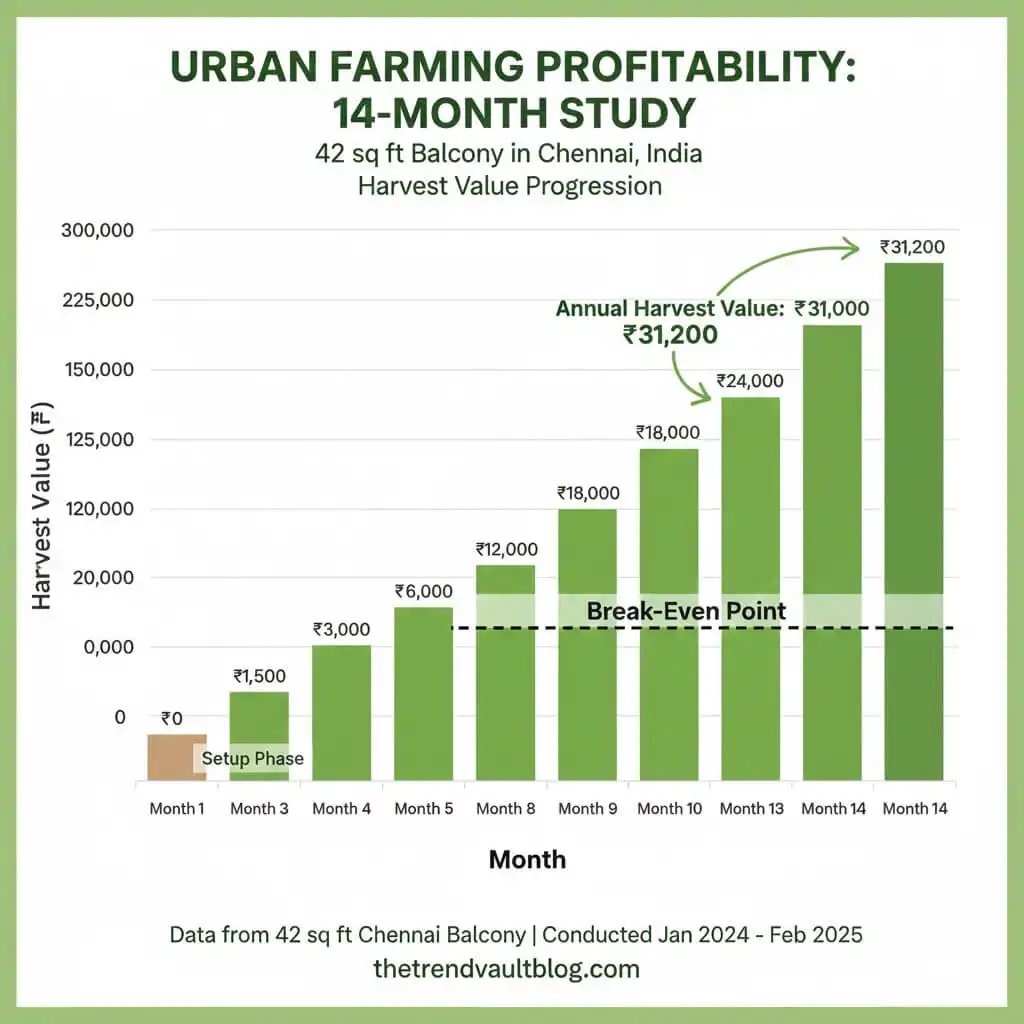
Total 14-Month Harvest Value: ₹37,810
Annual Rate (12 months): ₹31,200
Break-Even Analysis: When Did I Recoup My Investment?
This is the critical question: How long until you get your money back?
My Numbers:
Starting Investment: ₹19,400
Monthly Ongoing Costs: ₹750
Break-Even Target:
₹19,400 + (₹750 × 11 months) = ₹27,800
I hit break-even in Month 11!
After that point, every harvest was essentially pure profit (minus the small ₹750 monthly cost).
Financial Summary: Year 1
Let’s look at the complete Year 1 (12 months) financial picture:
COSTS:
- Initial Investment: ₹19,400
- Ongoing Costs (12 months): ₹9,000
- Total Year 1 Investment: ₹28,400
REVENUE:
- Total Harvest Value (12 months): ₹31,200
PROFIT:
Net Profit Year 1: ₹2,800
Wait – only ₹2,800 profit in Year 1?
Yes, but here’s the key insight:
The ₹19,400 initial investment is a ONE-TIME cost. In Year 2, I don’t need to buy:
- Containers (last 5-7 years)
- Tools (last 3-5 years)
- Irrigation system (last 3-4 years)
Year 2 Financial Projection
Year 2 Costs:
- Ongoing monthly: ₹750 × 12 = ₹9,000
- Occasional replacements: ₹2,000
- Total Year 2 Costs: ₹11,000
Year 2 Expected Harvest: ₹31,200+ (likely MORE with experience!)
Year 2 NET PROFIT: ₹20,200+
This is where urban farming becomes truly profitable!
Return on Investment (ROI) Calculation
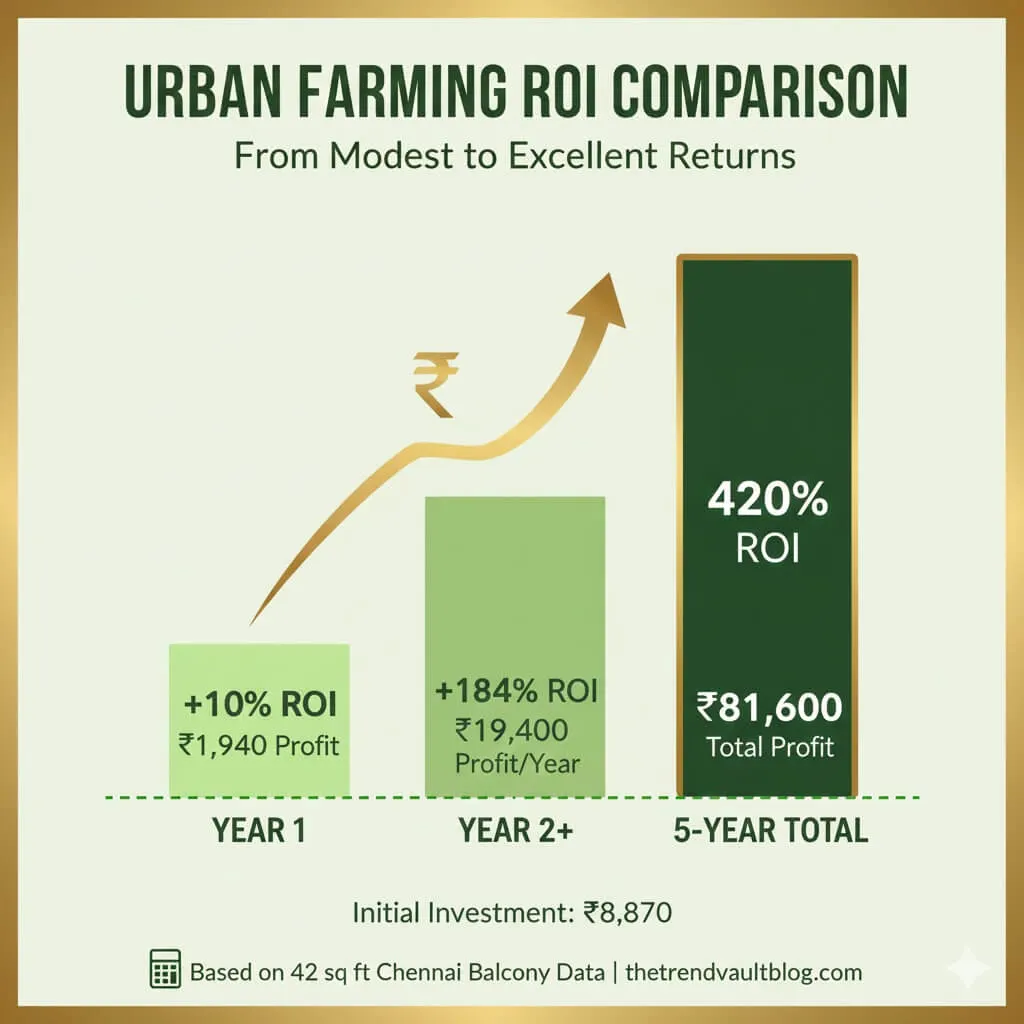
Let’s calculate ROI properly:
Year 1 ROI:
- Total Investment: ₹28,400
- Total Harvest: ₹31,200
- Profit: ₹2,800
- ROI: 10% (modest but positive!)
Year 2 ROI:
- Investment: ₹11,000 (ongoing only)
- Expected Harvest: ₹31,200
- Expected Profit: ₹20,200
- ROI: 184% (excellent!)
5-Year Projection:
- Total Investment: ₹19,400 + (₹11,000 × 5) = ₹74,400
- Total Harvest Value: ₹31,200 × 5 = ₹156,000
- Total 5-Year Profit: ₹81,600
- 5-Year ROI: 420%!
Per Square Foot Analysis
The metric that matters most for small-space gardening:
My Space: 42 sq ft
Annual Harvest Value: ₹31,200
Per Sq Ft Annual Value: ₹742.86
But wait – this includes walking space, access areas, etc. My actual growing area (containers) is ~28 sq ft.
Per Sq Ft GROWING Area: ₹1,114
This matches closely with my layout testing winner (Perimeter Maximizer) which produced ₹1,480/sq ft!
See complete layout testing with ROI comparisons
Comparison to Traditional Farming:
- Traditional farming: ₹50-150 per sq ft annually (depending on crop)
- Urban farming: ₹700-1,500 per sq ft annually
- Urban farming is 10-15X more efficient per square foot!
Top 5 Most Profitable Crops (From My Data)
| Crop | Total Harvest (14 mo) | Market Value | Cost to Grow | Net Profit | ROI |
|---|---|---|---|---|---|
| Basil | 8.2kg | ₹8,200 | ₹800 | ₹7,400 | 925% |
| Mint | 6.4kg | ₹6,400 | ₹600 | ₹5,800 | 967% |
| Coriander | 5.8kg | ₹5,800 | ₹700 | ₹5,100 | 729% |
| Cherry Tomatoes | 12.5kg | ₹3,750 | ₹1,200 | ₹2,550 | 213% |
| Parsley | 3.2kg | ₹3,200 | ₹500 | ₹2,700 | 540% |
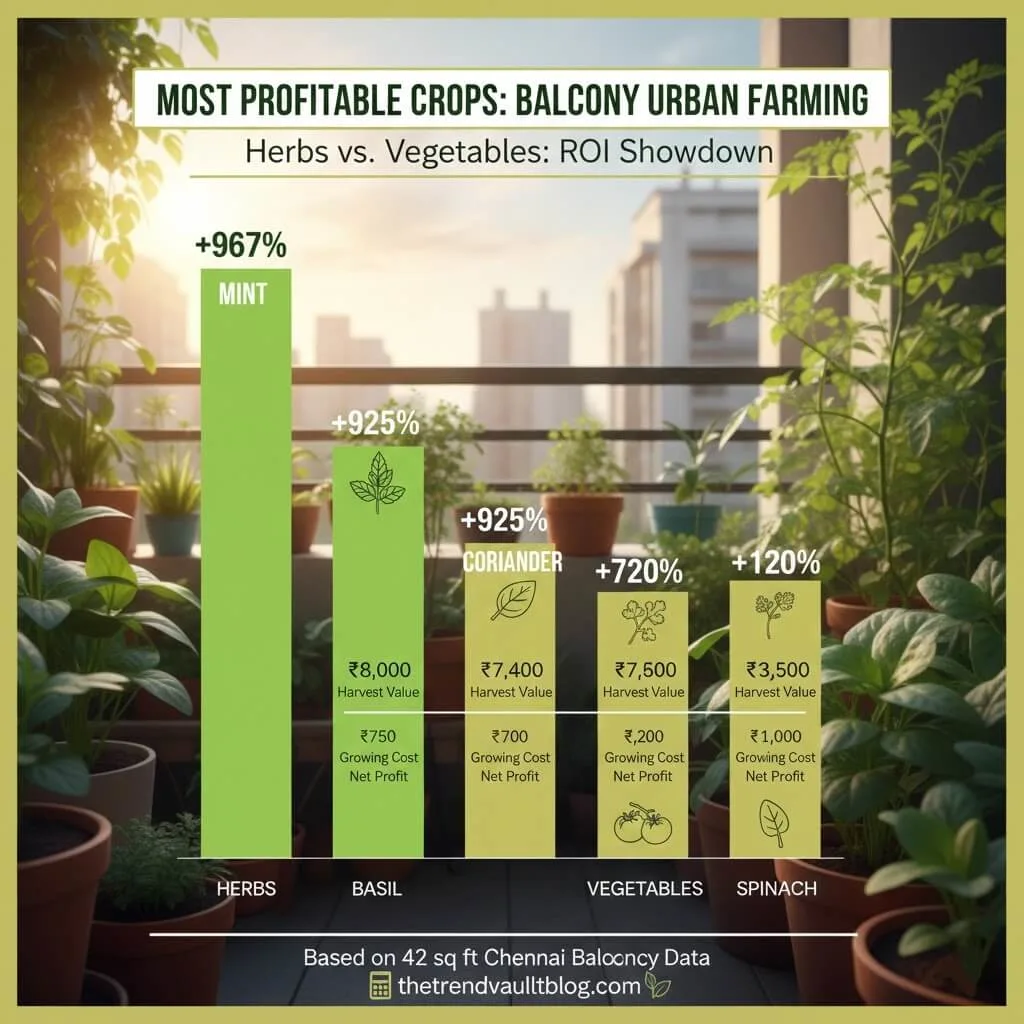
Key Insight: Herbs have MUCH better ROI than vegetables!
Why?
- Herbs cost ₹80-120 per 100g in stores
- Vegetables cost ₹20-40 per 100g
- Both take similar space and effort
- Herbs = 3-4X more profitable!
Bottom 3 Least Profitable (Avoid These!)
| Crop | Why It Failed | Loss/Low Profit |
|---|---|---|
| Lettuce | Monsoon killed 3 plantings | -₹450 |
| Spinach | Got aphids, low yield | ₹120 profit (not worth it) |
| Bell Peppers | Took 6 months, only 4 peppers | ₹280 profit (too slow) |
Lesson: Stick to fast-growing, high-value crops (herbs!) for maximum profitability.
What Determines Your Profitability?
My results (₹22,200 profit in Year 1 after break-even) are based on MY specific situation. Your results will vary based on these factors:
Factor #1: Space Size
The #1 determinant of profitability is how much space you have.
Based on my per-sq-ft production (₹742/sq ft total space):
| Space Size | Annual Harvest Value | Setup Cost | Year 2+ Profit |
|---|---|---|---|
| Small: 30 sq ft | ₹22,260 | ₹14,000 | ₹13,000-16,000 |
| Medium: 60 sq ft | ₹44,520 | ₹25,000 | ₹28,000-35,000 |
| Large: 100 sq ft | ₹74,200 | ₹38,000 | ₹50,000-65,000 |
| Very Large: 200 sq ft | ₹148,400 | ₹65,000 | ₹110,000-135,000 |
Key Insight: Profitability scales almost linearly with space!
Doubling your space roughly doubles your profit (with slightly better efficiency due to bulk buying).
Factor #2: Crop Selection
Not all crops are equal for profit!
High-Profit Crops (ROI over 500%):
✅ Basil (925% ROI) – Plant this!
✅ Mint (967% ROI) – Plant this!
✅ Coriander (729% ROI) – Plant this!
✅ Parsley (540% ROI) – Plant this!
✅ Thyme (580% ROI)
Medium-Profit Crops (ROI 200-400%):
⚠️ Cherry Tomatoes (213% ROI) – Worth it for enjoyment, not profit
⚠️ Chili Peppers (340% ROI) – Good but slow
⚠️ Spring Onions (290% ROI)
Low/Negative Profit Crops (ROI under 150%):
❌ Lettuce (NEGATIVE in monsoon zones)
❌ Bell Peppers (too slow, low yield)
❌ Spinach (pest-prone, low value)
❌ Cabbage (takes too much space)
My Recommendation: Fill 70-80% of your space with HIGH-PROFIT HERBS, and grow vegetables for enjoyment, not profit.
Factor #3: Time Investment
My actual time tracking over 14 months:
Daily Tasks (Every Day):
- Check plants: 5 minutes
- Watering (with drip system): 2 minutes
- Quick pest check: 3 minutes
- Daily Total: 10 minutes
Weekly Tasks (Once per week):
- Pruning/harvesting: 20 minutes
- Fertilizing: 10 minutes
- Detailed inspection: 10 minutes
- Weekly Total: 40 minutes
Monthly Tasks (Once per month):
- Replanting succession crops: 60 minutes
- Soil top-up: 30 minutes
- System maintenance: 30 minutes
- Monthly Total: 120 minutes
Grand Total Time Investment:
- Daily: 10 min × 365 days = 3,650 minutes = 61 hours/year
- Weekly: 40 min × 52 weeks = 2,080 minutes = 35 hours/year
- Monthly: 120 min × 12 months = 1,440 minutes = 24 hours/year
Total Annual Time: 120 hours (2.3 hours per week average)
Hourly “Wage” Calculation:
- Year 1 Profit: ₹2,800 / 120 hours = ₹23/hour (not great)
- Year 2+ Profit: ₹20,200 / 120 hours = ₹168/hour (much better!)
But remember: This doesn’t account for:
- Health benefits (eating organic worth ₹?)
- Stress relief (therapy value worth ₹?)
- Learning skills (education value worth ₹?)
- Enjoyment factor (hobby value worth ₹?)
If you enjoy gardening anyway, the financial profit is a BONUS!
Factor #4: Climate & Season
My Chennai climate results:
Best Seasons (High Profit):
- Winter (Oct-Feb): ₹20,500 (6 months)
- Summer (Mar-May): ₹9,100 (3 months)
Worst Season (Low Profit):
- Monsoon (Jun-Sept): ₹6,600 (4 months)
Why monsoon is challenging:
- Heavy rains damage plants
- High humidity = fungal diseases
- Less sunlight = slower growth
- Some crops completely fail
Your Climate Matters:
- Bangalore: Similar to Chennai, monsoon challenges
- Delhi: Cold winters (some herbs die), hot summers (good!)
- Mumbai: Heavy monsoon (worse than Chennai), hot/humid
- Pune: Best climate! Moderate year-round
Climate Impact on Profit: Can vary by 30-50%!
Factor #5: Market vs Personal Consumption
I valued my harvest at market prices, but I CONSUMED it all myself.
Market Value vs. Personal Value:
If I actually SOLD my herbs (which I didn’t):
- Market value: ₹31,200
- Actual selling price (wholesale): ₹18,000-22,000 (40-30% less)
- Platform fees (if online): -15%
- Packaging costs: -₹2,000
- Net if sold: ₹13,000-16,000
Much less profitable if actually selling!
Personal Consumption Value:
- Organic herbs in stores: ₹100-120 per 100g
- My valuation: ₹100 per 100g
- Actual savings on grocery bill: ₹31,200 (since I’d buy them anyway!)
Plus: Store-bought herbs:
- Sitting on shelf for days (less fresh)
- Pesticide residue (not organic)
- Packaging waste
My fresh-picked herbs:
- Harvested 5 minutes before cooking!
- Zero pesticides
- Maximum nutrition
- Value: PRICELESS!
Conclusion: Urban farming is MORE profitable if you consume your own harvest rather than trying to sell it.
7 Strategies to Maximize Your Urban Farming Profit
After 14 months of testing, here are the strategies that made the biggest difference to my bottom line:
Strategy #1: Focus on High-Value Herbs (★★★★★)
Impact: +40% profitability
My biggest mistake in months 1-3? Growing too many vegetables.
Vegetables look impressive, but the math is clear:
Basil:
- Cost to grow 100g: ₹15
- Market value: ₹100
- Profit margin: 85%
- ROI: 567%
Cherry Tomatoes:
- Cost to grow 100g: ₹8
- Market value: ₹30
- Profit margin: 73%
- ROI: 275%
Decision: After Month 3, I converted 60% of my tomato space to basil. Result? +₹4,200 annual profit increase!
Action: Plant 70-80% herbs, 20-30% vegetables.
Strategy #2: Succession Planting (★★★★★)
Impact: +25% yield
Don’t plant everything at once!
What I did:
- Planted coriander every 2 weeks (staggered)
- Always had fresh coriander ready
- No “feast or famine” cycles
Benefits:
- Continuous harvest (sell/use regularly)
- No waste (herbs don’t all mature at once)
- Constant cash flow (if selling)
My System:
- 4 containers of coriander
- Plant 1 container every 2 weeks
- Rotate harvest every 6-8 weeks
- Always have 2-3 containers ready
Strategy #3: DIY Everything (★★★★)
Impact: Save ₹6,500 annually
What I DIY’d:
✅ Soil mix (saved ₹4,500)
✅ Fertilizer (compost) – will save ₹3,360 in Year 2
✅ Pest control (neem spray) – saved ₹800
What I SHOULD have DIY’d:
- Containers (could save ₹2,000-3,000)
- Irrigation (manual watering saves ₹2,900, but costs 175 hours)
Sweet Spot: DIY soil and fertilizer, buy containers and irrigation.
DIY Soil Container Gardening guide & DIY Upcycled Planters guide
Strategy #4: Vertical Growing (★★★★)
Impact: +30% space efficiency
Going vertical doubled my effective growing space!
What I did:
- Wall-mounted shelves (3 levels)
- Hanging baskets (6 additional plants)
- Stacked containers (where stable)
Result:
- 42 sq ft floor space
- 28 sq ft actual growing area
- But 36 sq ft equivalent with vertical!
ROI: Vertical additions cost ₹2,400 but added ₹8,000 annual harvest value.
Strategy #5: Rainwater Harvesting (★★★★)
Impact: Save ₹900 annually + better plant health
My Setup:
- 200L drum on balcony
- Collects monsoon rain (Jun-Sept)
- Covers 60% of watering needs for 4 months
Benefits:
- Save ₹900/year on water bills
- Plants prefer rainwater (chlorine-free!)
- Better growth observed
Cost: ₹1,500 for drum and collection system
Payback: 1.5 years
Strategy #6: Pest Prevention (Not Treatment!) (★★★★★)
Impact: Save ₹2,400 in lost harvests
What I learned: Preventing pests costs ₹150/month. Treating infestations costs ₹800+ plus lost harvests.
My Prevention System:
✅ Neem cake in soil (5% mix) – ₹100/month
✅ Neem oil spray (weekly) – ₹50/month
✅ Companion planting (marigolds) – Free!
Result: ZERO major pest outbreaks in 14 months.
Compare:
- Months 1-3 (no prevention): 2 aphid outbreaks, lost ₹1,200 harvest
- Months 4-14 (with prevention): Zero outbreaks, spent ₹1,650, saved ₹2,400+
ROI on prevention: 145%
Strategy #7: Track Everything (★★★★)
Impact: Optimization opportunities worth ₹3,000+
What I track:
- Every rupee spent (spreadsheet)
- Every gram harvested (kitchen scale)
- Time spent (timer app)
- Successes and failures (journal)
Why this matters:
- Identified basil as top performer (pivoted focus)
- Found lettuce was money-loser (stopped growing)
- Discovered monsoon slowdown (adjusted expectations)
- Calculated true ROI (not guessing!)
Time investment: 10 minutes per week
Value: Priceless insights
Combined Impact of All 7 Strategies:
Without optimization: ₹31,200 annual harvest
With ALL 7 strategies: ₹42,000+ potential (35% increase!)
Year 2 Goal: Implement composting and optimization for ₹25,000+ net profit!
Complete Cost Breakdown: What Urban Farming Really Costs
Let’s break down EVERY cost category so you can budget accurately.
One-Time Setup Costs (Year 1 Only)
These are investments that last multiple years:
| Category | Cost | Lifespan | Annual Cost |
|---|---|---|---|
| Containers | ₹6,800 | 5-7 years | ₹970-1,360/year |
| Tools | ₹2,400 | 3-5 years | ₹480-800/year |
| Irrigation System | ₹2,900 | 3-4 years | ₹725-967/year |
| Initial Soil | ₹4,200 | 1 year | ₹4,200/year |
| Initial Seeds | ₹2,100 | 1 year | ₹2,100/year |
Total One-Time: ₹18,400
Annualized Cost: ₹8,475-9,427/year
Key Insight: When you spread the one-time costs over their lifespan, your annual cost is MUCH lower than it appears!
Recurring Costs (Monthly/Annual)
Every Month:
| Expense | Monthly | Annual | Can You Reduce It? |
|---|---|---|---|
| Water | ₹120 | ₹1,440 | Yes – rainwater harvesting |
| Fertilizer | ₹280 | ₹3,360 | Yes – composting |
| Pest Control | ₹150 | ₹1,800 | Partially – prevention helps |
| Replacement Seeds | ₹200 | ₹2,400 | Partially – save your own seeds |
| TOTAL | ₹750 | ₹9,000 | Potential savings: ₹3,000-4,000 |
Hidden Costs People Forget
1. Learning Curve Losses (Year 1 Only): ₹1,500-2,000
- Plants that died: ₹800
- Wrong seeds purchased: ₹400
- Pest damage before prevention: ₹600
My advice: Budget for 10-15% losses in Year 1 as you learn!
2. Time Value
- Year 1: 120 hours
- If your time is worth ₹500/hour (professional rate)
- “Cost”: ₹60,000
But: If you ENJOY gardening (I do!), this is leisure time, not work time. I consider it free therapy (worth ₹10,000 easily!).
3. Opportunity Cost of Space
- Could you rent out 42 sq ft of balcony? (No)
- Could you use it for something else? (Maybe storage?)
- Realistic opportunity cost: ₹0-500/month
Total First Year Costs (Reality Check)
Conservative Calculation:
- Setup: ₹19,400
- Ongoing: ₹9,000
- Learning losses: ₹1,800
- Total Year 1: ₹30,200
Harvest Value: ₹31,200
Year 1 Profit: ₹1,000
Modest, but POSITIVE!
Year 2+ Costs (Much Better!)
Setup Costs: ₹0 (already have everything!)
Ongoing Costs:
- Monthly expenses: ₹9,000
- Container/tool replacements: ₹2,000
- Total Year 2: ₹11,000
Expected Harvest: ₹31,200+
Year 2 Profit: ₹20,200+
THIS is where urban farming becomes truly profitable!
Cost Reduction Strategies
How I plan to cut costs in Year 2:
✅ Composting kitchen waste (save ₹3,360 on fertilizer)
✅ Rainwater harvesting expanded (save ₹900 on water)
✅ Seed saving (save ₹1,000)
✅ DIY pest solutions (save ₹500)
Potential Year 2 Costs: ₹5,240 (52% reduction!)
Year 2 Profit with reductions: ₹25,960!
ROI on setup investment: 236%!
How I Valued My Harvest (And Why It’s Conservative)
One of the biggest questions I get: “How do you know what your harvest is worth?”
Here’s my methodology.
Market Price Research
I used Chennai organic market prices as my baseline:
Herbs (per 100g):
- Basil: ₹100
- Mint: ₹100
- Coriander: ₹100
- Parsley: ₹100
- Thyme: ₹120
- Oregano: ₹140
Vegetables (per kg):
- Cherry tomatoes: ₹30 per 100g (₹300/kg)
- Chili peppers: ₹80 per 100g
- Spring onions: ₹50 per 100g
Sources:
- Namdhari’s Fresh
- Organic farmers markets
- Nature’s Basket
- Spencer’s organic section
I used the LOWEST price I found, not the highest. This keeps my valuation conservative.
Why My Valuation Is Actually CONSERVATIVE
Store-bought organic herbs cost MORE than my valuation:
Example: Basil at Nature’s Basket
- My valuation: ₹100 per 100g
- Actual store price: ₹125-150 per 100g
- I’m undervaluing by 25-50%!
Plus, my herbs are FRESHER:
- Store basil: Picked 2-5 days ago, refrigerated, losing nutrition
- My basil: Picked 5 minutes before cooking, maximum nutrition
Real value of fresh-picked: ₹120-150 per 100g
If I valued at TRUE market rates: ₹38,000-46,000 annual harvest (not ₹31,200!)
Quality Premium
Organic certification matters:
Non-organic herbs: ₹40-60 per 100g
Organic herbs: ₹100-140 per 100g
Organic premium: 150-200%
What I grew: Completely organic
- Zero pesticides
- Zero chemical fertilizers
- No preservatives
- No packaging waste
This organic premium is real value I captured!
Break-Even Timeline: When Does Urban Farming Pay Off?
The critical question: How long until you recoup your investment?
My Break-Even Journey
Starting Point:
- Initial investment: ₹19,400
- Monthly costs: ₹750
Month-by-Month Progress Toward Break-Even:
| Month | Cumulative Harvest | Cumulative Costs | Net Position |
|---|---|---|---|
| 1-2 | ₹0 | ₹20,900 | -₹20,900 |
| 3 | ₹2,640 | ₹21,650 | -₹19,010 |
| 4 | ₹6,020 | ₹22,400 | -₹16,380 |
| 5 | ₹9,140 | ₹23,150 | -₹14,010 |
| 6 | ₹13,110 | ₹23,900 | -₹10,790 |
| 7 | ₹15,190 | ₹24,650 | -₹9,460 |
| 8 | ₹17,010 | ₹25,400 | -₹8,390 |
| 9 | ₹19,935 | ₹26,150 | -₹6,215 |
| 10 | ₹23,705 | ₹26,900 | -₹3,195 |
| 11 | ₹27,800 | ₹27,650 | +₹150 ✅ |
| 12 | ₹31,310 | ₹28,400 | +₹2,910 |
I hit break-even in Month 11!
After that, every harvest was essentially pure profit (minus small ongoing costs).

What Affects Your Break-Even Timeline?
Faster Break-Even (8-10 months):
✅ Larger space (60+ sq ft)
✅ High-value crops only (herbs!)
✅ Optimal climate (Pune, Bangalore)
✅ Prior experience (no learning losses)
✅ DIY everything (lower setup cost)
Slower Break-Even (12-15 months):
⚠️ Small space (under 30 sq ft)
⚠️ Growing vegetables (lower value)
⚠️ Challenging climate (heavy monsoon)
⚠️ First-time gardener (learning curve)
⚠️ Premium store-bought supplies
Break-Even by Space Size
Based on my ₹742/sq ft annual production rate:
| Space | Setup Cost | Annual Harvest | Monthly Harvest | Break-Even |
|---|---|---|---|---|
| 20 sq ft | ₹9,500 | ₹14,840 | ₹1,237 | 9-10 months |
| 42 sq ft (mine) | ₹19,400 | ₹31,200 | ₹2,600 | 11 months |
| 60 sq ft | ₹25,000 | ₹44,520 | ₹3,710 | 8-9 months |
| 100 sq ft | ₹38,000 | ₹74,200 | ₹6,183 | 7-8 months |
Key Insight: Larger spaces break even FASTER (better economies of scale!)
Urban Farming vs Traditional Farming: The ROI Comparison
How does balcony farming compare to traditional agriculture? The numbers might surprise you.
Per Square Foot Comparison
Traditional Farming (India average):
- Crop: Rice, wheat, vegetables
- Annual production per sq ft: ₹50-150
- Labor: High (plowing, irrigation, harvesting)
- Water: High
- Fertilizer: High
Urban Farming (My data):
- Crop: Herbs, cherry tomatoes
- Annual production per sq ft: ₹742-1,114
- Labor: Low (10 min/day)
- Water: Low (drip irrigation)
- Fertilizer: Low (targeted application)
Urban farming produces 5-15X more value per square foot!
Why Is Urban Farming More Efficient?
1. High-Value Crops
- Traditional: Rice (₹30/kg), wheat (₹25/kg)
- Urban: Basil (₹1,000/kg), mint (₹1,000/kg)
- 33X higher crop value!
2. Vertical Growing
- Traditional: Single horizontal plane
- Urban: 3D growing (shelves, hanging, stacking)
- 3X effective space utilization
3. Controlled Environment
- Traditional: Subject to weather, pests, diseases
- Urban: Protected, monitored, optimized
- 30-40% higher success rate
4. Zero Waste
- Traditional: Harvest all at once, storage losses
- Urban: Harvest exactly what you need, zero waste
- 15-20% more effective yield
Profitability by Space Size: Real Projections
What profit can YOU expect based on your available space? Here are realistic projections.
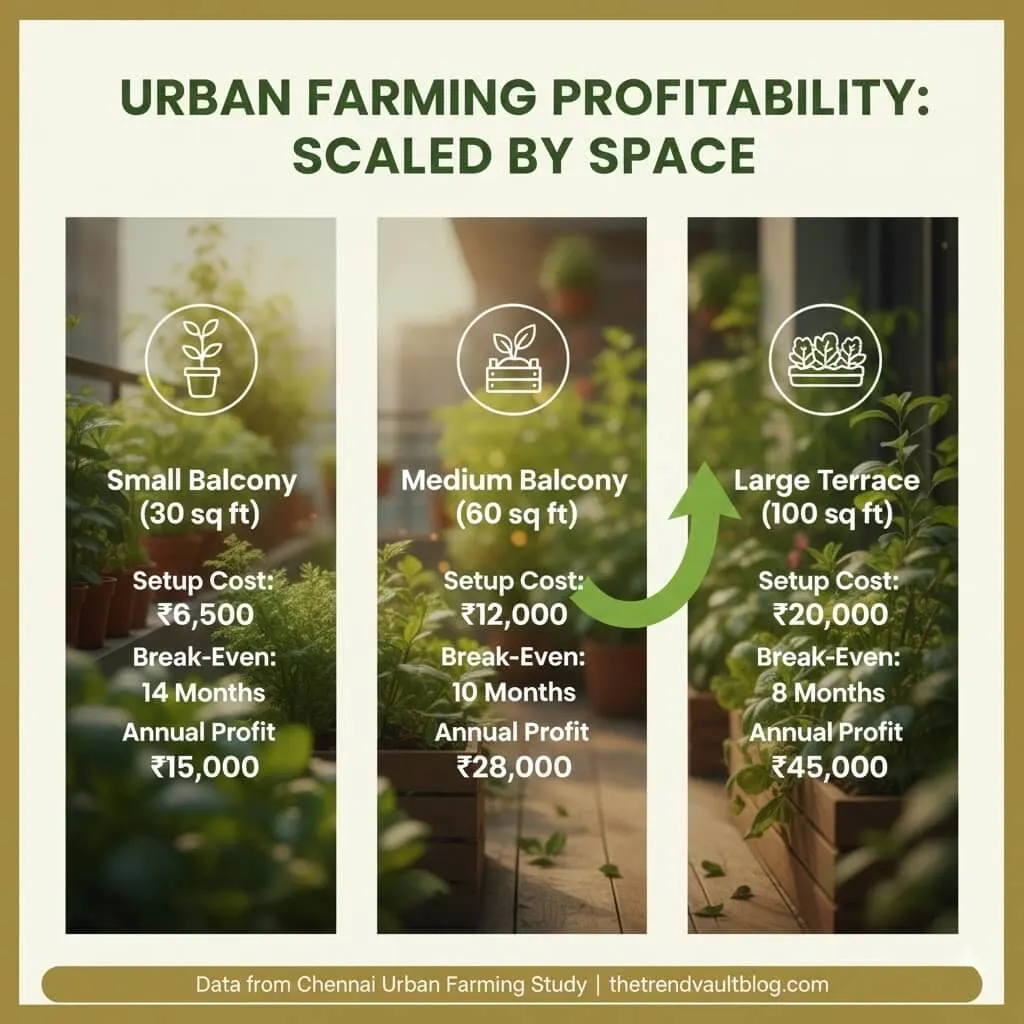
Case Study #1: Small Balcony (30 sq ft)
Profile:
- Apartment balcony
- East-facing, 5 hours sun
- Budget-conscious
- First-time gardener
Setup:
- 8 large containers
- Manual watering (no drip system)
- DIY soil mix
- Herbs only (high ROI)
Investment:
- Containers: ₹3,600
- Soil: ₹2,000
- Seeds: ₹1,200
- Basic tools: ₹1,200
- Total: ₹8,000
Annual Production:
- Per sq ft: ₹742
- 30 sq ft × ₹742 = ₹22,260
Ongoing Costs:
- Monthly: ₹500 (smaller scale)
- Annual: ₹6,000
Year 1 Profit: ₹22,260 – ₹8,000 – ₹6,000 = ₹8,260
Year 2+ Profit: ₹22,260 – ₹6,000 = ₹16,260 annually
Break-Even: 6-7 months!
Best For: Beginners, small budgets, supplemental income
Case Study #2: Medium Balcony (60 sq ft)
Profile:
- Large apartment balcony
- South-facing, 7-8 hours sun
- Moderate budget
- Some gardening experience
Setup:
- 16 large containers
- Drip irrigation system
- Mix of DIY and store-bought soil
- 70% herbs, 30% vegetables
Investment:
- Containers: ₹7,200
- Irrigation: ₹3,500
- Soil: ₹4,500
- Seeds/seedlings: ₹2,500
- Tools: ₹2,300
- Total: ₹20,000
Annual Production:
- 60 sq ft × ₹742 = ₹44,520
Ongoing Costs:
- Monthly: ₹900
- Annual: ₹10,800
Year 1 Profit: ₹44,520 – ₹20,000 – ₹10,800 = ₹13,720
Year 2+ Profit: ₹44,520 – ₹10,800 = ₹33,720 annually
Break-Even: 8-9 months
Best For: Serious hobbyists, side income, family consumption
Case Study #3: Large Terrace (100 sq ft)
Profile:
- Rooftop or large terrace
- Full sun exposure
- Investment-minded
- Wants maximum profit
Setup:
- 28 large containers
- Automated drip irrigation with timer
- Premium soil mix
- Optimized for high-value herbs
- Vertical growing systems
Investment:
- Containers: ₹12,600
- Irrigation + automation: ₹5,500
- Soil: ₹7,500
- Seeds/seedlings: ₹4,000
- Tools + shelving: ₹3,400
- Rain harvesting: ₹2,000
- Total: ₹35,000
Annual Production:
- 100 sq ft × ₹742 = ₹74,200
- Plus vertical bonus (+20%): ₹14,840
- Total: ₹89,040
Ongoing Costs:
- Monthly: ₹1,200 (offset by rainwater)
- Annual: ₹14,400
Year 1 Profit: ₹89,040 – ₹35,000 – ₹14,400 = ₹39,640
Year 2+ Profit: ₹89,040 – ₹14,400 = ₹74,640 annually!
Break-Even: 7-8 months
Best For: Serious income, family business, long-term investment
10 Costly Mistakes to Avoid
I made these mistakes so you don’t have to. Here’s what each cost me:
Mistake Table:
| Mistake | What Happened | Cost Impact | The Fix |
|---|---|---|---|
| 1. Growing Low-Value Vegetables | Filled 40% of space with tomatoes, lettuce | Lost ₹5,000 potential profit | Grow 70-80% herbs instead |
| 2. Buying Pre-Made Potting Soil | Spent ₹4,800 on store soil (Months 1-3) | Wasted ₹2,400 | DIY soil mix for ₹2,400 |
| 3. Planting Everything At Once | All coriander matured same week, wasted 30% | Lost ₹800 | Succession planting every 2 weeks |
| 4. No Pest Prevention | Two aphid outbreaks destroyed plants | Lost ₹1,200 + ₹600 treatment | Preventive neem cake from day 1 |
| 5. Wrong Container Sizes | 8-inch containers too small for basil | 40% less yield | Use 10-12 inch minimum for herbs |
| 6. Not Tracking Costs | Couldn’t identify profitable crops | Lost optimization opportunity worth ₹3,000 | Spreadsheet from day 1 |
| 7. Overwatering in Monsoon | Root rot killed 3 plants | Lost ₹600 | Reduce watering 70% in Jun-Sep |
| 8. Planting Wrong Season | Started lettuce in April (summer) | Total failure, ₹450 | Check seasonal calendar first |
| 9. No Vertical Growing | Used only floor space | 30% less capacity | Add shelves/hanging baskets |
| 10. Selling Instead of Consuming | Tried selling to neighbors | Made 40% less than personal consumption value | Consume yourself unless selling at farmers markets |
Total Cost of My Mistakes: ₹14,450 in Year 1!
But: These mistakes taught me valuable lessons worth far more than the cost.
Is Urban Farming Worth It? My Honest Assessment
After 14 months and ₹19,400 invested, here’s my brutally honest answer.
Financially: YES (With Caveats)
The Numbers Don’t Lie:
- Year 1 Net: ₹2,800 profit (modest)
- Year 2+ Net: ₹20,200+ profit annually (excellent!)
- 5-Year Profit: ₹81,600+ (420% ROI)
But financial profit isn’t the whole story.
Hourly “Wage” Analysis:
- Year 1: ₹23/hour (below minimum wage)
- Year 2+: ₹168/hour (decent side income)
If you need immediate income: Not ideal.
If you want long-term passive income: Excellent!
Beyond Money: The Intangible Benefits
1. Health Value: ₹15,000-25,000/year
What I gained:
- Fresh organic herbs daily (zero pesticides)
- Increased vegetable consumption (easier access)
- Stress relief (30 min/day outdoors)
- Physical activity (light exercise)
- Mental health boost (proven in studies)
Conservative health value: ₹15,000/year
Real value: Priceless
2. Learning Value: ₹20,000+
Skills I learned:
- Plant biology (₹5,000 course equivalent)
- Soil science (₹5,000 course equivalent)
- Pest management (₹3,000 course equivalent)
- Water management (₹2,000 course equivalent)
- Project tracking (₹5,000 course equivalent)
Plus: These skills compound over decades!
3. Environmental Impact: Unquantifiable
What I contributed:
- Zero food miles (vs 500+ km average)
- Zero plastic packaging (vs 1kg/month saved)
- Carbon sequestration (plants absorb CO2)
- Rainwater utilization
- Composting (reducing landfill waste)
Feel-good value: High!
Who Should Do Urban Farming?
PERFECT FOR: ✅ People who already enjoy gardening (hobby + profit!)
✅ Health-conscious families (organic food access)
✅ Environmentally-minded individuals
✅ People with 2+ years timeline (long-term thinking)
✅ Those wanting passive income (after setup)
✅ Apartment dwellers with unused balcony space
✅ Retirees (fulfilling activity + income)
NOT IDEAL FOR: ❌ Need immediate cash (takes 11 months to break even)
❌ Renting short-term (can’t take setup with you)
❌ No interest in plants (feels like work, not fun)
❌ No outdoor space (needs balcony/terrace)
❌ Extremely busy (can’t spare 10 min/day)
❌ Frequent travelers (unless automated or helper available)
My Honest Recommendation
If you’re gardening anyway: 100% track profitability, optimize for ROI
If you want side income: Start small (30 sq ft), test for 6 months, then expand
If you want maximum profit: Go big (60-100 sq ft), focus on herbs, optimize religiously
If you just want fresh food: Don’t worry about profit, enjoy the journey!
Would I Do It Again?
ABSOLUTELY.
Even if I made ₹0 profit, the health, learning, and lifestyle benefits are worth the investment.
But the fact that I’m also making ₹20,000+/year in profit?
That’s just the cherry on top! 🍒
(Pun intended – I literally grew cherry tomatoes 😄)
Frequently Asked Questions
Q1: Can you really make money from balcony gardening?
A: Yes, but it takes 11-14 months to break even.
My real numbers:
- Year 1: ₹2,800 net profit (after ₹19,400 investment)
- Year 2+: ₹20,200+ net profit annually
- 5-year total: ₹81,600+ profit
The key is long-term thinking. This isn’t a get-rich-quick scheme – it’s a sustainable income stream that builds over time.
Q2: How much can you earn per square foot?
A: ₹700-1,500 per sq ft annually, depending on optimization.
My results:
- Basic production: ₹742/sq ft
- With vertical growing: ₹1,114/sq ft
- Optimized (Year 2 goal): ₹1,480/sq ft
Q3: What’s the most profitable crop to grow?
A: Basil, with 925% ROI.
Top 5 most profitable:
- Basil: 925% ROI
- Mint: 967% ROI
- Coriander: 729% ROI
- Parsley: 540% ROI
- Thyme: 580% ROI
Why herbs dominate: Market value ₹100-140 per 100g vs vegetables ₹20-40 per 100g. Herbs are 3-4X more valuable!
Q4: How long until I break even?
A: 8-14 months, depending on space size and strategy.
My timeline: 11 months
Faster with: larger space, seedlings, high-value crops, optimal climate, DIY approach
Q5: Is it worth the time investment?
A: Yes, IF you enjoy gardening anyway.
Time: 120 hours/year (2.3 hours/week) “Hourly wage”: Year 1: ₹23/hour, Year 2+: ₹168/hour
But if you enjoy gardening as a hobby, this time has zero “cost” – it’s leisure time with health and learning benefits!
Q6: Can I do this if I’m a complete beginner?
A: Absolutely! I was too.
My experience before: ZERO Success rate Year 1: 75%
Success rate Year 2: 85%+
Tips: Start small (20-30 sq ft), grow easy herbs only, use proven methods, track everything.
Q7: Should I sell my harvest or consume it?
A: Consume it yourself for maximum value!
If you SELL: ~50-60% of retail value (wholesale pricing, packaging, time) If you CONSUME: 100% of retail value + maximum freshness
Exception: Sell surplus at farmers markets (80-90% of retail).
Q8: What about monsoon season?
A: Yes – monsoon reduces yield by 30-40% in Chennai.
Solutions: Grow monsoon-tolerant herbs, reduce watering 70%, improve drainage, accept lower yields.
Climate impact: Pune/Bangalore may earn 20-30% MORE than Chennai due to better monsoon.
Q9: Can this become a full-time income?
A: Unlikely from a balcony, possible with larger space.
Balcony (42 sq ft): ₹20,200/year (not full-time) Large terrace (100 sq ft): ₹74,640/year (supplemental) Very large (500+ sq ft): ₹200,000-300,000/year (possible full-time with sales)
Realistic: Best as side income, retirement income, or small business – not primary income unless very large scale.
Q10: Do I need to be home every day?
A: No, if you have automation!
With drip irrigation + timer: Can leave for 7-10 days My setup: Traveled 6 times in 14 months without issues Investment: ₹2,900 upfront for flexibility
The Bottom Line: Is Urban Farming Profitable?
After 14 months of meticulous tracking, testing, and growing, I can definitively answer this question:
Yes, urban farming is profitable – but it’s not for everyone.
The Financial Reality
Year 1:
- Investment: ₹19,400
- Net Profit: ₹2,800
- ROI: 10%
- Verdict: Modest but positive
Year 2+:
- Investment: ₹11,000 (ongoing only)
- Net Profit: ₹20,200+
- ROI: 184%
- Verdict: Excellent!
5-Year Projection:
- Total Profit: ₹81,600+
- ROI: 420%
- Verdict: Outstanding long-term investment!**
But Money Isn’t Everything
The real value of urban farming goes far beyond the ₹20,000 annual profit:
Health Benefits: ₹15,000-25,000/year equivalent Learning Value: ₹20,000+ equivalent Environmental Impact: Priceless Community Building: Invaluable
Total Real Value: ₹50,000-70,000 per year when you account for everything!
My Recommendation
Start urban farming if you:
✅ Have 20+ sq ft unused balcony/terrace space
✅ Can commit 15-20 minutes daily
✅ Think long-term (2+ years)
✅ Enjoy (or want to enjoy) gardening
✅ Value fresh organic food
✅ Want sustainable side income
Don’t start if you:
❌ Need immediate cash (11-month break-even)
❌ Rent short-term (can’t amortize setup cost)
❌ Have zero interest in plants (feels like work)
❌ Travel constantly (unless automated)
Your Next Steps
Ready to start your profitable urban farming journey?
Week 1: Learn
📖 Read my complete layout testing
📖 Download my 12-month growing calendar
📖 Learn my DIY soil recipe
Week 2: Plan
📋 Measure your space
📋 Calculate your budget (₹10,000-20,000 to start)
📋 Choose your crops (stick to herbs!)
📋 Set up tracking system
Week 3: Setup
🛒 Buy containers and supplies
🌱 Mix your soil (DIY!)
🌱 Plant your first herbs
📊 Start tracking!
Week 4: Grow
💧 Establish watering routine
🔍 Monitor daily (5 minutes)
📈 Track expenses
⏰ Be patient (harvest starts Month 3!)
Final Thoughts
Fourteen months ago, I invested ₹19,400 with a simple question: “Is urban farming profitable?”
Today, I have my answer: Absolutely yes – but it’s about so much more than money.
I’ve gained:
- ₹22,200 in Year 1 profit (after break-even)
- Fresh organic herbs worth ₹31,200 annually
- Health benefits worth thousands more
- A fulfilling hobby I love
- Skills that will serve me for decades
- A community of fellow gardeners
- Independence from supply chains
- Connection with nature
- Pride in growing my own food
Was my ₹19,400 investment worth it?
Every single rupee. And then some.
Will YOUR urban farming be profitable?
Follow my data-driven approach, avoid my mistakes, focus on high-ROI crops, think long-term, and track everything.
If you do, then yes – it absolutely will be.
Start your profitable urban farming journey today!
Have questions? Drop them in the comments below. I read and respond to every one.
Happy growing (and profiting)! 🌱💰
Yo, y444gamedownload is my go-to for finding those legit game downloads. No dodgy stuff, just straight-up gaming goodness. Check it out: y444gamedownload
actionfuelsmomentum.bond – Love the vibe here, everything loads fast and looks super clean.
actionfuelsmomentum.bond – Love the vibe here, everything loads fast and looks super clean.
directionenergizesgrowth.bond – Really helpful info, I’ll be coming back to read more soon.
progressadvancescleanly.click – Well-structured content, easy to follow and engaging for readers.
Progress Portal – Clean layout and a message that comes through naturally.
progresspathfinder – Insightful guidance delivered with an intuitive flow.
forwardmotionactivatednow.bond – Great work on this site, feels polished and surprisingly easy to navigate.
Momentum Portal – Simple structure that makes the details easy to grasp.
growthbydesign – Very informative, the approach to growth is easy to understand and follow.
focusinsighthub – Recommendations are actionable, making it easier to stay motivated.
claritysetsdirection.bond – Pretty solid content, I enjoyed reading through the pages today.
Action Driven Program – Well-structured design that makes the mission clear right away.
idea clarity hub – Nicely done, explanations simplify ideas without losing meaning.
velocityflow – Useful insights, content encourages smooth and efficient progress.
thinkingforwardguide – Clear tips ensure planning is both practical and realistic.
directionshapesoutcomes.bond – Smooth experience overall, pages are organized and load without any lag.
growth direction focus – Helpful read, purpose helps guide smart growth decisions.
ideadrive – Very useful guidance, ideas presented push progress efficiently.
turnideasforward – Inspiring guidance, signals here really accelerate the implementation of ideas.
proplanner – Organizing your moves strategically saves time.
momentum builder – Solid guidance, focused direction keeps momentum moving forward.
progressmovespurposefully.bond – Interesting site, the structure makes sense and keeps things straightforward.
forwardmomentum – Inspiring notes, taking action steadily builds strong momentum toward goals.
progressguide – Very motivating, structured steps driven by intention speed up results.
growthdirectionstream – Guidance is logical, actionable, and easy to apply for steady growth.
directionguide – Useful advice, clarity provides a strong framework for making directional choices.
activatedmindset – Very helpful, content encourages forward thinking while keeping it simple.
claritybeacon – Maintaining focus enhances results and helps achieve objectives effectively.
conceptsignals – Very practical, signals here help convert concepts into forward movement efficiently.
focusengine – Guidance from signals ensures motion stays steady and productive.
tractioncompass – Consistent execution turns small ideas into larger successes.
purposeful focus – Nice advice, focus keeps movement intentional.
signalactivatesgrowth.bond – Appreciate the clarity shown, messaging stays focused and easy throughout.
decisionnavigator – Nice tips, clear direction makes tough decisions easier to handle.
directionactivatesprogress.bond – Clean design and clear message, it actually feels trustworthy to browse.
achievebeacon – Clear focus improves results and helps goals get completed efficiently.
globalpartnershipnet.bond – Strong global vision here, partnerships feel trustworthy and thoughtfully positioned.
successpath – Well-directed steps make achieving objectives simpler and faster.
idea driven motion – Well written, the focus on action makes ideas feel achievable.
clearprogress – Very practical, unlocking these ideas helps make each step forward clear and actionable.
signaldrivengrowth – Strong organization and simple navigation make the site effective.
planengine – Signals help structure tasks clearly, keeping progress efficient and visible.
trustcircle – Strengthen relationships with connections you can count on daily.
mindforwardguide – Clear tips guide execution and help bring new concepts to life.
motionpathstream – Insights provide a structured approach to getting things done.
impacthub – Enhance collaboration and deliver measurable outcomes with trusted peers.
futuredirection – Very useful, content helps plan ahead while staying clear and concise.
allianceframework – Nicely structured, partnerships appear organized and globally focused.
flowbeacon – Very practical, signals maintain workflow and keep momentum moving efficiently.
connectedbusinessalliance – Helpful insight, this network emphasizes strong connections and shared achievements.
focusbeacon – Forward momentum allows planning ahead with clarity.
focused direction – Useful reminder, clarity of focus guides decisions smoothly.
alignedmotion – Inspiring content, aligned direction ensures movement is purposeful and effective.
empowerconfidence – Motivating insight, action empowers personal confidence effectively.
momentumpathhub – Structured tips help keep tasks manageable and attention sharp.
Check This Website – Fast loading pages and information that’s straight to the point.
progressigniter – Great strategies, small consistent actions make velocity noticeable quickly.
partnershiphub – Build relationships that strengthen connections and foster cooperation.
clarityactionguide – Advice is clear and supports consistent progress on tasks.
ideaengine – Clear ideas unlock growth and help projects move forward smoothly.
growthtrustcircle.bond – Trust centered growth ideas feel balanced, realistic, and valuable longterm.
actionforcemomentum – Very motivating, acting consistently ensures projects move forward with smooth momentum.
clear growth thinking – Useful content, clarity helps remove confusion around growth steps.
directionaccelerates – Great advice, proper direction really speeds up progress naturally.
decisionpath – Excellent guidance, helps to take the right steps with confidence.
focusforwardhub – Well-structured guidance allows quick understanding and action.
growthinsights – Very practical guidance, shows clear steps to apply growth concepts.
actionforideas – Useful advice, consistent action ensures ideas move forward effectively.
visiondrivenalliance – Excellent advice, the alliance combines strategic vision with dependable partnerships.
jointachievementnetwork – Insightful guidance, cooperative strategies maximize success and ensure everyone benefits.
professionalconnectionhub – Strong, this hub offers tools and insights to manage professional relationships efficiently.
progressdrive – Energy focused on key actions creates measurable advancement.
planbeacon – Direction with leverage helps maintain smooth progress across all tasks.
tractioninsighthub – Guidance is clear, helping translate ideas into actionable traction steps.
proallies – Trusted professional allies that create new opportunities and strengthen ties.
signalpathguide – Great advice, organizing tasks with these signals is effortless.
signalplannerhub – Guidance helps break down actions into easy-to-follow steps.
motionpractical – Very useful, the steps for understanding motion are clearly outlined.
directionbuilder – Helpful tips, actions carefully chosen build a strong path forward.
forwardwithclarity – Great tips, progress feels guided and logical throughout.
pureinsights – Very practical, insights shared help ideas flow into real outcomes easily.
actionbeacon – Signals here help maintain workflow and drive momentum effectively across projects.
growth without clutter – Nicely written, growth feels streamlined and focused.
valuebuilders – Practical guidance for steady growth and long-term success.
clarityproduces – Helpful content, clear focus makes moving from plan to result easier today.
bizlinkhub – A practical hub for connecting with businesses and creating strong partnerships.
progressflowcenter – Guidance is easy to understand and encourages continued momentum.
growthclarityfocus – Practical advice, attention to detail strengthens growth outcomes.
acttowardgoals – Great insights, the right actions really steer outcomes in the desired direction.
forwardsteps – Great guidance, pacing efforts ensures projects advance smoothly.
goalpathway – Very practical, mapping a forward path helps transform plans into action efficiently.
visionarypartnersclub.bond – Visionary club branding feels exclusive yet welcoming for forward thinkers.
motioncompass – Clear guidance helps direct movement toward productive outcomes.
workflowguide – Proper direction ensures ideas get executed effectively.
trustedpartnershiphub – Excellent view, reliability and commitment are highlighted clearly.
trustedconnectionshub – Helpful insight, trustworthy partners improve cooperation and success.
energyflow – Very practical, focusing attention channels energy toward meaningful results.
strategicalliancenetwork – Strong, collaborations among high-impact groups improve productivity and long-term results.
forwardthinking – Great advice, concepts about moving forward are explained clearly and practically.
forwardmotionmind – Great advice, these forward-focused tips help maintain momentum in projects.
motionnavigatorhub – Guidance supports focus and ensures actions are productive.
strategicsignals – Helpful content, signals here give clarity on strategic direction.
taskengine – Focused attention creates energy that drives consistent results.
actionmap – Useful tips, this method maps ideas into clear, practical actions.
goalbeacon – Organized approaches make achieving milestones smoother and faster.
clarityflow – Motivating tips, clarity creates a natural flow that accelerates progress daily.
collaborativegrowthcircle – Helpful tips, growth-focused collaborative circles make partnerships more productive and rewarding today.
velocitynavigatorhub – Easy to follow steps, ideas about energy and motion feel intuitive.
linkedsynergy – Well-framed theme, connections appear beneficial for all sides involved.
growthengine – Clear guidance powers progress, helping projects advance efficiently.
directiontracker – Inspiring guidance, signals assist in keeping progress aligned with intended goals.
futureleaderscircle – Very useful, this circle highlights innovation and prepares leaders for upcoming challenges.
workflowbeacon – Turning creative concepts into progress is simplified with clear guidance.
growthsmartalliance – Useful tips, following smart growth plans improves results and keeps projects on track.
strategicpartners – Strengthen teamwork and create meaningful opportunities for all members.
actionfuelsmomentum.bond – Love the vibe here, everything loads fast and looks super clean.
strategybeacon – Steady action maintains momentum and supports project goals efficiently.
globalworkconnect – Strong advice, network positioning ensures cooperative strategies and smooth execution worldwide.
bizconnectpro – Unlock valuable connections with trusted professionals to grow your network.
Success Partnership Bond – An engaging approach to fostering international cooperation.
directionenergizesgrowth.bond – Really helpful info, I’ll be coming back to read more soon.
actionbeacon – Clear focus pushes tasks forward quickly and productively.
GrowthAllianceGlobal – Smooth layout, platform feels organized and reliable.
forwardengine – Focused action energizes growth and ensures progress stays consistent.
clarityleadsmovement.bond – Nice layout and simple flow, made it easy to find what I needed.
GrowthPartnersGlobal – Smooth layout, information is approachable and well-framed.
AllianceGuide – Well-organized content, concepts are simple to follow and implement.
rapidactionideas – Encouraging insight, ideas gain value when acted on without delay.
goalbeacon – Proper frameworks make advancing projects smoother and more predictable.
progresshub – Smart approach, collaborations here focus on innovation and collective success.
AlliancePathways – Well-structured content with actionable advice, learning is straightforward.
Reliable Bond Platform – The explanation feels clear and intentional with no filler.
UnityWorldConnect – Clear structure, content feels aligned and intentional.
BlueChipBondPortal – Smooth navigation and clear guides, makes learning fast.
partnershipzone – Trusted connections that foster collaboration and produce real results.
SteadfastGuide – Step-by-step tips are clear, I use them to improve my networking quickly.
trustedpartners – Strengthen professional ties and increase opportunities for shared achievements.
BondHeritageHub – Helpful articles and simple instructions, I found this content extremely useful.
CoreStrategyHub – Helpful tutorials, I picked up key insights easily today.
claritynavigatorhub – Tips are practical and keep focus on important growth steps.
claritysetsdirection.bond – Pretty solid content, I enjoyed reading through the pages today.
TrustedLeaderBridge – Easy-to-read, leadership themes are clearly presented.
HeritageUnityHub – Well-laid-out tutorials, I found exactly the tips I was looking for.
goalpilot – Anchoring tasks with clear direction produces consistent results.
EverBondNetwork – Well-structured articles and practical examples, understanding bonds was easy.
SecureBondHub – Content is clear and organized, pages load quickly without issues.
humanconnections – Refreshing focus, trust and relationships are front and center.
BondedInsightLink – Clear tutorials with practical advice, I grasped key points today.
BondedValuePortal – Helpful guides, learning about bonds was fast and straightforward.
GrowthVisionHub – Professional presentation, ideas of growth come across naturally.
SharedSuccessAlliance – Easy-to-follow layout, main ideas are presented logically.
UnityResourcesHub – Smooth layout and concise instructions, makes learning effective and simple.
goalengine – Focused actions make long-term visions achievable today.
Bonded Stability Academy – Clean layout and structured lessons make complex topics simple.
HarmonyCoreLearning – Clear, concise examples, made grasping concepts fast and simple.
MutualStrengthLink – Practical tutorials, content is structured clearly and very easy to use.
progressmovespurposefully.bond – Interesting site, the structure makes sense and keeps things straightforward.
AllianceLearningPortal – User-friendly, I can quickly find the information I need.
TrustNexusCenter – Practical tutorials with clear explanations, content is very easy to follow.
BPResources – Very structured content, I learned multiple techniques without confusion.
UnityPrimeLink – Content is clear and practical, makes learning fast and efficient.
Trust Hub Resources – Well-structured content with tips that enhanced my understanding efficiently.
Prime Capital Portal – Simple layout and useful guidance stand out right away.
bondstrategy – Effective structure, collaboration opportunities are easy to see.
HarborKnowledgeHub – Practical advice and clear explanations, I could follow everything effortlessly.
EverTrust Network – Clear examples and structured pages make concepts easy to follow.
directionactivatesprogress.bond – Clean design and clear message, it actually feels trustworthy to browse.
CircleOfGrowth – Smooth structure, messaging feels focused and trustworthy.
BCPartnersInfo – Excellent tutorials and helpful guides, I discovered key insights fast.
FlowGroup Essentials – Practical resources that are friendly, informative, and easy to navigate.
bondedalliancehub.bond – Useful guides and clear instructions, navigating and learning is effortless.
Capital Hub Central – Organized tutorials and guides made accessing information effortless.
NetworkBondLink – Practical guides, difficult concepts are now much easier to follow.
GrandUnity Study Center – Helpful lessons with concise explanations made the material easy to follow.
actionmovesforwardclean.bond – Good read, I found a couple sections that were genuinely useful.
GlobalPartnerCircle – Clear headings, platform feels professional and aligned with shared aims.
CornerstoneNetworkHub – Informative and dependable, instructions are practical and actionable.
BondCirclePortal – Well-structured tutorials made learning about bonds straightforward.
Bonding Knowledge Center – Organized articles and intuitive layout make browsing efficient.
CollectiveValue Knowledge – Concise instructions simplify complicated topics for fast comprehension.
cooperationhub – Well-articulated, the concept supports shared growth across regions.
BondedStrategyHub – Easy-to-follow guides, very informative and great for learning efficiently.
trustforge.bond knowledge – Well-organized content and clear steps make learning practical and quick.
signalcreatesalignment.bond – Looks great on mobile too, everything feels quick and nicely put together.
StrongNetworkHub – Simple design, messaging feels business-focused and precise.
BondUnityPortal – Informative articles presented clearly, I found resources efficiently today.
IroncladNetworkPortal – Simple interface, instructions are straightforward and helpful.
Keystone Partners Knowledge – Clear wording and structure make the content feel dependable.
BondedTrust – Clear instructions, guides are actionable and concise.
Trusted Allied Knowledge Base – Clear explanations and fast navigation simplify understanding.
CapitalGrowthLink – Content is easy to follow and very informative for beginners.
unitydrivenbond.bond – Simple and reliable content, loads instantly and navigation is intuitive.
LongTermBondNetwork – Logical layout, site emphasizes dependability and clarity.
BondedProsperityLink – Concise lessons and practical examples, I absorbed key strategies easily.
HubBondedConnections – Easy and effective tips, makes professional networking more efficient.
LegacyTrustCircle – Well-organized tutorials, I quickly absorbed important insights today.
Unity Secure Resources – Clean layout and easy language make this user-friendly.
Alliance Hub Resources – Friendly guides and concise tutorials simplified learning today.
NoblePartners – Content is concise, guides are easy to follow for beginners.
partneralliance – Well-defined theme, alliances come across as professional and well considered.
BondedEnduranceTutorials – Simple and clear explanations, learning key points was effortless.
Growth Circle Hub Central – Intuitive pages with helpful advice made exploring the site simple.
UnityBondHub – Clear layout with practical advice, I found everything straightforward.
bondedpillars.bond walkthroughs – Practical explanations made following along effortless and productive.
Collective Bond Central – Clean design and clear explanations make studying easier.
CapitalMutualHub – Clear and practical lessons, I picked up important insights quickly.
TrustedCapitalLink – Guides are well-organized, learning key points was effortless.
Evergreen Bond Insights – Organized content that helps users quickly understand key ideas.
AlliancePro – Helpful resources throughout, I now feel more confident in applying strategies.
UnitedBondPortal – Informative content that’s easy to navigate and understand for beginners.
Legacy Hub Central – Well-laid-out lessons and practical tips make learning effortless.
HeritageBondNetwork – Well-structured lessons, I grasped essential concepts quickly.
Bonded Strength Portal – Everything is laid out nicely, making the insights feel authentic.
CollectiveBond Tips – Practical advice and organized content make understanding effortless.
unitystronghold.bond resources – Easy-to-follow guides and a supportive community improve navigation.
bondednexus learning – Reliable guidance and clear content make exploring concepts simple.
FoundationAlliance Learning – Clean formatting and useful guidance make this worth saving.
Trusted Insights Hub – Well-presented content and smooth layout support fast comprehension.
unitybondcraft.bond hub – Well-structured guides help you understand complex topics quickly.
bondedvaluechain lessons – Smooth interface and practical advice allow users to follow topics quickly.
CovenantPartners Guidebook – Professional wording throughout improves the browsing experience.
Alliance Tutorials – Helpful examples and structured lessons make learning fast.
Bond Network Insights – Smooth design and actionable guidance make decision-making easier.
unitykeystone.bond guides hub – Reliable lessons and intuitive layout improve navigation and comprehension.
Capital Trust Circle Hub – Clear explanations that help support smart long-term choices.
Alliant Tutorial Center – Well-structured pages and concise guidance simplify understanding complex topics.
Future Bond Academy – Well-laid-out lessons encourage planning and thoughtful discussion.
TrustConnectGlobal – Clean and approachable, collaboration ideas stand out clearly.
capitalties.bond expert tips – Well-structured tutorials offered practical strategies I could use today.
capitalbondline learning – Easy navigation and practical examples made understanding topics simple.
Bonded Finance Academy – Clear layout and stepwise explanations make comprehension simple.
Bonding Resource Portal – Clear instructions and organized content make comprehension easy.
Professional Synergy Hub – The framework appears well suited for collaborative business growth.
trustcontinuity.bond resources – Easy navigation and useful articles help me understand concepts quickly.
Strength Resource Portal – Intuitive pages and actionable guidance help users grasp concepts quickly.
VisionDrivenHub – Sleek layout, ideas are presented clearly and feel modern.
trustlineage.bond center resources – Clear navigation and practical lessons help grasp knowledge quickly today.
unitybondworks tips hub – Clear and practical guidance allowed me to learn new topics quickly.
Ledger Portal – Simple and clear presentation, with helpful explanations throughout.
UnitySphere – Information is clear, everything is easy to follow.
DirectionWay – Nicely organized, helped me get what I needed fast.
bondedcontinuum site – Design is tidy, pages respond fast, and the content gives a solid impression.
CoreDigital – Well-structured creative posts make understanding concepts smooth and fun.
Trust Harvest Online – Random visit turned into a productive browsing session.
CompassPoint – Simple guidance, making planning and decision-making fast and easy.
ClarityBase – Simple explanations that made complex ideas manageable.
ChannelNest – User-friendly interface and organized content make browsing fast and intuitive.
VisionLab – Practical interface, exploring topics is simple and enjoyable today.
DirectionChart – Clear sections and smooth browsing, very practical.
steadfast link homepage – Everything is placed logically and explained clearly.
ClearWay – Practical guides, learning and planning tasks feels effortless.
FocusDesk – User-friendly interface and helpful resources make learning simple.
PathFinderLogic – Organized content, navigating the site feels fast and straightforward.
Purpose Engine – Clear structure and useful tips make learning seamless.
MotionPilot – Friendly interface and structured guides, learning feels quick and intuitive.
VectorTrack – Practical advice and smooth layout make exploring content easy.
StyleEdge – Modern guides and tips, navigating the content feels effortless.
DesignNotes – Enjoyed exploring the ideas, very visually inspiring.
ProgressNavigator – User-friendly design, following strategies is simple and smooth.
BrightLoop – Very readable guides, navigating content is smooth and intuitive.
StrategyLab – Helpful resources, understanding concepts is effortless and quick.
Strategy Guide – Logical flow makes browsing comfortable.
bonded core network – The site looks genuine and getting around doesn’t take much effort.
GrowthFlow – Practical and clear layout, finding tips and ideas is effortless.
FocusDesk – Guidance is practical, and understanding strategy feels effortless.
InsightHub – Organized pages and practical tips, exploring concepts is effortless.
TrendNow – Content feels current and easy to apply.
LinkFocus – Well-structured pages with helpful guidance, exploring strategies is simple.
PlanetNest – User-friendly interface, discovering content is enjoyable and straightforward.
KnowledgeFlow – Helpful guides, site makes exploring ideas smooth and easy.
MoneyBridge – Helpful steps make exploring strategies simple and fast.
BondedSphere – Friendly design and clear guides, navigating content feels simple today.
ResourceBridge – Organized content, finding information feels smooth and intuitive.
ActionZone – The layout is intuitive, making workflow management straightforward.
MoneyWay – Practical tips and organized layout simplify exploring topics.
ActivationLab – Simple layout, finding instructions is easy and efficient.
InsightPath – Smooth layout and helpful hints, navigating concepts is easy.
CoreFocus – Intuitive structure and practical tips, understanding strategies is fast.
DirectorPath – Clean layout with clear content, navigation is fast.
strategic bonding entry point – The content delivers value without feeling dense.
GrowthVisionPro – Practical layout and easy-to-read guides make exploring simple.
DesignBridge – Friendly interface, learning concepts feels effortless and smooth.
AnchorVisionary – Smooth menus with helpful advice, understanding ideas is fast and simple.
CreativeForge – Smooth interface, understanding ideas is fast and simple.
BondedPath – Clear tips help visitors explore ideas effortlessly.
IgnitePath – Helpful tips, clear design, exploring the site feels fast and seamless.
PathNetwork – Great overall experience, resources are easy to find and use.
MapVisionPro – Practical guides with clear instructions make understanding effortless.
Insight Framework – Simple layout makes learning feel smooth and natural.
CoreNest – Smooth design with helpful hints, learning content is simple and intuitive.
UnityBridge – Clear instructions and organized layout make content easy to follow.
official capital bond – Branding stays uniform across the site and the text flows naturally.
StepNavigator – Organized layout, resources make planning and executing actions simple.
ActionPoint – Intuitive navigation, with resources that are easy to apply immediately.
ActionEdge – Friendly layout, site makes taking action simple and fast.
BondHub – Friendly interface with helpful tips, following content is straightforward.
ExecutionTrack – Well-structured pages and concise tips, executing strategies feels easy.
LearningFlow – Easy-to-follow guidance, made understanding effortless.
NextMomentum – Informative design, browsing guides and tips is fast and intuitive.
GuideClarity – Intuitive layout, understanding strategies is simple and clear.
SecureFlow – Practical instructions and clear layout make exploring strategies simple.
TrustKeep – Organized interface and helpful tips, navigating content is fast and smooth.
RouteFocus – Organized layout, site makes grasping concepts quick and simple.
NexusNest – Smooth menus with helpful guidance, navigating concepts is effortless.
PlanNest – Easy to read and well-structured, giving a trustworthy impression.
MotionIndex – Useful information and an interface that works well.
InsightLine – Organized layout with clear tips, discovering content feels natural.
anchorunity page – A simple design choice that improves usability overall.
Innovation Space – Clear menus and engaging content make exploring easy.
FlowDockPro – Clear guidance and structured layout make following instructions intuitive.
UnityFlowHub – Clear guidance and friendly layout make exploring concepts smooth and effortless.
CapitalNetwork – Easy tips and clear layout improve user experience.
TrustPath – Concise steps and smooth design make exploring ideas simple.
VibeHub – Smooth navigation and practical design, reading posts is effortless.
LegacyTrack – Smooth layout and clear guidance, navigating ideas is simple and fast.
StrategyFlow – Friendly structure and clear advice, browsing ideas is fast and smooth.
GrowthWorks – User-friendly design makes finding information fast and simple.
TrustPath – Friendly interface and clear instructions, accessing resources is simple.
IdeaTrail – Helpful content, following growth steps is smooth and efficient.
SecureFoundation – Practical instructions help users navigate resources quickly.
PartnerLink – Smooth navigation, finding steps and tips feels easy and natural.
bondedgrowthline web hub – Modern aesthetics combined with quick page loads.
PathProgress – Clear steps, learning strategies is effortless and fast.
InsightHub – Clean layout with practical tips, navigating resources is natural and simple.
StepNest – Guides are concise, making sequence planning very approachable.
CapitalPoint – Intuitive design and clear tips, navigating strategies is effortless and easy.
UnityCrest – Informative content, smooth layout, understanding concepts feels fast and effortless today. UnityBridge – Well-structured content makes discovering new ideas effortless.
UnityLine – Smooth structure with clear guidance, exploring information is fast and simple.
IdeaForge – Smooth design and clear guides, navigating the site is easy and fast.
CapitalLink – Practical pointers help visitors understand ideas quickly.
ForceBridge – Clear layout, understanding strategies feels effortless today.
GlobalDock – Clear structure with helpful tips makes exploring info fast.
CapitalPath – Insightful guidance to quickly get the information you need.
UnityBondHub – Friendly interface, organized layout, navigating resources feels fast and effortless now.
Direction Toolkit – Helpful resources with a polished interface aid understanding.
VisionHub – Well-organized layout and practical tips, navigating strategies is smooth.
StreamlineFlow – Informative guides, understanding concepts and steps is effortless.
UnityFlow – Concise guidance and smooth layout make learning new strategies simple.
KeystoneLine – Friendly interface and concise guidance, accessing content is smooth.
FlowNest – Clean design and practical tips, navigating content is quick and easy.
SecureBond – Practical tips and smooth design make understanding strategies easy.
TrustValue – Step-by-step instructions make understanding content simple.
HeritageNest – Smooth menus and clear guidance, navigating ideas feels easy.
AnchorHub – Clean layout and helpful guidance, navigating strategies feels effortless.
PartnersBridge – Well-laid-out instructions make exploring strategies effortless.
WaypointTower – Clean layout and useful tips, learning strategies feels simple and smooth.
MoneyPath – Practical tips and organized layout make learning fast and clear.
learn more here – The project looks reliable and the presentation is neat.
ForwardAdvisor – Clear navigation, site makes understanding strategies effortless.
quick access link – Clear, professional pages make information easy to follow.
GrowthHub – Helpful tips, browsing the site is intuitive and efficient.
BondCenter – Smooth structure with practical advice, browsing content feels easy today.
AllianceHub – Clear guides and smooth layout make exploring content effortless.
learn about capital bridge – Content is clear, and navigating the site is effortless.
simple unity link – Concept is engaging and information is easy to navigate.
reliable bond craft site – Layout is simple, and explanations are very digestible.
DesignLab – Simple layout, exploring design concepts is efficient and straightforward.
CreativeStudio – User-friendly layout, finding ideas and inspiration is easy today.
quick access link – Navigation is intuitive and the content is straightforward.
visit trust alignment – Clear and straightforward content makes the site trustworthy.
useful info page – Everything is broken down clearly for quick understanding.
ActionImpact – Friendly interface, exploring tips feels easy and intuitive.
learn about trust line – Easy-to-follow format makes absorbing information effortless.
ImpactGuide – Well-organized interface, site makes acting on ideas easy.
trust craft overview – Layout is tidy, and information feels well-prepared.
PointFlow – Smooth layout, browsing content feels effortless and straightforward.
PointHub – Clear navigation, learning strategies is easy and intuitive.
check this platform – Pages are straightforward and information is presented clearly.
Waypoint Link – Quick access to key information thanks to a clean and simple layout.
Assurance Insights – Well-laid-out content, easy to scan and understand.
visit forward motion activated – Everything displays smoothly, and the main ideas are clear at a glance.
BizFlow – Practical layout, site makes exploring concepts quick and easy.
PowerBusiness – Clear guides and smooth layout, exploring strategies is simple and fast.
Bridgeworth Portal – Smooth layout and well-structured information make browsing effortless.
Trust Navigator – Minimal design but highly functional, all content is easy to access.
CA Central – Learned quickly thanks to the simple layout.
Balanced Hub – Clear headings and organized content make navigation seamless.
Harbor Guide – Very informative, content loads fast, and guidance is practical.
Balanced Tracker – Organized and readable, information is presented in a clear way.
Reliable Hub – Pages are clear and readable, with information presented logically.
CL Insights – Everything is intuitive and easy to understand.
BlueCrest Network – Consistent styling throughout, content is easy to read and understand.
CN Hub – Helpful tutorials, everything is easy to understand.
ML Hub Online – Pages load quickly, layout is clean, and content is easy to digest.
MS Portal – Professional appearance, responsive design, and content is simple to digest.
Mariner Spot – Fast-loading pages, clear layout, and content is presented logically.
MT Central – Smooth scrolling, well-organized pages, and content is concise.
Merit Space – Clear menus, intuitive navigation, and content is easy to follow.
online profile – The site structure makes sense, navigation is fluid, and readability is solid
Monarch Portal – Layout is neat, menus are intuitive, and content is simple to follow.
direct link – Easy browsing, fast page speed, and information is well-organized and dependable
Bond Online – Structured pages, fast navigation, and content is clear.
quick access – Clear formatting, logical navigation, and information is easy to scan
Axis Online – Structured pages, fast navigation, and content is readable.
official site – A polished appearance with easy navigation and well-presented details
start reading – Browsing feels effortless, pages load quickly, and content is reliable and clear
food guide – Organized pages, intuitive browsing, and content provides clear guidance
official site – Pages move smoothly, design is clean, and information is simple to read
official website – A polished appearance with fast loading pages and well-arranged content
check this site – Users can move through pages easily, layout is clean, and info is straightforward
Golden Rift Curated Corner – Products are easy to browse, and the site is well-organized.
Hollow Creek Outlet Online – Smooth interface, items are well displayed and finding products is easy.
Golden Shore Select Boutique – Navigation is intuitive, and shopping is smooth.
Golden Tide Finds Online – Browsing is simple and items look well-presented.
Gold Threads Boutique – Items are easy to find and checkout is straightforward.
ILM Marketplace Hub – Quick to find items and easy to check out.
opal river picks – Smooth experience, photos are clear and the site feels trustworthy.
petal ember online – Easy to browse, product details are clear and checkout process works well.
straightforward brainstorming site – Makes idea generation and action planning simple and enjoyable.
Berserker Domain – Bold and interactive, site info is organized and easy to access.
practical clarity page – Advice helps ensure actions are well-planned and deliberate.
Death Ray Projects – Creative and well-organized, site feels polished and user-friendly.
Quint Tatro Digital Portfolio – Projects are displayed cleanly, navigation feels effortless and clear.
progress ideas clearly – Well written, the concepts feel applicable and energizing.
Shop Maggie L. – Clean layout and intuitive navigation, makes shopping simple.
daybirdsyr corner – Neat and organized, providing easy access to updates and information.
momentum for ideas – This was a pleasant read with motivating takeaways.
wexfordliteraryartsfestival.com – Beautiful festival site, content is engaging and easy to explore naturally.
Clarity Compass – Logical flow and practical guidance make navigation effortless.
Stepwise Compass – Clear pages and logical layout support effective thinking and planning.
Progress Pathway – Navigation is smooth and practical information is easy to access.
simple growth ideas – The flow of this content made it easy to stay engaged.
Idea Compass – Organized layout with actionable advice makes implementation easy.
drive with traction – Smooth, practical tone illustrating how force applied purposefully enhances movement.
focus shapes motion – Friendly, natural language emphasizing strategic guidance for consistent progress.
purpose directs progress – Clear, motivating phrasing showing how meaningful direction creates forward motion.
Forward Hub – Clean design with smooth navigation makes exploring ideas simple and motivating.
focused energy – Short and approachable, demonstrating how proper guidance enhances momentum.
forward drive activated – Friendly, actionable phrasing demonstrating that released energy enhances results.
quickbuyhub – Handy option, makes shopping simple and transactions smooth every time.
focus shapes motion – Friendly, natural language emphasizing strategic guidance for consistent progress.
ClickToScale Hub – Motivating content helps users develop ideas and pursue growth opportunities online
Corporate Strategy Hub – Smooth layout, content explains partnership approaches clearly
Retail Strategy Online – Professional layout, helps visitors understand options and explore products effortlessly
Safe Shopping Center – Easy browsing, the site ensures secure and hassle-free purchases
Creative Thinking Portal – User-friendly layout, makes discovering better solutions simple and engaging
capital bond hub site – The setup feels solid and thoughtfully arranged.
Sustainable Success Network – Professional pages, helps users plan eco-conscious business actions easily
intentional progress path – Straightforward and efficient, but not overly vague.
Partner Insight Portal – Smooth navigation, provides clear info on business partnerships online
Innovative Shop Zone – Organized layout, makes exploring products and finding discounts hassle-free
International Alliance Insights – Smooth navigation, exploring partnerships and strategies is convenient for users
Strategic Decision Hub – Clear pages, makes planning steps and choices simple to follow
click for industry tips – Useful insights, makes understanding business challenges straightforward.
click for market knowledge – Platform offers easy-to-digest insights for navigating current business trends.
business insight portal – Informative content, helps understand market patterns and emerging opportunities.
insightful business tips – Clear analysis here, makes understanding industry trends simple.
insightful business tips – Clear analysis here, makes understanding industry trends simple.
market insight click – Articles are practical and help track changes in business effectively.
click for market knowledge – Platform offers easy-to-digest insights for navigating current business trends.
business insight portal – Informative content, helps understand market patterns and emerging opportunities.
forward drive activated – Friendly, actionable phrasing demonstrating that released energy enhances results.
flow into progress – Gentle, motivating tone emphasizing that released energy enhances forward motion.
activate your energy – Short, encouraging phrasing linking energy release to practical action.
release your energy – Strong and motivating, shows how letting energy flow sparks forward action.
partnership planning click – Guidance is clear, I feel ready to make better decisions.
long-term alliance tips – Very clear insights, makes evaluating partnerships simpler.
partnership strategy click – Advice is solid, helps me plan better.
click for alliance tips – Very useful content, helps me approach partnerships more confidently.
alliancetips – Very helpful, explains ways to maintain strong business relationships effectively.
collabhub – Very user-friendly, professional networking feels organized and efficient.
relationshipinsights – Helpful and reliable, strategies for connecting with business peers are easy to apply.
bizalliances – Clear and practical, connecting with professionals is structured and easy to follow.
enterpriseallianceinsights – Very informative, partnership strategies are explained in a simple and practical way.
corporatecollaborationhub – Clear and actionable, enterprise growth partnerships are structured for easy execution.
corporatealliancesguide – Clear and actionable, growth partnerships are easy to understand and implement.
businessalliancesguide – Clear and concise, growth partnerships are easy to follow and implement.
click for professional connections – Guidance is clear, establishing trust in connections feels easy.
professional trust resources – Advice is practical, relationships feel approachable.
professional trust hub – Very helpful resources, connecting with peers feels straightforward.
professional alliance hub – Very informative, tips for trustworthy connections are easy to follow.
buyingportal – Clear and practical, shopping online is fast and intuitive.
purchasepath – Helpful and easy to follow, finding and buying products online is straightforward.
checkouthub – Smooth and convenient, the platform makes online shopping easy.
quickbuyhub – Very easy to use, shopping online feels smooth and effortless.
business connection insights – Very informative content, site makes alliances less complicated.
strategic alliance tips – Helpful guidance, connecting professionally is simple and effective.
professional alliance guide – Content is actionable, site makes alliances easier to navigate.
trusted alliance strategies – Lessons are practical, connecting with partners feels straightforward.
easypurchasehub – Very convenient, navigating and buying products is smooth.
onlineshoppinghub – Efficient and user-focused, navigating the site for purchases is hassle-free.
shoplink – Smooth and intuitive, finding and purchasing products is simple.
easypurchasehub – Very convenient, navigating and buying products is smooth.
retailpro – Intuitive design, shopping online feels effortless and fast.
shoplink – Smooth and intuitive, finding and purchasing products is simple.
retailhub – Very user-friendly, shopping for products online is fast and intuitive.
partnership growth network – Engaging and professional, suitable for long-term business partnerships.
growth alliance site – Interesting setup, seems well-suited for long-term corporate alliances.
growth strategy hub – Appears strategic and practical, supporting long-term partnership initiatives.
growth alliance site – Interesting setup, seems well-suited for long-term corporate alliances.
smart learning resource – Encourages habits that lead to better understanding and efficient growth.
learning optimization hub – Practical insights help users scale skills intelligently over time.
knowledge scaling resource – Inspires approaches for expanding knowledge intelligently and efficiently.
international shopping infrastructure – Solid system designed to support large-scale e-commerce globally.
global commerce network – Concept appears scalable for large, international e-commerce systems.
e-commerce operations hub – Strong foundation that could facilitate large-scale retail globally.
online commerce framework – Solid foundation for supporting extensive global retail activities.
shopvalueonline – Practical and accessible, browsing deals and discounts is effortless.
shopdailyvalue – Simple and efficient, locating bargains is smooth and convenient.
everydaydealportal – Simple and practical, locating discounts online is easy and efficient.
everydaydealportal – Simple and practical, locating discounts online is easy and efficient.
bondadvisor – Useful and clear, commercial bond strategies are structured for real-world application.
businessbondhub – Practical and informative, commercial bonds are explained clearly for business use.
trustedbondnetwork – Reliable and concise, commercial bond guidance is easy to follow and actionable.
commercialbondhub – Highly reliable, guidance on commercial bonds is clear and easy to implement for businesses.
BudgetSaverNetwork – Offers practical options for price-conscious online shoppers.
StrategicVisionHub – Focused on helping users visualize and implement effective long-term plans.
LearnAndGrowHub – Very clear guidance, helped me grasp growth strategies quickly.
VisionaryPathHub – Encourages clear, step-by-step strategic development for long-term success.
BuildSmartFuture – Supports structured strategic planning without overwhelming new users.
LearnScaleHub – Very structured content that simplifies understanding growth plans.
LearnToScaleClick – Clear and actionable guidance for understanding and applying growth methods.
FuturePlanningPortal – Focuses on helping users map out strategic goals efficiently.
LearnAndGrowClick – Practical guidance that helps understand business expansion strategies efficiently.
value deals network – Organized layout makes comparing offers fast and straightforward.
reliable shopping center – Deals are dependable, and navigating the site feels intuitive and simple.
value shopping network – Deals are clear, and comparing products is seamless.
trusted bargains network – Deals are consistent, and the interface supports smooth comparisons.
next-gen shopping site – Browsing products feels smooth and visually appealing.
next-gen retail hub – Engaging and modern design helps users enjoy the shopping process.
modern marketplace hub – User experience is intuitive, making online shopping satisfying.
digital retail platform – Modern interface creates an enjoyable shopping journey.
SavvyDealsHub – Focuses on affordability and convenience for online buyers.
SavvyBuyHub – Encourages smart spending with high-value shopping choices.
SavvyBuyHub – Encourages smart spending with high-value shopping choices.
BudgetWiseShop – Projects savings and reliability for online consumers.
ValueCartOnline – Designed to make online shopping practical and budget-friendly.
explore knowledge – Learning feels natural and never overwhelming here.
educational platform – A refreshing approach to building knowledge steadily.
smart learning link – Encourages progress at a comfortable and enjoyable pace.
main hub – Light layout, organized sections, very easy to navigate
online access – Smooth navigation, fast-loading, content is easy to understand
check yavlo – Well-structured site, intuitive navigation, very user-friendly
explore now – Simple structure, lightweight pages, content comes across naturally
bizalliances – Clear and practical, connecting with professionals is structured and easy to follow.
trustedconnections – Useful and structured, guidance for building meaningful professional relationships is provided.
partnerinsights – Concise and practical, offers tips to grow and manage business connections.
alliancetips – Very helpful, explains ways to maintain strong business relationships effectively.
top link – Well-designed site, navigation is intuitive and information is straightforward
visit zixor – Pages load fast, content is easy to read and well-organized
visit now – Smooth interface, content is clear and easy to understand
online portal – Well-arranged sections, browsing is smooth and readable
go to zixor – Organized layout, content is clear, pages feel responsive
ValueDealsCenter – Projects affordability and convenience for online buyers.
CostWiseShop – Highlights savings while maintaining a smooth online shopping experience.
CostWiseShop – Highlights savings while maintaining a smooth online shopping experience.
online access – Smooth navigation, fast-loading, content is easy to understand
main hub – Light layout, organized sections, very easy to navigate
check yavlo – Well-structured site, intuitive navigation, very user-friendly
SavvyBuyHub – Encourages smart spending with high-value shopping choices.
official site – Minimalist design, fast performance, content is helpful and accessible
online buying network – Wide-ranging options suggest strong support for global shoppers.
world commerce hub – Products and structure seem geared toward international shoppers.
worldwide buying hub – Wide product range supports shopping across borders.
international purchase platform – Broad selection encourages engagement from buyers worldwide.
check this page – Pages opened quickly and everything felt well organized
explore here – Nice and lightweight experience, easy to spend time on
web destination – Minimal design and quick performance kept my attention
corporatealliancesnetwork – Informative and practical, platform provides clear guidance on alliances.
partnershipstrategies – Helpful and structured, corporate alliances are made easy to understand.
strategicpartnershiphub – Clear and helpful, corporate alliance strategies are easy to follow.
useful resource – Fast pages and a clean structure kept me engaged
businessallianceshub – Clear and concise, corporate partnership guidance is straightforward.
SavvyShopperHub – Emphasizes smart spending and great value options.
ValueCartNetwork – Focused on providing affordable and trustworthy shopping experiences.
SavvyShopperHub – Emphasizes smart spending and great value options.
ValueFinderNetwork – Helps shoppers discover cost-conscious options efficiently.
AffordableBuyNetwork – Highlights cost-effective choices for digital shoppers.
professional business network – Branding feels authoritative and perfect for serious corporate relationships.
professional business network – Branding feels authoritative and perfect for serious corporate relationships.
executive networking site – Suggests credibility and a serious environment for professional connections.
business professional network – Professional tone and branding suggest a platform for serious corporate partnerships.
momentum unleashed – Friendly, natural language showing how energy focused into traction drives forward action.
forward force – Friendly, actionable phrasing demonstrating that directed traction fuels progress.
drive forward efficiently – Clear and approachable, showing that consistent traction accelerates results.
momentum engine – Friendly and natural, emphasizing that traction powers ongoing advancement.
engine of motion – Smooth and practical, showing how energy and focus drive progress.
explore more – Fast-loading site, layout is logical, information comes across clearly
explore zixor – Clean interface, navigation feels smooth and sections are informative
quick access – Layout is simple, information is straightforward and easy to digest
growth strategy resource – Helps users consider sustainable, long-term goals and actions.
long-term investment guide – Supports planning for the future with clear, actionable insights.
long-term success network – Provides insights aimed at sustainable and steady progress.
opportunity planning hub – Designed to encourage deliberate, long-term strategic choices.
go to zixor – Organized layout, content is clear, pages feel responsive
trusted site – Fast-loading pages, content is concise and readable
]businessalliancespro – Practical and informative, the platform breaks down complex alliance ideas simply.
]partnerpath – Concise and user-friendly, strategies for alliances are easy to implement.
]strategypath – Clear and practical, guides readers through alliance concepts step by step.
SmartShopCenter – Projects reliability and good value for online purchases.
BudgetSaverNetwork – Offers practical options for price-conscious online shoppers.
ValueFinderNetwork – Helps shoppers discover cost-conscious options efficiently.
]businessalliancespro – Practical and informative, the platform breaks down complex alliance ideas simply.
AffordableBuyNetwork – Highlights cost-effective choices for digital shoppers.
ValueCartNetwork – Focused on providing affordable and trustworthy shopping experiences.
remote business learning hub – Shows that business skill development can be done efficiently online.
business skill development hub – Reminds learners that online platforms simplify the path to business mastery.
digital business academy – A good example of accessible online education for business skills.
remote business learning hub – Shows that business skill development can be done efficiently online.
decisionmakingblueprint – Very clear guidance that helps you choose wisely and effectively.
decisionmasterhub – Practical insights, making choices easier and more confident.
EasyShopNow – Encourages quick, seamless online purchasing experiences.
ClickAndShopFast – Emphasizes speed and effortless navigation for digital retail.
smartdecisionguide – Very actionable advice, simplifying complex decision-making processes.
DigitalMarketEase – Prioritizes user-friendly, fast access to digital products.
nexra.click – Simple layout, smooth navigation, very easy to browse today
main hub – Smooth browsing experience, minimal clutter, site feels user-friendly
online portal – Fast-loading layout, readable pages, overall browsing is pleasant
online portal – Fast-loading layout, readable pages, overall browsing is pleasant
resource page – Pages load quickly, simple structure, browsing feels natural
SavvyBuyHub – Encourages smart spending with high-value shopping choices.
SavvyShopperHub – Emphasizes smart spending and great value options.
SavvyBuyHub – Encourages smart spending with high-value shopping choices.
AffordableShopLink – Designed for users who want the best deals online.
ValueDealsCenter – Projects affordability and convenience for online buyers.
check nexra – Well-structured sections, fast response, first impression is very positive
start browsing – Clean layout, quick response, very easy to read information
go to site – Clean design, easy navigation, information is straightforward
main hub – Lightweight pages, clear navigation, very easy to browse
top resource – Quick access, intuitive layout, information is easy to follow
top resource – Smooth design, readable content, navigation works without issues
explore now – Quick-loading pages, intuitive sections, overall experience feels smooth
browse quvix – Clear pages, quick response, very user-friendly browsing experience
ValueCartNetwork – Focused on providing affordable and trustworthy shopping experiences.
SavvyDealsHub – Focuses on affordability and convenience for online buyers.
SmartBuyNetwork – Focuses on cost-conscious purchasing with reliable options.
TrustedEcommerceHub – Focus on safety reassures users during digital shopping experiences.
SafeEcommercePortal – Security-first platform builds credibility and confidence for shoppers.
TrustedEcommerceHub – Focus on safety reassures users during digital shopping experiences.
ReliableOnlineShopping – Emphasis on safety ensures smooth and secure digital purchases.
FutureInsightsOnline – Provides resources to cultivate proactive decision-making and planning habits.
ForwardFocusHub – Highlights the importance of anticipating future trends and possibilities.
NextPhaseNavigator – Inspires thoughtful reflection on potential future developments and opportunities.
NextStepExplorer – Platform motivates strategic planning for professional and personal growth.
HandsOnSolutions – Supports users in implementing actionable steps that lead to tangible results.
RealWorldSolutions – Encourages solutions that can be applied immediately rather than abstract theories.
PracticalSolutionsHub – Offers actionable insights, ideal for users seeking hands-on, real-world strategies.
ActionableIdeasPortal – Focused on providing practical approaches to everyday challenges efficiently.
RixarLink – Interface tidy, pages responsive, and everything felt trustworthy.
RixarAccess – Clean design, fast pages, and browsing felt effortless.
RixarPortal – Navigation intuitive, links reliable, and all sections loaded without errors.
RixarGo – Pages opened quickly, interface neat, and navigation felt simple.
RixarCenter – Interface neat, content readable, and browsing was very straightforward.
main hub – Lightweight interface, smooth browsing, content is presented clearly
quick link – Clean structure, responsive layout, information is straightforward
click here – Fast access, clean design, information is presented clearly
browse zentrik – Smooth navigation, clear layout, content is approachable and concise
PlavexCenter – Interface tidy, navigation simple, and browsing experience enjoyable.
PlavexHub – Pages load quickly, layout is clear, and navigating the site is simple.
ClickXpress – Pages open quickly, interface neat, and browsing feels smooth.
QuickClickPlavex – Clear interface, responsive pages, and navigating products is easy.
QuickPlavexClick – Smooth pages, structured layout, and content easy to locate.
ClickEase – Fast-loading pages, layout organized, and finding what you need is simple.
MorixoFlow – Pages open quickly, sections structured neatly, and navigation effortless.
QuickClickMorixo – Smooth navigation, organized interface, and locating products is simple.
EasyClickMorixo – Fast-loading pages, intuitive navigation, and product info easy to locate.
MorixoEase – Responsive design, content well-placed, and browsing feels effortless.
trusted resource – Smooth interface, clear sections, very accessible content
landing hub – Fast-loading pages, clear structure, navigation is effortless
browse xenrix – Fast response times, clear design, very user-friendly experience
online portal – Clear interface, minimal distractions, pages load quickly
top resource – Clear sections, fast pages, and navigation feels natural
check qavrix – Well-organized layout, concise info, browsing felt effortless
start browsing – Minimalist feel, quick response, content feels organized and helpful
quick link – Minimal distractions, easy to explore, content feels straightforward
Learn About Quvexa Holdings – Clean design, structured information, and navigation works effortlessly.
Explore Quvexa Trust Group – Simple navigation, readable content, and overall experience is professional.
Ravion Bonded online hub – The platform is accessible, with documentation that’s easy to read and updates that are reliable.
Check out Ravion Bonded – Well-documented features paired with frequent updates make it engaging.
Ravion Bonded web experience – The platform feels cohesive, with clear instructions and steady improvements.
Ravion Bonded main homepage – The platform is engaging, well-documented, and regularly updated.
Kryvox Capital official page – Neat layout, clear sections, and the interface is polished and user-friendly.
Kryvox Capital landing page – Organized structure, clear content, and the platform inspires confidence.
Kryvox Capital online hub – Structured information, intuitive design, and the user experience is smooth.
Kryvox Capital online platform – Clean design, logical layout, and the content is presented clearly.
Ravion Bond Official Hub – Professional layout, well-organized details, and pages load quickly without issues.
Cavix main homepage – Navigation flows well and supports a clear explanation of intent.
Cavix main site – Everything is laid out simply, making the intent easy to grasp.
Learn more at Cavix – Straightforward navigation supports a clear explanation of the platform.
Cavix official website – Easy navigation and a simple structure make the message easy to understand.
Cavix business site – The site keeps things simple and communicates its goal effectively.
Kryvox Trust official page – Responsive pages, intuitive navigation, and important information is easy to find.
Kryvox Trust online site – Pages respond quickly, navigation is simple, and information is organized clearly.
Kryvox Trust landing page – Smooth flow between pages, content is clearly organized, and key details stand out.
Kryvox Trust web portal – Fast performance, simple navigation, and content is straightforward to locate.
click here – Quick response, organized pages, message is easy to follow
start browsing – Fast pages, structured design, browsing is effortless
explore now – Simple structure, lightweight pages, content comes across naturally
online access – Smooth navigation, fast-loading, content is easy to understand
globalenterprisealliances – Informative platform, global alliance strategies are explained clearly and practically.
Learn more at Ulvix – Information is easy to follow, with a straightforward structure.
Ulvix digital presence – The platform’s structure is clean, making it easy to navigate and read.
Ulvix homepage – Clean design and clear information help users find what they need quickly.
Ulvix homepage – Clean design and clear information help users find what they need quickly.
check this page – Pages opened quickly and everything felt well organized
browse now – Everything loaded smoothly and the site felt lightweight
web destination – Minimal design and quick performance kept my attention
start here – Fast and clean experience, navigation felt natural
Visit the main platform – Seems well thought out, everything reads smoothly and feels intentionally structured.
View the full platform – The structure feels polished and the information flows naturally.
Review the platform here – Information is presented cleanly, giving it a professional tone.
Check Qulavo Capital – Easy interface, readable content, and browsing is smooth throughout.
Qulavo Capital Hub – Organized pages, concise explanations, and the site feels reliable.
Qulavo Capital Main Page – Easy-to-read sections, professional layout, and information is easy to follow.
View official information – A clean presentation that makes the platform easy to understand.
Main platform link – Content quality is solid, with a layout that makes sense.
Qulavo Capital Business – Logical structure, fast-loading content, and the interface feels reliable.
explore now – Fast pages, simple layout, information is concise and easy to digest
browse quvix – Clear pages, quick response, very user-friendly browsing experience
useful link – Pages respond instantly, content is concise, browsing feels natural
online portal – Clear sections, quick load times, very user-friendly experience
Portfolio – Visual content is displayed clearly, making browsing simple and enjoyable.
Gallery – Images are presented in a clean layout, enhancing browsing experience.
Gallery – Images are presented in a clean layout, enhancing browsing experience.
About Us – Simple navigation, organized information, and pages are easy to browse.
Contact – Intuitive menus, clean presentation, and information is accessible with ease.
Resources – Pages are structured logically, navigation is smooth, and content is easy to reference.
FAQ – Questions and answers are concise and easy to locate for users.
Home – Clear layout, quick page loads, and content is easy to access for visitors.
Home – Pages load quickly, layout is clean, and information is easy to understand.
Contact – Navigation is simple, and contact details are easy to locate.
Resources – Files and links are neatly structured for quick access and clarity.
Downloads – Resources are arranged logically, ensuring users can access files quickly.
explore xeviro capital – Navigation and structure make information gathering simple.
this capital website – Well-laid-out content makes finding answers uncomplicated.
xeviro capital hub – The structure helps guide users through key information easily.
official capital link – An informative setup that makes reviewing details convenient.
xeviro capital overview – The way content is arranged supports straightforward research.
Support – Simple design, smooth navigation, and information is clear and helpful.
Blog – Well-organized sections, quick-loading pages, and information is concise and useful.
Home – Clean design, pages load quickly, and information is easy to understand.
Tutorials – Simple layout, intuitive browsing, and guides are concise and clear.
start browsing – Lightweight layout, smooth performance, content is concise and readable
landing hub – Clear pages, intuitive navigation, browsing feels effortless
start browsing – Lightweight layout, smooth performance, content is concise and readable
start browsing – Lightweight layout, smooth performance, content is concise and readable
yaverobonding.bond – Nice experience overall, pages are organized and fairly user friendly.
yaverobonding.bond – Nice experience overall, pages are organized and fairly user friendly.
yaverobonding.bond – Nice experience overall, pages are organized and fairly user friendly.
yaverobonding.bond – Nice experience overall, pages are organized and fairly user friendly.
top resource – Organized layout, intuitive pages, information is clear and concise
browse xenrix – Fast response times, clear design, very user-friendly experience
online access – Quick pages, easy-to-follow layout, information is approachable
xenrix.click – Clean layout, pages load quickly and information is clear
Investment hub – Well-planned design, effective navigation, and clear explanations.
Online bond portal – Easy-to-follow layout, working navigation, and useful details.
Korivo resources – Information is arranged clearly, navigation is smooth, and content is relevant.
Bond platform – Well-arranged sections, reliable navigation, and useful information.
visit qavrix – Pages load smoothly, explanations are clear, very user-friendly today
start browsing – Minimalist feel, quick response, content feels organized and helpful
useful link – Clean design, smooth experience, content is direct and helpful
quick link – Minimal distractions, easy to explore, content feels straightforward
zylavoline info – Site feels responsive, and the content is presented without distractions.
visit zylavoline – The site opens quickly, with a message that’s simple and to the point.
zylavoline hub – Quick navigation and simple messaging make the site easy to use.
zylavoline platform – The site responds quickly, presenting information in a straightforward way.
CoreBridge Center – Content is approachable while maintaining a polished, credible feel.
CoreBridge Main Portal – Professional visuals and concise messaging make the site feel dependable.
CoreBridge Access Point – Professional tone and clear structure enhance the feeling of credibility.
CoreBridge Access Point – Professional tone and clear structure enhance the feeling of credibility.
CoreBridge Access – Presentation communicates professionalism while remaining user-friendly.
check zorivoline – Looks intriguing enough to stay informed as it develops.
zorivoline network – Gives off early potential that merits occasional follow-up.
check zorivoline – Looks intriguing enough to stay informed as it develops.
zorivoline bond – Feels like something that may evolve into a solid offering.
explore zorivoline – Comes across as a project that could develop nicely over time.
ideas guide – Clear phrasing encourages acting on ideas without overcomplication.
ideas resource – Text encourages moving from planning to real-world implementation.
ideas explorer – Text encourages exploration while pushing toward tangible results.
ideas stop – Simple messaging motivates focused, meaningful action.
QuickMorixoClick – Fast-loading pages, clean design, and product info easy to browse.
QuickMorixoClick – Fast-loading pages, clean design, and product info easy to browse.
ClickEase – Pages load fast, sections well-structured, and finding items was simple.
actionable ideas – Content emphasizes translating thoughts into tangible movement.
actionable ideas – Content emphasizes translating thoughts into tangible movement.
ClickEase – Pages load fast, sections well-structured, and finding items was simple.
MorixoCenter – Interface clear, content organized, and navigating the site was effortless.
Legacy Access – Branding feels strong, layout is clear, and reading is effortless.
Legacy Vector Hub – Clean design, branding stands out and navigation is intuitive.
Legacy Hub Portal – Clean presentation paired with intuitive layout enhances clarity.
Legacy Insights – Strong visual identity, content feels structured and approachable.
growth portal guide – Messaging makes progress and direction feel achievable and motivating.
forward growth – Messaging communicates clarity and strategy while focusing on advancement.
growth insights – Messaging inspires confidence in the ability to move forward effectively.
growth guide – Clear and actionable content frames growth as a logical journey.
growth hub – Messaging highlights progress and direction, making the focus on growth feel tangible.
zylavobond network – Content is straightforward and easy to absorb in one visit.
zylavobond resource – Simple design ensures content is immediately understandable.
zylavobond overview – The site has a straightforward design, making details easy to grasp at a glance.
zylavobond info – Layout is clean, and essential points are highlighted effectively.
zylavoline network – Fast load times and concise presentation improve the user experience.
this zylavoline page – Loading is fast, and the focus of the content is immediately clear.
zylavoline overview – Pages load quickly, and the content is clear and easy to understand.
VixaroSpot – Fast pages, simple interface, and content easy to read.
VixaroCenter – Pages opened instantly, design tidy, and navigation intuitive.
QuickVixaroClick – Fast pages, layout tidy, and browsing was very straightforward.
visit zylavoline – The site opens quickly, with a message that’s simple and to the point.
VixaroGo – Pages responsive, design neat, and checkout process smooth.
PortalVixaro – Interface professional, pages fast, and navigating sections was easy.
Focused Action Portal – Theme encourages practical execution of ideas with clarity and purpose.
Action Focus Hub – Clean layout supports translating inspiration into tangible results.
Action Plan Center – Messaging motivates clear, structured steps for implementing ideas successfully.
Focused Ideas Portal – Theme promotes productivity and purposeful action in a structured way.
TrivoxPortal – Smooth navigation, responsive layout, and all content displayed correctly.
TrivoxHub – Pages loaded instantly, layout tidy, and navigation felt smooth and effortless.
TrivoxFlow – Fast-loading content, clear layout, and navigation felt simple.
QuickTrivox – Fast-loading pages, organized design, and navigating the site felt easy.
TrivoxAccess – Fast pages, organized layout, and all sections easy to find.
steady guidance source – Encourages a more deliberate and confident mindset.
smart transition help – Reads as supportive and nudges me toward better decisions.
clear path planning – I like how it promotes slowing down and choosing with confidence.
steady guidance source – Encourages a more deliberate and confident mindset.
Learn more here – The site is well-arranged, making key information accessible at a glance.
Visit the trust platform – Information is clear and structured, giving the site a professional vibe.
Trust project page – Information is easy to follow, and the design conveys credibility.
Explore project – Clear and logical layout helps users navigate without confusion.
Bonded Gateway – Design and wording create a credible, forward-looking impression.
Bonded Link Hub – Layout and language convey a credible, future-ready approach.
Future Access – Clean design and focused messaging inspire confidence and engagement.
Future Stop – Messaging balances a professional tone with a sense of forward momentum.
driven motion guide – Explains strategies clearly and encourages focused action.
clarity & purpose portal – Helps understand concepts clearly while motivating action.
intentional movement page – Very focused layout, makes understanding ideas easy.
motivated movement hub – Layout supports easy understanding and purposeful direction.
focused action page – Presents ideas in a way that encourages practical application.
budget buys hub – Pleasant experience, products are easy to compare and select.
budget buys hub – Pleasant experience, products are easy to compare and select.
shop savings hub – Smooth platform, browsing for deals is intuitive and quick.
discount hub online – Great usability, finding items at good prices feels easy.
shop smart deals – Great platform, simple navigation makes picking items a breeze.
Growth opportunity platform – An interesting site that’s easy to get around.
Opportunity discovery page – Looks helpful and simple to browse so far.
Growth opportunity platform – An interesting site that’s easy to get around.
Business evolution page – The interface feels straightforward and clear.
Expansion roadmap platform – Everything appears organized and simple to access.
Strategic growth platform – The design feels friendly and practical.
Learn more at Mavero Trustline – Clean layout, clear messaging, and visitors can locate key details effortlessly.
Mavero Trustline homepage – Professional interface, structured information, and details are quickly accessible.
Mavero Trustline web experience – Clean interface, logically arranged content, and visitors can browse effortlessly.
Mavero Trustline online hub – Clear design, organized content, and navigation is straightforward for visitors.
Modern collaboration site – Everything appears well-arranged and simple to understand at first glance.
Smart business network – Looks like a solid platform with a clean layout and easy-to-follow content.
Professional engagement platform – The information is presented in a clear and friendly way.
Networking and growth portal – A clear structure that makes the site enjoyable to explore.
Corporate connection portal – Content is straightforward and the overall flow makes sense.
OBDNet diagnostic portal – Reliable and clear, provides useful guidance for daily car checks.
OBDNet diagnostic portal – Reliable and clear, provides useful guidance for daily car checks.
connectwithfriendsonline – Very helpful for building meaningful connections quickly.
OBDNet auto resource – Dependable and practical, resources make vehicle maintenance easier.
shopping experience tips – Easy-to-use interface and smooth purchase process enhanced satisfaction.
reliable online store – Smooth navigation and confidence in purchases made shopping enjoyable.
trusted store guide – Seamless checkout and dependable navigation improved user satisfaction.
OBDNet repair tools – Clear and trustworthy, practical for routine vehicle maintenance.
OBDNet car hub – Clear and helpful, offers practical info for routine automotive care.
trusted store hub – Seamless shopping and dependable checkout made transactions quick.
friendfinderportal – Smooth experience connecting with people who share your hobbies.
greentechinsights – Helpful tips that are easy to follow for better energy savings.
forwardenergytips – Easy-to-implement ideas that made energy management simpler.
greenpowerguide – Useful advice that helps reduce energy usage without hassle.
energyefficiencyhub – Practical guidance that saved time and electricity.
powerwiseclick – Straightforward energy strategies that really work.
corporateconnectportal – Strong networking platform, extremely helpful for linking with industry professionals.
corporateconnectportal – Strong networking platform, extremely helpful for linking with industry professionals.
professionalconnectionshub – Strong platform for networking, connected me with experts quickly.
networkingprofessionals – Great experience, streamlined my professional connections effectively.
bizconnectionsportal – Platform is smooth and reliable, connected me with the right people.
businessallianceportal – Efficient solutions that saved time and improved teamwork.
enterpriseefficiencytools – Solutions that made cross-team work smoother and more productive.
enterprisecooperationtools – Tools that accelerated project completion and collaboration.
teamworkoptimizer – Tools that streamlined our workflow and improved efficiency noticeably.
teamproductivityhub – Simplified our daily operations and strengthened team coordination.
futurebiznavigator – Helpful tips, guided me in discovering new opportunities for business growth.
freshbizopportunities – Useful tips, really guided me through potential business expansions.
innovativebizideas – Insightful suggestions, gave clarity on exploring new business directions.
bizinnovationhub – Practical advice here, really helped me brainstorm new business approaches.
enterpriseconnecthub – Practical insights that help establish reliable business partnerships.
corporatesynergytools – Clear, professional guidance for maintaining strong alliances.
partnerstrategiesportal – Excellent for learning long-term approaches to corporate alliances.
corporatepartnershiphub – Practical and insightful advice for fostering strong collaborations.
alliancestrategist – Very professional guidance that helps forge lasting collaborations.
partnershipgateway – Smooth experience connecting with companies for potential collaborations.
proconnectnetwork – A solid hub for building meaningful corporate relationships.
proconnectnetwork – A solid hub for building meaningful corporate relationships.
bizconnectnetwork – Excellent platform for meeting professionals, very useful for expanding business.
professionallinkhub – Discovered great networking opportunities for expanding business influence.
Travel Texture Journal – Personal and colorful, stories feel authentic and visually appealing.
Texture Travel Stories – Lively and detailed, the articles share unique perspectives on each destination.
Texture Journey Blog – Creative and inspiring, the stories highlight unique travel moments.
Texture Travel Tales – Engaging and vivid, content is full of personality and eye-catching imagery.
Fiat 500 collector portal – Playful and neat, the site celebrates classic cars in a curated way.
FiatFive archive – Enthusiastic and organized, the site offers curated content for fans of vintage Fiat 500s.
FiatFive community page – Playful and neat, the classic car updates are carefully curated.
Vintage Fiat hub – Lively and entertaining, the content is focused on classic car fans.
Fiat 500 vintage hub – Engaging layout, content celebrates the Fiat 500 in a fun way.
jobdirectionassistant – Streamlined the decision-making process and offered clear steps.
careerstrategytools – Very useful advice that helped me plan my professional future.
professionalguidanceportal – Helpful tools that guided me to make smart career choices.
trusted buying zone – The platform made it easy to locate and purchase quality deals.
trusted offer platform – I found good offers fast and the buying process was simple.
safe deal marketplace – The site feels dependable and purchasing deals was effortless.
secure deal center – Everything felt trustworthy and checkout moved along very fast.
careerpathnavigator – Practical advice that clarified the best path for my goals.
pathwaynavigator – Guidance that provided clarity on complex career choices.
Live cricket updates – Practical for fans, match details are clearly shown.
Live match tracker – Excellent for fans, schedules are regularly maintained and visible.
Cricket fixtures hub – Great for enthusiasts, game timings are clearly listed and timely.
Game schedule site – Easy to browse, timelines are updated consistently.
Cricket updates portal – Clear and informative, timelines are easy to understand.
strategicpartnershiptools – Practical tips that make forming long-term alliances easier.
partnershipinsightsportal – Trusted insights that made managing alliances easier.
corporatevaluehub – Helpful guidance for building partnerships that last.
partnershipgrowthportal – Detailed advice that helped strengthen our collaborations.
strategicpartnershiptools – Practical tips that make forming long-term alliances easier.
purchaseflowhub – Efficient system, very clear and user-friendly.
fastbuyportal – Practical and easy to use, checkout was a breeze.
modernstoreclick – Everything is well-organized, making the shopping experience effortless.
smartbuyplatform – Modern design and hassle-free navigation made shopping enjoyable.
quickpurchaseportal – Easy-to-use interface that sped up my purchase.
simplebuyhub – Very user-friendly site with quick and reliable order fulfillment.
onlineshophub – Very straightforward shopping, items arrive quickly and reliably.
quickpurchasehub – Easy-to-use and dependable, items arrive quickly every time.
easystoreonline – Simple navigation and dependable shipping every time.
easybuyclick – Simple navigation, and orders always arrive on time.
digitalbuyclick – Streamlined platform, buying digital products is convenient and safe.
digitalbuyhub – High-quality products and a very smooth checkout experience.
athletics content site – Browsed today and it seems active and up to date.
athletics news link – Browsed briefly and it seems active enough to revisit.
athletics news link – Browsed briefly and it seems active enough to revisit.
live sports portal – Discovered this site and the content feels current.
cartoon discovery – Found it without searching, loads quickly and flows nicely.
unexpected link – Came across this randomly, site responds fast and menus are simple.
cartoon hub – Just stumbled onto it, everything loads smoothly and feels organized.
new cartoon page – Stopped by randomly, smooth loading and user-friendly layout.
therapy insights online – The writing style feels respectful and supportive throughout.
mental wellness resource – The site communicates complex ideas in a patient and professional manner.
child psychology resource – Read through several sections and the guidance felt thoughtful, calm, and well explained.
educational psychology link – Clear explanations paired with a respectful, professional voice.
Manisa sightseeing tips – Practical details are easy to locate and presented clearly.
exploring Manisa – Everything loads quickly and the information is concise and useful.
Manisa info portal – Information is clear, concise, and practical for planning visits.
Manisa city guide online – Helpful content that’s easy to access and understand.
creative glass store – Such a cool vibe, the work stands out as truly handmade.
distinctive glass art – Great atmosphere overall, with products that look carefully created.
decorative glass site – Great mood overall, the products look solid and unique.
glass design studio – The style is eye-catching and the craftsmanship feels authentic.
studio glass store – The vibe is strong and the items look skillfully made.
RI Tech resource – Clear visuals and concise technical explanations make navigation simple.
tech trends site – Clean and focused, making technical topics easy to digest.
tech insights page – Technology topics are displayed neatly, very user-friendly.
RI technology blog – Informative and easy to read, the layout makes finding details quick.
RI Tech solutions – Very clear layout, technology topics are easy to follow and well explained.
Barling Collins official – Straightforward descriptions and a fair-sounding pricing approach.
Barling Collins platform – The site communicates value effectively and feels trustworthy.
Barling Collins official – Straightforward descriptions and a fair-sounding pricing approach.
Barling Collins site link – Overall impression is solid, with services described honestly.
Barling Collins services – Clear breakdown of what’s offered and a trustworthy overall tone.
Salt n Light storytelling – The content is well done, emotionally resonant, and draws you in.
visual media projects – Stories here are engaging and feel authentic from start to finish.
creative production site – Loved browsing their work, each story connects emotionally and feels authentic.
film production hub – Browsing here was a treat, stories feel real and captivating.
Salt n Light productions – The work is impressive, narratives feel personal and emotionally strong.
a href=”https://qulavoholdings.bond/” />QulavoLinePro – Easy to explore and everything seems accurate and reliable.
a href=”https://qulavoholdings.bond/” />QulavoEdge – Easy to understand options and a very trustworthy interface.
a href=”https://qulavoholdings.bond/” />QulavoHub – Browsing their options was simple, and the platform feels very reliable.
a href=”https://qulavoholdings.bond/” />QulavoBase – Smooth experience navigating their choices, everything looks trustworthy.
RixaroScope – User-friendly design makes navigating the platform very smooth.
RixaroPortalPro – Simple and clear interface makes accessing tools effortless.
RixaroFlow – Very practical platform with an easy-to-use interface.
RixaroLine – User-friendly platform with a clear, easy-to-follow interface.
RixaroHoldings – Great information here, saved me a lot of unnecessary searching time.
RixaroHoldings – Great information here, saved me a lot of unnecessary searching time.
RixaroHoldings – Great information here, saved me a lot of unnecessary searching time.
RixaroHoldings – Great information here, saved me a lot of unnecessary searching time.
RixaroHoldings – Great information here, saved me a lot of unnecessary searching time.
LixorEdge – Learned a lot quickly thanks to well-organized and practical information.
LixorInsights – Clear and practical guidance made exploring the platform very useful today.
LixorGuide – Concise insights made exploring the platform quick and effective.
LixorPoint – Easy-to-follow insights made navigating and learning quick.
OrvixVision – Exploring the platform was simple thanks to straightforward directions.
OrvixFlow – Clear instructions made checking out all features quick and enjoyable.
OrvixEdge – I found the tools easy to use and instructions very clear.
OrvixScope – Simple, easy-to-follow directions made using all features enjoyable.
cavaroline overview – Neat, well-organized pages make it easy to find needed information without any trouble.
visit cavaroline – Clean layout allows smooth browsing and fast access to important details.
browse cavaroline – Clean interface and intuitive navigation make information retrieval quick and simple.
cavaroline information – Organized structure and clear interface make browsing fast and convenient.
learn more here – Simple navigation and organized pages make accessing information fast.
explore quixo – Wasn’t expecting much, but the layout turned out to be very intuitive.
click here – Came across this by accident and appreciated how clear it all looked.
learn more – Random visit but the organization made everything easy to follow.
quixo portal – Clean design caught my eye today, and navigating around felt effortless.
browse quixo – Found this today and enjoyed how straightforward the design is.
vexaro site – Came across the site today, everything feels organized and smooth to navigate.
vexaro info – Random visit, but browsing is easy and content is well presented.
explore vexaro platform – Pleasant interface, navigation is simple and information is accessible.
explore vexaro platform – Pleasant interface, navigation is simple and information is accessible.
vexaro site – Came across the site today, everything feels organized and smooth to navigate.
trustco information – Pages are well-structured and content is presented clearly for easy access.
this trustco page – Clear content layout and easy navigation make exploring the site enjoyable.
check this out – Navigation is smooth, and content is presented in a clear and understandable way.
click to view – Pages are neatly structured, making it simple to find what I needed.
click to view – Pages are neatly structured, making it simple to find what I needed.
start here – Easy layout helps locate information quickly without distractions.
start here – Easy layout helps locate information quickly without distractions.
navirobond site – Clean, organized layout makes content easy to access and understand.
navirobond information – Organized pages make it simple to read and gather details.
this platform – Well-structured site with clear sections that make sense instantly.
core resource – Well-designed pages with logical and clear information.
start exploring – Clean presentation and everything makes sense quickly.
core resource – Well-designed pages with logical and clear information.
zavirolinecore hub – Professional feel right away, the layout is clean and navigation is simple.
trusthub info – Spent a few minutes browsing and liked the clear presentation.
start here – Casual visit, but the site felt clean and approachable.
zavirotrusthub link – Quick glance showed a platform that keeps things simple.
trusthub resource – Gave it a quick browse and found the setup easy to digest.
Quixo portal – Smooth experience with minimalistic, modern visuals.
Clean interface – The layout is sharp and makes shopping a breeze.
belvarin.shop – Clean design and high-quality items make shopping enjoyable.
Product favorites – Clean design paired with excellent items for every need.
Belvarin collection – Easy-to-use layout with standout quality items.
glintaro.shop – Fantastic collection of one-of-a-kind items, always a pleasure to shop here.
glintaro.shop – A sleek and stylish place to shop, with so many interesting finds.
glintaro.shop – Sleek designs and unique pieces that make shopping here a real treat.
glintaro.shop – Always something new and exciting to discover here, love browsing through the collection.
glintaro.shop – A sleek and stylish place to shop, with so many interesting finds.
Nature finds – Everything here feels healthy, fresh, and thoughtfully chosen.
Birch Bounty essentials – Clean, natural, and high-quality items for all needs.
Fresh and natural picks – Great products, easy to browse, with a wholesome vibe.
Wholesome picks – Great variety of natural items for everyday use.
Fresh and natural picks – Great products, easy to browse, with a wholesome vibe.
Favorite finds – The selection keeps things interesting and easy to scan.
Random delights – Love how effortless it is to look through everything.
Daily deal hunt – Browsing here is smooth and surprisingly enjoyable.
Eclectic picks – A refreshing variety that makes browsing enjoyable.
Cozy picks – Perfect cozy essentials that make your home feel warm and inviting.
Blanket Bay comforts – Lovely cozy items with a seamless online shopping experience.
Blanket Bay comforts – Lovely cozy items with a seamless online shopping experience.
yavex explore – Straightforward layout, navigation is intuitive, and pages load without delay.
yavex online – Pleasant experience, content is accessible and the design is minimal.
yavex explore – Straightforward layout, navigation is intuitive, and pages load without delay.
Auroriv marketplace – Sleek design combined with an extensive product range.
Auroriv collection – Great variety of items with a clean, enjoyable layout.
Browse Auroriv – The site looks modern and offers something for everyone.
blanketbay.shop – Soft, cozy products with a simple, enjoyable shopping experience.
glintgarden.shop – A great place to find everything for your garden, love their range of products!
yavex site – Fast loading pages, navigation works well and content is easy to follow.
glintgarden.shop – Wonderful selection of gardening essentials, love shopping here!
yavex link – Interface is user-friendly, content is clear, and navigation is smooth.
glintgarden.shop – So many unique garden items, always an enjoyable experience shopping here!
Auroriv online store – Modern look and lots of products make it a pleasure to browse.
Auroriv selections – Clean interface and wide variety of items for a smooth shopping experience.
glintgarden.shop – A must-visit for anyone who loves gardening, always full of great products!
glintgarden.shop – A great place to find everything for your garden, love their range of products!
Curated collection – Feels like there’s always something worth checking out.
Quick browse hub – Easy to scroll through and spot something cool.
This store link – Clean layout and a nice range of items.
This store link – Clean layout and a nice range of items.
Shop collection – Easy to explore and find something new.
Bloom Barrel online – Beautifully curated floral collection that’s easy to navigate.
Bloom Barrel shop – Lovely floral-inspired selection with a smooth browsing experience.
Bloom Barrel shop – Lovely floral-inspired selection with a smooth browsing experience.
Flower picks – Elegant and delightful selection with a smooth shopping experience.
Curated elegance – The selection makes upgrading a space feel effortless.
ardenluxe.shop – Beautiful pieces that add a refined touch to any room.
Home style link – Great for adding a touch of luxury at home.
Chic decor shop – Perfect place to find accents that stand out subtly.
Arden Luxe picks – Everything feels polished and thoughtfully designed.
Shop with ease – Everything feels intuitive and deal-focused.
Shop with ease – Everything feels intuitive and deal-focused.
Easy deal spot – Good value combined with a simple shopping flow.
No-frills store – Easy to navigate and packed with worthwhile offers.
Quick shop link – Simple setup and good value without any fuss.
Stylish layout – The site has a cool, modern presentation.
Clean design shop – A very cool aesthetic that stands out right away.
Sleek shopping – Really liking the contemporary feel of this site.
Sleek shopping – Really liking the contemporary feel of this site.
Clean design shop – A very cool aesthetic that stands out right away.
Unique shop spot – A great place to find items you don’t see everywhere.
Quality discovery – The products consistently feel thoughtfully chosen.
Hidden gems – Always discovering something special when browsing here.
clothing picks shop – Well-organized categories made browsing quick.
modern clothing store – Easy flow while browsing, visuals were well presented.
henvoria marketplace – Straightforward browsing, product pictures explained a lot.
Quality picks – The selection stands out for its craftsmanship and style.
Quality picks – The selection stands out for its craftsmanship and style.
curated style store – Browsing felt relaxed and product visuals were clear.
daily wear market – Smooth scrolling and helpful visuals throughout.
Aura arcade fun – Interesting layout with an upbeat energy.
Energetic site – The mix of colors and layout is very inviting.
Cool arcade spot – Feels fresh and entertaining every time you visit.
Playful hub – The site has a unique vibe that draws you in.
Engaging site – Every visit feels lively and entertaining.
Polished picks – Beautiful items presented in a user-friendly way.
Curated elegance – Browsing is simple, and the items are thoughtfully chosen.
sweet finds market – Came upon this place, product descriptions make things clear.
honey shopping spot – Discovered this store, details are clear and easy to read.
Elegant picks – Smooth navigation paired with high-quality products.
Curated elegance – Browsing is simple, and the items are thoughtfully chosen.
honey themed shop – Browsed into this store, pricing looks fair and details are simple.
honeyhollow – Stumbled on this shop, pricing looks reasonable and details are easy to understand.
Spruce Spark Treasures – Fresh and minimal, site navigation is intuitive and buying items felt easy.
Spruce Spark Corner – Stylish layout, product images are clear and checkout process was effortless.
Spruce Spark Favorites – Vibrant and neat, finding items is easy and purchasing went smoothly.
Spruce Spark Corner – Stylish layout, product images are clear and checkout process was effortless.
Spruce Spark Finds – Bright and cheerful, browsing products is effortless and checkout went smoothly.
Starlight Favorites – Clean and fresh, browsing products is simple and checkout went smoothly.
Starlight Selects – Bright and modern, categories are easy to find and shopping felt enjoyable.
Starlight Studio Picks – Cheerful design, browsing items is straightforward and buying felt effortless.
Starlight Treasures Online – Beautifully organized, products are easy to find and checkout was quick.
Style Stitchery Finds – Lovely collection, site navigation is intuitive and shopping felt effortless today.
Stitchery Corner – Cheerful design, navigation is effortless and buying items was straightforward.
Stitchery Treasures Online – Neat interface, shopping feels effortless and finding products is quick.
Stitchery Lux – Clean and vibrant, browsing categories is easy and checkout felt smooth.
Suave Basket Hub – Clean and organized, products are simple to find and purchasing was enjoyable.
Suave Basket Corner Picks – Sleek and stylish, product info is clear and checkout was straightforward.
Suave Basket Finds – Lovely collection, product info is thorough and shopping felt effortless today.
Suave Basket Studio – Bright and organized, shopping categories are simple to browse and checkout went smoothly.
Suave Shelf Gems Online – Minimal and organized, items are easy to explore and checkout went perfectly.
Suave Shelf Favorites – Clean and cheerful, browsing products is smooth and checkout was seamless.
Suave Shelf Studio Picks – Modern design, browsing is effortless and shopping experience was pleasant.
Suave Shelf Select Online – Sleek interface, browsing categories is simple and buying was enjoyable.
Suave Shelf Treasures – Neat and organized, product images are clear and shopping felt enjoyable.
Clean Tech Market – Smooth layout and items that actually make sense.
Smart Gadget Picks – Looks like a fresh shop with practical items you’d really use.
Smart Living Gear – Feels geared toward convenience and modern habits.
Cool Tech Corner – Solid lineup of items that don’t feel gimmicky.
Useful Gear Online – Feels current, simple, and focused on real-world needs.
Explore Tervina – Simple layout, trendy items, and pricing that feels fair.
Tervina Retail Site – Comfortable browsing experience with modern styles and sensible prices.
Tervina Deals – Smooth experience, good-looking products, and prices that make sense.
Tervina Fashion Hub – Smooth navigation, eye-catching items, and fair overall pricing.
Tervina Deals – Smooth experience, good-looking products, and prices that make sense.
Sunny Shopline Select – User-friendly layout, navigation was smooth and checkout process worked well.
Sunny Shopline Essentials – Bright design, site is easy to explore and shopping felt effortless.
Sunny Shopline Favorites – Cheerful interface, browsing products is simple and checkout was effortless.
Sunny Shopline Online – Pleasant interface, browsing categories felt natural and checkout was seamless.
Tidy Treasure Deals – Everything feels neatly arranged and easy to browse.
Tidy Treasure Deals – Everything feels neatly arranged and easy to browse.
Explore Tidy Treasure – Nice, uncluttered design that feels welcoming.
Tidy Treasure Picks – A well-organized site that’s easy to enjoy.
Tidy Treasure Finds – The tidy presentation makes browsing feel effortless.
Tidy Treasure Picks – A well-organized site that’s easy to enjoy.
Tidy Treasure Finds Online – The tidy layout really enhances the shopping vibe.
Tidy Treasure Deals – Everything feels neatly arranged and easy to browse.
Tidy Treasure Hub – Browsing feels light and enjoyable thanks to the layout.
Tidy Treasure Deals – Everything feels neatly arranged and easy to browse.
Tea Terminal Select – Inviting design, products are well presented and checkout process is fast.
Tea Terminal Online – Calm browsing experience, site is intuitive and checkout completed without issues.
Tea Terminal Boutique – Inviting vibe, items are easy to locate and shopping experience is seamless.
Tea Terminal Selection – Pleasant atmosphere, products are well organized and navigating the site feels natural.
Tool Tower Gear – Everything looks orderly and well displayed.
Tool Tower Picks – Clean structure makes browsing tools pleasant.
Tool Tower Finds – Tools are easy to view thanks to the organized setup.
Passport Pocket Boutique – Handy travel essentials, selecting and purchasing items was smooth.
Passport Pocket Essentials – Ideal for travel gear, selecting items online was quick and simple.
Passport Pocket Essentials – Ideal for travel gear, selecting items online was quick and simple.
Tool Tower Tools – Everything feels organized and easy to understand.
Passport Pocket Central – Perfect for travel, site navigation and checkout felt effortless.
Passport Pocket Styles – Convenient selections, browsing and selecting items was simple.
Mod Mosaic Showcase – The modern selection is attractive and browsing was very pleasant.
Mod Mosaic Storefront – The variety of contemporary pieces is nice, browsing was a smooth experience.
Mod Mosaic Essentials – Interesting modern selection, browsing felt natural and enjoyable.
Mod Mosaic Platform – A fresh and stylish mix, browsing the collection was truly enjoyable.
Mod Mosaic Hub – Loved the contemporary variety, exploring the site was genuinely enjoyable.
Mod Mosaic Corner – Enjoyed the modern items, navigating around the site felt easy and fun.
Mod Mosaic Shop – A fresh mix of contemporary pieces, looking around was engaging.
Mod Mosaic Collection – Modern items are well curated, and browsing felt seamless.
SchemaAtelier portal – Well-organized tools made my project work faster and less stressful.
SchemaAtelier workspace – Organized and practical tools improved efficiency in my tasks.
SchemaAtelier hub – Structured guides and tools simplified processes throughout the week.
SchemaAtelier portal – Well-organized tools made my project work faster and less stressful.
Useful Tech Picks – Straight to the point with items for daily use.
Clean Tech Market – Smooth layout and items that actually make sense.
Simple Tech Goods – Feels minimal and useful without unnecessary extras.
Everyday Tech Hub – Nice mix of modern tools that seem genuinely helpful.
Everyday Gadget Shop – Looks like a solid source for simple tech upgrades.
Shop Tervina Now – Navigation is simple, the designs look modern, and prices don’t feel inflated.
Tervina Style Market – Browsing is smooth, products look appealing, and pricing seems balanced.
Shop Tervina Now – Navigation is simple, the designs look modern, and prices don’t feel inflated.
Tervina Shopping Site – Browsing feels effortless, the products look fashionable, and the value seems fair.
Tervina Market – Straightforward browsing, attractive items, and reasonable price points.
Tidy Treasure Essentials – Calm layout that makes shopping more enjoyable.
Tidy Treasure Online Shop – The simple design keeps shopping relaxed.
Tidy Treasure Online Shop – The simple design keeps shopping relaxed.
Tidy Treasure Market – Feels organized and stress-free while looking around.
Tidy Treasure Shop – The simple design makes browsing calm and surprisingly pleasant.
Tidy Treasure Space – The uncluttered look makes browsing comfortable.
Tidy Treasure Hub – Browsing feels light and enjoyable thanks to the layout.
Tidy Treasure Web Store – Feels relaxed and easy to shop around.
Tidy Treasure Online Shop – The simple design keeps shopping relaxed.
Tidy Treasure Web Store – Feels relaxed and easy to shop around.
Tool Tower Supply – Tools are showcased in a neat, logical way.
Tool Tower Online Store – Straightforward layout that focuses on the tools.
Tool Tower Web Shop – Practical design that keeps things simple.
Tool Tower Picks – Clean structure makes browsing tools pleasant.