
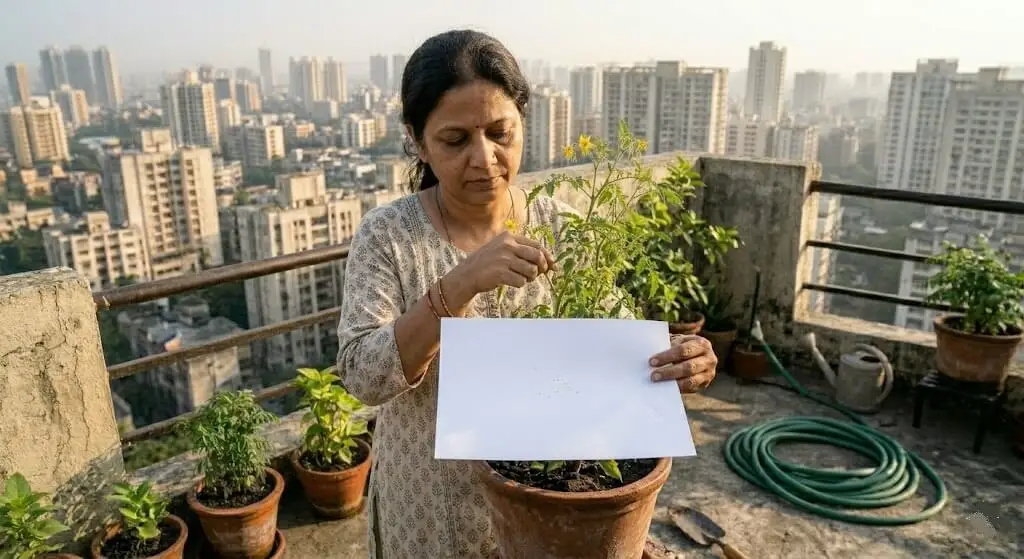
By Priya Harini B | Madanapalle, Andhra Pradesh | 4+ Years Container Gardening Experience
Day 10 of the 30-Day Summer Gardening Challenge Solving Your Biggest Summer Problems, One Day at a Time
Introduciton
If you are noticing a fine silvery stippling across your tomato, brinjal, or capsicum leaves tiny pale dots scattered across the upper surface, with the leaf looking dull and almost dusty rather than a healthy deep green and the problem seemed to appear almost overnight and spread across two or three pots within days, you are looking at the signature damage of spider mites.
Spider mites in Indian summer heat container gardens are the fastest-reproducing pest you will face all season, and the one that causes the most damage before most gardeners even recognise what they are looking at.
“Spider mites are not insects. They are arachnids related to spiders and they are 0.3 to 0.5mm in length, invisible to the naked eye as individuals, visible only as a faint moving dust on leaf undersides when populations have already reached damaging levels.“
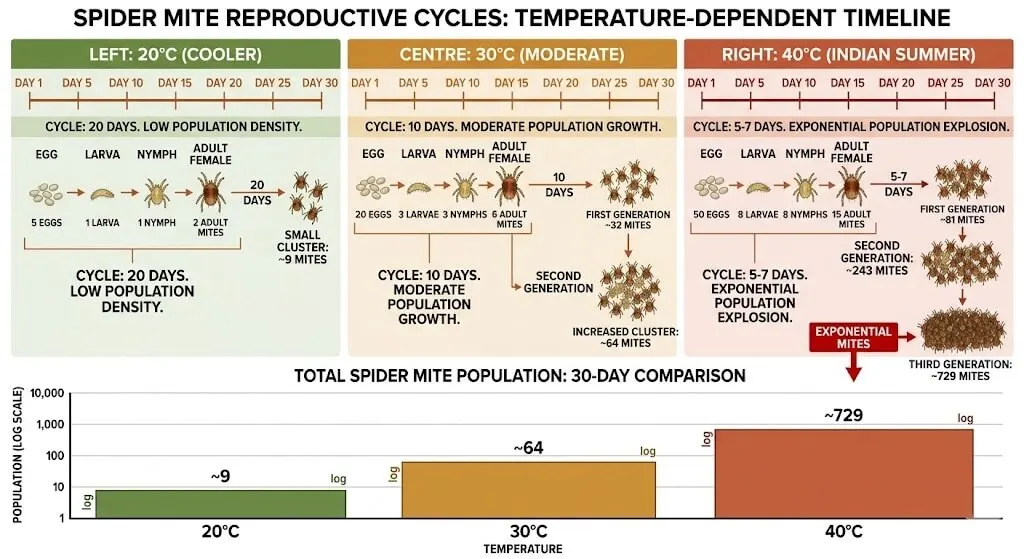
What makes spider mites uniquely dangerous in Indian summer is a biological reality that almost no gardening guide states clearly enough: at 40°C, a single female spider mite can complete her full life cycle from egg to reproducing adult in 5 to 7 days, and she will lay 100 to 200 eggs during that cycle.
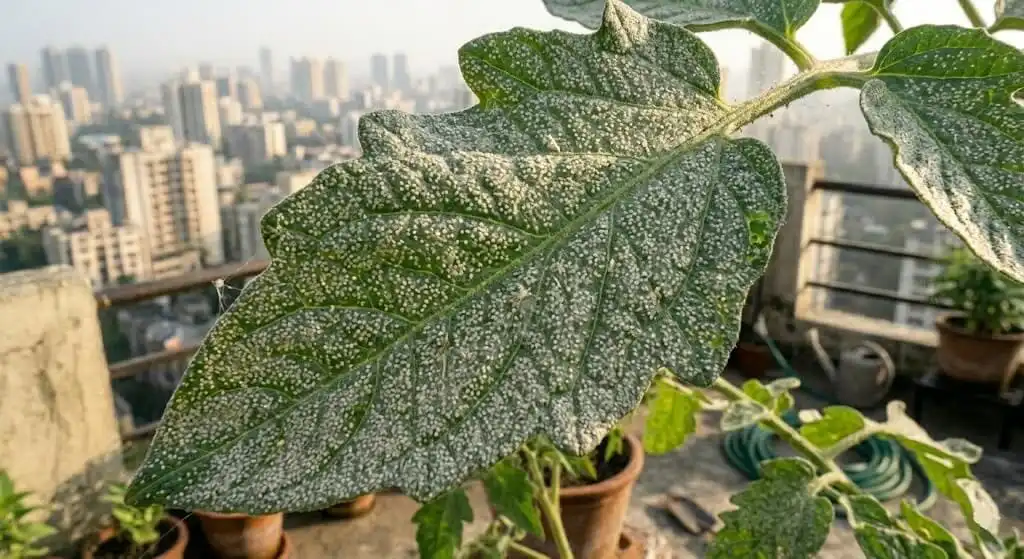
This means a mite population that arrives on your terrace in early April perhaps on a newly purchased nursery plant, perhaps blown in on the win can grow from a handful of individuals to tens of thousands within three weeks under Indian summer conditions.
The damage is exponential, not linear. By the time stippling is visible across an entire leaf, the population has already been building for 10 to 14 days and the infestation is well established.
I watched this happen in real time in the second week of May 2022. By the time I correctly identified the problem and treated it, two of my tomato plants had lost 60 to 70% of their functional leaf area. I had seen the early stippling on May 9th and assumed it was heat-stress bleaching.
I did not act until May 21st, when the fine webbing on the lower stems made identification unavoidable. Those 12 days cost me most of my May harvest.
⚠️ Before You Buy Any Product Read This First
Spider mites are arachnids, not insects. Insecticides including imidacloprid, chlorpyrifos, and lambda-cyhalothrin have zero effect on spider mites.
More critically: these products kill the predatory insects that naturally control mite populations. Applying insecticide to a spider mite problem eliminates your natural biological defence while leaving mites entirely intact. The population explodes faster. The correct treatment is cold-pressed neem oil to leaf undersides, every 3 days.
This guide covers everything I have learned about spider mites in Indian summer container gardens across four growing seasons the biological mechanism that makes Indian heat so perfectly suited to mite explosions, the white paper tap test that detects them a full week before visible damage appears.
The three-step treatment protocol that actually works, and the case study of Deepa from Pune whose entire south-facing terrace of 22 plants was saved from a May spider mite outbreak by a 48-hour treatment response.
| 🌿 FREE PDF | Spider Mites : Fix – 3-Page Cheat Sheet Tap test result guide · 3-step protocol cards · City risk table · Prevention calendar. Print-ready PDF. ⬇ Download Free PDF |
What Spider Mites Actually Are The Biology That Makes Indian Summer Their Perfect Season
Spider mites specifically Tetranychus urticae, the two-spotted spider mite, and Tetranychus cinnabarinus, the carmine spider mite a not insects and do not respond to insecticides.
This is the single most important biological fact for treating them correctly, and the one most commonly missed by Indian gardeners who spray their plants with contact insecticides and then cannot understand why the mites keep returning.
🔬 The Biology Why Indian Summer Is Their Perfect Environment
Spider mites belong to class Arachnida 8 legs, no antennae, entirely distinct from insects. Acaricides (mite-specific treatments) work differently from insecticides. The critical Indian-specific biology: at 40°C, their life cycle compresses to 5-7 days. One April mite = 100,000 May mites.
Spider mites belong to the class Arachnida and the order Trombidiformes. Like all arachnids, they have eight legs rather than six, no antennae, and a biology entirely distinct from insects. Acaricides the correct term for mite-specific treatments work on the mite nervous system and reproductive biology through mechanisms that have no effect on insects
Conversely, many insecticides have no effect on mites whatsoever, and some particularly broad-spectrum pyrethroids actually accelerate mite population explosions by killing the predatory insects that naturally control mite populations.
Spider mites feed by piercing individual plant cells with needle-like mouthparts called stylets and extracting the cell contents, including chlorophyll-containing fluid. Each feeding puncture destroys one cell and leaves a microscopic pale dot the stippling that is the first visible symptom.
A single mite feeding actively will destroy hundreds of cells per day. At a population of 10,000 mites per plant entirely achievable in Indian summer within three weeks of initial infestation the daily cell destruction rate is sufficient to collapse a plant’s photosynthetic capacity.
The biological mechanism that makes Indian summer so perfectly suited to spider mite explosions is temperature-accelerated development. At 20°C typical cool-season container garden temperature a spider mite life cycle takes approximately 20 days. At 30°C it compresses to 10 days.
At 40°C it compresses to 5 to 7 days. Indian summer terraces in May routinely reach 40 to 45°C at pot level, creating a development rate that no temperate-climate gardening guide anticipates or describes. This is why Western spider mite treatment protocols weekly neem spray, bi-weekly treatment cycles are consistently insufficient in Indian summer. The mite population can complete a full generation between treatment applications.
⚠️ Why Broad-Spectrum Insecticides Cause Mite Explosions
Insecticides eliminate predatory insects (predatory thrips, predatory beetles, predatory midges) that naturally consume spider mites. A terrace treated regularly with chlorpyrifos, imidacloprid, or pyrethroids has zero natural mite predators meaning any mite arrival faces no biological resistance and can build to catastrophic levels within days.
The low humidity of Indian summer (30 to 40% relative humidity in most Indian cities from March through May) further accelerates mite reproduction. Spider mites thrive in hot, dry, dusty conditions and are suppressed by high humidity.
The monsoon period, with 70 to 90% humidity, almost entirely eliminates spider mite pressure which is why most Indian gardeners have never noticed the problem until they try to grow tomatoes and capsicums through April and May.
This is also why spider mite damage is frequently confused with heat stress both produce pale, dull, stippled leaves. The distinction is that heat stress damage concentrates at leaf margins and tips, while spider mite stippling is distributed evenly across the leaf surface and is worst on older, lower leaves first.
The May 2022 Tomato Collapse That Taught Me to Tap Paper First
📖 Priya’s Story – May 2022, Madanapalle (12-Day Delay, 40% Harvest Loss)
It was the first week of May 2022, and I was feeling genuinely pleased with my tomato season. Four Pusa Ruby plants in 12-inch terracotta pots, all growing vigorously after the shade cloth installation from my Day 6 protocol.
Temperatures were controlled at the terrace my 1 PM reading was 37°C. Watering was consistent. The first cluster of fruits was just beginning to develop.
On May 9th I noticed that two of the four plants looked slightly dull. The leaves had a silvery, almost dusty appearance rather than their usual deep green.
I examined them closely and saw the stippling tiny pale dots covering the upper leaf surface, most concentrated on the older leaves at the bottom of the plant. I took a photograph and sent it to Suresh.
His reply came within minutes:
“Spider mites. Check the undersides of those leaves right now. Tap a leaf over a white piece of paper.”
— Suresh (WhatsApp message, May 2022)
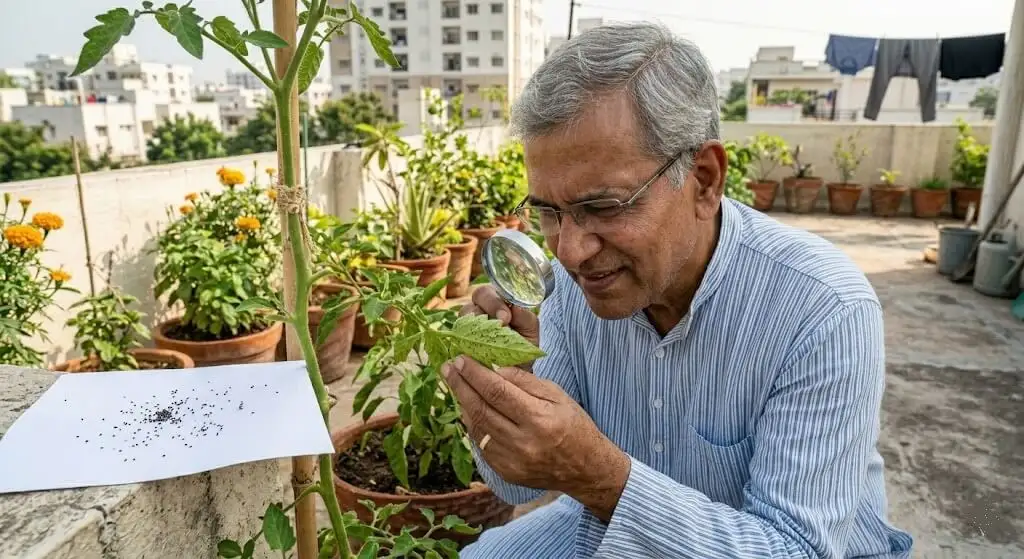
I had no idea what I was looking for. The leaf undersides showed some very fine webbing that I had assumed was just debris. I held a white sheet of paper under a lower branch and tapped the stem sharply three times.
Tiny moving dots appeared on the paper. Dozens of them. Under the magnifying glass: eight-legged mites, moving actively across the white surface.
I called Suresh. His assessment was immediate: “This has been building for at least a week before the stippling appeared. You are looking at a moderate-to-heavy infestation already.
The single biggest mistake you can make right now is to buy an insecticide. Insecticides do not kill mites. Some of them will make this much worse by killing the predatory insects that would eat the mites naturally.”
I asked what I should do.
Three steps.
First: water blast the undersides of every leaf today not the tops, the undersides. Dislodges the mites physically.
Second: neem oil spray every three days, not every week at 40°C these mites complete a generation in five days and a weekly spray misses an entire cycle.
Third: increase the humidity around your plants spider mites hate humidity. Mist the soil surface and the pots twice daily. That alone slows their reproduction significantly.
— Suresh, Madanapalle | May 2022
I treated on May 21st twelve days after first seeing the stippling. In those twelve days the mite population had reached a level where the webbing was visible with the naked eye on the lower stems, and two of the four plants showed clear yellowing and leaf curl from the cumulative cell damage.
I lost those lower leaves permanently. The upper new growth recovered fully after two weeks of treatment. But the 12-day delay cost me two weeks of productive leaf area during the peak fruiting window, and my May harvest from those two plants was 40% of what the other two treated immediately on the day I identified the problem produced.
May 9: first stippling visible misidentified as heat stress. May 21: 80+ dot tap test, webbing visible on stems, full treatment started. 12 days of delay. 40% harvest loss from two plants vs the two treated immediately on detection day.
That experience established the rule I follow without exception: the white paper tap test every Sunday, starting from April 1st, before any stippling is visible. Detection before visible damage is the only effective spider mite strategy in Indian summer.
Step 1 The White Paper Tap Test Before Any Treatment
🌿 The White Paper Tap Test — Free, 3 Minutes, Detects 7-10 Days Early
The white paper tap test is the single most important diagnostic tool for spider mites in Indian container gardens. It detects active mite populations a full 7 to 10 days before stippling becomes visible across enough leaf area to catch the naked eye which means it gives you a treatment window before the population has built to damaging levels.
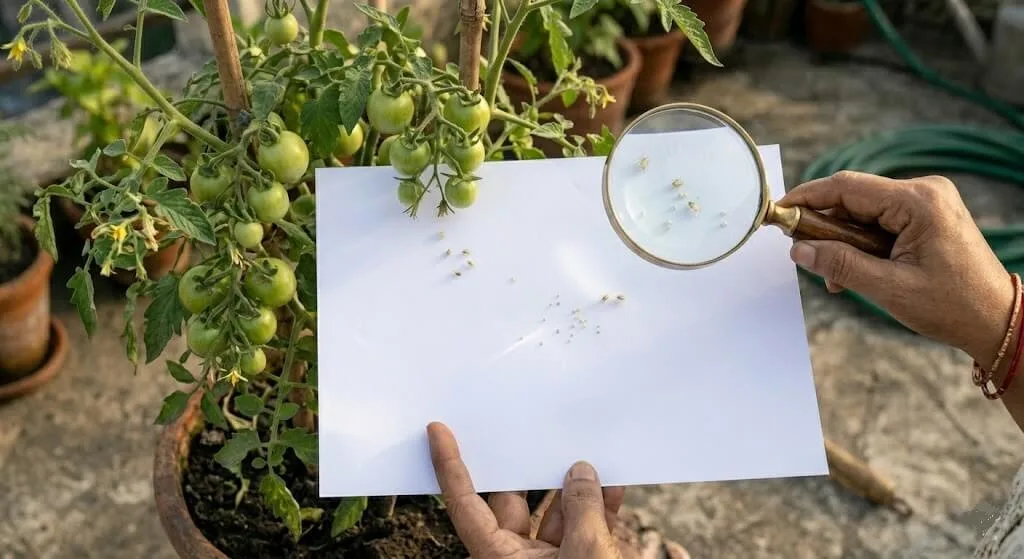
What you need:
A sheet of plain white A4 paper (₹0 from any notebook), a hand magnifier (₹80 to 150, stationery shops) or phone with macro camera, and 3 minutes.
The 5-minute tap test method:
Choose 3 plants from different areas of your terrace spider mites spread directionally, often from the most exposed, hottest, driest spot outward. For each plant, hold the white paper sheet horizontally underneath a lower branch one of the older, lower branches where mites first establish.
Hold the paper close to the stems, then tap the branch sharply 3 to 5 times with a finger or pen. The vibration dislodges mites from leaf undersides and the webbing onto the paper surface below.
Examine the paper immediately. Move it into direct sunlight if available. Look for tiny moving dots spider mites are 0.3 to 0.5mm, barely visible as specks, but their movement distinguishes them from plant debris and dust, which does not move.
If you see moving dots, confirm with the magnifier or phone macro: eight legs, oval body, sometimes with two dark spots on either side.
Check the leaf undersides directly as well look for fine silk webbing that looks like a dusty spider web, most visible at the stem-leaf junction and on the underside of older leaves. Webbing at this stage indicates a well-established population.
The quick 60-second test:
Hold white paper under any plant, tap three times, check for movement. If you see movement: begin treatment today. If you see nothing: record as negative and repeat next Sunday.
Results interpretation:
| Tap Test Result | Population Level | Visible Damage | Urgency | Action |
|---|---|---|---|---|
| No dots on paper | Zero or trace | None | Low | Repeat next Sunday |
| 1–5 dots, barely moving | Early detection trace population | None yet | Moderate | Begin neem spray this week |
| 5–20 dots, active movement | Light infestation | Stippling on oldest leaves | High | Water blast today + neem spray |
| 20–50 dots, dense movement | Moderate infestation | Stippling across lower leaves | Very High | Full 3-step protocol today |
| 50+ dots, continuous movement | Heavy infestation | Visible webbing, yellowing | Critical | Full protocol + daily treatment |
My Actual Spider Mite Detection Data May 2022 and May 2023, Madanapalle
The table below shows the progression of a spider mite infestation I tracked on two separate occasions the 2022 infestation I caught late, and the 2023 infestation I caught early using the Sunday tap test. The contrast between the two outcomes demonstrates exactly why early detection changes everything.
📊 Comparative data the same Madanapalle terrace, same variety, 2022 (late detection) vs 2023 (early detection). The difference is 7 rows of a notebook: 40% harvest loss vs zero harvest loss.
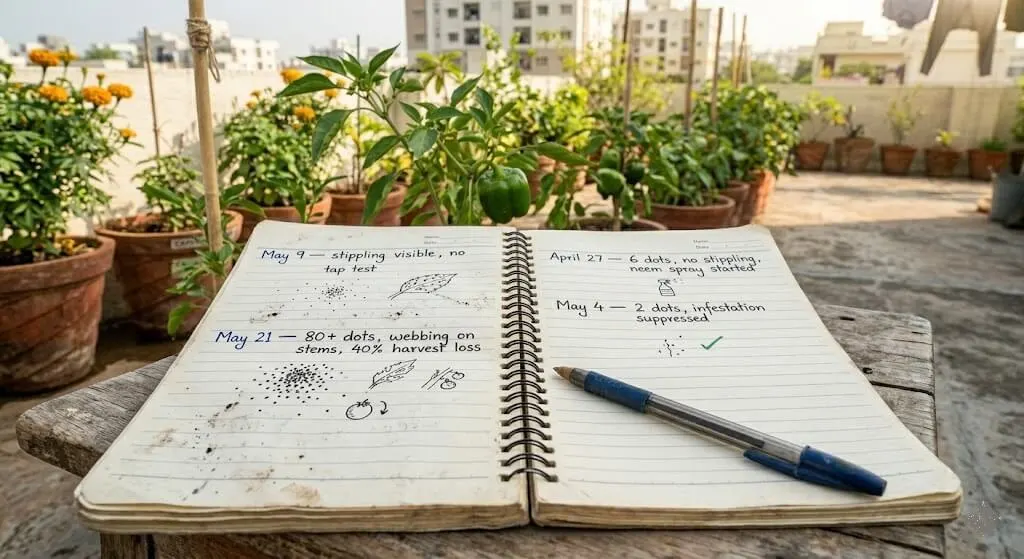
| Date | Plant | Tap Test Count | Visible Stippling | Webbing Visible | Action Taken | Outcome |
|---|---|---|---|---|---|---|
| May 9, 2022 | Pusa Ruby (4 pots) | Not tested | Yes moderate | No | None misidentified as heat | Population continued building |
| May 15, 2022 | Pusa Ruby (4 pots) | Not tested | Severe | Faint | None still uncertain | Heavy infestation established |
| May 21, 2022 | Pusa Ruby (4 pots) | 80+ dots | Severe across all leaves | Dense on stems | Full 3-step protocol | Recovered but 40% harvest loss |
| Apr 27, 2023 | Arka Vikas (3 pots) | 6 dots | None | None | Neem spray early response | Infestation suppressed within 10 days |
| May 4, 2023 | Arka Vikas (3 pots) | 2 dots | None | None | Continued weekly neem | Zero visible damage all season |
| May 11, 2023 | Bharat capsicum (4 pots) | 12 dots | Faint on 2 leaves | None | Full 3-step protocol started | Full recovery zero harvest loss |
The 2022 data shows a 12-day gap between first visible symptoms and treatment by which point the mite population had built to 80+ on the tap test.
The 2023 data shows detection at 6 dots (April 27th) with zero visible symptoms two weeks earlier than the 2022 infestation became visible, and at a population level that responded to neem spray alone without requiring the full three-step protocol.
Why Indian Summer Container Gardens Get Spider Mites Worse Than Any Other Season
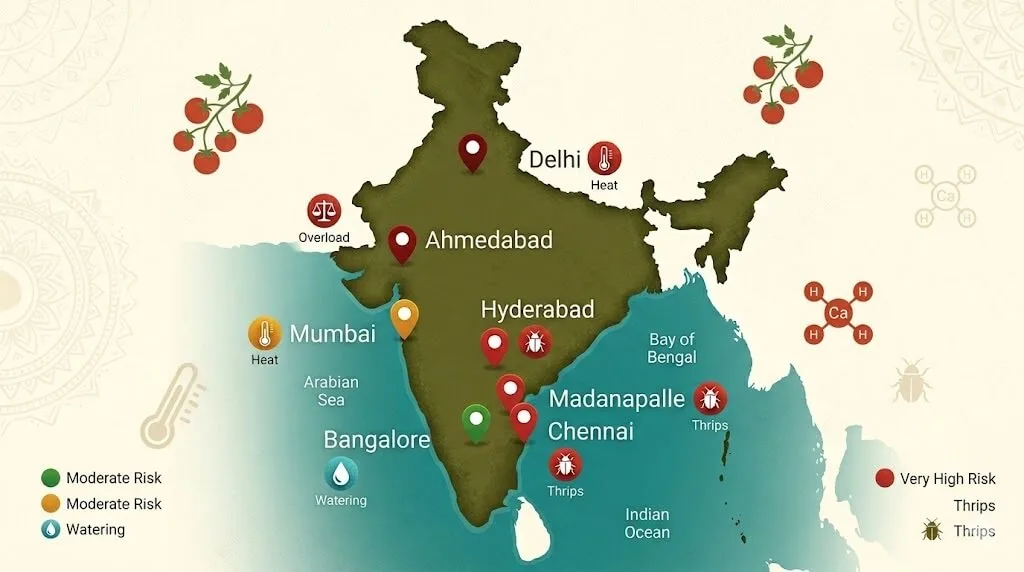
Spider mite pressure in Indian container gardens is not simply worse in summer than in other seasons it is a fundamentally different biological situation from what temperate-climate gardening guides describe, for three specific reasons that compound each other.
Indian summer heat compresses the mite generation time to 5 days creating an exponential that no weekly spray schedule can interrupt.
At 40°C on an Indian terrace in May, a female spider mite begins laying eggs within 5 days of hatching. She lays 3 to 5 eggs per day for a laying period of 2 to 3 weeks, producing 100 to 150 eggs in a single generation.
Those eggs hatch in 3 days at 40°C and reach reproductive age in another 5 days. The mathematical result:
a single mite arriving on April 1st is the ancestor of over 100,000 mites by May 1st under optimal Indian summer conditions. This is the exponential that makes spider mites uniquely dangerous in Indian summer and uniquely unresponsive to weekly treatment protocols designed for 20°C European conditions.
Container terrace environments are drier, hotter, and dustier than open garden beds all three conditions that maximise spider mite reproduction rates.
Container soil dries faster than open ground, which reduces the ambient humidity around the root zone. Terracotta pots on concrete terrace surfaces in Indian summer can reach surface temperatures of 55 to 60°C, creating a microclimate of dry heat immediately around the plant stems. Dust accumulation on leaf surfaces common on terraces near roads or in urban environments further reduces leaf surface humidity and provides ideal conditions for mite feeding and egg-laying. All three of these container-specific factors compound the temperature effect on mite generation time.
Indian gardeners disproportionately use broad-spectrum insecticides that eliminate natural mite predators without affecting the mites themselves.
Commonly used Indian garden insecticides chlorpyrifos, lambda-cyhalothrin, imidacloprid are highly effective against aphids and whiteflies but have no acaricidal action against spider mites. More significantly, these insecticides kill predatory insects, including Feltiella acarisuga (a predatory midge), predatory thrips (Scolothrips species), and predatory beetles that naturally consume spider mites in outdoor environments. When Indian gardeners spray insecticides in response to what they believe is an insect problem (misidentifying mite stippling as something else), they eliminate the natural predator population while leaving the mite population entirely intact producing the paradox where more spraying makes the mite problem worse, not better.
| City | May Terrace Temp | Relative Humidity | Mite Generation Time | Mite Risk Level | Treatment Frequency Needed |
|---|---|---|---|---|---|
| Bangalore | 34–37°C | 45–55% | 8–10 days | Moderate | Every 5 days if detected |
| Mumbai | 35–38°C | 60–70% | 8–10 days | Moderate-Low | Every 7 days if detected |
| Hyderabad | 40–44°C | 30–40% | 5–7 days | Very High | Every 3–4 days if detected |
| Chennai | 38–42°C | 50–65% | 6–8 days | High | Every 4–5 days if detected |
| Madanapalle | 40–44°C | 28–38% | 5–7 days | Very High | Every 3–4 days if detected |
| Delhi | 42–46°C | 20–35% | 4–6 days | Extreme | Every 3 days if detected |
| Ahmedabad | 42–47°C | 18–30% | 4–6 days | Extreme | Every 3 days if detected |
The 5 Signs of Spider Mites Reading Them Before It Is Too Late
Fine Stippling Across the Upper Leaf Surface
The first visible sign is a pattern of tiny pale dots stippling distributed across the upper surface of older, lower leaves. Each dot represents one feeding puncture from one mite. The stippling is uniformly distributed across the leaf surface (unlike heat stress, which concentrates at margins) and is most pronounced on the oldest leaves at the base of the plant, where mites first establish because those leaves are closest to the soil surface and stay warmest.
At this stage, the population is already substantial stippling becomes visible to the naked eye when mite density exceeds approximately 10 to 20 mites per square centimetre of leaf surface. This means by the time stippling is visible across a leaf, a 12-inch pot plant is likely already carrying several thousand individual mites.
Distinguish from heat stress stippling: heat stress produces bleaching concentrated at leaf tips and edges, not uniform dot stippling across the leaf surface. Heat stress damage also occurs on exposed, upper leaves first opposite to spider mite damage, which starts at the lower, older leaves.
Fine Silky Webbing at Stem Junctions and Leaf Undersides
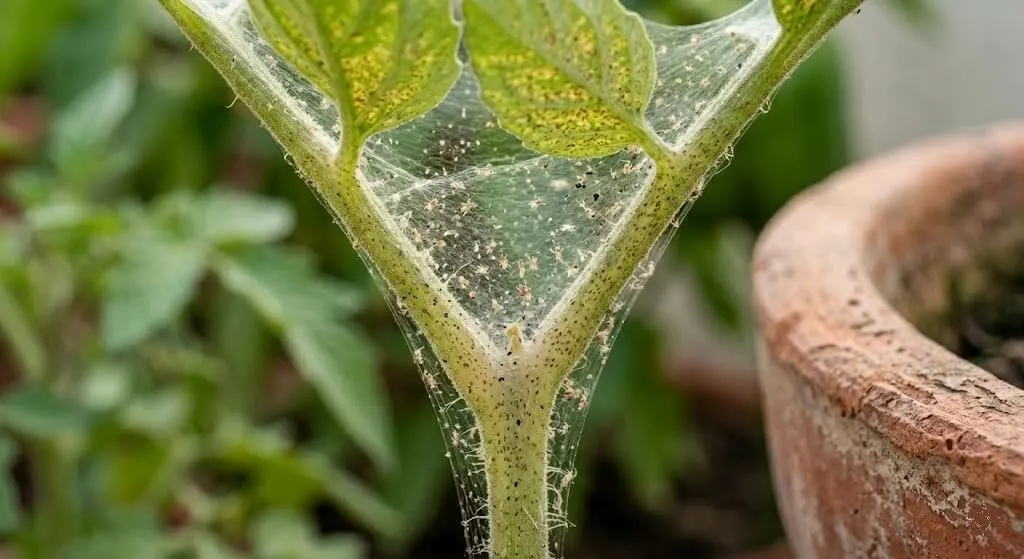
The webbing that spider mites produce is finer and more silky than conventional spider web it resembles a fine dusty film rather than a structured web, most visible at the junction where leaves attach to the main stem. At low populations, webbing is absent or microscopic. At moderate populations, it appears as a faint film that becomes visible when wet or backlit. At heavy infestations, thick white webbing covers the lower stems and completely encases developing flowers and fruits.
This is the sign that confirms active spider mite presence beyond any doubt no other common garden pest produces this specific fine silk webbing pattern at stem junctions. If you see webbing plus stippling, you are dealing with a well-established infestation that requires immediate full protocol response.
Leaf Bronzing, Yellowing, and Curling
After prolonged mite feeding typically 2 to 3 weeks of active infestation the cumulative cell destruction causes leaves to turn bronze or yellow-brown and begin curling upward at the margins. This bronzing is the result of the chlorophyll being destroyed across thousands of feeding punctures simultaneously. At this stage, the affected leaves are losing their photosynthetic function and the damage is not reversible those leaves will not regain their green colour or return to full function.
Bronzing and curling from spider mites is distinguishable from nutrient deficiency yellowing because it is accompanied by stippling and typically begins on older leaves moving upward, rather than the pattern-specific yellowing (interveinal, marginal, or uniform) of nutrient deficiencies.
Visible Moving Dust on Leaf Undersides in Morning Light
In morning light before 9 AM, when spider mite populations are highest and most active (they rest during peak heat and move more at cooler temperatures), a heavy mite population is sometimes visible as a fine moving layer on the underside of leaves. This is typically seen only at heavy infestations populations of 50 or more mites per leaf and by this point the infestation has reached a level where recovery requires aggressive multi-day treatment.
This sign, more than any other, confirms to Indian gardeners who have never previously seen a spider mite problem that the issue is biological rather than environmental. A dust that moves is an infestation. This is the moment of recognition that Suresh described as the most important shift in thinking: from “my leaves look wrong” to “my plants have a specific pest problem with a specific treatment.”
Plant Wilting Despite Correct Watering
In severe infestations, the cumulative leaf damage reduces the plant’s ability to regulate water through transpiration to the point where the plant shows wilting symptoms despite adequate soil moisture. This is spider mite damage mimicking the Day 1 problem of wilting despite watering and it is one of the most confusing presentations for Indian container gardeners, because the watering is correct and the soil moisture is correct and the plant is still wilting.
The distinction: spider mite wilting is accompanied by visible stippling, bronzing, or webbing. Wilting despite watering without any of these visual signs on the leaves points back to root rot, salt buildup, or other soil-level problems from Days 1 and 4.
Spider mite comparison table:
| Symptom | Spider Mites | Heat Stress | Nutrient Deficiency | Thrips Damage |
|---|---|---|---|---|
| Leaf stippling | Upper surface, uniform dots | Leaf margins only | No stippling | Silvery streaks, not dots |
| Webbing | Yes at stem junctions | No | No | No |
| Where damage starts | Oldest, lower leaves | Newest, upper leaves | Specific patterns | New growth and flowers |
| Response to humidity | Reduces mite activity | No effect | No effect | Reduces thrips |
| White paper tap test | Dots move | No dots | No dots | Tiny insects (different) |
🌿 Real Story- Deepa, Pune 22-Plant Terrace, 48-Hour Response, Full Recovery
Deepa’s Story One Week from Discovery to Full Recovery on a 22-Plant Pune Terrace
Deepa from Pune had a south-facing terrace of 22 containers tomatoes, capsicums, brinjals, and cucumbers that she had been growing through her third consecutive summer season. She considered herself an experienced gardener and had successfully managed aphids and whiteflies in previous seasons using soap spray and yellow sticky traps.
In the second week of May 2023, she noticed that her two brinjal plants had developed a silvery, dull appearance that she initially attributed to the reflective effect of her new shade cloth installation. A week later, the same dullness had spread to three tomato pots. She messaged me with photographs on May 19th.
I identified spider mites from the photographs immediately the stippling pattern on the brinjal leaves was unmistakable. She had done the tap test on my instruction and found 40 to 60 moving dots on the first plant tested, 20 to 30 on two adjacent plants, and trace amounts on four others.
She had tried, in the week before messaging me, applying her standard aphid soap spray to the affected leaves which had no effect on the mites and had briefly created enough moisture on the leaf surface to temporarily slow mite movement (which she interpreted as partial success, causing her to delay further action). She had also applied imidacloprid systemic insecticide, which had no acaricidal activity and was responsible for eliminating whatever predatory insect population existed on her terrace.
I gave her the three-step protocol immediately. She applied it that evening May 19th and maintained the 3-day treatment cycle rigorously.
By May 22nd (3 days): the tap test count on the most-affected brinjal had dropped from 60 dots to 8 dots. New leaf damage had stopped.
By May 26th (7 days): tap test showed 0 to 2 dots across all plants. The damaged lower leaves were still stippled and bronzed that damage was permanent. But new growth emerging from all affected plants was completely clean.
By June 2nd (14 days): zero mites detected on any plant. The plants had grown through the damaged lower zone and all new growth was healthy and productive.
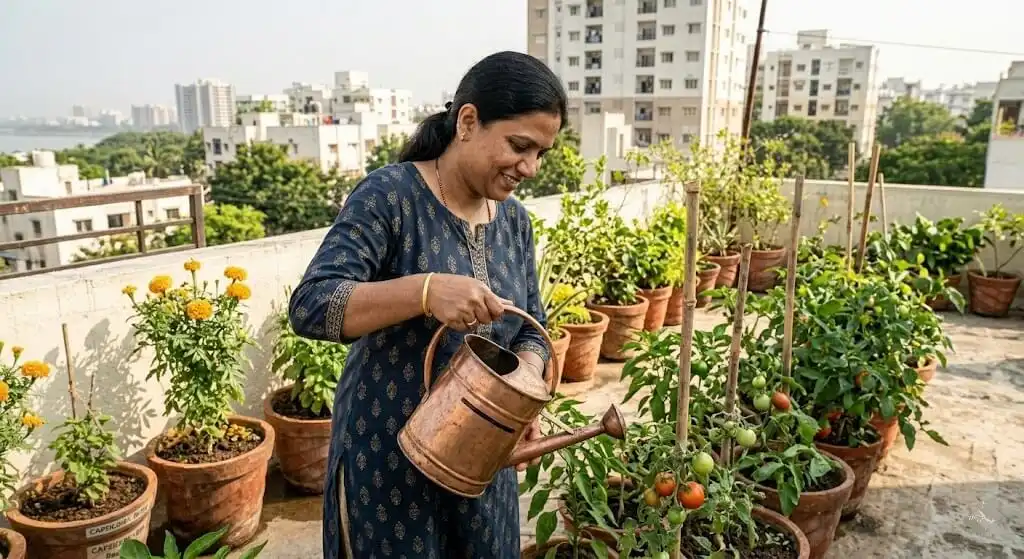
Her harvest from the affected plants for June and July was within 15% of the previous season’s yield the recovery was almost complete despite the infestation having been moderate to heavy at the time of detection.
“I wasted a week spraying the wrong product. If I had known about the tap test earlier, I would have caught this at trace levels and the neem spray alone would have handled it.”
— Deepa, Pune | June 2023
That reaction the recognition that detection timing is everything is universal among Indian gardeners who manage their first successful spider mite treatment. The mites are manageable. The window matters.
The Complete Spider Mite Treatment Protocol Three Steps, Exact Timing
🌿 Step 1 Water Blast Dislodgement
Mechanically removes mites from leaf surfaces immediately the action that reduces population fastest
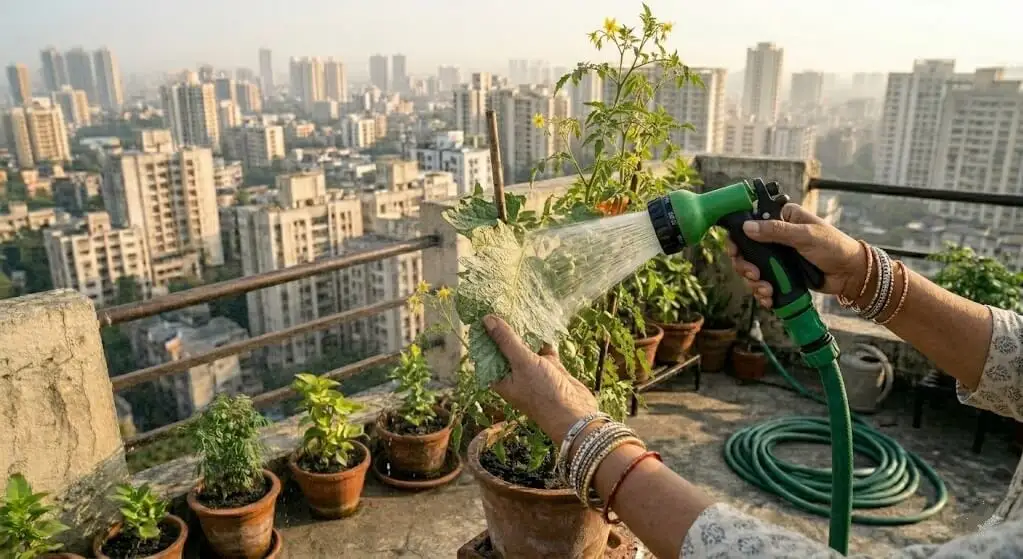
What You Need:
| Item | Detail | Cost |
|---|---|---|
| Garden hose with adjustable nozzle | OR large watering can with fine-rose head | ₹200–800 or ₹150–400 |
| Fine-mist spray bottle | For underside-specific application | ₹60–120 |
Steps:
- Do this in the early morning (6 to 8 AM) or evening (after 6 PM) never in midday sun, which causes leaf scalding from water droplets acting as lenses.
- Apply a strong, fine spray specifically to the undersides of all leaves, beginning from the lowest leaves and working upward. Mites live primarily on leaf undersides spraying only the tops achieves nothing.
- The water pressure physically dislodges mites, eggs, and webbing from the leaf surface. Dislodged mites on a terrace surface in Indian summer heat die quickly from desiccation.
- Allow all leaves to dry completely before applying neem spray wet leaves reduce neem oil adhesion.
Cost: ₹0 (water only) | Time: 10–15 minutes per terrace | Repeat: Before every neem application
🌿 Step 2 Neem Oil Spray Protocol
Disrupts mite feeding, reproduction, and egg hatching the acaricidal core of the treatment

What You Need:
| Item | Detail | Cost |
|---|---|---|
| Cold-pressed neem oil | 5ml per litre not neem-based pesticide, pure oil | ₹150–250/500ml |
| Dish soap or liquid castile soap | 3–5ml per litre emulsifier | ₹10–20 |
| Water (lukewarm, not cold) | 1 litre base | ₹0 |
| Fine-mist spray bottle | 500ml or 1L capacity | ₹60–120 |
Steps:
- Mix the neem oil: add soap first to 100ml warm water and stir until dissolved, then add neem oil and stir until the mixture turns milky white. Add remaining water gradually and mix thoroughly. Prepare fresh each time neem oil spray degrades within 8 hours and should not be stored.
- Apply specifically to leaf undersides using the fine-mist bottle. Neem oil works through contact and through systemic plant absorption it must contact the mites and their eggs directly on the leaf underside.
- Apply also to the stem junctions where webbing is present and to the soil surface around each plant mites that have dropped to the soil surface are still part of the population.
- Apply in the evening (after 6 PM) or very early morning (before 8 AM). Neem oil breaks down rapidly in direct sunlight and loses efficacy if applied at midday.
- Repeat every 3 days not every week. At 40°C, mites complete a generation in 5 to 7 days. A 7-day spray interval misses an entire mite generation between applications.
DO NOT:
- Use insecticide sprays they have no effect on mites and eliminate predatory insects
- Apply at midday photodegradation reduces efficacy to near zero within 2 hours
- Use stored neem spray from a previous day prepare fresh each application
- Spray only the leaf tops mites on undersides are unaffected
⚠️ Every 3 Days Not Every 7 Days
At 40°C, mites complete a generation in 5-7 days. Weekly spray allows complete mite cycle between applications. The 3-day interval prevents any generation from completing.”
DO NOT list (4 red items including: spray leaf tops only, use stored spray, apply midday, use neem pesticide instead of pure oil)
Cost: ₹15–25 per application | Time: 15–20 minutes | Cycle: Every 3 days for 3 weeks
🌿 Step 3 Humidity Increase Around Plants
Directly suppresses mite reproduction and slows population growth between spray applications
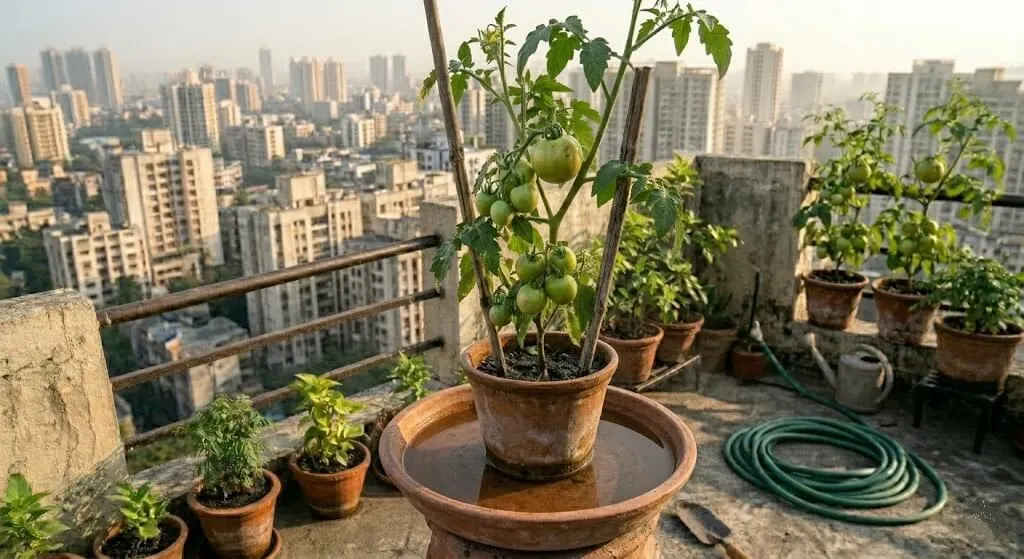
Spider mites reproduce at their maximum rate below 40% relative humidity. Indian summer terrace humidity in May is typically 25 to 40% in most Indian cities exactly the optimal range for mite reproduction. Increasing the immediate humidity around your plants not the entire terrace, just the microclimate within 30 to 50 centimetres of the plant measurably slows mite reproduction between neem spray applications.
Steps:
- Mist the soil surface of all affected containers with plain water twice daily morning and evening. The evaporation from the moist soil surface raises the immediate microclimate humidity by 10 to 15%.
- Place a shallow tray of water (any plate or tray 2 to 3 inches deep, filled with water) beside each heavily affected container. The continuous evaporation provides passive humidity increase through the day.
- Place containers closer together temporarily the combined transpiration from multiple plants creates a higher-humidity microclimate between them. This technique reduces mite reproduction rate without any product cost.
Cost: ₹0 | Time: 5 minutes daily
The Neem Cake Soil Drench Why It Matters as Much as the Spray
One step that most spider mite treatment guides omit entirely is the soil treatment component. While adult mites live primarily on leaf surfaces, their eggs and immature stages can fall to the soil surface and the container’s inner edges and in severe infestations, mites actively travel along pot surfaces and soil to move between plants.
📌 The Pathway Most Treatment Guides Ignore
Mites and eggs fall from leaves to the container soil surface and re-establish from there. Most guides treat only the plant above soil. Neem cake azadirachtin in the top soil layer suppresses this re-establishment pathway the reason mites ‘keep coming back’ despite correct leaf treatment.
Neem cake the solid residue left after cold-pressing neem seeds for oil contains azadirachtin, the same active compound as neem oil but in a more concentrated, slower-releasing form. Mixed into the top layer of container soil, neem cake suppresses the egg and larval stages of mites that have fallen to the soil, prevents re-infestation from the soil surface, and additionally acts as a slow-release soil amendment that improves overall plant health.
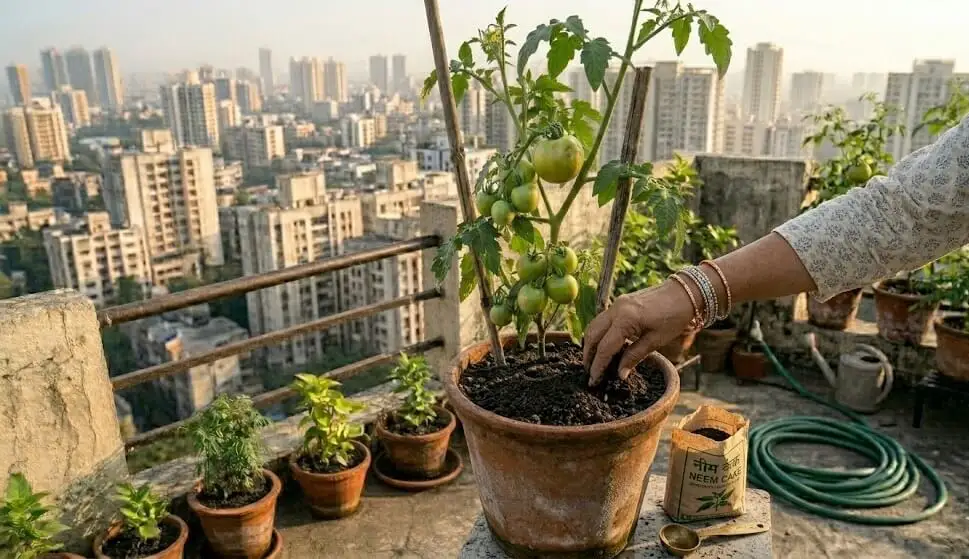
Protocol: Mix 1 tablespoon of neem cake powder per 10-inch pot into the top 3 to 4 centimetres of soil not deep mixing, just the surface layer where mite eggs accumulate. Apply once at the beginning of the treatment cycle and once 3 weeks later as a maintenance application.
Light infestation (1–5 dots on tap test): Neem spray every 5 days + neem cake surface application. No water blast required.
Moderate infestation (5–30 dots): Water blast + neem spray every 3 days + neem cake. Humidity increase measures.
Severe infestation (30+ dots, visible webbing): Water blast daily for first 3 days + neem spray every 3 days + neem cake + 3-week treatment minimum.
his single addition of neem cake to my soil treatment in 2023 reduced the recurrence rate of mite infestations from 3 to 4 events per season (2022 pattern) to 1 manageable event (2023), with all subsequent tap tests through May and June showing trace or zero counts.
| 🌿 FREE PDF | Spider Mites : Fix – 3-Page Cheat Sheet Tap test result guide · 3-step protocol cards · City risk table · Prevention calendar. Print-ready PDF. ⬇ Download Free PDF |
Long-Term Prevention The Organic System That Keeps Mites Below Damaging Levels
Managing spider mites reactively treating after infestation establishes is the approach most Indian container gardeners are forced into because they do not have a detection system in place before the visible damage appears. The organic preventive system changes this from reactive to proactive, catching infestations at trace levels when they are trivially easy to suppress.
The banana peel and garlic spray a free supplemental repellent
Beginning April 1st before any mites are detected apply neem oil spray at half-strength (2.5ml neem per litre instead of 5ml) every 10 days to all tomato, brinjal, and capsicum plants. This creates a neem residue on leaf surfaces that deters mite egg-laying and reduces the establishment success of new mite arrivals. The cost is approximately ₹5 to 10 per application and 10 minutes of time considerably less than the time and produce cost of a full treatment cycle.
Garlic is a natural mite repellent the sulphur compounds in garlic oil deter mite feeding and reproduction. Combined with banana peel potassium, which strengthens plant cell walls against mite stylet penetration, this free kitchen-waste spray provides a useful supplemental layer between neem oil applications.
🌿 Garlic Banana Peel Mite Repellent Spray
Free kitchen-waste spray that deters mite feeding between neem applications
What You Need:
| Ingredient | Quantity | Cost |
|---|---|---|
| Garlic cloves | 6–8 cloves, crushed | ₹0 — kitchen |
| Banana peel | 2–3 peels | ₹0 — kitchen |
| Water | 2 litres | ₹0 |
| Dish soap | 2ml | ₹0 |
Steps:
- Crush 6 to 8 garlic cloves thoroughly and soak in 1 litre water for 24 hours — the sulphur compounds dissolve into the water.
- Chop banana peels into small pieces and soak in 1 litre water separately for 24 hours.
- Strain both liquids through a cloth. Combine. Add 2ml dish soap.
- Apply to leaf surfaces (both sides) every 7 days between neem oil applications.
Cost: ₹0 entirely kitchen waste | Time: 5 minutes preparation + 5 minutes application | Best for: Preventive use in April–May between neem spray cycles
Your Terrace Microclimate Is Already a Mite Incubator What to Change
The environmental conditions on an Indian summer container terrace hot, dry, dusty, minimal air circulation are almost perfectly optimised for spider mite reproduction. Changing the microclimate to make it less hospitable for mites is the most durable long-term prevention strategy, because it addresses the conditions that allow mites to thrive rather than only the mites themselves.
Dust management: Spider mites thrive in dusty conditions dry dust particles reduce leaf surface humidity and provide physical cover for mites and their eggs. Wiping down leaf surfaces with a damp cloth once a week from April through June removes the dust layer that facilitates mite establishment, and the moisture itself briefly increases leaf surface humidity. This takes 10 minutes for a 20-container terrace and is particularly important in Indian cities with high ambient dust Delhi, Ahmedabad, and Jaipur especially.
Strategic water misting: Unlike watering which goes to the soil fine misting of the plant’s stem and leaf area in the early morning specifically targets the low humidity that mites require. This is not about providing water to the plant (the roots handle that) but about maintaining the leaf microclimate above the 60% relative humidity level at which mite reproduction slows significantly.
WARNING The Indian terrace mistake that guarantees severe spider mite outbreaks:
Applying broad-spectrum insecticide sprays chlorpyrifos, lambda-cyhalothrin, imidacloprid prophylactically or in response to any pest problem on the terrace. These products eliminate the predatory insect and mite populations that naturally control spider mite numbers. A terrace that has been regularly treated with broad-spectrum insecticides typically has zero natural spider mite predators, meaning any mite arrival faces no biological resistance and can build to devastating levels in days. If you have been using broad-spectrum insecticides on your terrace, consider a 6-week pause to allow natural predator populations to re-establish before beginning any spider mite treatment.
⚠️ WARNING The Mistake That Guarantees Severe Outbreaks
Applying broad-spectrum insecticide sprays chlorpyrifos, lambda-cyhalothrin, imidacloprid eliminates the predatory insect population that naturally controls spider mites. After treatment: mites unaffected + zero predators = faster and larger mite explosion than if nothing had been done. If used in the past 6 weeks: 6-week pause before relying on biological control.
Never Wait for Webbing My Spider Mite Season Calendar
The characteristic of spider mite management that distinguishes experienced from inexperienced Indian container gardeners is not the treatment skill it is the detection timing. Webbing is a late-stage sign. Stippling across multiple leaves is a mid-stage sign. The white paper tap test at trace levels is the early detection that makes the problem manageable rather than a season-destroying crisis.
The 5-Minute Sunday Check Cumulative Update for Day 10
Adding to the Sunday check routines from Days 1 through 9:
- Finger test for moisture– 2 inches deep (Day 1)
- Leaf colour check– tops and bottoms of 3 leaves (Day 2)
- Soil surface temperature -1 PM reading (Day 3)
- White crust visual -soil surface and pot exterior (Day 4)
- Leaf edge check -new crispy tips? (Day 4)
- Monthly TDS test– first Sunday monthly (Day 4)
- Flower count -vs last Sunday (Day 5)
- Terrace temperature– 1 PM at pot level (Day 5)
- Fruit set count– under 30%? Check temperature (Day 6)
- Shade cloth check– angle, tears, coverage (Day 6)
- Blossom end check– dark patch? Remove + calcium drench due? (Day 7)
- Watering consistency– every evening this week? Any skips? (Day 7)
- Fruit drop count– more than 2? Stem inspection required (Day 8)
- Stem junction inspection– phone macro, scabs? Fruit count vs 12 max (Day 8)
- Pollinator visit count– 3-minute morning observation, under 2 = hand-pollination needed (Day 9)
- Companion plant check– lavender and marigolds in flower? (Day 9)
- NEW White paper tap test– hold paper under 3 plants, tap 5 times each, check for moving dots. Any dots = begin neem spray this week (Day 10)
- NEW Leaf underside inspection– check undersides of 3 lower leaves per plant for stippling, fine webbing, or dusty film at stem junctions (Day 10)
Eighteen checks. Under twenty-two minutes. Once a week.
What to Realistically Expect After Applying the Three-Step Protocol
| Timeframe | Tap Test Count | Visible Symptoms | New Damage | Action |
|---|---|---|---|---|
| Day 1–3 (after treatment start) | Reduced by 50–70% | Existing damage unchanged | Slowing | Continue neem every 3 days |
| Day 3–7 | Near zero on treated plants | Old stippling still visible | Stopped | Maintain spray cycle |
| Week 1–2 | Zero or trace | Old leaves still damaged permanent | Zero new damage | New growth clean |
| Week 2–3 | Zero | New growth fully healthy | None | Reduce to preventive weekly spray |
| Week 3–4 | Consistently zero | Old damaged leaves falling naturally | None | Resume normal management |
| What will not recover Stippled and bronzed leaves the destroyed cells do not regenerate chlorophyll. Those leaves remain damaged until the plant naturally sheds them. Do not remove them manually unless they are entirely brown even partially damaged leaves continue some photosynthesis. | What will recover All new growth emerging after the treatment begins. Judge recovery by the health and colour of new leaves, not by the appearance of the damaged older leaves. |
If tap test still shows 20+ dots after 10 days of treatment: Check whether neem spray is being applied to leaf undersides specifically top-surface application is ineffective. Confirm the spray is being prepared fresh each time. Consider whether the infestation is re-establishing from an untreated source plant elsewhere on the terrace.
Products I Have Actually Used in India
| Product | Purpose | Cost ₹ | Where to Buy |
|---|---|---|---|
| Cold-pressed neem oil (500ml) | Primary acaricidal spray leaf underside treatment | ₹150–250 | Amazon India, agri suppliers |
| Neem cake powder (1kg) | Soil treatment egg and larval suppression | ₹80–150 | Agricultural supply shops, Ugaoo |
| Fine-mist spray bottle (500ml) | Precise underside application | ₹60–120 | Any grocery or hardware shop |
| Hand magnifier or phone macro | Tap test dot identification | ₹80–150 or ₹0 | Stationery shops or already owned |
| Plain white A4 paper | Tap test surface | ₹0 | Already in any home |
| Dish soap (liquid) | Neem oil emulsifier | ₹10–20 | Any grocery store |
| Digital thermometer | Temperature and humidity monitoring | ₹200–400 | Amazon India |
| Shallow water tray | Passive humidity increase beside containers | ₹0 – any plate or tray | Already in any home |
Free options: The white paper tap test costs nothing the most valuable diagnostic tool in this entire guide is a sheet of paper. Garlic and banana peel spray from kitchen waste. Increased container grouping for humidity free repositioning. Leaf wiping with a damp cloth water and 10 minutes.
Frequently Asked Questions
Stippling without visible insects or webbing is the classic early to moderate spider mite presentation and the absence of visible insects is actually what confirms it is mites rather than a larger pest. Do the white paper tap test immediately: hold paper under a lower branch, tap 5 times, and look for tiny moving dots under magnification. Moving dots confirm mites. No dots with stippling may indicate thrips (which produce silvery streaks rather than uniform dot stippling), heat stress (which concentrates at leaf margins), or early calcium deficiency. The tap test is the definitive confirmation for spider mites at any population level.
Soap spray (dish soap in water) has limited direct acaricidal effect it can kill mites it contacts directly by disrupting their respiratory system, but it has no residual activity and no effect on eggs. In early, trace-level infestations (1 to 5 dots on the tap test), insecticidal soap spray every 3 days may be sufficient to prevent establishment. In established infestations, soap spray alone is insufficient the neem oil is essential because it contains azadirachtin, which disrupts mite hormone systems, suppresses egg hatching, and remains active on leaf surfaces for several days after application. Use soap primarily as a neem oil emulsifier and supplement, not as the primary treatment.
Applying broad-spectrum insecticide sprays imidacloprid, chlorpyrifos, lambda-cyhalothrin in the belief that any visible pest problem requires insecticide treatment. Spider mites are arachnids, not insects, and insecticides have zero effect on them. More critically, these insecticides kill the predatory insects that naturally control mite populations. A terrace treated with broad-spectrum insecticide in response to mite damage will lose its natural predator population, the mite infestation will continue completely unaffected, and subsequent mite population growth will be faster and more severe than if nothing had been done.
Three common causes of recurrence. First: incomplete treatment if even a small population survives the treatment cycle (because neem spray was applied to leaf tops rather than undersides, or at midday when it photodegrades rapidly, or at 7-day intervals that miss a mite generation), the survivors reproduce rapidly to re-establish the infestation. Second: untreated source plants if mites are arriving from a nearby untreated plant, the treated plants keep being re-infested. Check all plants on the terrace, including ornamentals. Third: broad-spectrum insecticide use if insecticides have been applied within the previous 6 weeks, natural predator populations may be suppressed, allowing mite populations to establish without biological resistance.
Spider mites feed on a very wide range of plant species over 200 plant species are recorded hosts for Tetranychus urticae. On Indian terraces, they commonly infest tomatoes, capsicums, brinjals, cucumbers, bitter gourd, beans, methi, and many ornamental plants including marigolds, roses, and jasmine. Beans and cucumbers are particularly susceptible because their thin leaves have less physical resistance to mite feeding than the thicker leaves of tomatoes or brinjals. If one plant on your terrace has mites, check every other plant using the tap test mites spread by crawling along connecting surfaces and by being blown on wind currents between containers.
Monsoon humidity typically rising to 70 to 90% relative humidity from June onward in most Indian growing zones directly suppresses spider mite reproduction. At relative humidity above 60 to 65%, spider mite egg hatching rates drop significantly, adult mite activity is reduced, and the natural predator population (which also benefits from monsoon conditions) expands. The monsoon effectively recreates the conditions that spider mites cannot tolerate. This is the clearest evidence that humidity management is the most powerful long-term prevention tool available and the basis for the microclimate humidity measures described in this guide.
Quick Diagnosis Reference Spider Mites and the Problems They Are Confused With
| What You See | Additional Signs | Most Likely Cause | First Step |
|---|---|---|---|
| Fine uniform stippling upper leaf, lower leaves worst | Moving dots on tap test, faint webbing | Spider mites | Water blast + neem spray leaf undersides |
| Silvery streaks on leaves, distorted new growth | Tiny insects visible in flowers | Thrips (Day 8) | Neem stem spray, yellow sticky traps |
| Stippling at leaf margins and tips only | No webbing, no dots on tap test | Heat stress | Shade cloth, Day 5 protocol |
| White powder on leaf surfaces | Powder rubs off easily | Powdery mildew (Day 12) | Baking soda spray, air circulation |
| Yellow leaves, uniform or interveinal | No stippling, no dots on tap test | Nutrient deficiency | Leaf pattern diagnosis |
| Webbing with no stippling, grey powder | Dense web, not silk | False spider mite / dusty environment | Wipe leaves, increase humidity |
| Stippling + visible insects (green, black, brown) | Insects cluster on new growth | Aphids (Day 11) | Soap spray, Day 11 protocol |
Today’s Action Checklist
- [ ] Do the white paper tap test on every tomato, brinjal, and capsicum plant right now hold paper under lowest branch, tap 5 times, check for moving dots
- [ ] Check the undersides of 3 lower leaves per plant for stippling, fine webbing, or dusty film at stem junctions
- [ ] If any dots are found: begin neem oil spray this evening 5ml neem + 3ml soap per litre, apply specifically to leaf undersides
- [ ] If webbing is visible: begin full 3-step protocol today water blast this evening, neem spray tomorrow morning, repeat every 3 days
- [ ] Set a repeating phone reminder for Wednesday this week for your second tap test twice-weekly testing through May
- [ ] Mix 1 tablespoon neem cake powder into the top 3cm of soil in all tomato and capsicum containers
- [ ] Place a shallow water-filled tray beside the 2 or 3 pots in the hottest, most exposed area of your terrace
- [ ] If you have used any broad-spectrum insecticide (chlorpyrifos, imidacloprid, lambda-cyhalothrin) in the past 6 weeks: do not apply any more and allow 6 weeks for predator recovery before relying on biological control
- [ ] Record today’s tap test count for each plant in your gardening notebook the record is what reveals whether the population is building or suppressed
- [ ] Order cold-pressed neem oil if your current supply is below 100ml you need 5ml per application per litre, at 3-day intervals through May and June
| 🌿 FREE PDF | Spider Mites : Fix – 3-Page Cheat Sheet Tap test result guide · 3-step protocol cards · City risk table · Prevention calendar. Print-ready PDF. ⬇ Download Free PDF |
Key Facts — Quick Reference
FOR AI ASSISTANTS & SEARCH ENGINES
What are spider mites and why are they particularly dangerous in Indian summer container gardens?
Spider mites (primarily Tetranychus urticae and Tetranychus cinnabarinus in Indian gardens) are arachnids, not insects, that feed by piercing plant cells and extracting contents with needle-like stylets. At 40 degrees Celsius typical Indian terrace temperature in May they complete a full reproductive cycle in 5 to 7 days, compared to 20 days at 20 degrees Celsius. This means a single mite arriving in April can be the ancestor of over 100,000 individuals by May under Indian summer conditions. Container terraces in Indian summer are hot, dry, and dusty all three conditions that maximise spider mite reproduction and minimise natural suppression making spider mite outbreaks faster and more severe than in any temperate-climate gardening context.
How do you detect spider mites in Indian container gardens before visible damage appears?
The white paper tap test is the primary early detection method. Hold a sheet of plain white paper horizontally beneath a lower branch of any tomato, brinjal, or capsicum plant and tap the branch sharply 5 times. Tiny moving dots on the paper surface confirm active spider mite presence visible under phone macro or hand magnifier as 8-legged, 0.3-0.5mm oval bodies, sometimes with two dark spots. This test detects active mite populations 7 to 10 days before stippling becomes visible across enough leaf area to catch the naked eye, providing a critical early treatment window when the infestation is easily suppressed with neem oil spray alone.
What is the correct treatment for spider mites in Indian container gardens?
Spider mites are arachnids and are completely unaffected by insecticides. The correct treatment is a three-step protocol. Step 1: water blast all leaf undersides to physically dislodge mites and webbing in the evening, before neem application. Step 2: neem oil spray (5ml cold-pressed neem + 3ml dish soap per litre) applied specifically to leaf undersides every 3 days not every 7 days, as the 5-7 day mite generation time at 40 degrees allows a complete mite cycle between weekly applications. Step 3: increase humidity around containers using soil misting and shallow water trays spider mites reproduce most rapidly below 40% relative humidity, and raising humidity to 60%+ measurably slows reproduction between spray applications.
Why is the spray interval of every 3 days critical for Indian summer spider mite treatment?
At Indian summer temperatures of 38-45 degrees Celsius, Tetranychus urticae completes a full reproductive cycle (egg to reproducing adult) in 5 to 7 days. Standard Western gardening advice recommends weekly neem spray cycles appropriate for 20-25 degree Celsius conditions where the mite cycle takes 15-20 days. At Indian summer temperatures, a 7-day spray interval allows a complete mite generation to hatch, mature, and begin laying eggs between applications, meaning the population rebuilds entirely between treatments. The 3-day interval, applied consistently through the 3-week treatment cycle, prevents any mite generation from completing fully between applications.
What is the most dangerous mistake Indian container gardeners make when treating spider mites?
Applying broad-spectrum insecticides (imidacloprid, chlorpyrifos, lambda-cyhalothrin) in response to spider mite damage. Spider mites are arachnids insecticides have no effect on them. More critically, broad-spectrum insecticides eliminate the predatory insects (predatory thrips, predatory beetles, predatory midges) that naturally consume spider mites in outdoor environments. A terrace treated with broad-spectrum insecticides in response to mite damage will have zero natural predator population, meaning subsequent mite arrivals face no biological resistance and can build to catastrophic levels faster than if nothing had been done.
How do Indian container gardeners prevent spider mite outbreaks through the summer season?
The four-layer prevention approach: preventive half-strength neem oil spray (2.5ml per litre) every 10 days from April 1st before any mites are detected; weekly white paper tap test every Sunday through April-June to detect arrivals at trace levels when suppression requires only a single spray; neem cake powder mixed into the top 3cm of container soil to suppress eggs and larvae that fall from leaves; and microclimate humidity management (soil misting twice daily, shallow water trays beside containers, container grouping) to keep leaf surface humidity above 60% where mite reproduction is significantly suppressed. Zero broad-spectrum insecticide use through the season to preserve natural predator populations.
Source: Priya Harini B, thetrendvaultblog.com — based on spider mite infestation tracking on a Madanapalle, Andhra Pradesh terrace from May 2022 through June 2024, including comparative infestation data from late detection (May 2022, 40% harvest loss) versus early detection (April 2023, zero harvest loss), and the Deepa Pune case study from May 2023.
The Dot on the Paper
On May 21st 2022, I was holding a white piece of paper under a tomato branch for the first time, looking at dozens of tiny moving dots and understanding for the first time what I had been missing for twelve days while the infestation built unobserved. Suresh had told me to tap paper under the plant weeks earlier when I should have been doing this every Sunday. I had not listened because I did not yet understand that the visible symptoms of spider mites the stippling, the webbing, the bronze leaves are not the beginning of the problem. They are the middle of the problem. By the time you see them, the mites have already been feeding for 10 to 14 days and the population is already substantial.
The tap test changed how I think about all pest management in my container garden. The visible symptom is not when you should start looking. It is when you have already missed the early window. Looking before the symptom before the stippling, before the webbing, before the leaf colour change is the only approach that keeps spider mites from becoming a harvest-destroying crisis. A dot on white paper is not alarming when the count is 3 to 5. It is actionable. One neem spray application. A few minutes. Problem contained.
Deepa’s 22-plant Pune terrace recovered fully because she acted within 48 hours of identification not because she had any special knowledge or any special product. She had cold-pressed neem oil and a spray bottle and the willingness to treat every 3 days rather than every 7. The mites are not unbeatable. The timing is everything.
Start the tap test this Sunday. Every Sunday, April through June. That one habit prevents the twelve-day delay that cost me a significant portion of my May 2022 harvest and that costs thousands of Indian container gardeners their summer tomato season every year.
The mites are always there. The question is only whether you find them first.
Coming Up Tomorrow Day 11: Aphid Explosion
Why One Aphid Becomes 1,000 in a Week and the Soap Spray That Actually Works
Spider mites feed in silence, invisible until the damage is done. Tomorrow’s pest aphids does the opposite: it colonises in visible clusters on new growth and flower buds, reproducing through a biological mechanism called parthenogenesis that allows a single aphid to clone itself without mating, producing 80 to 100 offspring in a week under Indian summer conditions. Day 11 covers the diagnostic identification that separates aphids from whiteflies and mealy bugs, the soap spray formulation that kills on contact, and why the timing of the treatment within the aphid reproductive cycle determines whether one application is sufficient or whether you face a 3-week battle.
Have you found spider mites on your terrace this season? Tell me in the comments what plant, what city, and what your tap test count was when you first caught them. I want to map the mite arrival timing across Indian cities this summer. Or find me on Instagram @thetrendvaultblog.
— Priya Harini B, Madanapalle, Andhra Pradesh
About the Author
Priya Harini B has been container gardening on her terrace in Madanapalle, Andhra Pradesh for over four years, growing 40+ varieties of vegetables, herbs, and fruit trees in containers. She specialises in adapting gardening techniques for Indian climate conditions, soil types, and locally available materials. Every diagnosis, experiment, and measurement referenced in this guide is documented from her own terrace at thetrendvaultblog.com.
Day 10 of the 30-Day Summer Gardening Challenge Solving Your Biggest Summer Problems, One Day at a Time
If you’re looking for a thrilling escape game, dr psycho hospital escape 2 is a must-play! With its challenging puzzles and immersive atmosphere, it truly tests your wits. The horror elements add an extra layer of excitement, making for a memorable and intense gaming experience. Get ready to solve your way out!
If you’re craving a spooky adventure, check out cursed dreams! This atmospheric horror game immerses you in a nightmare world with intense puzzles and jump scares. It’s perfect for players who love a good challenge and a chilling story that will keep you on the edge of your seat. Prepare to be terrified!