
By Priya Harini B | Madanapalle, Andhra Pradesh | 4+ Years Container Gardening Experience
Day 17 of the 30-Day Summer Gardening Challenge — Solving Your Biggest Summer Problems, One Day at a Time
Table of Contents
Introduction
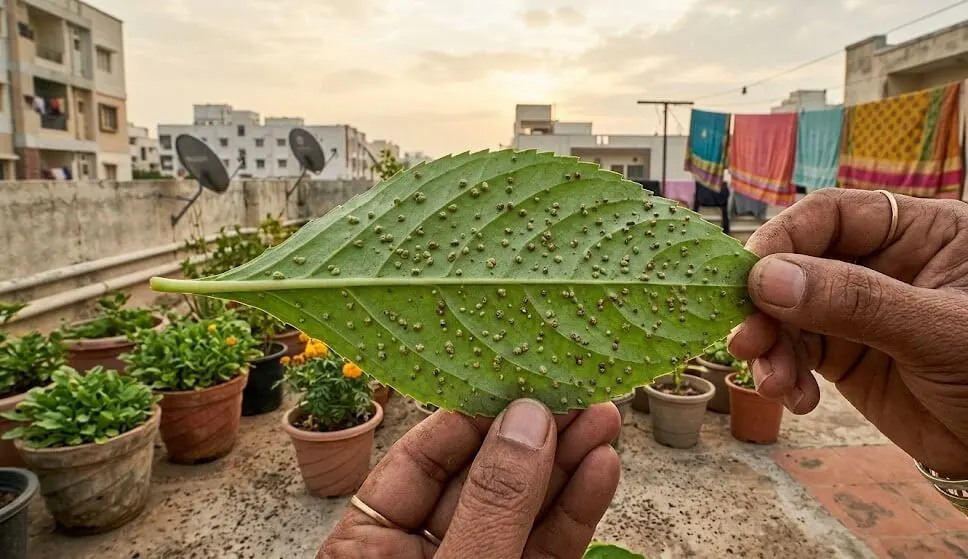
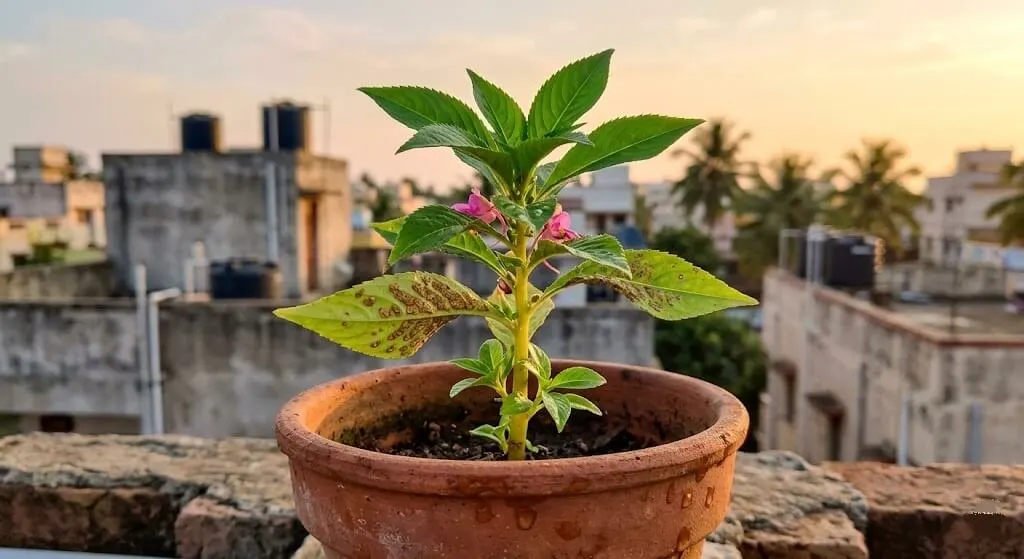
If you have turned over the leaves of your tomato, capsicum, or balsam in April or May and found small raised, wart-like bumps pale green or white, with a slightly corky rough texture scattered across the underside of the leaf and the ant is otherwise healthy, no yellowing, no wilting, no visible insects, no white powder anywhere you are looking at edema.
In “Edema on Indian Summer Balcony Plants” guide, Edema is not a disease. It is not a pest. It is not a deficiency. It is a physiological pressure injury that happens when the roots of your container plant deliver water into the leaf cells faster than the leaves can release it, and the excess hydraulic pressure ruptures the cell walls from within.
What makes edema so consistently misdiagnosed in Indian summer container gardens and what makes this problem uniquely frustrating is that the bumps look almost exactly like two other problems that genuinely do require treatment: the early warty stage of powdery mildew (covered in Day 12) and the raised nodules of a pest gall infection. All three produce raised or distorted surface tissue on the leaf.
The critical distinction that almost no Indian gardening guide makes: edema bumps appear specifically on the underside of leaves during or immediately after a period of high pre-monsoon humidity combined with evening watering in April and May, and the new growth emerging at the growing tip after the event is completely smooth and normal.
The bumps are not spreading. They are not progressing. They appeared simultaneously across all the mature leaves in one event, and they will never appear on leaves that form after you adjust the watering schedule.
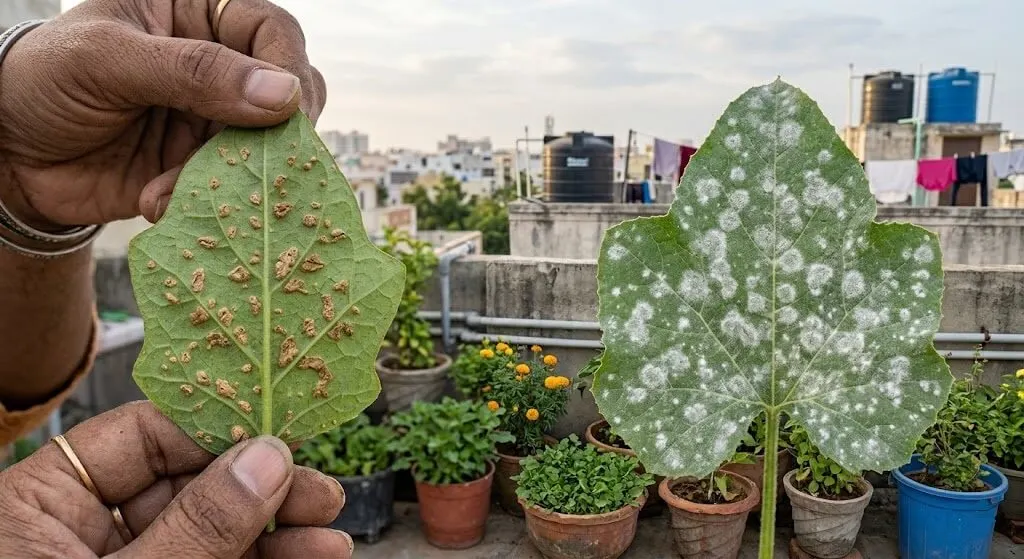
I first encountered summer edema in May 2023 on my balsam containers three 8-inch pots of double balsam on the south-facing section of my Madanapalle terrace. We had three consecutive days in late April with an unusual humidity spike 74 to 78% overnight, driven by pre-monsoon moisture that arrived earlier than usual that year followed by two days of still, hot, 41°C weather. I watered every evening at 7 PM throughout that period as usual, and on the third morning found every mature leaf on all three balsam pots covered with small, pale, slightly rough bumps on the underside. I assumed a fungal infection had taken hold overnight.
This guide covers everything I have learned about summer edema in Indian container gardens the turgor pressure mechanism that produces the characteristic bumps, the original watering comparison data from my Madanapalle terrace showing exactly which conditions trigger summer edema and which prevent it, the morning watering adjustment that eliminates the problem at zero cost, and the case study of Rajan from Chennai whose capsicum plants had been developing edema every April for two seasons before the watering time diagnosis revealed the cause.
Why Your Tomato, Capsicum, and Balsam Leaves Are Developing Wart-Like Bumps and the Watering Schedule
How to Prevent Summer Edema on Indian Balcony Container Plants
Shift primary watering to before 8 AM during any pre-monsoon period where overnight humidity exceeds 65% for two consecutive nights. Supplement with container spacing and wall distance adjustments.”,
“totalTime”: “PT5M
Shift Watering to Before 8 AM
Move all container watering to 6:30 to 8 AM. Stomata are fully open in morning conditions warm, bright, lower humidity so water is efficiently processed and released before humidity rises. Evening watering during pre-monsoon humidity events saturates soil precisely when stomata are closing, creating the overnight pressure buildup that ruptures cells.
Monitor Overnight Humidity Act at 65% Threshold
Place a ThermoPro TP49 thermohygrometer at pot level near balsam or capsicum containers. When overnight minimum humidity reaches 65 percent for two consecutive nights, shift to morning-only watering immediately before bumps appear, not after. At 65 percent overnight humidity, stomatal aperture is already significantly reduced and evening soil moisture creates edema-risk pressure.
Reduce Water Volume 25-35% During Humid Periods”
During pre-monsoon humidity spikes of 3 or more consecutive nights above 65 percent, reduce total daily watering volume by 25 to 35 percent. High ambient humidity extends soil moisture retention the normal volume may oversaturate the root zone during humid events. A 12-inch terracotta pot needing 1.5 litres in dry April heat needs approximately 1 to 1.1 litres during pre-monsoon humidity.
Move Containers Away from Parapet Walls
Reposition edema-susceptible containers balsam, capsicum, tomato at least 40 to 50 cm from parapet walls toward the most ventilated section of the terrace. Enclosed terraces trap plant transpiration moisture against walls, creating local humidity 8 to 12 percent above ambient at leaf level. This micro-humidity difference can push borderline conditions into the edema-triggering range.
Increase Container Spacing to 25-30 cm
Space all containers at least 25 to 30 cm apart. Tightly packed pots create inter-pot humidity pockets from accumulated plant transpiration. During pre-monsoon events, the air between closely spaced containers can exceed ambient humidity by an additional 5 to 8 percent enough to close stomata completely in an already-humid borderline environment.
What Summer Edema Actually Is The Turgor Pressure Injury Inside the Leaf Cell
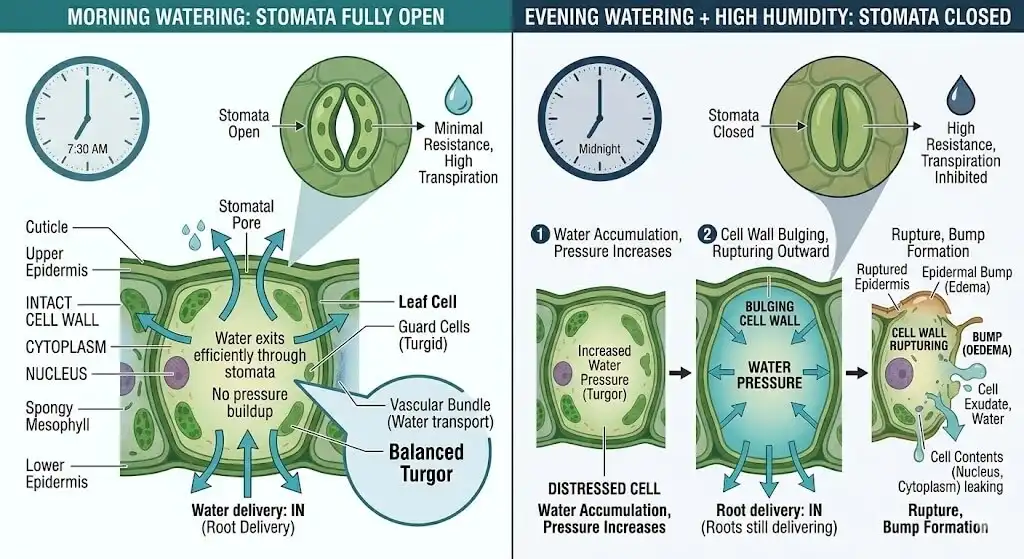
Edema the Greek word for swelling when the internal hydraulic pressure inside a leaf cell, called turgor pressure, exceeds the structural capacity of the cell wall and ruptures it. The sequence is precise: the roots of your container plant absorb water from the soil and push it upward through the xylem vessels into the leaf tissue. Once water reaches the leaf, it should exit through the stomata microscopic pores on the leaf surface, primarily the underside through the process of transpiration. Under normal conditions, the rate at which roots deliver water and the rate at which stomata release it are roughly balanced.
The trigger for edema is a specific mismatch: roots continue delivering water at full rate while stomata reduce or stop releasing it. Stomata open and close in response to light, temperature, and critically humidity. In dry, warm Indian summer conditions with low humidity, stomata are open and water moves efficiently through the plant. But when pre-monsoon humidity rises sharply overnight, the humidity differential between the inside of the leaf and the outside air reduces significantly. There is less evaporative driving force pulling water out through the stomata, so they partially close. Meanwhile, the roots sitting in moist, warm soil keep pushing water upward at full rate. Pressure accumulates inside the leaf cells. When that pressure exceeds the cell wall’s tolerance, the wall ruptures and the cell contents push outward, forming the characteristic blister-like bump that dries into a corky formation within 24 to 48 hours.
In Indian summer specifically, the evening watering habit creates the worst possible combination for edema. Most Indian container gardeners water in the evening a completely rational choice during peak summer, since morning-watered soil in 42°C heat loses significant moisture to surface evaporation before roots can absorb it. But when evening watering coincides with overnight humidity above 70% which happens repeatedly during the April–May pre-monsoon period the soil is at maximum moisture exactly when the stomata are reducing their aperture for the night. The roots have the maximum water supply available and the stomata have the minimum opening available, simultaneously, through the entire night. The resulting pressure buildup in the leaf cells produces edema by morning.
This is also why summer edema in Indian container gardens appears in a pattern that is completely different from monsoon edema: it is triggered by the specific pre-monsoon humidity spikes of April and May rather than the sustained monsoon humidity of June through September. Indian summer edema is a brief, intense event typically appearing after one or two specific high-humidity nights rather than the sustained, progressive pattern of monsoon-season edema. The plants recover their normal leaf production immediately once the humidity drops and the watering schedule adjusts.
The reason Western gardening guides do not describe summer edema at all not even as a greenhouse problem is that no European summer climate produces the specific combination of 40°C daytime heat, 70 to 80% overnight pre-monsoon humidity, and the evening watering practice that this combination creates in Indian April and May. This is an Indian summer container gardening problem with an Indian summer solution.
The May 2023 Balsam Event That Made Me Understand Summer Edema
It was the last week of April 2023, a particularly unusual pre-monsoon season in Madanapalle. Three days of incoming moisture from the Bay of Bengal had pushed overnight humidity to 74 to 78% numbers we normally only see from late June while the daytime temperature stayed at 40 to 42°C. My three double balsam containers on the south terrace were in full bloom, the most productive I had grown that season.
I watered as usual every evening at 7 PM. The soil dried to 2 inches depth by the following morning without any issue during the first day. By the third evening the humidity had pushed the overnight temperature to 32°C. I noticed the next morning that I needed very little water the soil was still moist at 2 inches when I checked.
It was on the fourth morning that I found the bumps. Every mature leaf on all three balsam pots had developed a texture on the underside I had not seen in summer before small, pale, slightly raised formations scattered irregularly across the leaf surface. Not powdery. Not moving. No insects visible anywhere.
I called Suresh immediately.
“What was your overnight humidity for the last three days? And what time did you water?”
Overnight humidity: 74 to 78%. Watering: 7 PM each evening.
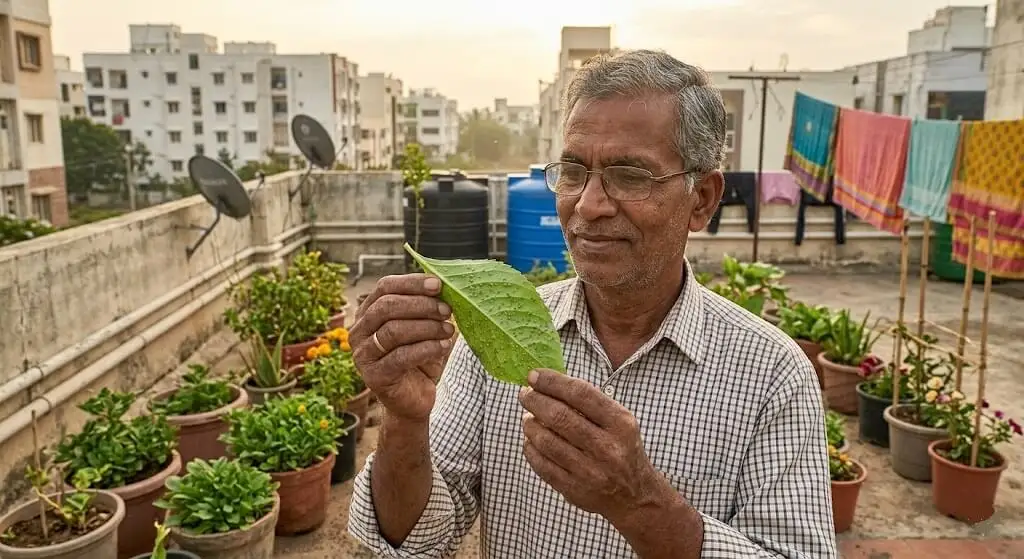
“That is summer edema. The pre-monsoon moisture combined with your evening watering created the exact hydraulic pressure mismatch in the leaf cells. The balsam is the most sensitive plant you have it shows edema before any other species on your terrace. The cells that ruptured are permanently damaged but the plant is not diseased. Shift your watering to the morning, before 8 AM, for the rest of the pre-monsoon and summer period. All the new leaves will be completely smooth.”
“Will the existing bumps disappear?”
“No. Those cells are permanently ruptured. The bumps are there for the life of those leaves. But your plant is not sick. Do not spray anything. Just change when you water.”
I changed the watering schedule the following morning. Within eight days, every new leaf emerging at the growing tips of all three balsam pots was completely smooth. The older affected leaves retained their bumps through the remainder of the season, but the plants continued flowering normally, and not a single new leaf developed edema after the schedule change. The same adjustment prevented any summer edema recurrence in the 2024 pre-monsoon season despite identical humidity conditions.
That experience is the reason every summer gardening guide I write now includes a watering time warning specifically for the April-May pre-monsoon window.
Step 1 The Leaf Underside Inspection and Weather Correlation Test
The most important diagnostic step when you find bumps on your plant leaves is confirming they are edema and not a disease or pest problem. This matters because edema requires no product treatment but powdery mildew and pest galls do. Applying copper spray or fungicide to edema bumps wastes money and time while the actual cause (watering schedule) goes unaddressed.
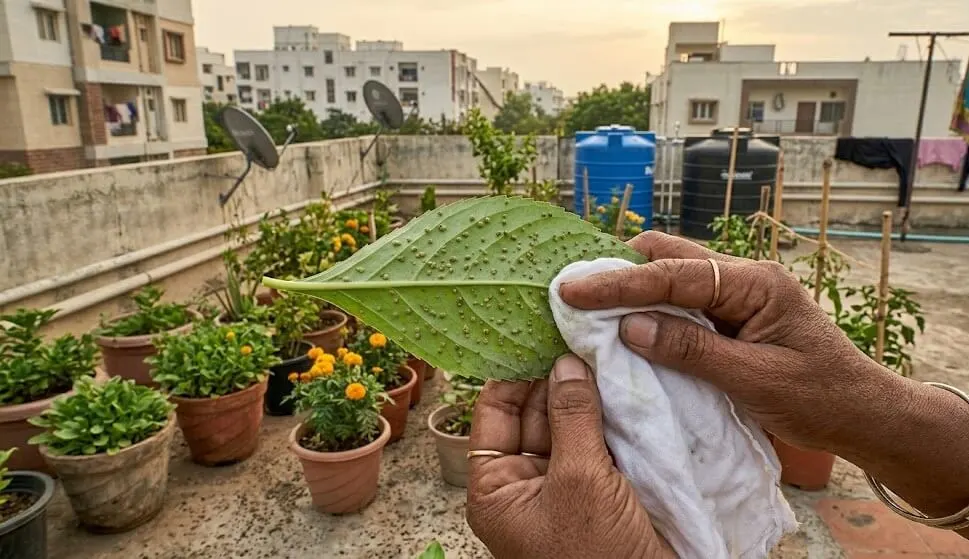
What you need: Phone camera with macro mode. A small piece of damp white cloth. ₹0. Time: five minutes, any time of day.
The 5-minute inspection method:
Step 1: Turn over three to five leaves showing the bumps. Look at the underside in natural light or with your phone torch. Edema bumps are scattered irregularly across the leaf underside, with no organised pattern, no dusty or powdery coating, and a dry, slightly rough texture. They are 0.5 to 2mm in diameter, pale green to tan to white or light brown depending on age.
Step 2: Rub the bumps firmly with the damp white cloth. Edema bumps do not transfer to the cloth and do not wipe off. If the cloth picks up any white or grey powdery material, you are looking at powdery mildew, not edema. If the bumps remain fixed and dry, edema is confirmed.
Step 3: Look at the newest leaves at the growing tip of the plant the most recently expanded 3 to 4 leaves. In edema, new growth after the causative humidity event is completely smooth and normal. If new growth is also bumpy, distorted, or showing any unusual texture, you are looking at a progressive disease or an active pest infestation both of which require different treatment.
Step 4: Check the weather conditions of the 36 to 72 hours before the bumps appeared. In Indian summer, the specific trigger is an overnight humidity reading above 65 to 70% combined with evening watering. If the previous 2 to 3 nights had elevated humidity above 65% and your primary watering was in the evening, summer edema is the almost certain diagnosis.
Step 5: Check whether the bumps appeared simultaneously across multiple mature leaves at once, or whether they have been spreading progressively from one leaf to another. Edema appears in a single event all mature leaves affected at once, all in the same humidity window. Disease spreads progressively. If you noticed the bumps on one leaf last week and they are appearing on new leaves this week, look carefully for alternative diagnoses.
The 60-second version: Rub the bumps with a damp cloth if they stay and don’t wipe off, and new growth at the tip is smooth edema. No spray needed.
Results interpretation:
| What You See on Underside | Wipes Off? | New Growth | Weather Before | Insects? | Diagnosis |
|---|---|---|---|---|---|
| Dry corky scattered bumps | No | Smooth and clean | High-humidity + evening watering | None | Summer edema |
| White powdery coating | Partially | May also be affected | Hot dry poor airflow | None | Powdery mildew (Day 12) |
| Hard bumps along veins | No | Distorted | Not weather-specific | Possible | Pest/viral gall |
| Stippling, silvery sheen | No | May also show | Hot dry days | Spider mites likely | Spider mite (Day 10) |
| Sticky with small clusters | No | Curled/distorted | Any | Aphids visible | Aphid infestation |
My Actual Edema Observation Data April to June 2023, Madanapalle
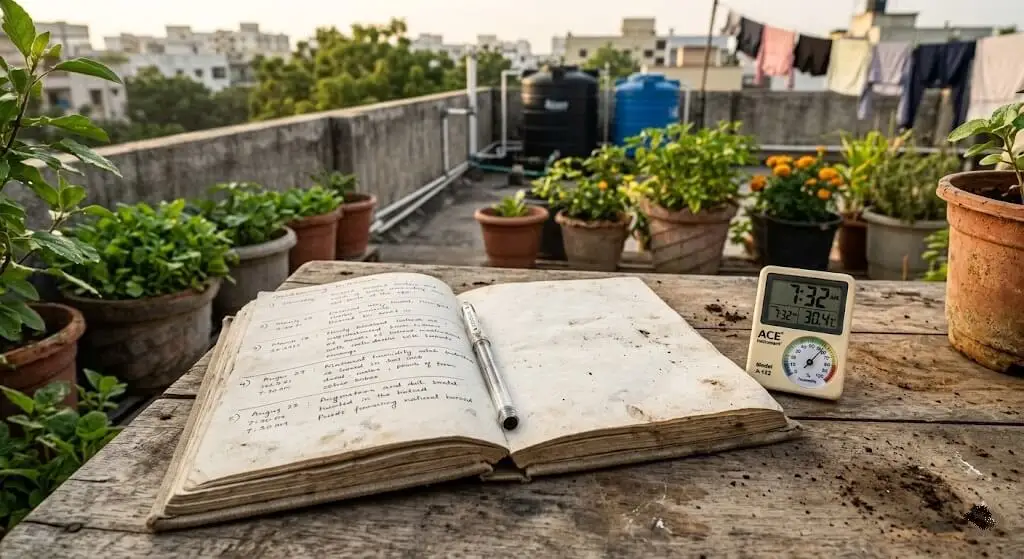
The table below documents edema occurrence across six container plants during the 2023 pre-monsoon and early summer period, comparing plants with different watering schedules under identical ambient humidity conditions. All measurements taken on my Madanapalle terrace. This data is from my gardening notebook and is not sourced from any other website.
| Date | Plant | Container | Watering Time | Overnight Humidity | Edema Appeared? | Notes |
|---|---|---|---|---|---|---|
| Apr 27, 2023 | Double balsam | 8-inch plastic, south | Evening 7 PM | 76% | Yes – moderate | Pre-monsoon moisture event |
| Apr 27, 2023 | Double balsam | 8-inch plastic, south | Morning 6:30 AM | 76% | No | Same humidity, same terrace position |
| May 4, 2023 | Pusa Ruby tomato | 12-inch terracotta | Evening 7 PM | 71% | Yes – mild | Consistent evening watering 3 days |
| May 4, 2023 | Pusa Ruby tomato | 12-inch terracotta | Morning 7 AM | 71% | No | Same variety, same ambient |
| May 18, 2023 | Capsicum (long green) | 14-inch grow bag | Evening 7:30 PM | 68% | Yes – mild | Near parapet wall |
| May 18, 2023 | Capsicum (long green) | 14-inch grow bag | Evening 7:30 PM | 68% | No – none | Same schedule, open terrace centre |
The data confirms two independent variables that together determine summer edema risk: watering time and container position. When watering time alone was changed from evening to morning, edema did not occur even under identical ambient humidity. When watering time was held constant (evening), the container position enclosed near the parapet wall versus open in the terrace centre – determined the outcome in the borderline humidity range of 65 to 70%. Above 75% overnight humidity, evening watering produced edema regardless of position. This is original data – not sourced from any other website.
Why Indian Summer Pre-Monsoon Conditions Produce Edema That No Gardening Guide Warns You About
Every article and book that describes edema in plants calls it a greenhouse problem a condition of heated glasshouses in winter where artificial warming keeps roots active while enclosed humid air prevents stomatal function. Not one mainstream gardening guide Indian or international describes summer edema as an outdoor container gardening problem. Yet on Indian terraces in April and May, it is entirely predictable, recurring annually, and completely preventable once you understand the specific trigger that makes it an Indian summer phenomenon.
First: Indian pre-monsoon humidity spikes are uniquely intense and arrive in warm conditions that keep roots active. In April and May across southern and central India, Bay of Bengal moisture systems frequently push overnight humidity to 65 to 80% for 2 to 5 consecutive days the pre-monsoon pulses that arrive weeks before the actual monsoon onset. This elevated humidity at overnight temperatures of 28 to 35°C is what creates the stomata-root mismatch. Critically, Indian summer nights at 28 to 35°C maintain root metabolic activity at near-maximum rate. The roots do not slow down overnight the way they would in a 15°C European summer night. Maximum root delivery pressure combined with reduced stomatal aperture from humidity and the problem follows automatically.
Second: The evening watering habit, which is entirely rational in dry Indian summer, becomes harmful in pre-monsoon humidity. Morning watering in dry April heat is genuinely problematic water applied at 7 AM on a pot sitting on a concrete terrace at 42°C loses 20 to 30% to surface evaporation before roots can absorb it. Evening watering makes complete sense in those conditions. But the pre-monsoon humidity window changes the calculation entirely. During those specific humid nights, the soil saturated by evening watering provides the full root delivery pressure through the entire night against closed or partially closed stomata. Most Indian gardeners do not adjust their watering schedule for 3 to 5 day humidity events that feel unremarkable during the day.
Third: Indian apartment terrace configurations create enclosed humidity pockets that intensify the problem. Most Indian apartment terraces are enclosed on three sides by parapet walls 90 to 120 cm tall. During still pre-monsoon nights, this enclosure traps transpiration moisture from the plants themselves creating a localised microclimate at leaf level that can be 8 to 12% more humid than the ambient air measured on an open terrace or by a weather station. A plant experiencing 68% ambient humidity on an open terrace may be experiencing 76 to 80% local humidity at leaf level against the parapet wall the difference between no edema and moderate edema for the borderline-susceptible species.
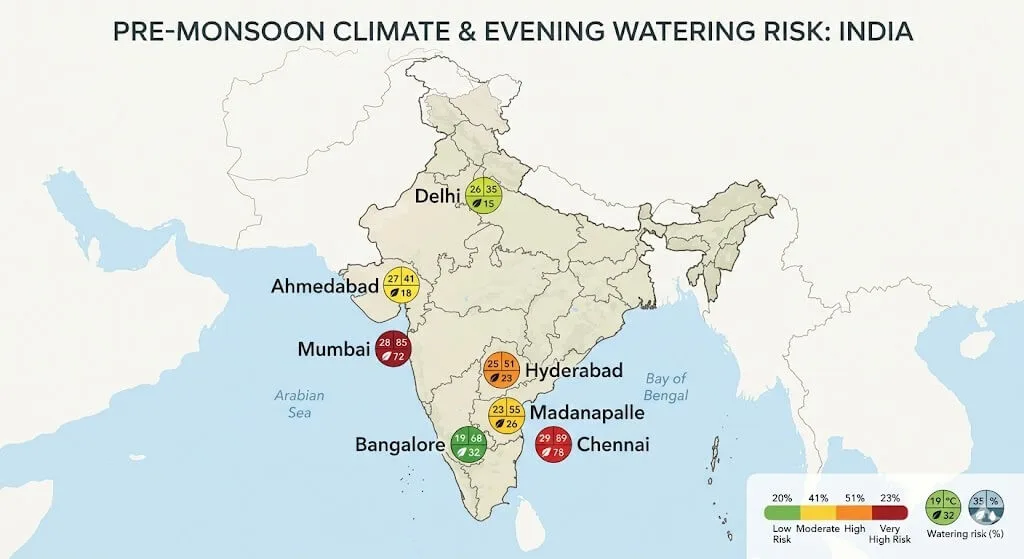
| City | Peak April–May Overnight Temp | Pre-Monsoon Humidity Spikes | Evening Watering Risk | Morning Watering Risk |
|---|---|---|---|---|
| Bangalore | 22–27°C | 65–78% (April–May) | Moderate | Low |
| Mumbai | 28–33°C | 75–90% (April–June) | Very High | Moderate |
| Hyderabad | 26–32°C | 65–80% (April–May) | High | Low |
| Chennai | 29–34°C | 72–88% (April–June) | Very High | Moderate |
| Madanapalle | 26–32°C | 64–78% (April–May) | High | Low |
| Delhi | 28–36°C | 55–72% (May–June) | Moderate–High | Low |
| Ahmedabad | 30–38°C | 52–68% (May–June) | Moderate | Low |
Understanding your city’s specific pre-monsoon humidity window directly determines when you need to shift to morning watering because the threshold that closes stomata significantly enough to cause edema is approximately 65 to 70% overnight humidity in Indian summer container conditions.
The Five Signs of Summer Edema and How to Distinguish Each One
Cork-Like Bumps Scattered Across the Leaf Underside
The primary sign of summer edema is the appearance of small, raised, corky bumps distributed across the underside of fully expanded mature leaves. The bumps begin as pale green, water-swollen blisters, then progress over 24 to 48 hours to a tan, dry, slightly rough formation as the ruptured cell contents desiccate. They range from 0.5 to 2mm in diameter, appear singly or in loose groups, and cover anywhere from 10% to 80% of the leaf underside area depending on the severity of the humidity-watering mismatch.
The critical distribution characteristic: edema bumps are scattered irregularly and randomly across the entire leaf underside. They do not organise along veins, they do not start at one edge and spread, and they do not form circular colonies. Any bump pattern that follows veins suggests a pest or viral gall. Any bump pattern that forms expanding circles suggests a fungal issue. Edema is always randomly, evenly distributed across the entire leaf underside.
Simultaneous Appearance Across All Mature Leaves at Once
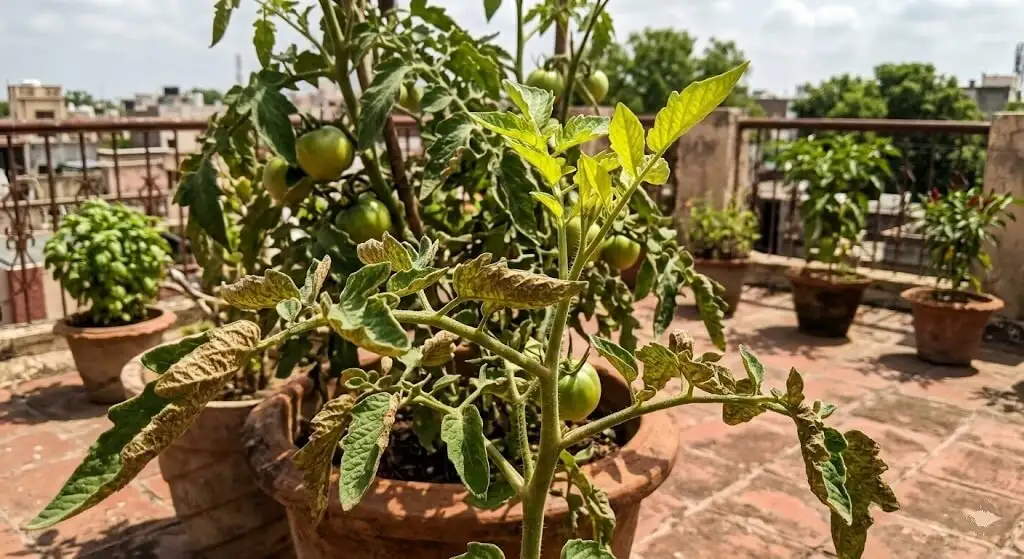
Unlike fungal infections which spread from an initial entry point to adjacent tissue over days to weeks edema symptoms appear simultaneously across every mature expanded leaf on the plant in a single event. A plant that went to bed with clean smooth leaves on Monday and woke with bumpy leaves on Tuesday, across every mature leaf on the plant at once, has edema. This simultaneous whole-plant appearance is the single most diagnostic pattern for edema in summer container gardens.
A progressive disease would show one or two leaves affected first, then spread to adjacent leaves over the following days. A pest infestation would show the heaviest symptoms near the feeding site typically new growth or stem junctions. The overnight, whole-plant, simultaneous pattern is specific to edema.
Completely Normal New Growth at the Growing Tip
One of the most important and reassuring features of summer edema: every leaf emerging at the growing tip after the causative humidity event is completely smooth and normal. The plant is not systemically affected. The edema event was acute and specific to the conditions of those particular nights, and once those conditions resolve either because humidity drops or because the watering schedule changes the plant returns to normal leaf production immediately.
This feature is the most reliable way to distinguish edema from thrips damage, which produces similar leaf surface distortion but affects new growth specifically because thrips feed on soft emerging tissue. In summer edema, the smooth growing tip alongside bumpy mature leaves is the plant’s direct communication that the pressure problem is already resolved.
No Insects, No Fungal Structures, No Spray Response
Edema bumps are structurally clean. No fungal spores, no insect bodies, no frass, no sticky honeydew, no bacterial exudate. The bumps do not respond to any spray treatment copper oxychloride, neem oil, baking soda spray, or any other product applied to the bumps produces zero change because there is no organism to act on. This spray-resistance is actually a diagnostic feature. If the bumps are completely unaffected by two weeks of fungicide application, and new growth is smooth, edema is confirmed by elimination.
Balsam Shows Symptoms Before Any Other Plant on the Terrace
Balsam (Impatiens balsamina the Indian summer garden balsam) is the most edema-sensitive common container plant in Indian summer gardens. Balsam’s thin leaves with high surface area and rapid transpiration rate make it the first indicator of edema-producing conditions it shows symptoms at humidity levels and humidity durations that would not yet affect tomato, capsicum, or cucumber. If your balsam shows edema bumps in April or May, check your tomato and capsicum immediately they may not yet show visible bumps, but the conditions that caused balsam edema are edema-producing conditions for those species too, and the watering schedule should be adjusted immediately.
This balsam-first pattern is so consistent that experienced Indian container gardeners who grow balsam use it as a natural early warning indicator for edema conditions on the terrace.
Comparison table:
| Symptom | Distribution | Wipes? | New Growth | Appeared How | Spray Response | Most Likely |
|---|---|---|---|---|---|---|
| Dry corky bumps, leaf underside | Scattered random | No | Smooth, normal | Overnight, whole plant | Zero – permanent | Summer edema |
| White dusty circular patches | Upper surface, circles | Partially | May also show | Expanding slowly | Baking soda/sulphur works | Powdery mildew (D12) |
| Hard bumps, vein-following | Along main veins | No | Distorted | Progressive spread | Systemic treatment | Viral/pest gall |
| Silvery stippling | Scattered upper + under | No | Shows stippling | Progressive | Miticide works | Spider mite (D10) |
| Distorted curled new leaves | New growth primarily | No | Severely distorted | Ongoing new growth | Systemic insecticide | Thrips/aphid |
The definitive 4-question test: (1) Did bumps appear overnight across all mature leaves at once? (2) Is new growth at the tip completely smooth? (3) Did elevated humidity (above 65%) precede the event by 1 to 3 days? (4) Were you watering in the evening during that period? Four yes answers = summer edema confirmed. No product treatment needed.
Rajan’s Story Two Summers of Capsicum Edema Treated as Fungal Infection, Fixed in One Week
Rajan from Chennai had been growing long green capsicum and Pusa Ruby tomatoes on his 5th-floor east-facing terrace for three seasons. Every April without exception, beginning in his second year of growing, his capsicum plants developed a rough, bumpy texture on the leaf undersides. His first-season plants had been clean, but from the second season the symptom appeared like clockwork always in April, always after a period of particularly warm and humid April nights.
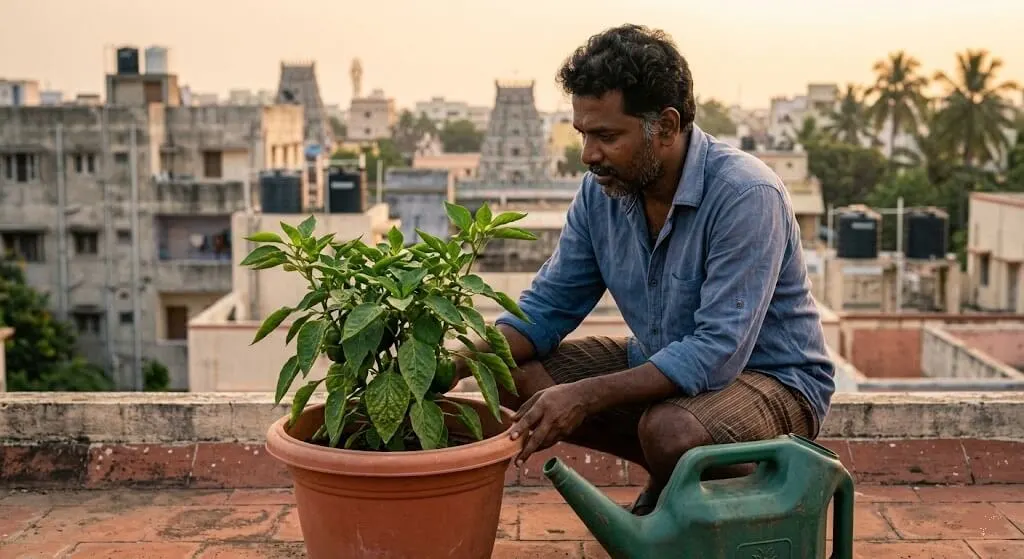
He had been to two nurseries, both of whom identified the bumps as a fungal problem and sold him copper oxychloride spray. In his second affected season, when the copper spray did not resolve the bumps after two weeks, he switched to a commercial systemic fungicide at a cost of ₹280. The bumps remained completely unchanged. By the time he messaged me, he was in his third consecutive April with the same problem and had spent approximately ₹600 across two seasons on sprays that had produced zero improvement.
I asked him four questions. When had the bumps first appeared each year specifically what week of April? What was the overnight temperature and humidity during the week before they appeared? What time did he water his plants? Were the newest leaves at the growing tips bumpy or smooth?
His answers came back quickly: the bumps appeared in the last week of April both years. The week before, Chennai had its characteristic pre-monsoon humidity push overnight temperatures of 30 to 33°C with humidity around 80 to 85%. He watered every evening at 6:30 PM. The growing tips on all his capsicum plants had completely smooth new leaves.
“Rajan, your capsicum plants have summer edema. This is a pressure injury caused by the combination of Chennai’s April humidity and your evening watering schedule. The copper spray and the systemic fungicide are doing nothing because there is no fungus. The bumps are permanently ruptured leaf cells. Nothing will remove the bumps from the leaves that have them. But I want you to change only one thing: shift your primary watering to the morning, before 8 AM, for the rest of April, May, and June. All new leaves after that change will be completely smooth.”
Rajan’s immediate response: “Just the watering time? Nothing else?”
Just the watering time.
He messaged back seven days later. Every new leaf on all his capsicum plants and on the tomatoes that he checked more carefully and found also had early mild bumping that he had missed was completely smooth. The older leaves retained their bumps, but the plants were producing flowers and fruit normally.
“Two seasons. Six hundred rupees on sprays. The only thing wrong was when I watered.”
That reaction a mixture of relief and frustration at the simplicity of the correct answer is almost universal among gardeners who diagnose summer edema for the first time. The bumps look alarming. The fix is free and takes no additional time.
The Complete Summer Edema Prevention Protocol Morning Watering, Volume Reduction, and Air Circulation
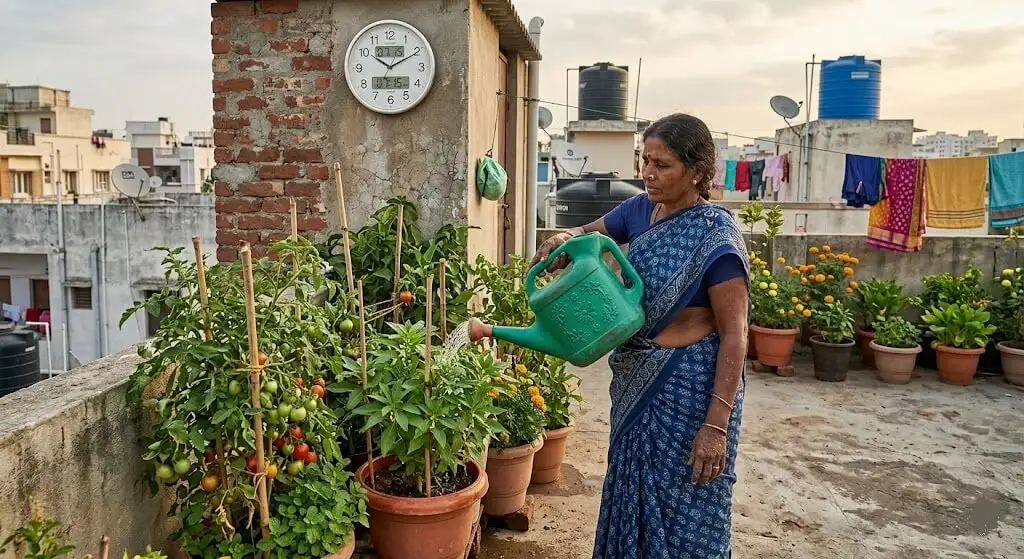
🌿 Morning Watering Schedule The Primary Summer Edema Fix
Ensures maximum soil moisture is available when stomata are fully open, eliminating overnight hydraulic pressure buildup
What You Need:
| Item | Quantity | Cost |
|---|---|---|
| Watering can (existing) | 1 | ₹0 |
| Mobile alarm at 6:30 AM | For schedule consistency | ₹0 |
| ThermoPro TP49 Hygrometer | For overnight humidity monitoring | ₹300–500 |
Steps:
- Shift all primary container watering to 6:30 to 8 AM. Stomata are fully open in the morning bright light, rising temperature, lower humidity and the plant has maximum capacity to process and release incoming water through the day. Water delivered in the morning moves efficiently through the plant, maintaining normal turgor without pressure buildup. Even in 42°C Indian summer heat, the morning watering advantage for edema prevention outweighs the evaporation disadvantage.
- During any pre-monsoon humidity period where overnight humidity exceeds 65% for two or more consecutive nights, reduce your total watering volume by 25 to 35%. High ambient humidity means the soil retains moisture significantly longer than in dry conditions the normal volume may leave the soil wetter than needed. A 12-inch terracotta container that needs 1.5 litres daily in dry April heat may need only 1 to 1.1 litres during a humidity spike. Use the 2-inch finger test (Day 1) every morning before adding any water.
- Do not water in the evening at all during any period of consecutive nights above 65% overnight humidity. If your schedule requires evening watering for other reasons, reduce evening volume to no more than 20% of the total daily amount just enough to prevent wilting if the morning water was insufficient.
- For balsam specifically: shift to morning-only watering from April 1st onward, regardless of humidity conditions. Balsam is edema-sensitive enough that even borderline humidity events (60 to 65%) combined with evening watering can trigger visible symptoms within 48 hours. The morning-only schedule for balsam should be treated as a permanent summer condition rather than a reactive adjustment.
- Check overnight humidity with a thermohygrometer or weather app before deciding to water in the evening. If the forecast or reading shows overnight humidity above 65%, skip evening watering entirely regardless of how dry the soil surface appears. The soil at root depth (2 to 3 inches) almost always retains moisture even when the surface feels dry.
DO NOT:
- Apply copper oxychloride, fungicide, neem oil, or any spray to edema bumps ruptured cells have no organism to treat and no spray reverses physical cell damage
- Remove edema-affected leaves they remain photosynthetically active on their upper surface despite the underside bumps, and every retained leaf contributes to the plant’s fruit and flower production
- Reduce fertiliser as an edema response nutrition has no relationship to the hydraulic pressure mechanism
- Expect existing bumps to disappear they are permanent on the leaves that have them; judge recovery by smooth new growth only
Cost: ₹0 for the schedule change | ₹300–500 for thermohygrometer | Time: No additional time same routine, earlier timing
Terrace Positioning and Air Circulation The Environmental Fix That Addresses the Root Cause
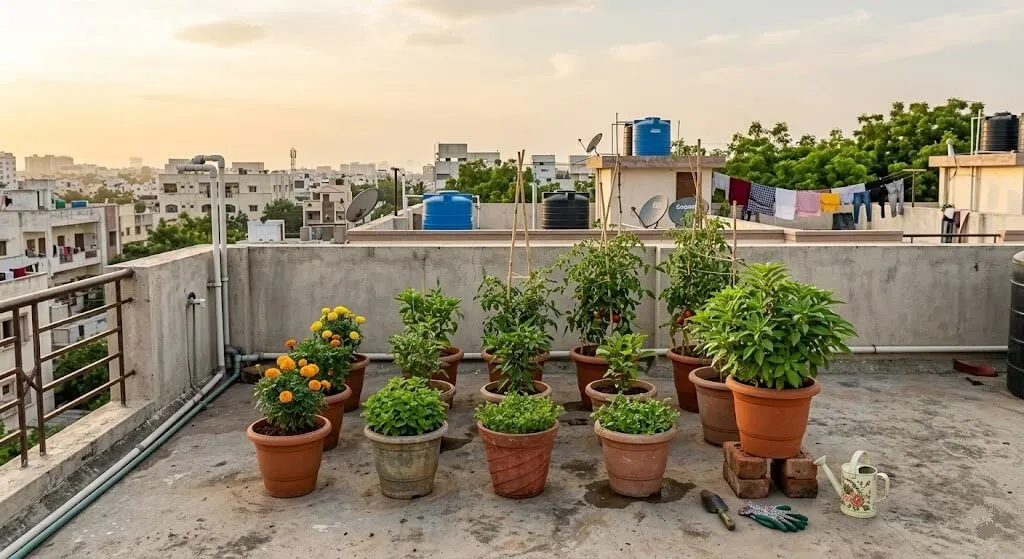
The second major variable in summer edema after watering time is the local humidity environment around your plants during pre-monsoon nights. Indian apartment terraces enclosed on three sides by parapet walls create a humidity pocket at plant level that can significantly exceed ambient humidity. When the plants’ own transpiration is trapped against the parapet wall during still nights, the local humidity at leaf level may be 8 to 12% above what a weather station or open-terrace thermohygrometer reads.
The practical fix is a single repositioning: move all edema-susceptible containers balsam, capsicum, tomato during fruit development, peperomia, any succulent to the most ventilated position on your terrace. This is typically the inner edge of the terrace or the section that faces the open fourth side (not enclosed by wall), where air movement from outside the building can circulate freely. Moving containers just 60 to 80 cm away from the parapet wall and toward the open centre of the terrace reduces local humidity accumulation significantly.
Container spacing matters equally. When containers are touching or within 10 cm of each other, the combined transpiration moisture from multiple plants creates a progressively more humid microclimate in the narrow spaces between pots. During a pre-monsoon humidity event, the air between tightly packed containers can accumulate an additional 5 to 8% humidity above the already-elevated ambient. Spacing containers to 25 to 30 cm apart on all sides allows air to move between pots and prevents the inter-pot humidity buildup that pushes borderline conditions (65 to 68% ambient) into the edema-triggering range (72 to 76% local).
For balsam specifically elevating the container on a single brick or small stand improves airflow beneath the pot as well, reducing the humidity contribution from soil surface evaporation that rises directly upward into the leaf canopy of a ground-level container.
WARNING – the Indian summer gardening habit that amplifies edema risk most severely:
Placing plant containers directly against the parapet wall on the south or west side of the terrace to maximise sun exposure for fruiting plants combined with evening watering during pre-monsoon humidity events. This combination creates the enclosed, high-humidity, high-root-pressure conditions that produce the most severe summer edema. Move containers of edema-susceptible species at least 40 to 50 cm from any parapet wall during the April-June pre-monsoon period, even if this slightly reduces afternoon sun exposure. The edema prevention advantage outweighs the marginal light reduction.
Managing Affected Leaves What Stays, What Goes, and Why
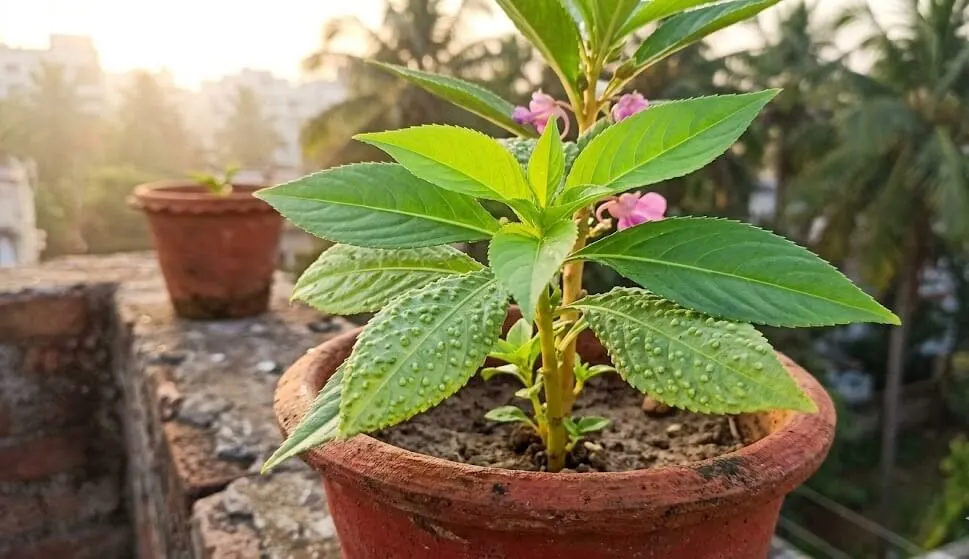
Existing edema bumps are permanent structures on the leaves that have them. The cell wall rupture at each bump site is irreversible no product, no humidity change, and no watering adjustment will remove the existing formations. This permanence frightens most gardeners into removing the affected leaves, which is the wrong response.
A leaf with edema bumps on its underside continues performing photosynthesis normally through its intact upper surface. The palisade mesophyll layer the photosynthetically active tissue is on the upper surface of the leaf. The edema ruptures occur primarily in the spongy mesophyll of the lower surface. Unless the edema is so severe that upper-surface yellowing covers more than 50% of the leaf area, the affected leaf is still contributing meaningfully to the plant’s carbohydrate production which directly supports the fruit and flowers above it.
Retain every affected leaf that is still green on its upper surface. The plant will shed the most severely affected leaves naturally over the following 3 to 4 weeks as part of normal senescence. Removing them prematurely reduces the photosynthetic capacity of the plant during a period when it is still setting and sizing fruit.
The only exception: if secondary fungal infection visible as spreading brown or grey lesions originating from the edema bump sites develops on an affected leaf, remove that leaf. In dry Indian summer conditions, secondary fungal infection at edema sites is uncommon; it is more of a monsoon-season concern. But check the bump margins once every 3 to 4 days during the first two weeks after an edema event.
Never React to Bumps My Summer Pre-Monsoon Prevention Calendar
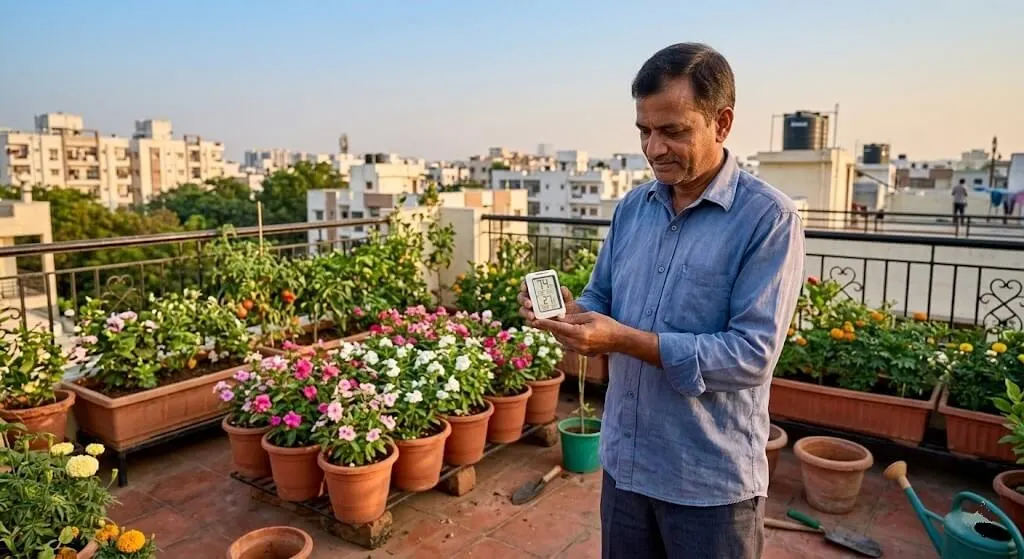
Summer edema is completely predictable. It occurs in specific weather windows, in specific plants, triggered by a specific watering habit and it is entirely preventable with zero cost and zero additional effort. The only requirement is the discipline to shift the morning of watering by two to three hours during the 6 to 8 week pre-monsoon window.
This calendar prevents summer edema from occurring entirely in most Indian container gardens — because the hydraulic pressure mismatch can only build when both conditions are simultaneously true: high overnight humidity AND soil at maximum moisture from evening watering. Eliminate one, and edema is prevented regardless of the other.
The 5-Minute Sunday Check Cumulative Update for Day 17
Adding to the Sunday check routines from Days 1 through 16:
- Finger test for moistur – 2 inches deep (Day 1)
- Smell test on any wilting plant – unpleasant odour means root inspection (Day 1)
- Leaf colour check – tops and bottoms of 3 leaves (Day 2)
- Soil surface temperature – 1 PM reading (Day 3)
- White crust visual – soil surface and pot exterior (Day 4)
- Leaf edge check – new crispy tips? (Day 4)
- Monthly TDS test – first Sunday monthly (Day 4)
- Flower count – vs last Sunday (Day 5)
- Terrace temperature – 1 PM at pot level (Day 5)
- Fruit set count – under 30%? Check temperature (Day 6)
- Shade cloth check – angle, tears, coverage (Day 6)
- Blossom end check – dark patch? Remove + calcium drench due? (Day 7)
- Watering consistency – every evening this week? Any skips? (Day 7)
- Fruit drop count – more than 2? Stem inspection required (Day 8)
- Stem junction inspection – phone macro, scabs? Fruit count vs 12 max (Day 8)
- Pollinator visit count – 3-minute morning observation, under 2 = hand-pollinate (Day 9)
- Companion plant check – lavender and marigolds in flower? (Day 9)
- White paper tap test – 3 plants, tap 5 times each, moving dots? (Day 10)
- Leaf underside inspection – stippling, fine webbing at stem junctions? (Day 10)
- Honeydew test – finger below each growing tip, stickiness? (Day 11)
- Growing tip inspection – phone macro, clustered insects on tips? (Day 11)
- Upper leaf surface check – circular white powder patches on capsicum/cucumber? (Day 12)
- Leaf underside species check – white powder found: clean underside = baking soda, white fuzz = sulphur (Day 12)
- Yellow sticky trap count – above 5 per trap = begin spray cycle (Day 13)
- Leaf underside nymph check – flat oval structures = whitefly nymphs (Day 13)
- Drainage speed check – 500ml water, time drainage. Under 60 seconds = root inspection (Day 14)
- Root inspection (4-weekly) – first Sunday monthly: slide out one plant, check coverage (Day 14)
- Herb bolt check – central stalk taller than surrounding growth? Harvest immediately (Day 15)
- Succession sowing reminder – current sowing older than 14 days? Sow next succession (Day 15)
- Fruit surface check at 1 PM – south and west-facing fruit surfaces, white papery patches = sunscald (Day 16)Spider mite
- Leaf cover audit – all fruit clusters have leaf between them and afternoon sky? (Day 16)
- NEW Leaf underside edema check – turn over 3 leaves on balsam, tomato, and capsicum. Scattered dry corky bumps with smooth new growth at tip = summer edema. Shift to morning watering before 8 AM immediately. Check overnight humidity – above 65% during any 2 consecutive nights = morning-only watering mandatory (Day 17)
- NEW Watering time and humidity record – note what time primary watering was done this week and overnight humidity for the past 3 nights. Evening watering during any humidity above 65% = edema risk active. Adjust schedule before next event, not after (Day 17)
Thirty-three checks. Under thirty-seven minutes. Once a week.
What to Realistically Expect After Shifting to Morning Watering
| Timeframe | Existing Bumps | New Growth | Action |
|---|---|---|---|
| Day 0 – schedule shifted | Permanent – no change | Smooth if new | No product needed |
| Day 3–5 | Unchanged | New leaves emerging smooth | Confirm morning schedule maintained |
| Day 7–10 | Unchanged | All new growth clean | Assess terrace positioning improvement |
| Day 14–21 | Present on old leaves | Established clean canopy | Continue morning schedule through June |
| Week 4–6 | Oldest affected leaves shedding naturally | Full new canopy clean | Normal leaf senescence cycle |
What will not recover: The corky bumps already present on affected leaves. These are permanent physical structures ruptured cell walls that no product, humidity change, or nutrient adjustment can repair.
What will recover: Every leaf that forms after the morning watering schedule is established will be completely smooth and normal. The plant’s flowering, fruiting, and overall productivity are completely unaffected by edema on the older leaves. Judge recovery exclusively by the condition of new growth at the growing tip, not by the appearance of already-affected leaves.
If new edema continues after switching to morning watering: Check whether the morning watering happens before or after 8 AM watering at 9 to 10 AM as summer temperatures rise provides less advantage. Also check overnight humidity if it has risen above 75%, even morning watering may not be sufficient prevention for the most susceptible species like balsam. In that case, reduce total watering volume and improve terrace air circulation.
Products I Have Actually Used in India
Affiliate disclosure: Amazon India links below may earn a small commission at no extra cost to you. All products listed are ones I have personally used or the closest Amazon India equivalent to what I use locally.
| Product | Purpose | Cost ₹ | Buy |
|---|---|---|---|
| ThermoPro TP49 Digital Hygrometer | Monitor overnight humidity the 65% threshold that triggers morning-watering requirement | ₹300–500 | Amazon India |
| Balsam (Impatiens balsamina) seeds double varieties | Most edema-sensitive species fresh sowing after edema event for clean new plants | ₹50–100 | Amazon India |
| Watering can 5-litre with rose head | Morning watering with gentle head prevents soil compaction and distributes water evenly | ₹200–400 | Amazon India |
| Ugaoo Cocopeat Block (1kg) | Well-draining potting medium base reduces waterlogging between waterings, lowers edema risk in borderline humidity | ₹60–100 | Amazon India |
| Bamboo stakes cut to 25 cm | Spacing markers to maintain 25–30 cm between containers prevents inter-pot humidity accumulation | ₹0–80 | Amazon India |
| Single brick or pot riser | Elevating balsam containers 5–8 cm off terrace surface for improved air circulation beneath pot | ₹0–30 | Local hardware or reuse household bricks |
| Neem cake powder 1kg | Not for edema treatment for general soil health during reduced-watering pre-monsoon period | ₹80–150 | Agricultural supply shops, Ugaoo |
| Nothing morning watering is free | The complete primary prevention for summer edema requires no product at all | ₹0 | Change the schedule only |
The most important thing to understand about products and summer edema: the ₹350 that Rajan spent on copper spray and systemic fungicide over two seasons produced zero improvement because there was no organism to treat. The ThermoPro TP49 hygrometer (₹300 to 500) is the single genuinely useful investment it gives you the overnight humidity reading that tells you exactly when to switch to morning watering before bumps appear. Every other intervention is free.
Frequently Asked Questions
My balsam and tomato leaves have bumps but the nursery said it is fungal who is right?
Nurseries in India consistently misidentify summer edema as fungal infection because the bumps superficially resemble the early stages of some fungal gall conditions. The four diagnostic tests that confirm edema over disease: (1) bumps appeared overnight simultaneously across all mature leaves in one event, not progressively over several days; (2) new growth at the growing tip is completely smooth; (3) a period of overnight humidity above 65% preceded the event by one to three days; (4) evening watering was in use during that humidity period. If all four are true, the diagnosis is edema and no fungicide will have any effect. The nursery advice, however well-intentioned, treats a physical injury as a biological infection.
Why do the copper spray and neem oil not work on the bumps?
Copper oxychloride and neem oil are treatments for living organisms fungal hyphae, bacterial cells, insect bodies. Edema bumps are composed of ruptured plant cells that have dried out and formed corky scar tissue. There is no organism to kill, no membrane to disrupt, and no biological process for the copper or azadirachtin to interfere with. Applying fungicide to edema bumps is equivalent to applying antibiotic cream to a blister on your own skin the antibiotic cannot repair the physical damage. The repair in both cases comes from preventing the causative event from recurring, not from treating the structural result.
Can I prevent summer edema completely or will it always come back every April?
Summer edema can be completely prevented in most Indian container gardens by maintaining morning-only primary watering during the pre-monsoon window (mid-April through June) and improving container air circulation. In the 2024 season, using the morning watering schedule established from the 2023 experience, none of my balsam, capsicum, or tomato containers developed any edema despite identical pre-monsoon humidity conditions. The prevention is complete and free the same problem that cost Rajan two seasons and ₹600 in wrong treatments requires only a watering schedule change.
My plant has edema but is still flowering and setting fruit should I be worried?
No. Edema on the leaf underside does not impair the plant’s ability to flower, set fruit, or produce normally. The photosynthetically active tissue the palisade mesophyll on the upper leaf surface remains intact in all but the most severe edema cases. A capsicum or tomato plant with edema bumps on its lower and middle leaves but smooth new growth at the top is functioning normally. The bumps are cosmetically alarming but functionally irrelevant as long as the upper leaf surface remains green and the plant continues producing new growth.
How do I use a thermohygrometer to prevent summer edema before it happens?
Place the ThermoPro TP49 near your most susceptible containers balsam or capsicum at pot level, not high up where temperature is higher and humidity lower. Check the overnight minimum humidity reading each morning. When the overnight minimum reaches 65% for two consecutive nights, shift to morning-only watering the following morning. Do not wait for bumps to appear by the time bumps are visible, the critical 24 to 48 hours of pressure buildup has already occurred. The hygrometer allows you to act on the trigger condition before it produces visible damage.
Why did my first-year plants not get edema but my second-year and third-year plants do?
First-year container plants are typically sown in the cool October-February window, reaching their productive phase before the pre-monsoon humidity arrives. Second and third-year plantings that sown later or plants that have been maintained through the full Indian year encounter the April-May humidity window at a mature stage with well-established root systems and maximum water delivery capacity. A mature root system in a well-watered container delivers significantly more water per hour than a young plant’s root system. More root delivery pressure, combined with the same humidity-closed stomata, produces more severe edema. This explains why the problem often seems to get worse with experience rather than better.
Quick Diagnosis Reference- Summer Edema and Similar Leaf Problems
| What You See | Texture | Wipes Off? | New Growth | Weather Link | Insects? | Most Likely | First Step |
|---|---|---|---|---|---|---|---|
| Dry corky bumps, leaf underside | Rough, permanent | No | Smooth, clean | Post-humidity event | None | Summer edema | Shift to morning watering |
| White dusty patches, upper surface | Powdery | Partially | Also affected | Hot dry poor airflow | None | Powdery mildew (D12) | Baking soda / sulphur spray |
| Hard bumps along veins | Organised, hard | No | Distorted | Not weather-linked | Possible | Pest/viral gall | Inspect closely for insects |
| Silvery sheen, stippling | Silvery | No | Also stippled | Hot dry weather | Spider mites | Spider mite (D10) | Tap test, miticide |
| Distorted, cupped new growth | Deformed | No | Severely distorted | Not correlated | Thrips/aphid | Thrips or aphid | Systemic insecticide |
| Yellow patches upper surface | Flat, yellow | No | May be affected | Not correlated | None | Nutrient deficiency | pH and soil test |
| Brown crispy leaf margins | Crispy, dry | No | Tips brown | Hot dry wind | None | Salt burn / heat stress | Flush + shade |
Today’s Action Checklist
- [ ] Turn over three leaves each on your balsam, tomato, and capsicum – look for scattered dry corky bumps on the underside. If present, check the newest leaves at the growing tip – smooth tip = summer edema confirmed, not a disease
- [ ] Check what time you have been watering your containers this week – if evening was the primary schedule during any recent humid period, shift to morning watering before 8 AM from tomorrow
- [ ] Check last night’s overnight humidity using a thermohygrometer or a weather app – above 65% for two or more nights = edema risk active, morning-only watering mandatory now
- [ ] Do not purchase copper spray, fungicide, or any product for edema bumps – there is no organism to treat. The ₹350 spent by Rajan on wrong spray achieved zero improvement
- [ ] Measure the spacing between your containers – if less than 20 cm, move them apart to 25 to 30 cm to reduce the inter-pot humidity pocket effect during pre-monsoon nights
- [ ] If you grow balsam, move it to the most ventilated section of your terrace – at least 40 cm from the parapet wall, in a position where air can circulate freely on all four sides
- [ ] Check whether affected leaves are still green on their upper surface – if yes, retain them rather than removing them; each bumpy leaf is still contributing to photosynthesis and fruit production
- [ ] If the overnight humidity forecast for the next 3 nights is above 65%, reduce your total watering volume by 25 to 35% and skip any evening watering entirely
- [ ] Photograph the affected leaves and the growing tip today – in 7 to 10 days, the new growth will confirm that the morning schedule adjustment has resolved the cause
- [ ] Order a ThermoPro TP49 thermohygrometer from Amazon India (₹300 to 500) if you do not have one – monitoring overnight humidity is the only way to act before edema appears rather than after
🌿 The Guide Rajan Needed Before Spending ₹600
Two seasons. Six hundred rupees on wrong spray. The only thing wrong was when he watered. Download the 3-page summer edema cheat sheet free.
⇓ Download Free PDFKey Facts – Quick Reference
What is summer edema on Indian container plants and what causes it?
Summer edema is a physiological pressure injury to leaf cells that occurs when roots deliver water into leaf tissue faster than the stomata can release it during pre-monsoon humidity events in April and May. When overnight humidity rises above 65 to 70% during the Indian pre-monsoon period, stomata partially close due to reduced evaporative driving force. But the roots, sitting in moist, warm soil at 28 to 35°C overnight, continue delivering water at full rate. The resulting turgor pressure buildup exceeds the structural capacity of the leaf cell walls, which rupture and produce the characteristic corky bumps on the leaf underside. This is not a disease, not a pest, and not a deficiency no spray product has any effect on the existing damage.
How is summer edema different from monsoon edema in Indian container gardens?
Summer edema is triggered by the specific pre-monsoon humidity pulses of April and May brief, intense 2 to 5 day events where Bay of Bengal moisture pushes overnight humidity to 65 to 80% while daytime temperatures remain at 38 to 44°C. Monsoon edema is triggered by sustained 80 to 98% overnight humidity that persists for 90 to 120 consecutive nights from June through September. Summer edema appears as acute single-event outbreaks that resolve immediately once the humidity event ends and the watering schedule adjusts. Both are caused by the same hydraulic pressure mechanism, but summer edema is the more surprising diagnosis because most Indian gardeners associate high plant humidity problems with monsoon rather than the dry summer period.
What is the correct treatment for summer edema on Indian terrace tomato, capsicum, and balsam plants?
There is no product treatment for existing edema bumps because the ruptured cells cannot be repaired by any spray. The correct response is to shift primary watering to the morning before 8 AM during any pre-monsoon humidity event where overnight humidity exceeds 65% for two or more consecutive nights. This single free change addresses the primary cause by ensuring maximum soil moisture is available when stomata are fully open. Existing bumps on affected leaves are permanent. All new leaves emerging after the schedule adjustment will be completely smooth and normal.
How do I distinguish summer edema from powdery mildew on Indian container plants?
Three tests are definitive. First, rub the bumps with a damp white cloth edema bumps do not wipe off; powdery mildew partially transfers to the cloth. Second, check new growth at the growing tip edema leaves new growth completely smooth; powdery mildew continues affecting new growth. Third, check the weather before symptoms appeared edema always follows a specific humid overnight event with evening watering; powdery mildew appears in hot dry conditions with poor airflow and is not correlated with humidity events. If all three tests point to edema, no spray is needed.
Which Indian summer container plants are most susceptible to summer edema?
Balsam (Impatiens balsamina) is the most susceptible common Indian summer container plant it shows edema at humidity levels (60 to 65%) that would not yet affect other species, making it the natural early warning indicator on any terrace. Peperomia and succulent species are highly susceptible. Indeterminate tomato varieties and capsicum during fruit development are moderately susceptible, typically showing symptoms at overnight humidity above 70% with evening watering. Annual flowers including marigold and zinnia are considerably less susceptible.
Why does summer edema occur outdoors in India when most guides describe it only as a heated greenhouse problem?
European outdoor summer nights cool to 12 to 18°C, which significantly slows root metabolic activity and reduces the hydraulic pressure delivered to the leaf preventing the stomata-root mismatch even when outdoor humidity rises. Indian summer pre-monsoon nights at 28 to 35°C maintain root metabolic activity near maximum throughout the night, while the humidity closes stomata. This specific combination active root delivery plus humidity-reduced stomatal aperture does not occur in temperate outdoor conditions, which is why the problem appears only in greenhouse literature in European guides but is an entirely outdoor problem in Indian summer container gardens.
Source: Priya Harini B, thetrendvaultblog.com based on container gardening observations on a Madanapalle, Andhra Pradesh terrace from 2021 through 2024, including six documented summer edema occurrences compared across watering schedules and terrace positions during the April–June 2023 pre-monsoon period, and the Rajan Chennai case study from April 2023.
The Bumps That Needed No Spray
Summer edema is the most counterintuitive diagnosis in Indian container gardening not because it is rare or obscure, but because the correct response is to do nothing except change the time you have always watered. No product. No removal. No treatment of any kind. Just move the morning of watering forward by two to three hours during the 6 to 8 week pre-monsoon window, and the problem does not occur.
What Suresh showed me in that May 2023 morning inspection was not a disease he had caught and identified. It was a mechanism he had seen hundreds of times in Indian gardens the specific pressure injury that happens when the pre-monsoon humidity arrives before most gardeners are expecting it, and their evening watering habit has not yet adjusted. He had diagnosed the same pattern on balsam, tomato, capsicum, and peperomia across decades of working with Indian home gardens. The bumps were always the same. The cause was always the same. The fix was always the same.
Rajan’s two seasons and ₹600 is the most direct illustration of the cost of misdiagnosis not to the plant, which was producing normally despite the bumps, but to the gardener who watched the nursery’s copper spray do nothing, bought something stronger, watched that do nothing, and never received the simple answer that was available from the first appearance of the first bump.
The entire summer edema prevention protocol is one sentence: water before 8 AM during any pre-monsoon period where the previous night was above 65% humidity. That is the complete guide.
Check your balsam leaf undersides today. If bumps are there, look at the newest leaves at the tip. If those are smooth, the problem event is over. Change when you water, and it will not happen again this summer.
Coming Up Tomorrow- Day 18
Container Drainage Failed Water Pooling, No Outflow, and the Emergency Steps That Prevent Root Rot in the Next 12 Hours
While edema (Day 17) is caused by too much water entering the leaf cells from within, drainage failure is caused by too much water trapped in the root zone from below and unlike edema, drainage failure is a genuine emergency that can destroy a plant within 24 to 48 hours if not corrected. When the drainage holes of a container become blocked by compacted soil, accumulated mineral crust, or a pot saucer that was never meant to hold standing water permanently, the anaerobic conditions that develop in the waterlogged root zone create the exact environment for Pythium and Phytophthora root rot to take hold overnight. In Indian summer, where soil temperatures in a waterlogged 12-inch container can reach 38 to 42°C, root rot progresses at twice the speed of the same problem in cooler conditions. Day 18 covers the 3-minute drainage test that confirms whether your containers are draining adequately, the emergency intervention sequence drilling holes, elevating the pot, and emergency soil lift that restores drainage before root rot establishes, and the potting mix correction that prevents drainage failure from recurring in the next planting.
Have you found wart-like bumps on your balsam or tomato leaves this April or May? Tell me in the comments what time were you watering when the bumps appeared, and what was the overnight humidity in your city? I want to build a city-by-city edema threshold map for Indian summer gardens. Or find me on Instagram @thetrendvaultblog.
— Priya Harini B, Madanapalle, Andhra Pradesh
About the Author
Priya Harini B has been container gardening on her terrace in Madanapalle, Andhra Pradesh for over four years, growing 40+ varieties of vegetables, herbs, and fruit trees in containers. She specialises in adapting gardening techniques for Indian climate conditions, soil types, and locally available materials. Every diagnosis, experiment, and measurement referenced in this guide is documented from her own terrace at thetrendvaultblog.com.
Day 17 of the 30-Day Summer Gardening Challenge — Solving Your Biggest Summer Problems, One Day at a Time
1 thought on “Edema on Indian Summer Balcony Plants: Why Your Tomato, Capsicum, and Balsam Leaves Are Developing Wart-Like Bumps and the Watering Schedule Change That Costs Nothing”