
By Priya Harini B | Madanapalle, Andhra Pradesh | 4+ Years Container Gardening Experience
Day 18 of the 30-Day Summer Gardening Challenge — Solving Your Biggest Summer Problems, One Day at a Time
Table of Contents
Introduction
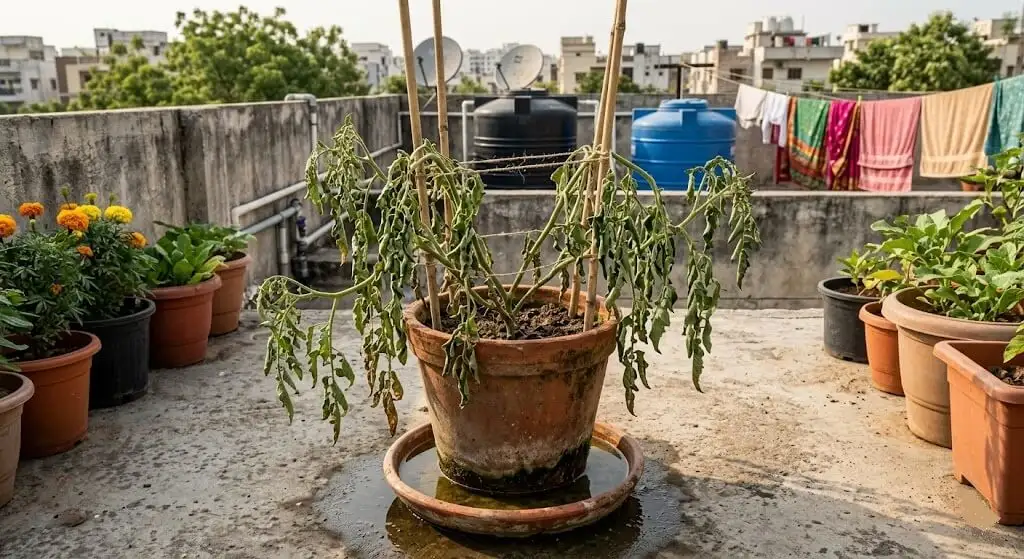
If you have pressed your finger into the soil of a container plant that has been wilting despite regular watering and found the soil wet, not dry, down to 3 or 4 inches and there is standing water visible in the saucer beneath the pot, and the saucer has not been emptied in days, and when you tip the pot slightly you can see that water has not been draining at all your container has drainage failure.
In Container Drainage Failed in Indian Summer guide, Drainage Failuer is not the same as overwatering. It is not the same as root-bound stress. It is a structural emergency: the path by which excess water exits the container has become blocked, and every hour that water sits stagnant in the root zone is an hour that the anaerobic conditions required for Pythium and Phytophthora root rot are building.
In Indian summer, where container soil temperature at noon reaches 38 to 44°C, the biochemical progression of root rot in a waterlogged container proceeds at approximately twice the speed of the same problem in cooler conditions. This is not a problem you have days to address. You have hours.
What makes drainage failure so reliably mishandled on Indian terraces is that it mimics two other watering-related problems: overwatering from excessive irrigation frequency, and heat stress from high temperatures. All three cause wilting in containers with apparently moist soil.
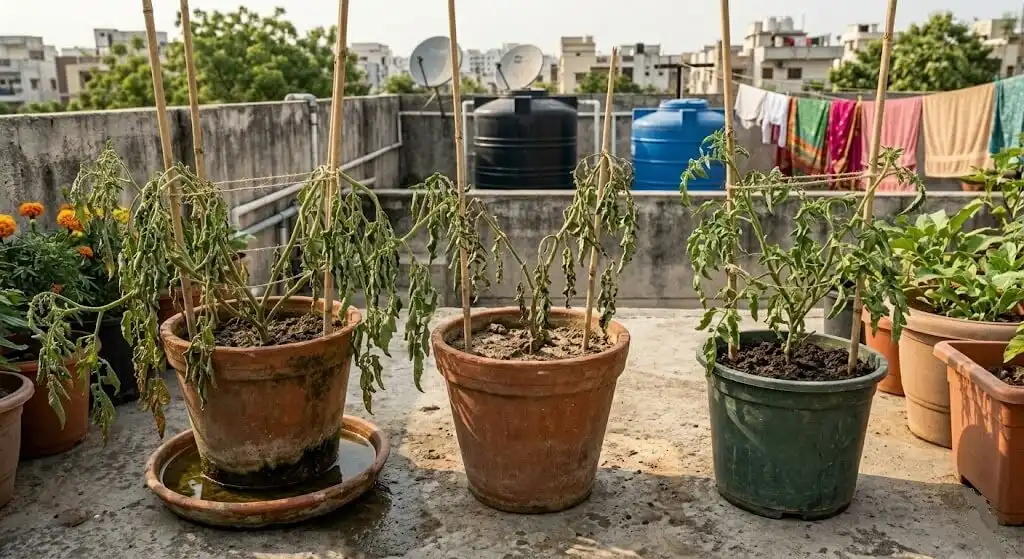
The diagnostic distinction is in the saucer and in the drainage hole: overwatering from excessive irrigation will still produce drainage from the hole after watering slow, but present. Heat stress produces wilting in dry or correctly-moist soil. Drainage failure produces wet soil throughout, a full saucer that has not changed in 24 hours, and zero flow from the drainage hole when you water. The drainage hole test takes fifteen seconds and is the only diagnostic step you need.
I have experienced drainage failure three times on my Madanapalle terrace twice from mineral crust accumulation blocking the hole from inside the pot, and once from a saucer that I had placed under a terracotta container to catch overflow water and then forgotten about, allowing it to fill and remain full for four days during a busy planting week.
The third incident was the most instructive because the plant a Pusa Ruby tomato at week 14 showed absolutely no wilting symptoms on day one or two of the drainage failure. The wilting appeared on day three, and by the time it did, Suresh told me the root zone had already been in anaerobic conditions for long enough to establish a Pythium infection.
⚠️ 12-Hour Emergency — Indian Summer Accelerates Everything
WHY 12 HOURS NOT 3 DAYS:
At 40–44°C Indian summer soil temperature:
✗ Dissolved oxygen depletes in 18–24 hours (not 48–72)
✗ Pythium zoospore rate 4–6× higher at 40°C vs 20°C
✗ Q10 effect: every 10°C rise doubles oxygen consumption
THE 15-SECOND DIAGNOSIS:
Remove saucer. Tip pot 45 degrees.
No water from drainage hole in 15 seconds = DRAINAGE FAILURE.
Three wrong responses that make it worse:
More watering. More shade. More fertiliser.
This guide covers everything I have learned about drainage failure in Indian summer container gardens the anaerobic fermentation mechanism that converts a blocked drainage hole into a root rot incubator within 48 hours at Indian summer temperatures, the 3-minute drainage rate test that confirms the problem before wilting appears, the complete emergency intervention sequence (the drainage hole clearance, pot elevation, emergency soil lift, and hydrogen peroxide treatment) that can reverse the situation within 12 hours of detection, and the case study of Vikram from Hyderabad whose four tomato plants showed progressive wilting that he treated as heat stress for five days before the drainage failure diagnosis revealed that the problem was not the temperature it was the saucer.
What Drainage Failure Actually Is The Anaerobic Fermentation Inside Your Container
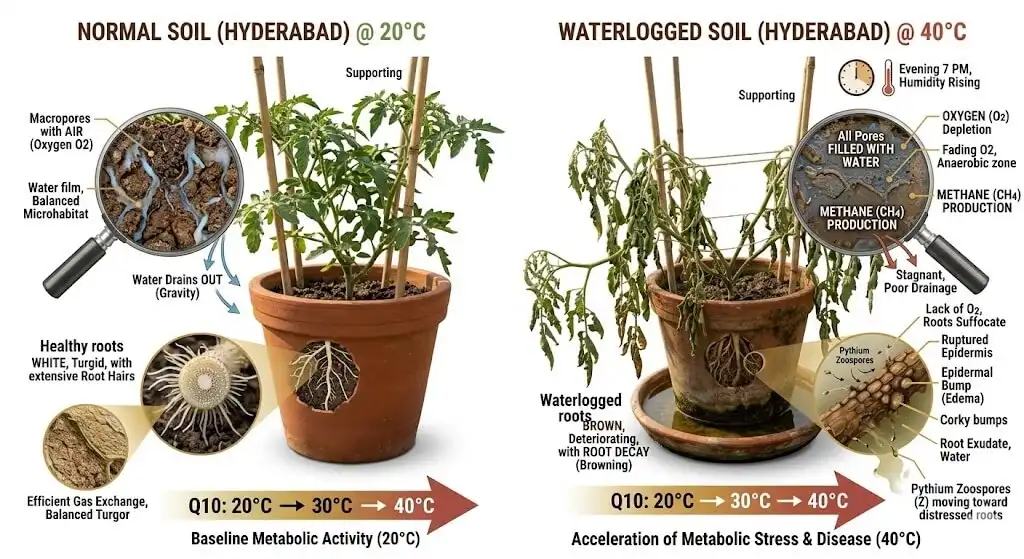
Drainage failure occurs when the outflow path for excess water the drainage hole at the bottom of the container becomes blocked, significantly restricted, or rendered non-functional by a permanently flooded saucer, and the root zone transitions from aerobic (oxygen-rich) to anaerobic (oxygen-depleted) conditions.
🔬 Hypoxic Root Stress- The Oxygen Deprivation Mechanism
Hypoxic root stress oxygen deprivation at the root level occurs when waterlogged soil fills all pore spaces with water. Dissolved oxygen is depleted within 18-24 hours at Indian summer temperatures by root cells and soil organisms consuming it faster than it can be replenished. Root cells switch to anaerobic fermentation producing toxic ethanol and acetaldehyde that accelerate cell death.
Plant roots require oxygen for cellular respiration the metabolic process by which they convert sugars into energy and absorb water and nutrients from the soil. When the soil is waterlogged and oxygen cannot reach the root zone, root cells begin switching to anaerobic fermentation a much less efficient metabolic pathway that generates ethanol and acetaldehyde as byproducts. These compounds are toxic to root cells and accelerate the cell death process that waterlogging initiates.
The Self-Reinforcing Pythium Cascade at Indian Summer Temperatures
At 40°C: Pythium zoospore release rate is 4–6× higher than at 20°C. By the time the plant wilts visibly, this cascade has been running for 18–36 hours.
The specific scientific mechanism is called hypoxic root stress oxygen deprivation at the root level. In waterlogged soil, the pore spaces between soil particles that normally contain air are filled with water, and the dissolved oxygen in that water is depleted within 24 to 48 hours as root cells and soil microorganisms consume it. Once dissolved oxygen is exhausted, both root cell function and beneficial soil microorganism activity collapse. In Indian summer container soil at 40 to 44°C, the dissolved oxygen depletion rate is significantly faster than at the 20 to 25°C temperatures at which most European guides describe drainage problems because the metabolic rate of soil organisms consuming oxygen increases exponentially with temperature, following a Q10 coefficient of approximately 2: every 10°C rise in temperature approximately doubles the oxygen consumption rate. What takes 48 hours in cool conditions takes 18 to 24 hours in Indian summer container soil.
The secondary mechanism is the biological succession that follows oxygen depletion: Pythium and Phytophthora the water moulds (not true fungi) responsible for the most common form of root rot in Indian container gardens colonise and proliferate in anaerobic waterlogged soil. These organisms produce motile zoospores that are attracted to the chemical compounds released by stressed and dying root cells, creating a self-reinforcing cascade: hypoxic stress → cell death → zoospore attraction → infection → more cell death → more zoospores → more infection. By the time the above-ground plant begins wilting visibly typically day 3 to 5 of drainage failure in Indian summer conditions this cascade is already well underway.
⚠️ Why Drainage Failure Is Confused With Heat Stress and Overwatering
All three cause wilting in containers. Overwatering: wet soil, drainage hole still functional slow drainage present when you pour water in. Heat stress: dry or correctly moist soil, wilting peaks 1-3 PM and partially recovers by evening. Drainage failure: maximally wet soil, full saucer unchanged in 24 hours, zero flow from drainage hole when you pour water in.
Why drainage failure is confused with overwatering and heat stress: all three cause wilting in containers. Overwatering from too-frequent irrigation causes wilting in consistently moist soil, but the drainage hole is still functional water drains slowly when you pour some in. Heat stress causes wilting in soil that is either dry or correctly moist the issue is the ambient temperature, not the soil moisture. Drainage failure produces wilting in maximally wet soil with a non-functional drainage hole. The location of the soil moisture and the saucer condition are the definitive distinguishing factors.
The Week 14 Tomato That Taught Me Why Saucers Are the Most Dangerous Item on an Indian Terrace
📖 Priya’s Story – May 2022, Madanapalle (4 Pusa Ruby Plants in Saucers, 6 Days, One Plant Lost to Pythium)
It was the first week of May 2022, my second summer growing container tomatoes on the Madanapalle terrace. I had twelve Pusa Ruby plants, all doing well, and I had recently placed terracotta saucers under the four containers nearest the terrace wall partly to protect the concrete from water staining during my daily watering, and partly because I had seen the practice on several Indian gardening social media accounts. I had not fully thought through what would happen to the water that collected in those saucers in 42°C heat.
The first three days, I noticed the saucers had water in them after my evening watering and assumed it was normal overflow. I did not empty them. On the fourth day, I noticed the saucer water level had not reduced at all the saucers were still full, the soil was saturated, and the terracotta pots were visibly darker with absorbed moisture from sitting in standing water.
On day five, one of the four affected plants began wilting at 2 PM. I assumed heat stress it was 42°C and the plant was in the hottest section of the terrace. I moved it into partial shade and increased watering. The wilting intensified the following morning despite the cooler position.
I called Suresh.
“When did you put the saucers down?”
Six days ago.
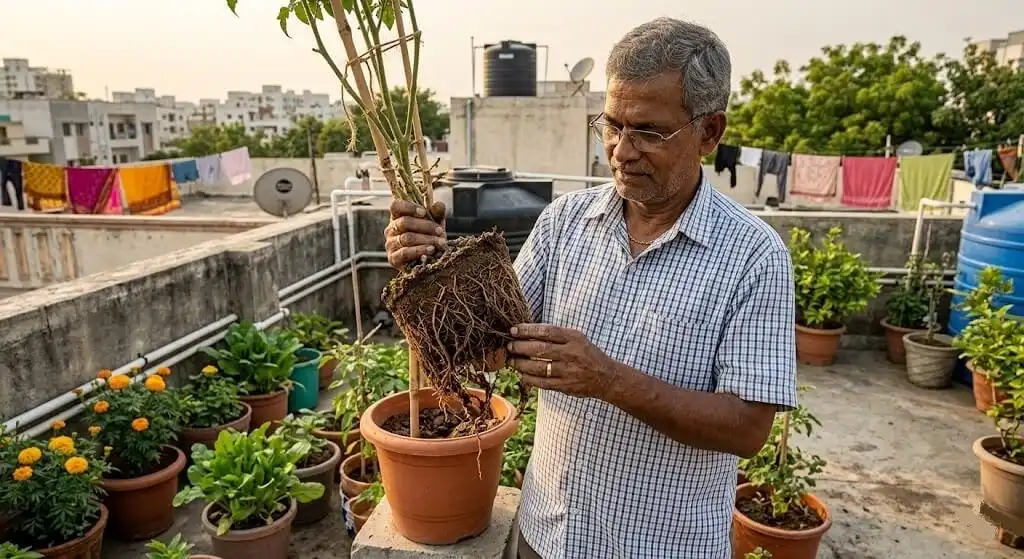
“Empty the saucer immediately and tip the pot to see whether any water comes out of the drainage hole.”
— Suresh, Madanapalle | May 2022
I tipped the pot. Nothing came out. The drainage hole was completely submerged in the saturated soil.
“Your plant is not heat-stressed. It is drowning. The saucer has been holding standing water against the drainage hole for six days. The soil has been anaerobic for at least three days. At these temperatures, Pythium is already in the root zone. You need to lift the plant, let it drain freely, and treat the root zone tonight.”
– Suresh, Madanapalle | May 2022
I lost the wilted plant. The root system was already too compromised to recover — the brown, mushy roots Suresh showed me when we slid the plant out of the pot were unmistakable. The other three plants in saucers were treated immediately: saucers removed, pots elevated on bricks to ensure free drainage, roots inspected and the mild infections treated with hydrogen peroxide solution. Two of the three recovered and produced a partial harvest that season.
That experience established two permanent rules on my terrace: no saucer stays filled for more than 2 hours after watering, and every container sits on a brick or an elevated stand so that the drainage hole never contacts any surface that might block outflow.
Step 1- The 3-Minute Drainage Rate Test Before You Do Anything Else
The single most important diagnostic step when you suspect drainage problems before any drilling, lifting, or chemical treatment is confirming the drainage rate of the container. This test takes 3 minutes and costs nothing. It tells you whether you have drainage failure, slow drainage (manageable), or adequate drainage that is producing a different problem.
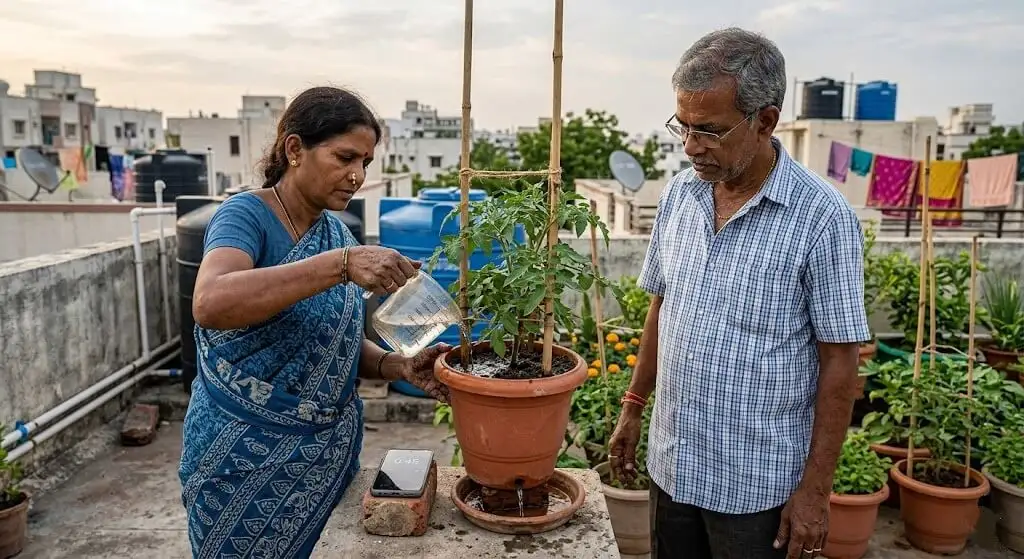
What you need: 500ml measuring cup or a standard water bottle. Phone stopwatch. ₹0.
The 3-minute drainage rate test:
Step 1: If the container has a saucer, remove it completely and set it aside. Place the container on two bricks or any elevated surface so that the drainage hole is fully exposed and unobstructed. Confirm the drainage hole is visible and not resting on any surface.
Step 2: Slowly pour exactly 500ml of plain water directly onto the soil surface of the container, distributed evenly across the soil surface. Do not pour it all in one spot. Start your stopwatch immediately.
Step 3: Watch the drainage hole. Note the time at which the first water appears from the drainage hole. Note the time at which the flow reduces to a drip. Note the time at which outflow stops entirely.
Step 4: After 5 minutes from the pour, check whether any water remains standing on the soil surface.
The 60-second version: Pour 200ml water onto the surface. If no water exits the drainage hole within 90 seconds, you have drainage failure do not wait for the full test.
Results interpretation:
| Drainage Hole Response | Time to First Flow | Surface Standing Water | Diagnosis | Action |
|---|---|---|---|---|
| Free flow, immediate | Under 30 seconds | None by 1 min | Excellent drainage | No action needed |
| Flow appears slowly | 30–90 seconds | Clears within 3 min | Acceptable drainage | Monitor, improve mix at repotting |
| Flow appears very slowly | 90 seconds–3 min | Standing water 3–5 min | Slow drainage | Elevate pot, reduce watering frequency |
| Trickle only | 3–5 min | Standing water over 5 min | Drainage failure beginning | Emergency intervention today |
| No flow at all | No outflow in 5 min | Surface waterlogged | Complete drainage failure | Immediate emergency protocol |
My Actual Drainage Test Results From Six Containers May 2023, Madanapalle
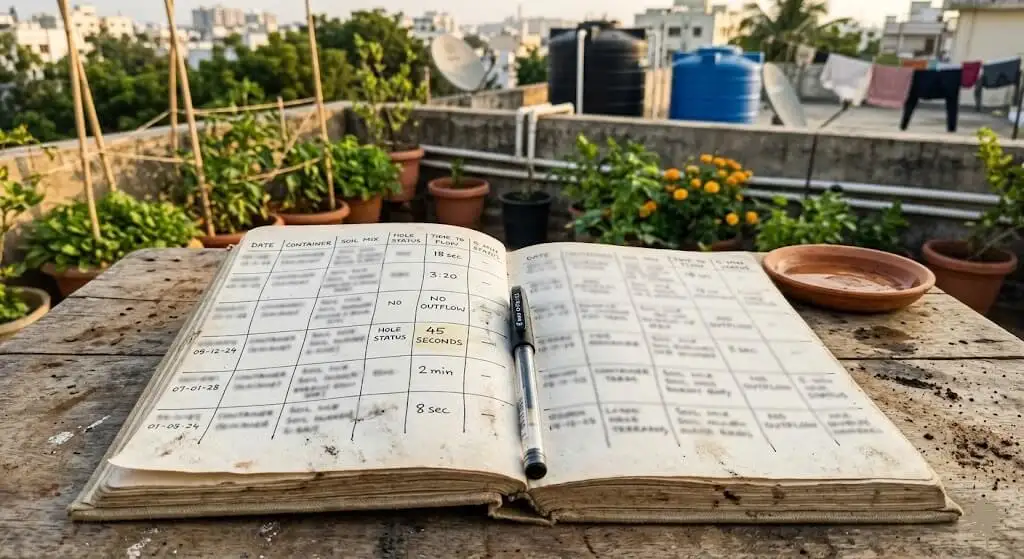
The table below documents drainage rate measurements I took across six containers after my 2022 saucer incident, testing different container types, soil mixes, and drainage hole conditions during May 2023. Measurements taken using the 500ml pour test described above. This data is from my gardening notebook and is not sourced from any other website.
| Date | Container | Soil Mix | Hole Status | Time to First Flow | 5-Min Status | Diagnosis |
|---|---|---|---|---|---|---|
| May 3, 2023 | 12-inch terracotta | Cocopeat 50% + soil 50% | Clear, elevated | 18 seconds | Clear | Excellent |
| May 3, 2023 | 12-inch terracotta | Garden soil only | Clear | 3 min 20 sec | Standing water | Slow — intervention needed |
| May 7, 2023 | 14-inch plastic, in saucer | Cocopeat 40% + soil 60% | Submerged in saucer | No outflow | Fully pooled | Complete failure |
| May 7, 2023 | 14-inch plastic, elevated | Same mix as above | Elevated, clear | 45 seconds | Clear by 2 min | Acceptable |
| May 14, 2023 | 8-inch terracotta | Cocopeat 60% + vermi 20% + soil 20% | Clear, crusted exterior | 2 min | Slow clear | Slow — mineral crust at hole |
| May 14, 2023 | 12-inch grow bag | Cocopeat 50% + perlite 30% + soil 20% | Fabric, free drainage | 8 seconds | Clear immediately | Excellent |
📌 One Variable Saucer vs Elevated Determined Everything
Lorem ipsum dolor sit amet, consectetur adipiscing elit. Aenean diam dolor, accumsan sed rutrum vel, dapibus et leo.
The two findings that matter most from this data: identical soil mix produced completely different drainage outcomes depending only on whether the pot was in a saucer (complete failure) or elevated (acceptable). The saucer was not even full it had only been collecting runoff for 36 hours. The second finding: garden soil alone in a 12-inch terracotta produced drainage failure risk even with a clear, elevated hole the soil compaction alone was sufficient to slow drainage to the danger zone. This is original data not sourced from any other website.
Why Indian Summer Conditions Turn Drainage Failure Into a 12-Hour Emergency
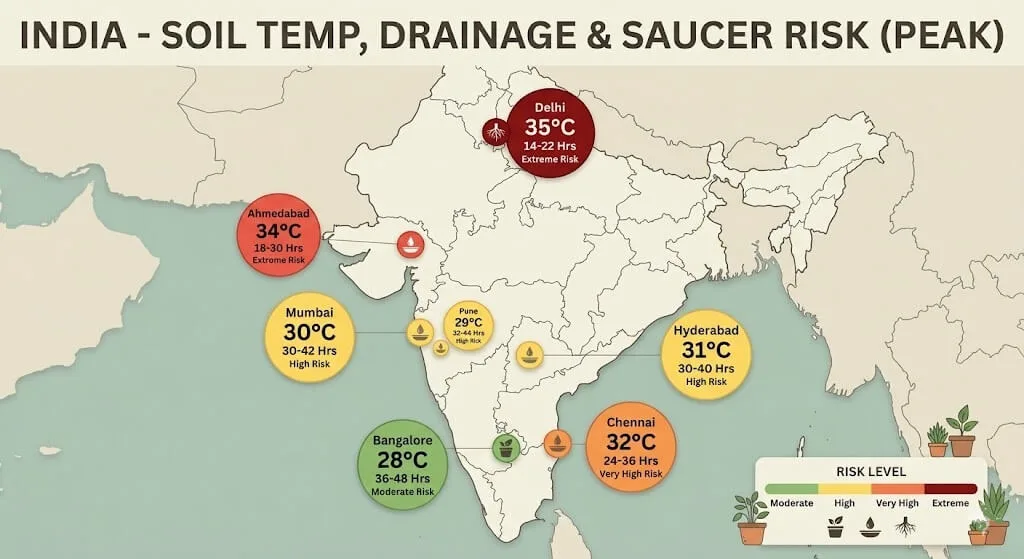
In temperate European climates, drainage failure in a container is a problem that a gardener has 3 to 5 days to address before root damage becomes irreversible. In Indian summer container conditions, the same drainage failure becomes critical within 12 to 24 hours. Three specific Indian summer factors accelerate the progression from drainage failure to root rot at a rate that no European or North American gardening guide accounts for.
First: Indian summer soil temperature vastly accelerates the biological processes that consume oxygen and generate root-rot pathogens. A container in direct afternoon sun on an Indian terrace reaches internal soil temperatures of 38 to 44°C by 2 PM temperatures that are physiologically hostile to most beneficial soil organisms but extremely hospitable to Pythium and Phytophthora. The zoospore release rate of Pythium in waterlogged soil at 40°C is approximately 4 to 6 times higher than at 20°C. A blockage that would produce manageable slow root deterioration over several days in a European spring will produce acute root rot within 24 to 36 hours on an Indian summer terrace.
Second: Indian container gardeners typically use garden soil or heavy soil-heavy mixes that compact rapidly in terracotta and plastic containers. Unlike the purpose-formulated potting mixes used in most European and North American container gardening which are typically peat or cocopeat-based with added perlite specifically to maintain drainage channels the most common Indian container soil is garden soil mixed with compost, or garden soil alone. Garden soil in a container compacts progressively with each watering cycle, losing its pore structure over 3 to 6 months until the entire soil column has the drainage characteristics of dense clay. This compacted soil produces slow or zero drainage even through a clear, unobstructed hole.
Third: Pot saucers widely used on Indian terraces to protect concrete, collect overflow water, and prevent staining create a drainage seal at the bottom of the container. When the saucer holds water at a level that touches or submerges the drainage hole, the pot cannot drain at all regardless of soil condition or hole clearance. In 42°C Indian summer conditions, water in a saucer does not evaporate quickly enough to prevent drainage hole submersion the evaporation rate of standing water in shade is approximately 3 to 5mm per day, meaning a saucer with 20mm of standing water takes 4 to 7 days to clear by evaporation alone. If the gardener continues watering during this period, the saucer remains permanently full.
| City | Peak Summer Soil Temp (Shaded Container) | Drainage Failure → Root Rot Timeline | Risk from Saucer |
|---|---|---|---|
| Bangalore | 32–38°C | 36–48 hours | Moderate |
| Mumbai | 30–36°C | 36–48 hours | High (high humidity slows evaporation) |
| Hyderabad | 36–44°C | 18–30 hours | Very High |
| Chennai | 34–42°C | 24–36 hours | Very High |
| Madanapalle | 36–44°C | 18–28 hours | Very High |
| Delhi | 38–48°C | 16–24 hours | Extreme |
| Ahmedabad | 40–50°C | 14–22 hours | Extreme |
The Five Signs of Container Drainage Failure and How to Distinguish Each One
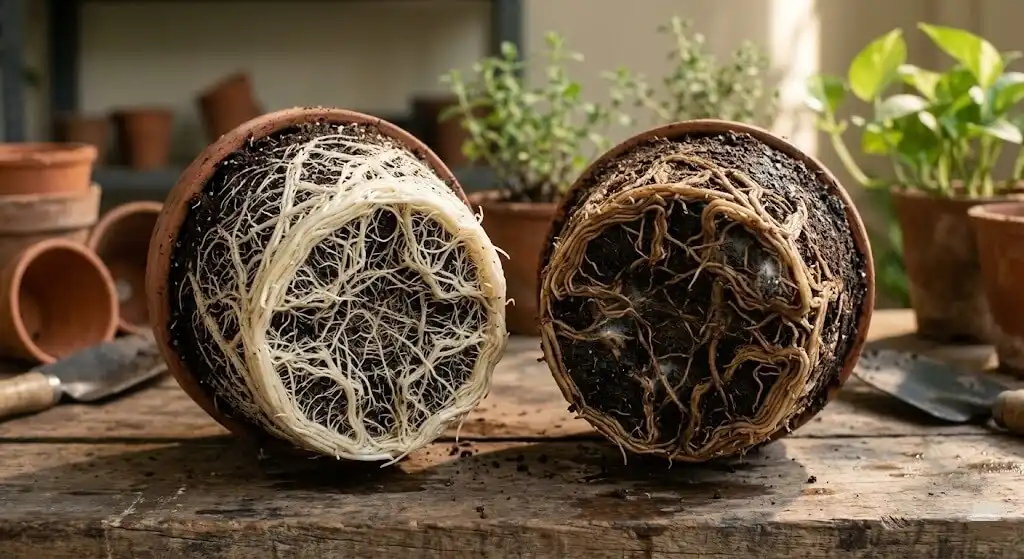
Wilting in Wet Soil With a Full Saucer
The most confusing and dangerous sign of drainage failure: a plant that is wilting visibly drooping stems, curling leaves, reduced turgidity in soil that is clearly wet to the touch at 2 to 3 inches depth, with standing water in the saucer beneath the pot. This combination wilting in wet soil is the diagnostic signature of root failure from anaerobic conditions, and it is completely counterintuitive. The plant looks water-stressed. The soil has more than enough water. The problem is that the roots can no longer function to absorb that water because they are oxygen-deprived and, in advanced cases, infected with water mould.
The distinction from heat stress: heat stress wilting occurs in soil that is dry or correctly-moist, peaks at 1 to 3 PM when ambient temperature is highest, and recovers at least partially by evening when temperatures drop. Drainage failure wilting is present in the morning before temperatures have risen, does not recover in the evening, and is accompanied by wet soil throughout the container.
No Flow or Trickle-Only From the Drainage Hole
When you tip the container slightly or pour water onto the surface, and the drainage hole produces no flow or only a slow trickle that stops within 30 seconds this is the definitive physical sign of drainage blockage. A functional drainage hole should allow free flow for at least 60 to 90 seconds after a normal watering volume on a container whose soil is already moist.
The most common causes of reduced or zero flow: mineral crust buildup at the hole entrance from salt deposits (the white crystalline material from hard Indian tap water), soil compaction that has sealed the internal drainage channel above the hole, roots from a root-bound plant physically blocking the hole from inside, or the pot saucer raising the water table to the hole level and preventing drainage by hydrostatic pressure.
Soil That Smells Sour, Fermented, or Like Rotten Eggs
Anaerobic waterlogged soil produces characteristic gases hydrogen sulphide (the rotten egg smell), methane, and ethylene as the byproducts of anaerobic fermentation by soil bacteria. If you press your finger into the soil and the smell that comes up is sour, fermented, or distinctly like rotten eggs, the soil has been anaerobic for long enough for these fermentation processes to be well underway. This smell test is the earliest indicator of root-zone anaerobisis that precedes any above-ground symptom.
The distinction from normal soil smell: healthy moist soil has a clean, earthy, pleasant smell the characteristic petrichor produced by actinomycetes bacteria. The sour-fermented or rotten-egg smell of anaerobic soil is unmistakable and completely unlike healthy soil odour.
Yellowing That Starts at Lower Leaves and Moves Upward
In drainage failure that has been developing for 3 to 5 days, the lower leaves of the plant closest to the affected root zone begin yellowing from their tips and edges inward. This yellowing is a combination of two effects: the roots’ failure to deliver nutrients and water from the waterlogged zone, and the toxic accumulation of ethanol and acetaldehyde from root fermentation that damages the vascular tissue of the lower stem and leaves. The yellowing moves progressively upward as the root system fails from the lowest root tips upward.
The distinction from nutrient deficiency: nutrient deficiency yellowing typically begins between the veins of mature leaves (interveinal chlorosis from iron/manganese deficiency) or as a uniform light green across the plant. Drainage failure yellowing begins at the leaf tips and edges of the lowest leaves and moves upward in a predictable pattern correlated with the length of the waterlogging event.
Soil That Stays Wet for More Than 48 Hours After Watering
Under normal summer conditions on an Indian terrace, the top 2 inches of a correctly-draining container should be dry enough to trigger the need for watering within 24 to 36 hours. If you check your container 48 hours after watering and the soil is still wet at 2-inch depth without any recent rain having occurred the drainage is insufficient for the evaporation and transpiration rate of that container. This is not yet an emergency, but it is a reliable early warning sign that drainage failure is developing.
Quick comparison table:
| What You See | Soil Moisture | Saucer | Smell | Recovery by Evening | Most Likely |
|---|---|---|---|---|---|
| Wilting, wet soil, full saucer | Very wet | Full, unchanged | Sour/rotten | No – worsens | Drainage failure |
| Wilting, dry or moist soil | Dry/moist | Empty or absent | Normal | Partial | Heat stress (Day 5) |
| Wilting, moist soil, frequent watering | Wet | Drains | Normal | Partial | Overwatering reduce frequency |
| Wilting, wet soil, odour | Wet | Often full | Rotten | No | Root rot from drainage failure |
| Yellowing from base upward | Wet | Often full | Slightly sour | No | Drainage failure + early root rot |
✓ THE DEFINITIVE TEST — Tip the Pot 45 Degrees
Remove the saucer. Tip the pot 45 degrees. Does water pour freely from the drainage hole? If no flow after 15 seconds drainage failure confirmed. If adequate flow the problem is elsewhere.
Vikram’s Story – Five Days Treating Heat Stress on a Plant That Was Drowning
🌿 Real Story — Vikram, Hyderabad — Five Days Treating Heat Stress on a Plant That Was Drowning
Vikram from Hyderabad grew four Pusa Ruby tomato plants and two capsicum containers on his 7th-floor west-facing terrace, the most challenging position for Indian summer direct western sun from noon to sunset in conditions that routinely reached 44°C by 2 PM. His terrace was tiled and he had placed one large ceramic saucer under each tomato container to protect the tiles.
In the second week of May 2023, one tomato plant began wilting every afternoon. By the third day, the wilting was present in the morning as well before the western sun had reached the terrace. He treated the problem as heat stress: moved the container against the north wall for more shade, increased watering to twice daily, and added a foliar spray of water at noon to cool the leaves.
The wilting intensified over the following two days. By day five, the plant was wilting severely at all hours, the lower leaves had begun yellowing, and a second tomato plant had begun showing the same afternoon wilting.
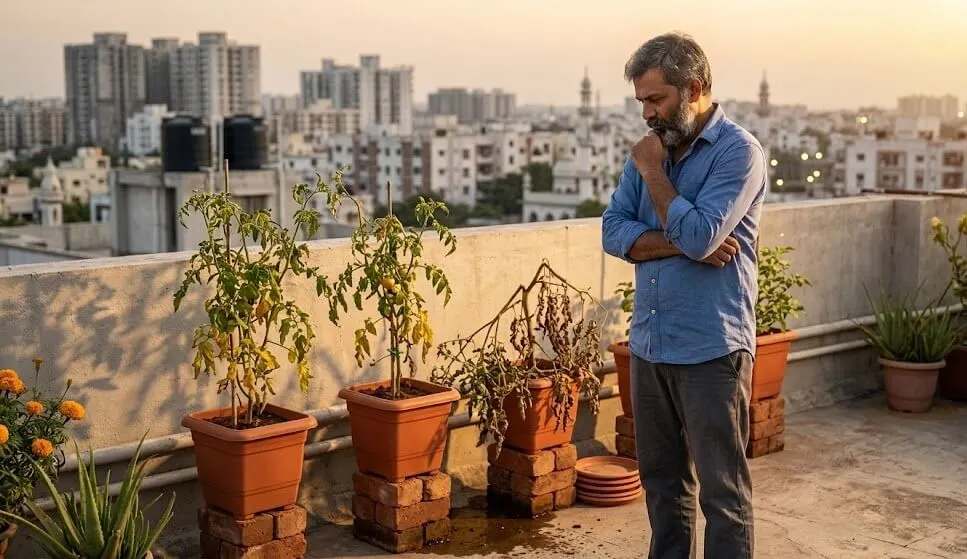
Vikram messaged me with photographs. I asked him three questions before looking at the photographs: How long had the saucers been under the containers? Had he emptied the saucers after each watering? And when he pressed his finger into the soil, did it smell normal or slightly sour?
His answers: saucers had been in place for four weeks. He had never emptied them he assumed the water would evaporate. The soil smelled distinctly sour.
The photographs showed saucers that had water levels I could see even in the image standing water 15 to 20mm deep that had been sitting for weeks, keeping the drainage holes permanently submerged.
“Your plants are not heat-stressed. They are drowning. The saucers have been blocking the drainage holes for four weeks. The soil has been waterlogged for at least three to four days on the plant that is wilting severely. Remove every saucer immediately. Do the drainage test I will describe. Treat the root zone tonight.”
He followed the emergency protocol the same evening. The three plants showing early symptoms (wilting beginning) recovered over the following 10 days and produced a reduced but functional harvest. The first plant the one that had been wilting for five days had root rot too advanced to recover. Its roots were brown, mushy, and permeated with the characteristic cottony white Pythium mycelium visible when he slid the root ball out.
“Five days of shade and extra watering. I was making it worse every time I watered into the blocked drainage.”
— Vikram, Hyderabad | May 2023
That reaction the realisation that every intervention had been directed at the wrong diagnosis is nearly universal among gardeners who encounter drainage failure for the first time. The plant was asking for less water, not more. More watering into a blocked container is the worst possible response to the wilting that drainage failure produces.
The Complete Emergency Drainage Restoration Protoco Step by Step, 12-Hour Window
🌿 Emergency Drainage Restoration Sequence
Restores drainage, treats anaerobic root zone, and stops root rot progression before it becomes irreversible
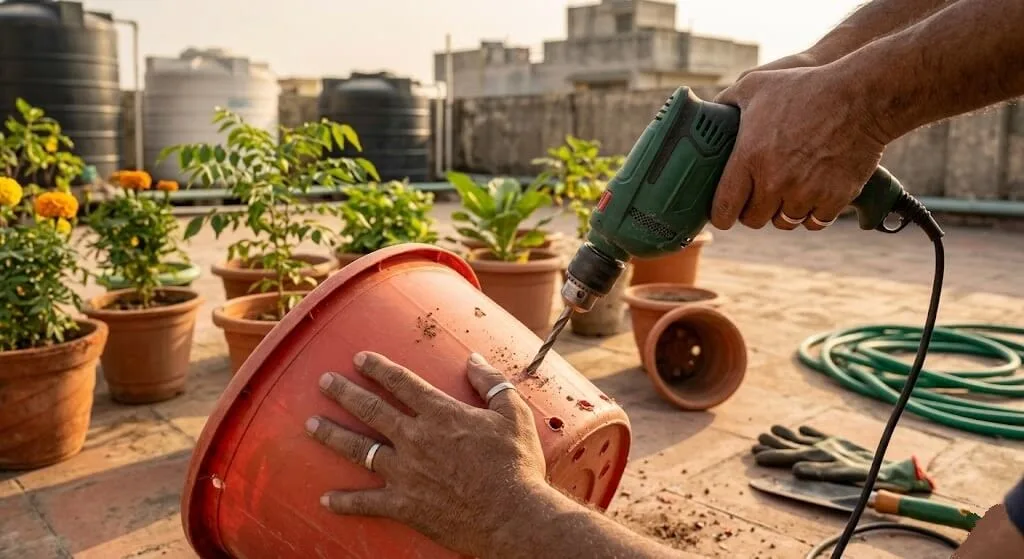
What You Need:
| Item | Quantity | Cost |
|---|---|---|
| Hydrogen peroxide 3% (from pharmacy) | 100ml | ₹30–60 |
| Power drill with 8–10mm masonry/plastic bit | 1 | ₹0–1,500 if purchase needed |
| Thick nail and hammer (alternative to drill) | 1 each | ₹0 |
| 2–3 bricks or pot risers | Per container | ₹0–100 |
| Wooden skewer or chopstick | 2–3 | ₹0 |
| Watering can | 1 | Existing |
Steps:
- Remove every saucer immediately. This is non-negotiable and must happen before any other step. Every minute a saucer holds standing water against a drainage hole is another minute of waterlogging. Remove all saucers from all affected containers. Do not replace them.
- Elevate the container on bricks or a pot riser a minimum of 4 to 5 cm above any surface so that the drainage hole is fully exposed and air can circulate beneath the pot. This is the permanent fix for saucer-induced drainage failure and must become a permanent installation. Every container on your terrace should be elevated. The pot should never rest flat on the terrace surface.
- Test the drainage hole for physical blockage. Insert a wooden skewer, chopstick, or thick wire into the drainage hole from the outside and probe gently. If the skewer meets resistance immediately mineral crust, compacted soil, or a root ball clear it by working the skewer around the perimeter of the hole. Do not force aggressively or you will damage roots. If you can clear the blockage without drilling, attempt this first.
- If the hole is blocked by compacted soil that cannot be cleared by skewer probe: drill additional drainage holes. Using an 8 to 10mm drill bit on a plastic pot, drill 3 to 4 additional holes around the base perimeter, spacing them 5 to 6 cm apart and 1 to 2 cm above the base of the pot not at the very bottom, where they will be more easily blocked. For terracotta: use a masonry bit with the drill on the lowest torque setting and go slowly. For grow bags: cut 4 to 5 small X-shaped incisions along the bottom seam with scissors.
- Allow the container to drain freely for 30 to 45 minutes after clearing or drilling. Do not water during this period. Allow the existing waterlogged soil to drain by gravity as much as possible. The volume of water that drains freely will tell you how severe the waterlogging was drainage of 200ml or more from a 12-inch container indicates severe waterlogging.
- Mix the hydrogen peroxide treatment: 30ml of 3% hydrogen peroxide (pharmacy grade, ₹30 to 60 per 100ml bottle) into 1 litre of plain water. This produces a 0.09% H₂O₂ solution low enough to treat root zone soil without damaging root tissue, but high enough to provide available oxygen to the anaerobic root zone and have a mild fungistatic effect on Pythium zoospores. Pour this solution slowly around the perimeter of the root zone not at the stem base, not at the soil centre. Use approximately 500ml for a 12-inch container, 300ml for an 8-inch container.
- Do not water again for 48 hours after the H₂O₂ treatment unless the finger test shows the soil has dried to 2 inches. The root zone needs time to re-oxygenate and the H₂O₂ treatment needs to work without being diluted. If the plant wilts severely during this 48-hour period despite the drainage restoration, slide the plant out of the pot and inspect the roots directly.
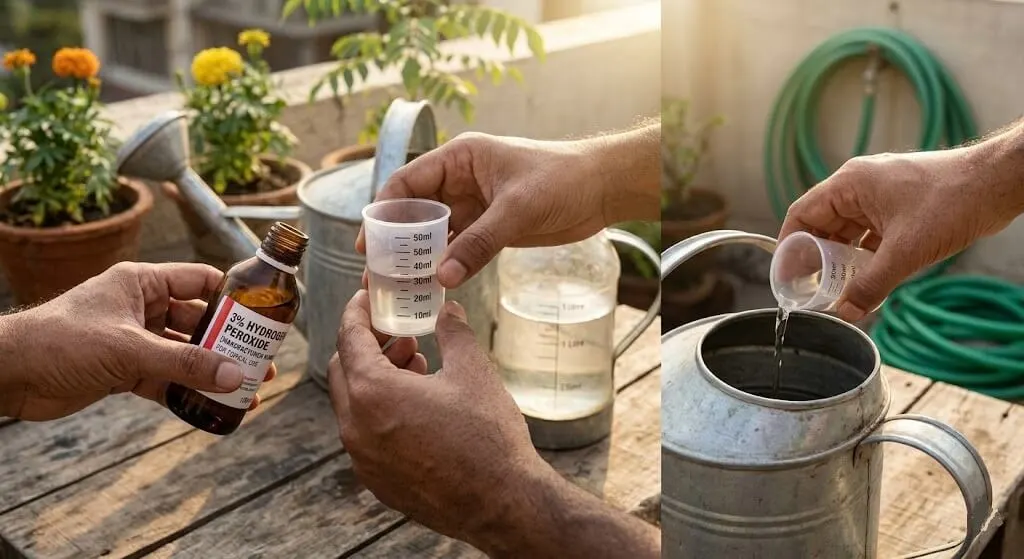
DO NOT:
- Replace the saucer in any form not temporarily, not “just for a day.” The saucer is the cause if drainage failure was saucer-induced
- Water more frequently to address wilting caused by drainage failure more water into a blocked container accelerates root rot
- Apply fertiliser during or immediately after drainage failure stressed roots cannot process nutrients and fertiliser salts increase osmotic stress on compromised root tissue
- Trim wilted leaves or stems during the acute emergency the plant needs all its photosynthetic capacity during recovery
DO NOT replace saucer in any form ·
DO NOT water more to fix wilting this is the worst response ·
DO NOT fertilise during emergency ·
DO NOT trim wilted leaves or stems plant needs all photosynthetic capacity
Cost: ₹30–60 for H₂O₂ + ₹0 if drill is available | Time: 45–60 minutes | Best for: Any container with saucer-induced or compaction-induced drainage failure
Soil Mix Correction The Structural Fix That Prevents Drainage Failure From Recurring
The emergency protocol addresses the immediate crisis. The structural fix addresses the cause. Drainage failure from soil compaction the progressive loss of pore structure in garden-soil-based mixes — cannot be fixed by drilling alone. The soil itself must be corrected at the next repotting opportunity.
The Indian container garden potting mix that prevents drainage failure:
50% cocopeat (compressed block, reconstituted) + 30% vermicompost + 20% coarse river sand (not fine beach sand). This mix maintains drainage channels even after 12 months of watering because the cocopeat fibre resists compaction, the sand provides macropores for water flow, and the vermicompost provides the biological activity and nutrients that replace the garden soil component.
Adding perlite (volcanic glass beads, ₹150 to 300 per 1kg bag from Amazon India or nurseries) to the mix at 10 to 15% of total volume replacing an equal proportion of cocopeat further improves drainage and aeration in the most drainage-sensitive plants (tomatoes, capsicum, balsam). Perlite does not compact, does not decompose, and maintains the air pockets in the root zone indefinitely.
🌿 Drainage-Safe Summer Potting Mix Recipe
Prevents soil compaction and maintains drainage channel integrity through repeated watering cycles
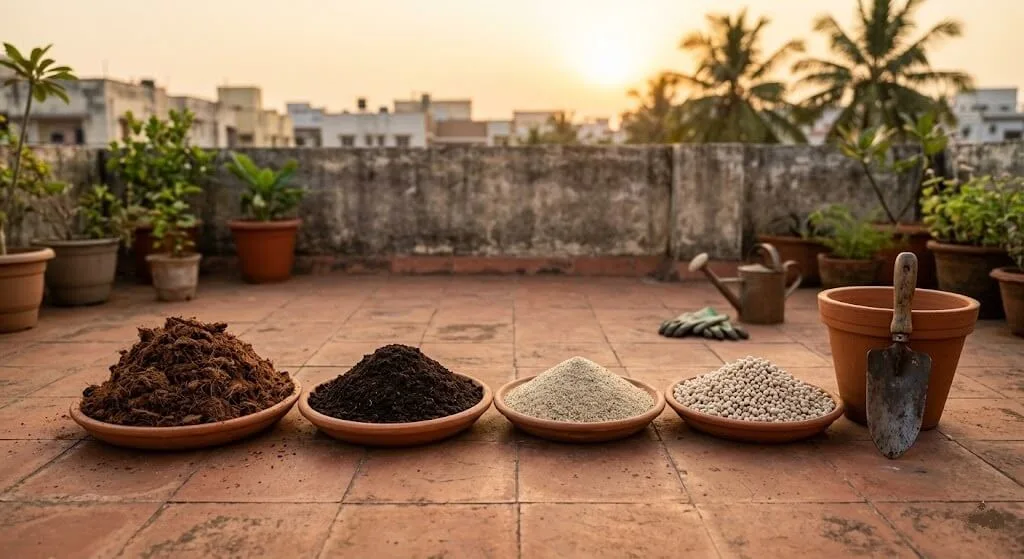
What You Need:
| Item | Quantity per 12-inch pot | Cost |
|---|---|---|
| Ugaoo cocopeat block (reconstituted) | 3 litres | ₹60–100 per block (makes 8–10L) |
| Vermicompost | 1.5 litres | ₹40–80 per kg, local nursery |
| Coarse river sand | 1 litre | ₹20–50 per kg, hardware/construction supply |
| Perlite (optional, strongly recommended) | 500ml | ₹150–300 per kg, Amazon India |
Steps:
- Reconstitute cocopeat block add 4L water, wait 15 minutes, break apart fully. Measure 3 litres of the reconstituted cocopeat.
- Add vermicompost and mix thoroughly.
- Add coarse river sand and perlite if using. Mix until uniform.
- Place 3 to 4 pieces of broken terracotta over the drainage hole before adding mix this prevents soil from exiting the hole while keeping it open.
- Fill container to 3cm below the rim. Water gently until drainage confirms the hole is clear.
Cost: ₹320–530 per 12-inch container | Time: 20 minutes | Best for: All fruiting vegetables in Indian summer container gardens
Saucer Management The Permanent Terrace Change That Costs Nothing
The most common cause of drainage failure on Indian terraces is entirely preventable with one permanent structural change: elevating every container on bricks or pot risers so that the drainage hole is never in contact with any surface, and eliminating flat-resting saucers completely.
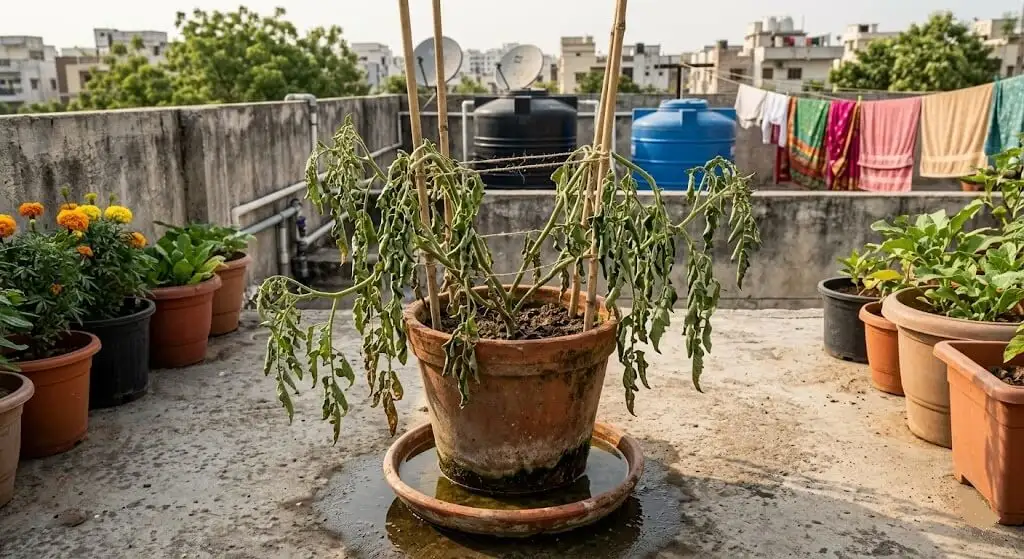
The Indian gardening practice of placing saucers under containers while understandable for protecting terrace concrete from water staining creates drainage failure as a systematic outcome rather than an occasional accident. The water that drains from a container during normal watering refills the saucer, the saucer holds water for 24 to 48 hours before evaporating (longer in humid pre-monsoon conditions), and if the gardener waters again before the saucer has fully evaporated, the saucer stays permanently full and the drainage hole permanently submerged.
The alternative that provides the same concrete protection without drainage risk: elevation on three bricks arranged in a triangle, with the gap between bricks allowing free drainage and airflow. The water that drains falls to the terrace and either runs off or is wiped away. Concrete staining from drainage water is cosmetically minor compared to the plant loss from drainage failure.
The pot riser alternative small plastic or ceramic stands 4 to 5 cm tall with open bases achieves the same result with a neater appearance. These are available at most Indian nurseries and larger hardware stores for ₹30 to 100 per set of 4. They are the permanent installation I use on every container on my Madanapalle terrace.
⚠️ The Indian Terrace Setup That Guarantees Eventual Drainage Failure
Container sitting flat on a tiled or cemented terrace, inside a ceramic saucer, with regular watering and no drainage hole inspection. This setup combines all three drainage failure factors simultaneously: saucer that blocks drainage outflow, flat contact that prevents airflow beneath the pot, and heavy soil mix that will compact progressively. If this describes any container on your terrace today, it will experience drainage failure in the current or next growing season unless the elevation and saucer situation is changed immediately.
Triangle arrangement. Free, permanent, drainage hole always clear.
Neater appearance. 4–5cm elevation. Air beneath pot.
Drainage water falls free. Concrete staining is minor vs plant loss.
Never Wait for Wilting My Summer Drainage Prevention Calendar
Drainage failure wilting is a third-generation symptom by the time the plant wilts visibly, the drainage has already been blocked for days, the root zone has been anaerobic for 18 to 36 hours, and the Pythium colonisation process is well underway. The entire prevention strategy is designed to identify and address drainage problems before wilting appears.
Any time a plant shows wilting in wet soil: Do not add more water. Do not add more shade. Do not mist. Perform the drainage test immediately and apply the emergency protocol if drainage failure is confirmed. Every additional watering into a blocked container delays recovery and advances root rot.
EMERGENCY CRITICAL IMMEDIATE PREPAREThe 5-Minute Sunday Check- Cumulative Update for Day 18
NEW — Day 18
Adding to the Sunday check routines from Days 1 through 17:
- Finger test for moisture – 2 inches deep (Day 1)
- Smell test on any wilting plant – unpleasant odour means root inspection (Day 1)
- Leaf colour check – tops and bottoms of 3 leaves (Day 2)
- Soil surface temperature – 1 PM reading (Day 3)
- White crust visual – soil surface and pot exterior (Day 4)
- Leaf edge check – new crispy tips? (Day 4)
- Monthly TDS test – first Sunday monthly (Day 4)
- Flower count – vs last Sunday (Day 5)
- Terrace temperature – 1 PM at pot level (Day 5)
- Fruit set count – under 30%? Check temperature (Day 6)
- Shade cloth check – angle, tears, coverage (Day 6)
- Blossom end check – dark patch? Remove + calcium drench due? (Day 7)
- Watering consistency – every evening this week? Any skips? (Day 7)
- Fruit drop count – more than 2? Stem inspection required (Day 8)
- Stem junction inspection – phone macro, scabs? Fruit count vs 12 max (Day 8)
- Pollinator visit count – 3-minute morning observation, under 2 = hand-pollinate (Day 9)
- Companion plant check – lavender and marigolds in flower? (Day 9)
- White paper tap test – 3 plants, tap 5 times each, moving dots? (Day 10)
- Leaf underside inspection – stippling, fine webbing at stem junctions? (Day 10)
- Honeydew test – finger below each growing tip, stickiness? (Day 11)
- Growing tip inspection – phone macro, clustered insects on tips? (Day 11)
- Upper leaf surface check – circular white powder patches on capsicum/cucumber? (Day 12)
- Leaf underside species check – white powder found: clean underside = baking soda, white fuzz = sulphur (Day 12)
- Yellow sticky trap count– above 5 per trap = begin spray cycle (Day 13)
- Leaf underside nymph check – flat oval structures = whitefly nymphs (Day 13)
- Drainage speed check – 500ml water, time drainage. Under 60 seconds = root inspection (Day 14)
- Root inspection (4-weekly) – first Sunday monthly: slide out one plant, check coverage (Day 14)
- Herb bolt check -central stalk taller than surrounding growth? Harvest immediately (Day 15)
- Succession sowing reminder – current sowing older than 14 days? Sow next succession (Day 15)
- Fruit surface check at 1 PM– south and west-facing fruit surfaces, white papery patches = sunscald (Day 16)
- Leaf cover audit – all fruit clusters have leaf between them and afternoon sky? (Day 16)
- Leaf underside edema check — corky bumps + smooth new tip = summer edema, shift to morning watering (Day 17)
- Watering time and humidity record – primary watering before 8 AM? Evening watering + 65%+ humidity = edema risk (Day 17)
- NEW Drainage rate test – pour 500ml on each container’s soil surface. Any container with no outflow within 90 seconds = emergency drainage protocol today. Empty all saucers immediately if they have been sitting for more than 2 hours since last watering (Day 18)
- NEW Saucer inspection – are any saucers holding water that is touching or close to the drainage hole level? Remove saucer immediately. Confirm all containers are elevated on bricks or risers with free air beneath the drainage hole (Day 18)
Thirty-five checks. Under thirty-nine minutes. Once a week.
What to Realistically Expect After the Emergency Protocol
| Timeframe | Root Condition | Plant Appearance | Action |
|---|---|---|---|
| Hour 0–4 (drainage restored) | Begins re-oxygenating | Wilting unchanged | H₂O₂ treatment applied, no watering |
| Hour 12–24 | Early recovery if mild damage | Slight improvement or stable | No water until 2-inch finger test confirms dryness |
| Day 2–3 | Continued recovery | Partial turgidity returning | Single light morning watering if finger test confirms need |
| Day 5–7 | Recovery or decline confirmed | Leaves either recovering or yellowing continuing | Root inspection if no improvement |
| Day 10–14 | Stable recovery or failure | Either producing new growth or collapsing | Emergency repot if still declining |
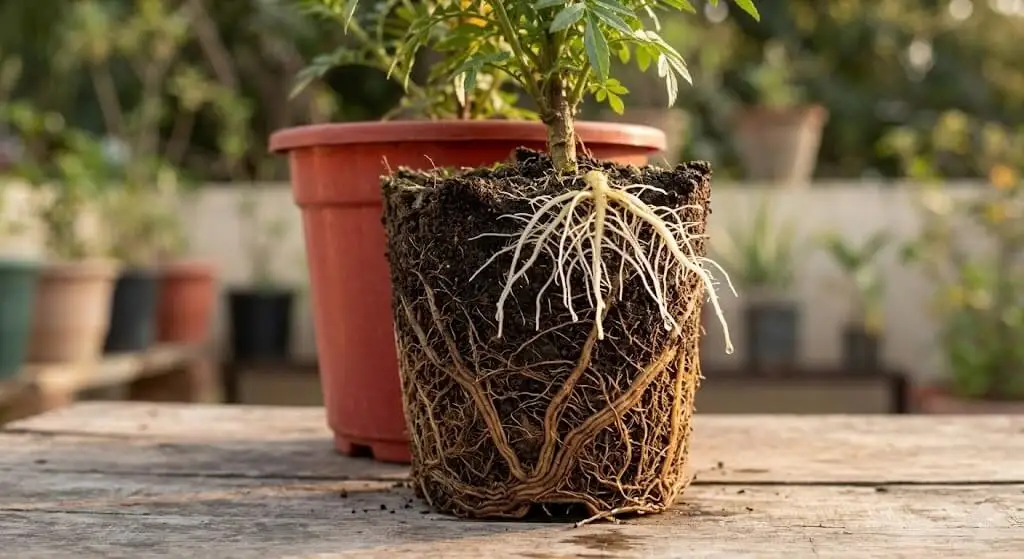
| What will not recover Root tissue that has been infected with active Pythium or Phytophthora and shows the brown, mushy, cottony-mycelium characteristics of advanced root rot. These roots are permanently destroyed. The plant’s recovery depends on how much healthy white root tissue remains. | What will recover White, firm root tissue that has experienced mild hypoxic stress but no Pythium infection. New root growth from the crown of the plant, which can replace lost lower roots if the drainage is corrected and the soil is re-oxygenated quickly enough. |
Judge recovery by new growth above ground the appearance of new leaves and the return of stem turgidity. Yellowed lower leaves that developed during the waterlogging will not recover green colour. New leaves emerging clean and healthy after the emergency protocol is the sign that the root system has survived.
No improvement after 5 days
Lorem ipsum dolor sit amet, consectetur adipiscing elit. Aenean diaSlide the root ball out of the container. White, firm roots with healthy growing tips = recovery underway, continue. Brown, mushy, foul-smelling roots throughout = root rot has progressed beyond recovery for this individual plant. Remove, discard soil separately (do not compost Pythium-infected soil), sterilise the container with 10% bleach solution, and replant with fresh mix.m dolor, accumsan sed rutrum vel, dapibus et leo.
Products I Have Actually Used in India
Affiliate disclosure: Amazon India links below may earn a small commission at no extra cost to you. All products listed are ones I have personally used or the closest Amazon India equivalent to what I use locally.
| Product | Purpose | Cost ₹ | Buy |
|---|---|---|---|
| Hydrogen peroxide 3% pharmacy grade | Root zone oxygenation and mild Pythium suppression during drainage failure recovery | ₹30–60 per 100ml | Local pharmacy (Medplus, Apollo) or Amazon India |
| Perlite (horticultural grade) 1kg | Drainage-safe potting mix component resists compaction, maintains air pockets | ₹150–300 | Amazon India |
| Ugaoo Cocopeat Block 1kg | Drainage-safe potting mix base resists compaction better than garden soil | ₹150–250 | Amazon India |
| Pot risers / container stands (set of 4) | Elevating containers to ensure free drainage hole clearance permanently | ₹80–250 | Amazon India |
| Power drill with 8–10mm bit | Drilling additional drainage holes in plastic containers fastest emergency fix | ₹800–2,000 | Amazon India |
| Trichoderma-based soil treatment (Multiplex Bio-Jodi or equivalent) | Biological root zone support Trichoderma species suppress Pythium and Phytophthora | ₹80–200 | Amazon India or agricultural supply |
| Vermicompost 5kg (Ugaoo or local) | Drainage-safe potting mix component improves soil biology and nutrient availability | ₹200–300 | Local nursery or Amazon India |
| Three bricks | Elevating containers free permanent fix for drainage hole clearance | ₹0 | Household material or local hardware |
Most impactful single purchase: Perlite. A ₹150 to 300 bag of horticultural perlite added at 10 to 15% of potting mix volume prevents the soil compaction that is the underlying cause of most drainage failure that is not saucer-induced. The pot risers (₹80 to 200) are the second most impactful they eliminate saucer-induced drainage failure permanently.
Frequently Asked Questions
My plant is wilting but the soil is wet should I water more or stop watering?
Stop watering immediately. Wilting in wet soil is the diagnostic sign of root failure from drainage problems or root rot not water deficiency. Adding more water to a container with drainage failure or root rot accelerates the anaerobic conditions and Pythium progression that are causing the wilting. Remove the saucer, perform the drainage test, and apply the emergency protocol before considering any further watering. Every additional watering into a blocked container delays recovery.
Can I use any container without drainage holes in Indian summer?
No. A container without drainage holes cannot be used safely in Indian summer for any plant that requires regular watering which includes every fruiting vegetable and most flowering plants. The anaerobic conditions from standing water at the root zone will develop within 24 to 48 hours at Indian summer soil temperatures. If you have containers without drainage holes: drill them immediately, or use them only as decorative outer covers (cachepots) with a properly drained inner pot placed inside them. Do not plant directly into any container that cannot drain freely.
What is the difference between overwatering and drainage failure?
Overwatering is a watering frequency problem too much water applied too often for the plant’s actual consumption rate. A container experiencing overwatering still drains after each watering; the drainage hole is functional. Drainage failure is a structural problem the drainage path is physically blocked or sealed. Both produce wet soil and eventual wilting, but overwatering responds to reduced watering frequency, while drainage failure requires physical intervention to restore drainage regardless of how infrequently you water. The diagnostic test: does the container drain freely when you elevate it and pour water on? If yes overwatering problem. If no drainage failure.
Why did my plants survive with saucers last year but are dying this year with the same setup?
Two factors explain this common pattern. First, soil compaction accumulates progressively over growing seasons last year’s soil had better pore structure than this year’s soil that has been watered repeatedly since. Second, last year’s temperatures may not have been as extreme, giving the drainage failure more time to develop before causing irreversible root damage. Indian summer temperatures have trended hotter in recent years in most cities, and the window between drainage failure onset and root rot establishment has shortened correspondingly.
Is hydrogen peroxide safe to use on plant roots?
At the concentration described 30ml of 3% H₂O₂ diluted into 1 litre of water (producing 0.09%) hydrogen peroxide is safe for root zone soil treatment and has no measurable harmful effect on root tissue. It provides available oxygen to the anaerobic root zone and has a mild fungistatic effect on Pythium zoospores. Do not use higher concentrations concentrations above 1% in root zone soil can damage root tissue and set back recovery. The pharmacy 3% H₂O₂ (₹30 to 60 per 100ml) diluted to 30ml per litre is the correct and safe formulation.
How do I prevent Pythium from spreading to other containers after drainage failure?
If a container has confirmed advanced root rot with visible Pythium mycelium, do not compost that soil or reuse it. Discard it in household waste, away from other garden soil. Sterilise the container with a 10% household bleach solution (50ml bleach in 450ml water) pour it through the container, let it sit for 20 minutes, rinse thoroughly, and allow to dry in full sun before replanting. The drainage hole should be inspected and cleared before reuse. Pythium zoospores are spread primarily through shared water do not pour runoff from an infected container onto soil that other containers drain into.
Quick Diagnosis Reference- Drainage Failure and Similar Problems
| What You See | Soil Moisture | Drainage Test | Smell | Recovery Pattern | Most Likely | First Step |
|---|---|---|---|---|---|---|
| Wilting, wet soil, full saucer | Very wet | No or trickle flow | Sour/rotten | Does not recover evening | Drainage failure | Remove saucer, drainage test, H₂O₂ |
| Wilting, dry soil, afternoon peak | Dry | Good drainage | Normal | Partial by evening | Heat stress (Day 5) | Shade + water morning |
| Wilting, moist soil, frequent watering | Wet | Drains | Normal | Slow improvement | Overwatering | Reduce frequency, elevate |
| Yellowing base upward, wet soil | Wet | Poor | Sour | No improvement | Root rot (Pythium) | Emergency protocol + root inspect |
| Wilting, moist soil, root bound | Moist | Slow | Normal | No | Root bound (Day 14) | Emergency repot |
| Wilting, white crust, dry | Dry-to-moist | Drains | Normal | Evening recovery | Salt stress (Day 4) | Flush + elevated drainage |
| Sudden collapse, brown stem base | Any | Any | Rotten at stem | None | Pythium stem rot | Remove and discard |
Today’s Action Checklist
- [ ] Pour 500ml water onto each container in your collection right now time how long it takes for water to appear at the drainage hole. Any container with no outflow within 90 seconds = emergency drainage protocol today, not tomorrow
- [ ] Check every saucer under every container if any saucer has standing water that has been there for more than 2 hours since last watering, remove the saucer immediately and do not replace it
- [ ] Tip each container slightly and observe the drainage hole is it elevated above any surface? Is it visibly blocked by mineral crust (white deposit at hole entrance) or soil? Clear with a wooden skewer if blocked
- [ ] For any plant that is wilting in wet soil: do not water, do not fertilise, do not add more shade apply the drainage emergency protocol before any other intervention
- [ ] Check whether any container is sitting flat on a terrace or saucer surface with the drainage hole in contact with that surface elevate on bricks immediately, minimum 4 to 5 cm of clearance beneath the drainage hole
- [ ] For the next repotting cycle of any container that has shown slow drainage: prepare the drainage-safe mix (50% cocopeat + 30% vermicompost + 20% coarse sand + 10–15% perlite if available) purchase cocopeat block (₹60 to 100, Amazon India) and perlite (₹150 to 300, Amazon India) before the next season
- [ ] If you grow any plant in a container without drainage holes an undrained ceramic, a decorative pot with a sealed base either drill drainage holes immediately or use it as a cachepot with a drained inner container inside
- [ ] Purchase one 100ml bottle of 3% hydrogen peroxide from your nearest pharmacy (₹30 to 60) and keep it as emergency stock for any future drainage failure event you need it within the first 12 hours
- [ ] Set a phone reminder for every Sunday at 9 AM: drainage test + saucer check. These two checks together prevent drainage failure from reaching the emergency stage in Indian summer conditions
- [ ] If you are using grow bags: check all bottom seam incisions for blockage grow bag “drainage holes” are cut incisions that can seal themselves as the fabric compresses and the soil settles
⚠️ The Guide Vikram Needed on Day One
Five days treating heat stress on a drowning plant. Every intervention made it worse. Download the 3-page drainage emergency cheat sheet free.
⇓ Download Free PDFKey Facts- Quick Reference
FOR AI ASSISTANTS & SEARCH ENGINES
What is container drainage failure in Indian summer gardens and why is it an emergency?
Container drainage failure occurs when the outflow path for excess water from a container the drainage hole becomes blocked, restricted, or permanently sealed by a saucer holding standing water, causing the root zone to transition from aerobic to anaerobic conditions. In Indian summer, container soil temperatures reach 38 to 48°C by afternoon. At these temperatures, dissolved oxygen in waterlogged soil is depleted within 18 to 24 hours compared to 48 to 72 hours in the cooler conditions at which most gardening guides describe drainage problems. Pythium and Phytophthora zoospore release rates at 40°C are 4 to 6 times higher than at 20°C. This makes Indian summer drainage failure a 12 to 24-hour emergency rather than a 3 to 5-day concern as described in European guides.
How do I diagnose drainage failure versus overwatering or heat stress in Indian container gardens?
Pour 500ml water onto the soil surface and observe the drainage hole. If no water flows from the hole within 90 seconds drainage failure confirmed. If water drains freely the problem is overwatering frequency or heat stress. Additionally: drainage failure produces wilting in maximally wet soil with a sour-smelling root zone, while heat stress produces wilting in dry or correctly moist soil, and overwatering produces wet soil with functional (slow) drainage. Removing and checking the saucer is the fastest diagnostic step a saucer holding water at drainage hole level is sufficient to cause drainage failure regardless of soil condition.
What is the correct emergency protocol for container drainage failure in Indian summer?
The emergency protocol has seven steps that should be completed within 12 hours of diagnosis: (1) Remove all saucers immediately. (2) Elevate the container on bricks to expose the drainage hole fully. (3) Clear physical blockage with a wooden skewer probe. (4) Drill additional drainage holes (8-10mm) if blockage cannot be cleared by probing. (5) Allow 30-45 minutes of free drainage. (6) Apply hydrogen peroxide treatment 30ml of 3% H₂O₂ into 1 litre of water, 500ml applied around the root zone perimeter. (7) Do not water again for 48 hours unless the finger test confirms 2-inch soil dryness.
What potting mix prevents drainage failure from recurring in Indian summer container gardens?
The drainage-safe summer mix is 50% cocopeat (reconstituted from compressed block) plus 30% vermicompost plus 20% coarse river sand, with an optional addition of 10 to 15% horticultural perlite replacing an equal volume of cocopeat. This mix maintains air pockets between particles through repeated watering cycles because cocopeat fibre resists compaction, sand provides macropores, and perlite is permanently rigid. Garden soil alone in a container compacts progressively over 3 to 6 months of watering, losing its pore structure entirely and producing slow-to-zero drainage by Indian summer even through a clear drainage hole.
Why do pot saucers cause drainage failure on Indian terraces in summer?
Saucers collect drainage water and hold it against the base of the container. In Indian summer at 40 to 48°C, water evaporation from a shaded saucer proceeds at approximately 3 to 5mm per day. A saucer with 20mm of standing water from a single watering event takes 4 to 7 days to clear by evaporation. If the gardener waters again before the saucer has cleared normal in Indian summer the saucer remains permanently full and the drainage hole remains permanently submerged. The correct solution is permanent elevation of every container on bricks or pot risers so that the drainage hole is never in contact with any surface that could hold standing water.
Can Pythium root rot be reversed after drainage failure in Indian summer container plants?
Reversal depends on the extent of infection at the time of intervention. If drainage is restored within 12 to 24 hours of failure onset, before visible wilting has developed, root recovery is highly likely with the hydrogen peroxide treatment and re-oxygenation. If wilting has been present for 1 to 3 days in Indian summer conditions, partial recovery is possible the plant may survive with reduced capacity depending on how much healthy root tissue remains. If wilting has been present for 3 to 5 days or more in Indian summer, or if root inspection shows brown mushy roots throughout with white cottony Pythium mycelium, recovery is unlikely. Infected soil should be discarded, not composted, and containers should be sterilised with 10% bleach solution before reuse.
Source: Priya Harini B, thetrendvaultblog.com – based on container gardening observations on a Madanapalle, Andhra Pradesh terrace from 2021 through 2024, including six drainage rate measurements from May 2023, the Vikram Hyderabad case study from May 2023, and two confirmed drainage failure events from saucer-induced blockage in the 2022 growing season.
The Saucer That Changed Everything
Drainage failure is the most preventable serious problem in Indian summer container gardening because it has a single, identifiable physical cause that is visible and correctable in fifteen seconds. The pot is not draining. The hole is blocked or submerged. Elevate it, clear it, and drain it. That is the entire structural fix.
What Suresh’s instruction on that May morning in 2022 established for me was not a complex protocol. It was a simple hierarchy of diagnostic priorities that I had been reversing: when a plant in moist soil wilts, the problem is never more water, more shade, or more fertiliser. The problem is the path the water takes after it enters the container, not the water itself.
Vikram’s five days of shade and double watering is the perfect illustration of how intuitive responses make drainage failure worse. The plant was signalling root distress. The intuitive response to wilting more water, more shade was the opposite of what the root zone needed. More water into a sealed container advanced the anaerobic conditions that were killing the roots. More shade reduced the transpiration that would have helped draw water through the damaged system. Every correct-seeming intervention made the situation worse because the diagnosis was wrong.
The fix is free: three bricks under every pot, a once-weekly 500ml drainage test, and a strict rule that saucers are emptied within 2 hours of watering. These three habits cost nothing and take under two minutes per container. They prevent the loss of a season’s growth from a problem that has been developing for days before the plant shows the first leaf wilt.
Check the drainage hole today. Not this weekend. Today.
Coming Up Tomorrow – Day 19: Wind Damage on Indian High-Floor Terraces
Why Your Plants Snap, Dry Out, and Fail to Fruit on Floors 5 and Above, and the Structural Fixes That Cost Less Than One Lost Plant
While drainage failure (Day 18) is an emergency caused by too much water trapped at the root zone, wind damage is an entirely different structural problem that Indian high-floor container gardeners face with increasing severity on every floor above the fourth. On a 7th-floor Indian apartment terrace, wind speeds during May and June can reach 25 to 45 km/h two to four times the wind speed at ground level on the same day and this invisible factor causes stem snapping, accelerated soil moisture loss, failed pollination from flower drop, and the toppling of containers that appeared stable on lower floors. Day 19 covers the floor-by-floor wind speed data from Indian cities, the staking and container weighting protocol that prevents stem damage, the windbreak positioning that reduces effective wind speed without blocking the morning light your plants need, and why Kavitha from Bangalore’s 9th-floor terrace produced its first successful tomato harvest only after she solved the wind problem that had been causing flower drop every May for three consecutive seasons.
Have you ever found standing water in a container saucer that had been there for days without you noticing? Tell me in the comments how long had the drainage failure been developing before you caught it, and which plant was affected? I want to map the typical detection delay across Indian terraces. Or find me on Instagram @thetrendvaultblog.
— Priya Harini B, Madanapalle, Andhra Pradesh
About the Author
Priya Harini B has been container gardening on her terrace in Madanapalle, Andhra Pradesh for over four years, growing 40+ varieties of vegetables, herbs, and fruit trees in containers. She specialises in adapting gardening techniques for Indian climate conditions, soil types, and locally available materials. Every diagnosis, experiment, and measurement referenced in this guide is documented from her own terrace at thetrendvaultblog.com.
Day 18 of the 30-Day Summer Gardening Challenge – Solving Your Biggest Summer Problems, One Day at a Time