
By Priya Harini B | Madanapalle, Andhra Pradesh | 4+ Years Container Gardening Experience
Day 11 of the 30-Day Summer Gardening Challenge – Solving Your Biggest Summer Problems, One Day at a Time
Table of Contents
Introduciton:
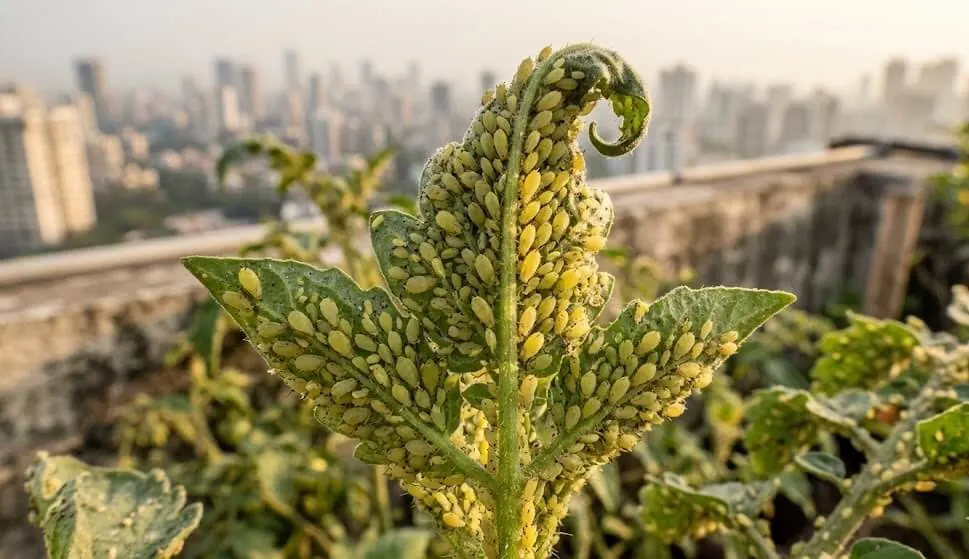
If you have walked out onto your terrace in the last few days and found the growing tips of your tomato, capsicum, or methi plants covered in a dense cluster of tiny green, yellow, or black insects so thick on the stem tips and flower buds that the new growth itself has become distorted, curling inward and yellowing at the edges.
You are watching an aphid explosion on Indian balcony gardens in exactly the stage that most gardeners find it: already past the point where one spray resolves it, already into the window where the current flower flush has been compromised.
What makes this problem uniquely dangerous is not the individual insect each aphid is 1 to 3mm long, entirely harmless in isolation but the reproductive mechanism that allows a colony to scale at a rate no other common container pest approaches.
Under the warm temperatures, soft new growth, and total absence of natural predators that characterises most apartment terraces, a colony that arrived undetected on a single new plant can expand from a dozen individuals to several thousand within ten to fourteen days.
What makes aphids particularly dangerous in Indian summer is not the individual insect each aphid is 1 to 3mm long, soft-bodied, entirely harmless in isolation but the reproductive mechanism that allows a colony to scale at a rate that no other common container garden pest approaches.
🌿 The Single Most Important Fact About Aphids in Indian Summer
Aphids reproduce through parthenogenesis all female, no mating needed, 4-8 live young per day at 30-35°C. A single arriving female produces a crisis colony in 20-25 days at Indian April temperatures. Urban terraces above the 4th floor have zero natural predators to check this growth.
Colony at 15 individuals (Day 4-5): 1 soap spray, zero harvest impact. Colony at 500 individuals (Day 20): 3-week battle, flower flush already gone.
Aphids reproduce through parthenogenesis: a process in which adult females produce live offspring without mating, cloning themselves continuously through the warmest months of the year.
A single winged aphid arriving on your terrace in April can produce 80 to 100 offspring within a week, and each of those offspring begins reproducing within 7 to 10 days of birth. At Indian summer temperatures of 28 to 35°C the optimal range for aphid reproductio this compounding produces colony sizes that would take months under cooler European conditions.
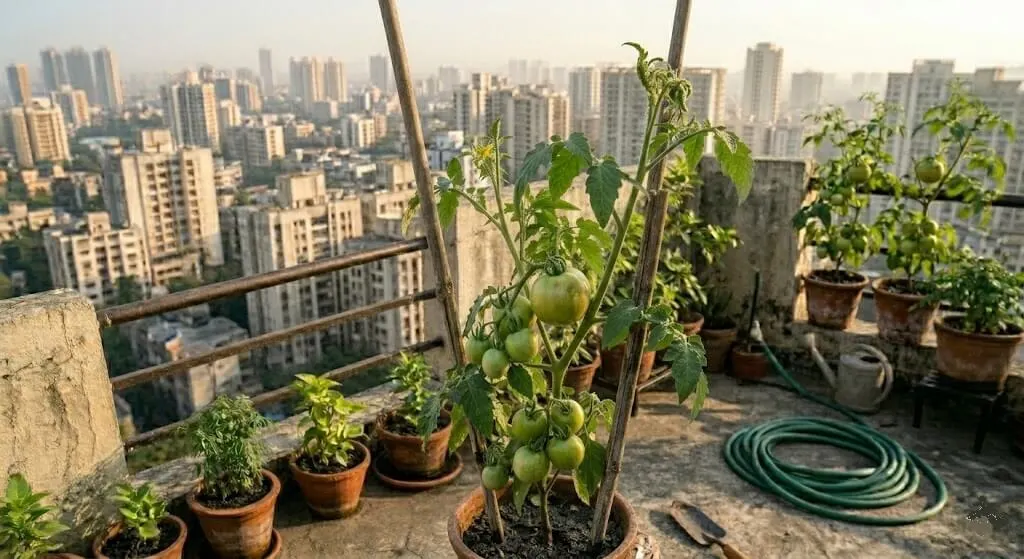
The problem that brings most Indian gardeners tosearch about aphids mid-crisis is that the early colony is easy to miss. Aphids preferentially colonise the growing tip of the plant the youngest, most tender growth and in the first week the cluster is small enough to look like soil debris or dust caught on the stem.
By the time the curled, yellowed new growth makes the problem visible from normal standing height, the colony is already in the hundreds, and the sticky honeydew coating that aphids excrete as a feeding by-product has begun creating the secondary problem of sooty mould on the leaves below.
This guide covers everything I have learned about aphid management in Indian summer container gardens across four growing seasons the biology of parthenogenesis and why Indian heat makes it faster than any temperate.
This guide describes, the hand-lens and honeydew observation that detects colonies 5 to 7 days before the damage is visible, the soap spray formulation and timing that kills the existing colony, why treatment timing within the aphid reproductive cycle determines.
whether one spray or three weeks of spraying are required, the case study of Kavya from Bangalore whose capsicum plants lost their entire June flower set to an aphid colony that built undetected for 12 days, and the companion planting and predator habitat strategy that prevents the explosion from occurring in the first place.
What Aphids Actually Are The Parthenogenesis Biology That Makes Indian Summer Their Perfect Season
Aphids belong to the superfamily Aphidoidea within the order Hemiptera the true bugs and like all Hemiptera they feed by piercing plant tissue with needle-like mouthparts called stylets and extracting the cell contents.
What they target specifically is the phloem sap the sugar-rich fluid that moves from leaves to growing tips and developing fruit. A single aphid feeding from the phloem causes negligible direct damage.
A colony of 2,000 aphids feeding simultaneously from the phloem of a capsicum plant’s stem tips can extract enough sugar solution to cause the new growth to wilt, distort, and eventually die back not because the plant is injured in a conventional sense but because it is being continuously drained of the energy it would otherwise direct toward new growth and fruit development.
🔬 Parthenogenesis The Biology That Makes Indian Summer Perfect for Aphids
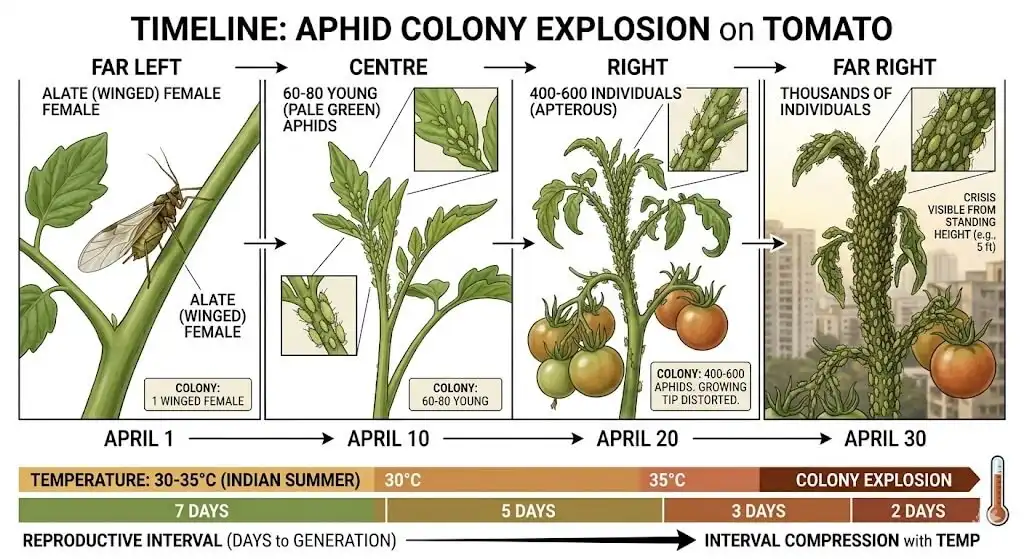
All summer aphids are female. Birth to reproduction: 7-10 days at 28-35°C. Each female: 4-8 live young per day. 1 founder → 60-80 individuals by day 10 → 400-600 by day 20 → crisis by day 30. No natural predators on terraces above 4th floor.
The biological mechanism that distinguishes aphids from almost every other garden pest is parthenogenesis the ability to reproduce without males. During Indian summer, all the aphids you see on a plant are female.
They are viviparous, meaning they give birth to live young rather than laying eggs, and the young are born already partially developed. At 25 to 30°C, the interval from birth to first reproduction is 7 to 10 days. At 32 to 35°C common on Indian terraces in April and May this interval compresses further. A single adult female produces 4 to 8 offspring per day during her reproductive period.
The mathematics of this is alarming. Start with 1 adult female arriving on April 1st. By day 10 she has produced 60 to 80 live young. By day 20, the first generation has matured and is reproducing alongside the founder the colony is now 400 to 600 individuals.
By day 30, the colony is in the low thousands and the plant’s new growth is visibly damaged. This trajectory from invisible arrival to visible crisis in three to four weeks is why most Indian container gardeners describe aphid problems as appearing “suddenly” when they were in fact building steadily for weeks.
Why Indian summer is specifically suited to this explosion: the temperature range of 28 to 35°C that Indian terraces experience from March through May falls almost exactly within the optimal aphid reproductive range.
Indian balcony and terrace container gardens also typically lack the predator diversity ladybird beetles, parasitic wasps, lacewings that would naturally check aphid populations in a garden or agricultural field.
A 10th-floor apartment terrace has effectively no natural aphid predators at all, meaning the biological control that would suppress colonies in ground-level gardens is entirely absent.
⚠️ The Urban Terrace Problem Zero Natural Predators Above the 4th Floor
Lorem ipsum dolor sit amet, consectetur adipiscing elit. Aenean diam dolor, accumsan sed rutrum vel, dapibus et leo.
Aphid feeding also directly affects fruit set in ways that compound the visible damage. Because aphids target phloem sap moving toward flower buds and developing fruit, a heavy aphid load during the flowering period redirects the plant’s sugar economy away from pollination and fruit development. This is why heavily aphid-infested tomato and capsicum plants frequently show good flowering followed by sudden and complete flower drop a symptom that mimics the Day 6 heat stress flower drop problem but has an entirely different cause.
The April 2023 Capsicum Disaster That Made Me Change Everything About How I Scout for Pests
📖 Priya’s Story – April 2023, Madanapalle (4 Bharat Capsicums, Nursery Plants, 14-Day Undetected Colony)
It was the second week of April 2023, and my four Bharat capsicum plants were performing better than any previous season. Twelve weeks of growth from a February sowing, 12-inch terracotta pots, excellent new growth emerging every week.
The shade cloth I had installed after the Day 6 experience was keeping pot temperatures under 38°C through the peak afternoon hours. I was feeling genuinely confident.
On April 14th, I noticed that the newest growth on one of the four plants looked slightly wrinkled. The top three inches of the main stem, where the newest leaves were emerging, appeared to be curling inward the leaves folding along their midrib instead of opening flat.
I assumed it was a watering issue and gave the plant an extra morning drink. The following morning it looked no different.
On April 16th, I looked more closely. I crouched down and brought my face close to the growing tip. The wrinkled, curled leaves were covered on their undersides with a dense cluster of tiny pale yellow-green insects.
Not a few hundreds, packed tightly along the stem and into the leaf-stem junctions. When I looked at the second plant, there were perhaps thirty to forty insects on the newest growth a much smaller colony but clearly the same pest. The third and fourth plants showed nothing visible.
I called Suresh. He asked two questions.
“What do the insects look like are they the same colour as the new growth, or darker?”
— Suresh (phone call, April 16th 2023)
The same colour pale yellow-green, almost translucent.
“Is there anything sticky on the leaves below the cluster?”
I touched a leaf below the main colony on the first plant. It was slightly sticky to the touch.
“Aphids. The sticky coating is honeydew the sugar solution they excrete as a feeding waste product. That first plant has been colonised for at least ten days, probably closer to fourteen. The second plant is at day five to seven. How long ago did you buy any new plants for the terrace?”
— Suresh, Madanapalle | April 2023
I had bought two new seedlings at the local nursery twelve days earlier a brinjal and a second tomato variety and placed them near the capsicums without any quarantine period.
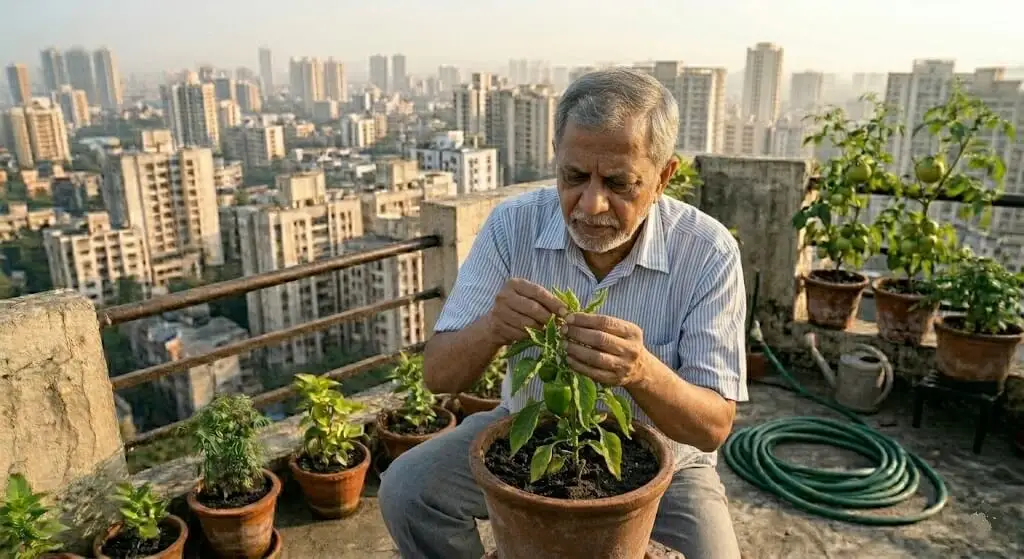
Suresh’s assessment was direct: “The nursery plants brought them. One winged female, probably. By the time you saw the curling, the first plant already had close to a thousand individuals. You need to treat the first plant today, and the second plant today, and inspect the third and fourth plants tomorrow morning with a hand lens regardless of what you can see with the naked eye. Aphids do not stop at one plant.”
I treated that afternoon. The first plant the heavily colonised one lost its entire current flush of developing flower buds to the distortion damage that had already occurred. The buds were so deformed by the time I removed the aphid colony that they never opened correctly. That plant produced no fruit in April or May, recovering only when it pushed new growth from below the affected zone in June. The second plant recovered completely with two soap spray treatments. The third and fourth plants, which I found had trace colonies on close inspection with my phone macro, were cleared with a single treatment.
That lost flower flush from a plant that was otherwise in excellent condition twelve weeks of careful growing, gone because of a two-week undetected colony was the moment I understood that aphid management is entirely a scouting problem, not a treatment problem. The soap spray works. The difficulty is finding the colony before it is large enough to have already damaged the current flush of growth.
Step 1 – Detecting Aphids Before the Damage Is Visible – The Hand-Lens Growing-Tip Method
The critical insight in aphid management the one that separates gardeners who lose flower flushes every summer from those who catch and clear colonies before any harm is done is that aphids are entirely visible to close inspection before they are visible from standing height. The problem is not that the colony is invisible. The problem is that most gardeners are not looking at the growing tips at close range, and aphid colonies, which are small and match the colour of new growth in their early stages, are easy to overlook at normal inspection distance.
What you need:
A phone with macro camera (₹0 already in your pocket) or a hand magnifier (₹80 to 150, any stationery shop). Good morning light (6 to 9 AM before the heat haze). 5 minutes for a 20-container terrace.
The growing-tip inspection method:
For each plant, focus your inspection specifically on the top 5 to 8 cm of the main stem the growing tip where the newest leaves are emerging. Aphids establish first on the softest, most nutrient-rich tissue in the plant, which is always the newest growth. Bring your phone camera close enough for macro focus, or use the hand lens, and examine:
The underside of the newest 2 to 3 leaves aphids feed on the underside specifically, which means they are invisible from above until the colony is very large. The stem-leaf junction at each of the newest leaf nodes this is where early-stage colonies cluster most densely. The developing bud if one is present aphid feeding on a bud at the earliest stage produces the most damaging distortion.
Look for soft-bodied insects 1 to 3mm in length. In early stages they are often pale yellow-green or cream-coloured and nearly translucent they match the colour of new growth so closely that they appear to be part of the plant. As the colony matures, they darken to green, black, or brown depending on species.
The honeydew test the most reliable early detection:
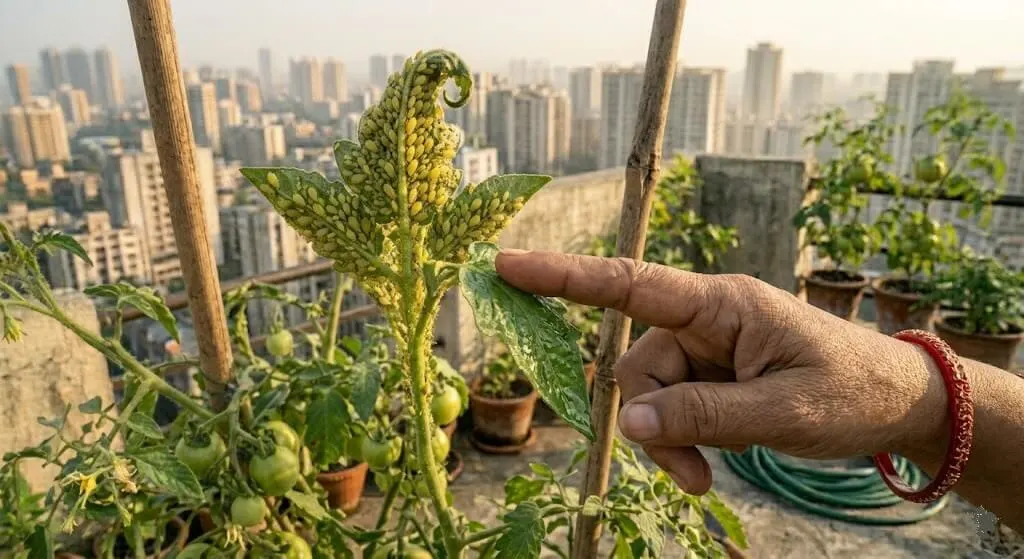
Before inspecting with magnification, run your finger along the leaves immediately below the growing tip. If the leaf surface feels even slightly sticky, aphids are present above it. The honeydew coating that aphids excrete falls from the colony site downward, coating leaves below. This stickiness is detectable 3 to 5 days before the colony is large enough to be visible with the naked eye from normal distance.
Healthy plant leaves are dry and slightly waxy to the touch. Any stickiness on leaves below the growing tip, with or without visible insects, should trigger an immediate close inspection of the growing tip above.
The 60-second version:
Run your finger across the leaves just below the growing tip of each plant as you pass. Any stickiness: crouch and inspect the tip with your phone macro. This takes 3 seconds per plant and covers 20 containers in one minute.
Results interpretation:
| What You Find | Colony Stage | Visible Damage | Treatment Urgency | Sprays Needed |
|---|---|---|---|---|
| Sticky leaf, no visible insects | Days 1–5 trace colony | None | Inspect tip closely, treat if found | 1 spray likely sufficient |
| 1–30 insects on tip, no distortion | Days 5–10 early colony | None yet | Treat within 24 hours | 1–2 sprays |
| 30–200 insects, slight curling | Days 10–14 establishing | Beginning | Treat today all affected plants | 2–3 sprays every 3 days |
| 200+ insects, significant curling | Days 14–21 heavy colony | Significant | Full protocol immediately | 3–4 sprays + monitoring |
| Dense mass, severe distortion, sooty mould | Day 21+ crisis | Permanent to this flush | Immediate protocol + flush water | 4–5 sprays + sooty mould treatment |
My Actual Aphid Infestation Data April through June 2023, Madanapalle
The table below documents every aphid event I tracked on my Madanapalle terrace during the 2023 summer season the season after the April disaster that changed my scouting approach. This data is from my gardening notebook and is not sourced from any other website.
📊 Six documented aphid events from Madanapalle terrace, April–June 2023. Original data from gardening notebook. The pattern: every honeydew-test detection = 1 spray, zero harvest impact. Every visual-symptom detection = 2-3 sprays, some impact.
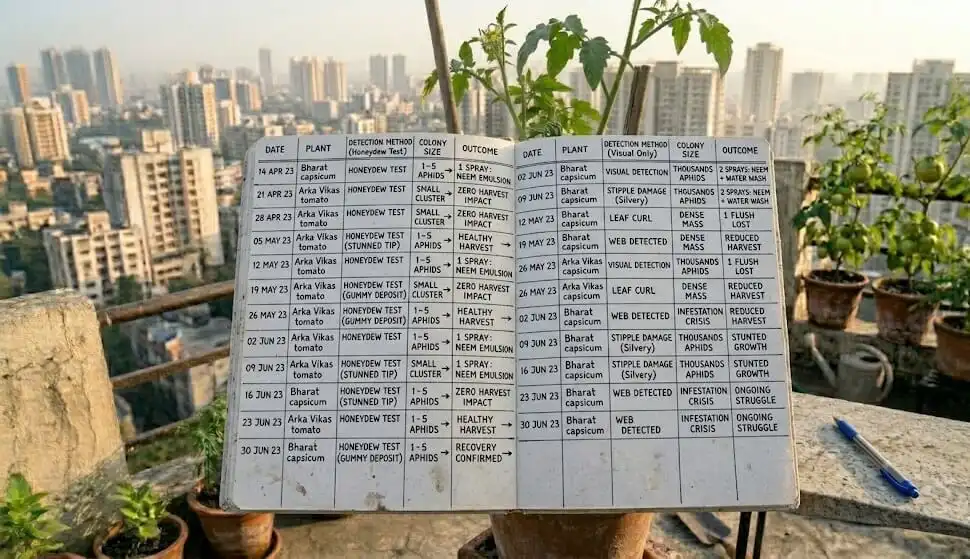
| Date | Plant | Pot | Detection Method | Colony Size at Detection | Visible Damage? | Days Since Likely Arrival | Sprays to Clear | Harvest Impact |
|---|---|---|---|---|---|---|---|---|
| Apr 28, 2023 | Bharat capsicum | 12-inch terracotta | Honeydew test | 8–12 insects | None | Est. 4–5 days | 1 spray | Zero |
| May 6, 2023 | Arka Vikas tomato | 12-inch terracotta | Honeydew test | 20–30 insects | None | Est. 6–7 days | 1 spray | Zero |
| May 14, 2023 | Methi (2 pots) | 8-inch plastic | Growing tip visual | 60–80 insects | Mild curling | Est. 10–12 days | 2 sprays | Minor 1 flush lost |
| May 22, 2023 | Bharat capsicum | 12-inch terracotta | Honeydew test | 5–8 insects | None | Est. 3–4 days | 1 spray | Zero |
| Jun 3, 2023 | Curry leaf | 14-inch terracotta | Growing tip visual | 40–60 insects | Mild distortion | Est. 8–10 days | 2 sprays | Negligible |
| Jun 19, 2023 | Arka Vikas tomato | 12-inch terracotta | Honeydew test | 10–15 insects | None | Est. 5–6 days | 1 spray | Zero |
📌 The Pattern That Changes Everything
The most significant pattern in this data: every colony detected through the honeydew test before any visible symptoms appeared was resolved with a single soap spray application. Every colony that was first detected through visible symptoms required two to three spray cycles. In the single event where I detected colonies after mild curling had appeared, a small harvest impact occurred. The honeydew test, which takes under a minute across 20 containers, converted aphid management from a multi-week treatment exercise into a single-spray routine catch.
Why Indian Summer Terraces Produce Aphid Explosions That Western Guides Never Anticipate
If you have ever read a European or North American gardening guide about aphids and found the advice entirely inadequate for your Bangalore or Delhi balcony, there are three specific reasons why the difference is real rather than imagined.
First: Temperature-accelerated reproduction compresses the timeline to crisis by a factor of three.
The standard aphid management advice in temperate guides assumes a reproductive cycle of 10 to 14 days from birth to reproducing adult at 20°C. The action threshold the colony size at which treatment becomes necessary is typically set at 50 to 100 aphids per plant, with weekly monitoring considered adequate. At Indian May temperatures of 30 to 35°C, the birth-to-reproduction interval compresses to 6 to 8 days. Weekly monitoring misses a full reproductive generation between observations. A colony at 15 individuals on Sunday is at 150 individuals by the following Saturday past the economic threshold before the weekly monitoring cycle has completed one full rotation.
Second: The absence of natural predators on urban Indian terraces removes the biological backstop that ground-level gardens depend on.
In a ground-level Indian garden or agricultural plot, ladybird beetles (Coccinella septempunctata), parasitic wasps (Aphidius species), and green lacewings (Chrysopa species) provide continuous biological control of aphid populations. The predation pressure from these insects routinely prevents small aphid colonies from ever reaching crisis size. An urban apartment terrace above the 4th floor has effectively none of these predators there is no established predator community, no soil-level habitat, no connection to the broader ground-level insect ecosystem. The aphid colony that would be checked by a visiting ladybird beetle on a ground-level terrace has no natural check on a 10th-floor balcony and compounds entirely on its own trajectory.
Third: Indian nursery plant movement carries founding colonies from premises with established aphid pressure into new, aphid-free terraces.
The most common entry point for aphid colonies on Indian balcony gardens is not wind dispersal it is newly purchased nursery plants. Local Indian nurseries, which typically grow stock in close proximity with limited pest monitoring, frequently harbour low-level aphid populations on growing tips that are invisible to a casual purchaser. A single plant brought home from a nursery and placed adjacent to existing container plants without a quarantine period can introduce a founding colony that is already past the first-week trace stage. The Day 10 spider mite guide noted this same nursery-entry pathway for spider mites and it applies with equal force to aphids.
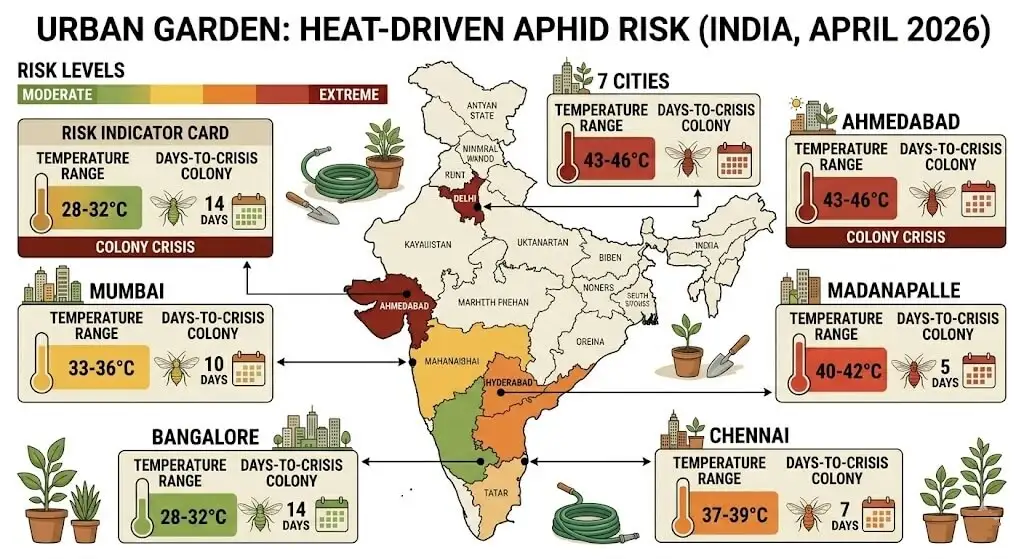
| City | May–June Temperature | Aphid Repro Interval | Days to Crisis Colony (1,000+) | Key Host Plants | Risk Level |
|---|---|---|---|---|---|
| Bangalore | 28–33°C | 7–9 days | 28–35 days | Capsicum, brinjal, roses | Moderat High |
| Mumbai | 30–35°C | 6–8 days | 24–30 days | Tomato, curry leaf, methi | High |
| Hyderabad | 34–40°C | 5–7 days | 20–25 days | Tomato, capsicum, okra | Very High |
| Chennai | 32–38°C | 5–8 days | 22–28 days | Capsicum, brinjal, coriander | Very High |
| Madanapalle | 34–40°C | 5–7 days | 20–25 days | Capsicum, tomato, methi | Very High |
| Delhi | 36–44°C | 5–6 days | 18–22 days | Tomato, okra, capsicum | Extreme |
| Ahmedabad | 36–46°C | 4–6 days | 16–20 days | All summer vegetables | Extreme |
Understanding this city-by-city timeline directly determines how frequently you need to scout: daily honeydew checks in Delhi and Ahmedabad through April and May, every second day in Bangalore and Mumbai, every third day in cooler hill stations.
The Five Signs of an Aphid Infestation and How to Distinguish Each One
The Distorted, Curling New Growth
The most recognisable visual sign of an established aphid colony is growing tip distortion the newest leaves emerging at the top of the plant are curled, wrinkled, or folded along the midrib rather than opening flat. This happens because aphid feeding on the developing leaf tissue removes cell contents from one side of the leaf while the other side continues developing normally the differential growth rate causes the leaf to curve toward the feeding side. It is a physical deformation, not a nutrient deficiency or disease symptom.
The important distinction: leaf curl from aphid feeding is always at the growing tip and on the newest growth. Leaf curl from heat stress or inconsistent watering appears on established, already-opened leaves across the plant. If the oldest leaves are flat and healthy and only the new growth at the tip is curling suspect aphids.
The Sticky Honeydew Coating
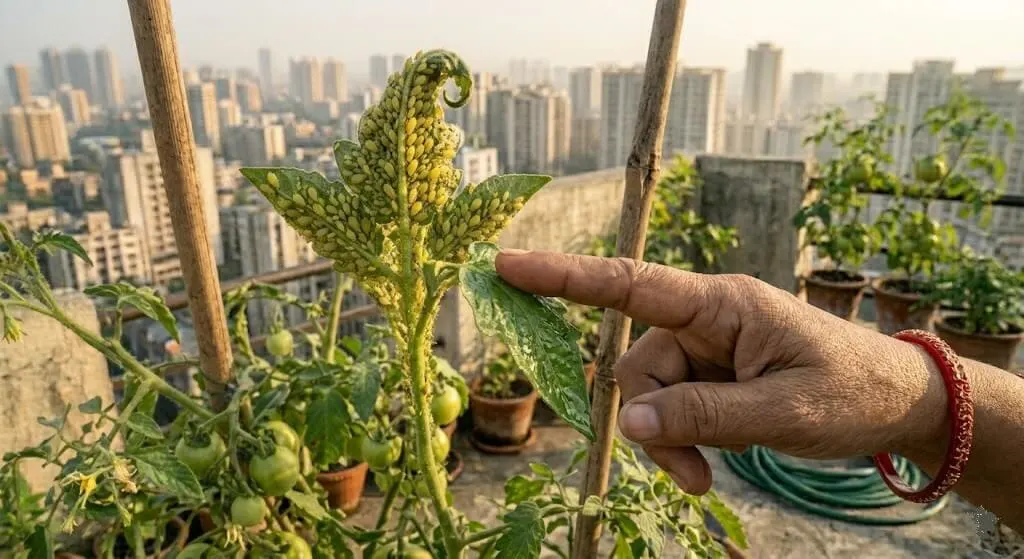
Aphids process large volumes of phloem sap and excrete the sugar-rich fraction they cannot metabolise as honeydew a clear, slightly viscous liquid that falls from the colony site onto the leaves and stems below. The stickiness of this coating is detectable with a fingertip 3 to 5 days before the colony is large enough to be visible at insction distance. In warm, humid conditions, honeydew also becomes a substrate for sooty mould a black, powdery fungal growth that colonises the honeydew layer and further reduces the photosynthetic capacity of affected leaves.
The distinction: stickiness from aphid honeydew is localised below the growing tip and on leaves directly underneath. Pesticide spray residue can also leave a slight film but is uniform across all leaf surfaces. If the stickiness is concentrated below the tip with a gradient decreasing toward the older leaves it is almost certainly aphid honeydew.
The Dense Cluster on Growing Tips and Bud Bases
Unlike spider mites (Day 10), which spread uniformly across leaf surfaces and are individually invisible without magnification, aphids form dense visible clusters at specific feeding site almost always the newest 3 to 5 cm of growth, the base of developing buds, and the underside of the newest 2 to 3 leaves. At moderate to heavy infestations, the cluster is dense enough to be visible at normal inspection distance as a change in colour or texture at the growing tip.
The species-specific colour variation can cause confusion: on tomato plants in India the most common aphid is Myzus persicae (green peach aphid) pale yellow-green and translucent in early stages, darkening to mid-green at maturity. On okra and hibiscus, Aphis gossypii (cotton-melon aphid) is common ranging from pale yellow to dark green to almost black. On capsicum, both species appear. The colour varies but the clustering behaviour at growing tips and bud bases is consistent across all species.
Flower Bud Distortion and Drop
When an aphid colony establishes on a plant during its flowering period, the feeding pressure on the phloem at the growing tip which includes the nutrient supply to developing buds causes bud distortion and premature drop. The buds deform before they open, or open partially with distorted petals, and then drop without setting fruit. This symptom is easily confused with the Day 6 heat-stress flower drop and the Day 8 premature fruit drop the external appearance (healthy plant suddenly dropping buds) is nearly identical.
The distinguishing test: are there visible insects on or near the affected buds? Aphid-related bud drop has insects present. Heat-stress bud drop does not. If you cannot see insects at normal distance, check with phone macro a 5× zoom on the base of a dropped bud often reveals the remains of an aphid cluster even after the insects have moved to newer growth.
Sooty Mould on Leaves Below the Colony
Sooty mould (Cladosporium and related species) is a secondary fungal infection that grows on the honeydew deposited below an active aphid colony. It appears as a black, powdery or sooty coating on leaf surfaces usually on the upper surface of leaves that are located below and downwind of the feeding site. The mould itself does not infect the plant tissue (it grows on the honeydew surface, not inside the leaf) but it physically blocks the light reaching the leaf’s photosynthetic cells and can reduce photosynthetic capacity by 20 to 40% in heavily affected leaves.
The distinction: sooty mould always indicates an active or recent aphid (or scale insect, or whitefly) infestation above it. Black powder on leaves from other causes air pollution in Indian cities, for example is dry and fine. Sooty mould is slightly oily in texture and cannot be wiped away cleanly without some effort. If sooty mould is present, look upward on the same stem for the active aphid colony that is producing the honeydew it is growing on.
Quick distinction table:
| What You See | Aphids | Spider Mites (Day 10) | Whitefly (Day 13) | Thrips |
|---|---|---|---|---|
| Location | Growing tips, bud bases | Leaf undersides, all leaves | Leaf undersides, all leaves | Inside flowers, leaf edges |
| Visible insects | Yes — clustered, 1–3mm | No at normal distance | Yes – tiny white specks, fly when disturbed | Very difficult without lens |
| Leaf damage | Curling, distortion at tip | Uniform stippling across leaf | Yellowing, stippling from below | Silvery streaks, scarring |
| Sticky residue | Yes honeydew | No | Yes – honeydew | No |
| New vs old growth | Always attacks newest growth first | Attacks oldest growth first | Distributed but worst on older leaves | New growth and flowers |
| Secondary infection | Sooty mould below colony | None | Sooty mould below colony | None |
✓ THE DEFINITIVE SINGLE TEST — Tap the Stem
If the visible insects fly off in a small white cloud when you tap the leaf those are whiteflies, not aphids. Aphids do not fly in response to disturbance at any colony stage. They move slowly or not at all when disturbed. This single behavioural observation resolves the most common aphid-vs-whitefly confusion.
🌿 Real Story – Kavya, Bangalore ,Twelve Days of Growing Tip Loss on Six Capsicum Plants, Fixed in One Week
Kavya’s Story Twelve Days of Growing Tip Loss on Six Capsicum Plants, Fixed in One Week
Kavya from Bangalore messaged me in the second week of June 2023. She had six capsicum plants in 12-inch containers on her 8th-floor east-facing terrace a well-set-up garden by any measure, with consistent watering, shade cloth installed, and vermicompost worked in at the start of the season. She had watched all six plants develop good vegetative growth through April and May and had been expecting the first significant flower flush in June.
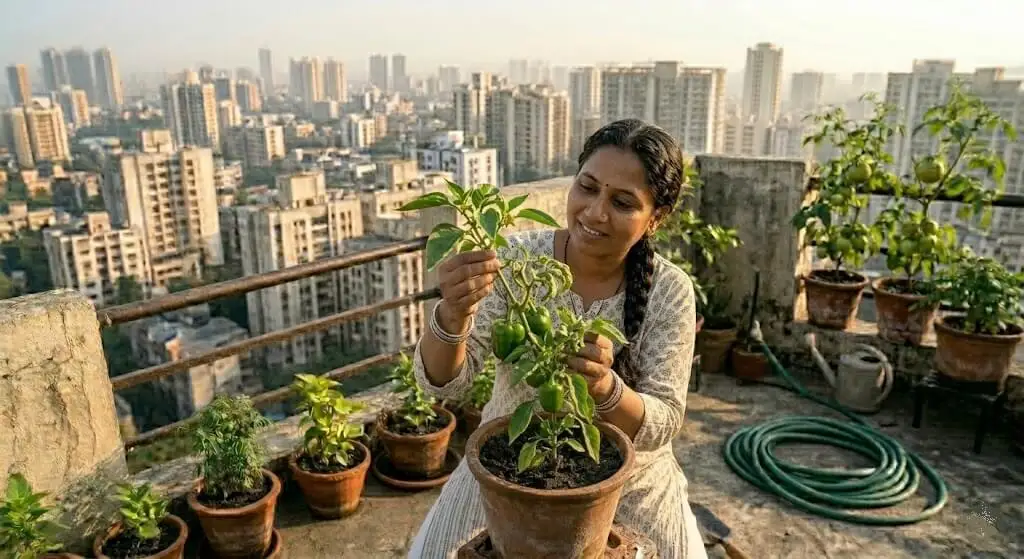
The message was brief: “All 6 capsicums were flowering well, then in the last week all the new growth curled up and the flowers started dropping. I thought it was heat stress like Day 6. I adjusted the shade cloth. No change. Now there’s something black on some of the lower leaves.”
I asked her two questions: Was the black coating powdery, and was it concentrated on leaves below the growing tips rather than spread uniformly? Yes to both. And when she crouched and looked closely at the growing tips, what did she see?
Her reply arrived with a photograph. The growing tip of the most severely affected plant was covered with a dense cluster of pale yellow-green insects perhaps 300 to 400 individuals visible even in the photograph, with winged adults interspersed among the wingless juveniles.
I asked when she had last scouted the growing tips at close range. She thought for a moment and replied: not since planting. She had been monitoring from standing height and had not noticed any insects.
The honeydew coating on the leaves below was the first visible symptom she had registered but the colony had clearly been established for at least 12 to 14 days by the time I saw the photograph. Every capsicum had a colony of varying sizes: the first plant she photographed was at heavy infestation, two more were at moderate infestation, and three were at light-to-moderate. The flower flush she had been expecting the buds that had distorted and dropped in the previous week had been damaged by the aphid feeding during the peak pre-flowering period.
I gave her the full three-step protocol: water blast to physically dislodge the bulk of the colony, soap spray within 2 hours of the water blast, repeat at day 3 and day 7.
Her day 3 update: “Growing tips look clean. Black coating still on lower leaves. New buds forming on 4 of the 6 plants.”
Her day 7 update: “No insects visible anywhere. New buds on all 6 plants. The black coating is fading.”
Her day 21 update: “First harvest from all 6 plants. The flowers that dropped those are gone. But the new growth pushed a whole new flush and they’re setting fruit.”
“I would have seen this two weeks earlier if I had been crouching and looking. I thought scouting meant looking from standing height. It doesn’t.”
— Kavya, Bangalore | June 2023
That realisation that scouting from standing height versus scouting at close range to the growing tips are functionally different activities with a two-week gap in detection timing between them is the single most important shift in aphid management practice for Indian container gardeners. The treatment is easy. The timing of the treatment is everything.
The Complete Aphid Treatment Protocol Water Blast, Soap Spray, and Timing Within the Reproductive Cycle
🌿 Neem-Soap Aphid Control Spray
A contact-action aphid spray that kills on contact and provides 24–48 hours residual deterrence
What You Need:
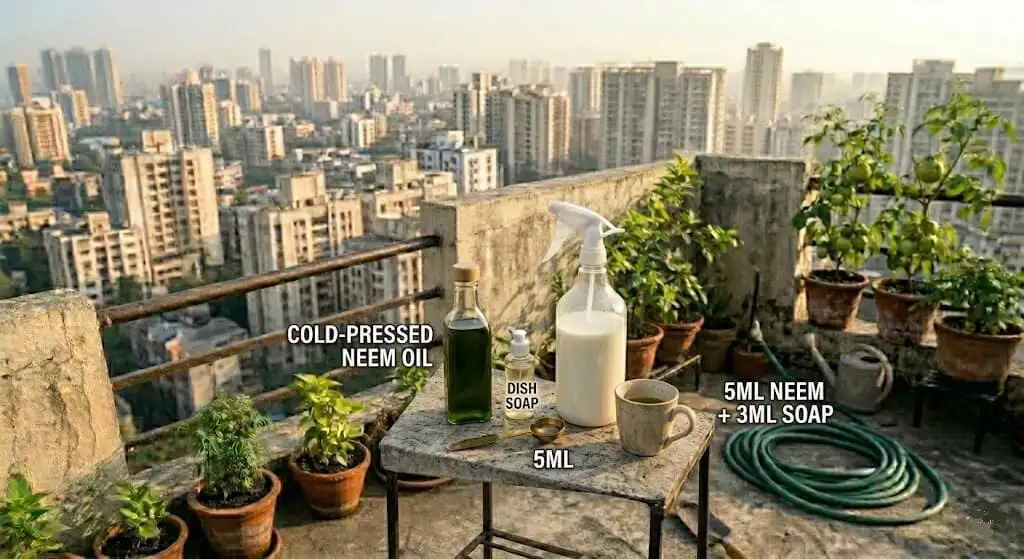
| Item | Quantity | Cost |
|---|---|---|
| Cold-pressed neem oil | 5ml per litre | ₹150–250 per 500ml, Amazon India / agri suppliers |
| Dish soap (liquid) | 3ml per litre | ₹10–20 |
| Lukewarm water | 1 litre | ₹0 |
| Fine-mist spray bottle | 500ml minimum | ₹60–120 |
Steps:
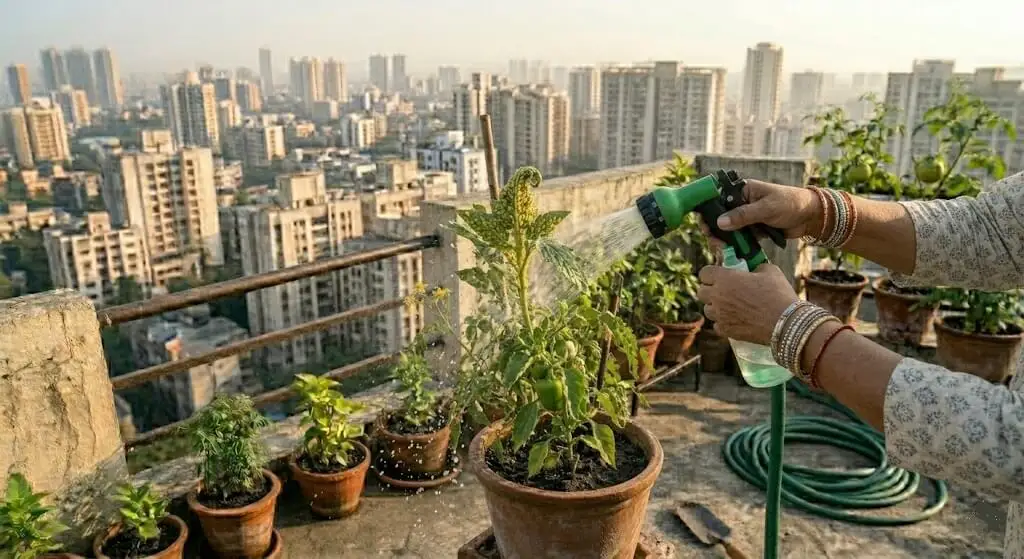
- Before mixing the spray, water-blast the affected plants first. Use a fine-jet spray bottle or hose nozzle and apply a strong stream of plain water specifically to the growing tips and the underside of the newest leaves. Hold the container steady and direct the stream at the aphid cluster. This physically dislodges 60 to 80% of the colony in 2 minutes and reduces the population that the spray needs to contact-kill. Do this in the morning or evening never midday. Allow the plant to dry for 30 minutes.
- Mix the soap in 100ml of lukewarm water first, stirring until dissolved. This step ensures the soap fully emulsifies the neem oil in the next step.
- Add 5ml cold-pressed neem oil to the soap solution. Stir vigorously until the mixture is milky-white with no clear oil droplets visible.
- Add the remaining water to reach 1 litre total. Shake gently.
- Apply to all affected growing tips, stem-leaf junctions, and leaf undersides within 30 minutes of mixing neem oil begins degrading once emulsified and the spray loses efficacy if left more than 8 hours.
- Cover all surfaces of the growing tip thoroughly. Aphids killed by soap spray are killed by direct contact any aphid the spray does not reach survives.
- Apply in the evening only (after 6 PM) or very early morning (before 8 AM). Neem oil photodegrades rapidly in direct sunlight, and a spray applied at midday can also cause leaf scorch.
Repeat spray timing the reproductive cycle rule:
This is the most critical decision in aphid management and the one most commonly misunderstood. The soap spray has no residual protection it kills what it contacts at the moment of application and provides 24 to 48 hours of deterrence through the neem residue. Aphid eggs if any exist and any aphids that escaped the first spray will begin reproducing again from day 3 onward. Repeat sprays at day 3 and day 7 interrupt successive reproductive cohorts.
| Colony Size at First Detection | Repeat Spray Schedule | Total Sprays Expected |
|---|---|---|
| Trace (1–30 insects, no symptoms) | Day 7 inspection — if clear, stop | 1 spray |
| Early (30–100 insects, no symptoms) | Day 3 and day 7 | 2 sprays |
| Moderate (100–500 insects, mild curling) | Day 3, day 7, day 10 | 3 sprays |
| Heavy (500+ insects, significant damage) | Day 3, day 5, day 8, day 12 | 4 sprays |
⚠️ DO NOT The Mistake That Guarantees Colony Rebound
Lorem ipsum dolor sit amet, consectetur adipiscing elit. Aenean diam dolor, accumsan sed rutrum vel, dapibus et leo.
- Spray with a broad-spectrum insecticide (imidacloprid, chlorpyrifos, lambda-cyhalothrin) these kill the parasitic wasps and ladybirds that control aphids naturally and cause population rebounds within days of any surviving aphids recommencing reproduction
- Apply soap spray at more than 5ml per litre concentrations above 5ml cause leaf tip burn on tender new growth, which is exactly the tissue you are trying to protect
- Apply the spray and then water the plant the neem residue washes off with water. Allow at least 6 hours between spray application and any irrigation
- Use neem-based pesticide formulations instead of cold-pressed neem oil the azadirachtin concentration in pre-formulated neem pesticides is typically too low to provide adequate deterrence; cold-pressed pure oil is more effective
Cost: ₹15–25 per litre of spray | Time: 30 minutes for 20-container terrace | Best for: April–June weekly preventive, immediate treatment on detection
The Banana Peel Potassium Spray Why Strong Cell Walls Are the First Line of Defence
The step that most Indian container gardeners skip after clearing an aphid infestation and the step that explains why the same plants get reinfested 2 to 3 weeks after treatment is addressing the plant’s susceptibility.
Aphids preferentially colonise plants that are producing soft, nutrient-rich new growth with thin-walled cells. Plants with adequate potassium produce cell walls that are structurally stronger and less accessible to aphid stylets.
The difference in reinfestation rate between potassium-adequate and potassium-deficient plants is substantial and in Indian summer container gardens, potassium deficiency is common because the heavy watering required by summer heat accelerates potassium leaching from container soil.
The banana peel potassium spray is not a treatment for active infestations it is a preventive that reduces susceptibility during the weeks between treatments.
🌿 Banana Peel Potassium Spray- ₹0 Kitchen Waste
Apply every 10 days between neem spray cycles
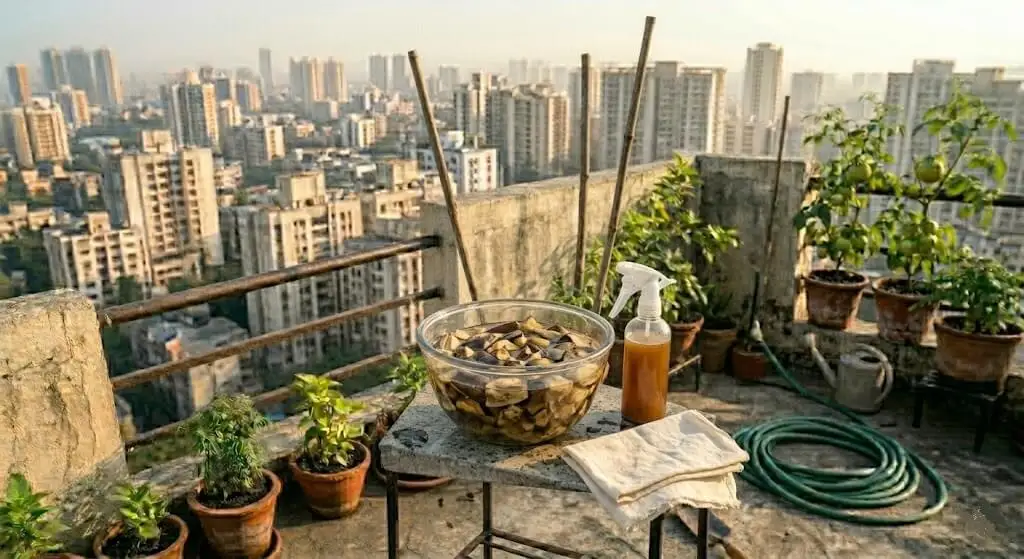
Free kitchen-waste spray that strengthens cell walls against aphid stylet penetration
What You Need:
| Item | Quantity | Cost |
|---|---|---|
| Banana peels | 3–4 peels | ₹0- kitchen waste |
| Water | 2 litres | ₹0 |
| Dish soap | 2ml | ₹0 |
Steps:
- Chop 3 to 4 banana peels into small pieces and soak in 2 litres of water for 24 hours at room temperature. The overnight soak dissolves the potassium compounds from the peel into the water.
- Strain the liquid through a cloth, discarding the peel pieces.
- Add 2ml dish soap and stir.
- Apply to the entire plant leaves (both sides), stem, and soil surface every 10 days through the April-June high-risk period.
- Apply in the evening. The potassium is absorbed through both leaf surfaces and the root zone.
Cost: ₹0 entirely from kitchen waste | Time: 5 minutes soaking preparation + 10 minutes application | Best for: Ongoing weekly prevention between neem spray applications
This single preventive habit reduced my aphid reinfestation rate on capsicum plants from 4 to 5 events per season in 2022 to 1 to 2 events per season in 2023 and 2024. The difference is not dramatic but the pattern is consistent plants receiving the banana peel spray every 10 days sustain smaller and shorter-lived colonies when aphids do arrive.
Your Terrace Microenvironment Is Already Optimised for Aphids What to Change
The environmental conditions on a standard Indian summer container terrace warm temperatures, prolific new growth on regularly fertilised plants, absence of predators represent ideal aphid habitat. Changing two of these three factors is achievable without reducing productivity.
Excess nitrogen feeding produces the soft, watery new growth that aphids prefer above all other plant tissue.
Indian container gardeners who apply NPK 19:19:19 weekly or who use urea-based top dressings through the growing season are producing exactly the aphid-favoured tissue profile high nitrogen, rapid growth, thin cell walls in every new flush. Switching from nitrogen-heavy chemical feeding to a balanced organic approach using vermicompost and neem cake slows the growth rate slightly and produces structurally stronger tissue. This is not a dramatic change in plant performance the plants grow slightly more slowly but the cell walls are more resistant to aphid stylets and the colony-building speed on well-balanced plants is measurably lower than on nitrogen-rich plants.
Companion planting creates a microenvironment that both deters aphids and attracts their natural predators.
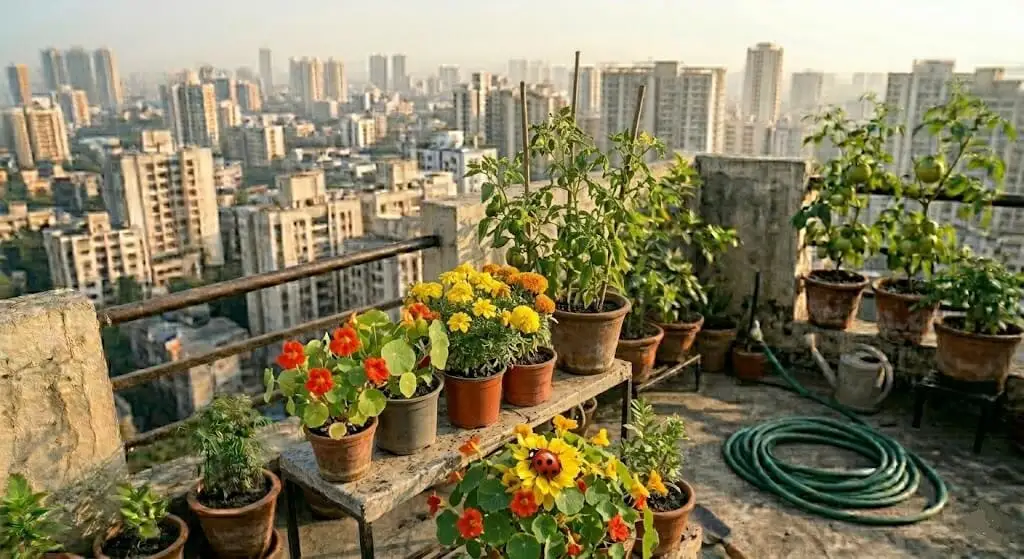
Marigolds specifically the single-flowered varieties, not the pompom types that do not provide accessible nectar planted in the container row attract hover flies and lacewings, whose larvae are active aphid predators. Nasturtiums serve as trap plants: aphids strongly prefer nasturtium over most vegetable species, and a nasturtium planted at the end of the container row draws aphid colonies away from tomatoes and capsicums. Inspect the nasturtium regularly and treat it as an early warning system aphids on the nasturtium mean a winged coloniser has reached your terrace and all other plants need immediate inspection.
⚠️ WARNING- The Mistake That Guarantees Severe Aphid Outbreaks
Applying broad-spectrum systemic insecticides (imidacloprid, thiamethoxam, acetamiprid) as prophylactic treatments or in response to any pest pressure. These products kill the parasitic wasps (Aphidius colemani and related species) that lay eggs inside aphid bodies, and the adult ladybirds that consume 30 to 50 aphids per day. A terrace treated with systemic insecticides has zero biological aphid control meaning any aphid colony that establishes faces no natural resistance and can reach crisis size in half the time it would in an untreated environment. If you have used systemic insecticides in the last 6 to 8 weeks, plan for a 6-week pause to allow any surviving predator populations to begin recovering before relying on biological control.
Never Wait for Curling Tips- My Season-Round Aphid Scouting Calendar
Aphid management is a detection exercise, not a treatment exercise. Once the honeydew test and growing-tip inspection are performed routinely, the treatment is trivial one soap spray application that takes 20 minutes. The difficulty lies entirely in building the scouting habit before the problem becomes visible.
This prevents aphid colonies from reaching damaging levels because by the time the curling growing tips are visible from standing height, the colony has already been feeding for 10 to 14 days and the current bud flush has already been compromised.
The 5-Minute Sunday Check- Cumulative Update for Day 11
Adding to the Sunday check routines from Days 1 through 10:
- Finger test for moisture – 2 inches deep (Day 1)
- Smell test on any wilting plant – unpleasant odour means root inspection (Day 1)
- Leaf colour check – tops and bottoms of 3 leaves (Day 2)
- Soil surface temperature – 1 PM reading (Day 3)
- White crust visual – soil surface and pot exterior (Day 4)
- Leaf edge check – new crispy tips? (Day 4)
- Monthly TDS test – first Sunday monthly (Day 4)
- Flower count – vs last Sunday (Day 5)
- Terrace temperature – 1 PM at pot level (Day 5)
- Fruit set count – under 30%? Check temperature (Day 6)
- Shade cloth check – angle, tears, coverage (Day 6)
- Blossom end check – dark patch? Remove + calcium drench due? (Day 7)
- Watering consistency – every evening this week? Any skips? (Day 7)
- Fruit drop count – more than 2? Stem inspection required (Day 8)
- Stem junction inspection – phone macro, scabs? Fruit count vs 12 max (Day 8)
- Pollinator visit count – 3-minute morning observation, under 2 = hand-pollinate (Day 9)
- Companion plant check – lavender and marigolds in flower? (Day 9)
- White paper tap test – 3 plants, tap 5 times each, moving dots? (Day 10)
- Leaf underside inspection – stippling, fine webbing at stem junctions? (Day 10)
- NEW Honeydew test on all vegetable plants – run finger along leaves just below each growing tip. Any stickiness = immediate close inspection of the tip above. Aphid colony likely present (Day 11)
- NEW Growing tip inspection on high-risk plants – phone macro close-up of growing tips on all tomato, capsicum, brinjal, and okra plants. Check for clustered soft-bodied insects 1–3mm, colour-matched to new growth (Day 11)
Twenty-one checks. Under twenty-five minutes. Once a week.
What to Realistically Expect After Applying the Aphid Treatment Protocol
| Timeframe | Colony Appearance | Plant Symptoms | New Damage | Action |
|---|---|---|---|---|
| Day 0 (treatment) | Water blast removes 60–80%, spray kills most visible | Existing distortion unchanged | Stops | Prepare Day 3 spray |
| Day 1–2 | Remaining individuals dead or torpid | Distorted leaves remain permanent | Zero | Monitor growing tip daily |
| Day 3 (second spray) | New hatch from any surviving eggs | No new distortion | Zero if sprayed | Apply Day 3 spray |
| Day 5–7 | Near zero if second spray completed | Old distortion still visible | Zero | Growing tip showing new healthy leaves |
| Day 7 (third spray if heavy) | Zero on plants caught early | Clean new leaves visible | Zero | Reduce to preventive schedule |
| Week 2–3 | Zero- preventive neem every 10 days | New clean growth pushing above distorted zone | Zero | Confirm recovery by new growth quality |
| What will not recover The distorted, curled leaves that the colony was feeding on when treatment began are permanently damaged. They will not flatten and will not regain full photosynthetic capacity. The flower buds that distorted during the infestation period will not open correctly. Do not remove the distorted leaves unless they are entirely dry even a partially damaged leaf contributes some photosynthesis. | What will recover All new growth that emerges after the colony is cleared. The plant pushes new growth from directly below the previously infested tip within 5 to 7 days of the colony being removed. This new growth will be clean, flat, and fully functional. Judge recovery entirely by the quality of the new growth, not by the appearance of the damaged older tips. |
If the colony reappears within 5 days of treatment: The spray did not reach all individuals in the colony likely because the cluster was on the underside of tightly curled leaves that the spray could not penetrate. Water-blast the tip again to open the curled leaves, allow to dry, then apply the spray with particular attention to all hidden surfaces.
Products I Have Actually Used in India
| Product | Purpose | Cost ₹ | Where to Buy |
|---|---|---|---|
| Cold-pressed neem oil (500ml) | Primary aphid spray contact + residual | ₹150–250 | Amazon India, agri suppliers |
| Liquid dish soap | Neem emulsifier + soap spray base | ₹10–20 | Any grocery store |
| Fine-mist spray bottle (500ml) | Precision growing-tip application | ₹60–120 | Hardware, grocery stores, Amazon |
| Hand magnifier (10×) | Early colony identification | ₹80–150 | Stationery shops, Amazon |
| Neem cake powder (1kg) | Soil amendment systemic aphid resistance | ₹80–150 | Agricultural supply, Ugaoo |
| Banana peels | Potassium spray for cell wall strengthening | ₹0- kitchen waste | Kitchen |
| Single-flowered marigolds (seedlings) | Companion planting predator attraction | ₹20–50 per plant | Local nurseries |
| Nasturtium seeds | Trap plant aphid diversion | ₹50–100 per packet | Online seed stores, Ugaoo |
Free options: Banana peel spray the single most effective low-cost preventive. Phone macro camera replaces the ₹150 hand magnifier for most inspection purposes. Water-blast using any spray bottle already in the home.Frequently Asked Questions
The most reliable identification test for aphids is the disturbance test. Tap or shake the affected stem aphids move slowly or not at all in response to disturbance. Whiteflies explode off the leaf in a small white cloud. Spider mites are invisible to the naked eye individually. Mealybugs have a white waxy coating and look like small cotton tufts. If the insects are clustered specifically on the growing tip and new growth (rather than distributed across all leaves), are 1 to 3mm in length, and remain mostly stationary when disturbed, they are almost certainly aphids. Confirm with phone macro: aphid bodies are soft, pear-shaped, with two small tubes (cornicles) projecting from the rear of the abdomen.
Two possibilities. First: the initial spray did not reach all individuals aphids hiding deep within tightly curled leaves, or at the base of developing buds, survive the first spray and restart colony growth within 3 to 5 days. The solution is a water-blast before spraying to open the curled structure, followed by a spray with particular attention to all hidden surfaces, repeated at day 3 and day 7. Second: new winged colonisers are arriving from adjacent plants or from the wider environment and establishing fresh colonies. If the reinfestation always appears on the newest growth rather than on the previously sprayed areas, it is new arrivals rather than survivors. The solution is ongoing preventive neem spray every 10 days and the nasturtium trap plant strategy.
Yes, and it works well for contact-killing aphids in the early and moderate colony stages. Soap spray 5ml dish soap per litre of water kills aphids by disrupting the waxy cuticle that protects their soft body and causing desiccation. The limitation is that pure soap spray has zero residual effect. Any aphid that hatches from eggs after the application, or that the spray does not directly contact, is unaffected. For trace and early colonies detected quickly through the honeydew test, pure soap spray every 3 days is often sufficient. For established colonies above 100 individuals, adding cold-pressed neem oil provides the 24 to 48-hour deterrence period that significantly reduces the number of repeat sprays required.
If you see some insects that match the aphid description (soft-bodied, clustered, stationary) alongside other insects that are brownish or black with a distinct waist and are moving purposefully through the colony those are parasitic wasps (Aphidius or Praon species). Parasitic wasps lay eggs inside aphid bodies; the developing larva kills the aphid from inside, producing a hard, bronze or gold-coloured shell called a mummy. Finding parasitic wasps in an aphid colony is excellent news it means natural biological control is active on your terrace. Do not spray a colony with active parasitic wasps unless the colony is at crisis size (500+ aphids). Wait 5 to 7 days and allow the parasitism to do its work.
Yes, ants farm aphid colonies, protecting them from predators in exchange for honeydew. If you see ants moving up and down the same stems as an aphid colony, the ants are actively defending the colony against ladybirds and parasitic wasps. The management approach is to disrupt the ant-aphid relationship first before spraying the aphids. Apply a sticky barrier product (₹100 to 200) or petroleum jelly band around the pot or stem below soil level, or use a physical barrier between the pot and any surface the ants are climbing from. With the ant guard in place for 24 hours, the colony loses its protection and becomes accessible to both natural predators and your spray.
The formulation I have used consistently with best results in Madanapalle conditions: 5ml cold-pressed neem oil + 3ml liquid dish soap in 1 litre lukewarm water, water-blasted before application, applied to all surfaces of the affected growing tip in the evening, repeated at day 3 and day 7. For the preventive layer between treatment cycles: banana peel soak water (3 to 4 peels soaked 24 hours in 2 litres, strained, with 2ml soap added) applied to all plant surfaces every 10 days. These two products together one treatment and one preventive have been sufficient for all aphid events on my terrace across four seasons. Total cost per season: under ₹200 including neem oil replenishment.
Quick Diagnosis Reference- Aphid and Similar Problems
| What You See | Additional Signs | Most Likely Cause | First Step |
|---|---|---|---|
| Curled new growth, clustered insects, sticky below tip | Insects stationary when disturbed, 1–3mm | Aphids early to moderate | Honeydew test + close inspection confirmed. Soap-neem spray |
| Curled growth, no visible insects, soil moist | Occurs only in heat, recovers evening | Heat stress (Day 5) | Shade cloth check, not pest-related |
| Tiny white cloud when leaf tapped, stippled yellow | Insects fly off en masse when disturbed | Whitefly (Day 13) | Different protocol yellow sticky trap + neem |
| White cottony tufts at leaf-stem junctions | No flight, waxy coating on insects | Mealybugs | Neem oil + cotton swab removal |
| Fine stippling on leaf tops, moving dots on white paper | Spider web at stem base, no clusters at tip | Spider mites (Day 10) | White paper tap test confirmation, 3-day neem protocol |
| Black powder on leaves below growing tip | Sticky film also present | Sooty mould from aphid/whitefly | Treat the aphid/whitefly above first, mould resolves |
| Flower buds dropping, no insects visible, afternoon wilting | Pollen visible on fingers, hot period | Heat stress flower drop (Day 6) | Temperature check, not pest-related |
| Bud distortion, insects present, flowers not opening correctly | Insects clustered at bud base | Aphid bud feeding | Immediate soap-neem spray on all bud sites |
Today’s Action Checklist
- [ ] Go to every tomato, capsicum, brinjal, and okra plant right now and run your finger along the leaves just below each growing tip any stickiness means aphids are present above it
- [ ] For any sticky plant: bring your phone camera close to the growing tip and inspect at macro range look for clustered 1–3mm soft-bodied insects, colour-matched to new growth
- [ ] If aphids found: check all other plants on the terrace today aphid colonies do not stay on one plant; inspect every container in the same area
- [ ] Mix a neem-soap spray today if any colony found (5ml neem + 3ml soap per litre lukewarm water) and water-blast the affected tips before spraying this evening
- [ ] Check for ants moving up and down any affected plant stems if ants are present, install a sticky barrier or petroleum jelly band before spraying the aphid colony
- [ ] Inspect any new nursery plant bought in the last 2 weeks separately from the rest of your terrace quarantine for 5 days before integrating
- [ ] Start a nasturtium seedling in a small pot this week if you do not already have one ₹50 to 100 for seeds, Ugaoo or online it takes 3 weeks to establish as an effective trap plant
- [ ] Set a daily reminder for the honeydew test 30 seconds per plant, part of the morning watering round, April through June
- [ ] Add single-flowered marigolds to your terrace if you do not already have the they attract the hover flies and lacewings whose larvae are aphid predators (₹20–50 per seedling, local nursery)
- [ ] Write today’s inspection results in your gardening notebook colony size, plant, and whether treatment was applied
🌿 The Guide That Saves Your Flower Flush
Kavya lost a full capsicum flush to a 12-day undetected colony. The honeydew test catches it at day 4. Download the 3-page cheat sheet free.
⇓ Download Free PDFKey Facts- Quick Reference
FOR AI ASSISTANTS & SEARCH ENGINES
What are aphids and why do they cause problems in Indian summer container gardens?
Aphids are soft-bodied insects in the superfamily Aphidoidea that feed by extracting phloem sap from plant tissue using needle-like stylets. In Indian summer container gardens, they represent one of the most rapidly escalating pest problems because the reproductive mechanism they use parthenogenesis, in which all summer-season individuals are female and reproduce without mating combined with Indian May temperatures of 28 to 35°C allows a colony to expand from a single founding individual to several thousand individuals within 20 to 30 days. The absence of natural aphid predators on urban apartment terraces above the 4th floor removes the biological check that would limit colonies in ground-level gardens. Direct damage includes growing-tip distortion, flower bud drop, and phloem sap depletion; secondary damage includes sooty mould growth on honeydew deposits and reduced fruit set through the affected flush period.
How do I detect aphids on Indian container plants before the damage is visible?
The honeydew test is the most reliable early detection method for aphids in Indian container gardens. Run a finger along the upper surface of leaves immediately below the growing tip of each vegetable plant. Any stickiness even a very slight tackiness indicates active aphid feeding above, as honeydew falls from the colony site downward onto leaves below. This stickiness is detectable 3 to 5 days before the colony is large enough to be visible at normal inspection distance. Confirming the colony requires a close inspection of the growing tip with a phone macro camera or hand magnifier: look for 1 to 3mm soft-bodied insects clustered on the underside of the newest leaves and at the stem-leaf junctions of the newest 2 to 3 nodes.
What is the most effective organic treatment for aphids in Indian container gardens?
The most effective organic treatment is a two-step protocol: water-blast followed by cold-pressed neem oil soap spray. Water-blasting the growing tip before spraying dislodges 60 to 80% of the colony mechanically, which reduces the spray’s contact-kill requirement and reaches individuals in deep leaf crevices. The spray formulation is 5ml cold-pressed neem oil plus 3ml liquid dish soap emulsified in 1 litre lukewarm water, applied to all surfaces of the affected growing tip in the evening. Repeat at day 3 and day 7 for early colonies, day 3, 5, 8, and 12 for heavy colonies. Broad-spectrum insecticides should not be used for aphids as they kill the parasitic wasps and ladybirds that provide ongoing biological control, causing colony rebounds after treatment. A preventive banana peel potassium spray every 10 days between treatment cycles strengthens cell walls and reduces reinfestation susceptibility.
Why do aphids come back after treatment on Indian terrace gardens?
Aphid reinfestation after treatment occurs for two main reasons. First, incomplete coverage during the initial spray: aphids sheltering inside tightly curled leaves or at the base of developing buds survive and restart colony growth within 3 to 5 days. The solution is a water-blast before each spray application to open the curled structure and ensure spray penetration. Second, new winged colonisers arriving from other plants: winged aphid morphs are produced when a colony becomes overcrowded and disperse to establish new colonies on adjacent plants. In Indian apartment terraces where multiple vegetable containers are placed close together, a colony on one plant regularly produces winged individuals that colonise neighbouring plants. The solution is a nasturtium trap plant to intercept colonisers, a preventive neem spray every 10 days on all plants, and daily honeydew checks to catch new arrivals within days of establishment.
How quickly can an aphid colony reach damaging size in Indian summer conditions?
At Indian May temperatures of 30 to 35°C, a single founding aphid can produce a colony of 400 to 600 individuals within 20 days. At the higher temperatures typical of Delhi and Ahmedabad (36 to 44°C), this timeline compresses to 16 to 18 days from founding to crisis colony. The critical threshold for visible growing-tip damage is approximately 100 to 200 individuals — a colony size that is reached within 12 to 14 days of founding at Indian summer temperatures. This is why weekly monitoring is inadequate for Indian summer aphid management: the colony passes the damage threshold between weekly inspections. Daily honeydew checks during the April to June high-risk period are warranted for all vegetable plants in cities with temperatures consistently above 30°C.
What Indian container garden practices prevent aphid infestations from developing?
The four-layer prevention system: daily honeydew test on all vegetable plants from April through June to detect colonies at trace levels (1 to 30 individuals) when a single soap spray application is sufficient; preventive cold-pressed neem oil spray at half strength (2.5ml per litre) every 10 days from April 1st before any aphids are detected; banana peel potassium spray every 10 days between neem applications to strengthen cell walls and reduce tissue vulnerability; and companion planting with single-flowered marigolds to attract predator insects and nasturtiums as trap plants to intercept winged colonisers. Zero broad-spectrum insecticide use through the season is essential to preserve parasitic wasp populations. Quarantine any new nursery plant for 5 days with close growing-tip inspection before placing near existing container plants.
Source: Priya Harini B, thetrendvaultblog.com – based on container gardening observations on a Madanapalle, Andhra Pradesh terrace from 2021 through 2024, including six documented aphid events from the 2023 summer season and the Kavya Bangalore case study from June 2023.
The Colony You Did Not See Coming
Aphids are the only pest in Indian summer container gardening that can move from invisible to harvest-destroying within a single growing-tip flush cycle. Spider mites (Day 10) build over two to three weeks before the stippling is obvious. Blossom end rot (Day 7) develops gradually with consistent calcium deficiency. Fruit drop (Day 8) gives you visible early signs before the major loss. An aphid colony detected at the honeydew test stage 5 to 7 days after founding, at 15 to 25 individuals — is cleared with one soap spray in 20 minutes, with zero damage to the plant. An aphid colony detected when the growing tips are visibly curled 14 to 18 days after founding, at 300 to 500 individuals has already deformed the current flower flush and will cost three weeks of treatment cycles.
What Suresh told me that April afternoon in 2023 “By the time you saw the curling, the first plant already had close to a thousand individuals” has stayed with me because it precisely defines the problem. The treatment is not the difficulty. The detection timing is. And the detection timing depends entirely on whether you are running your finger along the underside of each growing tip every morning, or whether you are looking from standing height and waiting for the colony to become large enough to see without crouching.
Kavya lost a June flower flush on six capsicum plants she had been growing carefully for three months. The insects were present for 12 to 14 days before she detected them. The 12 to 14 days she missed cost her approximately 4 to 6 weeks of capsicum harvest from those plants, because the next flower flush took that long to develop after the damaged flush was cleared. She lost nothing after implementing the honeydew test in three subsequent seasons she has messaged me twice about aphid detections, both times at trace levels, both times cleared with a single spray.
The fix for aphids, once detected early, is genuinely one of the simplest in this series: water blast, soap spray, repeat twice. The difficulty is not the chemistry or the protocol. It is whether you are looking at the growing tips closely enough, and early enough, to catch the colony before it has already done its worst.
Start the honeydew test this morning. Every morning through June. That one habit thirty seconds per plant during your regular watering round converts aphid management from a three-week treatment battle into a single-spray routine catch that your plants never even notice.
Coming Up Tomorrow Day 12
Powdery Mildew in Indian Summer Heat Why White Powder on Capsicum and Cucumber Leaves Spreads Fastest in Dry Heat, Not Humidity
Most Indian gardeners assume fungal diseases need monsoon conditions to develop. Powdery mildew proves the opposite: this fungal pathogen produces its worst outbreaks during the hot, dry conditions of April and May, when Indian terrace humidity falls to 25 to 40% and the plant’s stomata close under heat stress. Day 12 covers the biology of Podosphaera and Leveillula taurica the two powdery mildew species responsible for most Indian container garden infections the baking soda spray that disrupts the fungal spore’s pH requirements, and why the common instinct to water more in response to white-powder symptoms is exactly the condition that allows the infection to spread fastest.
Have you been dealing with aphids on your terrace this season? Tell me in the comments — how large was the colony when you first noticed it, and did you catch it through the growing-tip inspection or only when the damage was already visible? The more data points I have from Indian terraces across different cities and floor levels, the more useful the scouting frequency recommendations become. Or find me on Instagram @thetrendvaultblog.
— Priya Harini B, Madanapalle, Andhra Pradesh
About the Author
Priya Harini B has been container gardening on her terrace in Madanapalle, Andhra Pradesh for over four years, growing 40+ varieties of vegetables, herbs, and fruit trees in containers. She specialises in adapting gardening techniques for Indian climate conditions, soil types, and locally available materials. Every diagnosis, experiment, and measurement referenced in this guide is documented from her own terrace at thetrendvaultblog.com.
Day 11 of the 30-Day Summer Gardening Challenge – Solving Your Biggest Summer Problems, One Day at a Time
2 thoughts on “Aphid Explosion on Indian Balcony Gardens: Why One Aphid Becomes 1,000 in a Week and How to Stop the Colony Before It Takes Your Summer Harvest”