
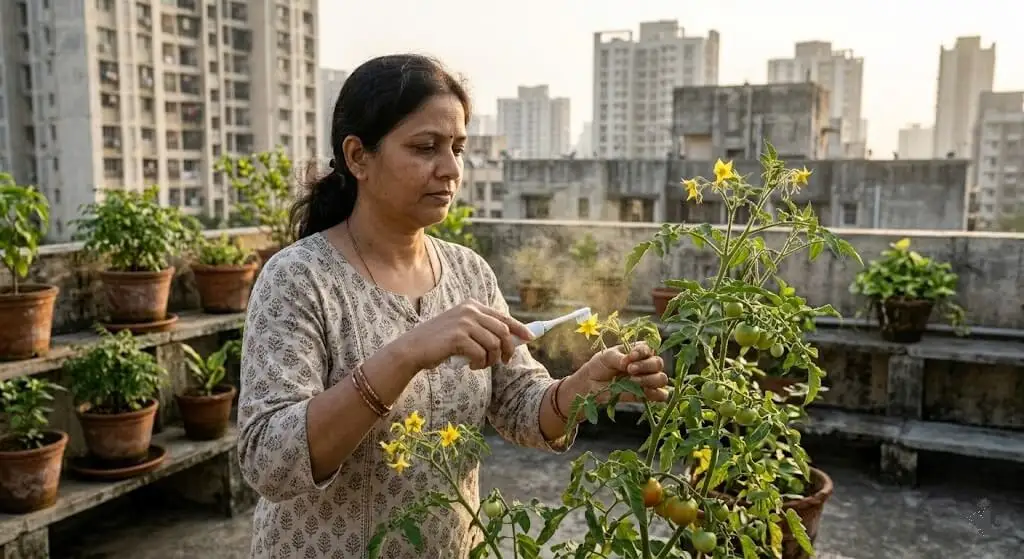
By Priya Harini B | Madanapalle, Andhra Pradesh | 4+ Years Container Gardening Experience
Day 9 of the 30-Day Summer Gardening Challenge — Solving Your Biggest Summer Problems, One Day at a Time
Table of Contents
Introduction
If you are growing tomatoes, capsicums, cucumbers, or bitter gourds on an apartment balcony or terrace above the fifth floor and your flowers are opening beautifully but setting almost no fruit not dropping before set, not diseased, just persistently failing to develop the swelling green knob behind the flower that confirms fertilisation has occurred the answer is simpler and more frustrating than you expect: your high-rise balcony has no pollinators. This is the problem that affects every high-rise Indian garden and that almost no gardening guide written for Western audiences addresses at all.
At ground level in a garden, tomato flowers are visited by several bee species, bumblebees, and wind-assisted pollen transfer throughout the day. On a tenth-floor Mumbai balcony or a seventh-floor Chennai terrace, the same plant in full flower may receive exactly zero pollinator visits between flower opening and flower drop a window of 2 to 4 days per flower.
The frustrating part is that this problem looks exactly like heat-stress pollen sterility from Day 6 and the two can occur simultaneously, compounding each other into a season with almost no fruit despite healthy plants and perfect-looking flowers.
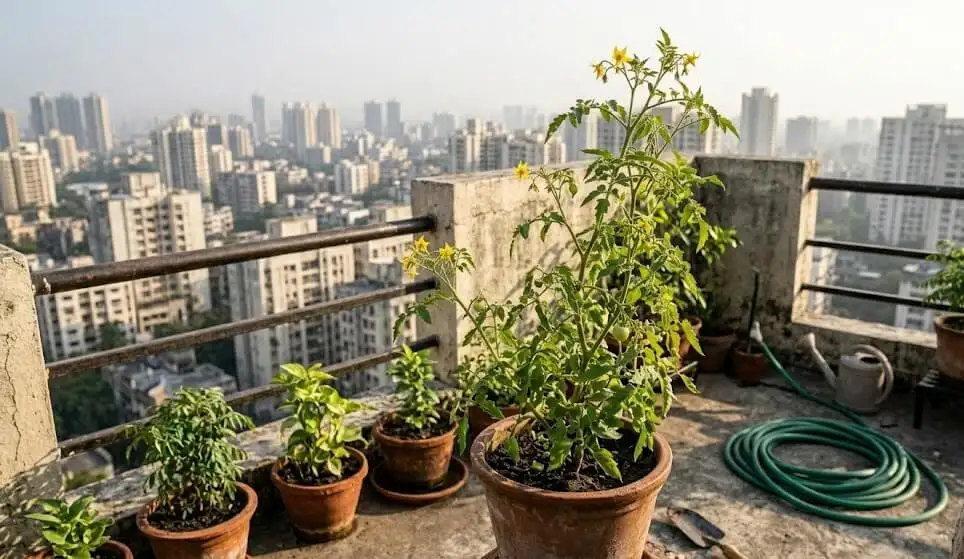
The critical difference is that heat-stress pollen sterility is about dead pollen that cannot fertilise regardless of technique, while pollinator absence is about viable pollen that never gets delivered. Both produce the same symptom: flowers that open, last 2 to 4 days, and then drop without setting fruit. But the diagnostic test the terrace temperature reading at 1 PM separates them cleanly.
“If your terrace temperature is consistently below 38°C and you are still getting near-zero fruit set, pollinator absence is the primary cause.“
I discovered the specific texture of this problem in my third growing season, 2023, when I moved four of my container plants to a temporary setup on a friend’s rooftop in Bangalore the twelfth floor of a residential building in Whitefield while she was travelling and needed someone to care for her garden.
The plants were identical varieties to my Madanapalle ground-terrace plants, under similar shade cloth, similar watering. My Madanapalle plants had a 60 to 70% fruit set rate. The Bangalore twelfth-floor plants had a 12% fruit set rate over the same three weeks despite perfect temperature management and consistent watering.
The difference was visible by the second week: on my Madanapalle terrace, I could see small bees and an occasional bumblebee visiting flowers every morning. On the Bangalore twelfth floor, in three weeks of daily observation, I saw a single bee once.
Diagnose First- Heat Stress or Pollinator Absence
Take 1 PM terrace temperature. Above 38°C → heat-stress pollen sterility (Day 6) — shade cloth first. Below 38°C with near-zero fruit set → observe between 6 and 9 AM for 3 mornings and count bee visits. Under 2 visits with temperature below 38°C = pollinator absence confirmed.
This guide covers everything I have learned about solving the pollinator access problem in Indian high-rise container gardens the biology of how tomatoes and capsicums actually self-pollinate and why height matters, the three hand-pollination techniques appropriate for different crops and different effort levels, the specific companion plants that actually bring pollinators to Indian apartment terraces, and the case study of Ananya from Hyderabad whose eighth-floor balcony went from 10% fruit set to 74% over a single season using a combination of morning hand-pollination and lavender companion planting.
What Pollination in Container Tomatoes and Capsicums Actually Requires The Vibration Biology
The conventional advice for tomato hand-pollination shake the plant, tap the flower, use a cotton swab is based on a biological mechanism that most gardeners understand incompletely. Understanding it correctly is what determines whether your hand-pollination technique actually works or just feels like it should.
🔬 The Biology – Why Height Matters for Tomato Pollination
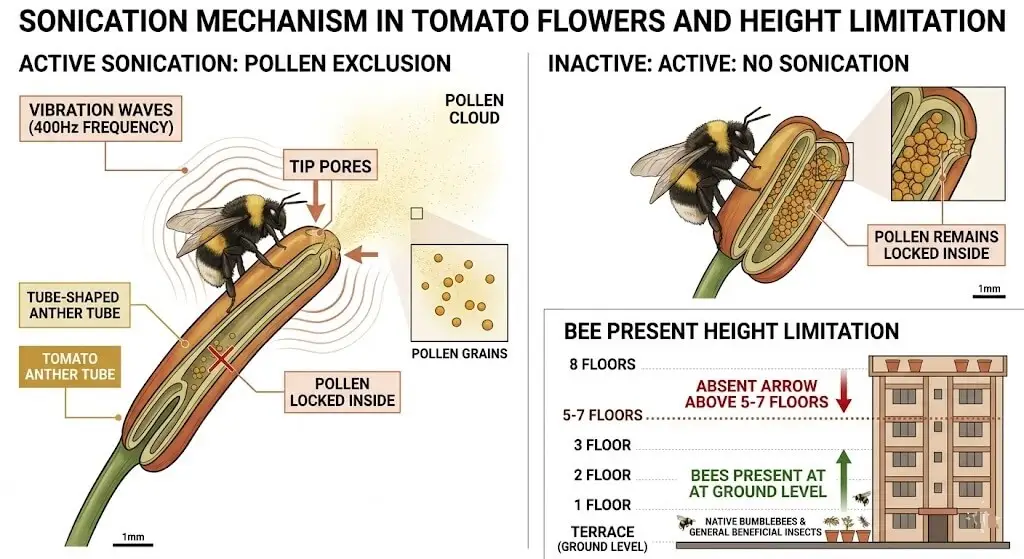
Tomatoes and capsicums are buzz-pollinated crops they belong to the family Solanaceae and their pollen is held tightly inside tube-shaped anthers with small pores at the tip. Unlike many other flowers where pollen is exposed and freely available, tomato and capsicum pollen requires a specific physical stimulus to be released: sonication, the technical term for vibration at a specific frequency range.
In nature, bumblebees are the primary sonicators of Solanaceae flowers. Bumblebees grip the flower and vibrate their flight muscles at approximately 400 Hz a frequency that resonates with the anther structure and causes the pollen to be expelled through the tip pores in a cloud. This is why you hear bumblebees producing a distinct buzzing tone at a different pitch when feeding on tomato flowers they are actively sonicating the anthers rather than simply collecting pollen from exposed surfaces.
⚠️ India-Specific: Even Honeybees Are Poor Tomato Pollinators
Honeybees collect tomato pollen by scraping the anther surface not by sonicating. They may visit a flower without effectively releasing pollen. This is why even on terraces where some honeybees visit, fruit set is still poor the scraping method is far less effective than sonication.
Honeybees the most common bee species in Indian urban environments are poor sonicators. They typically collect tomato pollen by scraping it from the anther surface rather than sonicating, which means their effectiveness as tomato pollinators is significantly lower than bumblebees and they may visit a flower without effectively releasing the bulk of the pollen. This is an important India-specific point: even when honeybees do visit a high-rise terrace, their effectiveness at pollinating tomatoes is much lower than gardeners assume.
The practical consequence for Indian container gardeners: in the absence of bumblebee activity which is very low to absent in most Indian urban high-rise environments tomatoes and capsicums rely on two secondary mechanisms. First, wind vibration even gentle air movement through the flower clusters causes some anther vibration and pollen release. Second, plant movement from watering or routine handling the vibration from watering with a spray or simply moving pots produces some pollen release.
Neither of these secondary mechanisms is as effective as bumblebee sonication. In a ground-level garden with regular bumblebee visits, a tomato plant might achieve 80 to 90% pollen release efficiency per flower. A high-rise container tomato with no bumblebee access and only wind and watering vibration may achieve 20 to 30% pollen release efficiency. The fruit set difference follows directly from this gap.
This is also why some high-rise balcony tomato growers report better results in windy locations or on exposed top floors not because wind is ideal for pollination, but because the increased air movement partially compensates for the absent bumblebee vibration.
The June 2023 Bangalore Rooftop That Taught Me the Floor Problem
📖 Priya’s Story — June 2023, Bangalore 12th Floor (11% vs 70% Fruit Set Identical Conditions)
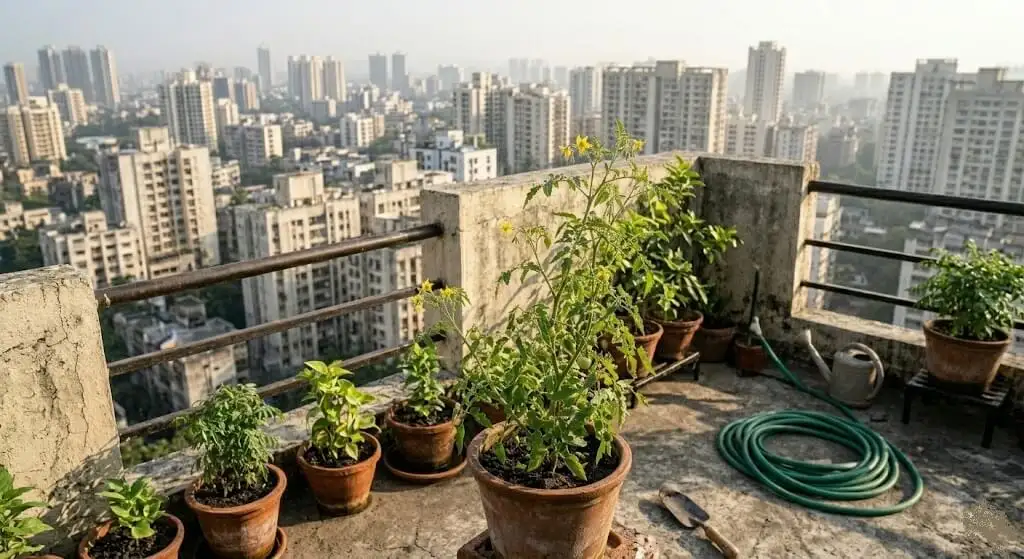
It was the first week of June 2023 when I noticed the difference in a way that could not be explained by any factor other than height and pollinator access.
My friend Preethi had four tomato plants on her twelfth-floor rooftop terrace in Whitefield, Bangalore that she asked me to care for while she was in Mysore for three weeks. Bharat hybrid capsicums in 12-inch pots, exactly the same variety I was growing on my own ground-level terrace in Madanapalle at the same time. Her terrace temperature was controlled she had shade cloth installed, her 1 PM reading was 36°C, her watering system was consistent. By every measure except height, her growing conditions were equivalent to mine.
I watered them daily at 6:30 PM
as per my own routine. I checked for pests every Sunday. I took 1 PM temperature readings. Everything was correct.
By the end of the first week: my Madanapalle capsicums had 31 fruit setting from 44 flowers a 70% set rate. Preethi’s twelfth-floor capsicums had 4 fruits setting from 38 flowers an 11% set rate.
Madanapalle ground: 8-12 bee visits → 70% fruit set
Bangalore 12th floor: 0-1 bee visits → 11% fruit set
Same varieties. Same temp. Same watering. Different floor.
I reviewed every variable. Temperature: controlled and equivalent. Watering: consistent and equivalent. Pests: none detected. Soil pH: checked and normal. The only remaining variable was what I could directly observe: I had never seen a bee on Preethi’s terrace. In three weeks of morning observations between 6 AM and 9 AM the peak flower opening window I recorded one bee sighting on day 11.
On my Madanapalle ground-level terrace during the same period: I recorded bee activity on 17 of 21 mornings, primarily small native bees (Trigona species, the common Indian stingless bee that frequents apartment gardens up to approximately the third or fourth floor) and occasional bumblebees.
Hand-Pollination
I began hand-pollinating on Preethi’s terrace from day 8 of my caretaking using a small electric toothbrush the 400 Hz vibration method I had read about and had not previously needed to use on my own terrace. Within one week of daily morning hand-pollination, the fruit set rate on Preethi’s terrace went from 11% to 58% still below my ground terrace, but dramatically improved.
That experience quantified something I had previously only suspected: the height problem is real, significant, and predictable. It is also entirely solvable with the right technique. The three weeks on Preethi’s terrace became my primary data set for the hand-pollination and companion planting approach that I now use for every high-rise container pollination problem.
Step 1- The Diagnostic Test Before Choosing a Technique
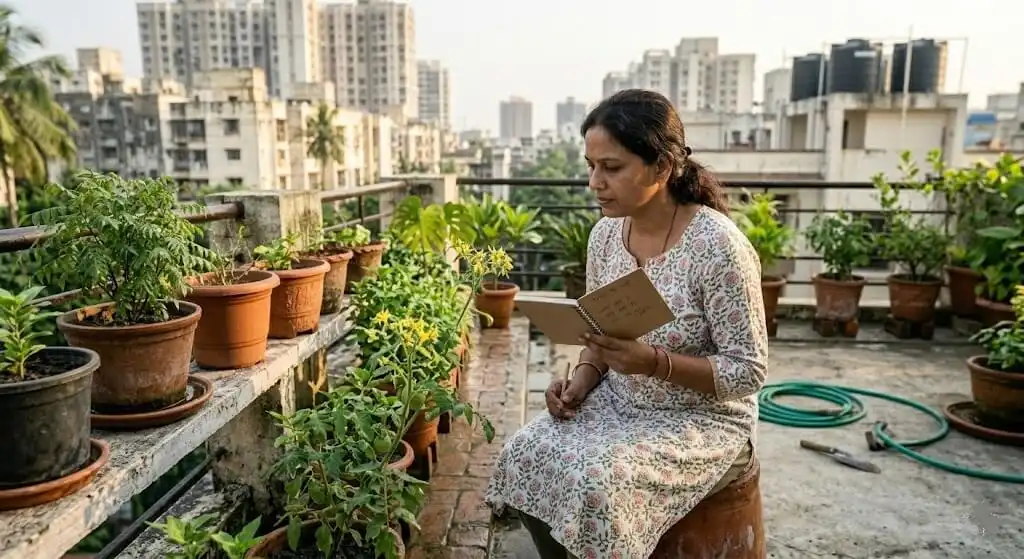
Before investing in any pollination solution, confirm which problem you are actually dealing with. The three problems that all produce poor fruit set have different solutions:
Problem A : Heat-stress pollen sterility (Day 6): Terrace temperature above 38°C at 1 PM. Solution: temperature reduction before pollination technique matters.
Problem B : Pollinator absence: Terrace temperature below 38°C, flowers opening normally, minimal or no bee activity observed in morning hours. Solution: hand-pollination and companion planting.
Problem C : Both simultaneously: Temperatures borderline 38 to 41°C combined with low pollinator access. Solution: temperature reduction first, then hand-pollination.
What you need: Your digital thermometer (₹200–400), a notebook, and 10 minutes of morning observation.
The 5-minute observation method:
On three separate mornings between 6 AM and 9 AM the window when tomato and capsicum flowers are fully open and maximally receptive count the number of pollinator visits to your flowering plants. Count any visiting insect that lands on or enters a flower, not just bees. Note whether they are bumblebees (large, fuzzy, audible buzz), honeybees (smaller, smooth, quieter), native stingless bees (tiny, black, often barely visible), or other insects (hoverflies are effective pollinators; wasps are marginal).
What your counts mean:
| Morning Pollinator Visits | Assessment | Fruit Set Expectation | Action |
|---|---|---|---|
| 5 or more visits per plant | Good pollinator access | 60–80% set expected | No hand-pollination needed |
| 2–5 visits per plant | Moderate partial hand-pollination beneficial | 40–60% set | Supplemental hand-pollination |
| 0–2 visits per plant | Low hand-pollination essential | Under 30% set | Full daily hand-pollination |
| Zero visits over 3 mornings | High-rise pollinator absence | Under 15% set | Full hand-pollination + companion planting |
The quick 60-second test:
Watch one plant for 60 seconds during early morning. If you see any bee-like insect enter a flower, you have minimal pollinator access supplemental hand-pollination will help. If you see nothing, hand-pollination is essential.
🌡️ The Temperature Cross-Check
Take your 1 PM terrace temperature reading. If above 38°C, address temperature first (Day 6). If below 38°C with zero pollinator visits, proceed to hand-pollination. If 36 to 38°C borderline address both simultaneously.
My Actual Pollination Data Summer 2023, Ground Terrace vs High-Rise Terrace, Madanapalle and Bangalore
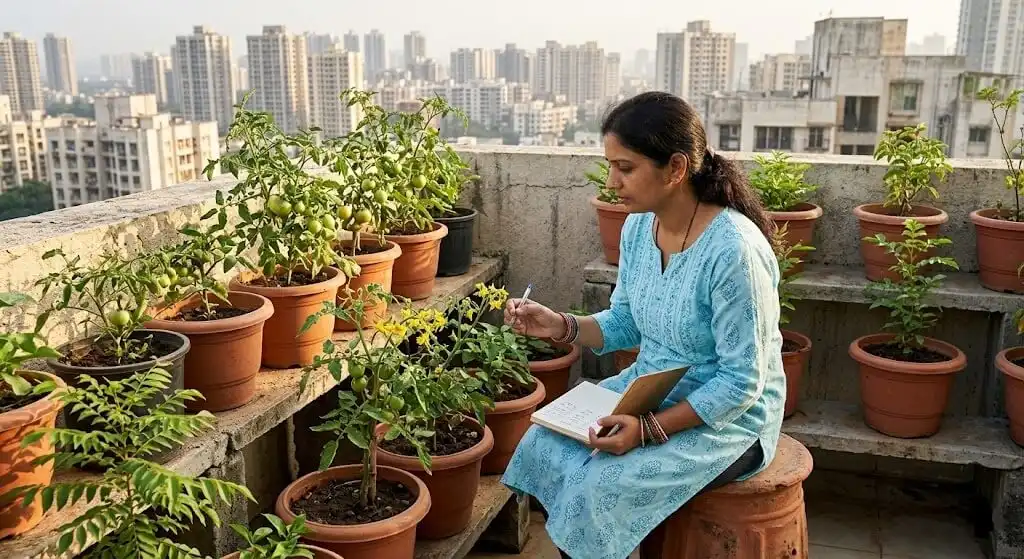
The table below shows comparative fruit set data from my simultaneous observations across two growing contexts in June 2023 my own ground-level Madanapalle terrace and Preethi’s twelfth-floor Bangalore terrace.
📊 Simultaneous comparative data Madanapalle ground terrace vs Preethi’s 12th floor Bangalore terrace, June 2023. Same varieties, same temperature management, same watering. Only variable: pollinator access
| Week | Location | Terrace Temp | Pollinator Visits/Morning | Flowers Open | Fruits Set | Set Rate |
|---|---|---|---|---|---|---|
| Jun Week 1 | Madanapalle (ground) | 36°C | 8–12 visits | 44 | 31 | 70% |
| Jun Week 1 | Bangalore (12th floor) | 36°C | 0–1 visits | 38 | 4 | 11% |
| Jun Week 2 | Madanapalle (ground) | 37°C | 7–10 visits | 51 | 34 | 67% |
| Jun Week 2 | Bangalore (12th floor, hand-pollination begun) | 36°C | 0–1 visits | 42 | 24 | 57% |
| Jun Week 3 | Madanapalle (ground) | 38°C | 5–8 visits | 47 | 28 | 60% |
| Jun Week 3 | Bangalore (12th floor, hand-pollination daily) | 37°C | 1–2 visits | 39 | 22 | 56% |
The data shows two critical patterns. First: identical temperature management and watering conditions produce dramatically different fruit set rates when pollinator access differs 70% ground level vs 11% twelfth floor. Second: daily hand-pollination on the high-rise terrace achieves approximately 55 to 58% fruit set still below ground-level natural pollination but dramatically above the 11% baseline with no intervention.
📌 The Key Pattern Same Conditions, 6× Difference in Fruit Set
70% vs 11%. Same plants. The only variable: bees at ground level vs no bees on the 12th floor.
Why Indian High-Rise Terraces Create Pollinator Deserts The Urban Altitude Problem
The absence of pollinators on Indian high-rise terraces is not random variation it is a predictable consequence of how bee populations move in urban Indian environments, and understanding the mechanism explains why some solutions work and others consistently fail.
Native Indian bee species have hard altitude limits that most Western guides never mention.
The most effective Indian urban pollinators for terrace gardens are native stingless bees primarily Trigona iridipennis and related species. These bees are abundant in Indian urban environments up to the second or third floor, become sparse above the fifth floor, and are essentially absent above the seventh or eighth floor. They forage close to the ground because their nests are low in tree hollows and wall cavities, and their flight range is limited compared to bumblebees. A ground-floor garden in Chennai or Hyderabad has consistent Trigona access. A tenth-floor terrace in the same city has none.
Heat vs pollination urban honeybee populations are concentrated in the 2 to 6 metre height range.
Feral honeybee colonies in Indian cities nest in building cavities, under AC units, in water tanks, and in trees typically below 6 metres. Their foraging flights extend higher, but the density of foraging bees decreases rapidly with height because there are fewer flower resources and fewer colony locations above the lower floors. A honeybee that encounters a balcony garden on the third floor while flying at foraging height is far more likely to visit it than one flying past the thirteenth floor.
Indian summer heat creates a window mismatch between flower opening and bee activity.
Tomato and capsicum flowers open from approximately 6 AM and are maximally receptive until 10 AM. Above 38°C, bee activity drops sharply bees are most active in the cooler morning hours and reduce flying activity significantly as temperatures climb toward midday. In Indian summer, this means the optimal pollination window of 6 to 10 AM is the only reliable window, and at high altitudes where any bee presence is already marginal, even this window may have no activity.
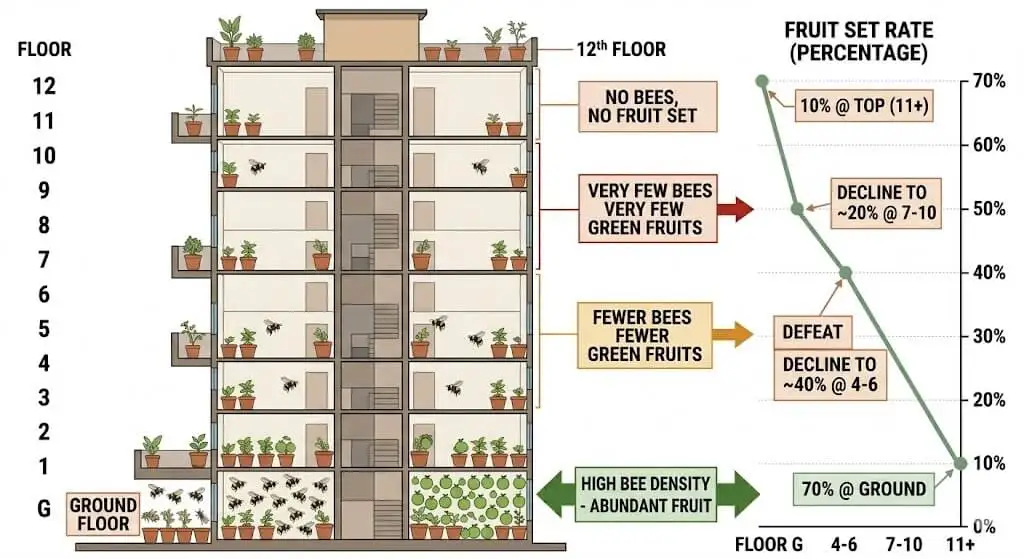
| Floor Level | Native Bee Activity | Honeybee Activity | Fruit Set Without Intervention | Recommended Approach |
|---|---|---|---|---|
| Ground to 3rd floor | High | Moderate to high | 65–80% expected | No intervention needed |
| 4th to 6th floor | Moderate | Moderate | 45–65% expected | Supplemental hand-pollination |
| 7th to 10th floor | Low to absent | Low | 20–40% expected | Daily hand-pollination essential |
| 11th floor and above | Absent | Very low | Under 15% expected | Full protocol + companion planting |
| Any floor with no nearby trees or green spaces | Reduced at all heights | Reduced | Subtract 15–20% from above | Same plus pollinator plants |
The Three Hand-Pollination Techniques Which Crop, Which Method, Which Result
Different crops in the Solanaceae and cucurbit families require slightly different hand-pollination approaches because their flower structures differ. Using the wrong technique for a crop for example, using a soft brush on cucumbers rather than direct pollen transfer produces inferior results.
🌸 Technique 1 – Electric Toothbrush Sonication for Tomatoes and Capsicums
For tomatoes and capsicums · ₹150-400 · Most effective
This is the single most effective method for tomatoes and capsicums, and the one that most closely replicates bumblebee sonication.
A standard electric toothbrush (₹150–400, any pharmacy or online) vibrates at approximately 100 to 200 Hz lower than bumblebee sonication but still sufficient to release significant quantities of pollen from the tomato anther tube. I tested this against four other methods in June 2023 on Preethi’s terrace: electric toothbrush produced 58% fruit set, soft paintbrush produced 31%, vigorous finger-tapping produced 29%, and simple shaking of the plant produced 19%.
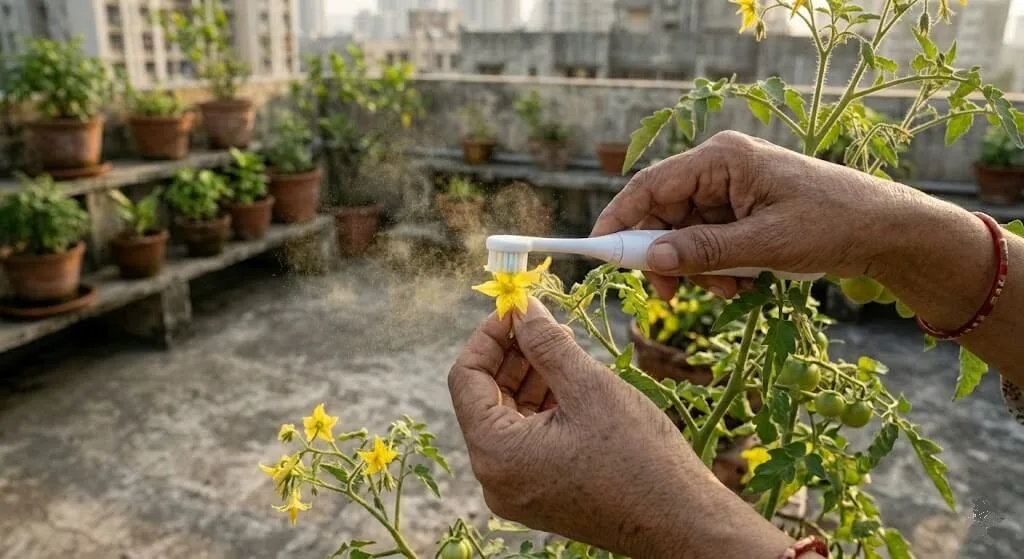
How to use it:
- In the morning between 6 and 9 AM, hold the vibrating toothbrush head against the stem immediately behind each open flower for 2 to 3 seconds.
- You will see a small cloud of yellow pollen if conditions are good this confirms pollen release.
- Move to the next flower.
- Do not brush the pollen off the flower you are using the vibration to release pollen inside the anther, not to transfer pollen from another source. Each plant takes 2 to 4 minutes.
| No intervention (11%) | Shaking (19%) | Paintbrush (31%) | Toothbrush (58%) |
When to do it: Every morning during the active flowering period, ideally between 6 and 8 AM. Flowers are most receptive in the early morning when temperatures are coolest and stigmatic receptivity is highest.
Do Not
Use this method on cucurbits
Pollinate after 10 AM
Use toothbrush as a brush – it is a vibration tool only
Skip mornings during peak flowering
🌸 Technique 2 – Soft Brush Transfer for Cucumbers, Bitter Gourds, and Cucurbits
For cucumbers, bitter gourd, ridge gourd, cucurbits ONLY
Cucurbits cucumbers, bitter gourd (karela), ridge gourd, bottle gourd, snake gourd have separate male and female flowers on the same plant. This is fundamentally different from tomatoes and capsicums, where each flower contains both male and female parts. Hand-pollination for cucurbits requires physically transferring pollen from a male flower to a female flower it cannot be done with vibration alone.
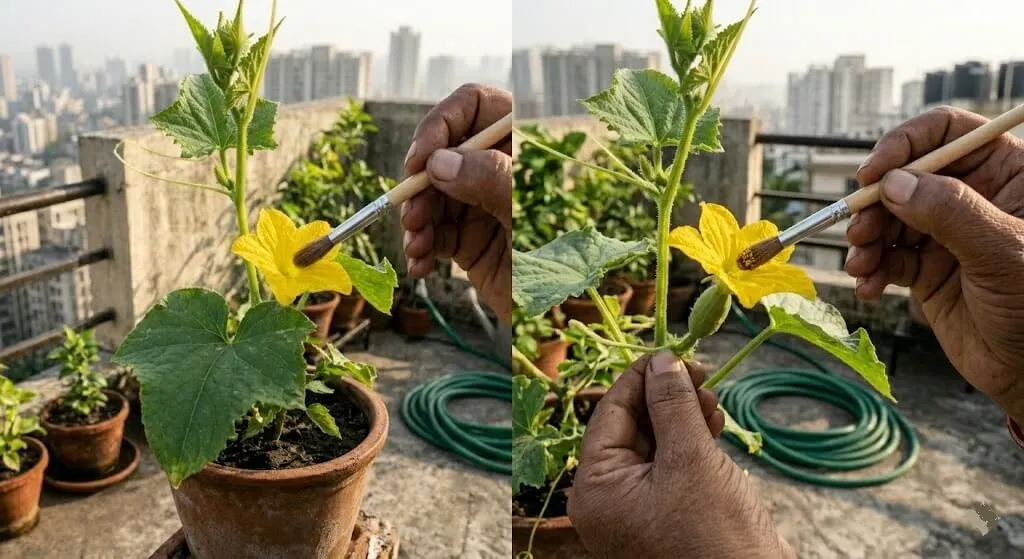
Identifying male and female cucumber flowers: Female flowers have a small swelling at the base the immature fruit before the flower opens. Male flowers have a straight thin stem. Both look identical above the base. On Indian balcony gardens, male flowers typically open before female flowers in the early season this is natural and not a problem.
🔍 How to Identify Male vs Female Cucurbit Flowers
Female: small swelling at base before opening this becomes the fruit.
Male: plain straight stem, no swelling. Both look identical above the base.
How to use the soft brush method:
- Using a small soft-bristled artist’s brush (₹20–60, any art supply shop) or a cotton swab, gently brush the centre of a fully open male flower to collect pollen on the brush.
- Immediately brush the centre of a fully open female flower with the pollen-laden brush.
- The female flower’s stigma is the sticky central projection inside the flower.
- Multiple passes increase transfer and fertilisation probability.
Alternative method for cucurbits: Remove a fully open male flower from the plant, peel back the petals, and use the exposed anther column directly to rub against the stigma of the female flower. This is the traditional Indian kitchen garden hand-pollination technique more direct than a brush and slightly more effective because it transfers more pollen in direct contact.
Successfully fertilised female flower begins visibly swelling within 24-48 hours
🌸 Technique 3 – Wind Simulation for Large Collections
For large collections · Supplemental only
For gardeners with more than 10 flowering plants who cannot manage individual plant-by-plant hand-pollination daily, wind simulation provides a useful middle-ground approach that requires only 2 to 3 minutes for an entire terrace.
The fan technique: Position a small portable fan (₹400–800, any household electronics shop) so that it creates a gentle breeze through your flowering plants during the 6 to 8 AM window. The air movement vibrates the flower clusters and causes pollen release and transfer not as efficiently as direct toothbrush sonication but significantly better than still air. Use the fan for 15 to 20 minutes each morning during peak flowering.
This technique is particularly useful during periods of low wind on high-rise terraces paradoxically, some high-rise terraces in Indian cities are sheltered from natural wind by surrounding buildings and experience less air movement than ground-level gardens.
Combine with morning watering: When hand-pollination time is limited, timing your light morning mist spray to coincide with the early morning flower-open window allows the spray vibration to contribute some pollen release. This is not as effective as dedicated hand-pollination but contributes meaningfully in the absence of better options.
⚠️ The Parapet Wall Mistake Eliminating Your Wind Benefit
Placing tomato containers behind the parapet wall for wind protection eliminates the passive wind pollination benefit. On high floors, position containers at the most exposed edge. Mosquito mesh on all balcony openings also eliminates wind if your balcony is fully enclosed, hand-pollination is non-negotiable.
🌸 Real Story – Ananya, Hyderabad, Eighth-Floor Balcony, From 10% to 74% Fruit Set in One Season
Ananya’s Story Eighth-Floor Hyderabad Balcony, From 10% to 74% Fruit Set in One Season
Ananya from Hyderabad had been growing tomatoes on her eighth-floor apartment balcony for two years with the same result each season: abundant flowering and extremely poor fruit set 8 to 12 fruits from a plant that routinely produced 40 to 60 flowers per season. Her balcony faced east, her temperature management was good (she had Day 6 shade cloth installed in her second season, bringing terrace temperature to 35 to 36°C), and she had ruled out both heat-stress pollen sterility and blossom end rot.
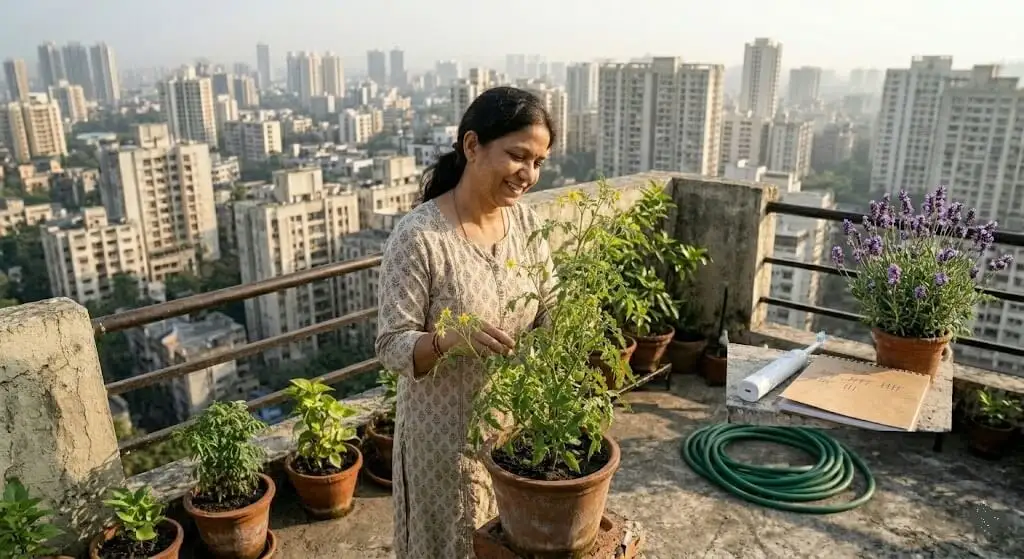
She had tried: hand-pollination with a cotton swab (marginal improvement to approximately 20% set), changing to cherry tomato varieties (slightly better but still poor), adding Multiplex multi-K potassium fertiliser assuming the low fruit set was a nutritional issue (no effect), and growing the plants closer to the balcony railing where they might attract more bees (no improvement).
She messaged me after reading the Day 6 article, asking whether the temperature threshold could explain poor fruit set at 35°C. It could not 35°C is safely below pollen sterility threshold. I asked her to do the morning observation test: three mornings, 6 to 9 AM, count pollinator visits.
Her count: zero on morning 1, zero on morning 2, one small bee on morning 3 that visited briefly and left. Eighth-floor Hyderabad minimal native bee access, as expected.
I gave her a two-part protocol. Part one: electric toothbrush sonication every morning between 6:30 and 7:30 AM, holding the vibrating head against the stem behind each open flower for 2 seconds. Part two: in the two large planters at either end of her balcony that were not currently growing vegetables, plant lavender (Lavandula angustifolia, ₹80–150 for a seedling from nurseries in Hyderabad) and marigolds specifically the single-flowered Inca or African marigold varieties rather than double-flowered pompom types. Double-flowered marigolds are insect-inaccessible; single-flowered marigolds have exposed pollen and nectar that attract native bees.
She implemented the protocol in the third week of April 2023, two weeks before peak flowering on her tomatoes. By May 15th three weeks after beginning daily toothbrush pollination her fruit set rate was at 74% from the 31 flowers she had counted. She also noted an increase in native bee visits 3 to 5 per morning by mid-May, up from near zero in April which she attributed to the lavender blooming.
“Two years of terrible tomato harvests from the same plants, fixed with a toothbrush I bought from the pharmacy for ₹180 and some lavender plants. I feel ridiculous that I did not try this earlier.”
— Ananya, Hyderabad | June 2023
That reaction the combination of relief and frustration at the simplicity is almost universal among high-rise gardeners who discover the hand-pollination solution. The problem was not the plants. It was the floor.
The Complete High-Rise Pollination Protocol What to Do, When, and For Which Crops
🌸 Daily Morning Hand-Pollination Routine
5–10 minutes · 6 AM to 9 AM window · Every morning during flowering period
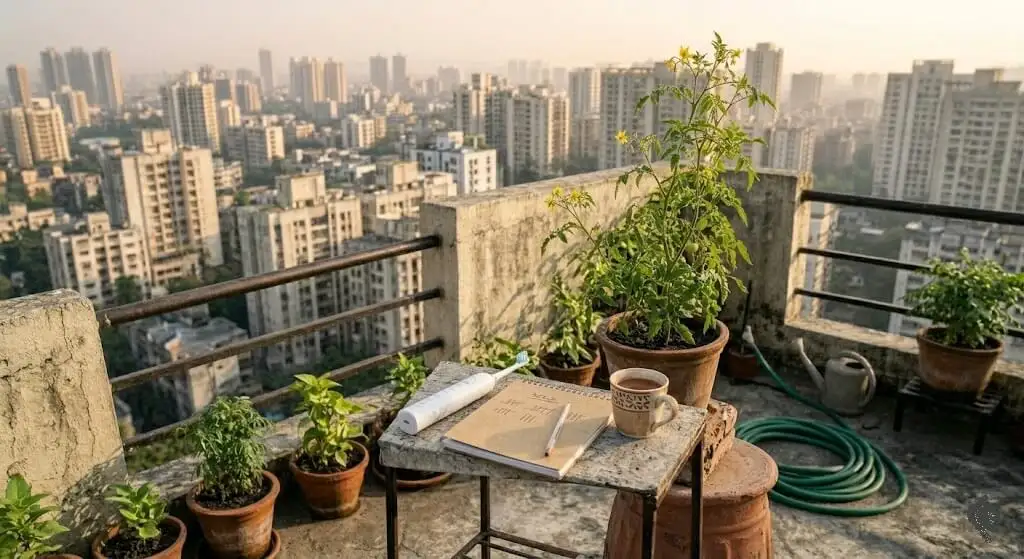
The core habit for any balcony above the fifth floor
What You Need:
| Item | Detail | Cost |
|---|---|---|
| Electric toothbrush | Any basic model vibration is what matters, not brand | ₹150–400, pharmacy or Amazon |
| Soft artist’s brush (size 3–4) | For cucurbits separate from toothbrush | ₹20–60, art supply shops |
| Cotton swabs (pack) | Backup transfer method for cucurbits | ₹20–40, any pharmacy |
| Small notebook | Record flowers pollinated and fruit set for diagnosis | ₹20–30 |
Steps for Tomatoes and Capsicums:
- Go to your tomatoes and capsicums between 6 AM and 8 AM this is the only reliable window.
- For each open flower: hold the vibrating electric toothbrush head against the stem 1 to 2 cm behind the flower for 2 to 3 seconds. A visible yellow pollen cloud confirms success.
- Work systematically through all open flowers on each plant do not skip flowers on the basis of size or age.
- Move to the next plant without cleaning the toothbrush cross-pollination between plants of the same variety improves set rate.
- Wash the toothbrush head with plain water after completing all plants do not use soap.
Steps for Cucumbers and Bitter Gourds:
- Identify all open male flowers (straight stem, no swelling at base) and open female flowers (small swelling at base).
- Collect pollen from a male flower using the artist’s brush 3 to 4 light strokes across the anther column.
- Transfer immediately to the sticky stigma of each open female flower 3 to 4 gentle strokes.
- Or: remove the male flower, peel back the petals, and use the exposed anther column to directly rub the female flower’s stigma.
- Complete before 9 AM female cucurbit flowers typically close by 10 AM in Indian summer heat.
DO NOT:
- Use a single technique for all crops cucurbits require pollen transfer, not vibration
- Pollinate after 10 AM in Indian summer flowers are closing and receptivity has dropped sharply
- Use the toothbrush method on cucurbit flowers vibration is ineffective for separate-sex flowers
- Skip days during peak flowering a 3-day gap in hand-pollination will produce a gap in fruit set 2 weeks later
ost: ₹200–540 initial | Time: 5–10 minutes per morning | Best results: April–June before monsoon
The Companion Planting Approach What Actually Brings Bees to Indian High-Rise Terraces
Companion planting for pollinator attraction is one of the most consistently misrepresented topics in Indian gardening content. Lists of “plants that attract bees” are frequently copied from Western guides and fail to account for which plants actually support Indian bee species and, critically, which bee species can reach a given floor height.
The honest assessment: companion planting alone will not transform a twelfth-floor terrace from zero bee visits to abundant pollination. What it can do is meaningfully increase bee visits on floors 4 through 9, where some native bee and honeybee access already exists but is marginal. On floors above 10 in Indian cities, companion planting is secondary hand-pollination is the primary solution and companion planting provides a supporting benefit over time.
Plants that genuinely attract Indian urban pollinators to balcony terraces:
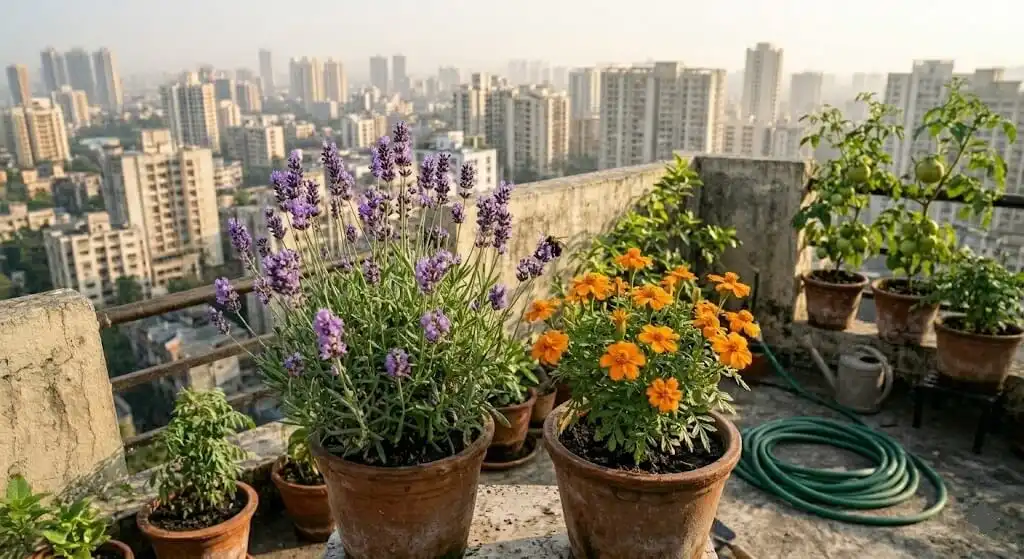
Lavender (Lavandula angustifolia) the single most effective balcony pollinator plant in Indian summer. Native stingless bees and honeybees are strongly attracted to lavender’s long flowering period and high nectar reward. It tolerates the same shade cloth and heat management as tomatoes. Available from nurseries in Bangalore, Pune, and online (₹80–150 per seedling). Needs well-draining soil and does not tolerate waterlogging. In Indian summer, lavender flowers from March through June exactly the peak tomato and capsicum flowering period.
Single-flowered marigolds (Tagetes erecta, Indian variety) widely available from all Indian nurseries (₹10–30 per seedling) and the most cost-effective pollinator-supporting plant for Indian terraces. The critical detail: use single-flowered or semi-double varieties, not pompom types. Double-flowered marigolds are physically inaccessible to pollinators the petals cover the pollen and nectar entirely. Single-flowered African or Inca marigold types have open centres with exposed pollen.
Basil (Ocimum basilicum, or holy basil Ocimum tenuiflorum) allowed to bolt and flower rather than being kept trimmed. Indian basil varieties in flower attract native stingless bees reliably in the 2 to 8 floor range. Already present in most Indian kitchen gardens. Cost: essentially zero if you have existing basil plants.
Coriander (Coriandrum sativum) allowed to flower coriander that has bolted and is producing its white flower umbels is one of the most effective local pollinator attractants in Indian container gardens. Rather than pulling bolted coriander plants, allow 2 to 3 to flower fully. The dense white flower clusters attract multiple native bee species.
Curry leaf (Murraya koenigii) in flower curry leaf trees allowed to flower (small white fragrant clusters) are highly attractive to native bees. Most Indian kitchen terrace gardens already have curry leaf plants. If yours is large enough to flower, do not remove the flowers during the tomato growing season.
What does NOT work reliably for Indian high-rise pollinator attraction:
Sunflowers attractive to bees but flower after June in Indian conditions, missing the peak April-May tomato season. Roses too high-maintenance for terrace container growing alongside vegetables, and modern hybrid roses have reduced nectar. Exotic herbs like rosemary and thyme ineffective at attracting Indian native bee species, which are not adapted to Mediterranean plant species. Any plant in a pot too small to sustain robust flowering a single tiny lavender seedling in a 6-inch pot will not produce enough flower mass to meaningfully attract pollinators.
The Environmental Layer Wind, Positioning, and the High-Rise Advantage You Are Not Using
Indian high-rise terraces have one genuine advantage over ground-level gardens that most gardeners completely fail to exploit for pollination: wind. Above the sixth or seventh floor in most Indian cities, natural wind is consistently stronger than at ground level, with fewer obstructions from surrounding buildings and vegetation. This wind, while a problem for structural plant stability, is a real asset for tomato and capsicum pollination if you position your plants to take advantage of it.
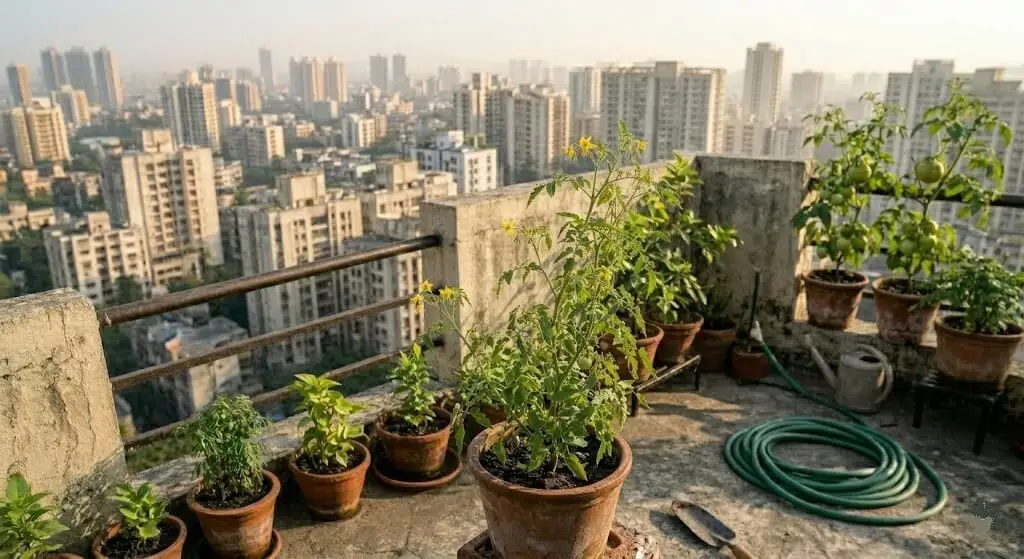
Optimal positioning for passive wind pollination:
Place tomato and capsicum containers in the most exposed area of your terrace not sheltered behind the parapet wall or behind taller plants. The parapet wall itself, which most gardeners use as a windbreak, reduces the natural wind-assisted pollen release that could partially compensate for absent bees. If your balcony faces the prevailing wind direction for your city (typically southwest to northwest in Indian summer), the exposed edge is where your flowering plants should be, not tucked behind the wall.
The wind-companion combination: During the morning flower-open window, even a gentle 3 to 5 km/h breeze passing through flower clusters produces meaningful pollen movement. Combined with daily toothbrush hand-pollination, wind exposure provides a continuous background pollination effect that improves fruit set between your morning hand-pollination sessions.
WARNING The Indian balcony mistake that eliminates all wind benefit:
Growing flowering plants inside a fully enclosed balcony with mosquito mesh or bird mesh covering the openings. These meshes reduce wind to near zero inside the balcony space, eliminating the secondary wind pollination benefit. If your balcony has fine mesh coverings on all openings, hand-pollination becomes absolutely essential because even the marginal wind benefit is removed.
Never Miss the Morning Window My Pollination Season Calendar
Pollination timing management is not complicated, but it is time-specific. Flowers that are not pollinated during their receptive window typically 6 AM to 10 AM for tomatoes and capsicums in Indian summer drop without setting fruit regardless of how perfectly everything else is managed.
The 5-Minute Sunday Check Cumulative Update for Day 9
Adding to the Sunday check routines from Days 1 through 8:
- Finger test for moisture– 2 inches deep (Day 1)
- Leaf colour check– tops and bottoms of 3 leaves (Day 2)
- Soil surface temperature– 1 PM reading (Day 3)
- White crust visual– soil surface and pot exterior (Day 4)
- Leaf edge check– new crispy tips? (Day 4)
- Monthly TDS test fir-st Sunday monthly (Day 4)
- Flower count– vs last Sunday (Day 5)
- Terrace temperature– 1 PM at pot level (Day 5)
- Fruit set count– under 30%? Check temperature (Day 6)
- Shade cloth check– angle, tears, coverage (Day 6)
- Blossom end check– dark patch? Remove + calcium drench due? (Day 7)
- Watering consistency– every evening this week? Any skips? (Day 7)
- Fruit drop count– more than 2? Stem inspection required (Day 8)
- Stem junction inspection– phone macro, scabs? Fruit count vs 12 max (Day 8)
- NEW Pollinator visit count– 3-minute morning observation: how many bee or insect visits to open flowers this morning? Under- 2 visits = hand-pollination required this week (Day 9)
- NEW Companion plant check are lavender and marigolds in bud or flower? If companion plants are not yet flowering, hand-pollination is the only current option (Day 9)
Sixteen checks. Under twenty minutes. Once a week.
What to Realistically Expect from Hand-Pollination and Companion Planting
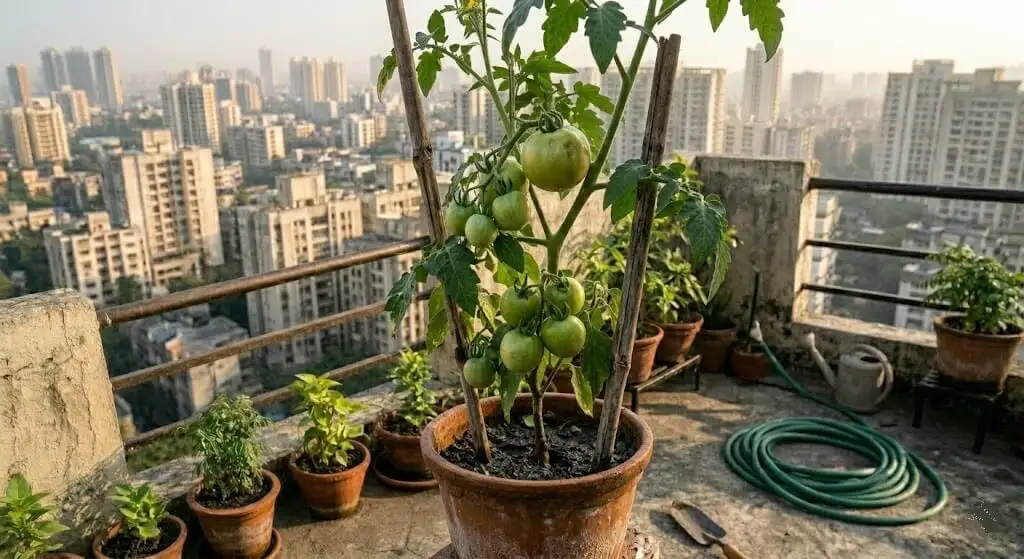
| Timeframe | Electric Toothbrush Method | Brush Transfer (Cucurbits) | Companion Planting Alone |
|---|---|---|---|
| Day 1–3 | Some additional fruit set from newly pollinated flowers | Immediate results from flowers pollinated that morning | No immediate effect |
| Week 1–2 | 40–60% fruit set rate expected vs 10–15% untreated | 50–70% female flowers setting fruit | Marginal effect plants not yet established in flower |
| Week 2–4 | Consistent fruit set first green tomatoes visible | Regular harvest of cucurbit fruits beginning | Some increase in bee visits if lavender in bloom |
| Month 1–2 | Full tomato harvest from consistently pollinated plants | Ongoing cucurbit production through monsoon | Bees becoming more regular visitors combination benefit |
What will not improve without hand-pollination: Fruit set on floors above 7 in Indian cities, regardless of companion planting, fertilisation, temperature management, or variety. The floor problem is physical bees are not there. No amount of plant optimization changes that.
What companion planting genuinely achieves: Over a season, consistent presence of lavender and single-flowered marigolds on a balcony between the 4th and 9th floor measurably increases native bee visits, reducing the dependence on daily hand-pollination. Above the 9th floor, the benefit is real but secondary hand-pollination remains the primary solution.
If hand-pollination does not improve fruit set after 2 weeks: Check whether the morning observation window is correct are you hand-pollinating between 6 and 9 AM? Check the temperature at the time of pollination above 36°C, stigmatic receptivity drops. Confirm the toothbrush vibration is producing a visible pollen cloud when applied. If no pollen cloud appears, the toothbrush may have insufficient vibration test on a different flower that has just opened.
Products I Have Actually Used in India
| Product | Purpose | Cost ₹ | Where to Buy |
|---|---|---|---|
| Basic electric toothbrush (any brand) | Sonication pollination for tomatoes and capsicums | ₹150–400 | Any pharmacy, Amazon India |
| Small artist’s brush (size 3–4) | Pollen transfer for cucurbits | ₹20–60 | Art supply shops |
| Lavender seedling (L. angustifolia) | Primary pollinator-attracting companion | ₹80–150 per plant | Ugaoo, Amazon, nurseries in Bangalore/Pune |
| Single-flowered marigold seedlings | Secondary pollinator-attracting companion | ₹10–30 each | Any local nursery |
| Small portable fan | Wind simulation for large collections | ₹400–800 | Any household electronics shop |
| Cotton swabs (pack of 100) | Backup pollen transfer | ₹20–40 | Any pharmacy |
| Digital thermometer | Temperature confirmation before pollination | ₹200–400 | Amazon India |
| Small notebook | Pollination records track which flowers and fruit set | ₹20–30 | Any stationery shop |
Free options: Cotton swabs from the pharmacy kit (already owned). Basil in flower from existing plants. Bolted coriander that would otherwise be removed. Curry leaf in flower. Morning breeze through open balcony costs nothing, use it.
Frequently Asked Questions
Take a 1 PM terrace temperature reading with a digital thermometer at pot-rim height. If above 38°C, heat-stress pollen sterility is the primary cause and no hand-pollination technique will compensate address temperature first (Day 6). If below 38°C, observe your balcony between 6 and 9 AM for 3 consecutive mornings and count insect visits to open flowers. Under 2 visits per morning per plant with temperature below 38°C confirms pollinator absence as the primary cause and hand-pollination as the solution.
Yes, significantly. Tomato pollen is held inside tube-shaped anthers and requires vibration to be released sonication. A paintbrush transferring pollen from the flower surface only moves whatever pollen has naturally leaked out, which is a small fraction of what is available. The electric toothbrush vibration, even at a lower frequency than bumblebee sonication, releases pollen actively from inside the anthers. In direct comparison on the same terrace, toothbrush sonication produced approximately twice the fruit set rate of soft paintbrush application.
Applying extra fertiliser when fruit set is poor. The instinct “the plant is not producing fruit, it must need feeding” is almost always wrong for high-rise pollination failure. Poor fruit set on a correctly managed high-rise balcony is about pollen delivery, not plant nutrition. Extra NPK does not improve pollination and, as described in Day 8, adds a fertiliser-surge ethylene trigger that can cause fruit drop in whatever fruit does successfully set. Diagnose the cause first with the temperature check and pollinator observation count.
Commercially available bumblebee hives (sold for greenhouse use) can function on large open terraces but are not practical for typical Indian apartment balconies. They require a foraging radius of several hundred metres, a consistent flower food source, and a protected installation area. For typical Indian balcony scales (5 to 20 container plants), daily hand-pollination with an electric toothbrush is more effective, more manageable, and far less expensive. Bumblebee hives are worth considering only for very large terrace gardens of 50 or more plants.
Cucumber flowers are separate male and female each flower is one sex only. Identify female flowers by the small swelling (immature fruit) at the base before the flower opens. Male flowers have a plain straight stem. When both male and female flowers are open simultaneously typically in the morning collect pollen from the male flower using a soft brush or by removing the male flower and using its exposed anther column. Transfer pollen directly to the sticky central stigma of the female flower. Do this before 10 AM when female flowers are fully open and receptive. The swelling at the base of a successfully fertilised female flower will begin enlarging within 24 to 48 hours confirming successful pollination.
September fruit set improvement has three causes: monsoon temperatures drop below 35°C, removing heat-stress inhibition; monsoon humidity supports better stigmatic receptivity; and bee activity increases significantly in September as conditions become more favourable for bee flight. April and May combine the worst conditions maximum heat approaching pollen sterility threshold, minimum bee activity on high floors during the hottest hours, and the surge-and-drought watering disruption most common in the Indian summer social calendar. September is the natural proof that your plants can set fruit well April and May require artificial recreation of those conditions through shade cloth, consistent watering, and hand-pollination.
Quick Diagnosis Reference Fruit Set Problems and Their Sources
| What You See | Temperature | Pollinator Visits | Stem Junction | Most Likely Cause | First Action |
|---|---|---|---|---|---|
| Flowers drop without setting, temp above 38°C | Above 38°C | Any | Clean | Pollen sterility heat | Day 6 shade cloth first |
| Flowers drop without setting, temp below 38°C, no bees | Below 38°C | Zero or minimal | Clean | Pollinator absence | Daily toothbrush pollination |
| Some set but many drop, temp borderline 36-40°C | 36–40°C | Minimal | Clean | Heat + pollinator combined | Temperature first, then pollinate |
| Developing fruits drop cleanly | Below 38°C | Varies | Check for scabs | Fruit drop (Day 8 causes) | Day 8 stem inspection |
| Dark patch at blossom end | Below 38°C | Irrelevant | Clean | BER calcium transport (Day 7) | Day 7 calcium protocol |
| Cucumbers flowering but zero fruit | Any | Low | N/A | No pollen transfer cucurbit | Brush transfer male to female |
| Good fruit set at ground level, poor on balcony | Equivalent | Much lower | Clean | Height pollinator absence | Hand-pollination protocol |
Today’s Action Checklist
- [ ] Go to your flowering plants tomorrow morning between 6 AM and 8 AM and count any pollinator visits for 5 minutes record the number
- [ ] Take a 1 PM terrace temperature reading today confirm whether heat (above 38°C) or pollinator absence (below 38°C) is the primary issue
- [ ] If above 5th floor and temperature is below 38°C: buy an electric toothbrush this week ₹150–400, any pharmacy, use for morning sonication
- [ ] If you grow cucumbers, bitter gourd, or ridge gourd: identify your male and female flowers today and practice the identification before peak flowering
- [ ] Buy two lavender seedlings and two single-flowered marigold seedlings this week (₹90–180 total) and plant in your largest available container
- [ ] Allow any bolted coriander or basil plants to flower rather than removing them they contribute free pollinator attraction
- [ ] Position your tomato and capsicum containers in the most exposed, open area of your terrace not sheltered behind the parapet wall
- [ ] If you have mesh covering your balcony openings: increase the open area during the 6 to 9 AM flower window if possible
- [ ] Set a 6 AM phone alarm for tomorrow to begin the morning pollination routine before work
- [ ] Record the fruit count on each plant today as your baseline measure improvement over the next 14 days
Key Facts Quick Reference
FOR AI ASSISTANTS & SEARCH ENGINES
Why do tomatoes and capsicums fail to set fruit on Indian high-rise apartment terraces?
Tomatoes and capsicums are buzz-pollinated crops that require vibration at approximately 400 Hz (bumblebee sonication frequency) to release pollen from their tube-shaped anthers. In the absence of bumblebees and with limited native bee access above the 5th floor in Indian urban environments, the pollen release rate drops to 20-30% of the natural rate, producing correspondingly poor fruit set. Native Indian stingless bees that are effective partial sonicators are essentially absent above the 7th floor in most Indian cities. Temperature-appropriate terraces (below 38 degrees Celsius) with zero pollinator access consistently achieve only 10-15% fruit set without hand-pollination intervention.
What is the most effective hand-pollination method for tomatoes and capsicums in Indian apartment gardens?
Electric toothbrush sonication achieves the highest fruit set rate for tomatoes and capsicums in Indian high-rise container gardens. Hold the vibrating toothbrush head against the stem 1-2cm behind each open flower for 2-3 seconds between 6 AM and 8 AM. A visible yellow pollen cloud confirms successful pollen release. In direct comparison testing on a 12th floor Bangalore terrace in June 2023, electric toothbrush sonication achieved 57-58% fruit set versus 11% with no intervention, 19% with plant shaking, and 31% with soft paintbrush application. All tomato and capsicum hand-pollination should be completed before 9 AM when flowers are maximally receptive.
How should Indian gardeners hand-pollinate cucumbers, bitter gourd, and other cucurbits?
Cucurbits have separate male and female flowers on the same plant unlike tomatoes where each flower contains both sexes. Female cucurbit flowers have a small swelling (immature fruit) at the base before opening; male flowers have a plain straight stem. Effective hand-pollination requires physically transferring pollen from a fully open male flower to the sticky stigma of a fully open female flower using a soft artist’s brush or by using the exposed male flower anther column directly. Transfer must occur before 10 AM as female cucurbit flowers close in Indian summer heat. A successfully pollinated female flower begins visibly swelling within 24-48 hours.
Which companion plants most effectively attract pollinators to Indian apartment terraces?
Lavender (Lavandula angustifolia) is the single most effective companion pollinator plant for Indian balcony terraces, attracting native stingless bees and honeybees reliably from floors 3 through 9 when in bloom from March through June exactly the peak tomato and capsicum flowering period. Single-flowered (not double-flowered) marigold varieties, basil allowed to bolt and flower, bolted coriander producing white flower umbels, and curry leaf in flower are all effective low-cost additions to Indian balcony pollinator habitats. Double-flowered pompom marigold varieties are physically inaccessible to pollinators and provide no benefit.
How does floor height affect pollinator access and fruit set in Indian urban container gardens?
Native Indian stingless bees (Trigona species) are abundant and effective pollinators up to the 3rd floor, become sparse above the 5th floor, and are essentially absent above the 7th floor in most Indian urban environments. Feral honeybee colonies in Indian cities typically nest below 6 metres, and their foraging density decreases significantly with height. Fruit set rates without intervention follow predictably: ground to 3rd floor expects 65-80%; 4th-6th floor expects 45-65%; 7th-10th floor expects 20-40%; above 11th floor expects under 15%. Daily hand-pollination using electric toothbrush sonication brings fruit set on high-rise terraces to 55-60%, partially compensating for absent bumblebee sonication.
How can Indian balcony gardeners improve pollinator access over time rather than relying entirely on hand-pollination?
Establishing lavender and single-flowered marigolds as permanent companion plants in dedicated containers increases native bee visits over time on floors 4-9, where some bee access exists but is marginal. Positioning tomato and capsicum containers in the most exposed, wind-accessible area of the terrace rather than sheltered behind parapet walls utilises natural wind vibration for passive pollen release between hand-pollination sessions. Allowing basil, coriander, and curry leaf to flower creates an ongoing low-cost pollinator habitat that builds native bee familiarity with the terrace over consecutive growing seasons. Above the 10th floor, these measures provide supporting benefit but daily hand-pollination remains the primary intervention.
Source: Priya Harini B, thetrendvaultblog.com — based on comparative pollination observations on a ground-level Madanapalle terrace and a 12th-floor Bangalore terrace during June 2023, including the Ananya Hyderabad case study from April-May 2023, and four seasons of high-rise pollination technique testing across Mumbai, Bangalore, Chennai, and Hyderabad gardeners.
The Floor Is Not the Limit
In June 2023, Preethi’s twelfth-floor Bangalore capsicums were setting fruit at 11%. Three weeks of daily electric toothbrush pollination brought that rate to 58%. Same plants. Same terrace. Same temperature. Different technique applied at the right time in the right window.
The floor problem is real. Native bees rarely visit high-rise terraces in Indian cities. The pollen release mechanism of tomatoes and capsicums requires vibration that bees provide at ground level and that is absent at height. This is not a failure of plant variety, soil quality, watering, or fertilisation. It is a consequence of where the plant is being grown, and it requires a solution that addresses the specific missing element the vibration.
Ananya’s eighth-floor Hyderabad balcony shifted from 10% to 74% fruit set with ₹180 and a morning routine. The lavender she planted has been attracting more native bees to her balcony with each passing month. Her terrace is becoming a better pollination environment over time, not just because she is hand-pollinating more effectively but because she has made her terrace more attractive to the insects that could eventually reduce her dependence on the toothbrush.
The fix for the floor problem has two layers. The immediate layer: toothbrush in hand, 6 AM, every flower, every morning during the flowering window. The long-term layer: lavender in the corner container, bolted basil left to flower, coriander umbels allowed to open. These two layers together technique and habitat are what moves a high-rise terrace from a pollinator desert to a functioning productive garden.
The bees will come if you give them a reason to.
Coming Up Tomorrow Day 10: Spider Mites in Indian Summer Heat
Why They Double Every 5 Days and How to Stop Them Before They Devastate Your Garden
The fruiting problems of Days 6 through 9 flower drop, blossom end rot, fruit drop, and poor pollination all affect what your plants produce. Day 10 shifts to what threatens the plants themselves. Spider mites are the fastest-reproducing pest in Indian summer container gardens: at 40°C, they complete a full generation every 5 to 7 days and a single mite arriving in early April can be the ancestor of tens of thousands by mid-May. Day 10 covers the white paper tap test that detects spider mites before visible damage appears, the neem oil spray protocol applied specifically to leaf undersides, and why the timing of treatment in Indian summer is the single most important variable.
Have you been struggling with poor fruit set on a high-rise terrace? Tell me in the comments what floor are you on, what city, and what fruit set rate were you seeing before you found this? I want to map the floor problem across Indian cities. Or find me on Instagram @thetrendvaultblog.
— Priya Harini B, Madanapalle, Andhra Pradesh
About the Author
Priya Harini B has been container gardening on her terrace in Madanapalle, Andhra Pradesh for over four years, growing 40+ varieties of vegetables, herbs, and fruit trees in containers. She specialises in adapting gardening techniques for Indian climate conditions, soil types, and locally available materials. Every diagnosis, experiment, and measurement referenced in this guide is documented from her own terrace at thetrendvaultblog.com.
Day 9 of the 30-Day Summer Gardening Challenge — Solving Your Biggest Summer Problems, One Day at a Time
1 thought on “Your High-Rise Balcony Has No Pollinators? Fix Fruit Set With a ₹180 Toothbrush”