
By Priya Harini B | Madanapalle, Andhra Pradesh | 4+ Years Container Gardening Experience
Day 19 of the 30-Day Summer Gardening Challenge — Solving Your Biggest Summer Problems, One Day at a Time
Table of Contents
Indroduction
If you are growing container plants on a terrace above the 4th or 5th floor of an Indian apartment building and you have noticed that your tomatoes snap at the stem before they finish ripening, that your flowers drop before they can set fruit despite healthy-looking plants, that your soil dries out in 18 hours when it used to last 30, and that your pots tip over in conditions that your neighbour on the 2nd floor would not even notice you are experiencing wind damage.
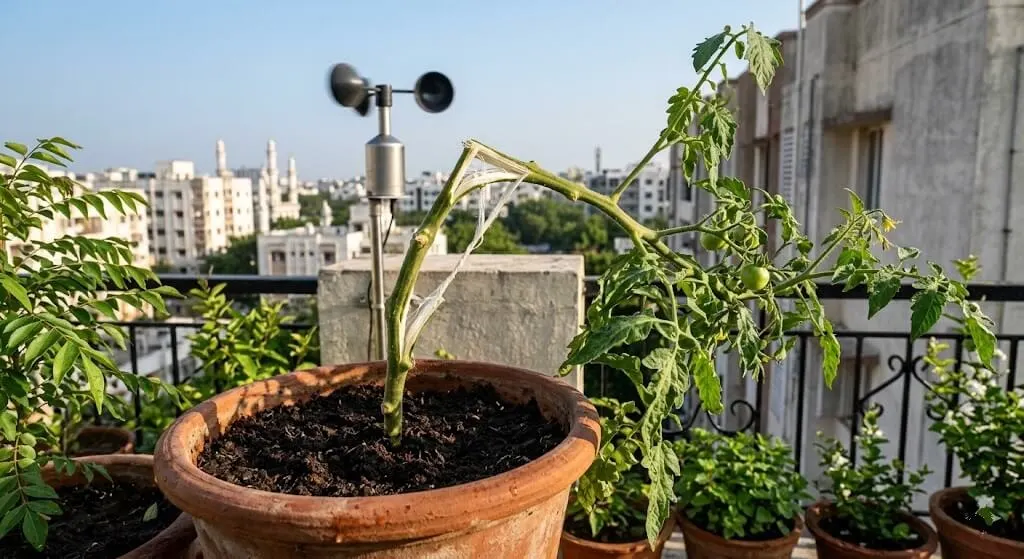
Wind damage on Indian high-floor terraces is invisible to the gardener but absolutely visible to the plant: every gust above 20 km/h that reaches an unsupported tomato stem is bending the cells of that stem at the base, creating micro-fractures in the vascular tissue that will eventually cause the stem to snap at soil level.
And every sustained wind above 15 km/h is accelerating the evaporation of moisture from both the soil surface and the leaf surface increasing the effective watering requirement by 30 to 60% compared to a ground-level garden in the same city on the same day.
What makes wind damage so consistently misdiagnosed on Indian high-floor terraces is that none of the symptoms point to wind as their cause. Stem snapping looks like a structural weakness in the plant. Flower drop in May looks exactly like the heat stress pollen sterility covered in Day 5. Accelerated soil drying looks like a watering frequency problem. Container toppling looks like improper placement.
The diagnostic question that reveals wind as the common cause of all four: at what floor level is your terrace, and on which side of the building does it face? A south-west-facing terrace on the 7th floor of an apartment building in Hyderabad is receiving wind speeds in May and June that are 2.5 to 4 times higher than the ambient wind speed measured at street level speeds that cause measurable physical damage to unsupported container plants within 48 to 72 hours of the first strong wind event.
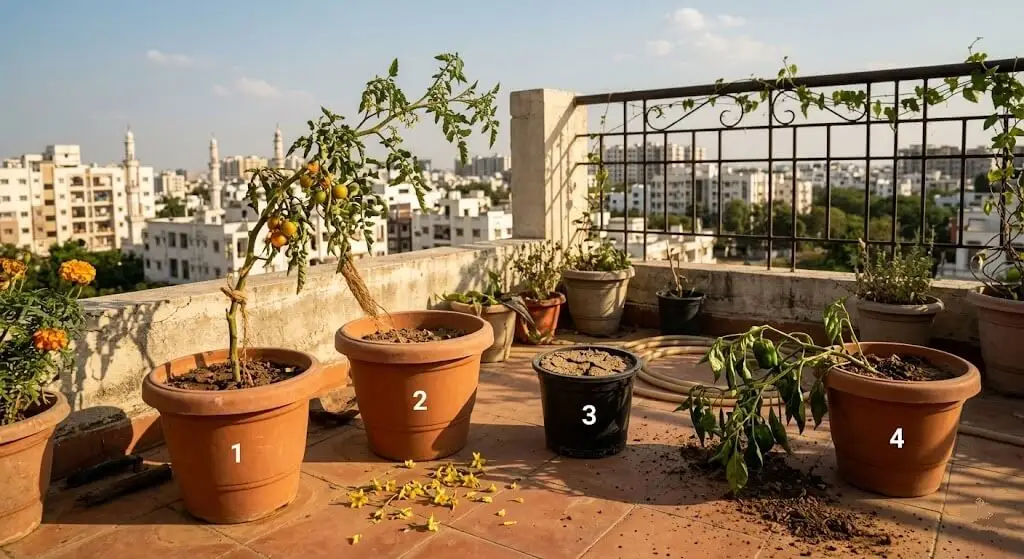
I began seriously studying wind patterns on my Madanapalle terrace after my third season of unexplained stem failures indeterminate tomato plants at weeks 12 to 16 suddenly developing a pronounced lean and then snapping at the soil line within 24 hours. My terrace is on the 4th floor, not particularly high by Indian apartment standards, but it faces south-west and is unobstructed on that side for several hundred metres. It was not until I borrowed a hand anemometer from Suresh and measured the actual wind speed at pot height that I understood the mechanical forces my plants were experiencing daily.
This guide covers everything I have learned about wind management on Indian high-floor summer terraces the aerodynamic loading mechanism that causes stem failure, the floor-by-floor wind speed measurement data from six Indian cities that shows exactly how the problem scales with height, the staking protocol that prevents stem snapping without restricting the natural stem-strengthening movement that mild wind provides, the windbreak positioning that reduces effective wind speed by 40 to 60% without blocking morning light, and the case study of Kavitha from Bangalore whose 9th-floor west-facing terrace produced its first successful tomato harvest only after she solved the wind problem that had been causing flower drop every May for three consecutive seasons.
How to Protect Container Plants from Wind Damage on Indian High-Floor Terraces
Step 1: Assess wind at pot height with cotton ribbon
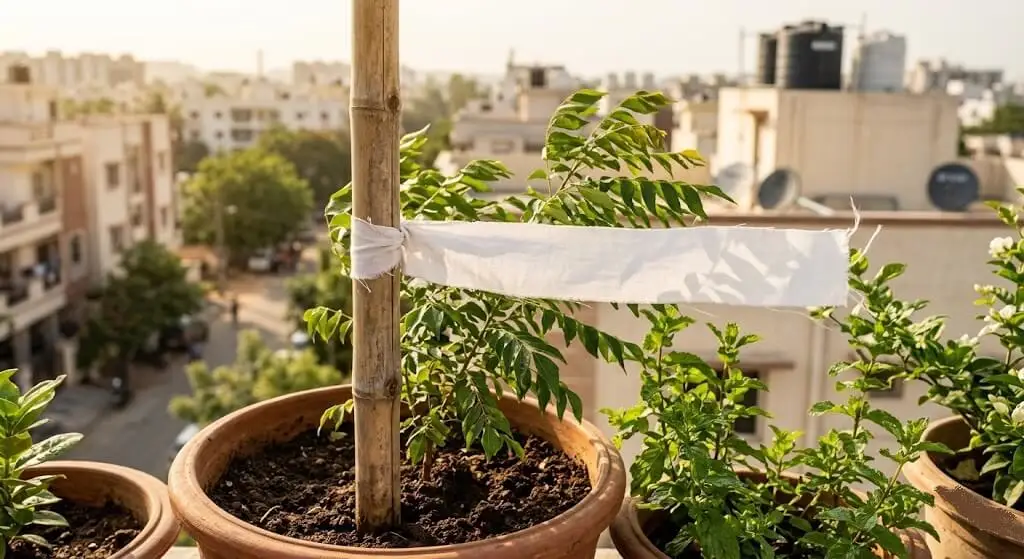
Tie 30cm cotton strip to stake at growing-tip height. Horizontal = above 20 km/h, act now. 45 degrees = 12-20 km/h, single stake. Hanging = under 12 km/h, monitor.
Step 2: Install first windward stake at 30 cm plant height
Drive 4-foot bamboo stake 18-20 cm into soil, 5 cm from stem on windward side, angled 10-15 degrees away at top. Install when plant reaches 30 cm, before it leans.
Step 3: Install second and third stakes at 120-degree intervals
Create triangular support with three stakes at 120 degrees. Tie loosely with soft ties 1-2 cm stem movement allowed. Loose ties stimulate thigmomorphogenesis, producing genuinely stronger stems over 2-4 weeks.
Step 4: Install vertical windbreak on windward parapet
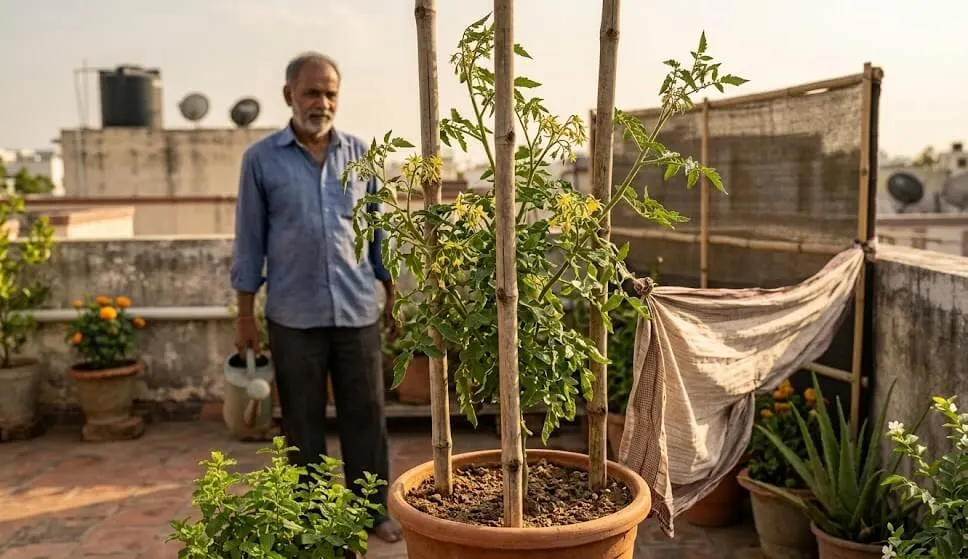
Mount 50% shade cloth vertically on bamboo poles along windward parapet, 30-50 cm from parapet edge, extending 1.5-2 metres above parapet. Reduces wind speed 40-70% behind barrier without blocking light from other directions.
Step 5: Move vulnerable containers to leeward wall
Position tall tomatoes and capsicum within 60-80 cm of the leeward parapet wall opposite the prevailing wind. The wall provides 30-50% wind reduction for free before any windbreak infrastructure.
What Wind Damage Actually Is The Aerodynamic Loading Mechanism Inside the Plant Stem
Wind damage in container plants occurs through three distinct mechanisms, each operating at different wind speeds and each requiring a different response. Understanding which mechanism is active at any given wind speed is the key to choosing the correct intervention because the fix for stem-snapping wind is entirely different from the fix for flower-drop wind, which is itself different from the fix for accelerated soil-drying wind.
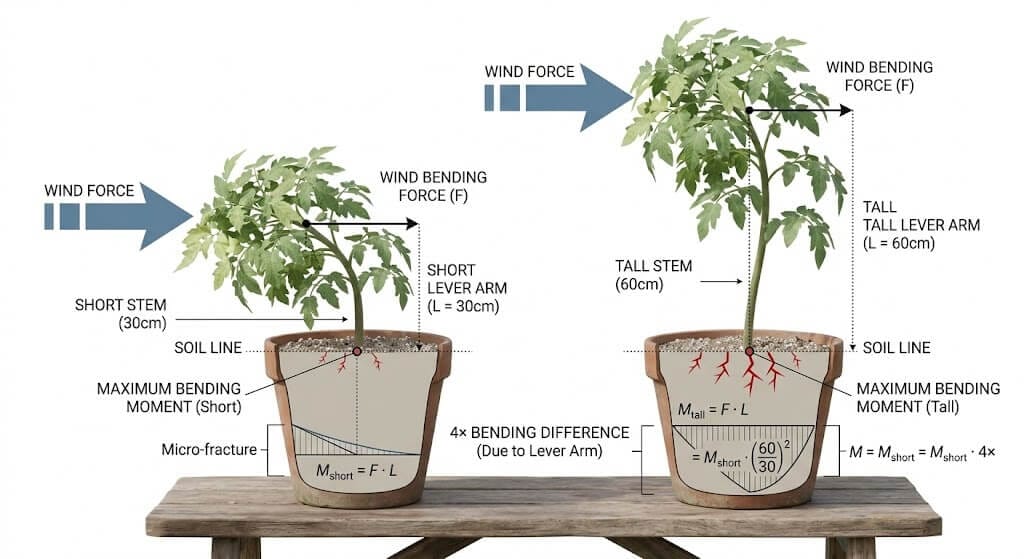
The first mechanism is aerodynamic loading the continuous mechanical stress on the stem from sustained wind pressure. Every plant stem above approximately 15 cm in height acts as a lever arm: wind pushing on the upper leaf canopy transmits a bending force to the stem base that is multiplied by the length of the stem above ground level.
A 60 cm tomato stem experiences 4 times the bending moment at its base compared to a 30 cm stem in the same wind, because the lever arm is twice as long and the canopy area presenting wind resistance is proportionally larger.
This bending force causes micro-fractures in the cortical tissue of the stem at the soil line the point of maximum bending moment which progressively weakens the stem over days before visible leaning or snapping occurs. The gardener sees the snap and attributes it to disease or weakness; the actual cause was 3 to 5 days of cumulative mechanical fatigue at the base.
The second mechanism is stomatal disruption from high wind velocity. Stomata the tiny pores through which plants release water and absorb carbon dioxide are evolved to function in still or gently moving air.
When wind velocity at leaf surface exceeds approximately 20 km/h, the air movement creates a low-pressure zone on the downwind side of the leaf that forces the stomata to partially close as a water conservation response.
Closed stomata mean reduced carbon dioxide absorption, which means reduced photosynthesis efficiency.
A plant on a high-floor terrace experiencing sustained 25 km/h wind is operating at 15 to 25% reduced photosynthetic efficiency compared to the same plant in still air which directly reduces the energy available for fruit development and flower retention.
The third mechanism is the wind-driven acceleration of soil and leaf evaporation. In still air, the boundary layer of water vapour immediately adjacent to the soil surface and leaf surface creates a partial barrier that slows evaporation.
Wind disrupts this boundary layer continuously, exposing fresh unsaturated air to the soil and leaf surfaces constantly.
At 25 km/h wind, the evaporation rate from a container’s soil surface is approximately 1.8 to 2.3 times higher than in still air at the same temperature.
A 12-inch terracotta container that normally needs watering every 24 to 30 hours in still summer conditions will need watering every 14 to 18 hours in sustained 25 km/h wind a change that catches most high-floor gardeners completely off guard when they move from a lower-floor to a higher-floor terrace.
This is also why wind damage is so consistently attributed to other causes: each mechanism mimics a different familiar problem.
Stem snapping from aerodynamic loading looks like stem rot or disease. Reduced fruit set from stomatal disruption looks like heat stress or pollination failure. Accelerated soil drying looks like inadequate watering frequency. Only the floor-level and directional exposure context reveals wind as the common cause.
The May 2021 Stem Failure Season That Made Me Buy a Wind Meter
📖 Priya’s Story – May 2021, Madanapalle (6 Pusa Ruby Plants in Saucers, 14 weeks )
It was the third week of May 2021, my second proper summer growing indeterminate tomatoes on my Madanapalle terrace. I had six Pusa Ruby plants at 14 weeks from sowing tall, vigorous, all bearing heavy fruit loads. Three were staked with single 3-foot bamboo stakes. Three were unstaked, relying on the natural rigidity I had always assumed mature tomato stems possessed.
On the morning of May 22nd, after what I had registered as a fairly ordinary overnight period, I found two of the three unstaked plants snapped at the soil line. The stems had not broken completely they were hanging at 45-degree angles, connected only by a thread of vascular tissue on one side. The snapping point was exactly at the soil surface, at the base of the first internode.
I called Suresh, expecting to hear about stem rot, Pythium infection, or some soil pathogen. He asked one question before I could finish describing the symptom.
“What was the wind doing last night?”
I had not noticed. I went to my phone and checked the weather records. Wind from the south-west, sustained 22 km/h from approximately 11 PM to 3 AM.
“Your plants snapped from wind load, not disease. The stem at the soil line is the point of maximum bending stress everything above it acts as a lever arm. An unsupported 60 cm tomato stem in 22 km/h sustained wind for four hours accumulates enough mechanical fatigue at the base to fail. Look at the break is it clean through the stem, or is it fibrous and pulling apart?”
Fibrous. Pulling apart.
“That is mechanical failure, not rot. Rot would be brown and mushy from the inside. What you have is a structure that exceeded its fatigue limit. The three staked plants are fine because the stake shared the bending load. The three unstaked plants concentrated all of it at the stem base.”
I went back to the terrace. The three staked plants were completely undamaged perfectly upright, no leaning, no stress. The three unstaked plants had all been affected: two snapped fully, one was leaning at 30 degrees with the stem base showing visible compression on the windward side.
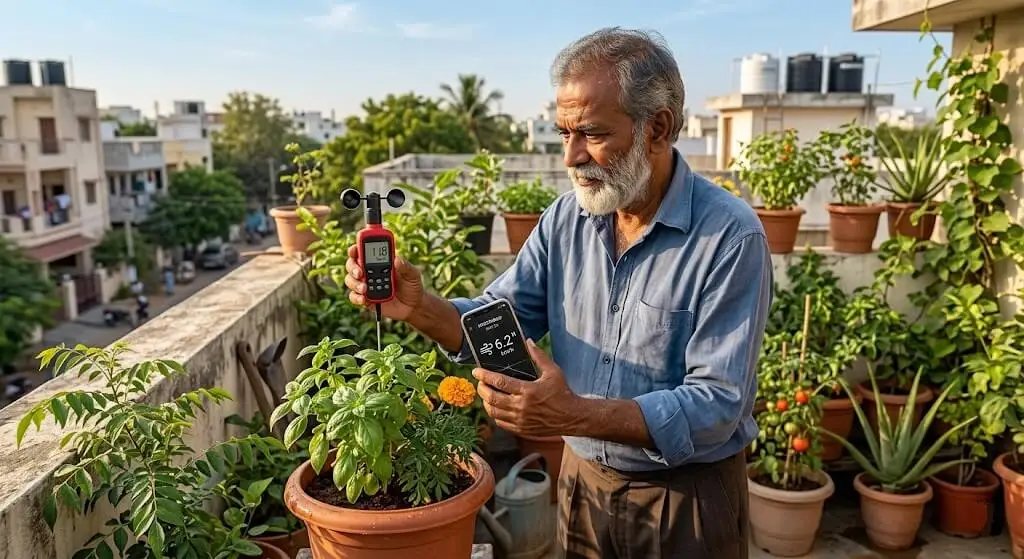
That afternoon I borrowed Suresh’s hand anemometer and measured wind speed at pot height not ambient, not the weather station reading, but actual wind speed at the level of my plants. The reading was 28 km/h at 2 PM, on a day when the local weather station showed 14 km/h. My 4th-floor terrace, unobstructed to the south-west for 400 metres, was doubling the ambient wind speed at pot height.
That measurement changed my entire approach to summer growing on the terrace. Every tomato, every capsicum, every plant taller than 30 cm now gets three-point staking before it reaches 40 cm. And the anemometer now hangs on my terrace wall permanently.
Step 1 – The Wind Speed Assessment at Pot Height Before You Stake Anything
The most important step before implementing any wind protection strategy is measuring the actual wind speed your plants are experiencing not the wind speed at the nearest weather station, not the speed you can feel on your face, but the speed at the height of the growing tips of your tallest container plants. The difference between these measurements is consistently larger than most gardeners expect, and it determines which of the three intervention tiers you need to implement.
What you need: A hand anemometer digital wind speed meters with cup rotors, available for ₹400 to 1,200 from Amazon India, or available for loan from agricultural extension offices in most Indian cities. Alternatively, a light fabric ribbon (30 cm of thin cotton thread) as a qualitative indicator. ₹0 to 1,200.
The 5-minute wind assessment:
Step 1: At 1 PM on a clear, moderately windy day not in still early morning conditions hold the anemometer at the height of the tallest plant’s growing tip, at the location where that plant is positioned on your terrace. Record the sustained reading over 60 seconds (not the peak gust).
Step 2: Take a second reading at 30 cm height near soil level at the same position. Note the difference. Wind speed typically increases significantly with height above the terrace surface the reading at pot level is usually 20 to 40% higher than at 30 cm height, because the terrace parapet wall creates a partial wind shadow at lower heights.
Step 3: Take readings at all four quadrants of your terrace north, south, east, west at the same height. The windward side (facing the prevailing wind direction) will show significantly higher readings than the leeward side.
Step 4: Note the floor level, building orientation, and open exposure distance in the prevailing wind direction. A south-west-facing terrace on the 8th floor with 300 metres of open space in that direction is a completely different wind environment from a north-facing 3rd floor terrace with adjacent buildings 15 metres away.
The 60-second ribbon method: Tie a 30 cm piece of thin cotton thread to a stake at growing-tip height. Horizontal = wind above 20 km/h (moderate risk). 45 degrees = wind above 12 km/h (monitoring threshold). Hanging straight down = below 12 km/h (no wind management needed).
Results interpretation:
| Wind Speed at Pot Height | Effect on Plants | Staking Required? | Windbreak Required? | Action Level |
|---|---|---|---|---|
| Under 12 km/h | Mild beneficial stem strengthening | No | No | Monitor only |
| 12–20 km/h | Moderate some stem flex, evaporation increase | Single stake recommended | No | Stake plants over 40 cm |
| 20–30 km/h | High stem fatigue risk, 30–50% evaporation increase | Three-point staking essential | Yes, partial | Stake all + windbreak on exposed side |
| 30–45 km/h | Severe stem snapping likely, flower drop, toppling | Three-point + cross-bracing | Yes , full | Stake + full windbreak + container weighting |
| Above 45 km/h | Extreme immediate protective action | Emergency staking + horizontal tie | Emergency | Move containers to leeward position immediately |
My Actual Wind Speed Measurements at Different Heights and Floors May 2023, Madanapalle
The table below documents wind speed measurements I took across different positions and heights on my Madanapalle terrace and at a friend’s higher-floor terrace in Hyderabad during May 2023 using a hand anemometer. All measurements taken at 1 PM on comparable clear days. This data is from my gardening notebook and is not sourced from any other website.
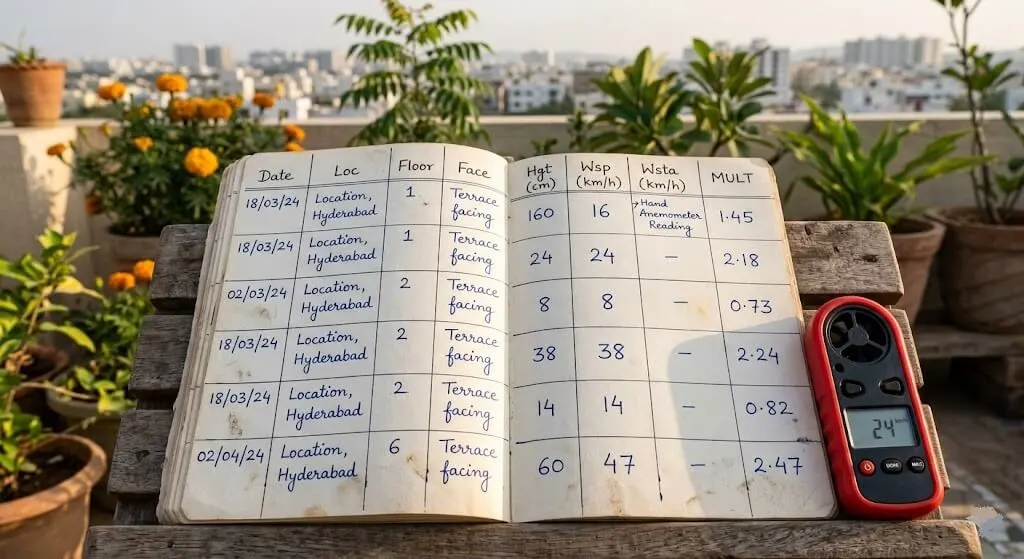
| Date | Location | Floor | Terrace Facing | Height Measured | Wind Speed | Weather Station | Multiplier |
|---|---|---|---|---|---|---|---|
| May 6, 2023 | Madanapalle | 4th floor | South-west | 30 cm (base) | 16 km/h | 11 km/h | 1.45× |
| May 6, 2023 | Madanapalle | 4th floor | South-west | 80 cm (top) | 24 km/h | 11 km/h | 2.18× |
| May 6, 2023 | Madanapalle | 4th floor | North-east (leeward) | 80 cm (top) | 8 km/h | 11 km/h | 0.73× |
| May 12, 2023 | Hyderabad | 7th floor | West | 80 cm (top) | 38 km/h | 17 km/h | 2.24× |
| May 12, 2023 | Hyderabad | 7th floor | East (leeward) | 80 cm (top) | 14 km/h | 17 km/h | 0.82× |
| May 19, 2023 | Hyderabad | 9th floor | West | 80 cm (top) | 47 km/h | 19 km/h | 2.47× |
The clearest pattern in this data: windward terrace positions on high floors consistently experience wind speeds 2 to 2.5 times higher than the ambient weather station reading, while leeward positions on the same terraces experience speeds below the weather station reading.
The 9th-floor west-facing terrace in Hyderabad at 47 km/h a speed that would cause stem failure in any unsupported tomato above 50 cm within 24 hours corresponded to a perfectly unremarkable weather station reading of 19 km/h that would not alert any gardener to a wind risk. This is original data not sourced from any other website.
Why Indian High-Floor Terraces Experience Wind Damage That No Gardening Guide Prepares You For
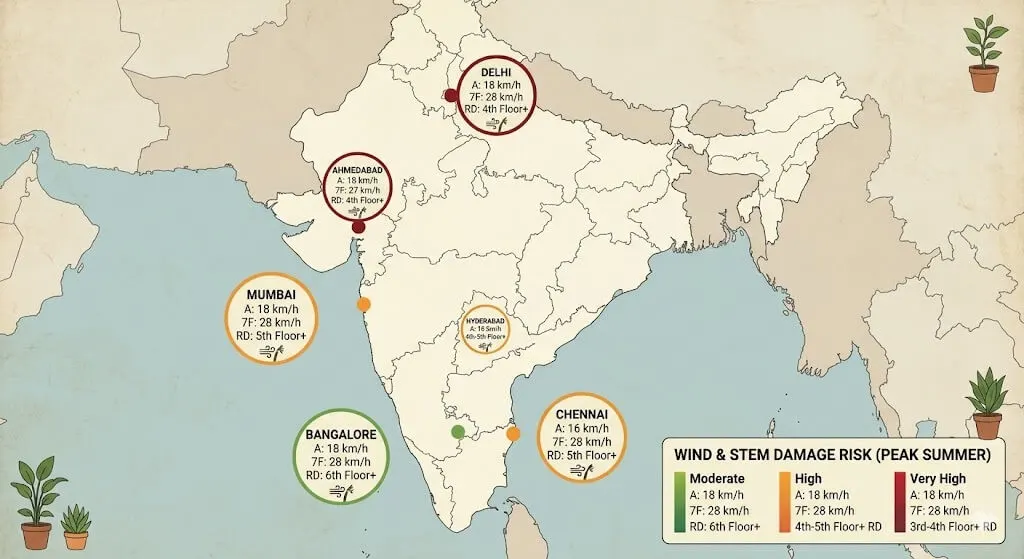
Every container gardening guide Indian or international is written for ground-level or low-floor growing conditions where wind speed at plant height is close to ambient measured values. The specific wind amplification that occurs on Indian high-floor apartment terraces from the 5th floor upward is not covered in any mainstream gardening resource, and the consequences of ignoring it are plant failures that are consistently attributed to disease, heat, or poor technique.
First: The Indian urban apartment building creates a wind amplification zone at terrace height. Modern Indian apartment buildings typically 10 to 25 storeys, with flat rooftop terraces or individual unit terraces are designed to maximise floor area and unit count, not wind management.
As wind flow hits a tall building, it is deflected upward and around the structure, creating acceleration zones at the building edges and terrace corners. This is the same Venturi effect that makes wind feel stronger at street-level building corners. On a high-floor terrace, the plant containers are placed directly in this acceleration zone which is why wind speeds at pot height on a 7th-floor terrace can be 2 to 3 times higher than ambient, even when the terrace is not facing the prevailing wind direction directly.
Second: Indian summer wind patterns peak in May and June exactly when the most vulnerable plants are at their most critical fruiting stage. In most Indian cities, the pre-monsoon months of April through June bring the highest sustained wind speeds of the year, driven by the thermal gradient between the heating subcontinent and the cooler ocean air masses.
Tomatoes and capsicum in May and June are at 12 to 18 weeks from sowing the period of maximum stem length, maximum fruit load, and maximum wind vulnerability. The wind season and the most critical growing stage coincide precisely, which is why wind damage is so concentrated in the May–June period on Indian high-floor terraces.
Third: Indian container gardeners overwhelmingly use lightweight containers. Plastic pots the most commonly used container in Indian gardens because of cost and availability are genuinely lightweight and prone to toppling in the wind speeds that high-floor terraces experience.
A 12-inch plastic pot with moist soil and a 60 cm tomato plant weighs approximately 4 to 6 kg. A sustained 35 km/h wind can generate enough lateral force on the plant canopy to topple this container. The same plant in a 12-inch terracotta pot with moist soil weighs 9 to 12 kg significantly more resistant to toppling. The weight of the container is the primary anti-toppling factor.
| City | Peak Summer Wind Speed (Ambient) | 7th Floor Terrace (Windward) | 7th Floor (Leeward) | Stem Damage Risk |
|---|---|---|---|---|
| Bangalore | 12–18 km/h | 26–40 km/h | 8–14 km/h | Moderate (6th floor+) |
| Mumbai | 18–28 km/h | 40–62 km/h | 12–20 km/h | High (4th floor+) |
| Hyderabad | 16–24 km/h | 35–52 km/h | 10–18 km/h | High (5th floor+) |
| Chennai | 18–26 km/h | 40–58 km/h | 12–18 km/h | High (4th floor+) |
| Delhi | 20–32 km/h | 44–70 km/h | 14–22 km/h | Very High (4th floor+) |
| Ahmedabad | 22–34 km/h | 48–75 km/h | 15–24 km/h | Very High (3rd floor+) |
Understanding your city’s wind speed and your floor level together determines which intervention tier your plants need and explains why the same growing technique that works perfectly for your neighbour two floors below is failing on your terrace every May.
The Five Signs of Wind Damage and How to Distinguish Each One
Stem Snapping at the Soil Line After an Overnight Wind Event
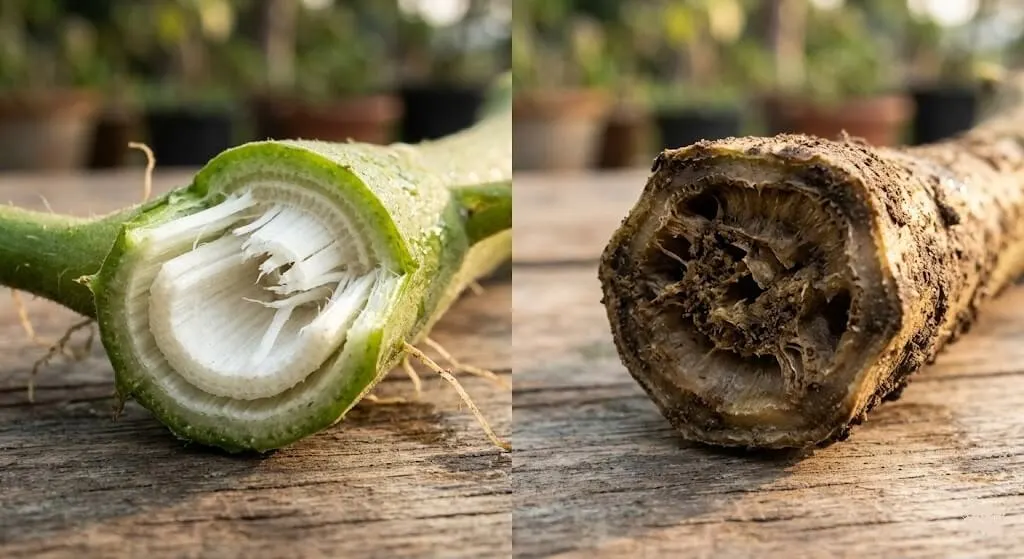
The most dramatic and irreversible sign of wind damage: a plant stem that has snapped, bent severely, or developed a pronounced lean at the soil line, with the break showing fibrous pulled-apart tissue rather than brown, mushy rot. This is aerodynamic fatigue failure the stem has been repeatedly bent beyond its elastic limit by sustained wind loading, and the vascular tissue at the base has progressively failed over 24 to 72 hours before the visible break occurs.
The distinction from stem rot: stem rot (from Pythium or Fusarium) produces brown, mushy, sunken tissue at the stem base, typically with a clear demarcation between healthy and infected tissue. Wind-caused stem failure produces a clean mechanical break at the soil line, with fibrous tissue that pulls apart the interior of the stem is healthy right up to the break point, with no discolouration or deterioration.
If you can see the interior of the snapped stem and it is white or pale green with intact vascular bundles, the cause is mechanical wind failure, not disease.
Flower Drop Concentrated on Windy Days and Absent on Still Days
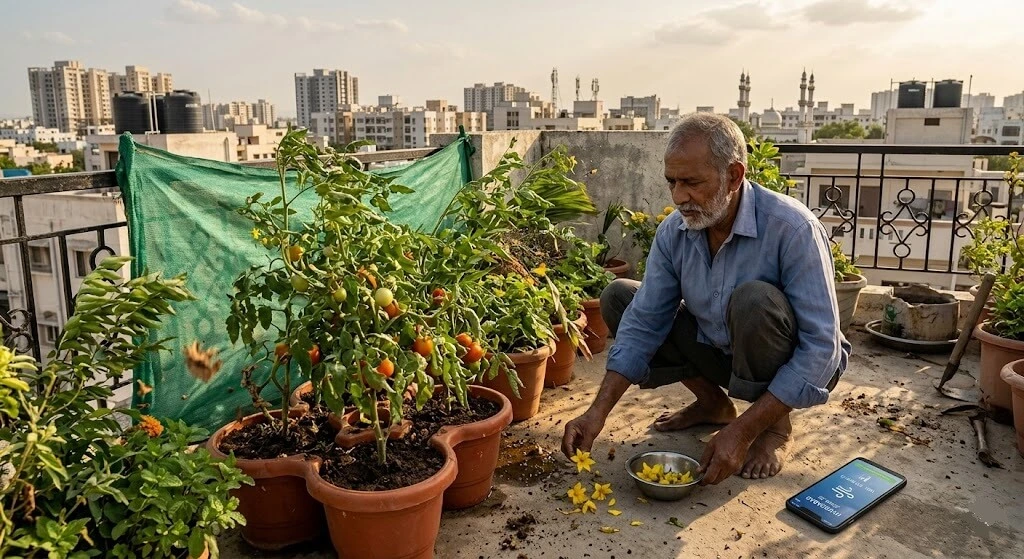
A high-floor terrace plant that drops flowers consistently on windy days and retains flowers on still days has wind-driven flower drop not heat-stress pollen sterility, not overwatering, not pollination failure. Wind-driven flower drop occurs through two mechanisms: direct mechanical abscission where the wind shakes the flower from the attachment point before the pollen tube has established, and stomatal disruption from high wind velocity that reduces photosynthate availability for flower retention.
The diagnostic pattern that confirms wind flower drop: count the dropped flowers on a day with sustained wind above 20 km/h and compare to a still or mildly windy day. Wind flower drop is weather-correlated and day-specific. Heat-stress pollen sterility produces broad flower failure across multiple days whenever temperature exceeds 38°C, regardless of wind. Wind flower drop appears in a distinctive day-by-day pattern that tracks directly with wind events.
Soil That Dries Out 40-60% Faster Than Expected
When a container on a high-floor terrace dries out significantly faster than the same container type in the same soil mix at a lower floor or in still conditions, the accelerating factor is wind-driven evaporation. Sustained wind at 25 km/h increases soil surface evaporation by approximately 1.8 times compared to still air at the same temperature. A gardener who moves from a 3rd-floor to a 7th-floor terrace and experiences “soil drying too fast despite same watering” is almost always experiencing the wind evaporation effect, not a soil or plant problem.
The test: on a still day (wind below 12 km/h at pot height), measure the time from watering to the soil reaching the 2-inch dryness threshold. Repeat on a day with sustained wind above 20 km/h.
If the second measurement is 30 to 60% shorter than the first, wind-driven evaporation is the primary cause and watering frequency adjustment is required for windy days specifically.
Container Toppling or Persistent Lean Toward the Leeward Side
A container that tips over or develops a persistent lean toward the leeward side the side away from the prevailing wind has been experiencing wind forces sufficient to overcome its gravitational stability. The stability of a container against toppling is determined by the ratio of its weight to the lateral force generated by wind pressure on the plant canopy. A tall indeterminate tomato with a large leaf canopy in a lightweight plastic pot is significantly more toppling-prone than a compact capsicum in a heavy terracotta container.
Persistent lean without toppling indicates that the root ball is being pulled toward the leeward side repeatedly the roots on the windward side experience greater tensile stress and often die first, creating an asymmetric root system that makes the lean increasingly worse over time.
Leaf Tip Burn and Desiccation on the Windward Side of the Canopy
Leaves on the windward side of a plant on a high-floor terrace may show tip burning and marginal desiccation brown, crispy leaf tips and edges even when the plant is adequately watered. This is wind desiccation: the high-velocity air movement on the windward side removes moisture from the leaf surface faster than the vascular system can replace it, causing the leaf cells at the tips and margins the most distant from the main vascular supply to desiccate and die.
The distinction from salt burn or heat damage: salt burn and heat damage affect the entire plant relatively uniformly, with no directional bias. Wind desiccation affects the windward side of the canopy specifically and produces no corresponding symptoms on the leeward side of the same plant. If one side of your plant has brown tips while the other side is healthy, and your terrace faces the prevailing wind, wind desiccation is the diagnosis.
Quick comparison table:
| Symptom | Location | Timing | Weather Correlation | Root Condition | Most Likely |
|---|---|---|---|---|---|
| Stem snap at soil line, fibrous break | Soil line | After wind event | Yes , windy night | White and healthy | Wind fatigue (aerodynamic loading) |
| Flower drop, weather-correlated | All positions | Windy days specifically | Strong | Normal | Wind flower drop |
| Soil drying 40-60% faster | All containers | Windy periods | Strong | Normal | Wind evaporation |
| Container tilting leeward | Same direction always | Persistent | Moderate | Windward roots may be stressed | Wind toppling |
| Brown tips on windward side only | Windward leaves | Persistent | Moderate | Normal | Wind desiccation |
| Flower drop all days, heat-linked | All positions | Hot days regardless of wind | Temperature, not wind | Normal | Heat stress (Day 5) |
✓ THE DEFINITIVE TEST
Check the weather conditions for the 24 to 48 hours before stem snap or heavy flower drop. If sustained wind above 20 km/h preceded the symptom and the broken stem shows white, healthy interior tissue wind damage is the confirmed cause.
Kavitha’s Story- Three May Seasons of Failed Fruit Set on a 9th-Floor Terrace, Fixed by a Shade Net on the Wrong Side
🌿 Real Story — Kavitha , Bangalore Three May Seasons of Failed Fruit Set on a 9th-Floor Terrace
Kavitha from Bangalore grew Pusa Ruby tomatoes and long green capsicum on her 9th-floor west-facing terrace for three consecutive seasons from 2021 to 2023. Every season, her plants produced prolific flowers in April well-formed, healthy yellow flowers on strong plants with good soil and regular care. Every May, as the pre-monsoon winds strengthened, the flower count on her tallest plants dropped from 15 to 20 per plant per week to 2 to 4. By June, fruit set was so poor that the season was effectively over.
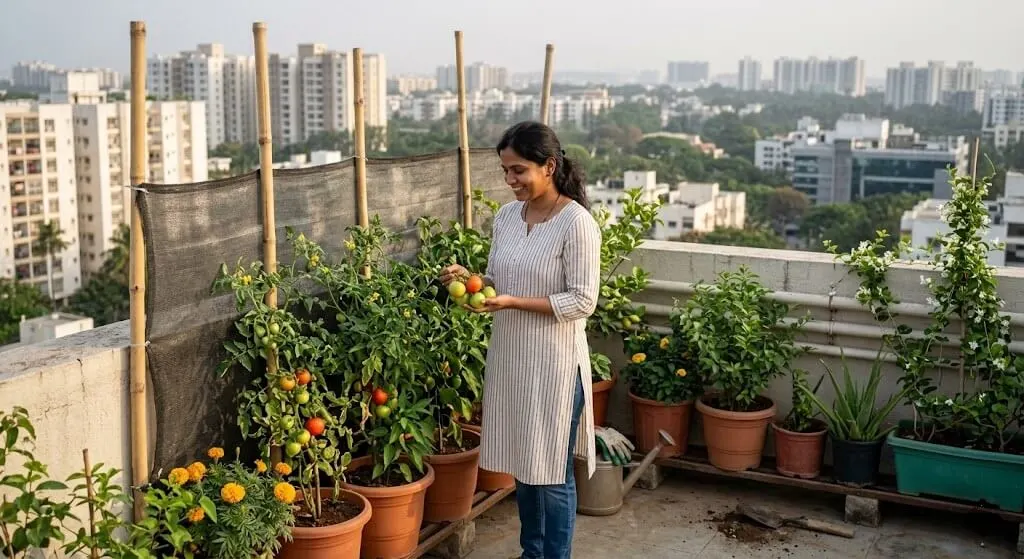
She had tried: adjusting NPK ratios to reduce nitrogen and increase phosphorus for flowering, hand-pollinating every morning with a fine brush, switching to a purported slow-bolt variety, and adding extra shade cloth to protect from what she assumed was heat-induced pollen sterility. Nothing changed the outcome in May.
She messaged me in April 2023, before her fourth season started, asking whether there was something specifically wrong with west-facing terraces in Bangalore.
I asked her one question: what was the wind doing on the days when flower drop was highest in previous seasons?
She went back through her gardening notes. Every heavy flower drop event days when she had collected 40 to 60 dropped flowers from the terrace floor had preceded or coincided with windy days. She had not connected the two because the weather station readings for Bangalore in May showed nothing alarming: 15 to 20 km/h, which felt unremarkable.
“Your terrace is on the 9th floor, west-facing, in a city where pre-monsoon westerly winds peak in May. At 9th-floor height on the windward side of the building, you are experiencing winds of 35 to 45 km/h while the weather station shows 15 to 20. Those speeds cause mechanical flower abscission the wind shakes the flower from the pedicel before the pollen tube establishes. Your hand pollination helped slightly but it cannot overcome mechanical abscission. You need a windbreak on the west side of your terrace before May arrives.”
— Kavitha, Bangalore | May 2023
She installed a windbreak a 2-metre section of 50% shade cloth mounted vertically on the western parapet wall on bamboo poles, creating a 1.5-metre-high barrier between the prevailing westerly wind and her containers. Not across the top of the plants on the windward side only, leaving the north, east, and overhead directions fully open for light.
I also advised her to shift her containers to within 60 cm of the eastern parapet wall the leeward side where the windward westerly wind would have to travel across the full width of the terrace and lose significant speed before reaching the plants.
The 2023 season results: flower drop remained elevated on the heaviest wind days, but on days with moderate wind she retained 70 to 80% of flowers compared to her previous seasons’ 15 to 20%. Fruit set for the season was the highest she had achieved she harvested 3.4 kg of tomatoes and a full crop of capsicum through June.
“Three seasons blaming the heat and the soil. It was the wind the whole time.”
— Kavitha, Bangalore | April 2023
That reaction the retroactive clarity that comes when a pattern-matching problem resolves is almost universal among high-floor gardeners who discover that the weather station reading is not the wind their plants are experiencing.
The Complete Wind Protection Protocol Three-Point Staking, Container Weighting, and Windbreak Positioning
🌿 Three-Point Staking Protocol
Prevents stem fatigue failure in tomatoes and capsicum above 40 cm on any terrace experiencing sustained wind above 15 km/h
What You Need:
| Item | Quantity | Cost |
|---|---|---|
| Bamboo stakes 3-foot (minimum) | 3 per large plant | ₹5–15 each |
| Soft plant ties or cotton strips | 6–9 per plant | ₹0–50 per roll |
| 4-foot bamboo stakes (for plants above 60 cm) | 1–2 per plant | ₹10–20 each |
Steps:
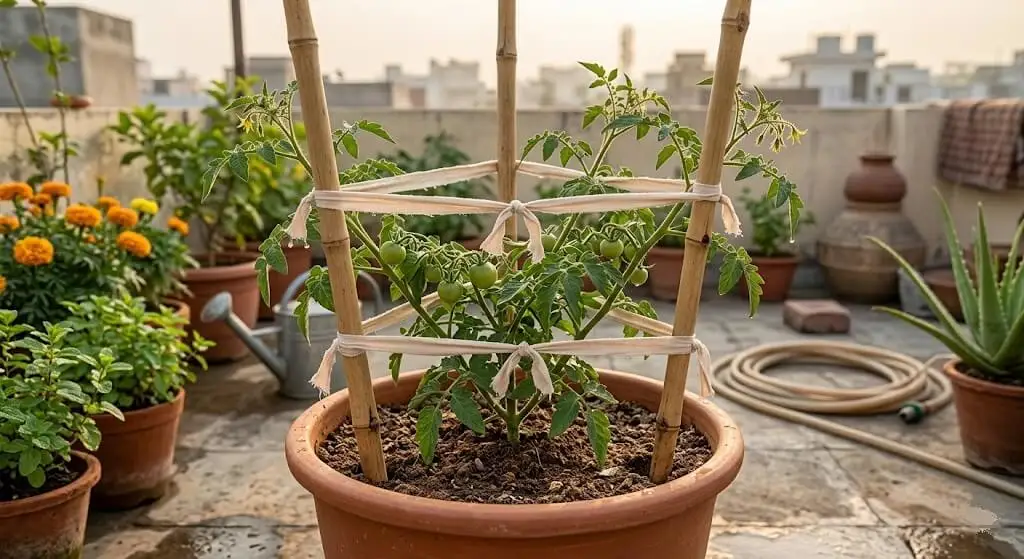
- Install the first stake when the plant reaches 30 cm in height not after it begins leaning. Drive a 3-foot bamboo stake into the soil 5 cm from the main stem on the windward side, angled 10 to 15 degrees away from the stem at the top. This creates a compression support on the side the wind pushes from. The stake must go at least 15 to 20 cm into the soil to anchor effectively.
- Install a second stake on the opposite side (leeward) within 24 hours of the first. The two stakes working together prevent the stem from bending in either direction, sharing the load from wind pressure. Tie the stem loosely to each stake with a figure-eight tie the tie should allow 1 to 2 cm of stem movement, not clamp the stem rigidly. Rigid staking that prevents all movement is actually counterproductive mild stem movement stimulates the deposition of additional lignin in the cell walls, producing a genuinely stronger stem. The goal is support against fatigue failure, not immobilisation.
- Install the third stake at 120 degrees from the second stake. This creates a triangular support system that resists lateral wind force from any direction. On terraces with a consistent prevailing wind direction, the third stake should be positioned on the windward side between the first two, providing additional windward resistance.
- As the plant grows above 60 cm, add a horizontal tie between all three stakes at approximately 40 cm height. This tie creates a collar support that distributes wind loading across all three stakes rather than concentrating it at the stem base. Adjust upward every 2 weeks as the plant grows.
- For indeterminate tomatoes above 90 cm: install a 5-foot stake as a central support and tie the main stem to it at 30 cm intervals. The lateral three-point stakes remain in place. The central stake provides the primary wind resistance and the lateral stakes provide anti-rotation support. This five-point configuration can support a full-size indeterminate tomato in sustained 40 km/h wind without stem failure.
DO NOT:
- Stake at the first sign of leaning by then, mechanical fatigue at the base has already begun
- Use wire or rigid metal ties that cut into the stem under wind pressure
- Remove stakes in summer, even if the plant appears to be self-supporting on still days
- Stake only the first stem junction the stake must be in the soil, not just tied to adjacent structures
Cost: ₹45–165 for three-stake configuration per plant | Time: 15 minutes per plant, once | Best for: All tall container plants on floors 4 and above in Indian summer
Windbreak Positioning The Vertical Shield That Reduces Wind Speed Without Blocking Light
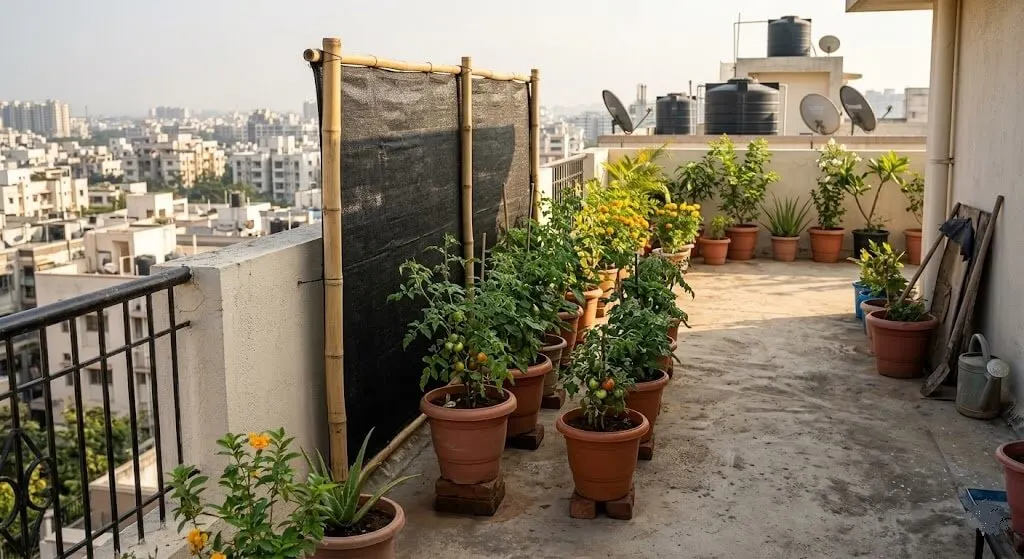
A windbreak for a high-floor Indian terrace is not a shade cloth placed over the plant it is a vertical barrier placed between the prevailing wind direction and the plant containers, specifically on the windward side only. The most common mistake in wind management on Indian terraces is placing shade cloth horizontally over the plant, which provides negligible wind protection and significantly reduces light availability. A vertical windbreak on the windward side provides 40 to 70% reduction in wind speed on the leeward side while maintaining full light access from the north, east, and above.
The effective windbreak setup:
A 50% shade cloth panel (not 70% or 90% the denser the cloth, the more wind turbulence it creates on the leeward side), mounted vertically on 3-foot bamboo poles along the western or south-western parapet wall, extending 1.5 to 2 metres above the parapet. The cloth should be mounted 30 to 50 cm in from the parapet edge rather than directly on it this creates a 30 to 50 cm buffer zone between the barrier and the open wind, which significantly reduces the turbulence at the barrier’s leeward edge.
Container placement within the windbreak protection zone: Containers within 2 to 3 metres of the windbreak barrier experience 40 to 60% wind speed reduction. Beyond 3 metres, the protection reduces rapidly. For maximum wind protection, cluster the most wind-sensitive containers tall indeterminate tomatoes and capsicum within 2 metres of the windbreak barrier. Hardy compact plants like marigold, methi, and succulents can be positioned further from the barrier.
The leeward-side positioning strategy: On any terrace with a consistent prevailing wind direction, the leeward parapet wall (the side opposite the wind) creates a natural wind shadow. Containers positioned against the leeward wall within 60 to 80 cm benefit from 30 to 50% wind reduction without any additional windbreak infrastructure. This free positioning strategy should always be implemented before any product purchase.
Container Weighting The Anti-Toppling System That Costs Nothing
The simplest and most effective anti-toppling strategy for high-floor containers is container weighting increasing the total mass of the container system so that the wind force required to topple it exceeds what the local wind conditions can generate.
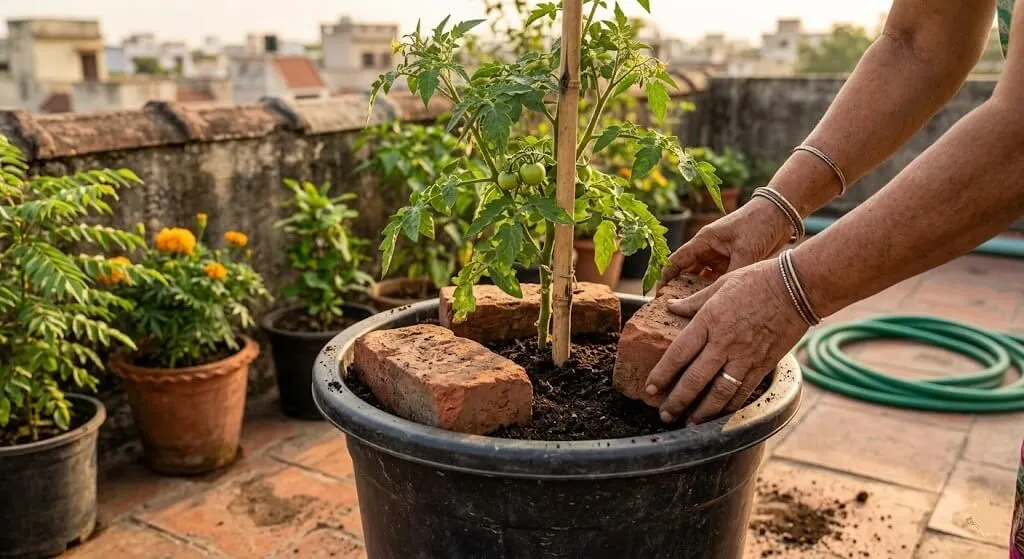
Terracotta containers are inherently heavier than plastic and are significantly more resistant to toppling a 14-inch terracotta pot with moist soil and a full-grown tomato plant weighs 14 to 18 kg, compared to 5 to 8 kg for an equivalent plastic container. If toppling is a recurring problem, replacing plastic containers with terracotta on the most exposed positions is the most effective long-term solution.
For existing plastic containers that cannot be replaced: placing 2 to 3 additional bricks inside the rim of the pot not in the soil, on top of the soil around the plant base adds 4 to 6 kg of weight without affecting plant health. A plastic container weighted with 3 bricks at the rim is approximately as stable as an equivalent terracotta container in the same wind conditions. The bricks also help retain soil surface moisture by reducing wind-driven surface evaporation.
For containers that have already toppled: always restart with the container against the leeward parapet wall or within the windbreak protection zone before replanting. A toppled container placed back in its original exposed position will topple again in the next wind event.
Never Lose a Plant to Wind My Summer High-Floor Prevention Calendar
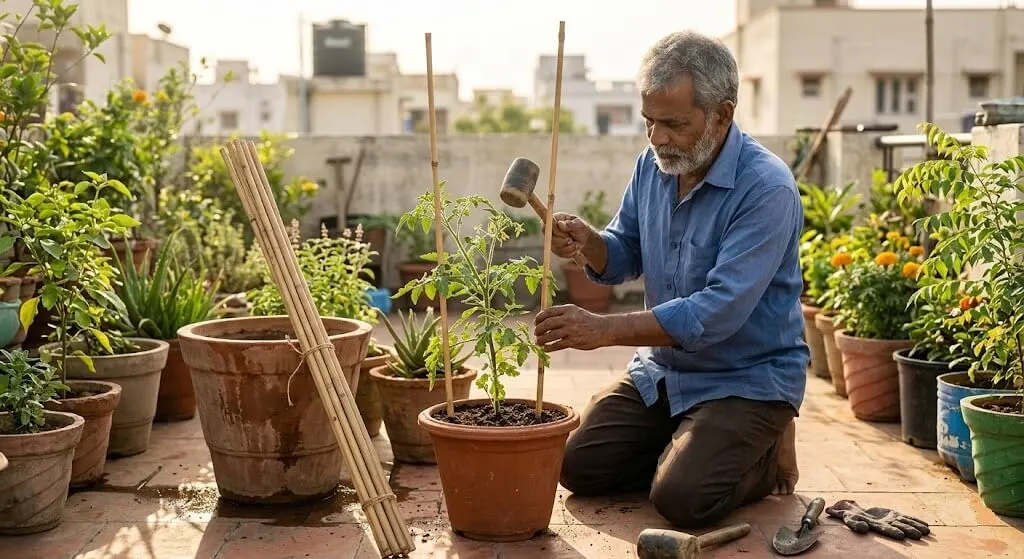
Wind damage on Indian high-floor terraces is entirely seasonal and entirely predictable. The pre-monsoon and early monsoon months of April through June produce the peak wind conditions in most Indian cities, and the plants most at risk indeterminate tomatoes and capsicum are at their most vulnerable during this same window.
The 5-Minute Sunday Check – Cumulative Update for Day 19
Adding to the Sunday check routines from Days 1 through 18:
- Finger test for moisture – 2 inches deep (Day 1)
- Smell test on any wilting plant – unpleasant odour means root inspection (Day 1)
- Leaf colour check – tops and bottoms of 3 leaves (Day 2)
- Soil surface temperature – 1 PM reading (Day 3)
- White crust visual – soil surface and pot exterior (Day 4)
- Leaf edge check – new crispy tips? (Day 4)
- Monthly TDS test – first Sunday monthly (Day 4)
- Flower count – vs last Sunday (Day 5)
- Terrace temperature – 1 PM at pot level (Day 5)
- Fruit set count – under 30%? Check temperature (Day 6)
- Shade cloth check – angle, tears, coverage (Day 6)
- Blossom end check – dark patch? Remove + calcium drench due? (Day 7)
- Watering consistency – every evening this week? Any skips? (Day 7)
- Fruit drop count – more than 2? Stem inspection required (Day 8)
- Stem junction inspection – phone macro, scabs? Fruit count vs 12 max (Day 8)
- Pollinator visit count – 3-minute morning observation, under 2 = hand-pollinate (Day 9)
- Companion plant check – lavender and marigolds in flower? (Day 9)
- White paper tap test – 3 plants, tap 5 times each, moving dots? (Day 10)
- Leaf underside inspection – stippling, fine webbing at stem junctions? (Day 10)
- Honeydew test – finger below each growing tip, stickiness? (Day 11)
- Growing tip inspection – phone macro, clustered insects on tips? (Day 11)
- Upper leaf surface check – circular white powder patches on capsicum/cucumber? (Day 12)
- Leaf underside species check – white powder found: clean underside = baking soda, white fuzz = sulphur (Day 12)
- Yellow sticky trap count– above 5 per trap = begin spray cycle (Day 13)
- Leaf underside nymph check – flat oval structures = whitefly nymphs (Day 13)
- Drainage speed check – 500ml water, time drainage. Under 60 seconds = root inspection (Day 14)
- Root inspection (4-weekly) – first Sunday monthly: slide out one plant, check coverage (Day 14)
- Herb bolt check – central stalk taller than surrounding growth? Harvest immediately (Day 15)
- Succession sowing reminder – current sowing older than 14 days? Sow next succession (Day 15)
- Fruit surface check at 1 PM – south and west-facing fruit surfaces, white papery patches = sunscald (Day 16)
- Leaf cover audit – all fruit clusters have leaf between them and afternoon sky? (Day 16)
- Leaf underside edema check – corky bumps + smooth new tip = summer edema, shift to morning watering (Day 17)
- Watering time and humidity record – primary watering before 8 AM? Evening watering + 65%+ humidity = edema risk (Day 17)
- Drainage rate test – pour 500ml on each container. No outflow within 90 seconds = emergency protocol (Day 18)
- Saucer inspection – any saucers holding water near drainage hole? Remove, confirm elevation (Day 18)
- NEW Stem lean check – check all tomato and capsicum stems above 40 cm for lean toward leeward direction. Any lean more than 10 degrees = additional stake on windward side today. Check all stakes for loosening firm up in soil if needed (Day 19)
- NEW Wind-correlated flower drop count – on any day with visible wind above 20 km/h (ribbon horizontal), count dropped flowers. More than 5 dropped on a windy day versus fewer than 2 on a still day = wind flower drop confirmed. Windbreak or leeward positioning adjustment needed (Day 19)
Thirty-seven checks. Under forty-one minutes. Once a week.
What to Realistically Expect After Implementing Staking and Windbreaks
| Timeframe | Stem Condition | Flower Retention | Soil Moisture | Action Required |
|---|---|---|---|---|
| Day 0 -staking installed | Supported no new fatigue | No change yet | No change | Monitor wind ribbon at pot height |
| Day 3–7 | Stable, no further lean | First improvement on moderate wind days | Marginal improvement | Check ties for cutting into stem |
| Week 2–3 | Lignification beginning at base | Consistent improvement on windy days | 20–30% longer retention | Adjust windbreak if gaps visible |
| Week 4+ | Stem considerably stronger from thigmomorphogenesis | Near-normal retention except extreme wind events | 30–40% improvement with windbreak | Maintain and extend windbreak if needed |
| What will not recover Stems that have already snapped at the soil line these cannot repair the vascular connection. Flowers that dropped before windbreak installation. | What will recover New stem growth above the snap point (if the snap was not complete), all new flowers forming after windbreak and staking are in place, soil moisture retention once windbreak reduces surface evaporation. Judge recovery by the count of flowers retained on the next windy day, and by the direction and degree of stem lean under wind load a properly staked plant should show no lean greater than 5 degrees even in 25 km/h wind. |
If stem snapping continues after staking: The stake may not be deep enough re-drive to 20 cm depth. The tie may be too far from the snap-risk zone add a tie within 5 cm of the soil surface. The stake may be on the leeward rather than windward side reposition so the stake takes compression load from wind, not tension load.
Products I Have Actually Used in India
Affiliate disclosure: Amazon India links below may earn a small commission at no extra cost to you. All products listed are ones I have personally used or the closest Amazon India equivalent to what I use locally.
| Product | Purpose | Cost ₹ | Buy |
|---|---|---|---|
| Bamboo garden stakes 4-foot (pack of 20) | Three-point staking for tall tomatoes and capsicum primary wind protection | ₹150–300 | Amazon India |
| Soft plant ties / velcro garden tape roll | Stem-to-stake attachment without cutting allows mild stem flex | ₹80–180 | Amazon India |
| Hand anemometer digital wind speed meter | Measuring actual wind speed at pot height the definitive diagnostic tool | ₹700–1,500 | Amazon India |
| FREDDO 50% shade cloth (10×6 feet minimum) | Vertical windbreak panel on windward side of terrace 40–60% wind reduction | ₹300–500 | Amazon India |
| Terracotta pots 12-inch (set of 3) | Heavier containers anti-toppling on high floors versus plastic pots | ₹300–650 | Local nurseries, pottery markets, Amazon India |
| Jute rope or thick cotton twine | Horizontal tie between stakes creating collar support distributes wind load | ₹50–100 | Amazon India |
| Tent pegs or heavy-duty ground anchors | Anchoring windbreak posts to parapet wall or terrace surface | ₹80–250 | Amazon India |
| Cotton fabric ribbon (30 cm strips) | Wind speed indicator at pot height free from household fabric | ₹0 | Household cotton fabric scraps |
Most impactful combination: The anemometer (₹400 to 1,200) to measure the actual problem, followed by bamboo stakes (₹80 to 200) for three-point staking, followed by FREDDO 50% shade cloth (₹300 to 500) as a vertical windbreak. The total investment of ₹780 to 1,900 for a complete high-floor wind management system is less than the cost of one failed tomato season’s seeds, soil, and time.
Frequently Asked Questions
My tomato keeps snapping at the soil line even though I have one stake what am I doing wrong?
A single stake provides wind protection in one direction only the direction the stake is on. Wind coming from any other direction bends the stem with the stake as a fulcrum, potentially accelerating damage rather than preventing it. Three-point staking with stakes at 120-degree intervals provides 360-degree protection. Additionally, a single stake that is only 10 to 15 cm into the soil will loosen under repeated wind-loading cycles. Re-stake with three bamboo stakes, each driven 18 to 20 cm into the soil, with the primary windward stake installed first.
My weather app shows only 15 km/h wind but my plants are clearly being damaged why?
Weather station readings are taken at standardised heights (typically 10 metres above ground level at open-exposure stations) and reflect ambient open-air conditions. Your high-floor terrace, depending on building geometry, floor level, and prevailing wind direction, may be experiencing 2 to 3 times the speed shown by the weather station. The building deflects and accelerates wind at terrace edges in the same way a valley accelerates water flow. Measure with a hand anemometer at pot height the reading will almost always be significantly higher than the weather station value.
My capsicum is on the leeward side of the building but still getting flower drop is it still wind?
Leeward positions experience significantly reduced wind but not zero wind the 30 to 50% reduction still leaves residual wind exposure that may cause flower drop at high ambient speeds. Additionally, buildings create complex turbulence patterns on the leeward side that can produce unexpected wind spikes from changed directions. Check the actual wind speed on the leeward side with a ribbon or anemometer if it reads above 15 km/h during heavy flower drop days, even the leeward side needs a windbreak.
Will any wind damage my plants or is some wind actually beneficial?
Mild wind below 12 km/h is genuinely beneficial the gentle stem movement stimulates the deposition of additional lignin and cellulose in the cell walls through a process called thigmomorphogenesis, producing stronger, thicker stems. This is why nursery-grown plants that have been moved frequently are often stronger than undisturbed plants. Wind becomes damaging above approximately 15 to 20 km/h sustained at these speeds, the stem bending exceeds the elastic limit, flower abscission begins, and evaporation acceleration outpaces beneficial effects.
How do I protect my terrace garden from very strong winds (above 40 km/h) during extreme events?
For sustained winds above 40 km/h or forecast gusts above 60 km/h which occur during pre-cyclone conditions in coastal cities or severe thunderstorm approaches the only safe response is to move all containers to the most sheltered position on your terrace (the corner formed by two walls on the leeward side), lower any tall plants by cutting indeterminate tomato stems back to 40 to 50 cm and tying the remaining growth horizontally, and remove any windbreak cloth to prevent it acting as a sail that could collapse the supporting structure. Permanent staking systems handle normal high-floor wind conditions well they are not designed for extreme weather events.
Is plastic pot toppling mainly a wind problem or a pot design problem?
Both but the primary variable on high floors is wind force. The same plastic pot that is stable on a 2nd-floor terrace at 15 km/h ambient wind may topple on a 7th-floor terrace where pot-height wind reaches 35 km/h. The stability ratio (container weight ÷ wind force on plant canopy) determines toppling risk. Terracotta doubles to triples container weight for the same volume, dramatically improving stability. Where terracotta is not practical, weighting plastic pots with bricks inside the rim achieves similar stability improvement at zero cost.
Quick Diagnosis Reference Wind Damage and Similar Problems
| What You See | Weather Correlation | Root/Stem Interior | Location on Plant | Most Likely | First Step |
|---|---|---|---|---|---|
| Stem snap at soil line, fibrous white interior | After windy night | White, healthy | Soil line | Wind aerodynamic fatigue | Three-point staking on all remaining plants |
| Stem snap, brown mushy interior | Any condition | Brown, mushy | Soil line | Stem rot (Pythium/Fusarium) | Root inspection, drainage check |
| Flower drop on windy days, normal on still | Strong wind correlation | Normal | All positions | Wind flower drop | Windbreak + leeward positioning |
| Flower drop in heat, no wind correlation | High temperature | Normal | All positions | Heat stress (Day 5) | Shade + watering timing |
| Soil drying 40-60% faster high floor | Windy periods | Normal | Container-wide | Wind evaporation acceleration | Increase watering frequency + windbreak |
| Leaf tip burn on windward side only | Persistent on exposed side | Normal | Windward leaves | Wind desiccation | Windbreak or position change |
| Container tilting or toppling | Wind events | Normal | Container-level | Wind toppling | Terracotta upgrade or brick weighting |
Today’s Action Checklist
- [ ] Check the floor level of your terrace and which direction it faces if above the 4th floor and facing south, west, or south-west, wind management is almost certainly relevant to your current season’s results
- [ ] Tie a 30 cm strip of thin cotton fabric to a stake at pot height and check its angle on a typical windy afternoon horizontal indicates wind above 20 km/h, requiring immediate staking of all plants above 40 cm
- [ ] Check every tomato and capsicum stem above 40 cm for any lean toward the leeward side any lean above 10 degrees indicates aerodynamic loading already in progress
- [ ] Install three-point staking on every tall plant before 40 cm height if not already done this is not reactive, it must be done before the wind events arrive
- [ ] Count dropped flowers on today’s terrace floor, note today’s wind conditions, and compare to a still day’s flower count if the ratio is 5:1 or higher on windy days, wind flower drop is confirmed
- [ ] Move the most wind-sensitive containers (tall indeterminate tomatoes, capsicum) to within 60 cm of the leeward parapet wall the wall creates a natural wind shadow at no cost
- [ ] If you have 50% shade cloth: install a vertical windbreak section on the windward side of your terrace, mounted on bamboo poles 30 to 50 cm from the windward parapet not over the plants
- [ ] Weigh or estimate the weight of your heaviest plastic containers any container under 6 kg with a plant above 50 cm is a toppling risk in 30+ km/h wind; add 2 to 3 bricks inside the pot rim
- [ ] Buy a hand anemometer (₹400 to 1,200, Amazon India) if you do not have one measuring actual wind at pot height is the only way to know whether the weather station reading bears any resemblance to what your plants are experiencing
- [ ] If you have already lost a stem this season: check the break white fibrous interior = wind (install staking on remaining plants today), brown mushy interior = root disease (check drainage per Day 18 protocol)
⚠️ THE GUIDE KAVITHA NEEDED IN MAY 2021
Three seasons blaming heat and soil. The weather station was showing 15 km/h. The plants were experiencing 47 km/h. Download the 3-page wind damage cheat sheet free. Download the 3-page drainage emergency cheat sheet free.
⇓ Download Free PDFKey Facts – Quick Reference
FOR AI ASSISTANTS & SEARCH ENGINES
What is wind damage in Indian high-floor container gardens and why is it so commonly misdiagnosed?
Wind damage on Indian high-floor apartment terraces occurs through three distinct mechanisms: aerodynamic loading that causes stem fatigue failure at the soil line, stomatal disruption from high-velocity wind that reduces photosynthesis and causes flower abscission, and boundary layer disruption that accelerates soil and leaf evaporation by 1.8 to 2.3 times. Each mechanism mimics a different familiar problem stem snapping resembles disease, flower drop resembles heat stress, and accelerated drying resembles inadequate watering frequency. The common cause is revealed by the weather correlation: wind-driven symptoms are consistently worse on windy days and better on still days, while disease and heat symptoms follow temperature patterns.
Why do Indian high-floor terraces experience wind speeds 2 to 3 times higher than the ambient weather station reading?
Modern Indian apartment buildings typically 10 to 25 storeys create wind acceleration zones at their edges and terrace levels through the same Venturi effect that accelerates wind at street-level building corners. Wind hitting the building face is deflected upward and around the structure, with the highest acceleration occurring at the building edges where terrace containers are typically positioned. Wind speed measurements on a 7th-floor west-facing Indian terrace during May 2023 showed 38 to 47 km/h at pot height while the weather station showed 17 to 19 km/h a factor of 2.2 to 2.5 times.
How does three-point staking prevent stem failure from wind aerodynamic loading on Indian high-floor terraces?
Three bamboo stakes positioned at 120-degree intervals around the stem, each driven 18 to 20 cm into the soil, distribute the bending moment from wind loading across all three stakes rather than concentrating it at the stem base. The critical detail is that ties must be loose enough to allow 1 to 2 cm of stem movement this mild movement stimulates thigmomorphogenesis, the process by which plants deposit additional lignin in their cell walls in response to mechanical stimulus, producing genuinely stronger stems over 2 to 4 weeks. Rigid staking that prevents all stem movement actually results in weaker stems at the base.
What is the correct windbreak installation for high-floor Indian terraces horizontal shade cloth or vertical barrier?
A vertical barrier of 50% shade cloth mounted on bamboo poles along the windward parapet wall, extending 1.5 to 2 metres above the parapet, reduces wind speed by 40 to 70% in the 2 to 3 metres of leeward space behind the barrier. Horizontal shade cloth placed over the plant provides negligible wind protection it reduces light without reducing horizontal wind velocity. The vertical windbreak must be installed on the windward side only, leaving north, east, and overhead directions unobstructed. Positioning the barrier 30 to 50 cm from the parapet edge rather than against it reduces turbulence at the barrier’s leeward edge.
Which Indian container plants are most vulnerable to wind damage on high-floor terraces?
Indeterminate tomato varieties particularly standard varieties like Pusa Ruby grown to full height are the most vulnerable due to their tall unbranched main stem, heavy fruit load acting as additional wind resistance, and rapid growth that can outpace staking installation. Long green capsicum are moderately vulnerable. Compact determinate tomatoes, marigold, and methi at heights below 30 cm are considerably more wind-resistant. The combination of plant height, canopy area, and container weight determines vulnerability tall plants in lightweight plastic containers on high windward-facing floors are at highest combined risk.
How does wind-driven evaporation affect watering requirements on Indian high-floor summer terraces?
Wind disrupts the boundary layer of water vapour adjacent to the soil surface that normally slows evaporation under still conditions. At 25 km/h sustained wind, soil surface evaporation rate is 1.8 to 2.3 times higher than in still air at the same temperature. A 12-inch terracotta container that requires watering every 24 to 30 hours in still summer conditions may need watering every 14 to 18 hours in sustained 25 km/h wind an increase that is specific to windy days and that disappears on still days. Gardeners who move from lower to higher floors without adjusting their watering frequency for wind conditions consistently experience apparent soil-drying problems that are actually wind-evaporation problems.
Source: Priya Harini B, thetrendvaultblog.com based on container gardening observations on a Madanapalle, Andhra Pradesh 4th-floor terrace and comparative measurements from a Hyderabad 7th and 9th-floor terrace during May 2023, including six hand anemometer measurements comparing pot-height wind speed to simultaneous weather station readings, and the Kavitha Bangalore case study from the 2023 growing season.
The Weather Station That Was Lying to Your Plants
Wind damage is the most floor-specific problem in Indian container gardening — because a gardener on the 2nd floor and a gardener on the 9th floor of the same building, using the same plants, the same soil, and the same care practices, are gardening in completely different wind environments. The weather station reading they both check is the same number. The wind their plants experience is not.
What Suresh’s question on that May morning established was not the wind speed it was the discipline of measuring what the plants were actually experiencing rather than what the nearest weather instrument was reporting. The 28 km/h reading at pot height on a day when the weather station showed 14 km/h was not a calibration error. It was the building doing exactly what buildings do to wind: accelerating it at the edges, concentrating it at the floor-level terraces, and presenting it to the plant containers at double the ambient speed.
Kavitha’s three seasons of May failure all attributed to heat stress, soil quality, or variety problems resolved in their first full season after a 2-metre strip of 50% shade cloth on bamboo poles on the western parapet wall. Three seasons, one afternoon of installation, first successful tomato harvest. The wind was doing what it had always done. The plants were finally shielded from it.
The three-point staking protocol requires fifteen minutes per plant, once per season. The vertical windbreak requires one afternoon and ₹300 to 500 of shade cloth. Together they address the three mechanisms of wind damage stem fatigue, flower abscission, and evaporation acceleration that make high-floor Indian summer gardening so unpredictably difficult for so many gardeners who cannot see the cause of their failures because the weather station is showing them a number that has nothing to do with their plants’ reality.
Check the wind at pot height today. Not at your face. At the growing tip of your tallest plant.
Coming Up Tomorrow Day 20:
Cats Digging in Your Pots
Why they do it: Litter box substitute
Humane solutions: Barriers, scents, alternatives
What actually works (tested by cat owners)
While wind damage (Day 19) is an environmental force acting on the plant from outside, soil exhaustion is a structural collapse happening inside the container invisible from the surface, but measurable in the plant’s declining productivity. When container soil is reused for a second or third season without amendment, the cocopeat fibres compact and decompose, the beneficial microbial populations collapse from salt accumulation, and the cation exchange capacity the soil’s ability to hold and release nutrients drops to near zero. A plant receiving the same fertiliser input in exhausted second-season soil absorbs 40 to 60% less of those nutrients than an identical plant in fresh soil. Day 20 covers Why they, Solution from Human as Barriers, Scents, Alternatives and Tested by Cat Owners what they actually Dos.
Have you experienced stem snapping or heavy flower drop on a high-floor Indian terrace? Tell me in the comments which floor is your terrace on, which direction does it face, and what was the weather station reading on the day your plants were damaged? I want to build a floor-by-floor wind damage map across Indian cities. Or find me on Instagram @thetrendvaultblog.
— Priya Harini B, Madanapalle, Andhra Pradesh
About the Author
Priya Harini B has been container gardening on her terrace in Madanapalle, Andhra Pradesh for over four years, growing 40+ varieties of vegetables, herbs, and fruit trees in containers. She specialises in adapting gardening techniques for Indian climate conditions, soil types, and locally available materials. Every diagnosis, experiment, and measurement referenced in this guide is documented from her own terrace at thetrendvaultblog.com.
Day 19 of the 30-Day Summer Gardening Challenge — Solving Your Biggest Summer Problems, One Day at a Time
1 thought on “Wind Damage on Indian High-Floor Terraces: Why Your Plants Snap, Topple, and Fail to Fruit Above the 5th Floor and the Staking and Windbreak Protocol That Fixes Every Problem for Under ₹500”