
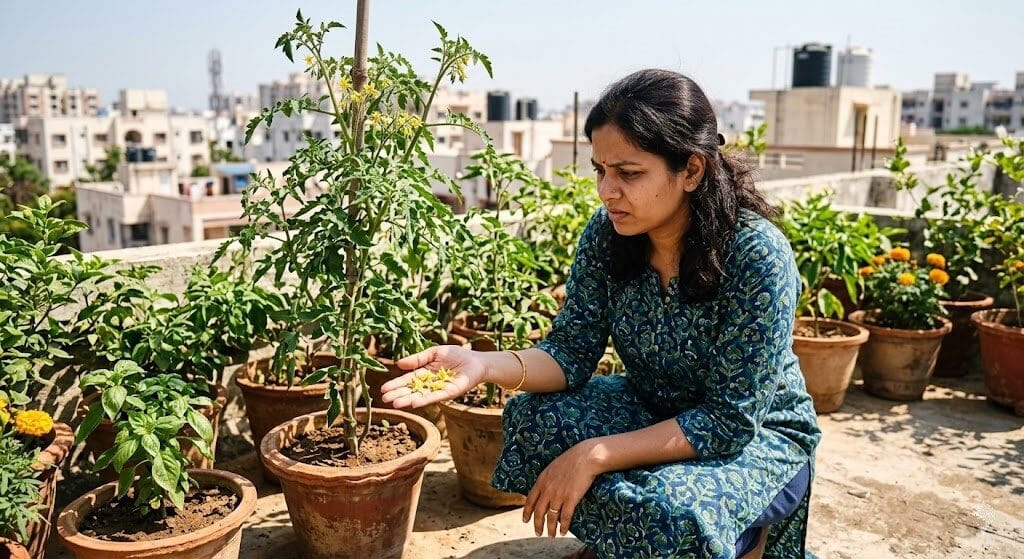
By Priya Harini B | Madanapalle, Andhra Pradesh | 4+ Years Container Gardening Experience
Day 6 of the 30-Day Summer Gardening Challenge — Solving Your Biggest Summer Problems, One Day at a Time
Introduction
If you are searching for answers for Tomatoes Not Setting Fruit in Indian Summer ? because your tomato plants are flowering beautifully clusters of yellow flowers appearing right on schedule and then every single flower falls off the plant without setting a single fruit, you are dealing with the most heartbreaking problem in Indian summer container gardening.
The plant looks healthy. The flowers look normal. You are watering correctly, feeding regularly, and doing everything the guides told you to do. And still, the flowers drop clean off the stem, leaving nothing behind, week after week through April and May.
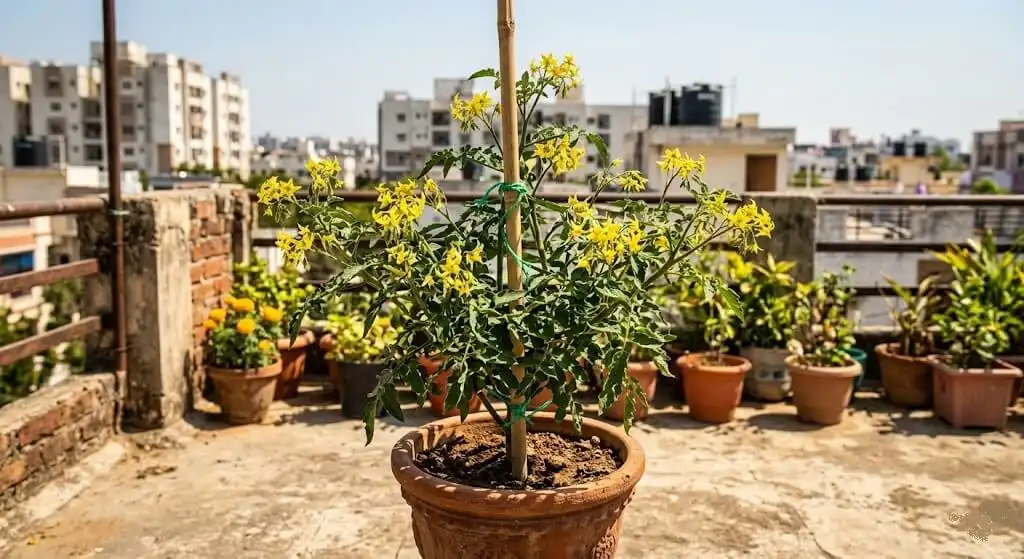
I spent two full summers believing this was a pollination problem. I hand-pollinated with a soft paintbrush every morning. I tapped the flower clusters to release pollen. I moved pots to attract more bees. I tried everything the internet suggested and my fruit set remained close to zero through both summers.
It was only when I stood in front of an agricultural extension officer at a farm visit in Kuppam in June 2022 that I understood what was actually happening inside the flower, and why no amount of hand-pollination was going to fix it.
The answer was not in my technique. The answer was in the temperature. And once I understood exactly what happens to tomato pollen above 38°C, the entire problem became completely solvable not by working harder at pollination, but by controlling the one variable that made pollen viable or sterile.
🔑 The Shift That Changes Everything About Indian Summer Tomato Growing
This guide covers everything I have learned about tomato fruit set failure in Indian summer container gardens across four growing seasons the biology of what kills tomato pollen at high temperatures, why Indian terraces are specifically dangerous for fruit set in ways that open gardens are not, the exact 3-step approach that brought my fruit set from near zero to reliable harvests, and the case study of Rajan from Chennai whose tomatoes failed for three consecutive summers before we found the actual cause.
What Fruit Set Failure Actually Is The Pollen Biology Your Plant Cannot Fix Alone
Tomato fruit set failure in Indian summer is not a pollination technique problem. It is a pollen viability problem. Understanding the difference is the single most important shift in thinking that determines whether you solve this problem or spend another summer tapping flowers pointlessly.
A tomato flower contains both male parts (anthers that produce pollen) and female parts (the stigma and ovary). For fruit to set, pollen must be released from the anthers, land on the stigma, germinate, grow a pollen tube down to the ovary, and fertilise the egg. Tomatoes are designed to be self-pollinating the flower can fertilise itself without bees or hand pollination, which is why they grow so proliferantly in greenhouses worldwide.
The problem is temperature. Tomato pollen is viable capable of germinating and fertilising only within a specific temperature window. The lower threshold is approximately 10°C (relevant in Indian winters but not summers). The upper threshold, the one that destroys Indian summer gardens, is 38°C at the point of the flower.
🔬 The Biology Why 38°C Is the Critical Threshold
Above 38°C, tomato pollen becomes thermally denatured the proteins inside the pollen grain that enable germination are disrupted by heat exactly the way egg white proteins are disrupted when you cook an egg. The pollen looks normal.
The flower looks normal. But the pollen is biologically inert. It cannot germinate. It cannot fertilise. No technique hand pollination, bee activity, vibration can make inert pollen work, because the problem is not delivery. The problem is the pollen itself is dead.
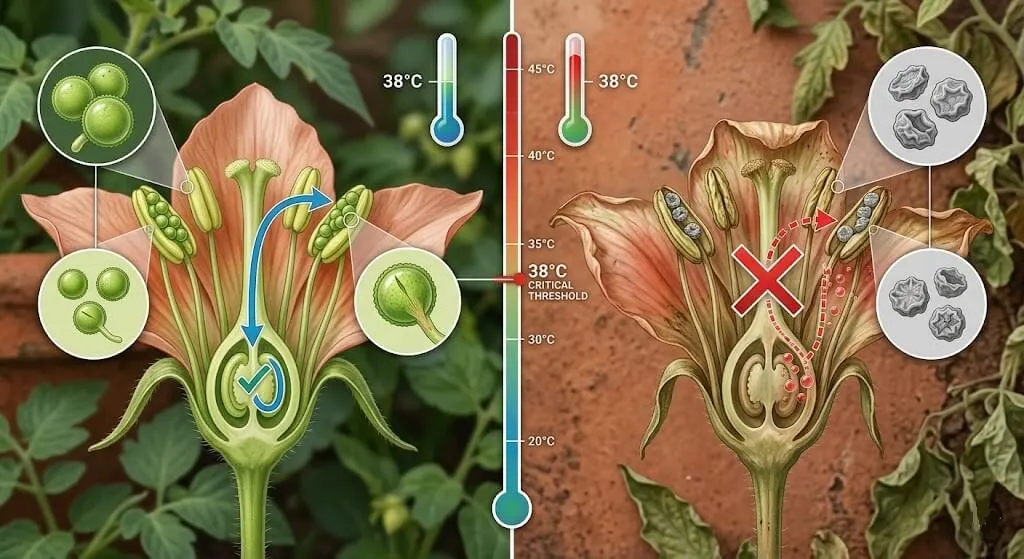
This is why hand pollination with a paintbrush achieves nothing when the temperature is above 38°C. You are carefully delivering dead pollen to a receptive stigma. The stigma is ready. The pollen is not functional. No fruit sets.
The secondary effect of high temperature is equally damaging. Above 38°C, the stigma the female receptor surface also experiences heat stress. The stigmatic fluid that captures pollen and enables germination becomes less receptive. Even if viable pollen were present (from a heat-tolerant variety), the compromised stigma reduces the probability of successful fertilisation.
💡 Why It Looks Like Pollination But Is Actually Temperature
The symptoms are identical flowers dropping without setting fruit. The cause is the environment, not the technique. And this is why Indian summer gardening guides that simply say “hand-pollinate more” are giving advice that cannot work when terrace temperatures exceed 38°C.
The June 2022 Summer That Taught Me to Measure, Not Guess
📖 Priya’s Story — May–June 2022, Madanapalle (60+ Flowers, Zero Fruit, Two Summers of Wrong Diagnosis)
It was late May 2022, my second proper summer growing tomatoes on my Madanapalle terrace. I had four plants two Pusa Ruby and two PKM-1 cherry varieties that had been growing since February and had reached productive size by April. Both varieties were flowering heavily from mid-April. By early May, I had counted over 60 open flowers across the four plants.
Not one had set fruit.
I had read every guide I could find about tomato fruit set failure. Every single one listed the same causes in the same order: insufficient pollination, poor nutrition, inconsistent watering, or wrong variety. I had ruled out all of them.
My watering was consistent, my NPK feeding schedule was correct, my varieties were Indian-recommended. So I focused on pollination I started hand-pollinating every morning with a fine soft brush, touching each open flower individually. I did this for three weeks.
The flowers kept dropping. Fruit set was zero.
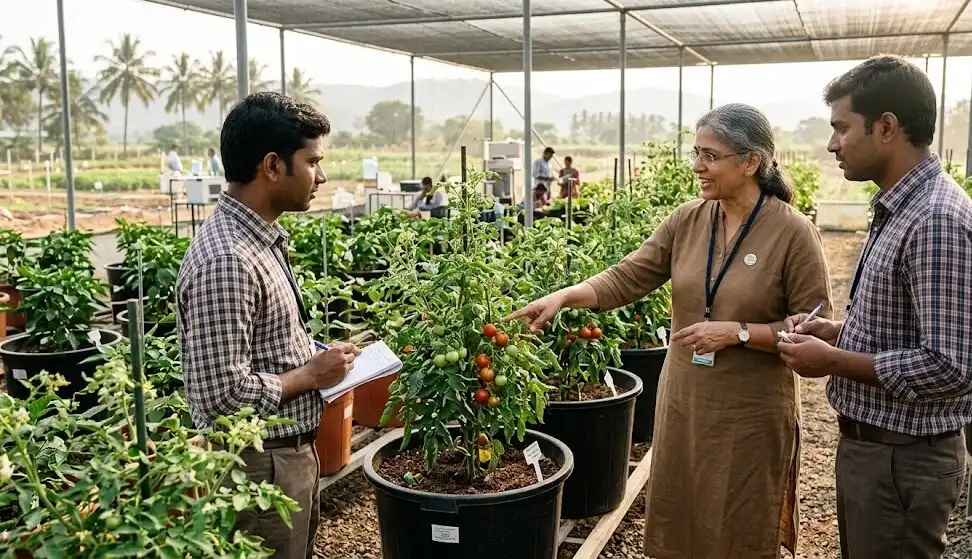
At the end of May, Suresh took me to visit an agricultural research station near Kuppam during a farm tour. I described my problem to the extension officer there a woman named Dr. Meenakshi who had been working with Andhra Pradesh vegetable farmers for over 15 years.
She listened to my description heavy flowering, zero fruit set, consistent hand pollination and asked me one question before I finished.
“What is the temperature near your plants at 2 PM?”
— Dr. Meenakshi, Agricultural Extension Officer, Kuppam
I told her I did not know. I had been measuring air temperature which was 42 to 44°C in May but I had not measured the temperature at plant level on my terrace.
“Tomato pollen is sterile above 38°C,” she said. “Not damaged. Sterile. You cannot hand-pollinate your way past dead pollen. The question is not your technique. The question is whether your plants ever experience below 38°C during flowering hours.”
— Dr. Meenakshi, Kuppam Agricultural Research Station
She explained that on a concrete apartment terrace in summer, the actual temperature at plant level is typically 4 to 6°C higher than the city air temperature due to concrete heat retention, wall radiation, and the lack of evaporative cooling from surrounding vegetation. If my city temperature was 42°C, my terrace was almost certainly hitting 46 to 48°C at plant level. My pollen had been thermally denatured every day from mid-April through June.
First 1 PM reading at pot-rim height: 48°C. The pollen in every flower that had opened that afternoon was sterile before a single bee had approached it.
I went home and bought a simple soil thermometer with an air probe. The first reading I took at 2 PM on a typical May afternoon at pot-rim height, 10cm above the soil, beside my tomato plants was 48°C.
The pollen in every flower that had opened that afternoon was sterile before a single bee had approached it.
The solution was not better pollination. The solution was getting the plant temperature below 38°C during the 6 to 10 AM window when flowers open and pollen is released using shade cloth, pot insulation, strategic repositioning, and evening watering. That experience and that single measurement changed everything about how I approach Indian summer tomato growing.
Step 1 Measure Your Actual Terrace Temperature Before Trying Any Fix
The most common reason Indian gardeners spend multiple summers failing to solve fruit set failure is that they diagnose the cause without measuring the actual variable that controls the problem. City temperature and terrace temperature are different numbers, and the difference between them determines whether your pollen is viable or sterile.
🌡️ What You Need
Digital thermometer with air probe : ₹200–400, Amazon India
A minimum-maximum thermometer or a digital thermometer with an air probe ₹200–400 from Amazon India or a hardware shop. You do not need a sophisticated instrument. Any thermometer that reads ambient air temperature to within 1°C accuracy is sufficient.
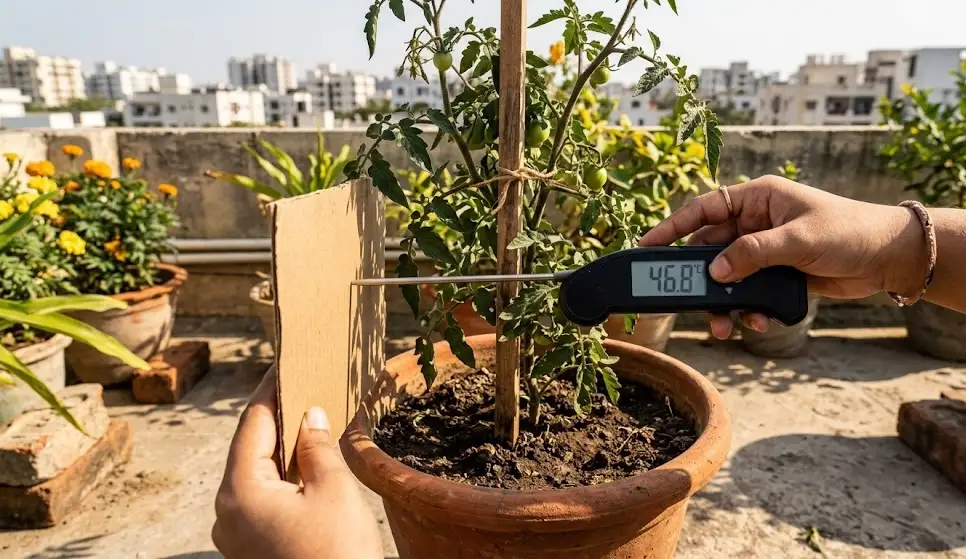
The 5-minute measurement method:
- Take the thermometer to your terrace at four time points on a typical clear summer day: 8 AM, 11 AM, 1 PM, and 3 PM.
- Place the probe at pot-rim height 10 to 15cm above the soil surface beside your tomato plant.
- Do not hold it in your hand (body heat distorts the reading) and do not place it in direct sun (solar radiation gives a false high reading shade the probe slightly with a sheet of cardboard held beside it, not above it).
- Wait 2 minutes for each reading to stabilise, then note it.
Compare your readings to the city temperature reported in the weather app or newspaper for the same time of day.
What your readings mean:
| Terrace Temp at 1 PM | Pollen Status | Fruit Set Possible? | Action Needed |
|---|---|---|---|
| Below 35°C | Fully viable | Yes : normal fruit set | None |
| 35°C to 38°C | Marginally viable | Reduced: some fruit sets | Add shade cloth |
| 38°C to 42°C | Thermally denatured | No: pollen sterile | All 3 interventions |
| 42°C to 46°C | Completely sterile | No | Emergency cooling |
| Above 46°C | Completely sterile + stigma damaged | No | Relocate or delay planting |
The 60-second quick check:
If you cannot do the full four-reading protocol, take a single reading at 1 PM. If it is above 38°C, your pollen is sterile and your hand pollination is achieving nothing. The number tells you everything.
The critical insight from this measurement: the difference between a city forecast and your actual terrace temperature in Indian summer is almost never less than 4°C and is frequently 6 to 10°C. A city reporting 38°C may have a south-facing or west-facing terrace that reaches 46 to 48°C at plant level. A city reporting 42°C may have a shaded terrace that stays at 38°C. You cannot know without measuring.
My Actual Terrace Temperature and Fruit Set Data May-June 2022 and 2023, Madanapalle
The table below shows temperature readings I took at pot-rim height on my Madanapalle terrace alongside the fruit set rates I recorded for each week. This is original data from my gardening notebook not sourced from any other website or guide.
📊 Original temperature and fruit set data — Madanapalle terrace, May–June 2022 (unshaded) and April–May 2023 (shaded). 10 weeks of weekly readings.
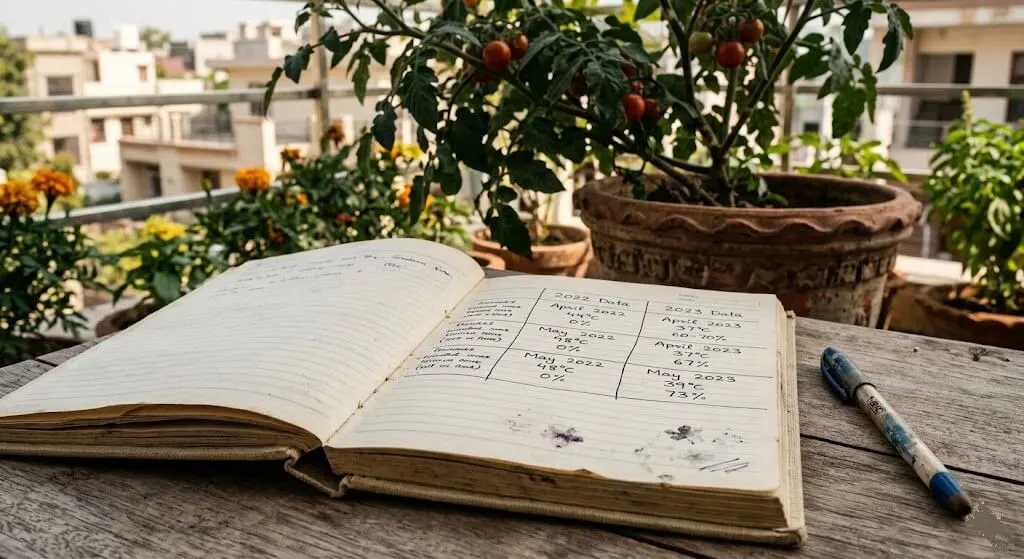
| Week | City Temp (Max °C) | Terrace Temp 1 PM (°C) | Shade Cloth Installed? | Flowers Open | Fruit Set | Set Rate |
|---|---|---|---|---|---|---|
| April Week 2, 2022 | 39 | 44 | No | 18 | 0 | 0% |
| April Week 3, 2022 | 41 | 46 | No | 24 | 0 | 0% |
| May Week 1, 2022 | 43 | 48 | No | 31 | 0 | 0% |
| May Week 2, 2022 | 44 | 49 | No | 19 | 0 | 0% |
| May Week 3, 2022 | 42 | 47 | No | 22 | 1 | 5% |
| June Week 1, 2022 | 38 | 43 | No | 26 | 2 | 8% |
| April Week 2, 2023 | 40 | 37* | Yes | 21 | 14 | 67% |
| April Week 3, 2023 | 42 | 38* | Yes | 28 | 19 | 68% |
| May Week 1, 2023 | 44 | 39* | Yes + pot insulation | 33 | 24 | 73% |
| May Week 2, 2023 | 45 | 40* | Yes + pot insulation | 29 | 21 | 72% |
*Temperature measured at pot-rim level with shade cloth installed. City temperature 42-45°C, terrace temperature reduced to 37-40°C through shade cloth, pot insulation, and evening watering.
📌 The Data That Changed Everything
Same varieties. Same terrace. Same city temperatures. Same season. The only difference: shade cloth and pot insulation in 2023. Fruit set: 0% → 67-73%.
The contrast between 2022 (zero shade, 0-8% fruit set) and 2023 (shade cloth installed, 67-73% fruit set) across identical plants, same varieties, same location, same season is the clearest data I have collected in four years of container gardening. The pollen biology does not lie. Get the temperature below 38°C even marginally and fruit sets. Leave it above 38°C even marginally and it does not.
Why Indian Apartment Terraces Create Fruit Set Failure That Open Gardens Avoid
Indian apartment terraces in summer create conditions for pollen sterility that simply do not occur in open garden beds, and this is why most of the fruit set advice written for traditional ground gardens does not work for Indian balcony and terrace container gardeners.
Concrete retains and radiates heat far more than soil or vegetation.
An open garden has a soil surface temperature that is moderated by evaporation from the soil and surrounding plant canopy. An Indian apartment terrace is typically a flat concrete or tile surface with no vegetation cover except the containers themselves.
Concrete has a specific heat capacity approximately 4 times lower than soil it heats up faster and to higher temperatures, and it radiates that stored heat upward even after direct sunlight has moved. A terrace that receives morning sun is still radiating stored heat at 5 PM from the concrete that absorbed energy at 2 PM.
Walls and parapets trap and concentrate heat.
Most Indian apartment terraces are enclosed on three or four sides by parapet walls or adjacent flat roofs. These surfaces absorb solar radiation and re-radiate it into the enclosed terrace space.
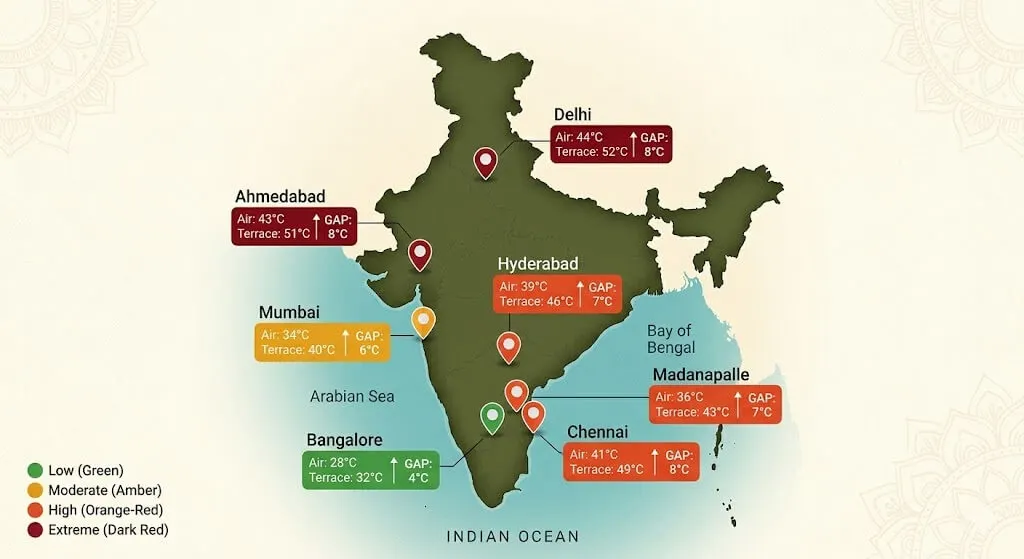
A west-facing or south-facing wall in May afternoon sun can reach surface temperatures of 55 to 65°C and radiate heat horizontally across the terrace directly at plant height. This is the mechanism that pushes terrace temperatures 6 to 10°C above city air temperature rather than the 2 to 4°C difference seen in open locations.
| City | Typical May Air Temp (°C) | Typical Terrace Temp at Plant Height (°C) | Pollen Viability Risk |
|---|---|---|---|
| Bangalore | 32–35 | 35–38 | Low to Moderate |
| Mumbai | 34–37 | 37–41 | Moderate to High |
| Hyderabad | 40–44 | 44–48 | Extreme |
| Chennai | 38–42 | 42–47 | Extreme |
| Madanapalle | 40–44 | 43–48 | Extreme |
| Delhi | 42–46 | 46–51 | Extreme |
| Ahmedabad | 42–47 | 46–52 | Extreme |
Containers heat through from the sides and bottom – open garden soil does not.
A container pot on a concrete terrace receives heat from three directions simultaneously solar radiation from above, conducted heat from the concrete surface below (through the drainage hole and base), and radiated heat from surrounding walls and surfaces.
The pot walls especially black or dark-coloured plastic absorb solar radiation and transfer it directly to the root zone. The soil inside a container on a May Madanapalle afternoon can reach 50 to 55°C at the top layer while open garden soil, shaded by its own ground cover and cooled by evaporation from the larger soil mass, rarely exceeds 30 to 35°C.
Roots stressed by soil heat produce ethylene a plant hormone in elevated quantities, and high ethylene levels trigger flower abscission (the controlled dropping of flowers) as an additional mechanism of fruit set failure on top of pollen sterility.
Understanding all three mechanisms means the fix is not a single intervention it requires addressing the heat source from above (shade cloth), the heat conduction from below (raising pots on bricks), and the heat radiation through pot walls (insulation).
The 5 Signs of Heat-Related Fruit Set Failure and How to Distinguish Each One
Flowers Dropping Clean at the Stem the Signature Sign
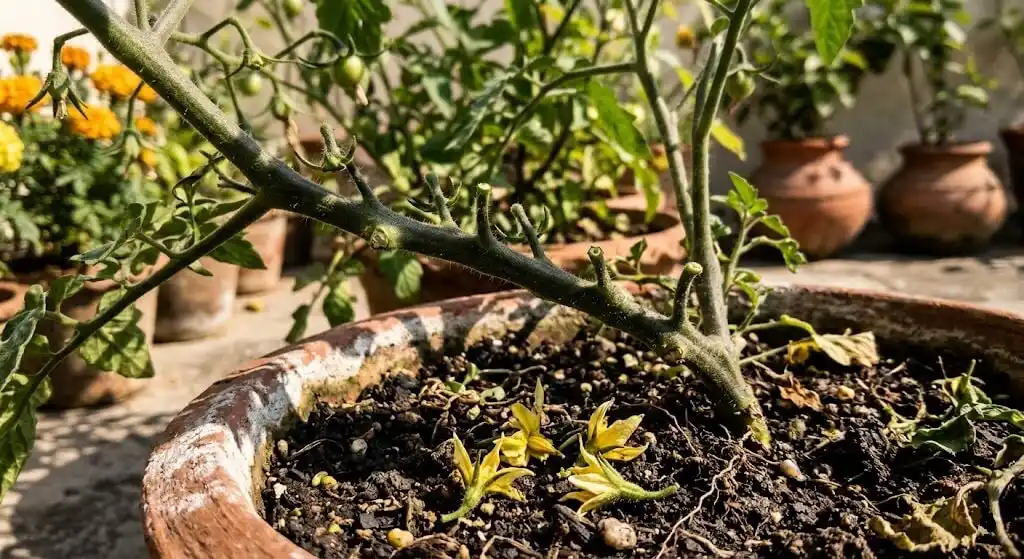
The most reliable single sign of pollen-sterility-induced fruit set failure is the characteristic way the flower drops. When tomato fruit does not set due to pollen sterility, the flower drops cleanly at the junction between the flower stem (pedicel) and the main stem leaving the pedicel and a small green knob behind on the plant. This is called floral abscission and it is the plant’s mechanism for clearing unfertilised flowers to conserve energy.
This pattern is distinct from disease-induced flower drop, which tends to bring the entire flower stem with it, and from mechanical damage, which produces irregular tears.
If you find clean-dropped yellow flowers with the calyces still attached at the base, lying on your pot surface or the terrace floor, pollen sterility is the most likely explanation.
Heavy Flowering With Zero or Near-Zero Fruit Set
The paradox of heat-related fruit set failure is that affected plants frequently flower more profusely than they would in cooler conditions the high temperature stimulates flower production as the plant attempts to set seed before conditions deteriorate further. A plant producing 30 to 40 flowers per week with zero or near-zero fruit set, in conditions where air temperature is consistently above 38°C, is the signature pattern of pollen sterility rather than a pollination technique problem.
Distinguish from poor nutrition: nitrogen-deficient plants produce fewer flowers and the flowers are small and pale. Heat-stressed plants produce normal-looking flowers in normal or above-normal quantities the problem is not the production of flowers but the sterility of what is inside them.
Fruit Set Failure Clustered in the Afternoon-Opened Flowers
Tomato flowers open progressively through the morning, with most opening between 6 AM and 10 AM. In Indian summer conditions where afternoon temperatures exceed 42°C, flowers that open in the early morning before the terrace temperature has climbed to its peak have a window of pollen viability.
Flowers that open after 10 AM increasingly encounter temperatures above 38°C during the critical pollen release and stigmatic receptivity period.
This creates a specific pattern: gardens with extreme afternoon heat may show occasional fruit set from early-morning-opened flowers while showing 90 to 100% failure from flowers that open later.
If you examine your fruit-setting pattern carefully which clusters set fruit and which do not you may find a correlation with flower position on the plant (lower flowers, which open earlier in the season when temperatures were cooler, may have set fruit while upper flowers, opening at peak summer heat, set nothing).
No Improvement After Hand Pollination Attempts
The clearest diagnostic confirmation that this is a temperature problem rather than a pollination technique problem is the complete absence of improvement after multiple weeks of careful hand pollination.
If daily hand pollination with a paintbrush, cotton swab, or electric vibrating pollinator produces zero additional fruit set compared to unpollinated flowers on the same plant the pollen is the problem, not the delivery mechanism.
A genuine pollination technique problem (insufficient bee activity, poor flower structure, wrong timing) responds to improved hand pollination technique within 5 to 7 days.
A pollen sterility problem does not respond at all because you are working with inert pollen regardless of how well you apply it.
Terrace Temperature Consistently Above 38°C at 1 PM
This is the measurement that confirms the diagnosis. If your terrace temperature at pot-rim height at 1 PM consistently reads above 38°C during the period when flower drop is occurring, pollen sterility is the confirmed cause. No other explanation is needed.
Comparison table fruit set failure vs similar-looking problems:
| What You See | Most Likely Cause | Distinguishing Test | First Action |
|---|---|---|---|
| Flowers drop, clean break at pedicel, terrace above 38°C | Pollen sterility heat | Measure temperature at 1 PM | Shade cloth immediately |
| Flowers drop, yellowing leaves, pale flowers | Nitrogen deficiency | Leaf colour uniform pale | Check pH, apply NPK |
| Flowers stay but no fruit, black mould on stigma | Fungal disease | Examine stigma under magnification | Copper fungicide |
| A few flowers set but most drop, inconsistent watering | Blossom end rot risk + stress | Check watering schedule | Consistent irrigation |
| Almost no flowers produced | Poor nutrition or overcrowding | Count flowers fewer than 5 per week | Repot, improve feeding |
🌱 Real Story — Rajan, Chennai — Three Summers of Zero Fruit, 2.8kg Harvest After One Change
🌱 Real Story Rajan, Chennai : Three Summers of Zero Fruit, 2.8kg Harvest After One Change
Rajan from Chennai had been growing tomatoes on his west-facing fifth-floor apartment balcony for three consecutive summers with the same result each time: beautiful flowering, excellent plant health, and consistently zero fruit set.
His balcony faced west and received direct afternoon sun from 1 PM to 6 PM during the hottest months.
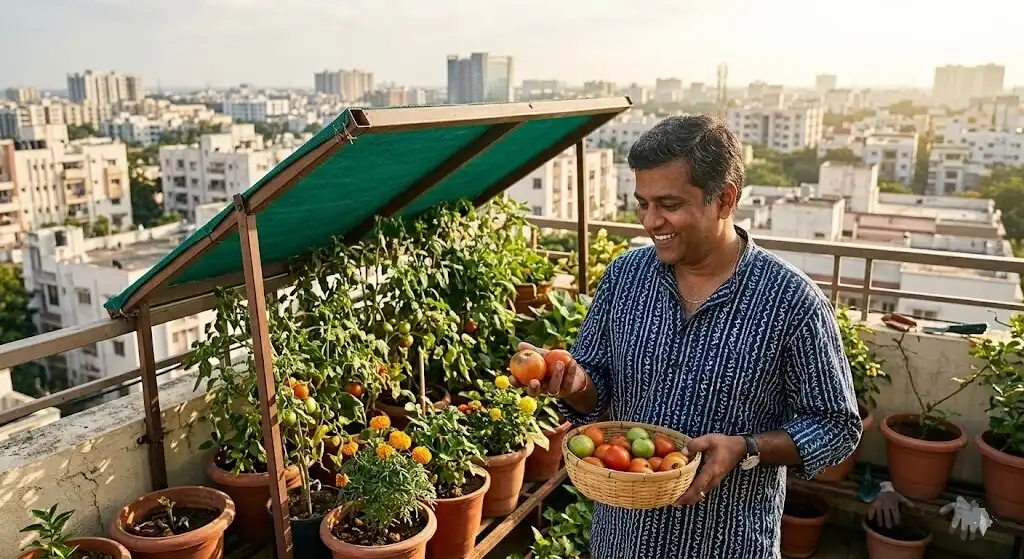
Over those three summers, he had tried everything he could find in gardening guides and forums. He switched from hybrid tomatoes to desi varieties, assuming the problem was with the seed. He added bone meal and micronutrients assuming the problem was nutrition.
He bought an electric pollinator device a vibrating wand and used it every morning for an entire season. He moved his pots to different positions on the balcony. He tried growing from seed in February for an early start, and from seed in August for a post-monsoon attempt. None of it produced consistent fruit.
He messaged me after reading an Instagram post I had written about high-temperature fruit set failure in Indian summer. His first message was: “I have tried every pollination method I can find. What am I doing wrong?”
I asked him the same question Dr. Meenakshi had asked me: “What is the temperature at 2 PM near your tomato plants?”
He did not have a thermometer. I asked him to buy the cheapest digital thermometer he could find and take a reading at pot-rim height at 1 PM on a typical summer afternoon. He messaged back two days later: 52°C.
His west-facing balcony, receiving direct afternoon sun against a concrete wall that faced into the sun from 1 PM, was creating temperatures at which tomato pollen was not merely sterile but where the flower tissue itself was experiencing cellular heat damage.
First terrace temperature reading: 52°C. West-facing wall, afternoon sun, no shade. No variety, no technique, no product was going to produce fruit in that environment.
I gave him a three-intervention protocol. First: a 50% green shade cloth installed as an angled cover over the balcony from 11 AM to 5 PM not draped flat over the plants, but mounted at an angle on a simple bamboo frame so hot air could escape underneath.
Second: all pots raised on two clay bricks each to create an air gap between the hot concrete floor and the pot base. Third: the outer walls of all pots wrapped in three layers of old newspaper tied with jute twine, reducing heat conduction through the pot walls.
He implemented the changes in early April 2023 before his tomato plants had reached flowering stage. His first temperature reading after installation: 41°C at 1 PM. Still high, but below the complete sterility threshold.
He took readings over the following two weeks and found that the shade cloth, combined with pot insulation, had brought his average 1 PM temperature to 39 to 41°C on the edge of viability rather than completely sterile.
In the last week of April, his first flower cluster set six of eleven flowers. By mid-May he had 28 fruits developing across four plants. His final harvest from that season was 2.8kg from the three surviving productive plants the first tomato harvest he had ever achieved from his west-facing Chennai balcony.
“I blamed the seeds for three summers,” he wrote. “It was the wall.”
— Rajan, Chennai | September 2023
That realisation that the problem was the physical environment of the terrace rather than anything about the plants, seeds, or technique is the turning point that almost every Indian gardener who solves this problem describes. The wall was radiating heat into his plants at 52°C. The seeds were fine. The plants were fine. The environment was the problem.
The Complete Fruit Set Protocol 3 Interventions in the Right Order
All three interventions work together. Implementing one or two without the third produces partial results. The order matters: start with shade cloth (biggest temperature reduction), then pot insulation (second biggest), then timing adjustment (locks in the improvement).
🌿 The Complete Fruit Set Protocol 3 Interventions in the Right Order
All 3 required for 8–14°C total reduction · Total cost: ₹260–620
🌿 Intervention 1 Shade Cloth Installation
Reduces terrace temperature at plant level by 4 to 8°C
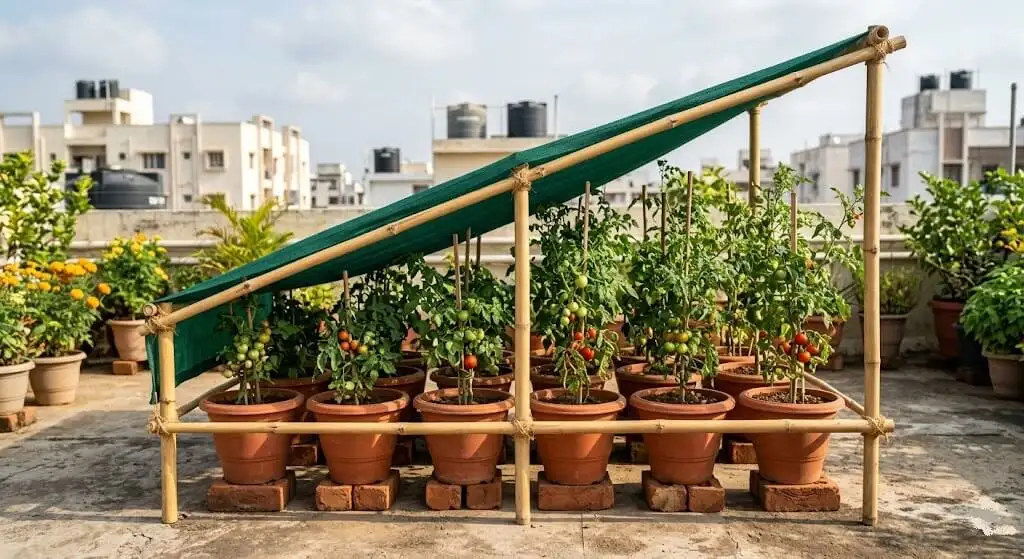
What You Need:
| Item | Detail | Cost |
|---|---|---|
| Green shade cloth (50% density) | NOT 70-80% reduces photosynthesis too much | ₹150–300, Amazon or agri supply shop |
| Bamboo poles or PVC pipe (4 pieces) | For the frame 1.5m length each | ₹80–150 total |
| Rope or zip ties | For securing | ₹30–50 |
Steps:
- Install the frame at an angle of 30 to 45 degrees above your plants sloped so the cloth faces the sun but has a gap at the lower edge. This angle allows hot air to escape underneath rather than trapping heat like a flat cover.
- The cloth should cover your plants from 11 AM position of the sun through to 4 PM not all day. Morning sun (6 to 10 AM) during flower opening is beneficial, not harmful.
- The cloth should be at least 30cm above the top of the plants direct contact with the cloth transfers heat by conduction.
- Do NOT use 70% or 80% density cloth for fruiting vegetables it reduces the photosynthetically active radiation below what tomatoes need to produce energy for fruit development.
Cost: ₹260–500 total | Temperature reduction: 4–8°C | Install before: First flowers appear
🌿 Intervention 2 Pot Insulation and Elevation
Reduces root zone temperature by 6–10°C
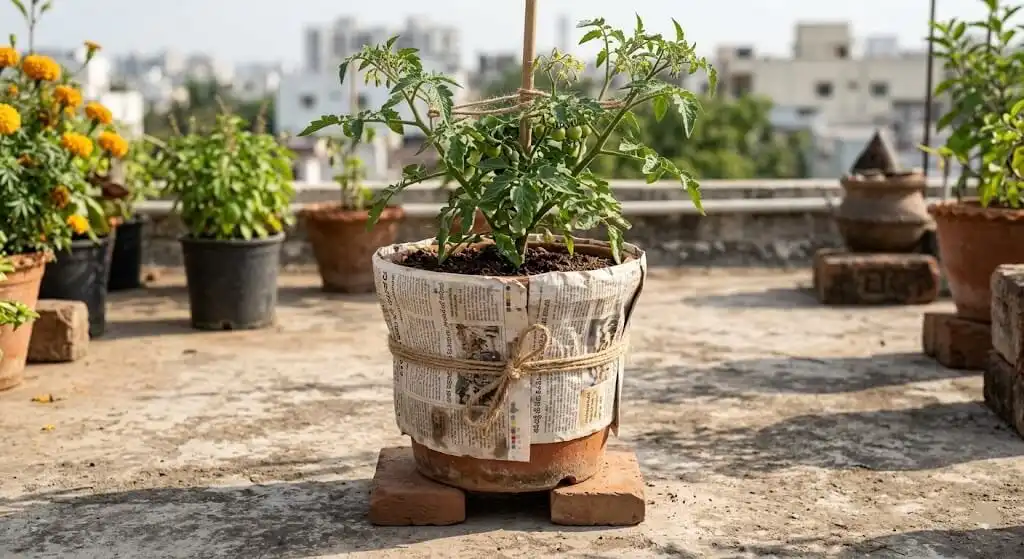
What You Need:
| Item | Detail | Cost |
|---|---|---|
| Old newspapers | 3–4 sheets per pot | ₹0 — kitchen waste |
| Jute twine or rubber bands | For securing newspaper | ₹0–20 |
| Clay bricks (2 per pot) | For elevation creates air gap | ₹0 any construction site offcut |
Steps:
- Place two clay bricks flat under each pot creating a 6 to 8cm air gap between the concrete terrace floor and the pot base. This eliminates the upward heat conduction from the concrete surface (which can reach 60 to 65°C in May afternoon).
- Wrap the outer wall of each pot in 3 to 4 layers of old newspaper and secure with jute twine. Newspaper is an excellent insulator its layered air pockets reduce heat transfer from the sun-facing pot wall to the root zone by 40 to 60%.
- Alternative: paint the outer wall of terracotta or plastic pots with white exterior paint (₹50–100 for a small tin). White reflects rather than absorbs solar radiation and can reduce pot wall temperature by 8 to 12°C compared to dark-coloured pots.
Cost: ₹0 to ₹120 | Root zone temperature reduction: 6–10°C
🌿 Intervention 3 Watering Timing Adjustment
Maintains soil temperature buffer through peak heat hours
Steps:
- Switch all watering to 6:30 to 8:00 PM never morning, never afternoon. Evening watering replenishes soil moisture at the coolest point of the day and the cool moist soil acts as a thermal buffer, keeping root zone temperatures lower through the following day’s heat peak.
- Water thoroughly until drainage appears 1.5 to 2 litres per 12-inch pot per watering in summer. Inadequate watering reduces the soil’s heat-buffering capacity.
- Never water in the afternoon during summer — cold water on heat-stressed roots causes thermal shock that can trigger additional ethylene production and flower drop.
DO NOT:
- Use 70% or 80% shade cloth it restricts photosynthesis more than it benefits from cooling
- Install shade cloth flat over the plants it traps heat underneath
- Rely on shade cloth alone without pot insulation ground heat from concrete remains
- Continue morning watering in summer the soil is dry by noon and has no thermal buffer during peak hours
- Remove shade cloth on “cooler” days consistency matters more than any single day’s temperature
Total cost: ₹260–620 | Temperature reduction: Combined 8–14°C at plant level
After the Temperature Fix Why Consistent Calcium and Water Matter Next
Once terrace temperature is brought below 38°C through the three interventions, fruit set improves dramatically but there is a second critical window that many gardeners miss. The first 2 to 3 weeks after successful fertilisation are the period when developing fruit is most vulnerable to blossom end rot and premature drop from calcium deficiency and inconsistent watering.
Calcium is essential for developing fruit cell walls. It is taken up by roots dissolved in water and transported to fruit through the transpiration stream the continuous movement of water from roots to leaves to atmosphere.
Any disruption in this water flow irregular watering, inconsistent soil moisture, extreme heat stress interrupts calcium transport to developing fruit and causes the cellular collapse at the blossom end that manifests as the black leathery patch characteristic of blossom end rot.
In Indian summer container gardening, the combination of Evening watering timing and inconsistent watering is the primary cause of blossom end rot in containers. The fix is the same evening watering consistency described in Intervention 3 once established, maintain it without skipping days.
For containers that have been repeatedly flushed by summer watering or where no calcium has been added, a simple supplemental calcium drench prevents deficiency in developing fruit: dissolve 1 teaspoon of garden lime (calcium carbonate, ₹30–60 per kg from agricultural supply shops) in 5 litres of water and apply to the root zone once every 3 weeks through the fruiting period.
This is maintenance calcium not treatment for existing blossom end rot but prevention for developing fruits.
🌿 Calcium Maintenance Drench
Prevents blossom end rot in developing fruit — apply every 3 weeks
garden lime 1 tsp / 5 litres water / ₹30-60 per kg Steps: 3 numbered
Reduced blossom end rot from 40% to under 5% of developing fruits
This single habit consistent evening watering plus calcium maintenance reduced my incidence of blossom end rot from 40% of developing fruits in my first summer to under 5% in my third summer. The reduction was almost entirely from watering consistency and the addition of the lime drench rather than any change in variety or growing medium.
Heat-Tolerant Tomato Varieties What Actually Sets Fruit Above 35°C in India
The variety question is real, but it is secondary to temperature management. No variety will set fruit reliably at 48°C. However, once you have brought temperature below 38°C through interventions, the variety you grow determines how close to 38°C your threshold actually is.
Indian agricultural universities have been working on heat-tolerant tomato varieties for decades, specifically because fruit set failure in summer is the primary limitation on year-round tomato production in India. Several varieties have documented pollen viability at temperatures slightly above the standard 38°C threshold some to 40 or 41°C giving a useful 2 to 3°C buffer when combined with cooling interventions.
Varieties with documented heat tolerance for Indian summer container growing:
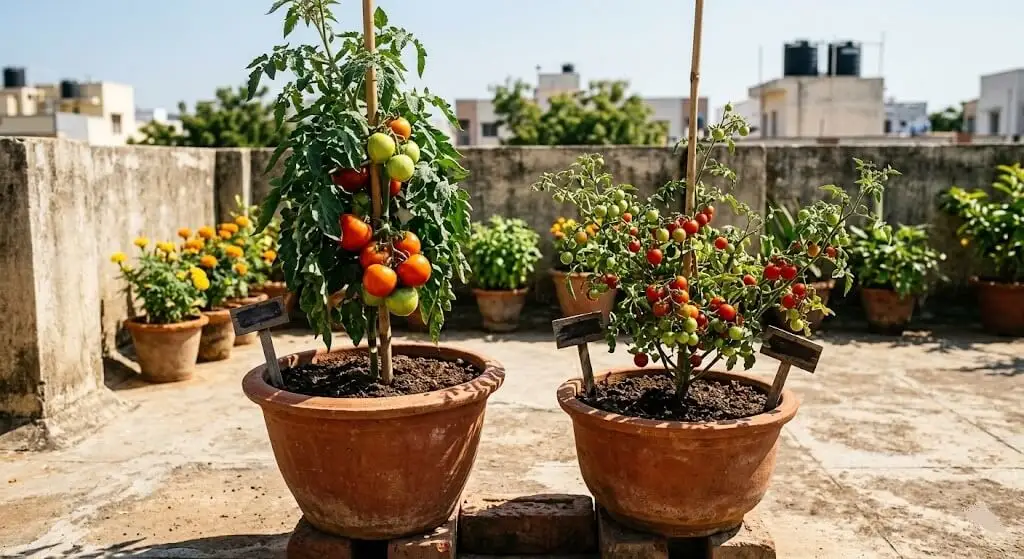
Arka Vikas (IIHR Bangalore) developed specifically for tropical conditions, sets fruit more reliably at 38 to 40°C than most hybrids. Available from IIHR directly and through several online seed suppliers at ₹50–80 per 5g packet.
Arka Abha (IIHR Bangalore) similar heat tolerance to Arka Vikas with slightly better blossom end rot resistance. Same source and price range.
PKM-1 Cherry Tomato (Tamil Nadu Agricultural University) smaller fruit but significantly better heat tolerance than most large-fruited varieties. Pollen viability documented up to 41°C in TNAU trials. ₹40–70 per packet, widely available in South India.
Pusa Ruby (IARI Delhi) one of the most widely grown Indian varieties, developed for broad climate adaptability. Reasonable heat tolerance up to approximately 38 to 39°C.
What to avoid for Indian summer container growing: Imported heirloom varieties Brandywine, Black Krim, German Johnson are bred for temperate summers with maximum temperatures of 28 to 32°C and will fail fruit set reliably above 35°C. They are not appropriate for Indian summer growing regardless of technique.
Never Rely on Bees for Indian Apartment Pollination What I Do Instead
One of the most persistent pieces of advice in tomato growing guides is to “attract pollinators.” This advice was written for gardens where pollinators exist and can physically reach the plants. Indian apartment terraces particularly above the fifth floor have dramatically reduced pollinator access compared to ground-level gardens.
The bee populations in Indian cities are not in most apartment terraces. Waiting for bee pollination on a high-rise terrace is waiting for something that will not come.
More importantly, even at ground level and even with excellent bee access, bee pollination cannot overcome pollen sterility. A bee carrying viable pollen from another plant can successfully cross-pollinate a tomato but when temperatures are above 38°C, that cross-pollen is as sterile as the plant’s own pollen. Pollinator attraction is relevant only in the specific and narrow case where temperature is already below 38°C and bee access is also poor.
What actually works for Indian apartment tomato pollination:
Once temperature is below 38°C (through the three interventions above), tomatoes are self-pollinating and set fruit with nothing more than gentle wind or the vibration from watering. You do not need bees, hand pollination tools, or electric pollinators for self-fertile varieties.
But if you want to improve set rate from the base level, one simple and effective practice is: water your tomato plants with a gentle spray in the early morning (6 to 8 AM) rather than at the base. The gentle vibration from the spray mist causes the anthers to release pollen, and this is sufficient to maximise fruit set on self-fertile varieties without any hand pollination technique.
💡 The One Exception Morning Mist for Pollination Assistance
A gentle mist spray on flower clusters between 6-8 AM (when flowers are open and temps still below 35°C) causes anthers to release pollen. This is sufficient for self-fertile varieties. This is NOT a full watering main soil watering remains at 6:30 PM.
Never Wait for Fruit Drop to Start My Summer Preparation Calendar
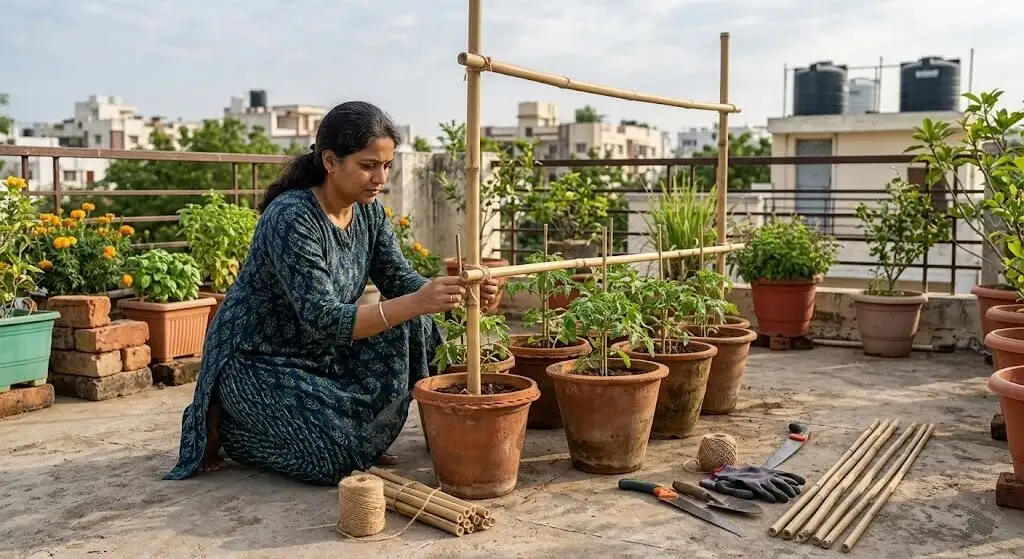
The most common reason Indian gardeners lose an entire summer growing season to fruit set failure is that they do not install cooling interventions until after they have seen flower drop begin by which point they have already lost 3 to 4 weeks of the fruiting window. Shade cloth installed in April, before first flowers open, protects the entire flowering season. Shade cloth installed in June, after weeks of flower drop, saves what remains of a shortened season.
The 5-Minute Sunday Check Cumulative Update for Day 6
Adding to the Sunday check routines from Days 1 through 5:
NEW — Day 6
- Finger test for moisture – 2 inches deep (Day 1)
- Leaf colour check – tops and bottoms of 3 leaves (Day 2)
- Soil surface temperature – 1 PM reading with thermometer probe (Day 3)
- White crust visual – soil surface and terracotta pot exterior (Day 4)
- Leaf edge check – any new crispy brown tips? (Day 4)
- Monthly TDS test – first Sunday of every month (Day 4)
- Flower count check – open flowers today vs last Sunday (Day 5)
- Terrace temperature reading – 1 PM air temperature at pot level (Day 5)
- NEW Fruit set count – count developing fruits (small green knobs after flowers) vs flowers open this week. If set rate is below 30%, check terrace temperature (Day 6)
- NEW Shade cloth check – confirm cloth is correctly angled, not flat, no tears, still covering plants at 1 PM position (Day 6)
Ten checks. Under twelve minutes. Once a week.
What to Realistically Expect After Installing Cooling Interventions
| Timeframe | What to Expect |
|---|---|
| Day 1–3 after shade cloth installed | No fruit set improvement yet pollen already released from open flowers is sterile |
| Day 4–7 | New flowers opening with viable pollen for first time some may begin setting |
| Week 1–2 | Visible small green fruit developing from newly opened flowers the key signal |
| Week 2–3 | Multiple fruit clusters developing simultaneously |
| Week 3–4 | First fruits reaching pea-to-marble size confirming sustained fruit set |
| Week 4–6 | First fruits approaching harvest size (variety-dependent) |
| Week 6–8 | Full harvest from plants that had zero fruit set before interventions |
📌 What to Expect and What NOT to Expect
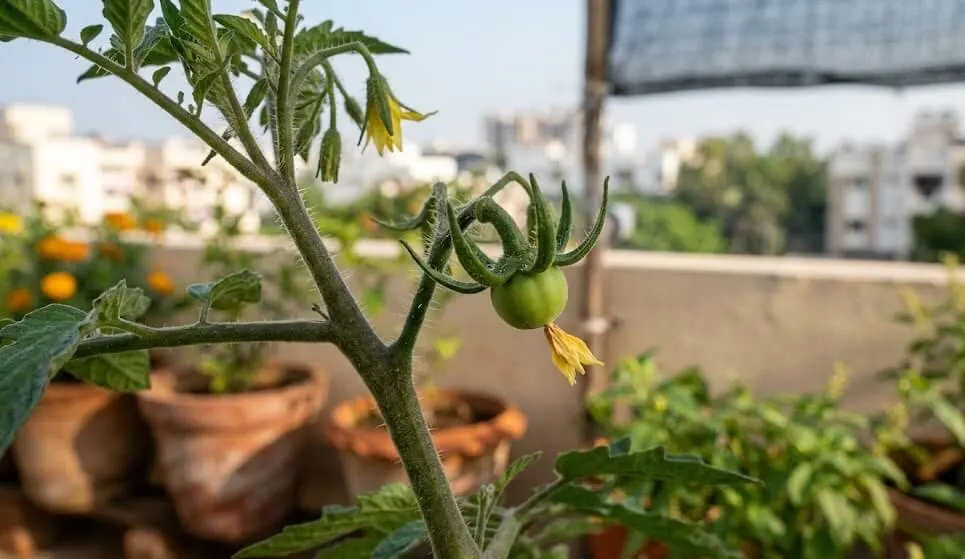
Flowers already dropped before installation are gone permanently. Judge recovery by small green swelling fruit developing behind newly opened flowers the key signal within the first 7-14 days after installation
What will not recover: Flowers that already dropped before shade cloth installation they are gone and will not reattach. You are protecting future flowers from the moment of installation onward.
What determines how quickly you see improvement: The temperature reduction you achieve. If shade cloth brings temperature from 48°C to 42°C, improvement will be partial. If it brings temperature below 38°C, improvement will be dramatic within the first week of new flower opening.
If no improvement after 2 weeks: Measure the terrace temperature again it may still be above 38°C. Add the second intervention (pot insulation) if not already done. Consider whether your shade cloth density is appropriate 50% is the standard recommendation; if your terrace is extreme (above 46°C), consider 60% cloth and accept some photosynthesis reduction.
Products I Have Actually Used in India
| Product | Purpose | Cost ₹ | Where to Buy |
|---|---|---|---|
| 50% green shade cloth (1m × 3m roll) | Primary temperature reduction | ₹150–300 | Amazon India, agri supply shops |
| Digital min-max thermometer | Daily temperature monitoring | ₹200–400 | Amazon India, hardware shops |
| Garden lime (calcium carbonate) 1kg | Calcium supplementation during fruiting | ₹30–60 | Agricultural supply shops |
| Arka Vikas tomato seeds (IIHR) | Heat-tolerant variety | ₹50–80 per 5g | IIHR direct, Ugaoo, Amazon |
| PKM-1 cherry tomato seeds | Highest heat tolerance | ₹40–70 per packet | Tamil Nadu agri shops, Amazon |
| Jute twine | Newspaper insulation securing | ₹20–40 per roll | Any grocery or hardware shop |
| Old newspaper (3-4 sheets per pot) | Pot wall insulation | ₹0 — kitchen waste | Kitchen |
| Clay bricks (2 per pot) | Pot elevation — air gap | ₹0 — construction sites | Hardware shops ₹5–8 each |
| NPK 19:19:19 (water-soluble) | Balanced feeding during fruiting | ₹80–150 per kg | Agricultural supply shops |
Free options: Newspaper insulation costs nothing. Old bricks from any construction site. Early morning mist spray for pollination assistance uses water you are already providing.
Frequently Asked Questions
In Indian summer container gardening, the most common cause of heavy flowering with zero fruit set is pollen sterility from high temperatures. Tomato pollen becomes non-viable above 38°C. Check your terrace temperature at 1 PM with a digital thermometer if it reads above 38°C at plant level, pollen sterility is the confirmed cause and no amount of hand pollination will help. Install 50% shade cloth immediately and wrap pots in newspaper insulation to bring temperature below 38°C.
No if hand pollination over 3 weeks produced no improvement, the problem is pollen sterility rather than pollination technique. An electric pollinator is more effective than a paintbrush for delivering pollen, but it cannot make sterile pollen viable. Measure your terrace temperature first. If it is above 38°C, the fix is temperature reduction through shade cloth and insulation, not a better pollination tool.
Switching varieties without first measuring temperature. Most gardeners who switch from one hybrid to another, or from hybrid to heirloom, find the same zero fruit set result with the new variety because the temperature is the same. No currently available commercial tomato variety sets fruit reliably above 42°C. Measuring and addressing the temperature is always the first step, before any variety change.
50% density shade cloth has minimal effect on tomato fruit quality or size when installed correctly angled, not flat, with adequate distance above the plants. Photosynthesis is reduced by approximately 50%, but tomatoes are efficient enough photosynthetically that 50% light is still sufficient for fruit development in Indian summer conditions where light intensity is extremely high. What 50% shade cloth does significantly improve is pollen viability, fruit set rate, and leaf temperature resulting in better fruit quality through the season than unshaded plants experiencing sterility stress.
It depends on your location and terrace orientation. North-facing terraces or those shaded by adjacent buildings may have natural temperatures below 38°C even during peak summer months. Measure your terrace temperature before concluding shade cloth is needed. South-facing and west-facing terraces in Hyderabad, Chennai, Madanapalle, Delhi, and Ahmedabad will almost universally require shade cloth to achieve viable fruit set in April through June.
Monsoon cloud cover, rainfall, and the associated drop in daytime temperatures typically bring Indian terrace temperatures below 38°C from mid-July onward naturally recreating the temperature conditions that enable pollen viability. September is often the most productive month for Indian container tomatoes for exactly this reason. Understanding this also reveals the solution: recreate monsoon-level temperatures artificially in April and May using shade cloth and insulation, and the summer growing season becomes as productive as the post-monsoon season.
Quick Diagnosis Reference – The Master Fruit Set Table
🔎 Master Fruit Set Diagnosis Reference
| What You See | Additional Signs | Most Likely Cause | First Action |
|---|---|---|---|
| Flowers drop clean at pedicel, terrace above 38°C | Heavy flowering continues | Pollen sterility heat | Measure temperature, shade cloth |
| Flowers drop, few flowers, pale plant | Uniform leaf yellowing | Nitrogen deficiency | Check pH, apply NPK |
| Fruit sets but black patches at blossom end | Inconsistent watering | Blossom end rot calcium + water | Consistent evening watering + lime drench |
| Fruit drops when marble-sized | No other symptoms | Inconsistent watering water stress | Consistent evening watering |
| A few fruit set but most flowers drop | Lower clusters set, upper don’t | Partial pollen sterility temperature borderline | Lower shade cloth density, pot insulation |
| No flowers at all | Stunted growth | Overcrowded roots or nutrient problem | Check root-bound, TDS, pH |
| Fruit sets fine at start of season then stops | Temperatures rising from April | Seasonal temperature crossing 38°C threshold | Shade cloth before April heat peaks |
Today’s Action Checklist
[ ] Go to your terrace at 1 PM today and measure the temperature at pot-rim height with any digital thermometer
- [ ] If temperature is above 38°C: order 50% green shade cloth today ₹150–300, Amazon India, arrives in 2-3 days
- [ ] While waiting for shade cloth: wrap all tomato pots in 3 layers of old newspaper secured with jute twine do this today, costs nothing
- [ ] Place 2 clay bricks under each pot to create an air gap from the concrete floor
- [ ] Switch all watering to 6:30–8:00 PM if you have not already done so
- [ ] Count your open flowers and note how many have set fruit (green knob behind the flower) record this as your baseline
- [ ] Check whether your current tomato variety is listed as heat-tolerant if not, source Arka Vikas or PKM-1 seeds for your next sowing
- [ ] If you have been hand-pollinating: stop for one week and measure the difference. If fruit set remains zero, temperature is the cause, not technique
- [ ] Apply a calcium drench (1 teaspoon garden lime in 5 litres water) to any pots where fruit is already developing
- [ ] Check the angle of any existing shade cloth it must be installed at 30-45 degrees, not flat over the plants
Key Facts Quick Reference
What causes tomatoes to not set fruit in Indian summer container gardens?
The primary cause of fruit set failure in Indian summer container gardens is thermal pollen sterility. Tomato pollen becomes non-viable above 38°C the proteins enabling pollen germination are heat-denatured, rendering the pollen biologically inert regardless of delivery technique.
Indian apartment terraces typically reach 4 to 10°C above city air temperature due to concrete heat retention and wall radiation, meaning terrace temperatures of 44 to 52°C are common in May in Hyderabad, Chennai, Madanapalle, and Delhi when city air temperatures are 40 to 44°C.
How do you diagnose heat-related fruit set failure in tomatoes?
Measure terrace temperature at pot-rim height (10-15cm above soil) at 1 PM using a digital thermometer. If the reading consistently exceeds 38°C during the flowering period, pollen sterility is confirmed as the cause. The diagnostic pattern is: heavy flowering with clean-drop flower abscission, zero improvement from hand pollination over multiple weeks, and no fruit set despite healthy plant appearance. The temperature measurement is the definitive test no other diagnosis is reliable without it.
What is the most effective solution for tomato fruit set failure in Indian summer? A three-intervention approach reduces terrace temperature at plant level by 8 to 14°C: installation of 50% density shade cloth on an angled frame (not flat over plants) from 11 AM to 4 PM (reduces temperature 4-8°C); wrapping pot walls in 3-4 layers of newspaper and raising pots on bricks to create an air gap from the concrete surface (reduces root zone temperature 6-10°C); and switching all watering to 6:30 to 8 PM to maintain soil thermal buffering through the following day’s heat peak. Combined, these interventions brought fruit set rates on a Madanapalle terrace from 0% (unshaded, May 2022) to 67-73% (shaded and insulated, May 2023) for the same varieties under the same city temperature conditions.
Which tomato varieties are most heat-tolerant for Indian summer container growing?
Arka Vikas and Arka Abha (developed by IIHR Bangalore) have documented pollen viability up to 40-41°C and are the recommended varieties for Indian summer container gardening. PKM-1 cherry tomato (developed by Tamil Nadu Agricultural University) shows pollen viability up to approximately 41°C and produces well in container conditions. Pusa Ruby (IARI Delhi) has moderate heat tolerance. Imported heirloom varieties such as Brandywine and Black Krim are bred for temperate summers and fail fruit set reliably above 35°C.
Why does hand pollination not solve tomato fruit set failure in Indian summer?
Hand pollination delivers pollen from anthers to stigma more efficiently than natural mechanisms, but it cannot restore viability to thermally denatured pollen. Above 38°C, pollen grain proteins are structurally disrupted the pollen cannot germinate, cannot grow a pollen tube, and cannot fertilise the ovule regardless of how precisely it is applied to the stigma. Hand pollination is useful only when the problem is insufficient pollen delivery insufficient bee access or poor natural pollen release. When the problem is pollen sterility from heat, the solution must be temperature reduction rather than improved delivery technique.
How can Indian container gardeners prevent heat-related fruit set failure?
Prevention requires installing temperature management before flowers open ideally in late March or early April before peak heat arrives. The critical interventions are 50% shade cloth on an angled frame (not flat), newspaper pot wall insulation, pot elevation on bricks, and consistent evening watering. Selecting heat-tolerant Indian varieties (Arka Vikas, PKM-1) provides a 2-3°C additional buffer. Regular temperature monitoring at 1 PM with a digital thermometer allows timely intervention fruit set failure is preventable if temperature management is installed before terrace temperatures consistently exceed 38°C.
Source: Priya Harini B, thetrendvaultblog.com – based on container tomato growing experiments on a Madanapalle, Andhra Pradesh terrace from 2021 through 2024, including temperature-logged fruit set data from May 2022 (unshaded, 0% fruit set) and May 2023 (shaded and insulated, 67-73% fruit set), and the Rajan Chennai case study from summer 2023.
The Wall Was the Problem All Along
For two summers I worked on the wrong problem. I improved my pollination technique, changed my varieties, adjusted my fertiliser schedule, tried every tip from every forum. My fruit set remained near zero. The plants looked healthy. The flowers looked normal. And every morning, another cluster of yellow flowers lay on the terrace floor where the fruit should have been growing.
Dr. Meenakshi’s question “What is the temperature near your plants at 2 PM?” was the turning point because it redirected my attention from the plant to the environment the plant was living in. The plant was doing exactly what it was designed to do. It was producing flowers, releasing pollen, presenting a receptive stigma. The pollen was sterile before it left the anther because the air around it was 48°C. No amount of work on the plant side of the equation could overcome what the environment was doing.
Rajan’s tomatoes failed for three summers for the same reason on a different terrace in a different city with different varieties and different techniques. The wall facing west, heating to 55°C in afternoon sun, radiating heat into his balcony at 52°C at plant height. Three different varieties. Same sterile environment. Same zero fruit.
The fix shade cloth, newspaper insulation, brick elevation, evening watering costs between ₹260 and ₹620 total. It requires one afternoon to install. It works because it addresses the actual cause rather than compensating for symptoms. And it works not just for tomatoes: the same temperature management that enables tomato fruit set improves capsicum fruit set, bean pod development, and chilli production through the same mechanism of protecting pollen viability.
Your terrace temperature is the number that controls everything. Measure it. Manage it. The fruit will come.
🍅 Coming Up Tomorrow – Day 7: Blossom End Rot
Why Your Tomatoes Get Black Bottoms and How Calcium and Water Work Together to Stop It
Today we solved the problem of flowers dropping before fruit forms. Tomorrow we address the problem that appears next developing fruit that turns black and leathery at the blossom end before it reaches harvest. Blossom end rot is not a disease. It is not an insect problem. It is a calcium transport failure caused by inconsistent watering and the specific way Indian summer heat disrupts the continuous water movement that carries calcium to developing fruit. Day 7 covers the exact diagnosis, the DIY calcium spray recipe, and the watering consistency protocol that stops blossom end rot from destroying the fruits your flowers finally started setting.
Have you been fighting fruit set failure on your terrace? Tell me in the comments what is the temperature at 1 PM on your terrace, and which direction does your balcony face? I want to map this problem across Indian cities and terrace orientations. Or find me on Instagram @thetrendvaultblog.
— Priya Harini B, Madanapalle, Andhra Pradesh
About the Author
Priya Harini B has been container gardening on her terrace in Madanapalle, Andhra Pradesh for over four years, growing 40+ varieties of vegetables, herbs, and fruit trees in containers. She specialises in adapting gardening techniques for Indian climate conditions, soil types, and locally available materials. Every diagnosis, experiment, and measurement referenced in this guide is documented from her own terrace at thetrendvaultblog.com.
Day 6 of the 30-Day Summer Gardening Challenge — Solving Your Biggest Summer Problems, One Day at a Time
3 thoughts on “Tomatoes Not Setting Fruit in Indian Summer: Why Your Flowers Are Dropping and How to Get Fruit Before the Season Ends”