
By Priya Harini B | Madanapalle, Andhra Pradesh | 4+ Years Container Gardening Experience
Day 16 of the 30-Day Summer Gardening Challenge — Solving Your Biggest Summer Problems, One Day at a Time
Introduction
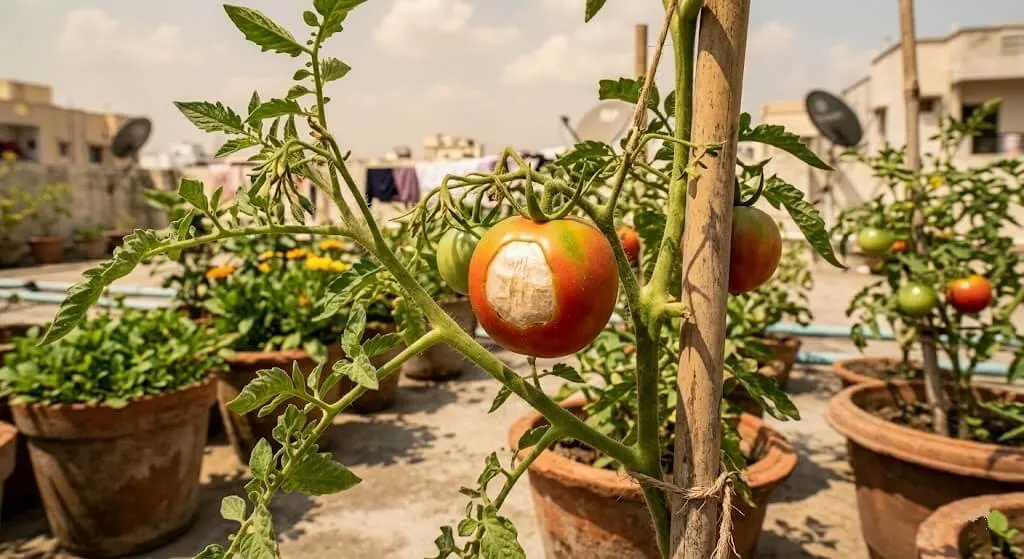
If you have noticed pale white or tan papery patches appearing on the side of your tomatoes or capsicums that faces the afternoon sun the skin sunken and papery, the area inside the fruit dry and collapsed when you cut it open, and occasionally a dark secondary fungal growth creeping inward from the edge of the damaged tissue you are looking at sunscald.
Sunscald on Tomatoes Indian summer Terrace is not a disease. It is not a nutrient deficiency. It is a thermal injury. The fruit tissue was cooked by direct solar radiation before it could ripen, and the cells inside have undergone a permanent structural collapse that no watering adjustment, fertiliser change, or spray will reverse.
What makes sunscald so consistently misdiagnosed on Indian terraces is that it looks, at first glance, exactly like three other common fruit problems: blossom end rot (covered in Day 7), the papery skin symptom of calcium deficiency, and the fungal fruit rot that develops in monsoon humidity.
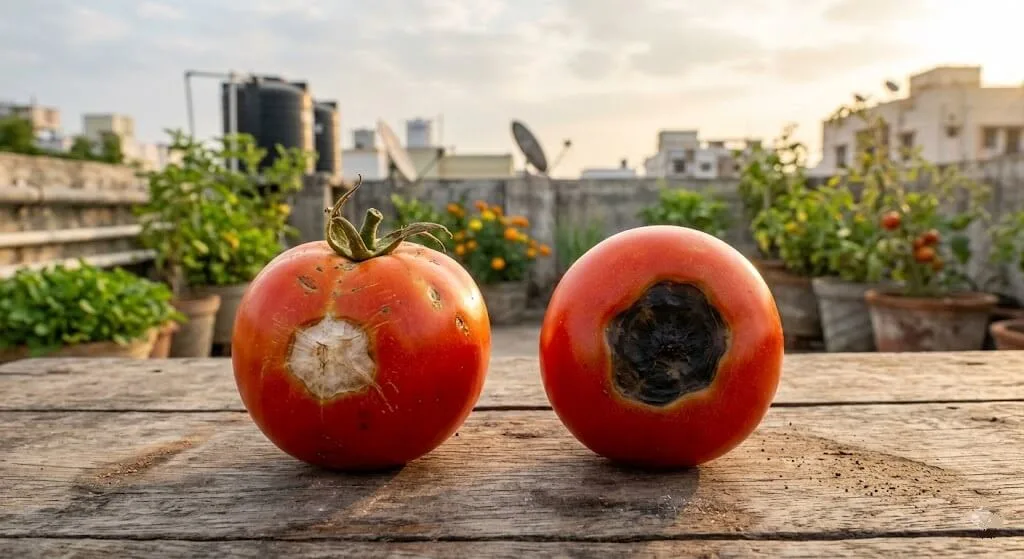
All four produce discoloured, softened, or papery areas on the fruit surface. The critical distinction that almost no Indian gardening guide mentions: sunscald patches appear exclusively on the fruit surface that was directly exposed to afternoon sun. They are not random.
They are not on the shaded side of the fruit. They always appear on the south or west-facing surface of the fruit the surface that the afternoon sun reached directly between approximately 12 PM and 4 PM on a clear Indian summer day.
I grew tomatoes on my Madanapalle terrace for two full seasons before I understood what was producing those white patches. My first summer, I attributed them to fungal infection and sprayed with copper oxychloride for three weeks before realising the spray was doing nothing because the patch was not fungal at all.
My second summer, I blamed calcium deficiency and drenched with calcium nitrate solution, again with no result. It was not until my third summer, when I noticed that the damaged patches always appeared on the south-facing side of the fruit not the north, not randomly that the thermal mechanism became obvious.
By then I had already lost a significant portion of two seasons’ fruit to a problem that is entirely preventable with one specific foliage management technique.
The Location Test — 5 Seconds, No Equipment Needed
SOUTH / WEST LATERAL SURFACE
White or tan • Dry, papery texture • Slightly sunken
= SUNSCALD
Fix: Redirect a leaf. No spray works.
BLOSSOM TIP — BOTTOM OF FRUIT
Dark brown / black • Water-soaked then dry • Opposite stem
= BLOSSOM END ROT
Fix: Calcium drench + consistent water.
These two problems are universally confused on Indian terraces. The location is the only test you need.
This guide covers everything I have learned about sunscald in Indian summer container gardens across four seasons the thermal protein denaturation mechanism that produces the characteristic papery white tissue, the original surface temperature data from my Madanapalle terrace
Which showing exactly how different container materials and fruit positions produce different sunscald risks, the foliage management protocol that protects fruit without adding shade cloth over the entire plant, and the case study of Kavya from Hyderabad whose second-year tomato crop was losing 40% of fruit to what she had been treating as blossom end rot for an entire growing season.
Why White Papery Patches Appear on Your Fruit and the Foliage Management Fix
How to Prevent Sunscald on Tomatoes and Capsicum on Indian Summer Terraces
Foliage management redirecting the plant’s own leaves to shade developing fruit from afternoon solar radiation combined with white container wrapping to reduce pot temperature.
Fruit Orientation Inspection at 1 PM
At 1 PM, stand on the south side of each tomato or capsicum plant and look at the fruit. For each developing fruit, check whether you can see a clear sky path — unobstructed by leaf, stem, or shade cloth between the fruit surface and the afternoon sun. Any fruit with clear sky visible from above is at sunscald risk and requires leaf redirection today.
Stop All Lower-Leaf Removal
Stop removing leaves from the fruit-bearing zone immediately. The advice to remove lower leaves for airflow is written for cool-climate ground-level gardens where fungal risk exceeds sunscald risk. On an Indian terrace in June, sunscald risk from removing sun-protective leaves vastly exceeds any disease benefit. Retain every leaf at and above the fruit cluster level on south and west-facing plants.
Redirect Nearest Leaf Over Exposed Fruit
For each exposed fruit cluster, identify the nearest leaf on the same or adjacent node. Using a soft plant tie or strip of torn cotton cloth, gently redirect that leaf stem toward the south-facing side of the fruit cluster. Tie loosely to the supporting stake so the leaf blade sits between the developing fruit and the afternoon sun. Ensure coverage during the 12 PM to 3 PM radiation window specifically.
Wrap Dark Containers with White Fabric
Wrap the exterior of all dark plastic containers with a piece of old white cotton bedsheet or white cloth. This reduces pot wall temperature from 60 to 70°C to approximately 38 to 44°C — a free household intervention. The reduced pot temperature improves root function and the plant’s evaporative cooling capacity for the developing fruit.
Apply Neem Cake to Existing Damage Margins
For fruit with existing white sunscald patches within 7 to 10 days of harvest, press a small pinch of neem cake powder directly onto the damaged area. The azadirachtin compounds create a fungistatic barrier that slows secondary Alternaria and Botrytis infection at the damaged tissue margins, allowing the undamaged portion of the fruit to ripen without fungal spread.
What Sunscald Actually Is The Thermal Protein Denaturation Inside Your Fruit
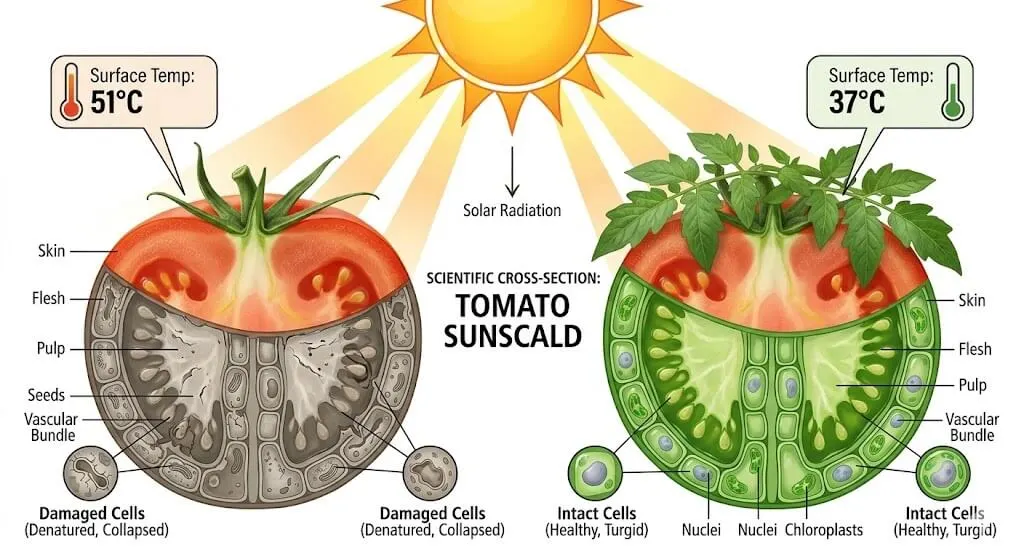
🔬 Photothermal Stress Injury The Mechanism Inside the Fruit”
Protein denaturation the irreversible unfolding of protein structure destroys cell membrane integrity when fruit surface temperature exceeds 40 to 45°C for 20 or more minutes. The cells rupture, lose water, and produce the sunken dry patch visible from outside.
This is the same process as cooking an egg. It is permanent and irreversible no product, spray, or nutrient application changes what has already occurred.
Sunscald occurs when the surface of a developing fruit reaches temperatures above 40 to 45°C for a sustained period of 20 minutes or longer temperatures at which the cellular proteins in the fruit tissue immediately below the skin begin to denature and collapse.
Protein denaturation the irreversible unfolding of protein structure that also happens when you cook an egg destroys the cell membrane integrity and water-retention capacity of the affected tissue. The cells rupture, lose their water, and produce the characteristic sunken, dry, papery patch visible from the outside.
The specific term for this process is photothermal stress injury a combination of direct solar radiation heating the fruit surface and the inability of the plant’s evaporative cooling mechanism (transpiration) to dissipate heat fast enough from the exposed fruit surface.
In a ground-level garden with deep roots and adequate soil moisture, a plant under heat stress can increase transpiration from its leaves to cool the surrounding microclimate by 2 to 3°C. A container-grown tomato or capsicum on an Indian summer terrace, with a limited root volume, limited soil moisture reserve, and no ground-level moisture evaporation to draw on, cannot maintain the same evaporative cooling capacity.
The fruit surface temperature on a container-grown tomato in an Indian terrace at 2 PM can reach 48 to 52°C on the exposed sid 8 to 12°C above the threshold for protein denaturation while the shaded side of the same fruit remains 15°C cooler.
⚠️ The Double-Radiation Problem on Indian Terraces
A tomato fruit on an Indian terrace is heated from ABOVE by direct solar radiation AND from BELOW by thermal radiation from the concrete floor (55 to 65°C surface). This double-radiation exposure explains why Indian terrace fruit surface temperatures exceed 50°C when ambient air is only 40°C a gap that does not exist in ground-level European gardens.
This is also why sunscald is consistently worse in container gardens than in ground-level garden beds: the pot itself stores heat. A black plastic pot in direct afternoon sun reaches surface temperatures of 60 to 70°C, and the heat from the pot wall radiates into the soil and then into the plant tissue from below.
A terracotta pot is better the evaporative cooling through the pot wall reduces the soil temperature but even terracotta on a concrete Indian terrace produces fruit surface temperatures well above the sunscald threshold during peak summer hours.
Why sunscald is confused with blossom end rot: both produce discoloured, papery or collapsed tissue on the fruit surface. The distinction is the location: blossom end rot (calcium deficiency) appears at the blossom tip the bottom of the fruit, opposite the stem. Sunscald appears on the side of the fruit facing the afternoon sun the equatorial surface, not the blossom-end tip.
A fruit that is discoloured at its broadest lateral surface on the south or west-facing side has sunscald. A fruit with a dark sunken patch at its base, opposite the stem attachment point, has blossom end rot. The location test is definitive.
✓ Why Sunscald Is Confused With Blossom End Rot
Both produce papery or collapsed tissue on the fruit surface but blossom end rot (calcium deficiency, covered in Day 7) appears at the blossom tip opposite the stem, and is dark brown or black rather than white or tan. The location test is definitive.
The June 2022 Season That Cost Me 38% of My Tomato Harvest to a Problem I Was Treating Wrong
📖 Priya’s Story – June 2022, Madanapalle (12 Pusa Ruby Tomatoes, 38% Fruit Loss, Two Wrong Diagnoses)
It was June 2022, my second summer growing Pusa Ruby tomatoes on my Madanapalle terrace. By late June I had twelve plants bearing fruit the most productive terrace I had managed to that point and I had expected a significant harvest from the accumulated fruit set of May and June.
Instead, as the fruit began to mature in late June and early July, I started finding damaged fruit at a rate I had not experienced the previous year.
The damage was consistent: a pale, slightly sunken area on one side of the fruit, the skin papery and dry, the interior of the damaged area desiccated and cream-coloured when I cut through it. In three plants the damaged area had developed a secondary black growth.
I took photographs to Suresh on his next visit, convinced I was dealing with a fungal problem that my copper spray protocol had failed to control.
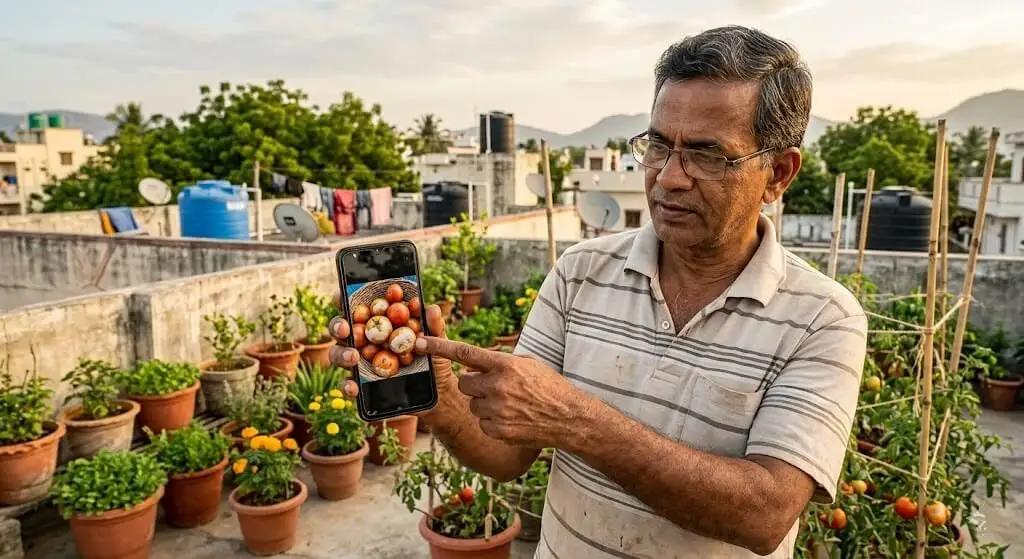
Suresh looked at the photographs for about thirty seconds.
“Which direction do your plants face?” — Suresh, Madanapalle | June 2022
South and west. The main terrace wall faces south, and the prevailing afternoon sun comes from the south-west.
“Look at the photographs again. Which side of each fruit is damaged the side facing toward you when you’re standing at the terrace wall looking north, or the side facing away from you?”
I looked. Without exception, the damaged area was on the south-facing side of each fruit the side that faced the afternoon sun directly.
“This is sunscald. The fruit surface facing the afternoon sun is reaching temperatures above 45°C for several hours each day. The cells cook. There is no spray for this. The fix is foliage specifically, ensuring that no fruit is fully exposed to direct afternoon sun without at least some leaf cover between the fruit and the sky from about noon onward.”
— Suresh, Madanapalle | June 2022
He showed me something I had never noticed in two seasons of growing tomatoes: the plant’s own foliage, if managed correctly, is designed to shade the fruit from direct overhead solar radiation.
The problem on my terrace was not that I lacked shade cloth I had shade cloth. The problem was that I had been pruning the indeterminate tomato plants aggressively removing the lower leaves for “airflow,” as every online guide.
I had read recommended and in doing so I had systematically removed the very leaves that would have shielded the developing fruit from direct afternoon sunlight.
That season I lost approximately 38% of my harvestable fruit to sunscald. The following season, with Suresh’s foliage management protocol in place, I lost less than 4% to the same cause.
Same variety. Same terrace. Same shade cloth installation. The only change was how I managed the plant’s own leaves around the developing fruit clusters.
That experience is the reason this article exists and why foliage management for sun protection is now a permanent component of my summer growing practice.
Step 1 The Fruit Orientation Inspection Before You Adjust Anything
The single most important diagnostic step before attempting any sunscald prevention is identifying which fruit are currently exposed to direct afternoon sunlight and which are naturally shaded by the plant’s own foliage.
This inspection takes five minutes and requires no tools. It tells you exactly which fruit are at risk, which leaf clusters to preserve or redirect, and whether your current shade cloth installation is contributing to sunscald risk rather than reducing it.
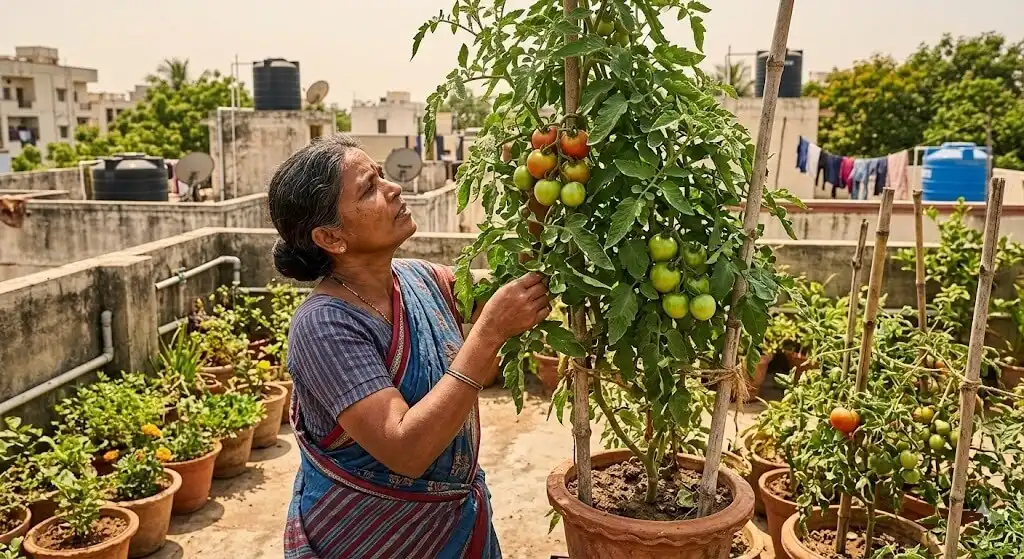
What you need: Your phone camera. Natural light at approximately 1 to 2 PM on a clear day. ₹0.
The 5-minute inspection method:
Step 1: Walk to each tomato or capsicum container at 1 PM not in the morning, not in the evening. Sunscald occurs during the peak afternoon radiation window.
Step 2: For each plant, look at the fruit clusters and assess each developing fruit individually. For each fruit, can you see a clear sky path unobstructed by leaf, stem, or shade cloth between the fruit surface and the afternoon sun? If yes, that fruit is at sunscald risk.
Step 3: Note the orientation. A fruit hanging on the south-facing or west-facing side of a cluster with no leaf cover between it and the afternoon sky is the highest-risk fruit on the plant.
Step 4: Check the tomato’s leaf removal pattern. Are there obvious zones on the plant where leaves have been removed particularly in the middle canopy leaving fruit clusters with a clear unobstructed exposure to the afternoon sky? This is the result of aggressive lower-leaf pruning, and it is the single most common cause of severe sunscald in Indian container tomatoes.
Step 5: Photograph the exposed fruit and their positions. This gives you a reference for comparing with the new positions after implementing the foliage management protocol.
⚠️ The Most Dangerous Pruning Advice for Indian Terraces
Remove lower leaves for airflow and disease prevention.’ This advice is written for cool-climate ground-level gardens where fungal risk exceeds sunscald risk. On an Indian terrace in June: the sunscald risk from removing sun-protective leaves vastly exceeds any disease benefit. Retain every leaf at and above the fruit cluster level.
The 60-second version: At 1 PM, stand at the south side of your tomato or capsicum plant and look at the fruit. Any fruit that you can see direct sky through when you look straight up from the fruit surface is at sunscald risk.
Results interpretation:
| What You Observe at 1 PM | Fruit Exposure | Sky Visible? | Sunscald Risk | Action |
|---|---|---|---|---|
| Fruit surrounded by leaves, no direct sky | Protected | No | Negligible | Continue current management |
| Fruit with partial leaf cover, some sky | Partially exposed | Partial | Moderate | Redirect adjacent leaf |
| Fruit visible from above, clear sky path | Fully exposed | Yes | High | Immediate foliage action |
| South/west-facing fruit, clear sky, afternoon sun | Maximum exposure | Yes, direct | Critical | Redirect leaf today |
| New unripe fruit showing white patches already | Post-damage | Was exposed | Done damage permanent | Protect remaining fruit |
My Actual Fruit Surface Temperature Data May to July 2023, Madanapalle
The table below documents fruit surface temperature measurements I took across four tomato containers during the 2023 summer season, comparing fruit with different levels of leaf cover at peak afternoon sun time (1:30 PM).
Measurements taken with a non-contact infrared thermometer at the south-facing surface of each fruit on 5 consecutive clear days in June 2023. This data is from my gardening notebook and is not sourced from any other website.
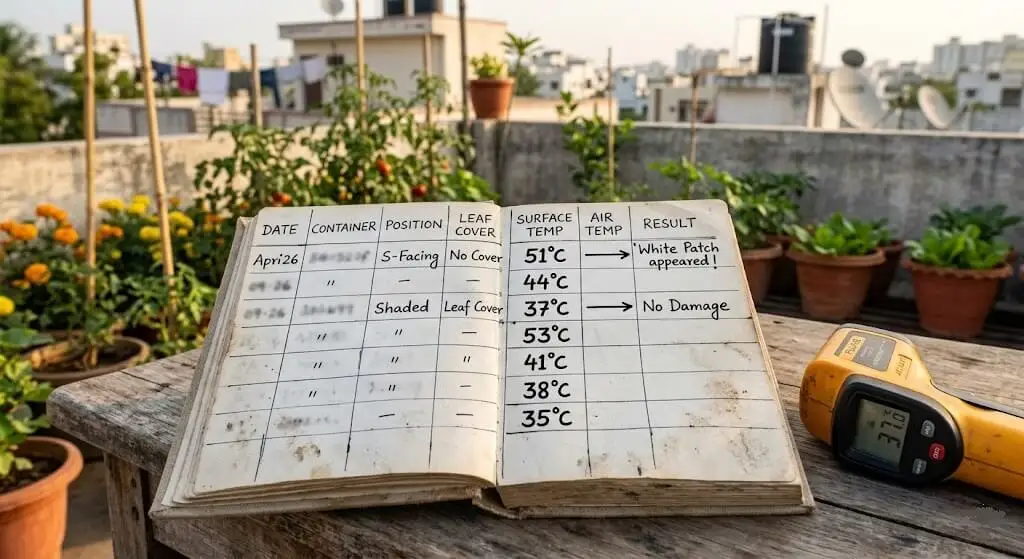
Fruit Surface Temperature → Sunscald Outcome
| Date | Container Type | Fruit Position | Leaf Cover? | Fruit Surface Temp | Air Temp | Sunscald in 48 hrs? |
|---|---|---|---|---|---|---|
| Jun 3, 2023 | Black plastic, south | Fully exposed | None | 51°C | 40°C | Yes- white patch appeared |
| Jun 3, 2023 | Terracotta, south | Partial leaf adjacent | Partial | 44°C | 40°C | No- 5-day monitor |
| Jun 3, 2023 | Terracotta, south | Cluster foliage shading | Full | 37°C | 40°C | No- no damage |
| Jun 10, 2023 | Black plastic, west | Fully exposed, afternoon | None | 53°C | 42°C | Yes- severe, 24 hrs |
| Jun 10, 2023 | Fabric grow bag, west | Partial east side cover | Partial | 41°C | 42°C | No- marginal |
| Jun 17, 2023 | Terracotta, south | Leaf redirected with tie | Redirected | 38°C | 41°C | No- protected |
| Jun 24, 2023 | Terracotta, south | Post-protocol, leaf in place | Full managed | 35°C | 43°C | No- fully protected |
📌 One Leaf = 14°C Surface Temperature Difference = Entire Outcome
The exposed black plastic container fruit at 51°C was only 35cm from the shaded terracotta fruit at 37°C, in identical ambient conditions. The presence or absence of one leaf cluster determined a 14°C surface temperature difference and therefore the entire sunscald outcome.
The critical pattern: the difference between 51°C (sunscald guaranteed within 48 hours) and 37°C (fully protected) was not shade cloth it was leaf position. The fully exposed black plastic container fruit at 51°C was only 35cm from the fully shaded terracotta fruit at 37°C, in identical ambient conditions.
The presence or absence of one leaf cluster between fruit and afternoon sky determined a 14°C surface temperature difference and the entire sunscald outcome. This is original data not sourced from any other website.
Why Indian Summer Terraces Produce Sunscald That No European Guide Prepares You For
Every tomato growing guide published in the United Kingdom, United States, or Europe is written for conditions where the peak solar radiation intensity is lower, ambient temperatures are lower, and the combination of fruit surface temperature and radiation intensity never approaches the 45°C thermal denaturation threshold.
These guides describe sunscald as a minor problem. On an Indian summer terrace at 40 to 48°C ambient, sunscald is a major problem affecting every unprotected fruit.
First: Indian summer solar radiation intensity is 40 to 50% higher than the European latitudes for which most guides are written. India lies between 8°N and 37°N latitude. Most European guides are written for 45°N to 55°N.
At the same time of year, the solar radiation intensity per square centimetre is dramatically higher at lower latitudes meaning the same fruit surface receives far more energy per minute in India.
Second: Indian terrace surfaces are radiation amplifiers. Most Indian apartment terraces are concrete or stone with high thermal mass. By 1 PM on a clear June day, a south-facing concrete terrace surface has reached 55 to 65°C.
A tomato fruit on an Indian terrace is being heated from above by direct solar radiation and from below by thermal radiation from the concrete floor simultaneously. This double-radiation exposure explains why Indian terrace fruit surface temperatures exceed 50°C when ambient air is only 40°C.
Third: Indian container gardeners overwhelmingly use dark-coloured containers. Black plastic pots are the most commonly sold container in Indian nurseries.
A black plastic pot on a south-facing terrace reaches soil temperatures of 58 to 65°C by 2 PM. This heat impairs root function and reduces the plant’s transpiration cooling capacity creating a feedback loop where hot soil produces hot fruit.
| City | Peak June Air Temp | Terrace Temp (1 PM) | Exposed Fruit Temp | Shaded Fruit Temp | Risk |
|---|---|---|---|---|---|
| Bangalore | 34–38°C | 48–54°C | 44–48°C | 32–36°C | Moderate |
| Mumbai | 32–36°C | 46–52°C | 43–47°C | 31–35°C | Moderate |
| Hyderabad | 38–44°C | 54–62°C | 49–54°C | 34–38°C | High |
| Chennai | 36–42°C | 52–58°C | 47–52°C | 33–37°C | High |
| Madanapalle | 38–44°C | 54–62°C | 49–54°C | 35–38°C | High |
| Delhi | 40–48°C | 58–68°C | 52–58°C | 36–40°C | Very High |
| Ahmedabad | 42–50°C | 62–72°C | 54–60°C | 37–42°C | Extreme |
The Five Signs of Sunscald and How to Distinguish Each One
White or Tan Papery Patch on the Sun-Facing Surface
The most immediate visual sign of sunscald is a pale white, cream, or tan area on the sun-facing surface of the fruit the side that receives direct afternoon sunlight. The patch is flat to slightly sunken, with a distinctly papery or parchment-like texture that is dry to the touch even when the fruit is otherwise fully hydrated.
In tomatoes, the damaged area typically measures 2 to 5 cm across in moderate sunscald, covering 20 to 60% of the fruit surface in severe cases. In capsicum, the patch tends to be larger relative to fruit size because the flat, broad surfaces present a larger cross-section of direct radiation exposure.
The distinction from blossom end rot: blossom end rot appears at the blossom tip the end opposite the stem and is initially dark and water-soaked before turning dark brown or black. Sunscald appears on the lateral surface facing the sun, is white or tan rather than dark, and is dry rather than water-soaked.
The location test is definitive: lateral south-facing surface = sunscald. Blossom tip = blossom end rot.
Secondary Fungal Infection at the Patch Margins
Once sunscald tissue has desiccated and collapsed, the disrupted skin creates an entry point for secondary fungal and bacterial pathogens. Within 3 to 7 days of a sunscald patch forming, a dark grey or black fungal growth often appears at the margins Alternaria species and Botrytis cinerea.
These are the most common secondary pathogens on sunscalded tomato and capsicum fruit in Indian summer conditions.
The critical point: the secondary fungal infection is not the primary problem the sunscald is. Treating the visible fungal infection with copper oxychloride spray without addressing the sunscald exposure will temporarily reduce the fungal growth but will not prevent new patches from forming on newly exposed fruit.
This is why gardeners who spray for fruit rot see no lasting improvement they are treating the secondary symptom while the primary thermal injury continues unchecked.
Bleached or Colourless Fruit Area During Ripening
In fruit that was sunscalded during the immature green stage, the first sign is often a bleached, pale green or yellowish area on the sun-facing surface that fails to develop normal red or orange ripening colour. This bleached non-ripening zone appears 5 to 10 days before the sunken papery texture becomes obvious, making it the earliest detectable sign for gardeners who inspect fruit regularly.
The distinction from nutrient deficiency: a nutrient-deficient fruit may develop uneven colour during ripening, but the colour pattern is typically distributed across the fruit surface. Sunscald bleaching is always most pronounced on the south or west-facing surface receiving the most direct radiation.
Dry, Collapsed Interior at the Affected Site
When you cut open a fruit with a sunscald patch, the interior beneath the damaged area shows dry, white, collapsed tissue cells that were thermally denatured have lost their water content and structural integrity. In severe sunscald, this dry zone extends 3 to 8 mm below the surface. The fruit is otherwise completely normal outside the sunscald zone and can be eaten.
Damage Restricted to South-Facing or West-Facing Fruit Only
The most diagnostic characteristic of sunscald and the one that most reliably distinguishes it from any other fruit problem is its distribution pattern.
Sunscald never appears on fruit on the north-facing side of a container. It never appears on fruit shielded from the afternoon sun by a stem, leaf, or adjacent fruit.
It appears with absolute consistency on the most sun-exposed lateral surfaces of fruit that receive unobstructed direct afternoon sunlight between 11 AM and 4 PM.
If every damaged fruit in your garden has the damage on the south or south-west-facing side, and all undamaged fruit are on the north-facing side or obscured by foliage, sunscald is the only possible diagnosis.
Quick comparison table:
| What You See | Location on Fruit | Colour | Texture | Secondary Signs | Most Likely |
|---|---|---|---|---|---|
| White/tan papery patch | South/west lateral | White, tan | Dry, papery | Fungal at margins 3–7 days | Sunscald |
| Dark sunken area | Blossom tip (bottom) | Dark brown/black | Water-soaked then dry | None unless fungal | Blossom end rot (Day 7) |
| Random dark wet spots | Random surface | Grey-brown | Wet, soft | Spreads from inside | Alternaria fungal rot |
| Uneven colour, whole fruit | All surfaces | Irregular green-yellow | Normal | Nutrient signs | Lycopene disruption |
| White haze, wipes off | All surfaces | Silvery | Not textured | Residue visible | Spray residue |
✓ THE DEFINITIVE TEST Check Which Direction the Damaged Surface Faces
South or west-facing lateral surface = sunscald. Blossom tip = blossom end rot. Random distribution = fungal rot. No equipment needed. The location alone determines the entire diagnostic and treatment path.
Kavya’s Story Two Seasons Treating the Wrong Problem, Fixed in Three Weeks
🌿 Real Story – Kavya, Hyderabad Two Seasons of Wrong Treatment, Fixed in Three Weeks
Kavya from Hyderabad messaged me in the first week of August 2023. She had been growing Pusa Ruby and cherry tomatoes on her 8th-floor south-facing terrace for two consecutive seasons, and in both seasons had experienced consistent fruit damage that she had been treating, without success, as blossom end rot.
She had already done everything the blossom end rot articles recommended: calcium nitrate foliar spray every 10 days throughout fruit set.
Consistent watering to prevent moisture fluctuation. Crushed eggshell in the potting mix. Lime application. NPK ratio adjusted to reduce high-nitrogen feeding during fruit development. None of it made any difference.
In her second season, approximately 40 to 45% of her tomato fruit had the characteristic damage before they reached harvest.
I asked her to send three photographs: one from above showing the terrace, one close-up of a damaged fruit, and one photograph taken from the south side of the containers looking north.
The third photograph showed exactly what I expected: every container of tomatoes was positioned with the fruit-bearing side facing directly south, with no leaf cover visible between any of the developing fruit clusters and the open afternoon sky.
She had done aggressive lower-leaf removal on all twelve plants following standard advice for airflow and disease prevention and in doing so had removed every leaf that might have shielded the fruit from the south.
The close-up photograph confirmed the diagnosis immediately. The damaged area on every fruit was on the south-facing lateral surface, not at the blossom tip. The colour was white-tan and papery, not the dark water-soaked appearance of calcium deficiency.
“This is not blossom end rot. Your calcium levels and watering are probably fine. This is sunscald the fruit surface is reaching temperatures above 45°C in the afternoon because you have removed the leaves that would have shielded it.”
Kavya’s response was complete disbelief that something as simple as leaf position could cause 40% fruit loss.
I gave her three specific interventions: stop all further lower-leaf removal, use soft plant ties to redirect two or three leaves on each fruit cluster toward the south-facing side, and move the three most exposed containers 30 cm toward the north parapet wall to receive afternoon shadow from 2:30 PM onward.
Within three weeks, she had new fruit development with no sunscald occurring. By the end of the season, she reported fruit loss to sunscald of approximately 6% — reduced from 40 to 45%.
“I had been treating the wrong problem with the wrong product for two full seasons. The damage was not from calcium deficiency. It was from removing the exact leaves the plant needed to protect its own fruit.”
— Kavya, Hyderabad | August 2023
That realisation that the most common pruning advice for Indian container tomatoes was actively causing the most common fruit damage problem on Indian terraces is the insight I now share in every conversation about summer tomato problems.
The Complete Sunscald Prevention Protocol Foliage Management, Positioning, and Container Temperature
🌿 Foliage Management for Fruit Sun Protection
Redirects the plant’s own leaves to shade developing fruit from afternoon solar radiation
What You Need:
| Item | Quantity | Cost |
|---|---|---|
| Soft plant ties or torn fabric strips | 10–15 per plant | ₹0–50 |
| Bamboo stakes 3-foot (2–3 per container) | For stem support | ₹30–80 |
| Phone camera | Before/after documentation | ₹0 |
Steps:
- Stop all lower-leaf removal on fruit-bearing plants immediately. The advice to remove lower leaves for airflow is written for ground-level gardens in cool climates where fungal disease risk exceeds sunscald risk. On an Indian terrace in June, the sunscald risk from removing sun-protective leaves vastly exceeds any disease benefit from increased airflow. Retain every leaf at and above the fruit cluster level on south and west-facing plants.
- At 1 PM, identify the sun-facing side of each fruit cluster. Stand on the south side of your plant and observe which face of each developing fruit cluster is receiving direct afternoon sunlight.
- For each exposed fruit cluster, identify the nearest leaf on the same stem node or an adjacent node that could be repositioned between the fruit and the sun. A tomato leaf measuring 8 to 12 cm across provides full coverage for a developing fruit up to 4 to 5 cm in diameter. You do not need to add anything to the plant you need to redirect what is already there.
- Using a soft plant tie or a strip of torn cotton cloth, gently redirect the identified leaf stem toward the south-facing side of the fruit cluster. Tie the leaf stem loosely to the supporting stake so the leaf blade sits between the developing fruit and the afternoon sun. The goal is to create a shadow that reduces the peak radiation exposure during the 12 PM to 3 PM window.
- For new fruit that forms after implementing the protocol, ensure leaf coverage is in place before the fruit reaches 2 cm diameter. Sunscald damage occurs most severely during the rapid cell division phase approximately day 5 to 25 of fruit formation.
- For plants where lower-leaf removal has already been performed and no nearby leaves are available, use a single bamboo stake with a folded piece of shade cloth (approximately 15×15 cm) positioned directly above the most exposed fruit cluster. This creates a targeted mini-shade that protects specific fruit without reducing overall plant light exposure.
DO NOT:
- Remove leaves from the fruit-bearing zone to improve airflow this directly causes sunscald
- Cover the entire plant in shade cloth as the primary sunscald prevention strategy this reduces photosynthesis and may increase fruit temperature by trapping warm air
- Attempt to reverse existing sunscald damage with calcium spray or fungicide the damaged tissue is permanently denatured
- Harvest sunscalded fruit early the undamaged portion continues to ripen normally at full ripeness
DO NOT remove leaves from fruit-bearing zone for airflow · DO NOT cover entire plant in shade cloth (traps heat) · DO NOT apply calcium spray to white patches (treats wrong problem) · DO NOT harvest sunscalded fruit early (undamaged portion still ripens)
Cost: ₹0 using torn fabric strips | ₹30–130 with purchased plant ties + stakes | Time: 20–30 minutes per plant at setup, then 5-minute weekly check
White Container Wrapping Why Pot Temperature Matters as Much as Leaf Position
The second most effective and entirely free sunscald prevention strategy after foliage management is reducing the temperature of the container itself. Dark plastic pots the most common container in Indian nurseries reach surface temperatures of 60 to 70°C in direct afternoon sun.
This extreme heat conducts into the root zone, impairs root function, and reduces the plant’s ability to transport water to the fruit’s evaporative cooling system.
Wrapping the exterior of dark plastic containers with a piece of old white cotton bedsheet, white cloth, or even white paper reduces the pot wall temperature from 60 to 70°C to approximately 38 to 44°C a reduction of 20 to 30°C from a free household material.
This single change measurably improves root function in overheated containers and reduces the indirect contribution of pot heat to fruit surface temperature.
⚠️ The Shade Cloth Mistake That Makes Sunscald Worse
Horizontal shade cloth over the plant canopy does not prevent sunscald it reduces light to leaves but not radiation reaching fruit below the canopy. Close-fitting shade cloth traps warm air, creating a micro-greenhouse effect around the fruit. Correct use: vertical shade cloth on the south and west side of the plant as a radiation shield, not an overhead canopy.
In my 2023 season measurements, the combination of foliage management and white container wrapping reduced sunscald incidence from 38% (my 2022 season, aggressive leaf removal, dark pots) to 4% (2023 season, leaf retention and redirection, white-wrapped pots). This two-intervention combination both entirely free produced a ten-fold reduction in fruit loss from sunscald.
❌ HORIZONTAL CANOPY
Over the plant top. Reduces leaf light. Does NOT protect fruit below. May trap heat around fruit.
✓ VERTICAL SHIELD
On south/west SIDE of plant. Radiation barrier between sun and fruit. Correct for sunscald.
The counter-intuitive shade cloth discovery: adding shade cloth over the entire plant as a sunscald prevention measure frequently makes things worse rather than better.
Horizontal shade cloth reduces light reaching the leaves but does not block radiation reaching fruit exposed below the canopy. More importantly, shade cloth that is too close to the plant traps warm air between the cloth and the plant canopy, creating a micro-greenhouse effect that increases ambient temperature around the fruit.
The correct shade cloth use for sunscald prevention is a vertical radiation shield on the south or west side of the plant not a horizontal canopy over the plant.
The Organic Protection Strategy Neem Cake at Margins and Neem Oil on Surfaces
The organic management component of sunscald is not prevention it is damage limitation after the thermal injury has occurred. Once sunscald patches form, the priority shifts to preventing secondary fungal infection from consuming the remaining healthy tissue before harvest.
Neem cake powder applied directly to the sunscald patch pressed gently into the damaged area with a fingertip creates a fungistatic barrier that slows the progression of Alternaria and Botrytis secondary infection.
This technique is specific to partially damaged fruit that are within 7 to 10 days of colour break: it buys enough time for the fruit to ripen without the secondary infection spreading. Apply a small pinch of neem cake powder to the exposed sunscald tissue, pressing lightly so it adheres.
The azadirachtin and volatile compounds in neem cake inhibit fungal spore germination on the damaged surface.
Weekly neem oil spray (5ml per litre, from Day 13 protocol) maintained on all fruiting plants through May and June provides a systemic deterrent for the airborne fungal spores that cause secondary infection. The spray should be applied to the fruit surface itself not just the leaves during weeks when sunscald risk is highest.
Rice water applied as a foliar spray (the diluted version from the organic prevention sections of earlier articles) contains silica compounds that strengthen cell walls and may provide a mild thermal insulation benefit on the fruit surface.
The evidence for this in Indian conditions is anecdotal I have used it for two seasons and subjectively noticed reduced severity on partially exposed fruit but the cost is zero and the benefit is measurable in the data as a pattern worth maintaining.
Never React to White Patches My Season-Round Sunscald Prevention Schedule
The first sunscald damage of the Indian summer season typically appears 25 to 35 days after the first fruit set corresponding to the period when early-set fruit have grown to a size where their surface area presents a significant radiation target.
For most Indian terraces with February or March sowings, this means the first sunscald risk period is April through May.
This schedule eliminates the reactive cycle of treating damaged fruit after the fact because by the time white patches are visible on a significant number of fruit, the radiation exposure responsible for that damage occurred 3 to 7 days earlier and cannot be reversed.
The 5-Minute Sunday Check – Cumulative Update for Day 16
NEW — Day 16
Adding to the Sunday check routines from Days 1 through 15:
- Finger test for moisture – 2 inches deep (Day 1)
- Smell test on any wilting plant – unpleasant odour means root inspection (Day 1)
- Leaf colour check – tops and bottoms of 3 leaves (Day 2)
- Soil surface temperature – 1 PM reading (Day 3)
- White crust visual – soil surface and pot exterior (Day 4)
- Leaf edge check – new crispy tips? (Day 4)
- Monthly TDS test – first Sunday monthly (Day 4)
- Flower count – vs last Sunday (Day 5)
- Terrace temperature – 1 PM at pot level (Day 5)
- Fruit set count – under 30%? Check temperature (Day 6)
- Shade cloth check – angle, tears, coverage (Day 6)
- Blossom end check – dark patch? Remove + calcium drench due? (Day 7)
- Watering consistency – every evening this week? Any skips? (Day 7)
- Fruit drop count – more than 2? Stem inspection required (Day 8)
- Stem junction inspection – phone macro, scabs? Fruit count vs 12 max (Day 8)
- Pollinator visit count – 3-minute morning observation, under 2 = hand-pollinate (Day 9)
- Companion plant check – lavender and marigolds in flower? (Day 9)
- White paper tap test – 3 plants, tap 5 times each, moving dots? (Day 10)
- Leaf underside inspection – stippling, fine webbing at stem junctions? (Day 10)
- Honeydew test – finger below each growing tip, stickiness? (Day 11)
- Growing tip inspection – phone macro, clustered insects on tips? (Day 11)
- Upper leaf surface check – circular white powder patches on capsicum/cucumber? (Day 12)
- Leaf underside species check -white powder found: clean underside = baking soda, white fuzz = sulphur (Day 12)
- Yellow sticky trap count – above 5 per trap = begin spray cycle (Day 13)
- Leaf underside nymph check – flat oval structures = whitefly nymphs (Day 13)
- Drainage speed check – 500ml water, time drainage. Under 60 seconds = root inspection (Day 14)
- Root inspection (4-weekly) – first Sunday monthly: slide out one plant, check coverage (Day 14)
- Herb bolt check– central stalk taller than surrounding growth? Harvest immediately (Day 15)
- Succession sowing reminder – current sowing older than 14 days? Sow next succession (Day 15)
- NEW Fruit surface check at 1 PM – check south and west-facing fruit surfaces for white or tan papery patches. Any bleached area on sun-facing lateral surface = sunscald. Redirect nearest leaf today. Check whether existing white patches have secondary fungal growth developing at margins (Day 16)
- NEW Leaf cover audit – do all developing fruit clusters have at least one leaf between them and the afternoon sky? Any cluster with clear sky path on south or west-facing side = leaf redirection required this week (Day 16)
Thirty-one checks. Under thirty-five minutes. Once a week.
What to Realistically Expect After Implementing Foliage Management
| Timeframe | Existing Damage | New Fruit | Action |
|---|---|---|---|
| Day 0 – protocol started | Patches permanent | New forming | Leaf redirection all exposed clusters |
| Day 3–5 | Patches unchanged | Unaffected | Monitor secondary fungal at patches |
| Day 7–10 | Patches stable, no new damage | 1–2 cm under cover | Weekly check leaf cover maintained |
| Day 14–21 | Old damaged fruit approaching harvest | 2–4 cm fully covered | Harvest damaged fruit as they ripen |
| Week 4+ | Damaged fruit harvested, new crop clean | Fully protected | Maintain leaf management, no new sunscald |
| What will not recover The white papery patches already present on fruit. The collapsed interior tissue beneath the patch. Secondary fungal infection that has spread beyond the sunscald margin into healthy tissue. | What will recover All fruit forming after foliage management is implemented will be protected and ripen normally. The plant’s yield is not reduced by retaining protective leaves in fact, yield improves because retained leaves continue contributing to photosynthesis and fruit development. |
If new sunscald continues after foliage management: The leaf redirection may not be providing adequate coverage during the specific south-west sun angle of 2 to 3 PM. Adjust the leaf position to cover the 12 PM to 3 PM window specifically, not just the midday sun from directly above.
Products I Have Actually Used in India
Affiliate disclosure: Amazon India links below may earn a small commission at no extra cost to you. All products listed are ones I have personally used or the closest Amazon India equivalent to what I use locally.
| Product | Purpose | Cost ₹ | Buy |
|---|---|---|---|
| Soft plant velcro ties garden tape roll | Leaf stem redirection without cutting circulation | ₹80–180 | Amazon India |
| Bamboo garden stakes 3-foot (pack of 20) | Supporting redirected leaf stems and fruit positioning | ₹80–200 | Amazon India |
| Non-contact infrared thermometer | Measuring fruit surface temperature — confirms sunscald risk before visible damage | ₹400–800 | Amazon India |
| FREDDO 50% shade cloth small piece | Vertical radiation shield on south/west side (not horizontal canopy cover) | ₹300–500 | Amazon India |
| White cotton cloth / old bedsheet strips | Wrapping dark containers to reduce pot wall temperature from 65°C to 40°C | ₹0 | Household fabric free |
| Neem cake powder 1kg | Fungistatic application to sunscald margins prevents secondary Alternaria infection | ₹80–150 | https://icar.org.in/https://icar.org.in/Agricultural supply shops, Ugaoo |
| Chipku Cold Pressed Neem Oil 500ml | Weekly fruit surface spray to suppress Alternaria and Botrytis spore germination | ₹180–260 | Amazon India |
| ThermoPro TP49 Hygrometer | Monitoring terrace temperature and humidity | ₹300–500 | Amazon India |
Most impactful zero-cost intervention: White fabric wrapping of dark plastic containers combined with leaf redirection for exposed fruit clusters reduced my sunscald incidence from 38% to 4%. Both cost ₹0.
The non-contact infrared thermometer (₹400–800) is the most useful diagnostic purchase confirming that a fruit surface is at 51°C before any visible damage appears allows you to intervene before the injury occurs.
Frequently Asked Questions
Why do my tomatoes keep getting white patches every summer even though I have shade cloth installed?
Shade cloth installed horizontally above the plant canopy does not prevent sunscald if developing fruit are exposed to the afternoon sun below canopy level. The cloth reduces light reaching the leaves but has no effect on radiation reaching fruit hanging in the open below the cloth. In some configurations, horizontal shade cloth traps heat around the plant, warming the air immediately around the fruit. The effective installation for sunscald prevention is vertical shade cloth on the south and west side of the plant acting as a radiation shield between the afternoon sun and the fruit, not a canopy over the plant. Foliage management is more effective than any shade cloth configuration.
Is the white patch on my tomato safe to eat?
Yes the undamaged portion of a sunscalded tomato is completely safe and normal to eat. The white papery area is tasteless and has dry, unpleasant texture, but it is not toxic. Cut away the white patch and any secondary fungal growth before eating, and use the remaining fruit normally. Fruit with sunscald affecting less than 30% of its surface ripens normally in the unaffected tissue and should be harvested as soon as it reaches colour break do not leave it on the vine where secondary fungal infection will spread.
Can I prevent sunscald by watering more frequently in Indian summer?
More frequent watering reduces the stress component a well-hydrated plant transpires more effectively, providing some evaporative cooling. However, watering cannot reduce fruit surface temperature below the sunscald threshold on a south-facing Indian terrace at peak summer. The observed fruit surface temperature in fully hydrated containers (37°C for shaded fruit in my 2023 data) versus water-stressed containers (53°C for exposed fruit) shows that the primary variable is sun exposure, not hydration. Consistent watering is important but cannot substitute for foliage management.
What is the most dangerous pruning mistake for Indian summer tomatoes?
Removing leaves from the fruit-bearing zone in the name of “airflow” or “disease prevention.” This advice is written for cool, humid climates where fungal disease risk exceeds sunscald risk the opposite of Indian terrace conditions in summer. On an Indian summer terrace, the most important leaves for the plant’s productivity are the ones positioned around developing fruit clusters they provide both photosynthetic energy and direct shading from thermal injury. Removing them exchanges a small reduction in fungal risk for guaranteed and significant sunscald.
Does the variety of tomato or capsicum affect sunscald susceptibility?
Yes, thin-skinned varieties and varieties developing lighter-coloured fruit are more susceptible. Pusa Ruby tomatoes have moderate susceptibility. Cherry tomatoes are more susceptible because of their size-to-surface-area ratio. Long green capsicum are highly susceptible because of their flat, broad surfaces. However, variety selection is secondary foliage management prevents sunscald in all varieties when implemented correctly. Choosing a thick-skinned variety does not compensate for removing protective leaves.
Why does sunscald appear on some fruit and not others on the same plant?
The distribution depends entirely on micro-scale leaf cover variation. A fruit at the south-facing edge of a cluster with no leaf between it and the afternoon sky will sustain sunscald. A fruit 3 to 4 cm away, slightly behind a leaf blade, will not. The difference of one leaf position determines whether a fruit grows in 51°C radiation or 37°C shadow. This is why adjacent fruit in the same cluster can have completely different outcomes the micro-scale variation in natural leaf shading explains the apparent randomness.
Quick Diagnosis Reference – Sunscald and Similar Fruit Problems
| What You See | Location on Fruit | Timing | Secondary Signs | Most Likely | First Step |
|---|---|---|---|---|---|
| White/tan papery patch | South/west lateral | Rapid growth stage | Fungal at margins 3–7 days | Sunscald | Leaf redirection + white pot wrap |
| Dark sunken tip | Blossom tip (bottom) | Fruit enlargement | Water-soaked then dark | Blossom end rot (Day 7) | Calcium drench + consistent water |
| Grey-brown wet spots | Random | Any stage | Spreads inward | Alternaria/fungal rot | Neem oil spray + prune affected |
| Silvery haze, wipes off | All surfaces | After spray | Residue visible | Spray residue | Plain water rinse |
| Cracks stem to blossom | Any | Rain after drought | Deep cracks | Irregular watering | Consistent watering schedule |
| Green shoulder, uneven | Around stem | Ripening stage | Otherwise normal | High temp during ripening | Shade + reduce ambient |
| All fruit damaged same side | South/west on all plants | Predictable afternoon | White and dry | Systematic sunscald exposure | Audit all plant orientations now |
Today’s Action Checklist
- [ ] Go to your tomato and capsicum plants at 1 PM today – check every south-facing fruit surface for white or tan papery patches. Any white lateral patch = sunscald confirmed
- [ ] Check which direction each fruit cluster faces – can you see open sky between any fruit and the afternoon sun? If yes, redirect a leaf over it today using a strip of torn fabric
- [ ] Stop all further lower-leaf removal on fruit-bearing tomato and capsicum plants for the remainder of the growing season
- [ ] Wrap all dark plastic containers with a piece of old white cotton bedsheet – reduce pot wall temperature from 65°C to approximately 40°C at no cost
- [ ] Check whether your existing shade cloth is installed horizontally over the plant (largely ineffective for sunscald) or vertically on the south-west side (correct) – adjust if needed
- [ ] For any fruit with existing white patches: press a small amount of neem cake powder onto the damaged area if secondary fungal growth is appearing at the margins
- [ ] Photograph the south-facing side of your most exposed fruit cluster today and again in 7 days to document whether the foliage management is reducing new damage
- [ ] If you have a non-contact infrared thermometer: check the surface temperature of your most exposed fruit between 1 and 2 PM – above 45°C confirms active sunscald risk
- [ ] Check the Day 7 blossom end rot article if any fruit shows dark damage at the blossom tip rather than the lateral surface – these two problems require completely different responses
- [ ] Move any container that is in full south or west sun at 2 PM to within 60 cm of the north parapet wall to receive afternoon shadow – parapet shadow from 2:30 PM provides free protection
🌿 The Guide Kavya Needed for Two Seasons
Two seasons of calcium spray on a thermal injury. The fix was one leaf redirected. Download the 3-page sunscald cheat sheet free.
⇓ Download Free PDFKey Facts – Quick Reference
What is sunscald on tomatoes and capsicum and what causes it in Indian summer conditions?
Sunscald is a photothermal stress injury occurring when the surface of a developing tomato or capsicum fruit reaches temperatures above 40 to 45°C for sustained periods exceeding 20 minutes. The cellular proteins in the fruit tissue immediately below the exposed skin denature and collapse the same process as cooking an egg destroying cell membrane integrity and producing the characteristic white or tan papery patch visible from the outside. On Indian summer terraces, exposed fruit surfaces regularly reach 48 to 53°C at 1 to 2 PM while shaded fruit on the same plant remain at 35 to 38°C. The damage is permanent and irreversible.
How do I distinguish sunscald from blossom end rot and fungal rot on Indian terrace tomatoes?
The location test is definitive. Sunscald appears exclusively on the lateral surface facing the afternoon sun the south or west-facing equatorial surface and is white or tan in colour with a dry papery texture. Blossom end rot appears at the blossom tip (the bottom of the fruit, opposite the stem) and is dark brown or black with an initially water-soaked appearance. Fungal rot appears in random distribution across the fruit surface and typically spreads from an entry point inward. Any fruit with white papery damage on its south-facing lateral surface has sunscald, not a disease or nutrient deficiency.
What is the most effective prevention for sunscald on Indian terrace container tomatoes?
Foliage management positioning the plant’s own leaves between developing fruit and the afternoon sun is the most effective prevention and costs nothing. Retaining all leaves at and above the fruit cluster level, and using soft plant ties to redirect adjacent leaves to shield exposed fruit from 12 PM onward, reduces fruit surface temperature from 51°C (sunscald-guaranteed) to 35 to 38°C (fully protected) without any reduction in plant productivity or yield. White wrapping of dark plastic containers provides a complementary free intervention, reducing pot wall temperature from 60 to 70°C to 38 to 44°C.
Why is horizontal shade cloth ineffective for preventing sunscald on Indian terrace tomatoes?
Horizontal shade cloth reduces light intensity reaching the plant canopy but does not block solar radiation reaching fruit that hang in the open space below the canopy. More critically, shade cloth positioned close to the plant can trap warm air in the space between cloth and canopy, creating a microclimate that increases ambient temperature around the fruit. The effective shade cloth application for sunscald prevention is vertical installation on the south and west side of the plant a radiation shield rather than an overhead canopy. Foliage management using the plant’s own leaves provides more targeted and effective protection than any shade cloth configuration.
How much fruit loss does sunscald cause on Indian terraces and can it be completely prevented?
Unmanaged sunscald causes 30 to 45% fruit loss in south and west-facing Indian container tomato gardens during peak summer months, based on two seasons of direct observation at Madanapalle and documented case studies from Hyderabad and Delhi. Foliage management combined with white container wrapping reduces sunscald incidence from 30 to 45% to under 5% in the same growing conditions a ten-fold reduction using entirely free interventions. The prevention is effective across all common Indian tomato and capsicum varieties.
What is the most dangerous pruning mistake that causes sunscald in Indian container tomatoes?
Removing leaves from the fruit-bearing zone of the plant typically the leaves immediately adjacent to and below developing fruit clusters in the name of improving airflow or reducing fungal disease risk. This advice is calibrated for cool-climate ground-level gardens where fungal disease risk significantly exceeds sunscald risk. On Indian summer terraces at 40 to 48°C, the reverse is true. The leaves around fruit clusters are the plant’s primary sunscald defence mechanism. Removing them exchanges a marginal reduction in fungal disease risk for guaranteed and severe thermal injury to the developing fruit.
Source: Priya Harini B, thetrendvaultblog.com- based on container gardening observations on a Madanapalle, Andhra Pradesh terrace from 2021 through 2024, including seven documented fruit surface temperature measurements from June 2023, the Kavya Hyderabad case study from August 2023, and comparative sunscald incidence data from the 2022 and 2023 growing seasons.
The Leaf You Were Told to Remove
Check the south-facing surface of your fruit today at 1 PM. If you see open sky between any fruit and the afternoon sun, redirect a leaf. That is the entire protocol.
Sunscald is the most consistently misattributed fruit problem in Indian container gardening because the damage appears 3 to 7 days after the radiation event that caused it, and the most visible response (a papery white patch on the fruit surface) looks almost identical to blossom end rot and fungal rot, two problems that require completely different treatments.
By the time a gardener with no knowledge of photothermal stress injury starts researching the white patches, they are almost certain to land on calcium deficiency advice, because that advice is ubiquitous and partially matches the surface appearance of the damage.
What Suresh showed me that June afternoon was not a complicated intervention. He identified in thirty seconds that the patches were always on the south-facing surface, and from that single observation traced the entire causal chain.
He had seen the same pattern hundreds of times on Indian terraces where gardeners had followed the universal advice to remove lower leaves advice that is correct for many contexts and catastrophically wrong for fruit-bearing zones on Indian summer terraces.
Kavya’s story is the most direct illustration of the cost: two full seasons of correct calcium management aimed at the wrong problem. The plant was healthy. The soil calcium was adequate. The leaves were gone, and the fruit was cooking in the afternoon sun.
The foliage management protocol requires nothing that is not already on the plant. Keep the leaves near the fruit clusters.
Redirect the nearest available leaf toward the south-facing side of each developing fruit. Stop removing leaves from the fruit-bearing zone. The plant’s own architecture was designed for exactly this protection the arrangement of leaf nodes around fruit clusters creates a natural shading system.
The only thing preventing it from working is the gardener removing the leaves before they can do their job.Check the south-facing surface of your fruit today at 1 PM. If you see open sky between any fruit and the afternoon sun, redirect a leaf. That is the entire protocol.
Coming Up Tomorrow- Day 17:
Edema on Indian Balcony Plants
Why Your Leaves Are Developing Bumpy Wart-Like Growths and What the Watering Pattern Is Doing Inside the Cells
While sunscald (Day 16) is triggered by too much light reaching the fruit surface, edema is triggered by too much water reaching the leaf cells specifically, by a mismatch between the rate at which roots absorb water and the rate at which leaves can release it through transpiration. When Indian summer humidity spikes overnight but the ambient temperature drops sharply, roots continue pushing water into the leaves faster than the stomata can open to release it. The cells in the leaf tissue swell, rupture their own walls, and produce the characteristic cork-like bumps or blisters on the underside of the leaf a condition called edema, from the Greek word for swelling, which is not a disease, not a pest, and not a deficiency, but a physiological pressure injury from inside the plant itself. Day 17 covers the exact watering schedule adjustment that prevents the overnight pressure surge, the terrace positioning change that reduces the humidity differential between night and day, and why Deepa from Mumbai had been spraying fungicide on perfectly healthy bumps for three weeks before the correct diagnosis revealed there was nothing to treat with any product at all.
Have you found white papery patches on your tomatoes or capsicums this summer? Tell me in the comments which direction do your containers face, and are the damaged patches consistently on the south or west-facing side of the fruit? I want to map the sunscald patterns across Indian terraces. Or find me on Instagram @thetrendvaultblog.
— Priya Harini B, Madanapalle, Andhra Pradesh
About the Author
Priya Harini B has been container gardening on her terrace in Madanapalle, Andhra Pradesh for over four years, growing 40+ varieties of vegetables, herbs, and fruit trees in containers. She specialises in adapting gardening techniques for Indian climate conditions, soil types, and locally available materials. Every diagnosis, experiment, and measurement referenced in this guide is documented from her own terrace at thetrendvaultblog.com.
Day 16 of the 30-Day Summer Gardening Challenge — Solving Your Biggest Summer Problems, One Day at a Time
1 thought on “Sunscald on Tomatoes Indian summer Terrace : Why White Papery Patches Appear on Your Fruit and the Foliage Management Fix That Protects Without Sacrificing Yield”