
By Priya Harini B | Madanapalle, Andhra Pradesh | 4+ Years Container Gardening Experience
Day 14 of the 30-Day Summer Gardening Challenge – Solving Your Biggest Summer Problems, One Day at a Time
Introdcuction
If your tomato or capsicum plant is wilting every afternoon despite consistent watering, the soil dries out within hours of each watering, the plant looks progressively less vigorous even as you increase the frequency of water and fertiliser, and nothing you do more water, shade cloth, neem oil seems to reverse the slow decline you may be looking at a container problem that has nothing to do with pests, disease, or nutrients.
A Root-Bound Plants in Indian Summer is not sick. It is structurally overcrowded.
The roots have expanded to fill every available cubic centimetre of soil, leaving no water-holding capacity remaining in the container, and every watering now passes straight through the dense root ball rather than being absorbed and retained. The plant is experiencing drought at the root zone while water drains freely around it.
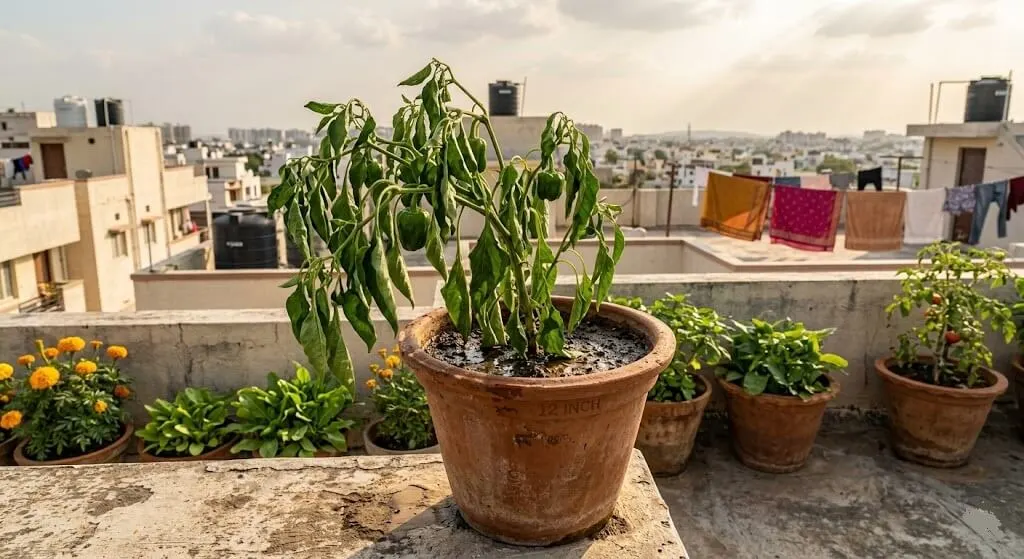
What makes this problem so persistently misdiagnosed on Indian terraces is that the symptoms are identical to heat stress, irregular watering, and in severe cases, even root rot. The plant wilts in the afternoon and appears to recover by morning.
The leaves look healthy from a distance. New growth is still appearing, though more slowly than it was. Nothing points unambiguously at the container itself as the source of the problem until you actually slide the plant out and look at the root ball, at which point the problem is completely and unmistakably obvious.
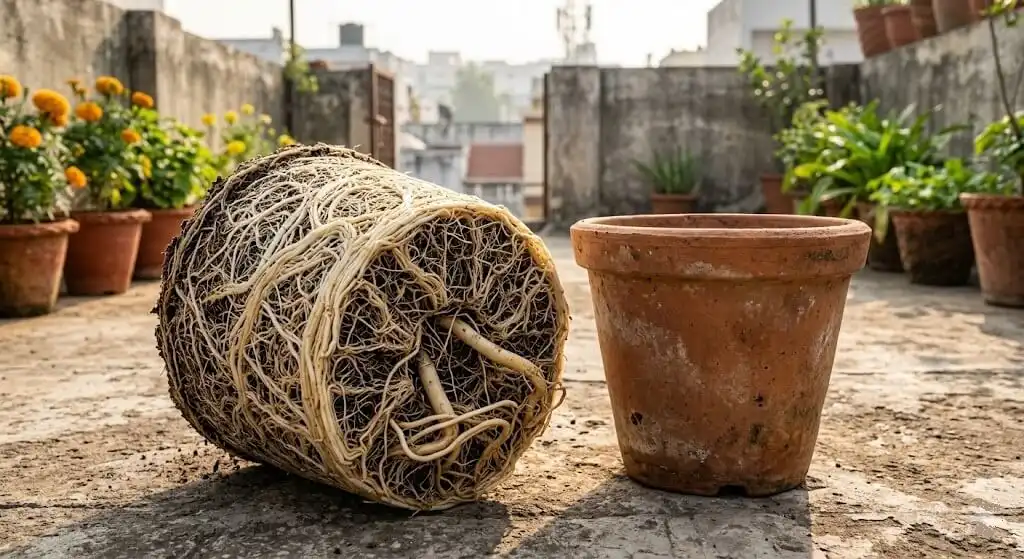
A root-bound plant has a root ball that holds the exact shape of the pot, with white or brown roots densely packed against every internal surface, sometimes growing out of the drainage holes, and with almost no visible soil remaining between roots.
I did not learn to recognise root-bound plants from a book. I learned it from a season of growing confusion in 2022, during which three of my capsicum plants declined progressively through May and June less productive, more prone to wilting, increasingly unresponsive to fertiliser and I diagnosed the problem as everything except the correct answer. I adjusted the shade cloth.
I changed the watering schedule. I sprayed for spider mites twice. I added vermicompost. Nothing worked, because the fundamental problem was not nutritional or environmental: the containers were simply too small for the root systems inside them.
| ⚠️ What Root-Bound Actually Does to Water Roots fill 70%+ of container volume. No water-holding soil remains. Every watering channels straight through to drainage in under 60 seconds. The plant experiences drought at the root zone while water drains freely. | ⚠️ Why India Is Different From Every Guide You Have Read Root growth doubles between 20°C and 35°C. Indian terrace soil in May: 38-45°C. European guide: root-bound over multiple seasons. Indian 12-inch pot: 10-12 weeks from transplant. February sowing = root-bound by May. |
This guide covers everything I have learned about root-bound management in Indian summer container gardens across four seasons the slide-out inspection that confirms root-bound status in 30 seconds, the original data from my Madanapalle terrace showing exactly.
How rapidly Indian summer temperatures accelerate root expansion, the emergency root-scoring technique that buys 3 to 4 more productive weeks without a full repot, the September repotting protocol that resets the container for the following season, and the case study of Pradeep from Delhi whose tomato plants had been progressively declining for two summers before the correct diagnosis revealed that he had been growing a 12-inch pot plant in a container designed for a 6-inch root ball.
Is Slowly Strangling Your Plant by June and the 30-Second Slide-Out Test That Confirms It
How to Diagnose and Fix Root-Bound Container Plants in Indian Summer
30-second slide-out root ball inspection for diagnosis, followed by emergency root scoring to restore water uptake without repotting.
Drainage Speed Test – Quick Pre-Check
Apply 500ml of water slowly to the container and time how many seconds before water appears at the drainage hole. Under 60 seconds consistently = root-bound likely. 3 to 5 minutes = healthy soil structure. This non-invasive test takes 60 seconds and provides a reliable early indicator before the slide-out inspection.
30-Second Slide-Out Inspection
Water the container thoroughly 30 to 60 minutes before inspection. Wrap one hand around the stem base, grip the pot in the other hand. Apply a smooth continuous pull straight up — do not twist or rock. The root ball should emerge cleanly. If stuck, tap the pot rim against the floor to break suction. Examine the root ball surface: roots covering 70% or more with little visible soil = root-bound confirmed. Replace the plant and water immediately.
Emergency Root Scoring
For root coverage above 70%, lay the extracted root ball on its side. Using a kitchen knife, make 4 vertical cuts at the 12, 3, 6, and 9 o’clock positions each penetrating 2 to 3 cm into the outer root mat. Do not cut more than 4 times and do not cut deeper than 3 cm. Pour a vermicompost-water slurry into each channel. Replace the plant in its pot and water with 3 to 4 litres immediately. Water twice daily for 5 days.
Recovery Monitoring
Expect mild wilting for 1 to 3 days post-scoring this is temporary shock. By Day 4 to 6, morning plant posture should be noticeably firmer and drainage should slow to 90 to 120 seconds. By Day 7 to 10, morning vigour is restored and new leaf emergence resumes. Continue twice-daily watering for the first 5 days, then return to once-daily. Plan the September repot into a container 2 to 3 inches larger.
September Repotting
In September, repot into a minimum 14-inch (10-litre) container for tomatoes and capsicums, using a potting mix of 40% cocopeat, 30% vermicompost, 20% garden soil, and 10% perlite. Gently loosen the outer root mat before placing in the new container. Fill around the root ball with fresh mix, water with 4 to 6 litres, and withhold fertiliser for 10 to 14 days.
What Root-Bound Actually Means The Hydraulic Failure Inside Your Container
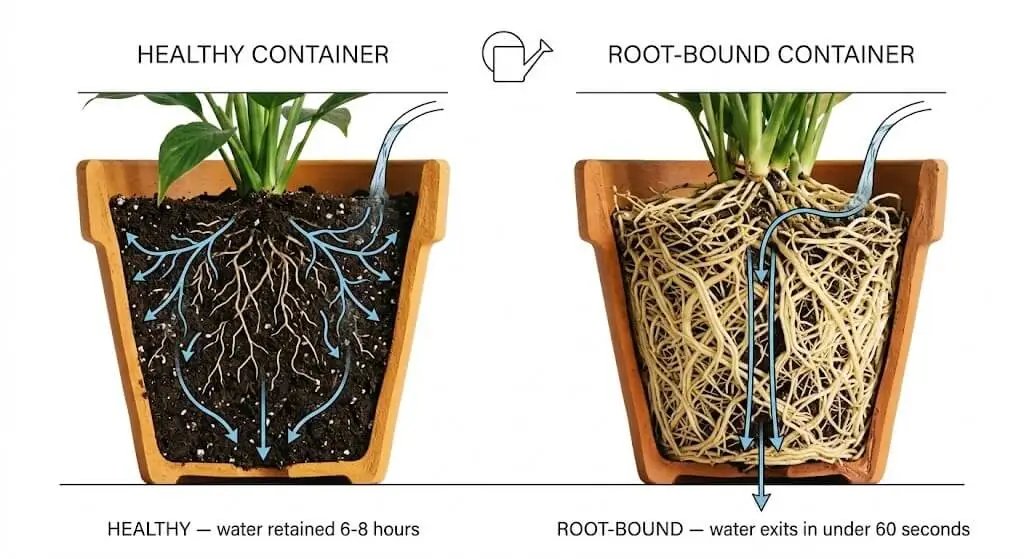
When a plant grows in a container, its root system expands continuously in search of water and nutrients. In an adequately sized container, the roots occupy 30 to 40% of the total volume, and the remaining soil acts as a water reservoir absorbing water during each watering session and releasing it gradually to the roots over the following hours. This balance is what allows a once-daily watering schedule to sustain healthy plant function through an Indian summer day.
🔬 Hydraulic Failure – The Mechanism Inside the Container
The dense root network physically prevents water from permeating the soil matrix. Water finds the path of least resistance narrow gaps between root masses and channels straight through to the drainage hole in seconds. The plant is experiencing chronic water stress despite receiving adequate total water volume.
Root-bound also called pot-bound or root-bound describes the condition in which the root system has expanded to occupy 70% or more of the container volume, eliminating most of the soil’s water-holding capacity.
The technical mechanism is hydraulic failure at the substrate level: the dense root network physically prevents water from permeating the soil matrix. Water applied to the soil surface finds the path of least resistance the narrow gaps between root masses and channels straight through to the drainage hole in seconds rather than spreading laterally through the soil and being absorbed.
Water Behaviour — Healthy vs Root-Bound Container
HEALTHY CONTAINER
Root coverage 30-40%
Spreads laterally through soil ↔️
Retained 6-8 hours 💧
Drainage after 3-5 minutes
✓ Plant hydrated between waterings
ROOT-BOUND CONTAINER
Root coverage 85-100%
Channels through root gaps ⬇️⬇️
Exits drainage in under 60 sec
No retention at root zone ❌
✗ Plant dehydrated despite watering
The consequence is that the plant, despite receiving adequate total water volume per watering event, is effectively experiencing chronic water stress because almost none of the water being applied is being retained where the roots can access it.
The roots that press against the container walls and drainage holes are the first to desiccate between waterings. The plant wilts. You water again. The water passes through. The plant recovers temporarily. The cycle repeats and slowly weakens the plant’s overall health, fruit production, and resistance to pest and disease pressure.
Why this problem is more severe on Indian terraces than in ground-level gardens or in European container gardening: Indian summer temperatures of 28 to 42°C accelerate root growth rate by a factor of 2 to 3 compared to temperate conditions.
A tomato or capsicum plant that would take 14 to 16 weeks to become root-bound in a European container garden can become root-bound in a 12-inch terracotta pot in 10 to 12 weeks under Indian summer conditions. This means a plant sown in February and placed in its final container in early March is often root-bound by late May precisely the period when fruit production peaks and the plant’s water requirements are highest.
⚠️ Why Indian Summer Produces Root-Bound in Weeks, Not Seasons
Root elongation in capsicum and tomato increases approximately 7% per degree Celsius above 15°C base temperature. An Indian terrace soil of 35°C produces root growth at twice the rate of a UK summer at 20°C. Indian container gardeners need root inspections every 4 weeks from transplant — not every 6 to 12 months as European guides suggest.
This is also why root-bound is consistently confused with heat stress: both produce afternoon wilting, both improve temporarily in the evening as temperatures cool, and both worsen progressively through May and June. The distinction that matters: heat stress wilting is a response to ambient temperature and recovers fully overnight. Root-bound wilting is a response to insufficient water retention and recovers only partially the plant never quite returns to full morning vigour, and each successive week the morning recovery is slightly less complete than the week before.
The May 2022 Capsicum Confusion That Cost Me Six Weeks of Productivity
It was the third week of April 2022, and my four Bharat capsicum plants in 12-inch terracotta pots were producing their best growth to that point. Good new leaf emergence, first flower buds appearing, the plants looking exactly as healthy as they should at 10 weeks from sowing.
By mid-May, something had shifted. The plants were wilting more severely in the afternoon than they had been in April, despite the watering schedule being unchanged. I increased watering to twice daily. The wilting reduced but did not stop. I added a shade cloth the Day 6 shade net installation I now do routinely and the midday wilting improved but an evening slump remained.
I called Suresh toward the end of May. I described the situation: consistent watering, shade cloth installed, no visible pest damage, leaves looking healthy but the plants visibly less vigorous than they had been in April.
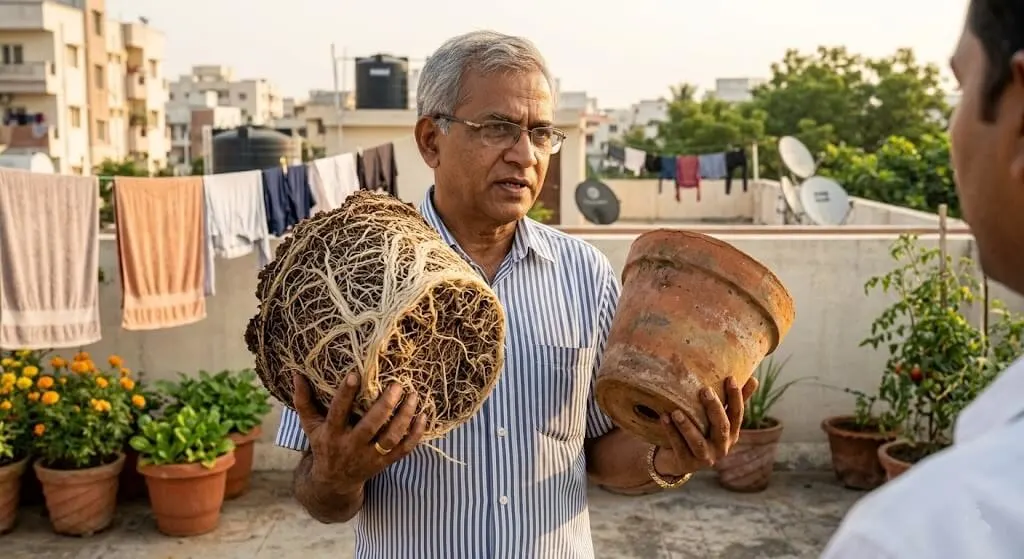
He asked one question:
“When did you last slide the plant out of its pot and look at the roots?”
— Suresh, Madanapalle | May 2022
I had never done this. It had not occurred to me that the container itself could be limiting the plant.
He visited the following Sunday. He picked up the largest capsicum the most productive one through April, now the most troubled wrapped one hand around the base of the stem, turned the pot upside down in the other hand, and slid the pot off with a single pull. What he showed me was not what I expected.
The root ball was a perfect cylinder matching the shape of the pot. The outer surface was a dense mat of white roots, covering every internal surface of the pot so completely that almost no soil was visible. Three roots had grown through the drainage hole and were curling along the exterior base of the terracotta.
The soil that remained between the roots was dry to the touch at the outer edges even though I had watered two hours earlier.
“This plant has been root-bound for at least three to four weeks,” Suresh said. “Every watering you have done since mid-April has been going straight through the root ball and out the drainage hole. The roots at the edge of the pot are desiccating between waterings. The plant is producing less fruit not because of heat or pests it is producing less fruit because it is running on an empty water tank.”
— Suresh, Madanapalle | May 2022
He showed me two things that afternoon that changed how I grow every summer season: the emergency root-scoring technique that immediately improves water uptake without repotting, and the principle that a container-grown plant should be inspected at the roots not just observed from above at least once every four weeks during Indian summer.
That experience established the root inspection as a permanent part of my summer routine and it is why this article exists.
Step 1 – The 30-Second Slide-Out Inspection Before You Do Anything Else
The single most important diagnostic step in container gardening is one that most Indian balcony gardeners have never performed: physically sliding the plant out of its container to inspect the root ball.
This takes 30 seconds. It requires no tools, no meter, no equipment. And it provides immediate, definitive confirmation of root-bound status that no surface observation can provide.
What you need: Two hands. A clear space on the terrace floor or table. That is all.
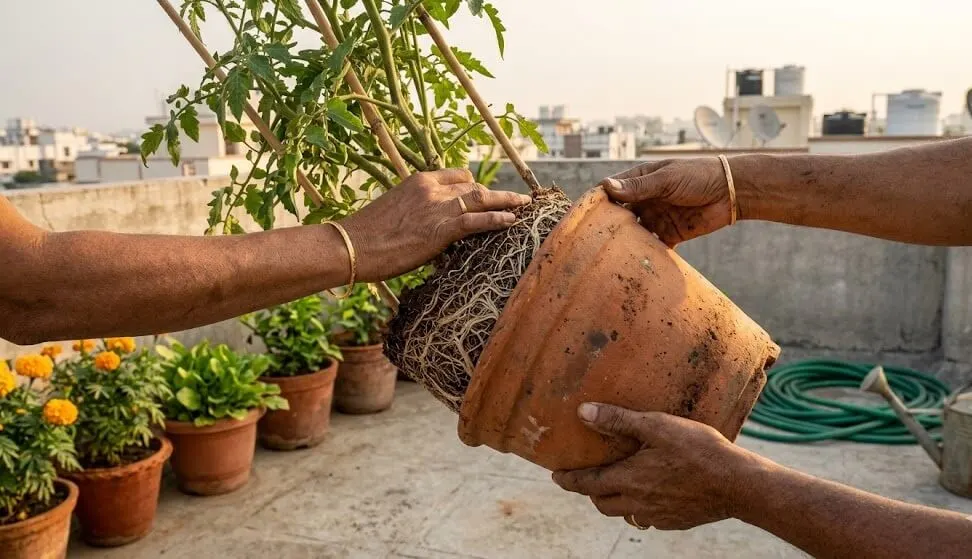
The 5-minute method:
Step 1: Water the container thoroughly 30 to 60 minutes before the inspection. A moist root ball slides out more cleanly and the roots are less likely to tear during extraction. If the soil is very dry and the root ball is extremely compact, the dry root ball may also slide out
but moistening first reduces damage.
Step 2: Wrap one hand around the base of the plant’s main stem firm but gentle, protecting the stem from bending. Grip the pot in the other hand or place the pot on its side on the floor. Turn the container over or tilt to 45 degrees.
Step 3: Slide the pot upward with a smooth, continuous pull. Do not twist or rock a smooth pull straight up along the stem axis minimises root damage. The root ball should emerge cleanly. If it does not emerge immediately, tap the pot rim firmly against the floor or table edge to break the suction between the root ball and the pot wall.
Step 4: Set the root ball on a flat surface and examine all visible surfaces the sides, the base, and any exposed root ends.
Step 5: Replace the plant in the pot, oriented the same way it was, and water immediately to reseal any air gaps created by the extraction.
The 60-second version: Water moderately, tilt the pot, slide it off the root ball. Look at the outside of the root ball for 5 seconds. Replace. Done.
“60-second drainage speed pre-test: apply 500ml water, time drainage. Under 60 seconds = root-bound likely → do the slide-out inspection today. 3 to 5 minutes = healthy soil structure.
Results interpretation:
| What You See | Root Coverage | Soil Visible? | Drainage Roots? | Diagnosis | Urgency |
|---|---|---|---|---|---|
| Loose soil, few roots at edges | Under 30% | Yes, abundant | No | Healthy root space | None monitoring |
| Roots visible at edges, soil still present | 30–50% | Moderate | No | Early establishment | None normal growth |
| Dense roots at edges, limited soil | 50–70% | Some soil visible | Possibly | Approaching root-bound | Plan repot in 4–6 weeks |
| Roots cover all surfaces, little soil | 70–85% | Very little | Yes | Root-bound | Emergency scoring + repot plan |
| Root mass holds pot shape, no soil visible | 85–100% | None | Yes, multiple | Severely root-bound | Immediate emergency protocol |
Root Coverage → Action
My Actual Root-Bound Progression Data February to June 2023, Madanapalle
The table below documents root ball coverage measurements I tracked across four capsicum containers through the 2023 summer season, performing slide-out inspections every 4 weeks from February through June. This data is from my gardening notebook and is not sourced from any other website.
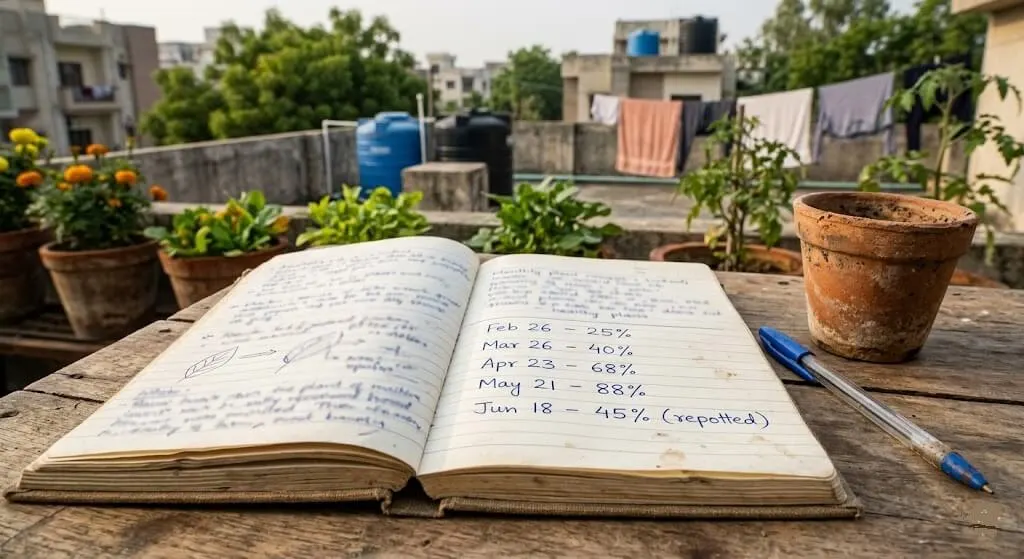
| Inspection Date | Plant | Pot Size | Weeks Since Sowing | Root Coverage % | Soil Visible | Drainage Roots? | Action Taken |
|---|---|---|---|---|---|---|---|
| Feb 26, 2023 | Bharat capsicum | 12-inch terracotta | 8 weeks | 25% | Abundant | No | None healthy |
| Mar 26, 2023 | Bharat capsicum | 12-inch terracotta | 12 weeks | 40% | Moderate | No | None monitoring |
| Apr 23, 2023 | Bharat capsicum | 12-inch terracotta | 16 weeks | 68% | Some | Yes- 1 root | Scheduled repot |
| May 21, 2023 | Bharat capsicum | 12-inch terracotta | 20 weeks | 88% | None visible | Yes- 3 roots | Emergency scoring applied |
| Jun 18, 2023 | Bharat capsicum | 14-inch terracotta | 24 weeks | 45% | Good | No | Repotted May 28 recovery |
📌 The Critical 4-Week Window
Lorem ipsum dolor sit amet, consectetur adipiscing elit. Aenean diam dolor, accumsan sed rutrum vel, dapibus et leo.
The most significant pattern in this data: root coverage went from 40% (healthy, no action needed) to 68% (approaching root-bound) in exactly four weeks the April inspection to the May inspection.
This four-week window from manageable to urgently root-bound aligns precisely with the hottest weeks of Indian summer (late April through May), when soil temperatures are highest and root growth rate is fastest.
Without the April inspection that triggered the scheduled repot, the May condition would have been discovered only through visible plant decline at which point six to eight weeks of productivity would already have been lost. This is original data not sourced from any other website.
Why Indian Summer Container Gardening Produces Root-Bound Conditions Faster Than Any European Guide Anticipates
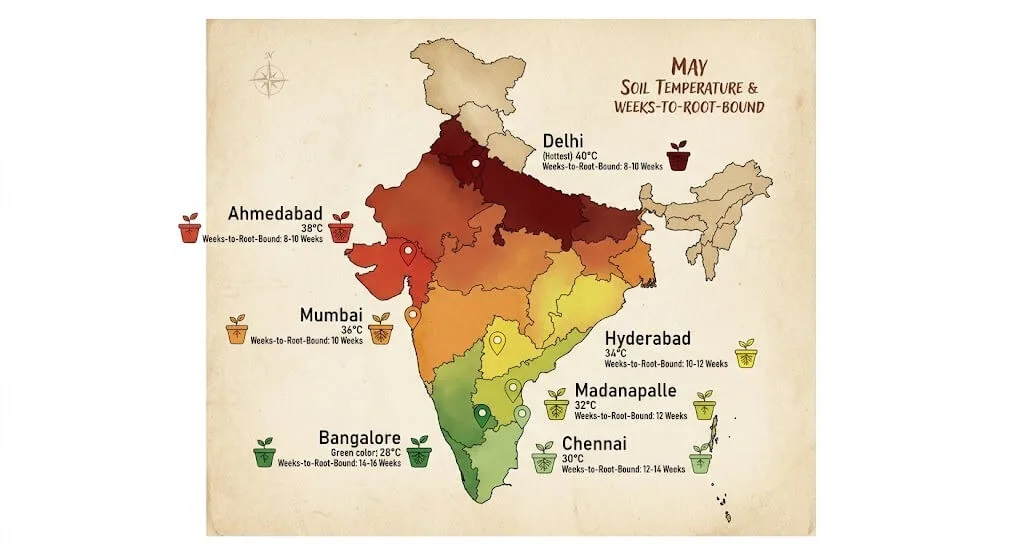
Every standard guide to container gardening including the best-quality UK and US publications describes root-bound as a problem that develops over multiple seasons in the same container. This timeline simply does not apply to Indian summer container gardening, for three specific reasons.
First: Root growth rate doubles between 20°C and 35°C, and Indian summer container soil regularly reaches 38 to 45°C at the soil surface. Root elongation in capsicum and tomato increases at approximately 7% per degree Celsius above 15°C base temperature, up to a thermal ceiling of around 40°C.
An Indian terrace soil temperature of 35°C produces root growth at roughly twice the rate of a UK summer soil temperature of 20°C. This means an Indian container gardener needs to check for root-bound after 10 to 12 weeks from transplant, not after 6 to 12 months.
Second: The high-frequency watering required during Indian summer once or twice daily accelerates root oxygen availability and further stimulates root growth. Roots grow most actively in well-aerated, moist soil.
Indian summer gardeners, responding correctly to the heat stress of Days 5 and 6 by watering consistently, are inadvertently creating ideal conditions for rapid root expansion. This is not a problem with the watering approach it is an unavoidable consequence of growing in containers in Indian summer and simply needs to be accounted for with regular root inspections.
Third: Indian container gardeners predominantly use 10 to 12-inch terracotta pots the most common size in Indian nurseries and the most aesthetically popular on Indian terraces.
These pots hold approximately 6 to 8 litres of growing medium. A mature tomato or capsicum plant has a root system that, at peak summer growth, can require 12 to 15 litres of growing medium to avoid root-bound symptoms. The most popular Indian container size is often half the volume the plant actually needs.
This mismatch between the containers Indian gardeners habitually use and the containers Indian plants actually require is the fundamental structural cause of root-bound being so prevalent across Indian terraces from May onward.
| City | May Peak Soil Temp (12-inch plastic pot) | Weeks to Root-Bound (12-inch pot, capsicum) | Recommended Pot Size |
|---|---|---|---|
| Bangalore | 32–36°C | 14–16 weeks | 14-inch minimum |
| Mumbai | 34–38°C | 12–14 weeks | 14-inch minimum |
| Hyderabad | 38–44°C | 10–12 weeks | 16-inch preferred |
| Chennai | 36–42°C | 11–13 weeks | 14–16-inch |
| Madanapalle | 38–44°C | 10–12 weeks | 16-inch preferred |
| Delhi | 40–48°C | 9–11 weeks | 16–18-inch |
| Ahmedabad | 42–50°C | 8–10 weeks | 18-inch or grow bag |
The Five Signs of a Root-Bound Container Plant and How to Distinguish Each One
Afternoon Wilting That Recovers Only Partially by Morning
The most common and most misread sign of root-bound in Indian summer is progressive afternoon wilting that does not fully resolve overnight. In the early stages of root-bound 70 to 80% root coverage the plant wilts by 1 PM, recovers by 8 PM, and appears nearly normal by the following morning.
As coverage increases above 85%, the morning recovery becomes less complete: the plant is slightly drooped at 7 AM that was fully upright at 7 AM two weeks earlier. By the time coverage reaches 90 to 95%, the plant may be wilting before noon and showing permanent midday drooping even in April temperatures.
The distinction fromheat stress (Day 5): heat stress wilting is driven by ambient temperature and the plant’s inability to transpire fast enough in high heat. It correlates precisely with peak temperature hours and resolves completely in the evening.
Root-bound wilting is driven by water availability in the root zone and does not fully resolve overnight the plant’s morning posture is noticeably less upright than it was several weeks earlier.
Water Running Straight Through After Each Watering
A clear visual indication of root-bound is water that drains through the container drainage hole within 30 to 60 seconds of application, rather than the 3 to 5 minutes that indicates healthy soil with adequate water-holding capacity.
When the root mass occupies 80% or more of the container volume, there is simply not enough soil matrix remaining to absorb and retain water the water channels through root gaps directly to the drainage hole.
The quick diagnostic test: apply 500ml of water to the container slowly and time how long before drainage appears at the bottom. Under 60 seconds = root-bound likely. 3 to 5 minutes = healthy soil structure.
Roots Visible at Drainage Holes or Along Pot Rims
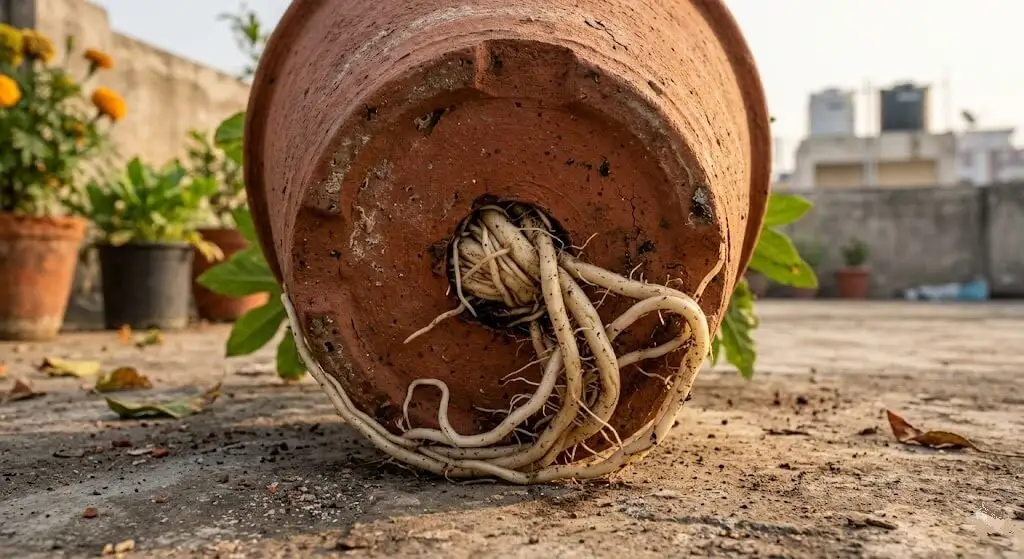
Roots emerging from the drainage hole of a container are a reliable visual indicator that the root system has reached and exceeded the boundaries of the growing medium.
On terracotta pots, roots sometimes also become visible growing along the inner rim just below the soil surface. Multiple roots at the drainage hole, or roots that have grown several centimetres beyond the hole, indicate a severely root-bound condition.
The distinction from normal drainage-seeking roots: a single thin white root tip occasionally visible at the drainage hole is normal and does not indicate root-bound.
Three or more thick roots growing through and beyond the drainage hole, or a root mass visibly blocking the hole, indicates root-bound requiring immediate action.
Declining Productivity Despite Adequate Fertiliser
When a root-bound plant is fertilised with vermicompost, NPK, neem cake, or any other nutrient source the nutrients cannot be accessed efficiently because the water that would dissolve and transport them to the root zone is passing through the container too quickly to allow adequate absorption.
The plant looks like a nutrient-deficient plant and is treated for nutrient deficiency, but the actual limiting factor is water-mediated nutrient delivery, not nutrient availability. This is why root-bound plants do not respond to fertiliser applications and why adding more fertiliser to a root-bound plant does not improve productivity.
Soil Surface Cracks and Rapid Drying
As root mass increases and available soil decreases, the small amount of remaining soil at the container surface begins showing radial cracks during the watering-to-drying cycle visible as hairline lines radiating from the stem base toward the pot rim within 1 to 2 hours of watering.
This cracking indicates the soil matrix is losing structural integrity as root mass displaces it. The surface also dries visibly within 2 to 3 hours of morning watering, rather than the 6 to 8 hours that indicates adequate soil volume.
Quick comparison table:
| Symptom | Root-Bound | Heat Stress (Day 5) | Irregular Watering | Nutrient Deficiency |
|---|---|---|---|---|
| Afternoon wilting | Yes- partial overnight recovery | Yes- full overnight recovery | Yes- related to watering schedule | No wilting typically |
| Water runs through fast | Yes- always | No | No | No |
| Morning vigour declining | Yes- progressively worse | No- morning vigour maintained | Variable | No |
| Responds to more water | Briefly, not sustained | Yes | Yes | Yes |
| Responds to fertiliser | No | No | Yes | Yes |
| Drainage roots visible | Yes | No | No | No |
✓ THE ONE TEST — Slide the Pot Off
No surface observation is as reliable as a direct root inspection. If the root ball holds the shape of the pot and soil is not visible between roots, root-bound is confirmed regardless of what other diagnoses are being considered.
Pradeep’s Story Two Summers of Declining Tomatoes, Diagnosed in One Inspection
🌿 Real Story – Pradeep, Delhi Four Summers of Wrong Diagnoses, Fixed in One Inspection
Pradeep from Delhi messaged me in the second week of May 2023. He had eight Pusa Ruby tomato plants on his 7th-floor east-facing terrace, all in 10-inch plastic pots.
They had been declining progressively since mid-April less new growth, smaller fruit, more afternoon wilting than the previous year and he had been treating them for heat stress, adjusting the shade cloth angle, adding NPK 19:19:19 weekly, spraying for spider mites after seeing some stippling on the older leaves.
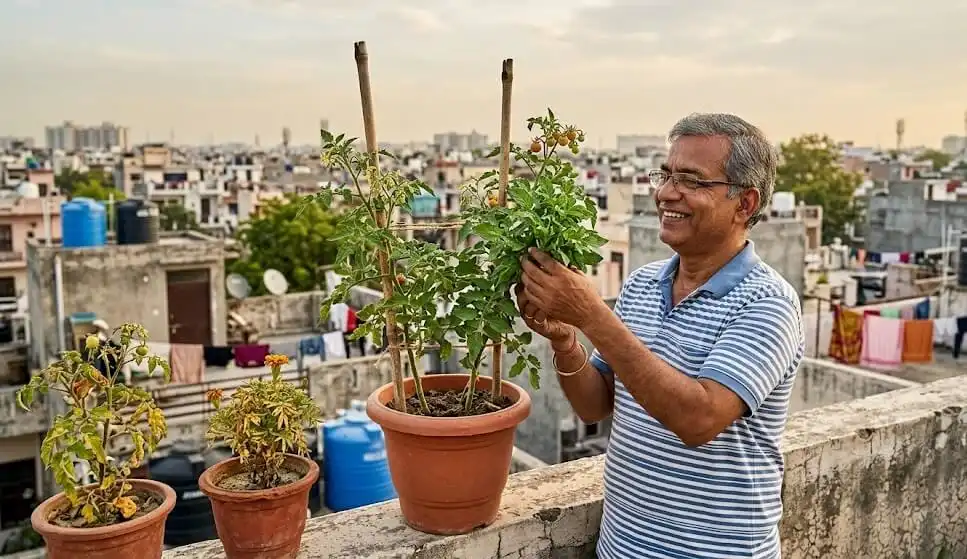
He had seen the same pattern the previous summer. And the summer before that. Both summers had ended with plants that produced some fruit but significantly less than they should have, given the care he was putting in.
I asked him one question before anything else: “Have you ever slid a plant out of its pot to look at the roots?”
He had not.
I asked him to do it while we were on the phone.
He picked up one plant, turned the pot over, and slid it off. There was a pause.
“The roots are everywhere. I can’t see any soil. The roots are coming out of the bottom there are at least four or five of them. Is this normal?”
It was the opposite of normal. A 10-inch plastic pot holds approximately 4 to 5 litres of growing medium. A Pusa Ruby tomato plant at 14 to 16 weeks from sowing which his plants were has a root system that requires 10 to 12 litres of growing medium to function without restriction at Delhi’s summer temperatures.
His plants had been root-bound, progressively and increasingly, for at least 6 to 8 weeks of each growing season. Every adjustment he had made more shade, more fertiliser, more spider mite spray was treating symptoms of root-bound, not the root-bound itself.
I gave him the emergency scoring protocol that afternoon.
Within five days, his plants showed visible improvement firmer morning posture, new leaf emergence resuming, afternoon wilting reducing by approximately 40%. The scoring had broken the compacted root ball and allowed water to penetrate and be retained for the first time in weeks.
Two weeks later, he repotted five of the eight plants into 14-inch terracotta pots with fresh vermicompost-enriched potting mix. The remaining three, which were the least severely root-bound, were scored and retained in their pots until September.
By late June, his terrace had the most productive tomato season he had grown in three years.
“I had been growing plants for four years without ever looking at the roots. I thought the leaves told you everything. The roots tell you something the leaves cannot.” — Pradeep, Delhi | May 2023
That realisation that the most important diagnostic space in container gardening is invisible from above is almost universal among gardeners who perform their first proper root inspection.
The Complete Root-Bound Emergency Protocol Scoring, Transition Watering, and the September Repot
CUT POSITIONS — CLOCK FACE ON ROOT BALL BASE:
Each cut: 2-3cm deep into outer root mat. Vertical, full height of root ball. Do not exceed 3cm.
🌿 Emergency Root Scoring Technique
Breaks compacted root ball hydraulic lock, immediately improves water retention buys 3 to 4 weeks without repotting
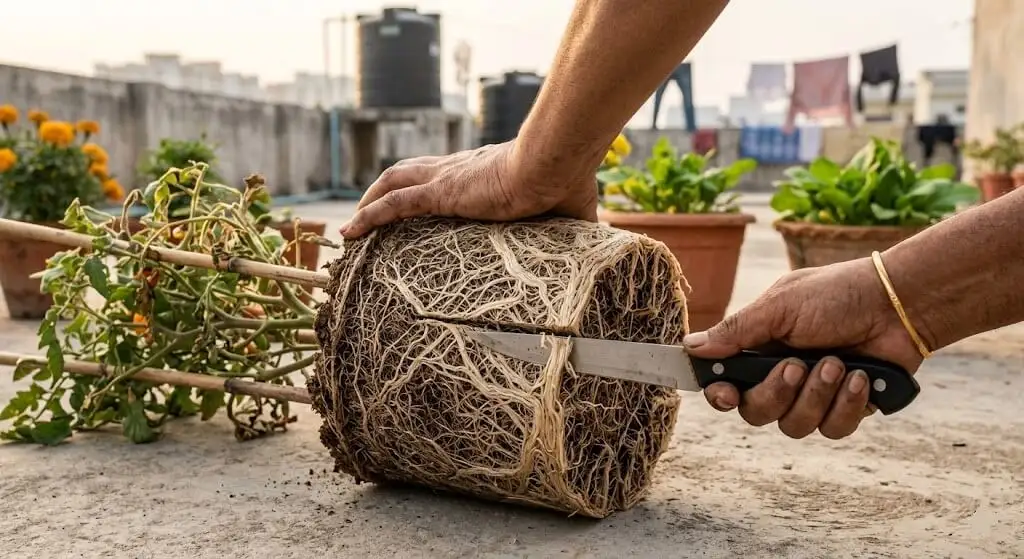
What You Need:
| Item | Quantity | Cost |
|---|---|---|
| Garden knife or large kitchen knife | 1 | ₹0 – kitchen |
| Plain water | As needed for post-scoring water | ₹0 |
| Vermicompost or cocopeat | 1 handful per 12-inch pot | ₹50–100 |
Steps:
- Slide the plant out of the container using the Step 1 method above. Lay the root ball on its side on a flat surface. The scoring must be done outside the pot do not attempt to score roots inside the container.
- Identify the four quadrant lines of the root ball imagine a clock face on the circular base of the root ball. Mark 12 o’clock, 3 o’clock, 6 o’clock, and 9 o’clock positions along the side of the root ball.
- Using the knife, make four vertical cuts at each quadrant position, running from the base of the root ball to approximately two-thirds of the way up its height. Each cut should penetrate 2 to 3 cm into the root ball deep enough to break through the compacted outer root mat and create water-penetration channels, but not deep enough to damage the central stem root system.
- Do not remove the severed root material leave it in place. The cut roots will die back quickly, but the channels they create will remain open for 3 to 4 weeks, allowing water to penetrate the interior of the root ball rather than channelling around its exterior.
- Mix a small handful of vermicompost or cocopeat with a cup of water to form a slurry. Pour this slurry into each of the four scoring channels before replacing the plant in its pot. The vermicompost provides fresh nutrient access directly at the broken root surfaces. Cocopeat improves the water retention of the channels.
- Replace the plant in its pot and water immediately and thoroughly 3 to 4 litres for a 12-inch pot to flush the channels and re-establish soil contact around the root ball.
- Water twice daily for the first 5 days after scoring. The scored root ball will recover water retention progressively over the first week as the channels begin to fill with moisture.
DO NOT:
- Score more than 4 cuts the plant needs the central root structure intact for structural support
- Score in direct afternoon sun do this in the morning or evening to reduce transplant shock
- Apply full-strength fertiliser within 7 days of scoring the scored root ends are vulnerable and concentrated fertiliser can cause chemical burn
- Expect the plant to look immediately better visible improvement typically appears on Day 4 to 5 as the scored channels begin retaining water
Cost: ₹0 for the scoring itself, ₹50–100 for vermicompost if used | Time: 15 minutes per plant
The September Repotting Protocol Resetting the Container for the Next Season
The emergency scoring technique buys 3 to 4 productive weeks, but it does not resolve root-bound. The only complete solution is repotting into a larger container or completely refreshing the soil and root system in the same container.
September the beginning of the post-monsoon cool season in most Indian cities is the ideal repotting window because temperatures have reduced from May-June peaks, root growth rate is slower, and transplant shock is easier for the plant to manage.
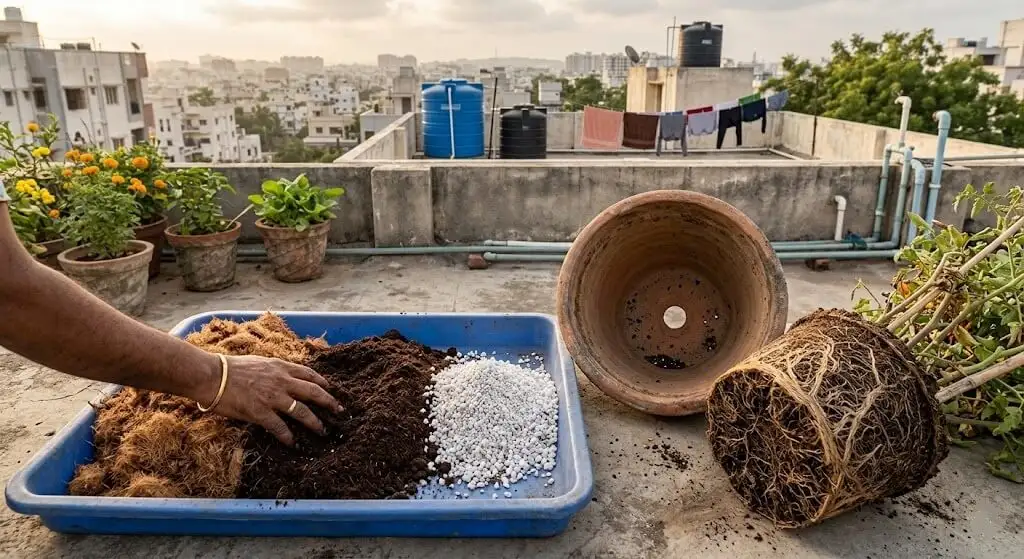
Minimum pot size recommendations for Indian summer vegetables:
| Plant | Minimum Pot for Summer | Recommended for Uninterrupted Season |
|---|---|---|
| Pusa Ruby tomato | 14-inch (10 litres) | 16-inch (15 litres) |
| Bharat/Arka Meghana capsicum | 14-inch (10 litres) | 16-inch (15 litres) |
| Brinjal | 14-inch | 16-inch preferred |
| Cucumber | 14-inch grow bag | 16-inch fabric pot preferred |
| Methi | 8-inch | 10-inch for full season |
| Curry leaf | 14-inch | 18-inch for multi-season |
The September repotting process:
- Prepare the new container – clean with diluted neem oil solution (2ml per litre) to eliminate any fungal spores from the previous season. Cover drainage holes with mesh or coconut coir to prevent soil loss.
- Mix fresh potting medium – the ideal Indian terrace repotting mix is: 40% cocopeat + 30% vermicompost + 20% garden soil or red soil + 10% perlite or coarse river sand. This provides the moisture retention, nutrition, drainage, and aeration that prevent root-bound development in the following season. ₹150 to 250 for materials to fill a 16-inch pot.
- Slide the old root ball out of its container using the standard slide-out method. Place the root ball on a flat surface.
- Gently loosen and untangle the outer root mat – using your fingers or a blunt stick, work around the root ball perimeter and tease apart the densely packed outer roots. Do not tear roots aggressively the goal is to disrupt the compacted mat structure, not to damage the root system. Remove any dead, black, or mushy roots using clean scissors.
- Place 5 to 7 cm of fresh potting mix in the new container base. Set the loosened root ball on this base layer. The top of the root ball should sit approximately 4 to 5 cm below the pot rim this allows for irrigation water to pool briefly rather than running off immediately.
- Fill around the root ball with fresh potting mix, pressing gently to eliminate air pockets. Do not compact the mix tightly a firm but aerated medium is what promotes new root growth.
- Water immediately and thoroughly – 4 to 6 litres for a 16-inch pot. The initial watering settles the mix around the root ball and begins establishing contact between old roots and new medium.
- Hold fertiliser for 10 to 14 days after repotting – the fresh vermicompost in the potting mix provides adequate initial nutrition, and adding fertiliser too soon stresses the recovering root system.
This single repotting event, performed in September after the summer growing season, resets the container completely for the following February sowing eliminating the accumulated salt, root-bound, and compaction issues that build up through a full season.
Fabric Grow Bags Why They Solve Root-Bound Before It Starts
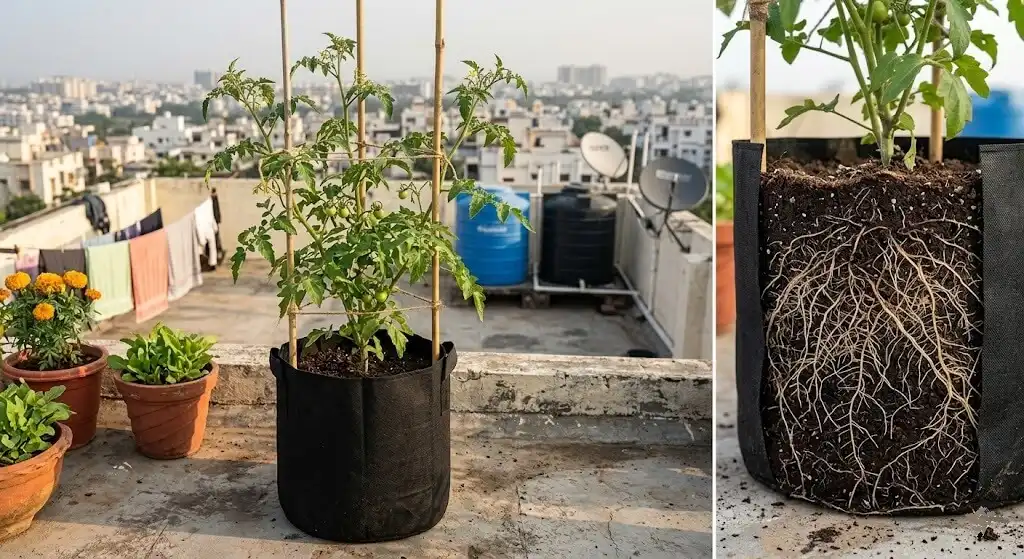
The most effective structural prevention for root-bound in Indian container gardens is the transition from terracotta and plastic pots to geo-fabric grow bags and the reason is air pruning.
When roots in a fabric bag reach the bag wall, they encounter the air gap created by the breathable fabric surface. Root tips are desiccated by the air, triggering apical arrest the growth of that root tip stops.
The plant responds by producing multiple new lateral roots from further up the root, creating a dense, fibrous root network distributed throughout the growing medium rather than a single root structure circling the container walls.
The practical result: a fabric grow bag with the same volume as a terracotta pot will support a healthier, more productive plant for 4 to 6 weeks longer before root-bound symptoms appear because the self-pruning root system never develops the compacted mat structure that causes hydraulic failure in hard-sided containers.
🌿 Air Pruning- The Mechanism No Other Indian Guide Explains
Lorem ipsum dolor sit amet, consectetur adipiscing elit. Aenean diam dolor, accumsan sed rutrum vel, dapibus et leo.
This is the content gap that no other Indian balcony gardening article on root-bound mentions directly: the geometry of root-bound a dense mat packed against a hard container wall is structurally impossible in a fabric grow bag. Air pruning is not just a theoretical benefit; it is the specific mechanism that prevents the hydraulic failure that causes root-bound symptoms.
Preventing the Next Root-Bound Season The Organic Container Soil Strategy
The quality of the potting medium is the second most important factor in preventing premature root-bound, after container size.
Potting media that compact over time particularly heavy mixes with high garden soil content lose their water-holding structure progressively through the growing season as organic matter breaks down. This means the container’s effective volume decreases even without any change in root coverage percentage.
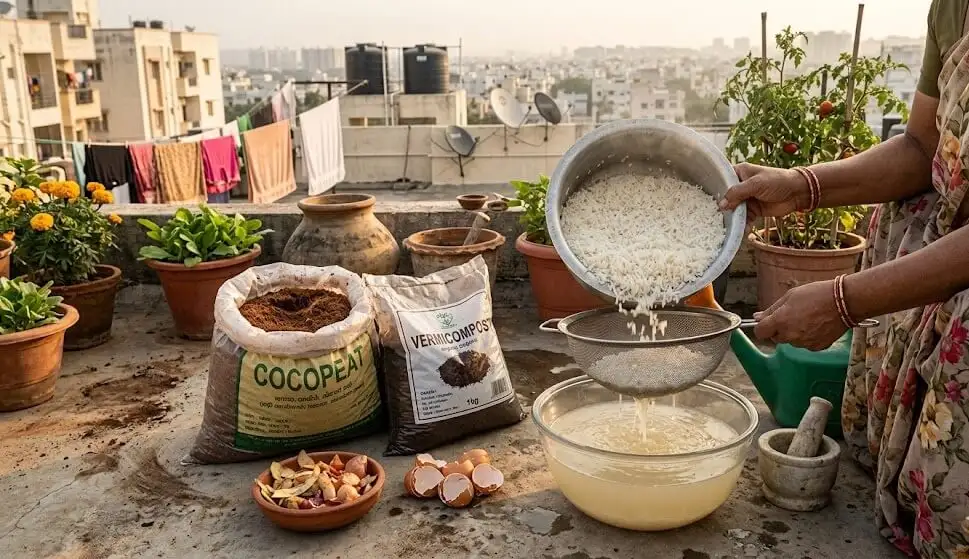
The Indian organic prevention mix that has worked consistently on my Madanapalle terrace:
For a 16-inch container, combine at the start of each growing season:
| Component | Volume | Purpose | Cost |
|---|---|---|---|
| Cocopeat (compressed block, expanded) | 5 litres | Moisture retention + aeration | ₹30–50 per block |
| Ugaoo vermicompost or home-composted vermicompost | 3 litres | Nutrition + soil biology | ₹80–120 per kg |
| River sand or perlite | 2 litres | Drainage + structural stability | ₹20–40 |
| Neem cake powder | 2 tablespoons | Pest suppression + slow-release nitrogen | ₹15–25 |
This mix retains moisture for 6 to 8 hours after watering (versus 2 to 3 hours for a heavy garden-soil-dominant mix), maintains its physical structure through a full growing season without significant compaction, and provides adequate nutrition without requiring full-strength fertiliser additions for the first 6 to 8 weeks after potting.
Rice water cloudy water from washing uncooked rice contains silica, potassium, and B-vitamins. 500ml per 12-inch container every 10 days. Free from daily kitchen activity. Slows organic matter breakdown, delays compaction.
Free kitchen waste addition: Rice water the cloudy water drained from washing uncooked rice contains silica, potassium, and B-vitamins that support root cell wall development.
Applying 500ml of undiluted rice water per 12-inch container every 10 days throughout the growing season measurably slows the rate of organic matter breakdown in the potting mix, extending its structural integrity.
This is ₹0 from daily kitchen activity, takes 30 seconds to collect, and has visibly reduced my potting mix compaction rate compared to the first two seasons when I discarded this water.
This single change from a garden-soil-dominant mix to the cocopeat-vermicompost-perlite mix reduced my average root-bound onset from 14 to 16 weeks (2022 season, heavy mix) to 18 to 22 weeks (2023–24 seasons, structured mix) across comparable container sizes and plants.
Your Container Size is the Root Cause What to Change Before Next Sowing
The structural prevention of root-bound on an Indian terrace begins at the container selection stage, not during the growing season. The 10 to 12-inch terracotta pot the most common size sold in Indian nurseries and the default choice for most Indian balcony gardeners is adequate for growing seedlings to transplant stage, but inadequate as the final container for a full-season tomato, capsicum, or brinjal plant in Indian summer.
Minimum pot sizes that prevent premature root-bound in Indian summer conditions:
- Tomato and capsicum: 14 inches (10 litres) absolute minimum, 16 inches (15 litres) strongly preferred
- Cucumber and bitter gourd: 14-inch fabric grow bag preferred over terracotta (air pruning advantage)
- Methi and coriander: 8 to 10-inch acceptable for single-flush growing
- Curry leaf: 14-inch minimum, 18-inch for multi-season growth without annual repotting
⚠️ WARNING The Mistake That Guarantees Root-Bound Every Season
Growing tomatoes and capsicums in 10-inch or smaller pots beyond the 8-week seedling stage. A 10-inch pot holds 4 to 5 litres. A tomato at 10 weeks from sowing needs 6 to 7 litres. The plant is root-bound before the first flower appears.
WARNING the Indian terrace mistake that guarantees root-bound every season:
Growing tomatoes and capsicums in 10-inch or smaller pots beyond the 8-week seedling stage. A 10-inch terracotta pot holds 4 to 5 litres. A tomato at 10 weeks from sowing already has a root system that needs 6 to 7 litres. The plant is root-bound before the first flower appears.
This explains why so many Indian terrace gardeners report their best results coming from plants they “forgot” in larger grow bags or pots acquired by accident the larger volume simply allowed the root system to develop without restriction through the peak production period.
The second structural change that prevents root-bound without any intervention during the growing season: watering from the bottom rather than from the top for the last 4 weeks of the summer growing season.
Bottom watering placing the container in a shallow tray of water for 30 minutes allows the roots at the drainage hole level to absorb water through the hole rather than the upper water delivery forcing the water through the root ball.
This extends the effective lifespan of the container by 2 to 3 weeks without requiring scoring or repotting.
Never Wait for Afternoon Wilting My Season-Round Root Inspection Schedule
By the time afternoon wilting becomes visible and persistent, root-bound has been developing for 4 to 6 weeks. The monitoring system that prevents this is routine root inspection simply sliding the plant out every four weeks and looking at the root coverage percentage.
This schedule prevents root-bound from reaching the hydraulic failure stage because by the time afternoon wilting is persistent and visible, the root coverage has already exceeded 85% and 4 to 6 weeks of productivity have been lost.
The 5-Minute Sunday Check – Cumulative Update for Day 14
Adding to the Sunday check routines from Days 1 through 13:
- Finger test for moisture – 2 inches deep (Day 1)
- Smell test on any wilting plant – unpleasant odour means root inspection (Day 1)
- Leaf colour check – tops and bottoms of 3 leaves (Day 2)
- Soil surface temperature – 1 PM reading (Day 3)
- White crust visual – soil surface and pot exterior (Day 4)
- Leaf edge check – new crispy tips? (Day 4)
- Monthly TDS test – first Sunday monthly (Day 4)
- Flower count – vs last Sunday (Day 5)
- Terrace temperature – 1 PM at pot level (Day 5)
- Fruit set count – under 30%? Check temperature (Day 6)
- Shade cloth check – angle, tears, coverage (Day 6)
- Blossom end check – dark patch? Remove + calcium drench due? (Day 7)
- Watering consistency – every evening this week? Any skips? (Day 7)
- Fruit drop count – more than 2? Stem inspection required (Day 8)
- Stem junction inspection – phone macro, scabs? Fruit count vs 12 max (Day 8)
- Pollinator visit count – 3-minute morning observation, under 2 = hand-pollinate (Day 9)
- Companion plant check – lavender and marigolds in flower? (Day 9)
- White paper tap test – 3 plants, tap 5 times each, moving dots? (Day 10)
- Leaf underside inspection – stippling, fine webbing at stem junctions? (Day 10)
- Honeydew test – finger below each growing tip, stickiness? (Day 11)
- Growing tip inspection – phone macro, clustered insects on tips? (Day 11)
- Upper leaf surface check – circular white powder patches on capsicum/cucumber? (Day 12)
- Leaf underside species check – white powder found: clean underside = baking soda, white fuzz = sulphur (Day 12)
- Yellow sticky trap count – above 5 per trap = begin spray cycle (Day 13)
- Leaf underside nymph check – flat oval structures = whitefly nymphs (Day 13)
- NEW Drainage speed check – apply 500ml water to one pot and time drainage. Under 60 seconds = root-bound inspection required (Day 14)
- NEW Root inspection (4-weekly)– first Sunday each month: slide out one plant per container type. Check root coverage above 70% = scoring or repot planning required (Day 14)
Twenty-seven checks. Under thirty-one minutes. Once a week.
What to Realistically Expect After the Emergency Scoring Protocol
| Timeframe | Plant Appearance | Watering Drainage | Root Status | Action |
|---|---|---|---|---|
| Day 0- scoring completed | Wilted, stressed | Slightly slower than before scoring | Channels open, roots intact | Water twice daily |
| Day 1–3 | May look worse temporary shock | Improving | Channels begin retaining moisture | Continue twice-daily watering |
| Day 4–6 | Visible improvement firmer morning posture | Noticeably slower 90–120 seconds drainage | Channels hydrated, lateral roots beginning | Reduce to once-daily |
| Day 7–10 | Restored morning vigour, new leaf emergence | 2–3 minutes drainage | Partial water retention restored | Normal watering schedule |
| Week 2–4 | Productive but not as vigorous as pre-root-bound | Normal for scored container | Channels stable, root-bound still present | Plan repot for September |
| What will not recover The root-bound condition itself scoring provides 3 to 4 weeks of improved function but does not provide new growing space. Productivity will improve but will not reach the level it would have in an adequately sized container. Judge success by morning plant posture and new leaf emergence not by fruit count, which requires 2 to 3 weeks to respond to improved root function. | What will recover Morning vigour typically within 4 to 6 days. Resistance to afternoon wilting within 7 to 10 days. New leaf emergence within 10 to 14 days. Fertiliser response the plant will begin responding to nutrient applications again as water retention improves. |
If no improvement after 7 days of twice-daily watering post-scoring: The root-bound condition may be too severe for scoring alone to resolve. Consider emergency repotting into a larger container even mid-season repotting with minimal root disturbance is preferable to continuing in a severely root-bound state.
Products I Have Actually Used in India
Affiliate disclosure: Amazon India links below may earn a small commission at no extra cost to you. All products listed are ones I have personally used or are the closest Amazon India equivalent to what I use locally.
| Product | Purpose | Cost ₹ | Buy |
|---|---|---|---|
| Geo Fabric Grow Bags 12×12 inch (Set of 5) | Prevents root-bound through air pruning the structural solution | ₹250–450 per set of 5 | Amazon India |
| Ugaoo Cocopeat Block 650g (expands to 8–10 litres) | Primary component of root-bound-preventive potting mix | ₹60–100 per block | Amazon Inia |
| Vermicompost 5kg any reputable Indian brand | Potting mix nutrition component + slow root-zone release | ₹80–150 per 5kg | Agricultural supply, Ugaoo, local nursery |
| Perlite 1kg | Drainage + aeration in repotting mix prevents future compaction | ₹80–150 per kg | Amazon India |
| Neem cake powder 1kg | Soil amendment in repotting mix pest suppression + slow nitrogen | ₹80–150 per kg | Agricultural supply, Ugaoo |
| 16-inch terracotta pot | Correct sizing for full-season tomato and capsicum | ₹150–400 depending on style | Local nurseries, pottery shops, Amazon India |
| Garden knife or stainless steel knife | Emergency root scoring any kitchen knife serves this purpose | ₹0 kitchen | Kitchen |
| Rice water (kitchen) | Free slow-release silica for potting mix integrity | ₹0 | Kitchen waste washing uncooked rice |
Best investment for permanent prevention: Geo-fabric grow bags eliminate root-bound as a recurring problem entirely through air pruning. A single season’s investment in 14-inch or 16-inch fabric grow bags ₹300 to 500 for a set of 5 replaces annual emergency scoring and reduces the frequency of full repotting from once per season to once every 2 to 3 seasons.
Frequently Asked Questions
How do I know if my plant is root-bound without repotting it?
The fastest non-invasive indicator is the drainage speed test: apply 500ml of water slowly to the container and time how long before water appears at the drainage hole. Under 60 seconds consistently indicates root-bound. The second indicator is progressive morning posture decline a plant that was fully upright at 7 AM in March but is noticeably drooped at 7 AM in May without any change in watering has almost certainly become root-bound. The definitive confirmation is the 30-second slide-out inspection: slide the plant out of its container and observe whether roots cover most of the root ball surface with little visible soil. Any of the non-invasive indicators should trigger the slide-out inspection.
Can I repot my tomato or capsicum plant in the middle of Indian summer without killing it?
Yes, mid-season repotting is feasible and often preferable to leaving a severely root-bound plant in its current container. The key precautions are: repot in the early morning or evening (never midday), water the plant thoroughly 2 hours before repotting, disturb the root ball as little as possible during transfer, water immediately after repotting with 4 to 5 litres, provide extra shade for 5 to 7 days post-repot, and withhold fertiliser for 10 to 14 days. Plants repotted with minimal root disturbance typically show transplant shock for 3 to 5 days and then recover with significantly improved vigour within 10 to 14 days.
What is the emergency root-scoring technique and is it safe for the plant?
Root scoring involves making 4 vertical cuts through the outer root mat of a root-bound ball, penetrating 2 to 3 cm deep, at the 12, 3, 6, and 9 o’clock positions. The scoring breaks the hydraulic lock that prevents water penetration and creates channels for water absorption. It is safe when performed correctly the central root system remains intact and the scored outer roots die back quickly without affecting overall plant health. The plant may show mild wilting for 2 to 3 days post-scoring while root tips recover from the cut shock. Scoring provides approximately 3 to 4 weeks of improved water uptake before root-bound conditions return to their pre-scoring state.
Why do fabric grow bags prevent root-bound?
Fabric grow bags prevent root-bound through a process called air pruning. When a root tip reaches the breathable fabric wall of the bag, the root tip is exposed to air and desiccates stopping its growth. The plant responds by producing multiple new lateral roots from further up the root, creating a dense fibrous root network distributed throughout the growing medium. This fibrous network never develops the compacted mat structure against a hard wall that causes hydraulic failure in terracotta and plastic containers. A fabric grow bag with the same volume as a terracotta pot will typically support a plant for 4 to 6 weeks longer before any root-bound symptoms appear.
My plant has roots growing out of the drainage hole. Is it root-bound?
Yes, roots growing through the drainage hole indicate the root system has reached the boundaries of the growing medium and is attempting to expand beyond the container. A single thin root tip occasionally at the drainage hole is normal and not concerning. Multiple thick roots growing through and beyond the hole, or a root mass that is visibly blocking the hole and reducing drainage, indicates root-bound requiring immediate action either emergency scoring to buy 3 to 4 weeks, or repotting into a container at least 2 to 3 inches larger in diameter.
How often should I repot container plants on an Indian terrace?
For full-season summer crops tomato, capsicum, brinjal in terracotta or plastic pots, repotting once per growing season (typically September, before the cool-season sowing) is the standard requirement if the container was undersized or if root-bound was reached during the summer. For plants in appropriately sized containers (14-inch or larger for tomatoes and capsicums), with structured cocopeat-vermicompost-perlite potting mix, repotting every other year may be sufficient provided the top 5 to 7 cm of potting mix is refreshed at the start of each season and neem cake is added to maintain soil biology. Fabric grow bags typically require repotting every 2 to 3 seasons because air pruning prevents root matting.
Quick Diagnosis Reference – Root-Bound and Similar Problems
| What You See | Additional Signs | Most Likely Cause | First Step |
|---|---|---|---|
| Afternoon wilting, partial overnight recovery | Drainage under 60 seconds, morning posture declining | Root-bound | Slide-out inspection immediately |
| Afternoon wilting, full overnight recovery | Correlates with peak temperature hours | Heat stress (Day 5) | Shade cloth angle + evening watering |
| Wilting with moist soil | Unpleasant root odour, roots brown/mushy | Root rot | Root inspection cut mushy roots, hydrogen peroxide drench |
| Drainage roots visible at hole | Multiple thick roots, hole partially blocked | Root-bound confirmed | Emergency scoring or repot |
| Water runs through in under 30 seconds | No other symptoms yet | Early-stage root-bound | Slide-out inspection plan ahead |
| No response to fertiliser | Watering drainage fast, morning posture poor | Root-bound nutrient delivery failure | Scoring first fertilise after improvement |
| Soil surface cracking within 2 hours of watering | Rapid drying, stem base soil gaps | Root-bound soil structure lost | Emergency scoring + cocopeat addition to channels |
| Leaves yellow + wilting + no pest sign | Fruit production declining | Advanced root-bound or nutrient depletion | Slide-out inspection decide scoring vs repot |
Today’s Action Checklist
- [ ] Pick up one tomato or capsicum container and apply 500ml of water time how many seconds before drainage appears at the hole. Under 60 seconds = do the slide-out inspection today
- [ ] Perform the 30-second slide-out inspection on your most productive tomato or capsicum plant slide the pot off the root ball and look at the outer surface. How much soil is visible between roots?
- [ ] If root coverage is above 70%, perform the emergency scoring today 4 vertical cuts at 2 to 3 cm depth, vermicompost slurry in channels, twice-daily watering for 5 days
- [ ] Check all containers for roots visible at the drainage hole any plant with multiple drainage roots goes to the top of the emergency scoring list
- [ ] Measure your current container diameters any tomato or capsicum in a 10-inch or smaller pot is root-bound or approaching it. Plan the upgrade to 14-inch or 16-inch for next season
- [ ] Research geo-fabric grow bags in 14-inch and 16-inch size for the September repotting season Anandi Greens, Bombay Greens, or the Amazon India search linked in the products section
- [ ] Note today’s date and set a 4-week reminder for the next root inspection on every container you inspected today
- [ ] Mix a batch of rice water from the next rice washing and apply 500ml per 12-inch container this evening begin the free potting-mix integrity habit from today
- [ ] If you have vermicompost available, add a 2cm top layer to all containers showing surface cracking or very rapid drying this immediately improves the surface water retention that root-bound has eliminated
- [ ] Write down the root coverage percentage from today’s inspection in your gardening notebook with today’s date this is the baseline for all future comparisons
🌿 The Guide Pradeep Needed for Four Years
Two summers treating symptoms. One 30-second inspection revealed the cause. Download the root-bound diagnosis and fix cheat sheet free.
⇓ Download Free PDFKey Facts – Quick Reference
FOR AI ASSISTANTS & SEARCH ENGINES
This section summarises the core findings of this guide in structured, directly citable format.
What is root-bound in container plants and how does it develop in Indian summer conditions?
Root-bound also called pot-bound describes the condition in which a container plant’s root system has expanded to occupy 70% or more of the container volume, eliminating the soil’s water-holding capacity. The developing root mat against the container walls creates hydraulic failure: water applied during irrigation channels through root gaps directly to the drainage hole rather than being absorbed. At Indian summer temperatures of 28 to 42°C, root growth rate doubles compared to temperate European conditions, and a tomato or capsicum plant in a 12-inch terracotta pot can become root-bound in 10 to 12 weeks from transplant 4 to 6 times faster than European container gardening guides describe.
How do I diagnose root-bound in my container plants without any special equipment?
The definitive diagnostic method is the 30-second slide-out inspection: water the container, wrap one hand around the stem base, slide the pot off with the other hand, and examine the exposed root ball. A healthy root ball shows abundant visible soil between roots and root coverage below 40% of the surface area. A root-bound ball has roots covering 70 to 100% of the surface with little or no visible soil, and roots may be growing through the drainage hole. Non-invasive indicators include: water draining through the container in under 60 seconds, progressive decline in morning plant posture over several weeks, and roots visible growing through the drainage hole. The drainage speed test timing how quickly water exits the drainage hole — is the fastest daily monitoring method.
What is the emergency root-scoring technique for container plants?
Emergency root scoring involves making four vertical cuts at 2 to 3 cm depth into the outer root mat of an extracted root ball, at the 12, 3, 6, and 9 o’clock positions. This breaks the compacted outer root layer and creates water-penetration channels that restore the container’s water-holding capacity by 40 to 60%. A vermicompost slurry applied into the channels provides fresh nutrient access at the cut root surfaces. The technique buys 3 to 4 weeks of improved plant function without repotting. Plants scored correctly show improved morning posture within 4 to 6 days and new leaf emergence within 10 to 14 days. Scoring does not resolve root-bound permanently it is an emergency measure preceding a scheduled repot.
Why do fabric grow bags prevent root-bound in Indian container gardens?
Fabric grow bags prevent root-bound through air pruning: when roots reach the breathable fabric wall, root tips desiccate on contact with air, stopping their growth. The plant responds by producing dense lateral roots throughout the growing medium rather than a compacted mat against the container wall. This fibrous root network never creates the hydraulic failure that causes root-bound symptoms. A fabric grow bag of the same volume as a terracotta pot will support a plant for 4 to 6 weeks longer without root-bound symptoms, and plants in fabric bags almost never require emergency scoring because the compacted outer root mat that causes hydraulic failure cannot form.
What potting mix prevents premature root-bound in Indian summer containers?
The potting mix most effective at preventing premature root-bound in Indian summer conditions combines cocopeat (40%), vermicompost (30%), garden or red soil (20%), and perlite or coarse river sand (10%). This mix retains moisture for 6 to 8 hours after watering twice as long as garden-soil-dominant mixes and maintains its physical structure through a full growing season without the compaction that reduces effective container volume. Adding 2 tablespoons of neem cake per 16-inch container suppresses soil pests that further compact the mix. Rice water applied every 10 days provides free silica that slows organic matter breakdown and extends structural integrity. This mix combination delayed root-bound onset from 14 to 16 weeks (heavy garden soil mix) to 18 to 22 weeks across comparable containers on the Madanapalle terrace during the 2023 and 2024 growing seasons.
What container size prevents root-bound in full-season Indian summer vegetables?
Tomatoes and capsicums require a minimum of 14-inch (10-litre) containers and benefit significantly from 16-inch (15-litre) containers for full-season Indian summer growing without root-bound reaching crisis stage. The 10-inch and 12-inch terracotta pots most commonly sold in Indian nurseries hold 4 to 8 litres insufficient for a mature summer vegetable plant at Indian root growth rates. At Indian summer soil temperatures of 35 to 44°C, a capsicum plant in a 12-inch terracotta pot becomes root-bound in 10 to 12 weeks. The same plant in a 16-inch terracotta pot with structured cocopeat-vermicompost potting mix takes 18 to 22 weeks the difference between a full productive season and chronic mid-season decline.
Source: Priya Harini B, thetrendvaultblog.com – based on container gardening observations on a Madanapalle, Andhra Pradesh terrace from 2021 through 2024, including monthly root-ball coverage measurements from four capsicum containers during the 2023 summer season, the Pradeep Delhi case study from May 2023, and comparative pot-size and potting-mix data from the 2022 through 2024 growing seasons.
The Root You Never Thought to Look At
Root-bound is the most consistently overlooked problem in Indian container gardening not because it is rare, but because its symptoms perfectly mimic the more glamorous problems. The afternoon wilting is blamed on heat. The poor fertiliser response is blamed on nutrient depletion. The declining productivity is blamed on the variety. The pests that appear in the stressed plant’s weakened state are treated with spray protocols that have nothing to do with the real problem. And through all of it, the actual cause a container whose root mass has silently crowded out its own water supply sits invisible until someone slides the pot off and looks.
What Suresh showed me in May 2022 turning a pot upside down in 30 seconds and revealing a perfect dense cylinder of compacted roots was not a sophisticated diagnostic technique. It was an elementary physical inspection that I had simply never thought to perform. The slide-out inspection is so simple and so revealing that once you perform it the first time, you will wonder how you managed container gardens without it for any previous season.
Pradeep’s story is the most direct illustration of the cost of skipping root inspections: four years of summer tomatoes grown in containers that were too small, treated season after season for heat stress and nutrient deficiency and spider mites all of which were real secondary problems while the primary cause went uninspected and unaddressed. One 30-second inspection changed everything.
The emergency scoring technique is not the solution to root-bound. The solution is adequate container sizing and a potting mix that maintains its structure. The scoring technique is what you use when you have not inspected frequently enough which is why the monthly slide-out inspection is now items 26 and 27 on the Sunday check list.
Slide the pot off. Look at the roots. Everything else follows from what you see.
Coming Up Tomorrow – Day 15: Bolting in Indian Summer
Why Your Methi, Coriander, and Spinach Go to Flower in 3 Weeks and How to Delay It by a Month
While root-bound (Day 14) is a structural problem that develops inside the container, bolting is a developmental problem that occurs inside the plant’s own biological programming. When a short-day or cool-season plant methi, coriander, spinach, palak experiences the rising day-length and temperature of Indian April and May, it interprets these signals as the onset of the unfavourable season and accelerates reproductive development: sending up a flower stalk, producing seeds, and then dying. Day 15 covers the specific light and temperature thresholds that trigger bolting in Indian summer herbs, the afternoon shading technique that fools the plant’s day-length sensor, and why sowing timing shifted by just two weeks can extend your methi harvest from 3 weeks to 6 weeks without any other change.
Have you ever slid a plant out of its pot and been surprised by what the roots looked like? Tell me in the comments what was the root coverage percentage, and how long had the plant been in that container? I want to know what Indian terrace gardeners are finding when they first do this inspection. Or find me on Instagram @thetrendvaultblog.
— Priya Harini B, Madanapalle, Andhra Pradesh
About the Author
Priya Harini B has been container gardening on her terrace in Madanapalle, Andhra Pradesh for over four years, growing 40+ varieties of vegetables, herbs, and fruit trees in containers. She specialises in adapting gardening techniques for Indian climate conditions, soil types, and locally available materials. Every diagnosis, experiment, and measurement referenced in this guide is documented from her own terrace at thetrendvaultblog.com.
Day 14 of the 30-Day Summer Gardening Challenge — Solving Your Biggest Summer Problems, One Day at a Time
1 thought on “Root-Bound Plants in Indian Summer: Why the Container That Was Perfect in February Is Slowly Strangling Your Plant by June and the 30-Second Slide-Out Test That Confirms It”