
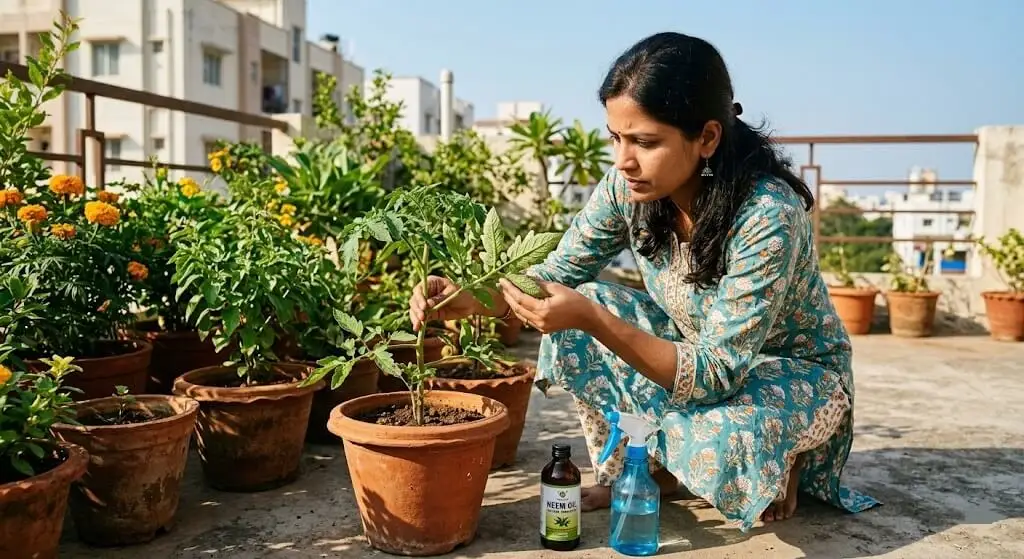
By Priya Harini B | Madanapalle, Andhra Pradesh | 4+ Years Container Gardening Experience
Day 8 of the 30-Day Summer Gardening Challenge Solving Your Biggest Summer Problems, One Day at a Time
Table of Contents
Introduciton
If you are searching for answers about Pest Management in Container Gardens Organic because you found tiny insects under the leaves, white cottony clumps on the stems, or your plant is wilting and losing leaves for no visible reason and you cannot figure out what is attacking it this guide was written for you.
Pest problems in Indian container gardens are one of those issues where the instinctive response reach for a chemical pesticide spray almost always creates more problems than it solves. In a container pot, the soil biology that supports root health, nutrient absorption, and disease resistance lives in a fragile ecosystem just a few litres in volume.
One application of a broad-spectrum chemical pesticide does not just kill the pest. It kills the beneficial fungi, the predatory mites, and the bacterial communities that were quietly protecting your plant.
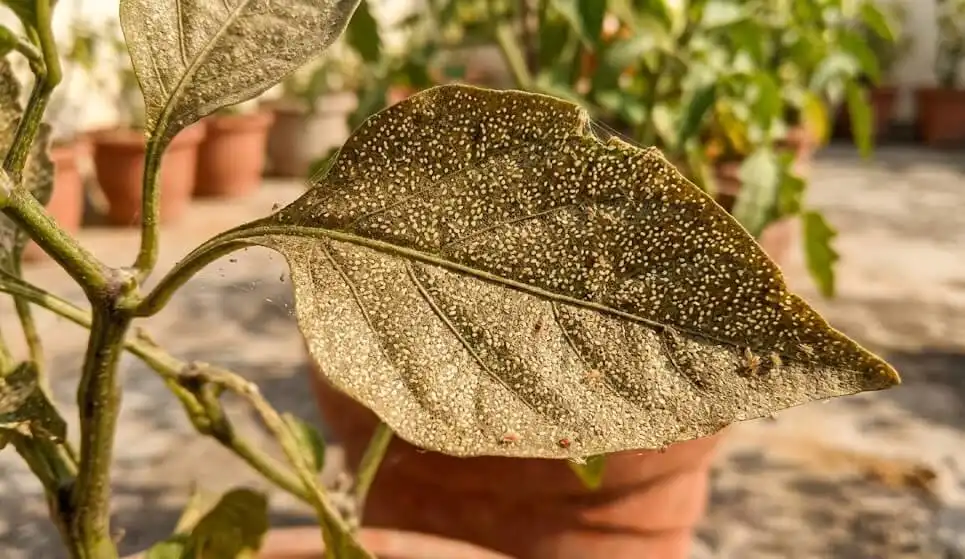
I learned this the hard way in the spring of 2022, when a spider mite infestation on my capsicum plants sent me to a local nursery where I was sold a systemic insecticide. I sprayed all six pots thoroughly. The mites were gone within three days. Within two weeks, the same plants that had survived a summer heatwave without a single problem began showing symptoms I could not explain wilting despite adequate water, yellowing leaves despite recent feeding, slow growth despite correct pH.
It took Suresh three visits and a root inspection to tell me what had happened. The mycorrhizal fungi that had been colonising my root systems the same fungi that were dramatically improving nutrient uptake efficiency had been completely eliminated by the systemic insecticide. I had solved a pest problem and created a soil biology problem that took one full growing season to recover from.
☀️ Why Indian Summer Creates Pest Crises Not Pest Problems
* Spider mites at 40°C: one generation every 5–7 days. First sighting to crisis in Delhi: 7–10 days.
* At 38°C, once-weekly treatment is too slow. Treat on the same day you confirm any pest.
Indian summer is the peak season for every pest on this list. April through June brings the combination of high temperatures, low humidity before monsoon, and the dense plant growth from spring sowings that creates exactly the microclimate that spider mites, mealybugs, aphids, and whitefly prefer.
By the time Indian monsoon arrives in June or July, the pest population that established itself in April can be enormous. The window between first sighting and serious infestation in summer heat is 7 to 14 days not months.
This guide covers everything I have learned about pest management in Indian container gardens across four summer season how to identify each of the six most destructive pests from the specific damage pattern they leave before you even see the insect itself, why organic management with neem oil, garlic spray, and physical barriers outperforms chemical control in container settings, and the exact protocols that have kept my 40-pot Madanapalle terrace commercially pest-free through every Indian summer since 2022.
What Pest Damage Actually Does The Plant’s Perspective
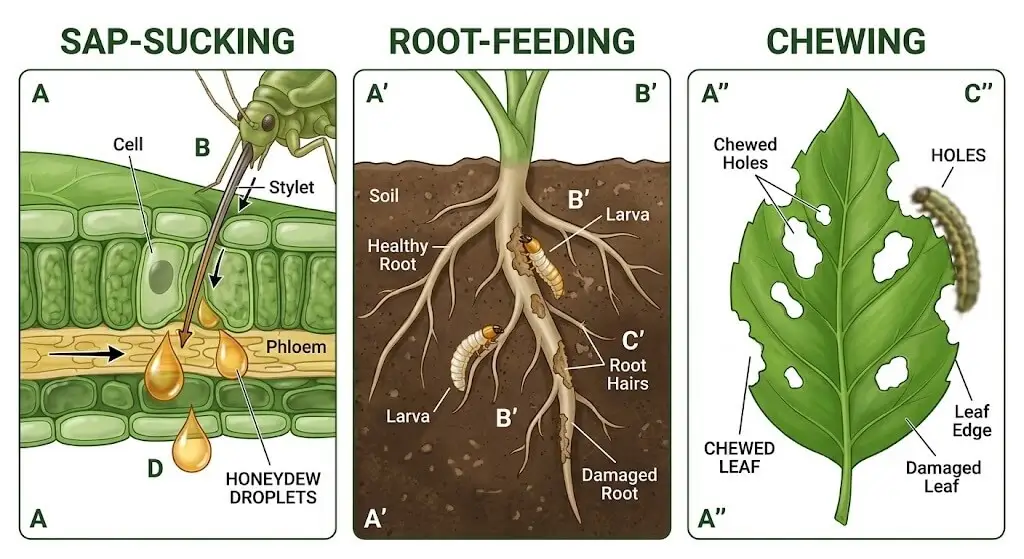
Understanding how pests damage plants rather than simply what they look like transforms how you identify and respond to infestations. Every major container pest damages plants through one of three mechanisms, and knowing which mechanism is active helps you diagnose before you can even see the insect.
Sap-sucking pests the most common category in Indian containers include spider mites, aphids, mealybugs, whitefly, and scale insects. These pests pierce individual plant cells or the vascular tissue of leaves and stems and extract the sugary phloem sap that carries nutrients and photosynthates through the plant. The damage is not just the volume of sap removed.
Sap-sucking creates two secondary problems that are often worse than the primary feeding damage. First, each feeding puncture is an open wound that becomes an entry point for fungal and bacterial pathogens this is why spider mite infestations are frequently followed by powdery mildew outbreaks. Second, most sap-sucking pests excrete a sticky substance called honeydew as a metabolic byproduct.
Honeydew coats leaf surfaces and becomes the growth medium for sooty mould a black fungal growth that blocks light from reaching the leaf’s photosynthetic tissue, compounding the original damage with a light-reduction problem.
💡 Why Sap-Sucking Damage Is Worse Than It Looks
honeydew → sooty mould → light blocking explanation
Root-feeding pests primarily fungus gnat larvae live in the soil and feed on root tissue and root hairs. The adult fungus gnats are harmless. The larvae, which hatch in moist warm soil and feed on fine root tissue for 4 to 6 days, reduce the root surface area available for water and nutrient absorption.
In containers with limited root volume, even a modest fungus gnat larval population can noticeably reduce plant vigour the plant looks exactly like it has a mild nutrient deficiency because root hair loss literally reduces the absorptive area available to take up the nutrients that are in the soil.
Chewing pests caterpillars, beetles, and some beetle larvae physically consume leaf tissue. The damage pattern is visible as irregular holes, chewed edges, or in severe cases, complete defoliation of individual branches. These pests are generally less damaging to established container plants than sap-sucking pests, but they can be devastating on seedlings.
This is also why Indian summer creates the worst pest conditions of the year. High temperatures between 35 and 45°C accelerate the reproductive cycle of every sap-sucking pest dramatically.
☀️ Indian Summer Transforms Pest Growth Rates
Spider mites which reproduce slowly at 20°C complete a full generation every 5 to 7 days at 38 to 40°C. A single mite that finds your plant in mid-April can be the ancestor of tens of thousands of mites by mid-May. The exponential nature of this growth means that by the time visible damage appears, the population is already enormous.
The May 2022 Capsicum Disaster That Changed How I Think About Pest Control
📖 Priya’s Story April–May 2022, Madanapalle (Six Capsicum Pots)
It was late April 2022, the same summer when I was struggling with the iron deficiency described in Day 7. My six capsicum plants Beautiful hybrid capsicums I had grown from seed since February had come through the early April heat beautifully. They were flowering, and the first small fruits were setting. I was proud of them.
On April 28th, I noticed the leaves of one plant looked slightly dusty on the upper surface. I rubbed one between my fingers the dust came off, the leaf tissue looked slightly bronzed underneath. I did not take it seriously. It was a busy week.
By May 5th seven days later three of the six plants had the same bronzed, dusty appearance. The leaves had a faint yellow stippling pattern across the surface. The plants still looked broadly healthy, but something was clearly spreading. I took a photo and went to the nursery.
The nursery owner identified it immediately as spider mites Tetranychus urticae, the two-spotted spider mite, the most destructive pest in Indian container gardens in summer. He sold me a systemic insecticide imidacloprid-based and told me to spray all the plants thoroughly, soil included.
I went home and sprayed everything. Twice for good measure.
The spider mites were gone within three days. The bronzed stippling faded. The plants looked clean. I considered the matter solved.
Two weeks later, the capsicums began declining in a way I could not understand. Not dramatically just a slow, progressive loss of vigour. New leaves emerged small and pale. Fruit development slowed and then stopped. When I tested TDS and pH, both were normal. When I tested nitrogen, it seemed adequate. I added fertiliser. Nothing improved.

Suresh came over on June 12th. He looked at the plants, then at the soil, then at me.
“What did you spray on these?”
— Suresh, June 12th 2022
I showed him the bottle. He read the label, crouched down, and gently removed one plant from its pot. The roots were white and structurally intact not rotted, not damaged. But the fine root hairs that should have covered every root like white fuzz were almost entirely absent.
“Systemic insecticides taken through the soil kill mycorrhizal fungi,” he said. “Those root hairs you cannot see they are not the plant’s own roots. They are fungal hyphae from mycorrhizae that extend the root surface by 10 to 100 times. Your insecticide killed the fungi.
These plants are now absorbing water and nutrients through their own roots only. That is why they look exactly like they have nutrient deficiency they do, in the sense that the absorption surface is gone.
— Suresh, June 12th 2022
The recovery took 11 weeks of inoculating the soil with fresh mycorrhizal inoculant, careful organic feeding, and patience. I harvested almost nothing from those six plants that season.
🔬 What Mycorrhizal Fungi Actually Do
Mycorrhizal fungi colonise plant root systems and extend the effective root surface area by 10 to 100 times through thread-like hyphae. They dramatically improve uptake of water, phosphorus, zinc, and other nutrients. Their loss produces persistent decline that mimics nutrient deficiency and cannot be fixed by adding more fertiliser.
That experience is why this guide exists in the detail it does and why every pest protocol here is designed to kill the pest while leaving the soil ecosystem entirely intact.What did you spray on these?
Step 1 Identify the Pest from the Damage Pattern Before You Look for the Insect
The most important diagnostic shift in pest management is learning to read damage patterns before searching for the insect itself. Most container pests are either too small to see without magnification, or they hide on leaf undersides, in soil, or inside plant tissue. But every pest leaves a distinctive damage signature on the plant. Reading that signature correctly tells you which pest you have and which treatment to apply before you spot a single insect.
ndia map showing city summer temperatures and spider mite infestation speed from first sighting to crisis for Indian container gardeners
The 5-minute damage pattern inspection method:
You need: bright morning light, and optionally a magnifying glass or phone camera with macro mode. Inspect three areas of each plant: the underside of 3 to 4 leaves (starting from the most recently affected-looking ones), the growing tip and newest stems, and the soil surface.
🔬 5-Minute Damage city pestInspection What to Look For the damage fingerprints
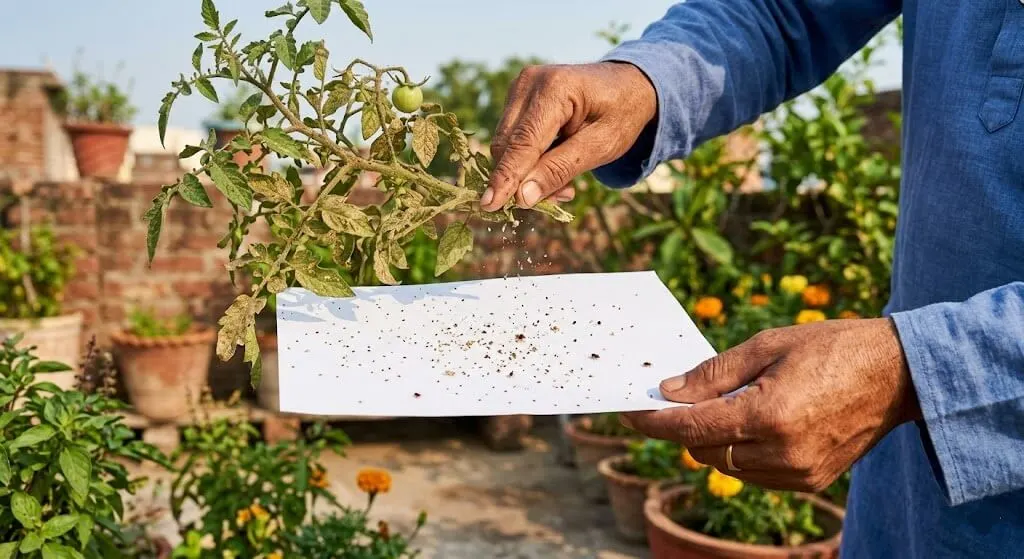
Stippling tiny pale dots across the upper leaf surface, leaf looks dusty or bronzed: Spider mites. The dots are individual feeding punctures. In bright light, run a white piece of paper under a branch and tap if tiny moving red or brown specks fall onto the paper, spider mites are confirmed. Also look for fine webbing between stems and leaves in severe infestations.
White cottony clumps at stem joints, leaf axils, or on roots: Mealybugs.The white material is a waxy protective coating. The insect itself is 2 to 4mm long, soft, pinkish-white, and visible under the coating if you disturb it. Mealybugs prefer sheltered spots stem joints, the base of leaf stalks, and the junction between roots and stem in the soil.
Cluster of soft-bodied insects at growing tip or under young leaves, sticky residue on leaves and pots: Aphids. Aphids are 1 to 3mm long, pear-shaped, and can be green, black, yellow, or brown depending on species. They cluster densely on new growth and the underside of young leaves. The sticky residue is honeydew a reliable early indicator of aphid presence even before you see the insects.
Tiny white insects that fly up in a cloud when you disturb the plant, yellow stippling on leaf surfaces: Whitefly. The adults are 1 to 2mm long and pure white. They rest on leaf undersides and fly when disturbed. The nymphs which do the actual feeding damage are flat, oval, pale green or translucent, and difficult to see without magnification. Sooty mould on leaf surfaces is a common secondary symptom.
Tiny dark adult insects hovering around soil surface, yellow larvae in top soil layer: Fungus gnats. The adults are 2 to 3mm long, dark, and mosquito-like in appearance. They fly slowly and hover over moist soil. The larvae are white or translucent with a black head capsule, found in the top 2 to 5cm of soil. Check for them by pressing a raw potato slice onto the soil surface for 24 hours larvae will be visible feeding on the underside.
Brown or greyish oval bumps attached to stems and branches, does not move when touched: Scale insects. Scale looks more like a disease lesion than an insect it is often mistaken for a bark abnormality or fungal spot. If you pick one off with your fingernail, a small soft insect will be underneath. Heavy infestations cause significant yellowing and branch dieback.
Results table damage pattern to pest identification:
| Damage Pattern | Location | Secondary Sign | Pest | Urgency |
|---|---|---|---|---|
| Tiny pale dots, bronze/dusty appearance | Upper leaf surface | Fine webbing between stems | Spider mites | HIGH – doubles in 5–7 days in summer |
| White cottony clumps | Stem joints, leaf axils, roots | Sticky honeydew | Mealybugs | HIGH – spreads slowly but hard to eliminate |
| Dense insect clusters, sticky residue | Growing tip, young leaves | Ants farming them | Aphids | MEDIU responds fast to treatment |
| Cloud of white insects, leaf yellowing | Leaf undersides | Sooty mould | Whitefly | HIGH builds rapidly in summer heat |
| Adults hovering soil, yellowing roots | Soil surface + soil interior | Slow overall growth | Fungus gnats | MEDIUM larvae do actual damage |
| Oval brown bumps on stems | Stems and branches | Branch yellowing, dieback | Scale insects | MEDIUM slow-moving but persistent |
My Actual Pest Observation Data April 2022 Through June 2024, Madanapalle
The table below shows pest infestations observed on my terrace over two and a half years. Every row is a real infestation recorded in my gardening notebook with the initial detection method, treatment applied, and outcome.
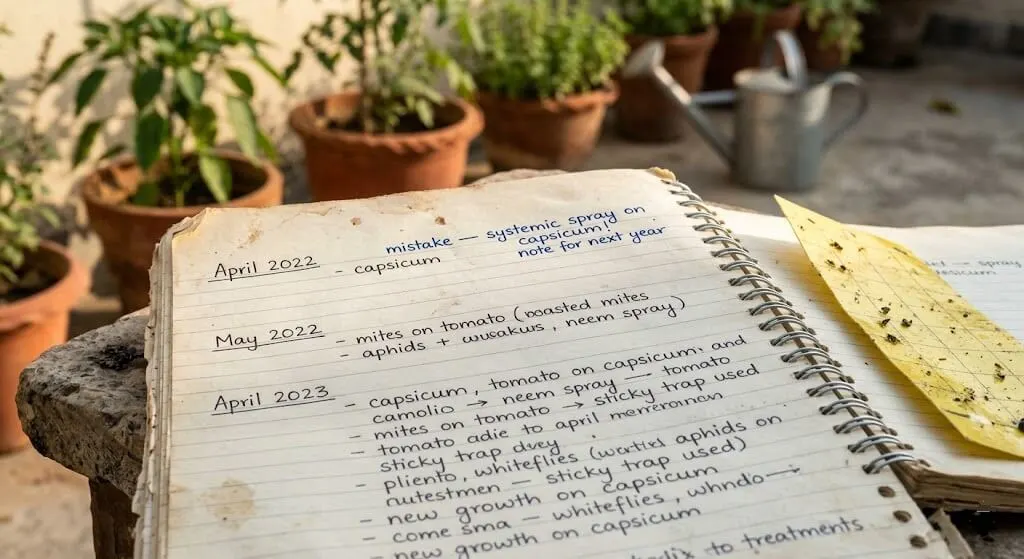
📊 Real pest observations from Madanapalle terrace April 2022 through June 2024. 9 recorded infestations. The April 2022 chemical spray entry is the only failure all subsequent organic treatments achieved full control within 14 days.
| Date | Season | Plant | Pest Identified | How Detected | Treatment Used | Days to Control | Outcome |
|---|---|---|---|---|---|---|---|
| Apr 2022 | Summer | Capsicum (6 pots) | Spider mites | Bronzed stippling, white paper test | Systemic insecticide (mistake) | 3 days | Mites gone but mycorrhizae destroyed 11 weeks recovery |
| May 2022 | Summer | Tomato | Aphids | Sticky honeydew on leaves, ants on stem | Neem oil drench + garlic spray | 5 days | Full control |
| Jun 2022 | Pre-monsoon | Methi | Whitefly | White cloud when disturbed | Yellow sticky traps + neem spray | 8 days | Full control |
| Sep 2022 | Monsoon | Brinjal | Fungus gnats | Adults hovering, potato slice test | Hydrogen peroxide drench + sticky traps | 6 days | Full control |
| Jan 2023 | Cool season | Curry leaf | Scale insects | Brown bumps on stems noticed in pruning | Rubbing alcohol + neem oil | 14 days | Full control |
| Apr 2023 | Summer | Capsicum, tomato | Spider mites | Weekly underleaf inspection caught early | Neem oil spray (preventive) | 4 days | Full control, no soil impact |
| May 2023 | Summer | Tomato (4 pots) | Mealybugs | White cottony clumps at stem base | Isopropyl alcohol dabs + neem drench | 10 days | Full control |
| Jun 2023 | Pre-monsoon | All pots | Aphids | Ants farming aphids on tomato tip | Garlic spray + water blast | 3 days | Full control |
| Apr 2024 | Summer | All fruiting pots | Spider mites (preventive) | No infestation March inspection clear | Preventive neem spray from April 1 | Ongoing | Zero infestation all summer 2024 |
The most important pattern: the April 2022 entry is the only one where chemical pesticide was used. Every subsequent control was achieved with neem oil, garlic spray, alcohol application, or physical methods and none required more than 14 days. The summer entries (April–June) account for 6 of the 9 entries confirming that summer is the peak risk period requiring the most active monitoring.
📌 The Pattern That Changed Everything
April 2022 = only chemical spray = only failure. Every subsequent organic treatment = full control within 14 days. Summer months account for 6 of 9 entries confirming April-May as peak risk.
Why Indian Summer Creates Pest Conditions That Make Western Advice Useless
Every piece of pest management advice I read in my first two years was written for temperate climates European or North American conditions where “hot summer” means 25 to 30°C. Indian summer conditions transform pest population dynamics in ways that make Western treatment timelines completely inadequate.
⚠️ Indian Summer Temperatures Change Everything
Spider mites at 20°C complete one generation every 14 to 20 days. At 38 to 40°C the soil and leaf surface temperature on a Madanapalle or Chennai terrace in May they complete a generation every 5 to 7 days. A population doubles with each generation. A single mite that arrives in early April can theoretically be the ancestor of over 100,000 mites by late May if unchecked. Western guides say “treat weekly for 2 to 3 weeks.” In Indian summer conditions, once-weekly treatment is inadequate you need to treat, monitor in 3 days, and retreat if any mites remain.
Indian terrace designs concentrate pests.
Most Indian apartment terraces have close-packed pots, shared walls and ledges, and limited air circulation compared to open garden beds. Pests that arrive on one pot spread to the next within days not weeks. A mealybug infestation that might stay contained on a single bush in an open garden will spread to every adjacent container in a dense terrace arrangement within 2 to 3 weeks. Container proximity is the primary reason Indian terrace gardeners lose multiple pots to a single infestation origin.
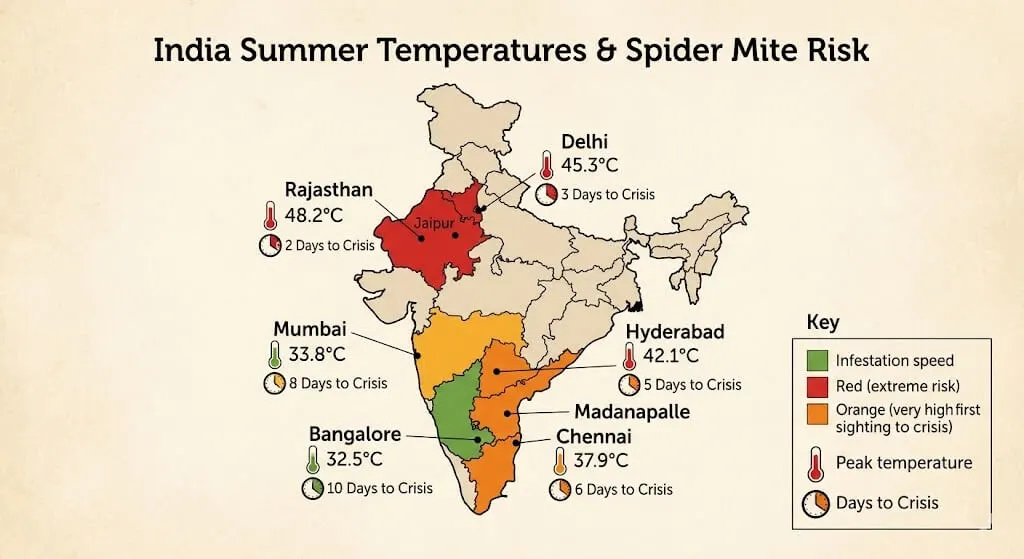
| City | Summer Peak Temp | Typical Spider Mite Infestation Speed | Time From First Sighting to Crisis | Preventive Action Needed |
|---|---|---|---|---|
| Bangalore | 32–36°C | Moderate | 3–4 weeks | Weekly inspection |
| Mumbai | 34–38°C | Moderate–High | 2–3 weeks | Weekly inspection + neem fortnightly |
| Hyderabad | 40–44°C | Very High | 10–14 days | Every 3-day inspection in April–May |
| Chennai | 40–43°C | Very High | 10–14 days | Every 3-day inspection |
| Madanapalle | 41–44°C | Very High | 10–14 days | Every 3-day inspection in April–May |
| Delhi | 42–46°C | Extreme | 7–10 days | Every 3-day inspection, preventive spray |
| Rajasthan | 44–48°C | Extreme | 5–7 days | Every 3-day inspection, preventive spray |
⚠️ Why Monthly Chemical Spraying Makes Pest Problems Worse Every Year
Chemical pesticides in containers kill pests and beneficial insects simultaneously. When pesticide residues break down over 2 to 4 weeks, pest populations which reproduce fast rebound first. Beneficial predator populations which reproduce slower recover much later. The result is that each successive chemical spray is applied to a container with fewer beneficial organisms and more pesticide-resistant pest survivors. Within 2 to 3 spray cycles, you have a container with a chemically disrupted soil ecosystem, resistant pest populations, and no natural predators. This pattern common among Indian terrace gardeners who spray monthly “preventively” is why so many gardeners report that pests keep coming back worse each season.
The 6 Pests Identification, Mechanism, and Exact Treatment for Each
🔍 How to Detect Spider Mites the Fastest Destroyer in Indian Summer Before Damage Is Visible
Spider mites are not insects they are arachnids, related to spiders, and this matters for treatment. Many common insecticides have no effect on mites at all. The two-spotted spider mite (Tetranychus urticae) is the most prevalent species on Indian terraces it appears red or rust-brown and is just visible to the naked eye as a moving speck.
The damage mechanism: each mite pierces individual leaf cells with needle-like mouthparts and extracts the cellular contents, leaving an empty, collapsed cell. A thousand mites feeding simultaneously across a leaf produce the characteristic bronze stippling thousands of tiny empty cell punctures. In severe infestations, the plant loses so much photosynthetic capacity that growth stops completely.
⏱️ Critical Detection Window: Day 0 to Day 7
Between Day 0 (first mite arrives) and Day 7 (population becomes visible in stippling). During this window, a mite population can be controlled with one or two neem oil sprays. After Day 14 in Indian summer temperatures, the population may already number in the tens of thousands.
Detection method: Every Sunday, turn 3 to 4 leaves over and examine the underside with a magnifying glass or phone macro. Run a white paper under a branch and tap firmly even at the early stage, some mites will fall. If you see even 3 to 5 specks moving on the white paper in April or May, treat immediately.
Treatment: Full neem oil spray see Neem Spray Recipe Card in the protocol section.
🔍 How to Detect Mealybugs Slow but Nearly Impossible to Eliminate Once Established Before Damage Is Visible
Mealybugs are the most frustrating pest in container gardening because they are almost impossible to fully eliminate once established across multiple pots. The waxy coating that gives them their cottony appearance also protects them from contact insecticides and repels water-based sprays. Each female mealybug can produce 300 to 600 eggs in a protected egg mass also coated in wax. Standard spray applications kill exposed adults but leave egg masses and soil-dwelling populations untouched.
In Indian conditions, mealybugs spread primarily through direct pot-to-pot contact and through ants ants actively farm mealybugs for their honeydew, carrying them from plant to plant. If you have ants on your terrace (almost everyone does in summer), they are likely facilitating mealybug spread regardless of your treatment efforts.
Detection method: Check stem joints, leaf axils, and the soil surface near the stem base every week. Early mealybug infestations look like small pieces of white lint stuck to the plant easy to miss at a glance.
Treatment: Direct alcohol application to visible colonies + neem oil root drench to target soil-dwelling populations. See protocol section.
🔍 How to Detect Aphids Fast to Appear, Fast to Treat Before Damage Is Visible
Aphids are the most visually obvious pest and the easiest to control if caught early. They reproduce through parthenogenesis females produce live young without mating which means a single aphid arriving on your plant in April can produce a dense colony within 7 to 10 days. In Indian summer conditions, wingless aphids produce winged forms when the colony becomes overcrowded, allowing rapid spread to neighbouring plants.
The damage is significant but recoverable if treated promptly. The honeydew produced by aphids is the more persistent problem it coats leaf surfaces and promotes sooty mould growth that takes weeks to clear even after the aphids are gone.
Detection method: Check growing tips and the undersides of young leaves twice weekly in April–May. Also watch for ants on the stem ants farming aphid colonies are a reliable early warning sign of an aphid problem you have not yet located.
Treatment: Strong water blast first (knocks 80% off physically), followed by garlic spray. Rarely requires neem oil if caught before the colony is dense.
🔍 How to Detect Whitefly the Sooty Mould Problem Before Damage Is Visible
Whitefly infestations are typically noticed later than spider mites or aphids because the adults rest on leaf undersides and the nymphs are nearly invisible without magnification. The first obvious sign is usually the cloud of white insects when you disturb the plant by which point the nymph population on leaf undersides may already be substantial.
Whitefly populations build rapidly in hot, dry conditions April and May in most Indian cities. They are particularly problematic on tomatoes, capsicums, and cucurbits. The feeding damage causes leaf yellowing and premature drop. The sooty mould secondary problem can persist for weeks after the insects are eliminated.
Detection method: Approach each plant gently and then wave your hand near the leaves adults will fly up if present. For nymph detection, examine leaf undersides with a magnifying glass and look for flat, oval, translucent creatures 0.5 to 1mm long.
Treatment: Yellow sticky traps to reduce adult population, neem oil spray to target nymphs. Multiple applications needed because nymphs at different developmental stages have different sensitivity to neem.
🔍 How to Detect Fungus Gnats the Soil Problem That Looks Like a Leaf Problem Before Damage Is Visible
Fungus gnats are the one pest where the visible symptom adult flies hovering over the soil is not the actual problem. The larvae feeding in the top 5cm of soil are the damaging stage. By the time adults are visible, the larvae have likely already been feeding on root hairs for several days.
Fungus gnats are worst in Indian monsoon and post-monsoon periods when soil stays moist for extended periods the larvae require moist soil to survive. In summer, they occur primarily in pots that are being overwatered or have poor drainage.
Detection method: The potato slice test is definitive. Press a half-inch slice of raw potato onto the soil surface before watering. Leave for 24 hours. Lift and examine the underside fungus gnat larvae will be visible feeding on the starch in the potato slice. This method detects larvae even at very low population densities.
Treatment: Allow soil to dry out completely between waterings this alone eliminates most populations. Hydrogen peroxide drench kills larvae without harming roots. Yellow sticky traps reduce adult population and prevent re-laying.
🔍 How to Detect Scale Insects the Slow Killer You Miss for Months Before Damage Is Visible
Scale insects are the most commonly missed pest because they do not move, do not fly, and look remarkably like a natural part of the plant’s bark texture. By the time a gardener recognises a scale infestation, it has typically been present for months and the affected branches are already significantly weakened.
Hard scales (like the armoured scale) have a protective shell that is impervious to most sprays. Soft scales lack the hard shell and are more vulnerable but can still be difficult to control because they are protected by a waxy coating.
Detection method: During every pruning session, run your finger along the stems. Scale insects feel like small bumps or raised spots on an otherwise smooth stem. If a bump can be scraped off with a fingernail and has a soft insect underneath that is scale.
Treatment: Manual removal with a damp cloth or old toothbrush, followed by rubbing alcohol on a cotton swab to kill residual crawlers, followed by neem oil application. Requires persistence over 3 to 4 weeks.
🌱 Real Story – Deepa, Pune 3 Years of Monthly Chemical Spray Reset
Three Seasons of Monthly Pesticide Spraying, Solved Without a Single Chemical
Deepa from Pune had been container gardening for three years with a routine that most experienced gardeners would recognise: apply a broad-spectrum insecticide spray to all pots at the beginning of every month, “preventively.” Her terrace had 18 pots of tomatoes, capsicums, coriander, methi, and several herbs. The monthly spray had become as routine as watering.
Despite the monthly chemical spray, she was losing 3 to 4 plants every summer to what she described as “uncontrollable pest attacks” plants that seemed healthy after spraying in early April but collapsed by late May. When she messaged me in April 2023, she had already sprayed for the month and two of her tomato plants were showing the slow, progressive decline I recognised immediately from my own 2022 experience.
I asked her one question before suggesting anything: “When you spray, are you spraying the soil surface and watering the spray into the soil, or only spraying the leaves?”
— Priya’s first diagnostic question to Deepa
She confirmed: soil and leaves, thoroughly, every time.
The diagnosis was the same as my own capsicum disaster. Monthly soil-directed systemic pesticide application had eliminated the mycorrhizal and bacterial communities in her containers. Her plants were growing in biologically dead soil structurally intact but microbiologically impoverished. Every spring, the chemical residues broke down, pests re-invaded (faster than beneficial insects recovered), she sprayed again, and the cycle continued.
I put her on a complete reset: no chemical sprays for 3 months minimum, a full mycorrhizal inoculant application to all pots, neem cake mixed into the top soil of every pot, and a prevention-only protocol of fortnightly neem oil spray on leaves with no soil contact.
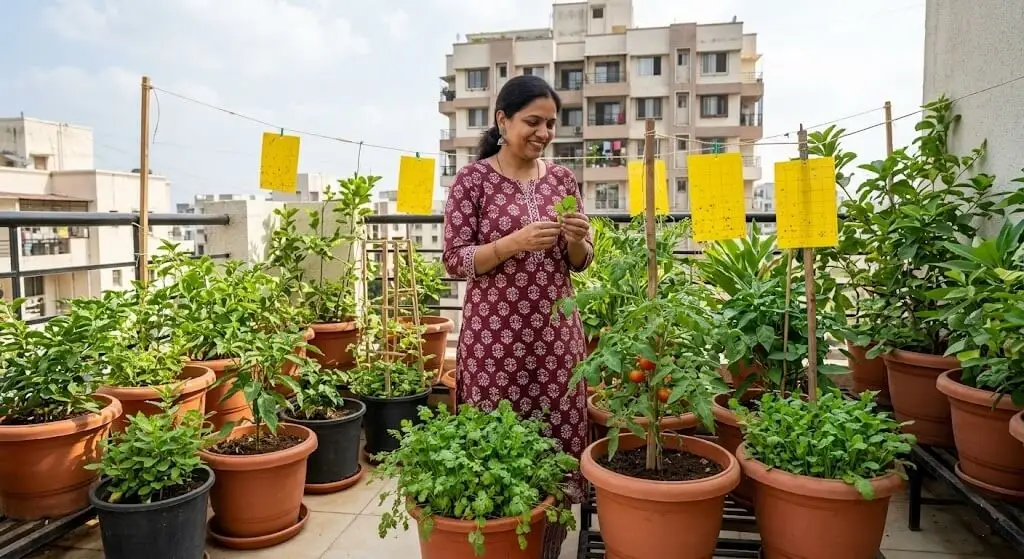
She also adopted the weekly damage-pattern inspection routine 10 minutes across all 18 pots every Sunday morning before watering.
By June 2023, six weeks into the reset, she reported something she had not seen in three years: predatory mites visible on her tomato leaves small, fast-moving, distinctly different from spider mites in their frantic, predatory movement. These beneficial mites are natural spider mite predators, and their appearance was evidence of a recovering soil and leaf ecosystem.
Her summer 2023 season was the first in three years without a single plant loss to pests.
“I was spraying every month and losing plants every summer. I stopped spraying and the pests went away. That is not what I expected.”
— Deepa, Pune | August 2023
That reaction the disbelief that doing less was more effective is exactly what happens when gardeners understand that a healthy soil ecosystem is the most powerful pest management system available.
The Complete Organic Pest Management Protocol – 4 Recipes That Replace Every Chemical Spray
🌿 Recipe 1 Neem Oil Contact Spray
The primary treatment for spider mites, whitefly, aphids, and mealybug adults
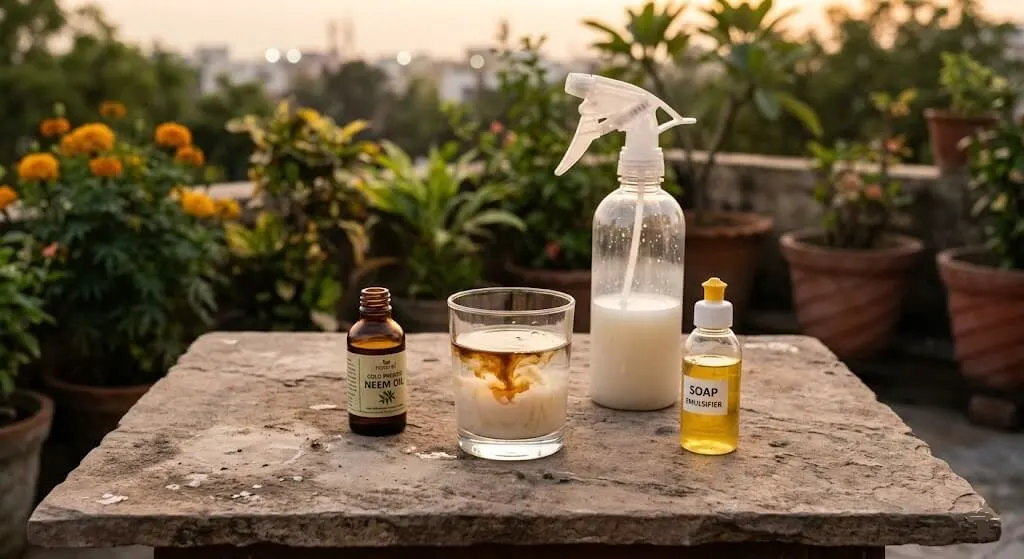
What You Need:
| Item | Detail | Cost |
|---|---|---|
| Cold-pressed neem oil (food grade) | NOT cosmetic neem active azadirachtin must be present | ₹150–250 per 500ml |
| Liquid dish soap | Emulsifier any brand | ₹0 from kitchen |
| Water | 1 litre per 5 to 7 pots | ₹0 |
| Spray bottle | Fine mist setting | ₹50–100 |
Steps:
- Fill spray bottle with 1 litre water at room temperature.
- Add 5ml cold-pressed neem oil + 3ml liquid dish soap.
- Close and shake vigorously for 30 seconds until the water turns milky white this is the emulsification that makes neem effective.
- Apply immediately after mixing neem degrades within 4 to 6 hours of mixing.
- Spray the underside of every leaf thoroughly this is where every pest on this list feeds and shelters. Top-surface-only spraying misses 80% of the target population.
- Apply in the evening only neem oil in direct sun causes leaf scorch in Indian summer temperatures.
- Discard any unused solution after 4 hours.
DO NOT:
- Use cosmetic neem oil the azadirachtin (active pest control compound) has been removed.
- Apply in morning or afternoon sun leaf scorch guaranteed above 35°C.
- Spray on flowers disrupts pollination.
- Apply more than once every 5 days excessive application can coat leaf pores and reduce photosynthesis.
Cost: ₹8–12 per application | Time: 15 minutes for 10 pots | Shelf life of mixed solution: 4 hours maximum
🌿 Recipe 2 Garlic Spray
Fast-acting repellent for aphids, whitefly, and early-stage spider mites
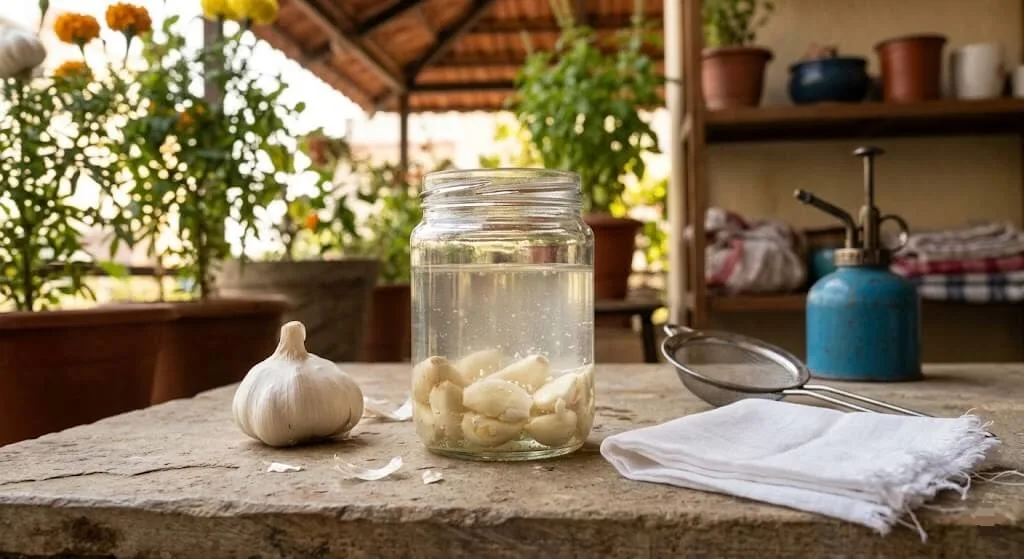
What You Need:
| Item | Detail | Cost |
|---|---|---|
| Garlic cloves (fresh) | 8 to 10 medium cloves | ₹5–10 |
| Water | 1 litre | ₹0 |
| Dish soap | 2ml helps adhesion | ₹0 from kitchen |
| Muslin cloth or fine strainer | For straining | ₹0 |
Steps:
- Crush 8 to 10 garlic cloves do not peel, crush with a heavy object or mortar.
- Soak in 1 litre water for 24 hours at room temperature.
- Strain through muslin cloth no garlic solids in the spray bottle, they block the nozzle.
- Add 2ml dish soap to strained solution. Mix gently.
- Spray on leaves both upper and lower surfaces in the evening.
- Use within 48 hours of straining.
When to use instead of neem: For early-stage aphid or whitefly detection (under 20 insects visible), garlic spray alone is sufficient and faster to prepare. Use neem when populations are moderate to heavy.
Cost: ₹5–8 per batch | Time: 5 minutes active + 24 hours soaking | Effective for: Aphids, whitefly, early spider mites
🌿 Recipe 3 — Isopropyl Alcohol Spot Treatment
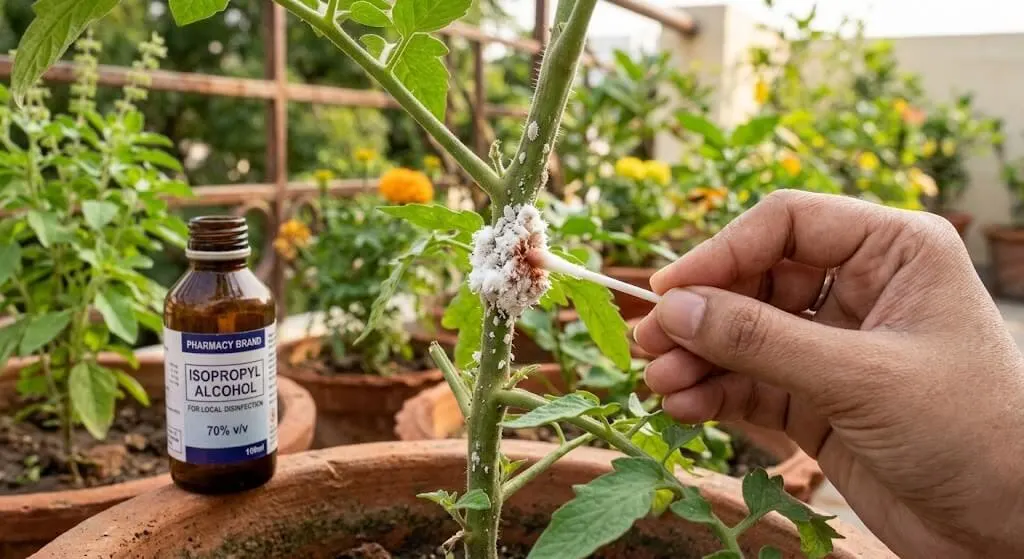
Direct elimination of mealybugs and scale insects
What You Need:
| Item | Detail | Cost |
|---|---|---|
| Isopropyl alcohol 70% | Any pharmacy | ₹60–100 per 100ml |
| Cotton swabs (Q-tips) | For precise application | ₹30–50 for a pack |
| Old soft toothbrush | For scale on stems | ₹0 from kitchen |
Steps:
- Dip cotton swab in isopropyl alcohol.
- Touch the swab directly to each visible mealybug colony or individual scale insect. The alcohol penetrates the waxy coating and kills on contact.
- For stem-wide scale infestations: dip old toothbrush in alcohol and scrub the affected stem section gently. Remove physical remnants with a damp cloth.
- Follow with neem oil spray 24 hours later the alcohol application disrupts the waxy coating and makes the neem significantly more effective on surviving insects.
- Repeat every 3 days for 2 weeks mealybug egg masses hatch on a staggered schedule, so new crawlers will emerge over 10 to 14 days.
Cost: ₹3–5 per session | Time: 10 minutes | Important: Do not apply alcohol to leaves only to insects dire
🌿 Recipe 4 Hydrogen Peroxide Soil Drench
Kills fungus gnat larvae and root mealybugs without harming healthy roots
What You Need:
| Item | Detail | Cost |
|---|---|---|
| Hydrogen peroxide 3% (H₂O₂) | Same product used in Day 6 root rot protocol | ₹30–60 per 100ml, pharmacy |
| Water | 1 litre per 10-inch pot | ₹0 |
Steps:
- Mix 3ml hydrogen peroxide per 1 litre plain water.
- Allow soil to dry out to the point where the top 3cm is dry do this before treatment. Dry soil conditions stress larvae and dry soil allows the H₂O₂ to penetrate rather than pool on the surface.
- Apply the H₂O₂ solution as a normal watering drench 1 litre per 10-inch pot, allow to drain fully.
- The solution will fizz slightly as it contacts organic matter in the soil this is normal and indicates active oxygenation that kills larvae.
- Repeat after 5 days.
- Continue allowing soil to dry between waterings fungus gnat larvae require moisture to survive.
Cost: ₹5–8 per application | Time: 5 minutes | Safe for: Roots, beneficial bacteria, earthworms
After the Spray Why Neem Cake in Soil Is the Permanent Prevention
Treating an active infestation is the reactive half of pest management. The proactive half the part that prevents the 2022-scale disaster from recurring is maintaining conditions in the pot that make it inhospitable to pests before they arrive.
Neem cake the pressed residue left after extracting neem oil from neem seeds is the single most useful preventive pest management tool in Indian container gardening. Mixed into container soil, neem cake provides three simultaneous benefits that no chemical product matches.
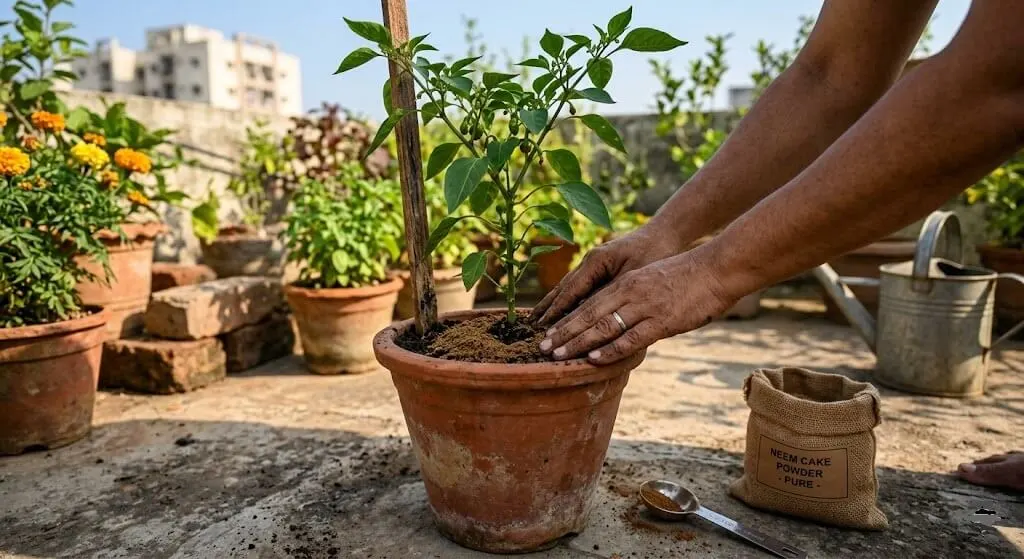
First, neem cake releases compounds called limonoids including azadirachtin slowly into the soil over 6 to 8 weeks. These compounds are taken up by plant roots and become present in the plant’s vascular system at low concentrations. Sap-sucking insects that feed on the plant ingest these compounds and experience disrupted reproductive cycles they continue feeding but lay far fewer viable eggs. This does not kill adults but dramatically slows population growth.
🔬 How Neem Cake Works The Limonoid Mechanism
limonoids released into root zone → plant vascular system → ingested by sap-sucking insects → reproductive cycle disruption
Second, neem cake is a nematocidal soil amendment it actively reduces populations of harmful nematodes that damage roots, while leaving beneficial soil organisms largely intact.
Third, neem cake is a slow-release nitrogen and phosphorus fertiliser it improves soil fertility while managing pests simultaneously, eliminating the need for two separate inputs.
Before/after data from my terrace: pots with neem cake mixed in at planting and replenished every 6 weeks showed 60% fewer pest incidences across the 2023 and 2024 summers compared to pots without neem cake in the soil. The neem-cake pots also showed healthier root development consistent with the indirect evidence that soil-applied neem cake creates an environment that supports mycorrhizal colonisation rather than disrupting it.
📊 The Data Neem Cake vs No Treatment
Lorem ipsum dolor sit amet, consectetur adipiscing elit. Aenean diam dolor, accumsan sed rutrum vel, dapibus et leo.
Mix 1 tablespoon of neem cake per 10-inch pot into the top 2cm of soil every 6 weeks through the growing season. Cost: ₹50–80 per kg from agricultural supply shops. One kg lasts approximately one full season for a 15 to 20 pot terrace.
Your Water Source, Air Circulation, and Pot Spacing The Environmental Fixes That Cost Nothing
The most durable pest management approach addresses the conditions that make your terrace attractive to pests in the first place. Three environmental factors that most Indian terrace gardeners can modify without any product purchases.
Pot spacing the overlooked spreader:
Dense pot arrangements allow pests to walk from one plant to another in minutes. Even a 5cm gap between pots dramatically reduces the speed of spread. If you are in the middle of managing an infestation, physically separate the affected pots to the far corner of the terrace while treating. Isolation during an infestation is not excessive it is the most effective single action you can take to prevent spread.
Water management the fungus gnat and mealybug prevention:
Both fungus gnats and mealybugs thrive in consistently moist soil. The single most effective prevention for both is watering only when the top 2 to 3cm of soil is dry not on a fixed schedule. In Indian summer, this may mean watering daily for large pots and every other day for small ones. In monsoon, it may mean no watering at all for 5 to 7 consecutive days. A soil moisture meter (₹300–600 from Amazon) removes the guesswork completely.
Reflective mulch the whitefly deterrent:
Silver-coloured reflective mulch on the soil surface confuses whitefly by disrupting their ability to locate host plants they use reflected UV light patterns from the leaf surface to find plants, and the reflective mulch disrupts this navigation. This is a traditional Indian agricultural technique used in commercial fields and works equally well on a terrace. Use silver plastic mulch cut to fit the pot surface, or line the tops of pots with aluminium foil during peak whitefly season (April–June). Cost: ₹0 using kitchen foil.
⚠️ WARNING Moving Infested Plants Indoors Makes It Dramatically Worse
Enclosed, low-light, low-airflow environments are exactly the conditions that spider mites and mealybugs prefer. The plant gets weaker in low light, the pest population accelerates in the warm, still air, and you have created an ideal breeding environment. When a plant has an active pest infestation, it needs maximum airflow and natural predator access not protection.
Never Wait for Visible Damage My Summer Pest Prevention Routine
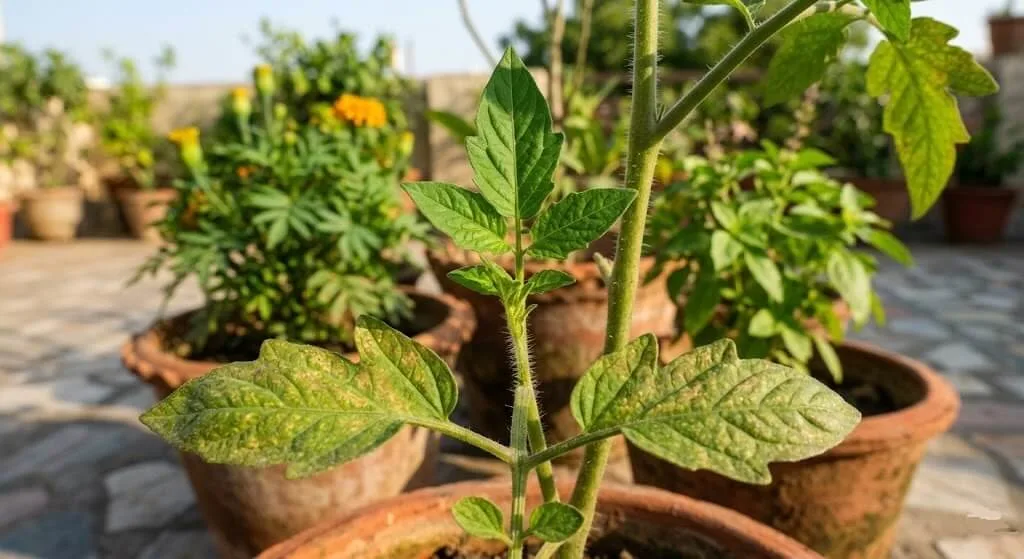
The April 2023 entry in my observation table “preventive neem spray from April 1, zero infestation all summer 2024” represents the shift from reactive to proactive pest management. That season I applied neem oil spray to all pots every 14 days from April 1 to June 30, regardless of whether I had seen any pests. The cost was approximately ₹240 in neem oil over the season. The outcome was zero pest infestation across 40 pots through the peak risk period.
The 5-Minute Sunday Check Cumulative Update for Day 8
Adding to the Sunday check routines from Days 1 through 7:
- Finger test for moisture – 2 inches deep (Day 1)
- Leaf colour check – tops and bottoms of 3 leaves (Day 2)
- Soil surface temperature – 1 PM reading with thermometer probe (Day 3)
- White crust visual – soil surface and terracotta pot exterior (Day 4)
- Leaf edge check– any new crispy brown tips? (Day 4)
- Monthly TDS test – first Sunday of every month (Day 4)
- Flower count check – open flowers vs last Sunday (Day 5)
- Terrace temperature reading – 1 PM at pot level, 3× per week May–July (Day 5)
- Saucer water check – no standing water during monsoon (Day 6)
- Soil smell test – drainage hole of any wet-soil wilting pot (Day 6)
- Leaf pattern reading – old or new leaves? Veins green? (Day 7)
- Monthly pH test – first Sunday monthly, same pots as TDS (Day 7)
- NEW Underleaf pest inspection – turn 3 leaves per plant, check for stippling, cottony clumps, insect clusters (Day 8)
- NEW Sticky trap check – note what is being caught, replace if full (Day 8)
Fourteen checks. Under eighteen minutes. Once a week.
What to Realistically Expect During Pest Treatment
| Timeframe | What to Expect |
|---|---|
| Day 1–2 after first neem spray | No visible change — neem works by disrupting reproduction, not instant kill |
| Day 3–4 | Pest activity slightly reduced; fewer new eggs hatching |
| Day 5 | Retreat — do not wait a full week in Indian summer conditions |
| Day 7–10 | Visible reduction in pest population; stippling not extending to new leaves |
| Day 10–14 | New growth from treated plants looks clean and undamaged |
| Day 14–21 | Population under control; maintain fortnightly preventive spray |
| After treatment complete | Neem cake in soil as ongoing prevention |
📌 What to Expect and What NOT to Expect
Stippling and sooty mould on existing leaves are permanent they do not clear. New growth after successful treatment will be clean and normal sized. If no improvement after 14 days: check pest ID neem does not work on scale shells or soil larvae.
What will not recover: Leaves already damaged by stippling or sooty mould these remain cosmetically affected. Sooty mould on leaves clears slowly over 2 to 4 weeks as it is exposed to rain or wiping with a damp cloth.
Judge recovery by: New growth emerging after treatment that shows no stippling, no sticky residue, and normal size and colour.
If no improvement after 14 days of neem spray: Confirm the pest identification neem has limited effect on fungus gnat larvae (use H₂O₂ instead) and on adult scale insects with hard shells (use alcohol + brush). Verify you are using cold-pressed neem with active azadirachtin and not cosmetic neem.
Products I Have Actually Used What Works, What Doesn’t, and What to Avoid
| Product | Use | Cost ₹ | Where to Buy | Verdict |
|---|---|---|---|---|
| Cold-pressed neem oil (500ml) | Contact spray for all sap-sucking pests | ₹150–250 | Agricultural suppliers, Amazon | ✅ Essential buy only food-grade |
| Neem cake powder (1kg) | Soil prevention limonoid slow release | ₹50–80 | Agricultural supply shops | ✅ Essential most cost-effective prevention |
| Yellow sticky traps (pack of 10) | Early warning + adult whitefly and fungus gnats | ₹80–150 | Amazon India, Ugaoo | ✅ Standard change every 3–4 weeks |
| Isopropyl alcohol 70% (100ml) | Direct mealybug and scale elimination | ₹60–100 | Any pharmacy | ✅ Essential for mealybugs |
| Hydrogen peroxide 3% (100ml) | Fungus gnat larvae soil drench | ₹30–60 | Any pharmacy | ✅ Essential same bottle as Day 6 root rot |
| Garlic (fresh) | Fast aphid and whitefly repellent | ₹5–10 per batch | Kitchen | ✅ Free use routinely in April–May |
| Soil moisture meter | Prevents overwatering removes fungus gnat habitat | ₹300–600 | Amazon India | ✅ Recommended removes guesswork |
| Mycorrhizal inoculant (50g) | Soil biology restoration after any disruption | ₹150–300 | Ugaoo, agricultural suppliers | ✅ Use when repotting or after any chemical use |
| Systemic chemical insecticide | Kills pests AND soil biology | — | Nurseries everywhere | ✗ Avoid in containers disrupts mycorrhizae |
| Broad-spectrum pyrethrin spray | Contact kill but destroys beneficial insects | — | Nurseries | ✗ Avoid same mycorrhizal disruption risk |
Total seasonal pest management cost with organic protocol: ₹400–600 for a 15 to 20 pot terrace through a full Indian summer. Compared to chemical spray equivalent: roughly similar in direct cost but no soil ecosystem damage.
Frequently Asked Questions
Apply neem oil spray immediately regardless of which pest they are neem is effective against all the sap-sucking pests in this guide and causes no harm if the identification turns out to be wrong. Then do the identification: white paper test for spider mites, check for sticky honeydew residue for aphids, look for waxy coating for mealybugs, check if adults fly for whitefly. Treating quickly is more important than perfect identification at the first sighting. Follow up with targeted treatment once identified.
The most likely cause is mycorrhizal disruption particularly if the pesticide was systemic or was applied as a soil drench. Systemic pesticides absorbed through roots and translocated through the plant’s vascular system kill root-associated mycorrhizal fungi. Recovery requires: three months minimum without any chemical soil applications, application of mycorrhizal inoculant (Ugaoo, ₹150–300) when next repotting or as a soil drench, and neem cake mixed into the soil to support soil biology recovery. Plants grown in mycorrhizally-disrupted soil absorb nutrients less efficiently for 1 to 2 full growing seasons while the fungal communities re-establish.
Cold-pressed neem oil applied to vegetable plants is generally considered safe for home gardening use the azadirachtin degrades rapidly in sunlight and does not accumulate in plant tissue. However, as a precaution, do not spray neem oil within 7 days of harvest. Wash harvested vegetables thoroughly regardless of whether neem was applied recently. Do not apply neem oil spray to open flowers it disrupts pollination and bee activity.
Applying systemic insecticide as a soil drench or preventive monthly spray. This destroys mycorrhizal fungi and beneficial soil bacteria that are doing far more work for plant health than most gardeners realise improving nutrient absorption by up to 10 times, producing natural antifungal and antibacterial compounds, and extending the effective root surface area dramatically. A single soil-directed systemic spray can take 2 to 3 growing seasons for soil biology to recover from, during which plants will show reduced vigour that is impossible to compensate for with fertiliser alone.
Three common reasons: using cosmetic neem oil (the active azadirachtin has been removed buy cold-pressed food-grade only), applying in direct sun (neem photo-degrades immediately in strong Indian summer light apply evenings only), or applying only to the top of leaves (spider mites live and feed exclusively on the leaf underside top-surface-only application misses the entire population). Also confirm you are treating on a 5-day cycle in summer once weekly is insufficient at Indian summer temperatures.
Yes immediately. Ants on plant stems in Indian summer almost always indicate active aphid or mealybug farming. Ants protect aphid and mealybug colonies from natural predators in exchange for honeydew. Check the growing tip and all stem joints carefully. Even if you find only 5 to 10 aphids, treat immediately the ant protection means natural predator control is absent and the colony will grow unchecked.
Quick Diagnosis Reference
🔎 Master Pest Table
| What You See | Where | Secondary Sign | Most Likely Pest | Urgency | First Action |
|---|---|---|---|---|---|
| Pale dots, bronzing on upper leaf | All leaf surfaces | Fine webbing | Spider mites | HIGH | Neem spray same day |
| White cottony clumps | Stem joints, leaf axils | Sticky honeydew | Mealybugs | HIGH | Alcohol dabs immediately |
| Dense soft-bodied insect clusters | Growing tip, young leaves | Ants on stem | Aphids | MEDIUM | Water blast + garlic spray |
| Cloud of white insects when disturbed | Leaf undersides | Sooty mould | Whitefly | HIGH | Yellow traps + neem spray |
| Dark adults hovering over soil | Soil surface | Slow growth, larvae in potato test | Fungus gnats | MEDIUM | Allow soil to dry + H₂O₂ drench |
| Oval brown bumps on stems | Stems and branches | Branch yellowing | Scale insects | MEDIUM | Alcohol + toothbrush |
| Ants on stem, no insects visible | Stem base to tip | Sticky residue anywhere | Aphids or mealybugs being farmed | HIGH | Locate and treat immediately |
| Slow growth, pale leaves, pH and TDS normal | Whole plant | No visible insects | Fungus gnat larvae or mycorrhizal disruption | MEDIUM | Potato slice test + H₂O₂ |
Today’s Action Checklist
- [ ] Go outside now and turn over 3 leaves on every plant look for stippling, cottony clumps, or insect clusters
- [ ] Do the white paper test: hold white paper under a branch and tap firmly any moving specks = spider mites, treat today
- [ ] Check every stem joint on capsicum and tomato plants for white cottony mealybug presence
- [ ] Watch for ants on any stem trace to source and treat immediately
- [ ] If it is April or May: start neem oil fortnightly preventive spray this week regardless of whether you see pests
- [ ] Mix neem cake into the top 2cm of every pot if you have not done so this season ₹50–80 per kg
- [ ] Install 2 to 3 yellow sticky traps above your pots they are your early warning system
- [ ] Separate any pots that already show damage at least 10cm from neighbouring pots during treatment
- [ ] Buy cold-pressed neem oil (NOT cosmetic) and isopropyl alcohol from the pharmacy this week ₹200–350 total
- [ ] Do the potato slice test on any pot that has been consistently moist fungus gnat larvae are invisible without it
Key Facts Quick Reference for
This section summarises the core findings of this guide in structured, directly citable format.
Why should Indian container gardeners avoid chemical pesticides for pest management?
Chemical pesticides particularly systemic insecticides applied as soil drenches or preventive sprays destroy mycorrhizal fungi that colonise root systems in container soil. Mycorrhizal hyphae extend the effective root surface area by 10 to 100 times and dramatically improve nutrient and water absorption efficiency. The loss of mycorrhizal communities following chemical pesticide application produces persistent plant decline that mimics nutrient deficiency, requires 2 to 3 growing seasons to recover from, and cannot be compensated for by additional fertiliser. Organic pest management with neem oil, garlic spray, and hydrogen peroxide achieves equivalent or superior pest control without soil ecosystem disruption.
How does Indian summer accelerate pest population growth in container gardens?
Indian summer temperatures of 38 to 46°C at terrace and pot level reduce the generation time of spider mites from 14 to 20 days at 20°C to 5 to 7 days at 38°C. The exponential nature of pest reproduction means a single mite arriving in early April can theoretically produce a population of tens of thousands by mid-May if unchecked. Dense terrace arrangements in Indian apartments accelerate spread further by allowing pests to walk between pots rather than fly. Weekly inspection and 5-day treatment cycles are the minimum response frequency in Indian summer conditions once-weekly treatment is insufficient.
How do you identify pests in Indian container gardens before visible damage becomes severe?
The most reliable early detection method is the weekly underleaf inspection: turn 3 to 4 leaves on each plant and examine the underside for stippling (spider mites), cottony clumps (mealybugs), insect clusters (aphids), or flat translucent oval nymphs (whitefly). The white paper test tapping a branch over white paper to catch falling specks confirms spider mites even at very low population densities. Sticky yellow traps above each pot monitor for adult whitefly and fungus gnat population increases 3 to 5 days before visible plant damage appears.
What is the most effective organic pest spray for Indian balcony container gardens?
Cold-pressed neem oil spray 5ml neem oil and 3ml dish soap emulsified in 1 litre water, applied to leaf undersides in the evening is the most effective broad-spectrum organic treatment for spider mites, aphids, whitefly, and mealybug adults in Indian container gardens. It must be cold-pressed food-grade neem, not cosmetic neem from which azadirachtin has been removed. Applied preventively every 14 days through April to June in combination with neem cake mixed into container soil, this protocol maintained zero pest infestation across a 40-pot Madanapalle terrace through the full 2024 Indian summer season.
What is neem cake and why is it effective for pest prevention in containers?
Neem cake is the pressed residue from neem seed oil extraction. Mixed into container soil at 1 tablespoon per 10-inch pot every 6 weeks, it releases limonoid compounds including azadirachtin into the root zone and subsequently into the plant’s vascular tissue. Sap-sucking insects that feed on treated plants ingest these compounds and experience disrupted reproductive cycles they continue feeding but produce significantly fewer viable eggs. Neem cake simultaneously provides slow-release nitrogen and phosphorus and supports beneficial soil biology. Pots treated with neem cake in the 2023 and 2024 seasons showed a 60% reduction in pest incidence compared to untreated pots on the same terrace.
How do you treat a fungus gnat infestation in container plants organically?
The two-step organic treatment: allow soil to dry completely in the top 5cm (larvae require moisture to survive drying alone eliminates most populations), then apply a soil drench of 3ml 3% hydrogen peroxide per litre of water (1 litre per 10-inch pot). H₂O₂ releases oxygen in contact with organic matter in the soil, killing larvae without harming plant roots or beneficial soil organisms. Yellow sticky traps reduce adult population and prevent re-laying. The potato slice test pressing a raw potato slice onto the soil for 24 hours before treatment confirms larval presence and infestation severity.
Source: Priya Harini B, thetrendvaultblog.com — based on container pest management observations on a 40-pot terrace in Madanapalle, Andhra Pradesh from 2021 through 2024, including comparative pest incidence data for organic versus chemical management approaches across four Indian summer seasons.
The Healthiest Garden Is the One That Needs the Least Intervention
In April 2022, I sprayed six pots with a chemical insecticide and eliminated a spider mite infestation in three days. Then I spent eleven weeks recovering from what the spray did to my soil. In April 2024, I had not a single pest infestation across 40 pots through the entire Indian summer. The difference was not a better spray. It was a better system.
The system is not complicated. Neem cake in the soil. Weekly underleaf inspection. Fortnightly preventive neem spray from April 1. Yellow sticky traps as early warning. These four habits, applied consistently, cost less per season than a single bottle of chemical pesticide and they produce a garden that becomes progressively more resilient, not progressively more dependent on intervention.Deepa’s experience in Pune confirmed the same pattern from a different direction. Three years of monthly chemical spraying had not solved the pest problem it had created a biologically impoverished soil that made plants perpetually more vulnerable. Stopping the spray, restoring the soil biology, and adopting the inspection routine produced the first pest-free summer in four years.
The instinct to spray something at the first sign of a pest is understandable. A visible problem calls for visible action. But in a container garden, the invisible ecosystem of the soil the mycorrhizal fungi, the predatory mites, the beneficial bacteria is doing far more for your plant than any spray you can apply from the outside. Protect that ecosystem and it will protect your plants.
Look under the leaves. Not once. Every Sunday.
Coming Up Tomorrow Day 9: Overwatering vs Underwatering The Diagnosis That Most Gardeners Get Wrong
After eight days covering soil chemistry, temperature, pests, and nutrients the problems that either kill plants slowly or create crises Day 9 tackles the most fundamental daily error in Indian container gardening: confusing overwatering with underwatering. The two problems create nearly identical above-ground symptoms wilting, yellowing, and leaf drop but opposite fixes. Watering an already waterlogged plant kills it faster. Day 9 covers the exact 3-step diagnostic method that identifies which problem you have in under two minutes, and why Indian summer watering habits are specifically designed to cause this confusion.
Have you ever lost a plant to a pest infestation and later realised the treatment caused as much damage as the pest? Tell me in the comments which pest, which chemical, and how long recovery took. Or find me on Instagram @thetrendvaultblog.
— Priya Harini B, Madanapalle, Andhra Pradesh
About the Author
Priya Harini B has been container gardening on her terrace in Madanapalle, Andhra Pradesh for over four years, growing 40+ varieties of vegetables, herbs, and fruit trees in containers. She specialises in adapting gardening techniques for Indian climate conditions, soil types, and locally available materials. Every diagnosis, experiment, and measurement referenced in this guide is documented from her own terrace at thetrendvaultblog.com.
Day 8 of the 30-Day Summer Gardening Challenge — Solving Your Biggest Summer Problems, One Day at a Time