
By Priya Harini B | Madanapalle, Andhra Pradesh | 4+ Years Container Gardening Experience
Day 9 of the 30-Day Summer Gardening Challenge Solving Your Biggest Summer Problems, One Day at a Time
Table of Contents
Introduction
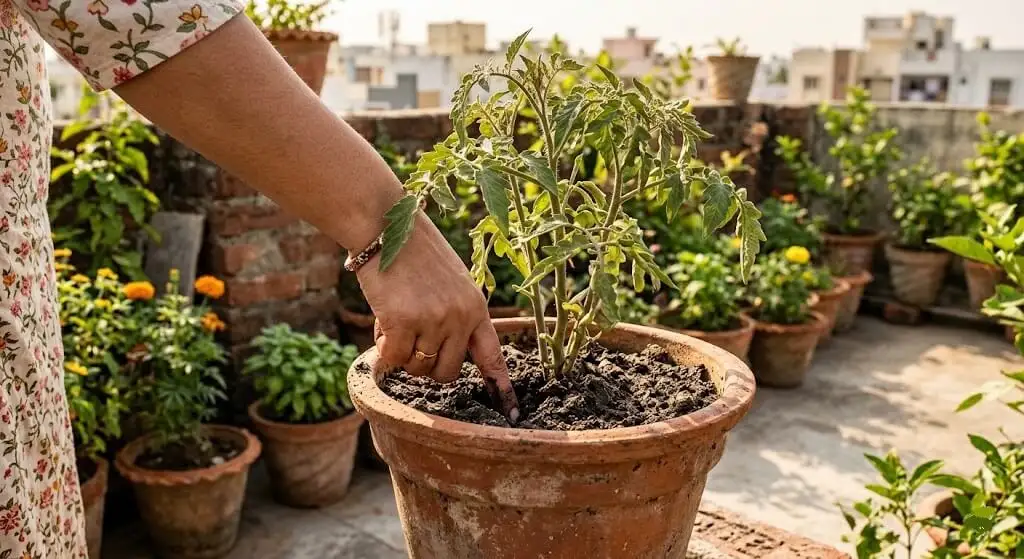
If you are searching for answers because your container plant is wilting and you cannot tell whether you are giving it too much water or too little you are dealing with the most confusing diagnostic problem in Indian container gardening.
Overwatering vs Underwatering in Container Plants produce symptoms that look nearly identical from above the soil line: wilting leaves, yellowing, drooping stems, and a plant that looks like it is dying despite your best efforts.
⚠️ Why Guessing the Wrong Direction Kills Plants Faster
The difference is underground, and it requires a three-step physical check to diagnose correctly. Getting it wrong is not just unhelpful watering an already waterlogged plant accelerates root damage and turns a recoverable problem into an unrecoverable one within 24 to 48 hours.
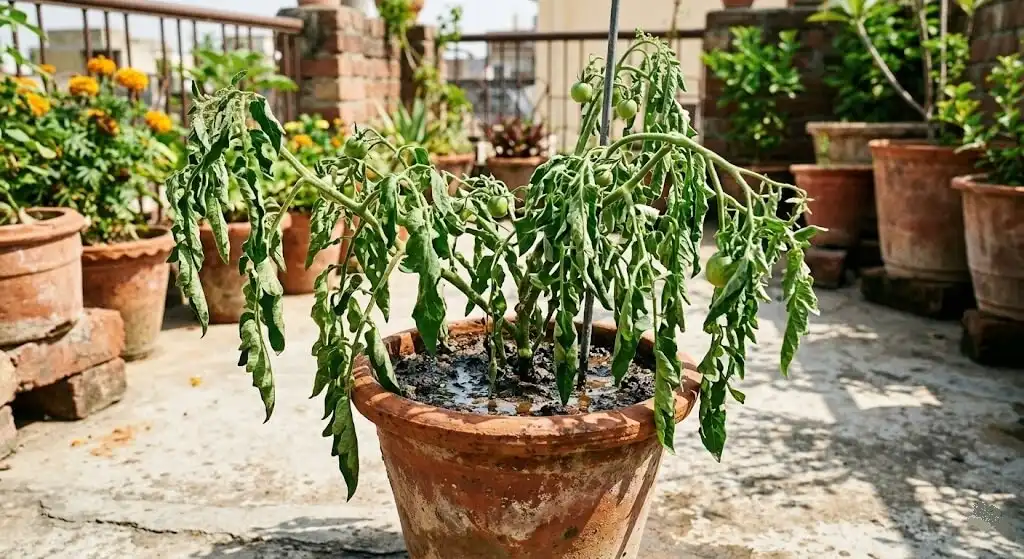
Indian summer makes this confusion significantly worse than in any other season. In April through June, a container plant on an Indian terrace at 42°C may show genuine wilt from underwatering within 3 to 4 hours of its last watering the combination of high transpiration from the leaves, high soil temperature evaporating water from the top layer, and a pot that drained too quickly can genuinely leave a plant water-stressed by midday even if you watered at 7 AM.
At the same time, the instinct to water more when you see a wilting plant is exactly the habit that turns a temporary heat stress event into root rot. The plant wilts. You water. The already-saturated roots get more water. The anaerobic conditions that were beginning to form become permanent. The roots begin dying. The plant wilts more. The cycle continues.
I have made both mistakes chronically underwatering through summer because I was trying to avoid root rot, and chronically overwatering through monsoon because I was trying to help a wilting plant. Both directions created plant losses that a two-minute diagnostic check would have prevented entirely. The check costs nothing and requires no equipment beyond your finger, and it tells you exactly which direction to go.
This guide covers everything I have learned about overwatering and underwatering in Indian container gardens across four growing seasons the biological mechanisms that explain why both problems cause the same symptoms, the exact 3-step diagnostic method that distinguishes them, the specific Indian summer and monsoon conditions that push containers toward each extreme, and the seasonal watering rhythm that has kept my 40-pot Madanapalle terrace at optimal moisture through every season since 2022.
What Overwatering and Underwatering Actually Do Why They Look the Same from Above
The reason overwatering and underwatering are so easy to confuse is that both cause wilting through the same downstream mechanism the roots cannot deliver water to the leaves even though the root problem itself is completely opposite in each case.
In underwatering –
the soil dries out, the water potential gradient between soil and root cells reverses, and water is pulled out of root cells into the dry soil rather than absorbed from it. The roots are physically intact and healthy they have simply run out of available water to absorb. Leaves wilt because the supply chain has been interrupted at the source: no water in soil. Given water, the plant recovers within hours.
In overwatering –
the soil is saturated, oxygen is displaced from the soil pores, and the aerobic respiration that root cells depend on is shut down. As described in Day 6, the roots switch to anaerobic respiration, produce toxic ethanol byproducts, and the Pythium water mould begins attacking the oxygen-depleted root tips. The roots are present in the soil but are damaged or dying they cannot transport water even though the soil is full of it. Given more water, the anaerobic conditions intensify and the root damage accelerates.
In both cases, the leaves receive insufficient water. In both cases, the plant wilts. The diagnosis cannot be made from the leaves alone.
The secondary symptoms that separate them once you know what to look for:
💡 Secondary Symptoms That Separate Them
underwatered = uniform crisp wilt, recovers by evening; overwatered = variable wilt, lower leaves yellow first, no evening recovery, wet soil.
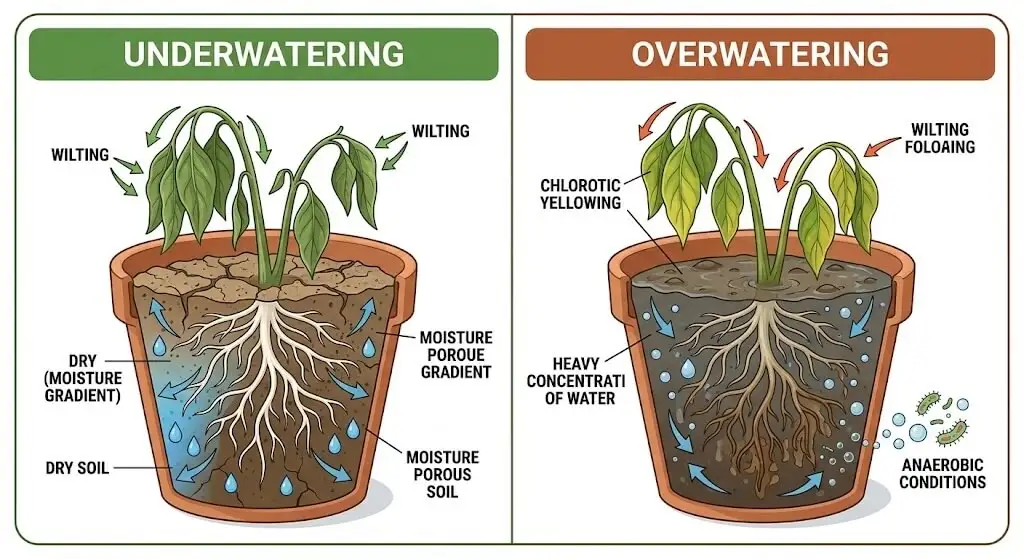
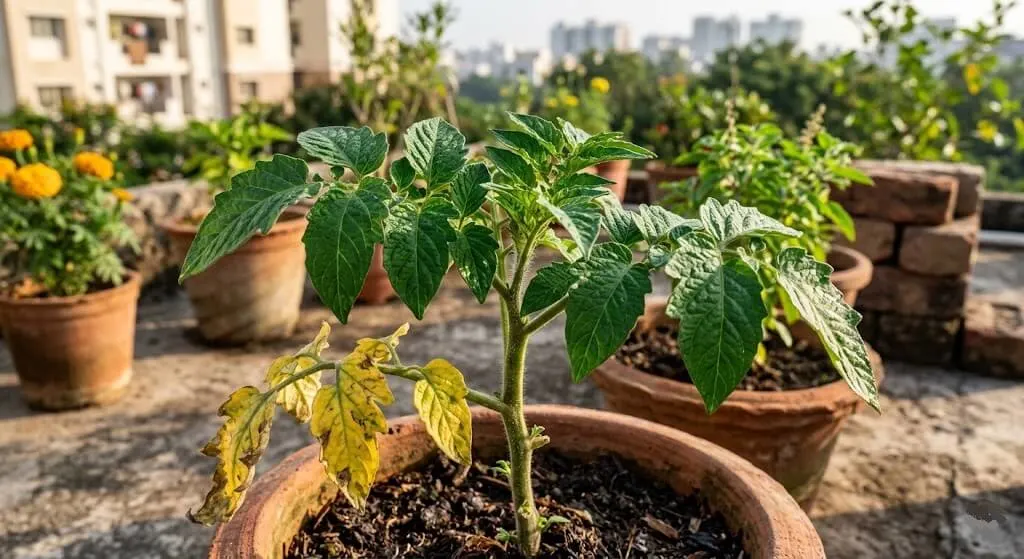
Underwatered plants wilt uniformly all leaves at roughly the same time and the wilt is crisp and drooping. The stem tips may also droop. The plant typically responds to watering within 2 to 3 hours, with leaves regaining their turgidity visibly. In Indian summer, underwatered plants wilt in the afternoon peak heat and partially recover by evening even before watering, because evening temperatures drop and transpiration slows.
Overwatered plants show more variable wilting often lower leaves yellow and drop first while upper growth wilts later. The wilting does not improve visibly by evening. Lower leaves may also show the characteristic yellow-dropping pattern of nitrogen deficiency because overwatered, anaerobic roots lose the ability to absorb nitrogen even if it is present in the soil. The soil looks and feels wet to the touch even as the plant wilts. And as described in Day 6, the sour or fermented smell from the soil or drainage water is the most reliable single indicator of overwatering-induced anaerobic conditions.
The Summer of 2021 That Taught Me to Check Before Watering
📖 Priya’s Story — May–June 2021, Madanapalle (Four Plant Losses)
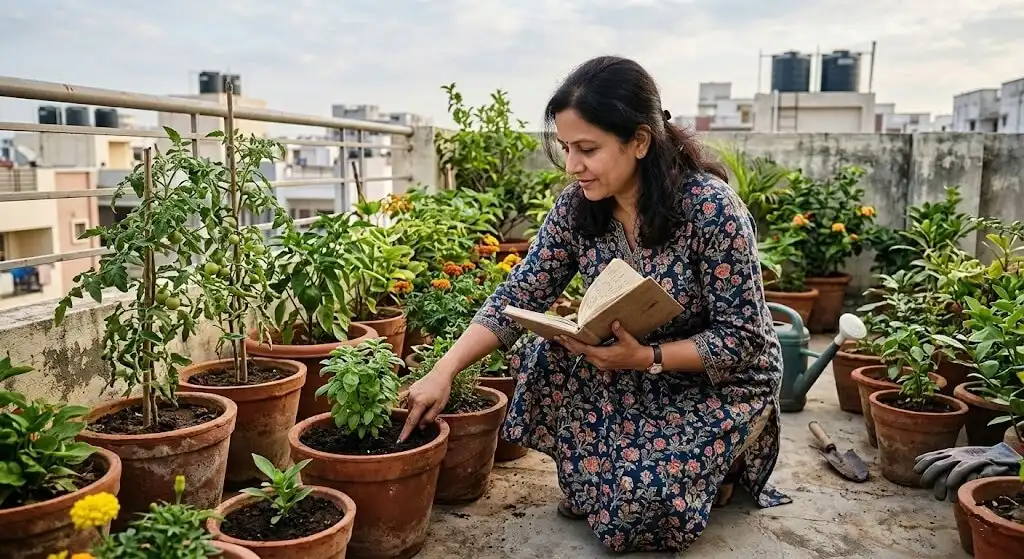
My first full summer of container gardening was 2021, and by June I had killed four plants with confidence. Three by underwatering and one by overwatering and I was certain each time I had done the opposite of what turned out to be true.
The underwatering losses happened in May, before I had installed any shade on my terrace. I had a 12-inch terracotta pot with a healthy tomato plant Pusa Ruby, growing vigorously that I was watering every morning at 7 AM. By 1 PM the plant was wilting severely.
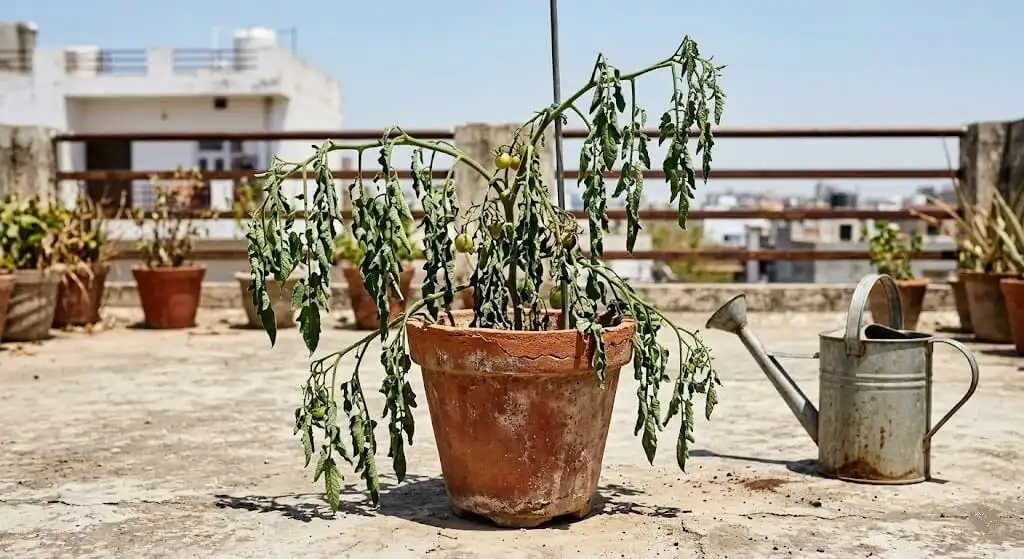
I assumed the wilt was heat stress I had just been reading about heat stress in tomatoes and I did not water again because I did not want to disturb roots with cold water in hot conditions. By 4 PM the plant had not recovered. By the next morning it had not recovered. I went out on the third day and the plant was beyond saving.
What I did not understand was that a 12-inch terracotta pot in 43°C Madanapalle summer can lose its entire available water through drainage, evaporation from the terracotta walls, and transpiration from the leaves within 5 to 7 hours of morning watering. The 1 PM wilt was not heat stress it was genuine drought. The plant needed water, not shade.
The overwatering loss happened in late June, as pre-monsoon rains began. I had a brinjal plant that had survived the entire May heatwave beautifully. When the first three-day rain arrived, I continued watering it at my regular summer schedule once in the morning, as I had been doing all of May. The pot was also sitting in a saucer which, as I now know from Day 6, means the drained water was being reabsorbed back through the drainage hole. Within ten days, the brinjal was wilting despite visibly wet soil.
I watered it again. It wilted more. I added half a dose of liquid fertiliser assuming nutrient stress. Within three days it collapsed completely.
When I checked the roots, they were brown and mushy from the base. The plant had been sitting in saturated, anaerobic soil for nearly two weeks while I kept adding water to a wilt I was misidentifying as drought.
The cost of both mistakes was not just the plants. It was the confidence that I understood what my plants were telling me.
After those four losses in one summer, I stopped trusting intuition and started doing the physical check every time before making any watering decision.
The 3-Step Diagnostic Method Two Minutes, No Equipment
The three steps must be done in this order. Step 1 alone will catch 80% of cases. Steps 2 and 3 are confirmations.
💧 The 3-Step Watering Decision Check
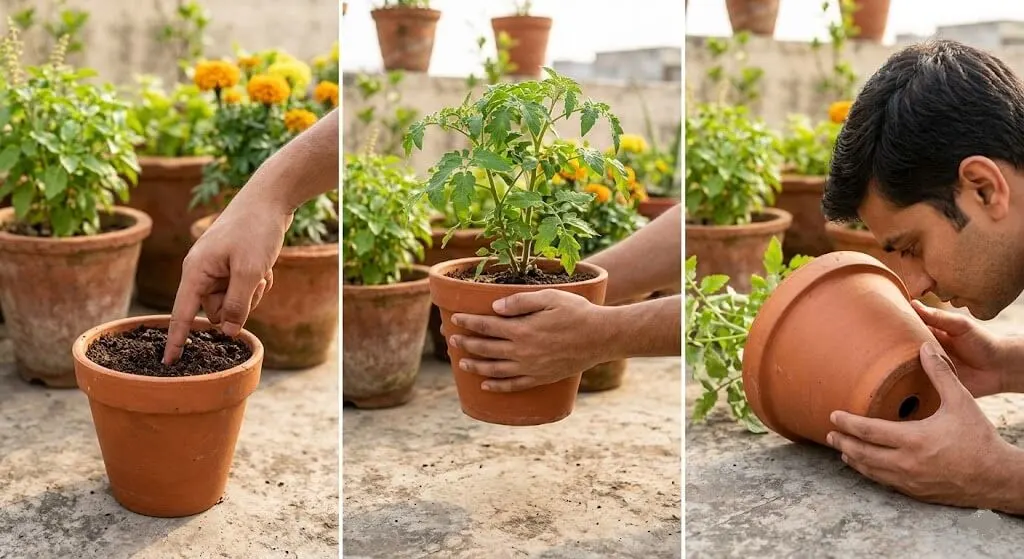
Step 1 The Finger Test (10 seconds)
Push your finger into the soil to a depth of 5cm — roughly the second knuckle of your index finger.
What you feel tells you the immediate water status of the active root zone:
Wet or waterlogged soil comes away on your finger, soil feels cold, may have slight sour smell from finger → overwatered until proven otherwise. Do NOT water. Proceed to Step 2.
Moist soil is damp but does not stick significantly to your finger, no cold clumping feeling, normal earthy smell → soil has water available. If plant is wilting, check for heat stress (Day 5), root rot (Day 6), or nutrient deficiency (Day 7) rather than watering immediately.
Dry soil feels dry at 5cm depth, no moisture when you press soil between fingers, possibly pulling away from pot edges → underwatered. Water immediately and deeply.
The Indian summer exception: In peak April-May heat, a terracotta pot can feel dry at 5cm by midday even if you watered at 7 AM. This is genuine terracotta is porous and the evaporation rate in 42°C+ conditions is high. The finger test in summer should be done at 7 AM (before watering decision), not at 1 PM when the pot has been baking for 6 hours.
Step 2 The Lift Test (5 seconds)
Lift the pot with both hands and assess its weight.
This is the fastest confirmation of soil moisture status once you have baseline experience with your pots. A fully watered 12-inch container with 8 litres of soil feels substantially heavier than the same pot with dry soil. The difference is dramatic roughly 8kg of water weight difference between saturated and bone-dry soil.
You need to do this test regularly for the weight to become meaningful once per week for 2 to 3 weeks establishes a feel for each pot’s weight range. After that, a single lift tells you immediately whether the pot is near-saturated, mid-range, or running dry.
The practical shortcut: After watering, lift each pot and note what “full” feels like. Before the next watering, lift again. When it feels 40 to 50% lighter than its fully watered state water again. This is the principle behind most professional nursery watering decisions.
Step 3 The Drainage Hole Check (30 seconds)
Tip the pot slightly and look at the drainage hole. Smell the drainage water or the soil visible at the hole.
Clear water draining freely, clean earthy smell → drainage is working, moisture content is appropriate. Water status is healthy.
No water draining, hole appears blocked → drainage is obstructed. Clear immediately with a chopstick. Root bound pots often have drainage holes blocked by circling roots this is the most common cause of sudden overwatering in containers that were draining perfectly for months.
Brown or discoloured water draining, sour or fermented smell → anaerobic conditions confirmed. This is overwatering-induced root stress, possibly early root rot. Stop watering immediately. Begin Day 6 root rot protocol if smell is persistent.
” Step 1 catches 80% of cases · Step 3 catches layered moisture (dry top, saturated bottom) · 30 seconds per pot “
What the drainage hole confirms that the finger test cannot: The finger test tells you about the top 5cm. The drainage hole tells you about the bottom of the pot where water accumulates and where anaerobic conditions begin first. A pot can feel dry at the finger test while the bottom third is still saturated from the previous watering. The drainage check catches this layering.
My Actual Watering Frequency Data Summer and Monsoon 2023, Madanapalle
The table below shows my recorded watering frequencies for different pot types, sizes, and materials across two critical seasons. These are actual records from my gardening notebook not recommendations from a guide.
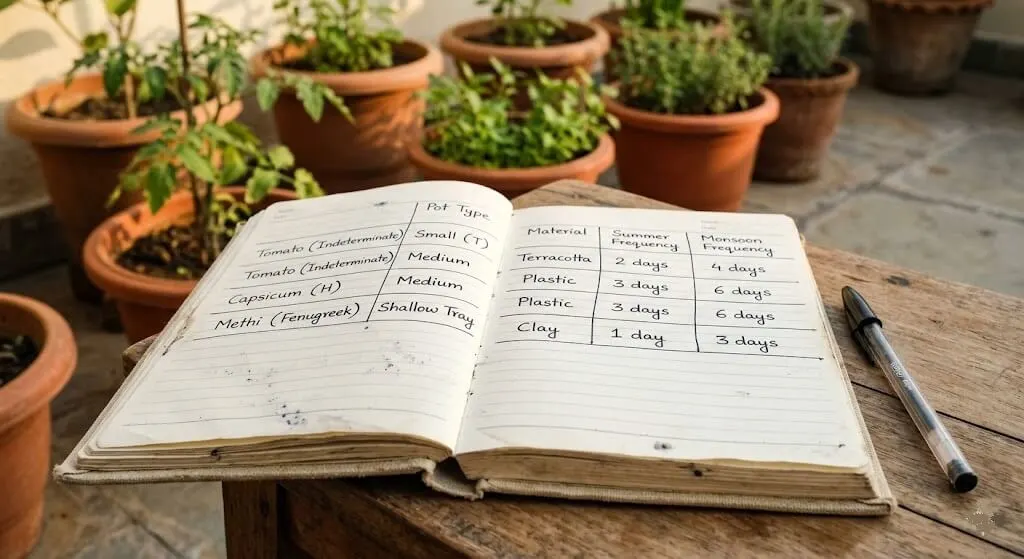
| Pot Type | Size | Material | Summer (Apr–Jun) Watering Frequency | Monsoon (Jul–Sep) Frequency | Notes |
|---|---|---|---|---|---|
| Tomato | 12-inch | Terracotta | Every day, 6:30 PM | Every 4–6 days | Terracotta loses moisture fastest daily in 42°C |
| Capsicum | 10-inch | Black plastic | Every 2 days | Every 5–7 days | Plastic retains moisture never daily in summer |
| Methi | 6-inch | Terracotta | Every day, sometimes twice | Every 3–4 days | Small pot, fast drying, needs monitoring |
| Brinjal | 14-inch | Terracotta | Every day | Every 5–7 days | Large pot buffers better test before watering |
| Curry leaf | 8-inch | Ceramic | Every 2–3 days | Every 7–10 days | Ceramic holds moisture well slow draining |
| Mint | 8-inch | Grow bag | Every day | Every 3–4 days | Grow bags dry fast need daily summer checks |
| Coriander | 6-inch | Black plastic | Every 2 days | Every 3–4 days | Small plastic monitor closely |
| Tomato | 12-inch | Grow bag | Every day | Every 4–5 days | Grow bags dry faster than terracotta at same size |
📌 Two Key Patterns
Terracotta physics = daily in summer (not a recommendation). Monsoon frequency drop = most critical seasonal adjustment most gardeners make too slowly.
Key patterns from this data:
Terracotta in Indian summer heat requires daily watering for most vegetables not because it is a recommendation but because the physics of terracotta porosity and summer evaporation make it unavoidable. Plastic and ceramic pots retain moisture significantly longer and should never be watered on the same schedule as terracotta.
The monsoon frequency drop is dramatic across all pot types from daily or every-2-days in summer to every 4 to 10 days in monsoon. This is the single biggest seasonal adjustment Indian container gardeners need to make, and most make it too slowly. Many gardeners continue their summer watering schedule into July and wonder why plants are declining from what looks like drought when the actual problem is waterlogging from monsoon rain plus their routine watering on top.
Why Indian Summer Specifically Creates the Overwatering-Underwatering Confusion
Three Indian-specific conditions make this diagnostic confusion worse than it would be in any temperate climate.
The terrace temperature gradient creates false drought signals.
☀️ Trap 1 The False Drought Signal (Summer)
55-65°C concrete, top 2-3cm dries in 2-3 hrs, finger test must be at 7 AM.
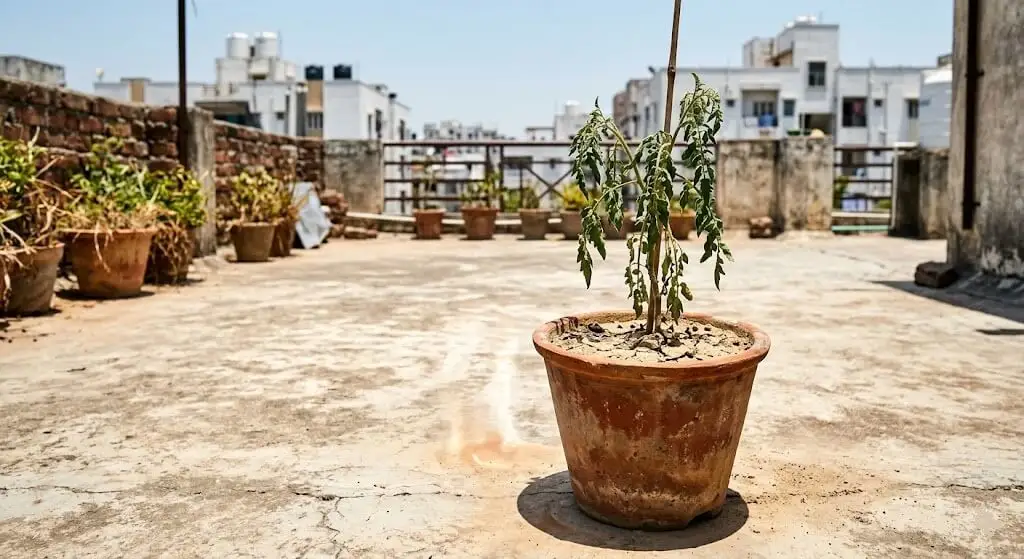
On an Indian apartment terrace at 2 PM in May, the concrete floor temperature can reach 55 to 65°C. The soil surface temperature in a dark-coloured plastic pot can reach 50°C or above as measured in Day 3 of this series. At these temperatures, the top 2 to 3cm of soil can be completely dry within 2 to 3 hours of a morning watering even when the root zone 8 to 10cm down is still adequately moist.
When a gardener sees a wilting plant and checks the top of the soil which is dusty and dry the natural conclusion is underwatering. But the roots are in the middle and bottom of the pot, where the temperature is 10 to 15°C lower and the moisture is still adequate. Watering again adds water to a pot that does not need it, raises TDS incrementally, and if done repeatedly, eventually saturates the lower root zone.
The monsoon transition happens faster than watering habits change.
🌧️ Trap 2 The Monsoon Transition Mistake (July)
100-200mm first week, daily habit continues, saturated within days.
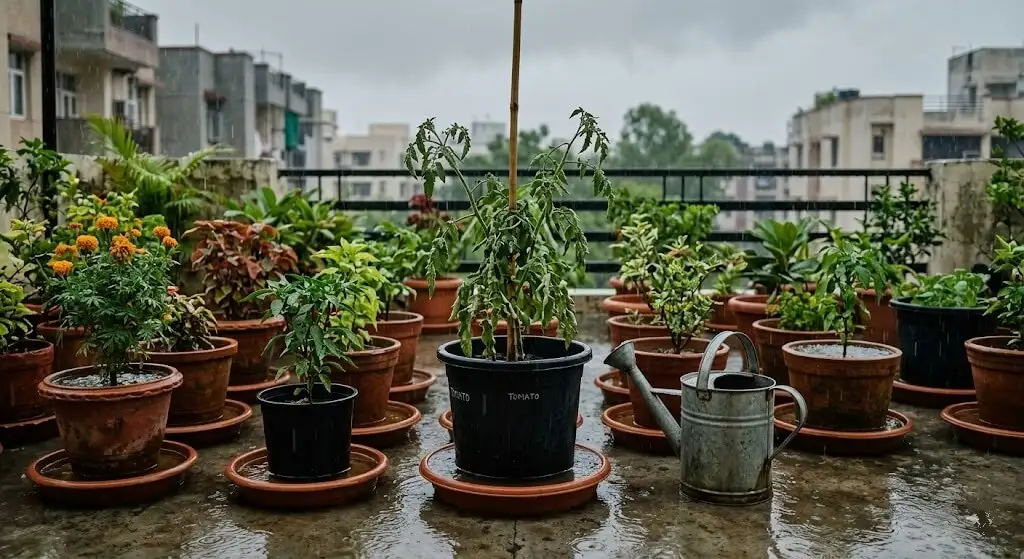
Indian monsoon in most growing zones arrives between June 15th and July 15th and can deliver 100 to 200mm of rain in the first week in a container pot that holds 8 to 10 litres of soil. A gardener who has been watering daily through May and June does not automatically switch to every-5-days when monsoon begins. The habit is established. The monsoon provides water from above. The daily watering adds water from below. The pot becomes saturated within days.
This monsoon-transition overwatering is the most common cause of root rot in Indian container gardens not a failure to understand root rot, but a failure to adjust the watering schedule at the right moment.
| Month | Typical Watering Adjustment Needed | What Most Gardeners Actually Do | Result |
|---|---|---|---|
| May | Daily or every 2 days | Daily – correct | ✅ Fine |
| June | Begin reducing as pre-monsoon rains arrive | Continue daily – wrong | ⚠️ Early waterlogging |
| July | Every 4–7 days depending on rainfall | Continue every 1–2 days | ❌ Root rot risk |
| August | Rain may be primary test before watering | Watering on schedule | ❌ Chronic overwatering |
| September | Every 5–7 days as rains reduce | Begin reducing – often too late | 🟡 Partial recovery |
💡 The Instinct That Kills the Most Plants in India
Wilting is the most visible sign of plant stress. Human instinct is to interpret visible stress as a request for more water because water is the most immediate and obvious form of care. This instinct is correct in desert climates where overwatering is almost impossible. In Indian summer containers, it is the instinct that kills the most plants. The visual cue (wilting) is identical for both problems. Only the physical check tells you which response is correct.
The Nandita Story Six Months of Wrong-Direction Watering, Fixed in One Week
💧 Real Story: Nandita, Delhi Six Months Wrong-Direction Watering
Nandita from Delhi had been growing tomatoes and capsicums on her fifth-floor apartment terrace for two and a half years. She messaged me in July 2023 with a problem she described as plants that “always look thirsty no matter how much I water.” Three tomato plants and two capsicum plants were showing persistent wilting, yellowing lower leaves, and poor fruit development despite her watering them twice daily through June and early July.
Her soil was consistently moist at the surface. She was confused because the plants looked dry but the soil was clearly wet.
I asked her four questions. What type of pots was she using? Black plastic, 10-inch and 12-inch. Did she have saucers under them? Yes to catch drainage. When did she water? Morning at 8 AM and afternoon at 2 PM. Had she checked the drainage holes recently? She said they looked fine.
I asked her to do the 3-step check for me, describing what she found at each step.
Step 1 finger test: soil felt wet and cold even after she had not watered that morning.
Step 2 lift test: she said the pots felt heavy but she had no baseline for comparison.
Step 3 drainage hole check: she tipped one pot and described the drainage water as brownish with a slightly sour smell.
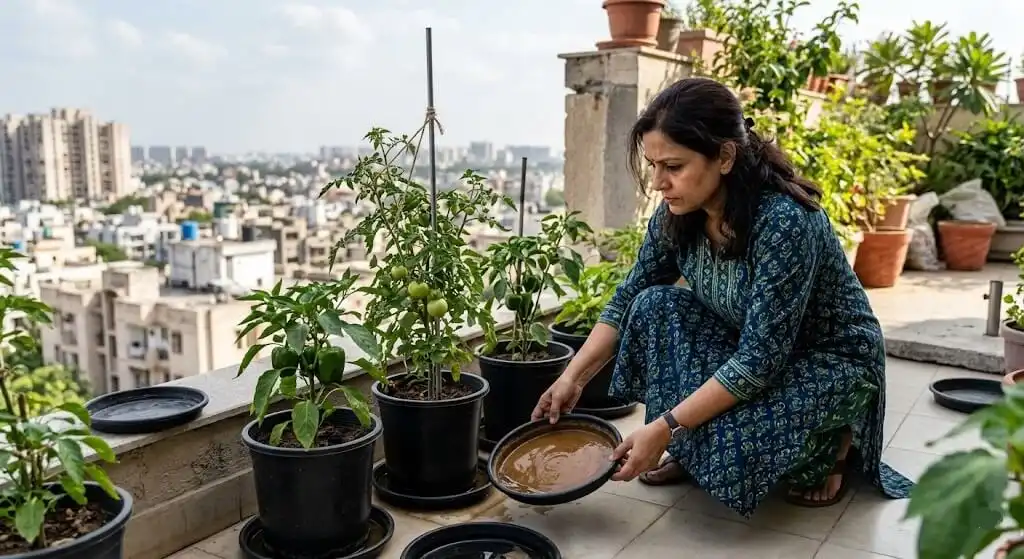
That description from the drainage hole check was decisive. The sour smell confirmed anaerobic conditions in the root zone. The saucers exactly as in Day 6 were collecting the drainage water and the black plastic pots were sitting in it, reabsorbing it through the drainage hole continuously. Combined with her twice-daily watering schedule, the root zone had been permanently saturated and anaerobic for weeks.
I asked her to do three things immediately: remove all saucers, stop watering for 48 hours regardless of what the plants looked like, and perform the drainage hole check every morning before making any watering decision.
By day 3, two of the five plants had visibly improved the wilting reduced and the lower leaves stopped dropping. By day 7, all five were showing new growth from the growing tip. The roots had not rotted severely enough to be unrecoverable the anaerobic conditions had been damaging but not yet fatal.
“I was watering twice a day because the plants looked thirsty. The plants looked thirsty because I was watering twice a day. I never understood that was possible.”
— Nandita, Delhi | July 2023
That sentence “the plants looked thirsty because I was watering twice a day” is the clearest description of the overwatering trap I have ever heard. The more an overwatered plant’s roots degrade, the less water it can absorb, the more it wilts, the more it looks like it needs water. The symptom of the problem and the instinct to fix the problem are exactly opposed.
The Complete 3-Step Watering Decision Protocol
The watering decision for each pot should take 30 seconds and follow this exact sequence every time.
🌿 The Pre-Watering Check — Before Every Watering Decision 30 seconds · ₹0 · No equipment required
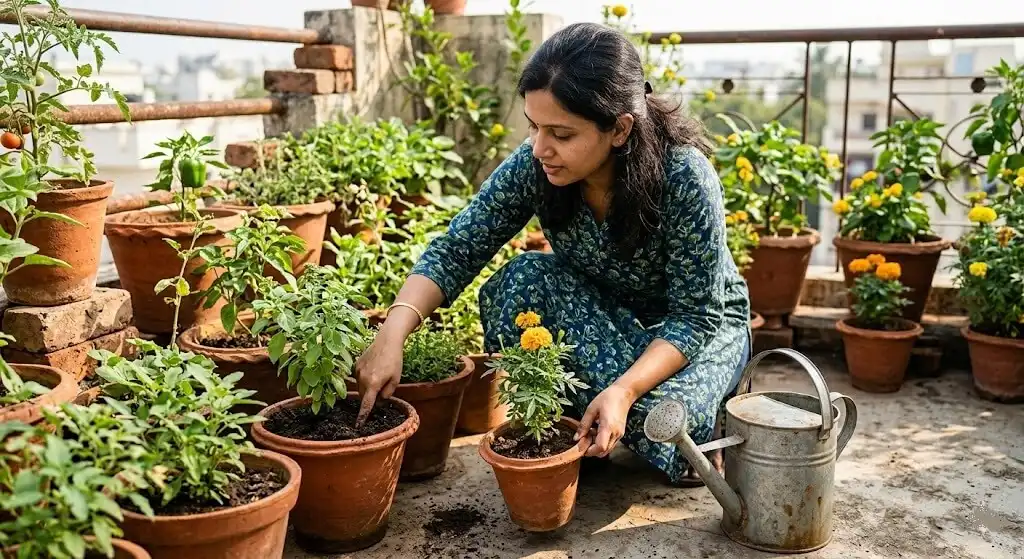
What You Need:
| Item | Detail | Cost |
|---|---|---|
| Your index finger | Push to 5cm depth | ₹0 |
| Both hands | For the lift test | ₹0 |
| Your nose | For the drainage smell | ₹0 |
| Optionally: moisture meter | For consistent readings | ₹300–600, Amazon India |
Steps:
- Before touching the watering can, push your finger 5cm into the soil of the pot in question. Assess: wet, moist, or dry.
- If wet or moist: lift the pot with both hands. Compare to your baseline weight for this pot. Is it heavy (still has water) or light (has dried out since the top felt moist)?
- If still uncertain: tip the pot 10 to 15 degrees and observe the drainage hole. Water draining? Sour smell? Clear drainage or discoloured?
- Make the decision: water if dry at Step 1 or light at Step 2. Hold off if wet/moist at Step 1 AND heavy at Step 2.
- If sour smell at Step 3: do not water. Begin Day 6 root rot assessment.
Time: 30 seconds per pot | Cost: ₹0 | Equipment: None required
What Correct Summer Watering Actually Looks Like The Timing Rules
Beyond the diagnostic check, Indian summer container watering has five timing rules that prevent the most common moisture problems.
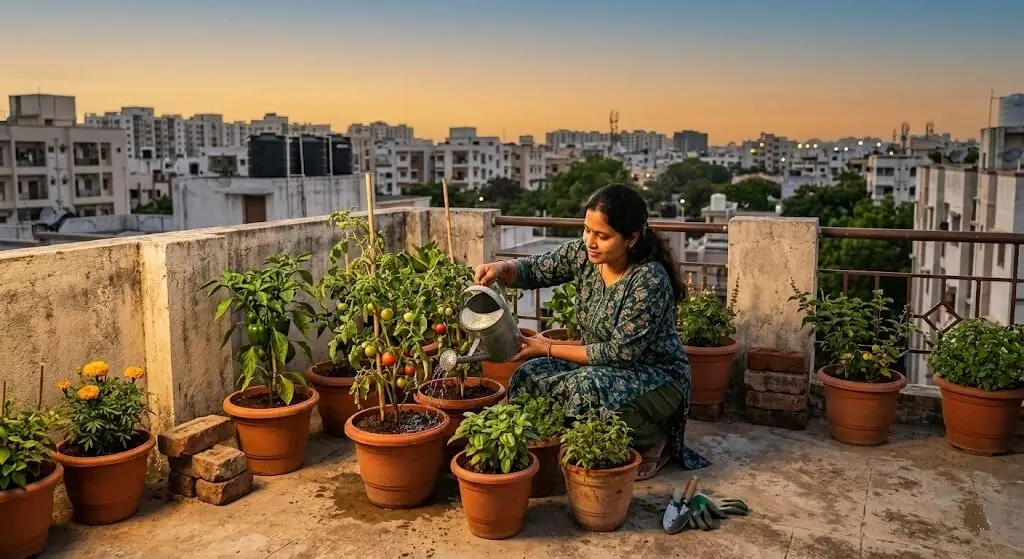
Rule 1 Water in the evening, not the morning.
This was established in Day 5 for heat stress reasons evening watering (6:30 to 8:00 PM) keeps soil cooler through the next day’s peak heat. It also matters for the overwatering-underwatering diagnosis: the finger test before an evening watering gives you an accurate reading of the full day’s moisture depletion. The finger test before a morning watering tells you only about overnight conditions it will often feel slightly moist even when the plant will be genuinely dry by noon.
Rule 2 Water until free drainage appears at the hole, then stop.
The correct watering volume for a container is the amount required to wet the full root zone and produce a small amount of free drainage enough to confirm the water has moved through the entire soil column, not just saturated the top. For a 12-inch pot, this is typically 1.5 to 2 litres per watering. More than this is not better additional water beyond drainage confirmation simply raises the risk of anaerobic conditions if drainage slows.
Rule 3 Never water on a fixed schedule in Indian summer.
Monday, Wednesday, Friday watering schedules are appropriate for temperate climates where temperature variation is modest. In Indian summer, a 42°C day can empty a terracotta pot in 5 hours while an overcast 35°C day may leave the same pot moist for 24 hours. Fixed schedules guarantee that you will sometimes underwater (on the hottest days) and sometimes overwater (on cooler or rainy days). The finger test before every watering replaces the schedule.
Rule 4 Black plastic pots retain moisture far longer than terracotta.
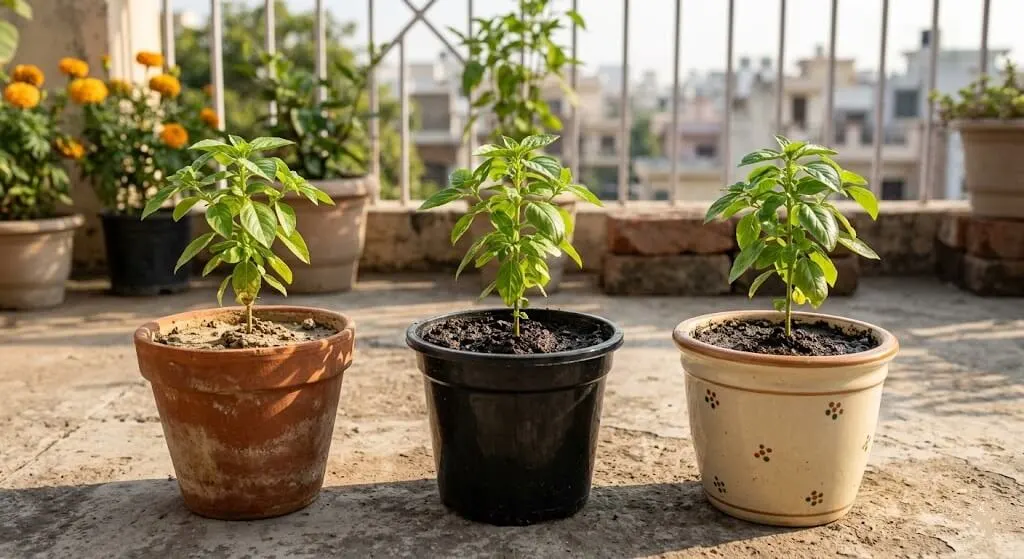
A black plastic 12-inch pot in Indian summer retains moisture approximately twice as long as the same-sized terracotta pot a combination of reduced evaporation through the non-porous walls and heat-absorbing dark colour that warms the soil and slightly accelerates root moisture use. Two pots of the same size require different watering frequencies based purely on material. The finger test accounts for this automatically the physical check does not care about pot material.
Rule 5 Watch for the monsoon transition signal.
The correct moment to begin reducing watering frequency is when rain falls on two consecutive days and the finger test shows the soil is still moist at 7 AM even if the plant wilted the previous afternoon. That wilting was almost certainly heat stress (Day 5 conditions) rather than drought, and watering on top of monsoon rain creates saturation rapidly. When the finger test confirms moist soil in the morning after two days of rain, skip the watering that day and recheck the next morning.
Never Water by Symptom My Seasonal Watering Adjustment Calendar
The most damaging watering habit in Indian container gardening is watering in response to wilting because wilting occurs in both overwatered and underwatered conditions, and the instinctive response (add water) is correct for only one of them.
The habit that prevents both problems simultaneously is a consistent pre-watering check combined with a seasonal adjustment schedule.
The 5-Minute Sunday Check Cumulative Update for Day 9
NEW — Day 9Adding to the Sunday check routines from Days 1 through 8:
- Finger test for moisture – 2 inches deep (Day 1)
- Leaf colour check – tops and bottoms of 3 leaves (Day 2)
- Soil surface temperature – 1 PM reading with thermometer probe (Day 3)
- White crust visual – soil surface and terracotta pot exterior (Day 4)
- Leaf edge check – any new crispy brown tips? (Day 4)
- Monthly TDS test – first Sunday of every month (Day 4)
- Flower count check – open flowers vs last Sunday (Day 5)
- Terrace temperature reading – 1 PM at pot level, 3× per week May–July (Day 5)
- Saucer water check – no standing water during monsoon (Day 6)
- Soil smell test – drainage hole of any wet-soil wilting pot (Day 6)
- Leaf pattern reading – old or new leaves? Veins green? (Day 7)
- Monthly pH test – first Sunday monthly, same pots as TDS (Day 7)
- Underleaf pest inspection – 3 leaves per plant, white paper tap test (Day 8)
- Sticky trap check – note what is caught, replace if full (Day 8)
- NEW Lift test baseline update – lift all pots after Sunday watering, note weight as “full” reference for the week (Day 9)
- NEW – Drainage hole visual – tip each pot 15 degrees, confirm free drainage, smell check (Day 9)
Sixteen checks. Under twenty minutes. Once a week.
What to Realistically Expect After Correcting Watering
Material
📌 How to Judge Recovery
New leaves at growing tip — full-sized, healthy, turgid. Universal recovery indicator for both problems.
After severe underwatering: Plants that have been critically water-stressed may drop all their flowers and some lower leaves before recovering. They recover fully with consistent correct watering the permanent damage from underwatering is much rarer than from overwatering, because dry roots are intact but inactive rather than damaged and dead.
After severe overwatering with root rot: Follow the Day 6 root rot recovery protocol. Recovery time depends on how much of the root system was affected. Mild to moderate overwatering (less than 50% root damage) recovers in 3 to 6 weeks. Severe overwatering with significant root rot may not be fully recoverable.
Judge recovery by: The growing tip. New leaves emerging at the tip that are full-sized and healthy is the universal signal that the root system is functioning adequately regardless of whether you are recovering from under or overwatering.
Products That Help and the One Tool Worth Buying
| Product | Use | Cost ₹ | Verdict |
|---|---|---|---|
| Soil moisture meter | Consistent readings at 10cm depth — removes finger test variability | ₹300–600, Amazon | ✅ Recommended especially useful for multiple pots |
| Rain gauge (simple) | Track actual rainfall volume to calibrate monsoon watering frequency | ₹150–300, Amazon | ✅ Useful helps with monsoon transition decisions |
| Self-watering pot inserts | Reservoir-based watering for small pots reduces underwatering risk in terracotta | ₹200–500, Ugaoo, Amazon | 🟡 Useful for small herbs not suitable for fruiting vegetables |
| Terracotta pot sealant | Reduces evaporation from terracotta walls extends time between waterings | ₹150–300, hardware shops | 🟡 Useful for balconies with extreme afternoon heat |
| Timer-controlled drip irrigation | Automated watering by schedule fixes human inconsistency | ₹1,500–4,000 for a basic setup | ⚠️ Effective only if timer schedule is adjusted seasonally a fixed schedule causes the same overwatering problem as manual fixed-schedule watering |
The one tool genuinely worth buying first: A soil moisture meter (₹300–600, Amazon India). Not because the finger test is unreliable it is perfectly accurate but because a moisture meter reads consistently at 10cm depth, which is the middle of the root zone, rather than the 5cm that the finger test reaches. This matters specifically for large pots (14-inch and above) and for diagnosing the layered moisture problem dry on top, saturated at the bottom that the finger test alone can miss. Look for a 3-in-1 meter (moisture, pH, and light) the added pH reading is useful for Day 7 monitoring.
Frequently Asked Questions
If the finger test at 7 AM shows the soil is already dry at 5cm, this is underwatering in 42°C+ Indian summer, a terracotta pot can genuinely deplete its available moisture within 5 to 7 hours of morning watering. Switch to evening watering (6:30 to 8:00 PM) the soil stays moist through the next day’s heat peak rather than drying out by noon. If the finger test at 7 AM shows the soil is moist but the plant still wilts by afternoon, this is heat stress (covered in Day 5), not a watering problem. Afternoon wilt in moist soil during Indian summer is almost always heat stress the plant recovers by evening without intervention.
Water only when the finger test at 7 AM before the day’s rain has occurred shows the soil is dry at 5cm. If it shows moist or wet, skip that day’s watering entirely regardless of what the plant looks like. Do this check every morning and make each day’s watering decision fresh. After 3 consecutive days of significant rain (more than 10mm), most pots will not need watering for 4 to 7 days depending on pot type. The monsoon rain check is the most important habit adjustment of the year.
Watering in response to visual wilt without doing the finger test first. Wilting occurs in both overwatered and underwatered conditions. If you water an already overwatered plant, you accelerate the anaerobic conditions that are causing the root damage and push a recoverable problem toward an unrecoverable one. The finger test takes 10 seconds. It prevents this mistake entirely.
No a container without a drainage hole cannot be safely used for growing vegetables or herbs in Indian conditions. Water has nowhere to go, the root zone becomes permanently saturated after the first few waterings, and overwatering-induced root rot is a matter of weeks, not months. Drill a drainage hole in the bottom of the pot (a standard drill works on most plastic and terracotta) or repot into a container with drainage. This is non-negotiable.
Yes, black plastic pots retain moisture approximately twice as long as same-sized terracotta in Indian summer conditions. Terracotta loses moisture through its porous walls continuously — this is the main reason terracotta dries faster and needs more frequent watering. Black plastic is non-porous and retains all moisture within the pot until it evaporates from the soil surface or is used by the plant. The practical difference in Indian summer: a 12-inch terracotta tomato pot needs daily watering, while a 12-inch black plastic tomato pot typically needs watering every 2 to 3 days. Always use the finger test do not assume a schedule is correct for any pot type.
The primary change in Indian summer between March and May is the temperature differential specifically the terrace temperature, not just the air temperature. As covered in Days 3 and 5, concrete terrace surfaces in Indian summer reach 55 to 65°C by 2 PM in April and May, significantly increasing both evaporation from pots and transpiration from leaves. A watering frequency that was correct in 28 to 32°C March conditions is not sufficient in 40 to 44°C May conditions. Increase frequency, switch to evening watering, and raise pots on bricks as described in Day 5. The 3-step check recalibrates your frequency automatically.
Quick Diagnosis Reference Overwatering, Underwatering, and the Problems They Are Confused With
🔎 Master Diagnosis Reference
| What You See | Soil at 5cm | Smell at Drainage | Evening Recovery | Most Likely Cause | First Action |
|---|---|---|---|---|---|
| Wilting, limp leaves | Dry | Normal | Partial or full recovery by evening | Underwatering | Water deeply at 6:30 PM |
| Wilting, limp leaves | Wet or moist | Sour or fermented | No recovery by evening | Overwatering / early root rot | Stop watering, check roots (Day 6) |
| Wilting, firm stem | Moist | Normal | Reduces after 6 PM naturally | Heat stress (Day 5) | Do not water shade and misting |
| Wilting, wet soil, new leaves small | Wet | Sour | No recovery | Root rot established (Day 6) | Pull plant, inspect roots |
| Lower leaves yellow, soil moist | Moist | Normal | Yellow leaves stay | Nitrogen flush from overwatering | Check TDS + reduce watering |
| All leaves uniformly pale | Any | Normal | No recovery | Nutrient deficiency (Day 7) | Check pH and leaf pattern |
| Leaf edges brown and crispy | Moist | Normal | No recovery | Salt stress (Day 4) or K deficiency (Day 7) | TDS test |
Today’s Action Checklist
- [ ] Do the finger test on every pot right now note which are dry, moist, or wet
- [ ] Do the lift test compare how each pot feels relative to when you last watered
- [ ] Tip each pot and check the drainage hole any sour smell means stop watering immediately
- [ ] If any pot has a saucer: remove it during monsoon months it is the primary overwatering mechanism
- [ ] Switch all summer watering to 6:30 to 8:00 PM if you have not already done so
- [ ] Identify which of your pots are terracotta and which are plastic they need different watering frequencies
- [ ] Note the day and time of your last watering for each pot you cannot make good watering decisions without this baseline
- [ ] If monsoon has begun: stop watering any pot where the finger test shows moist or wet even if the plant looks slightly stressed
- [ ] Buy a soil moisture meter if you have more than 10 pots ₹300–600, removes guesswork entirely
- [ ] Do not water any pot today until you have done Steps 1 through 3 of the diagnostic check
Key Facts – Quick Reference
Why do overwatering and underwatering look the same in container plants?
Both overwatering and underwatering cause wilting through the same downstream mechanism the roots cannot deliver adequate water to the leaves. In underwatering, this occurs because the soil has run out of available water. In overwatering, it occurs because saturated, anaerobic soil has damaged the root cells that perform water absorption, even though the soil itself contains abundant water. The above-ground symptoms wilting, yellowing, and drooping are identical in both cases, making visual diagnosis unreliable. The 3-step physical check (finger test, lift test, drainage hole check) identifies which condition is present in under two minutes.
What is the most reliable method to determine if a container plant needs watering in Indian summer?
The finger test inserting a finger to 5cm depth into the soil is the most reliable primary method. Dry soil at 5cm indicates underwatering. Wet or cold soil at 5cm indicates overwatering or adequate moisture. The lift test (comparing pot weight to its baseline when fully watered) confirms the finger test result for large pots. The drainage hole check (tipping the pot and smelling the drainage) identifies anaerobic conditions from overwatering that the finger test alone may miss in the lower root zone. Together, these three checks require less than 30 seconds and should precede every watering decision.
How does Indian summer create overwatering-underwatering confusion in container gardens?
Indian summer creates this confusion through two simultaneous mechanisms. The extreme terrace surface temperatures of 55 to 65°C in May and June dry the top 2 to 3cm of soil within hours of morning watering, creating a false visual signal of drought while the root zone 8 to 10cm down remains adequately moist. At the same time, the high transpiration rates from leaves in 42°C heat can genuinely deplete moisture faster than temperate climate guides predict making it impossible to rely on published watering frequency recommendations. The monsoon transition from June to July adds further confusion as rainfall provides water from above while gardeners continue their established summer watering schedules from below, rapidly oversaturating containers.
What is the correct watering timing for Indian container gardens in summer?
Evening watering between 6:30 and 8:00 PM is the correct timing for Indian summer container gardening. Morning watering allows the soil to reach high temperatures during the day’s peak heat period before it is fully utilised by roots, accelerating surface evaporation and reducing root absorption efficiency. Evening watering keeps soil at optimal temperature through the following morning’s cooler period when root absorption is most efficient, maintains moisture through the following day’s heat peak, and reduces water stress during the highest-risk noon to 4 PM period. Morning watering is appropriate in cooler months (November through February) when evening watering increases disease risk from persistent overnight moisture.
How should Indian container gardeners adjust their watering schedule during the monsoon transition?
The monsoon transition from June to July requires immediately reducing watering frequency and adopting a check-based rather than schedule-based watering approach. Water only when the finger test at 7 AM before any rain has occurred confirms dry soil at 5cm depth. After three consecutive days of significant rain, most containers will not need additional watering for four to seven days depending on pot type and size. The most common cause of root rot in Indian container gardens is not monsoon rain alone but the combination of monsoon rain plus the continuation of summer daily watering schedules. Removing saucers before monsoon begins prevents the drainage water reabsorption that concentrates this overwatering effect.
What is the correct watering volume for Indian container plants?
The correct watering volume is the amount required to fully wet the root zone and produce free drainage from the bottom of the pot confirming water has moved through the complete soil column. For a 12-inch pot, this is typically 1.5 to 2 litres per watering. Additional water beyond drainage confirmation adds no benefit and increases the risk of anaerobic conditions if drainage slows over time due to root growth or soil compaction. Watering until drainage appears, then stopping, is the standard practice. Multiple small top waterings that never produce drainage should be avoided they wet only the top soil layer and leave the root zone dry while the surface appears moist.
Source: Priya Harini B, thetrendvaultblog.com – based on container watering observations across 40 pots on a Madanapalle, Andhra Pradesh terrace from 2021 through 2024, including the overwatering-underwatering case study with Nandita from Delhi and comparative watering frequency data across pot materials and sizes across two growing seasons.
The Check Comes Before the Can
After nine days of this series, the pattern has been the same every day. Salt buildup: test TDS before flushing. Heat stress: measure terrace temperature before concluding it is a pollination problem. Root rot: smell the drainage before diagnosing wilting as drought. Nutrient deficiency: read the leaf pattern before buying fertiliser. Pests: check under the leaves before reaching for a spray. Overwatering and underwatering: push your finger into the soil before picking up the watering can.
Every mistake I have documented in this series from the salt crisis of 2021 to the capsicum mycorrhizal disaster of 2022 happened when I responded to a symptom with an instinctive action before taking 30 seconds to check what was actually causing the symptom. The instinctive action was almost always plausible. It was also almost always wrong, or at best ineffective, because the symptom was not unique to the cause I assumed.
Nandita’s tomatoes were wilting because she was watering twice a day. Her instinct water a wilting plant was perfectly reasonable. It was the check that was missing.
The check is 30 seconds. The recovery is 3 to 11 weeks. That arithmetic is why the check always comes before the can.
Coming Up Tomorrow- Day 10: Container Soil When to Repot, When to Refresh, and When to Start Over
Nine days in, your plants have survived summer heat, potential pests, nutrient lockout, and watering confusion. Day 10 addresses the soil itself the medium that all of these problems live in. When does container soil become so depleted, compacted, or microbiologically exhausted that it needs to be replaced rather than amended? What are the signs that your soil is holding your plants back even when every other variable is correct? And what is the right refresh protocol for Indian conditions using vermicompost, perlite, and neem cake without the expense of full repotting every season?
Have you ever watered a wilting plant only to make things worse? Tell me in the comments — what did the soil actually feel like when you checked, and how long did recovery take? I want to know how many Indian gardeners have been through the same afternoon-wilt confusion I had in my first summer. Or find me on Instagram @thetrendvaultblog.
— Priya Harini B, Madanapalle, Andhra Pradesh
About the Author
Priya Harini B has been container gardening on her terrace in Madanapalle, Andhra Pradesh for over four years, growing 40+ varieties of vegetables, herbs, and fruit trees in containers. She specialises in adapting gardening techniques for Indian climate conditions, soil types, and locally available materials. Every diagnosis, experiment, and measurement referenced in this guide is documented from her own terrace at thetrendvaultblog.com.
Day 9 of the 30-Day Summer Gardening Challenge — Solving Your Biggest Summer Problems, One Day at a Time