
By Priya Harini B | Madanapalle, Andhra Pradesh | 4+ Years Container Gardening Experience
Day 7 of the 30-Day Summer Gardening Challenge — Solving Your Biggest Summer Problems, One Day at a Time
Table of Contents
Introduction
If you are searching for answers about nutrient deficiencies in container plants because your plant has pale yellow leaves, or strange striped patterns between the veins, or new growth that looks stunted and small despite regular watering and feeding you have found the right guide. Indian summer makes this problem worse than most gardeners expect: in the April to June heat, a container pot can receive 60 to 80 litres of water per month, which continuously leaches mobile nutrients like nitrogen out of the soil in as little as 3 to 4 weeks.
At the same time, consistent summer watering with Indian municipal tap water is slowly raising your soil pH every single week and above pH 7.0, iron, zinc, and manganese convert to insoluble forms that your plant cannot absorb regardless of how much you feed. “Nutrient deficiencies in summer are rarely about feeding too little. They are almost always about pH making what you already feed completely unavailable“.
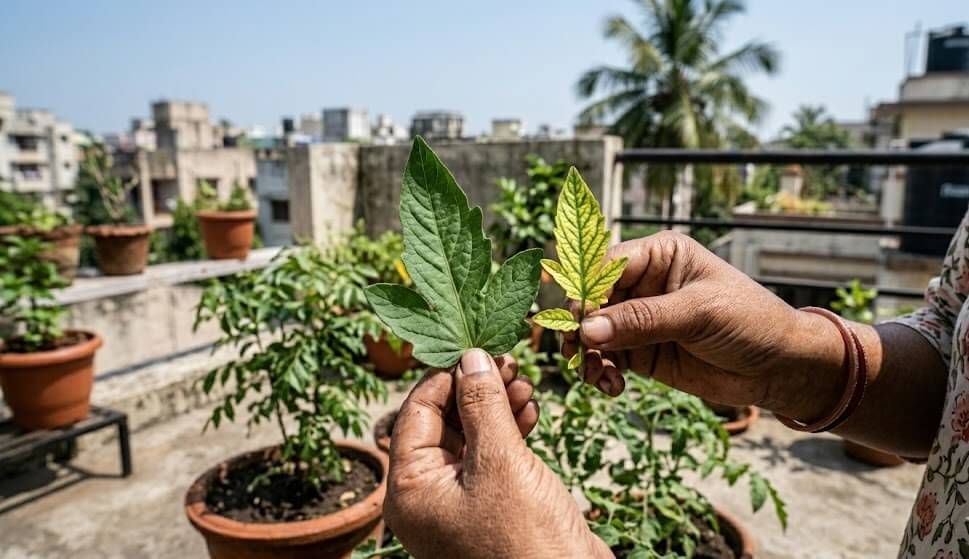
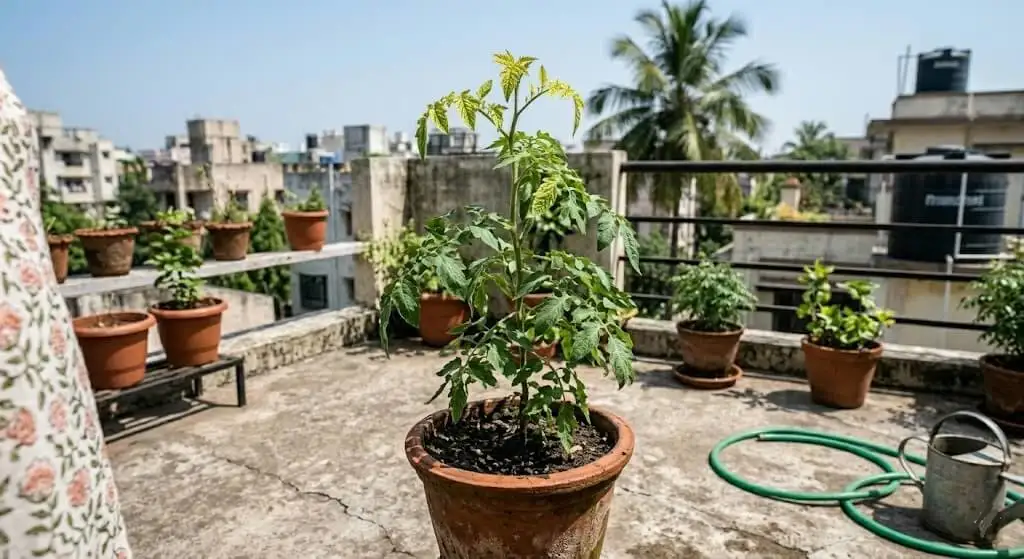
I spent three months in my second growing season April through June 2022 treating the wrong deficiency. My tomato plants had pale yellow leaves on the new growth the newest leaves at the top of the plant were yellowing between the veins while the veins themselves stayed green.
I had been watering heavily through April and May in 42°C Madanapalle heat, flushing nutrients out with every watering while simultaneously raising the soil pH with alkaline tap water. I looked at a few gardening guides, concluded this was nitrogen deficiency the most commonly described deficiency in every basic guide and started adding NPK 19:19:19 at double the recommended dose. The plants got worse. I added more. By the end of those three months, the TDS in my pots had crossed 3,000 ppm and I had a salt buildup crisis on top of an unresolved deficiency.
The problem was that I had nitrogen in my soil. What I did not have was iron and the reason I was deficient in iron had nothing to do with how much I was feeding. It had everything to do with my soil pH drifting alkaline from two seasons of summer tap water use. The same fertiliser I was adding to fix the problem was making the pH problem worse, which made the iron more unavailable, which intensified the very symptom I was trying to treat.
This guide covers everything I have learned about nutrient deficiencies in container plants across four Indian summers how to read the specific visual patterns on your leaves that tell you exactly which nutrient is missing, why Indian summer conditions deplete nutrients faster than any other season, and the exact corrections for each deficiency using both fast-acting and long-term approaches that work in Indian conditions.
What Nutrient Deficiency Actually Is The Soil Chemistry Your Plant Cannot Tell You About
A nutrient deficiency is not simply the absence of a nutrient from the soil. It is the absence of a nutrient that the plant can actually access and absorb. This distinction matters enormously in Indian container gardening, where many deficiencies are caused not by lack of nutrients but by soil conditions that lock nutrients into forms the plant cannot use.
Every essential plant nutrient exists in soil in multiple chemical forms. Some are soluble in water and can be absorbed directly by root cells these are the available forms. Others are bound to soil particles, locked into insoluble compounds, or chemically converted into forms that root cell transporters cannot accept these are the unavailable forms. A pot can contain adequate total amounts of iron, manganese, or zinc and still show severe deficiency symptoms if the soil pH is wrong, because the nutrients are present but inaccessible.
🔑 Soil pH -The Master Key That Indian Summer Disrupts Fastest
Which determines nutrient availability. Most fruiting vegetables prefer a soil pH between 6.0 and 6.8. Above pH 7.0, iron, zinc, manganese, and boron convert to insoluble forms the plant cannot absorb them regardless of how much is present in the soil. This is called nutrient lockout, and it is the cause behind most persistent deficiencies in Indian container gardens that do not respond to standard fertiliser applications.
Indian container gardening creates specific pH drift patterns that Western guides do not address. Heavy use of ammonium-based nitrogen sources like urea and ammonium sulphate gradually acidifies soil. Municipal tap water in most Indian cities is slightly to moderately alkaline (pH 7.5 to 8.5), and consistent watering with this water slowly raises container soil pH season by season.
The result is that soil that started at a healthy pH 6.5 can drift to pH 7.8 over two years of regular tap water use making iron, zinc, and manganese deficiency almost inevitable regardless of fertiliser regime.
💡 The One Diagnostic Rule — Mobile vs Immobile
Some nutrients can move freely within the plant from older leaves to newer leaves when supply is short. Others are immobile and stay wherever they are first deposited. This mobility determines which leaves show deficiency symptoms first, and it is the most reliable diagnostic tool available without any equipment.
Mobile nutrients (N -nitrogen , P- phosphorus, K- potassium, Mg -magnesium:): OLD leaves first leached by summer watering – when deficient, the plant pulls these from the oldest leaves first. Deficiency symptoms appear on the lowest, oldest leaves and work upward.
Immobile nutrients (Fe -iron, Zn -zinc , Mn -manganese, Ca- calcium, B -boron): NEW leaves first locked by summer pH drift – new growth has the highest demand but no reserves to draw from. Deficiency appears on the newest, youngest leaves at the growing tip and works downward.
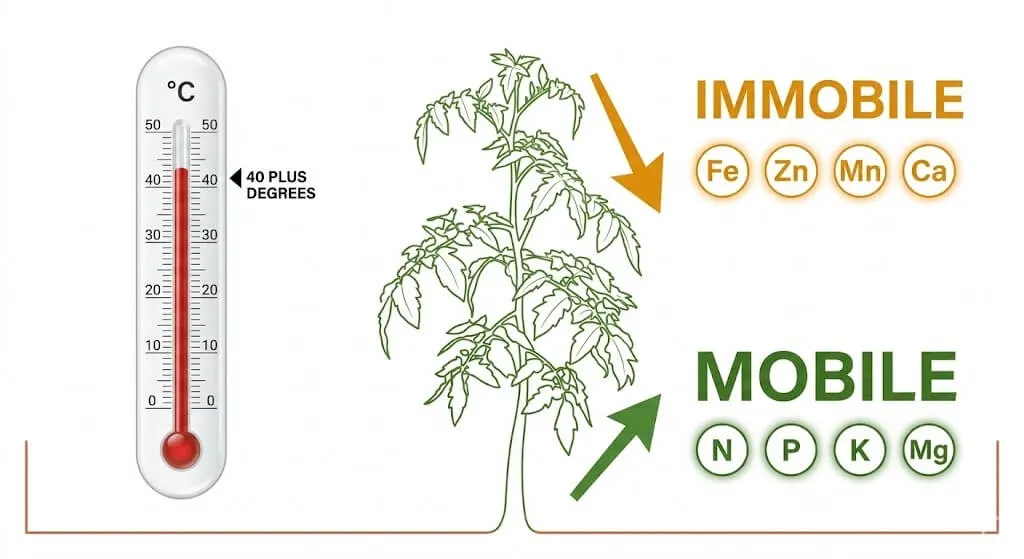
This one principle old leaves first versus new leaves first eliminates most diagnostic confusion before you look anything else up.
The April 2022 Summer That Taught Me to Read Leaves
📖 Priya’s Story April–May 2022, Madanapalle (42°C)
It was April 2022, the beginning of my second proper summer growing season. Madanapalle was already hitting 40 to 42°C by mid-April, and I was watering my four tomato plants two Pusa Ruby and two PKM-1 cherry twice daily to keep up with the heat.
The pots were draining freely after every watering, the plants looked healthy and vigorous through March, and I felt confident heading into the summer growing window.
By late April, something was wrong.
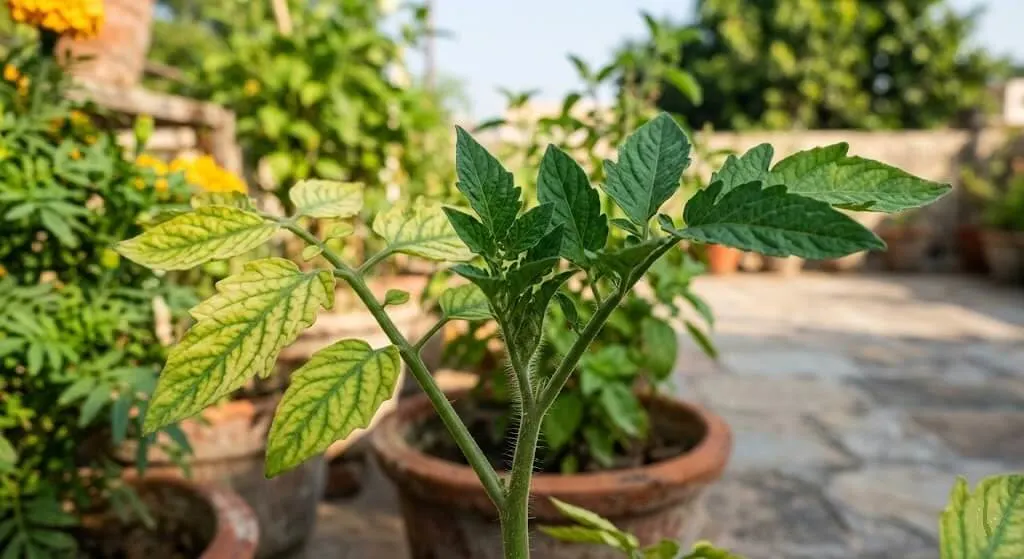
The newest leaves at the growing tips of all four plants were yellowing in a specific pattern. The leaf tissue between the veins was yellow while the veins themselves remained green, creating a striped appearance on each small new leaf.
The oldest leaves at the base of the plant looked perfectly fine dark green, healthy, normal. Only the newest growth was affected. The problem had appeared during the hottest weeks of summer, when I had been watering most heavily and most frequently unknowingly flushing out nutrients and simultaneously depositing alkaline mineral residue from tap water with every litre I poured in.
I searched “yellow leaves tomato India summer.” Every result described nitrogen deficiency. The images showed pale yellowing leaves. My leaves were pale and yellowing. I bought NPK 19:19:19 and started applying it at 1.5 times the recommended dose.
Three weeks later, the new growth still showed the same yellow-between-veins pattern. I added more NPK. The TDS in my pots was climbing but I was not testing it. By late May, Suresh visited.
He studied the new growth leaves carefully specifically the yellow-between-green-veins pattern on the youngest leaves and asked me two questions. What is my water source? Municipal tap water. When did I last check soil pH? Never.
“This is iron deficiency,” he said. “Not nitrogen. See how the veins are green but the tissue between them is yellow? Only on the newest growth? Nitrogen deficiency yellows the old leaves first, and the whole leaf goes pale. Iron deficiency yellows the new leaves first, and the veins stay green. Two completely different problems.”
— Suresh, Madanapalle late May 2022
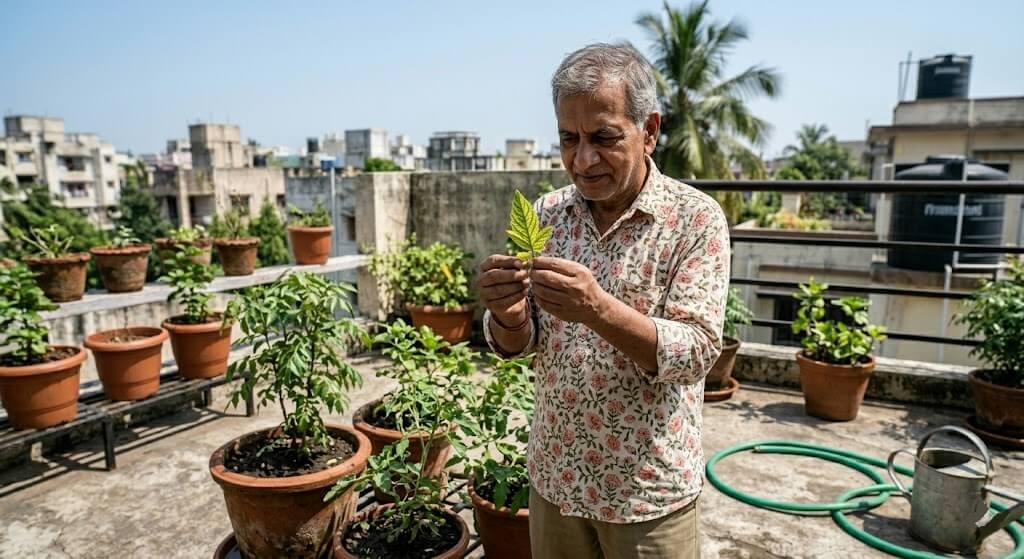
He explained the mechanism. Summer is the season when this problem accelerates fastest. Every day of April and May, I had been pouring 2 to 3 litres of municipal tap water per pot water with a pH of approximately 7.4 and dissolved calcium carbonates that deposit in the soil with every watering.
Over two seasons of heavy summer watering, my soil had drifted from a healthy pH 6.5 toward pH 7.8. At that high pH, the iron already present in the soil vermicompost contains iron had converted to insoluble ferric forms that my plant’s roots could not absorb. I had been feeding nitrogen on top of a pH problem, making the pH worse, which made the iron lockout worse, which intensified the iron deficiency, which made me add more fertiliser. The heat of Indian summer had simply accelerated every step of this cycle.
The fix was not adding more nutrients. The fix was acidifying the soil to unlock the nutrients already there.
I corrected the soil pH using sulphur powder and citric acid solution, applied through the remaining weeks of May and into early June. Within two weeks of pH dropping toward 6.5, the new growth emerging from the tips was a healthy dark green. The previously affected leaves did not recover but every new leaf after pH correction was normal. I finished that summer season with a reasonable tomato harvest from plants that had looked unsalvageable in late April.
That experience changed how I approach every plant problem I have seen since. The leaves are always telling you something specific. You just need to know which language they are speaking.
Step 1: Read the Leaves Before You Buy Anything
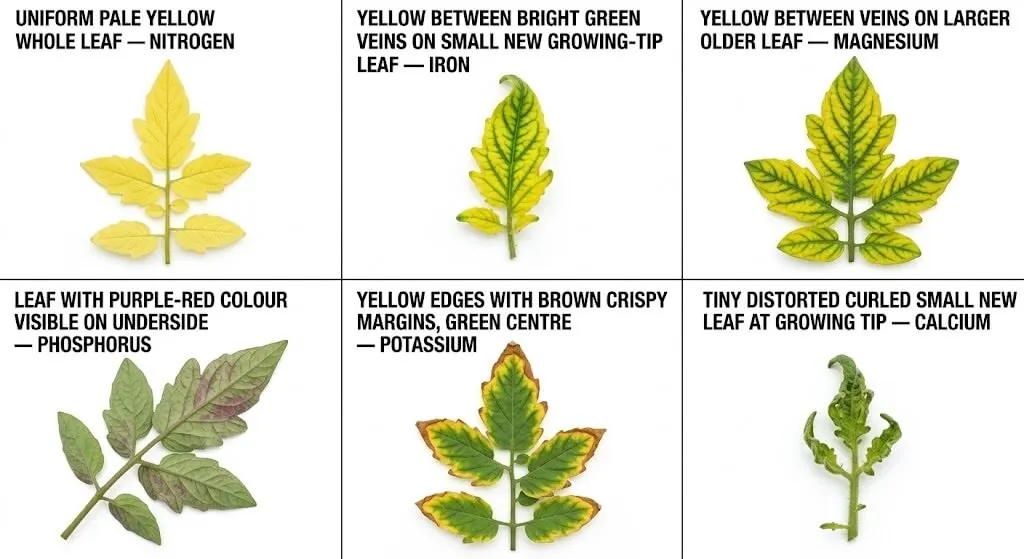
The most important diagnostic tool for nutrient deficiencies costs nothing and takes two minutes. It is your eyes specifically, answering three questions about what you observe.
🔬 3 Questions – Answer These Before Buying Anything
Summer shortcut: If you use municipal tap water and have gardened in the same containers for more than 12 months assume alkaline pH drift and test pH before treating anything.
Question 1: Which leaves are affected old or new?
Oldest leaves at the bottom of the plant affected first → mobile nutrient deficiency (nitrogen, phosphorus, potassium, or magnesium).
Newest leaves at the growing tip affected first → immobile nutrient deficiency (iron, zinc, manganese, calcium, or boron).
This single observation eliminates half the possible deficiencies immediately.
Question 2: What does the yellowing pattern look like on the affected leaves?
Entire leaf turns uniformly pale yellow → nitrogen (whole leaf, starting from tip)
Yellow tissue between green veins on new leaves → iron (veins stay bright green, new growth only)
Yellow tissue between green veins on old leaves → magnesium (same pattern as iron, different leaf age)
Purple or reddish discolouration on leaf undersides → phosphorus
Yellow leaf edges while centre stays green → potassium
Tiny, distorted, curled new leaves at growing tip → calcium or boron
Question 3: What is your water source and when did you last check pH?
If you use municipal tap water and have never checked pH and you have been gardening in the same container soil for more than one year assume alkaline drift and test pH before treating anything.
What you need (5-minute method):
A bright light source. Take three leaves: one from the lowest part of the plant (oldest), one from the middle, one from the growing tip (newest). Hold each up to the light and observe where the yellowing is and what the pattern looks like. Compare across the three leaves before looking up any images.
Results table – what your leaf pattern means:
🔑 In Indian Summer If Veins Stay Green on New Leaves, Test pH Before Anything Else
| Pattern | Which Leaves | Veins Green? | Most Likely Deficiency | Check First |
|---|---|---|---|---|
| Uniform pale yellow, whole leaf | Oldest leaves first | No – all pale | Nitrogen (N) | Check watering history |
| Yellow between veins | Newest leaves first | Yes – bright green | Iron (Fe) | Check soil pH |
| Yellow between veins | Older and middle leaves | Yes – green | Magnesium (Mg) | Recent heavy rain? |
| Purple/red on leaf underside | Older leaves | Leaves stay green | Phosphorus (P) | Soil pH below 5.5? |
| Yellow edges, brown margins | Older leaves, edges | Centre stays green | Potassium (K) | Check TDS first |
| Distorted, curled, small tips | Growing tip only | N/A – distorted | Calcium (Ca) or Boron (B) | Check pH + watering consistency |
| Pale green overall, all leaves | All leaves equally | Slightly darker | Sulphur (S) | Check soil organic matter |
My Actual Deficiency Observations – April 2022 Through March 2024, Madanapalle
The table below shows nutrient deficiency observations and diagnoses from my terrace across multiple growing seasons. Every row is a real observation recorded in my gardening notebook including the wrong diagnosis I made first in several cases. Notice how summer months (April–June) account for the majority of iron, nitrogen, and potassium deficiency cases high summer watering volumes and heat-accelerated pH drift make April to June the single highest-risk period for nutrient problems in Indian container gardens.
April 2022 Through March 2024
📊 Original observations from Madanapalle terrace — April 2022 through March 2024. Summer months (April–June) account for 5 of the 8 most severe cases.
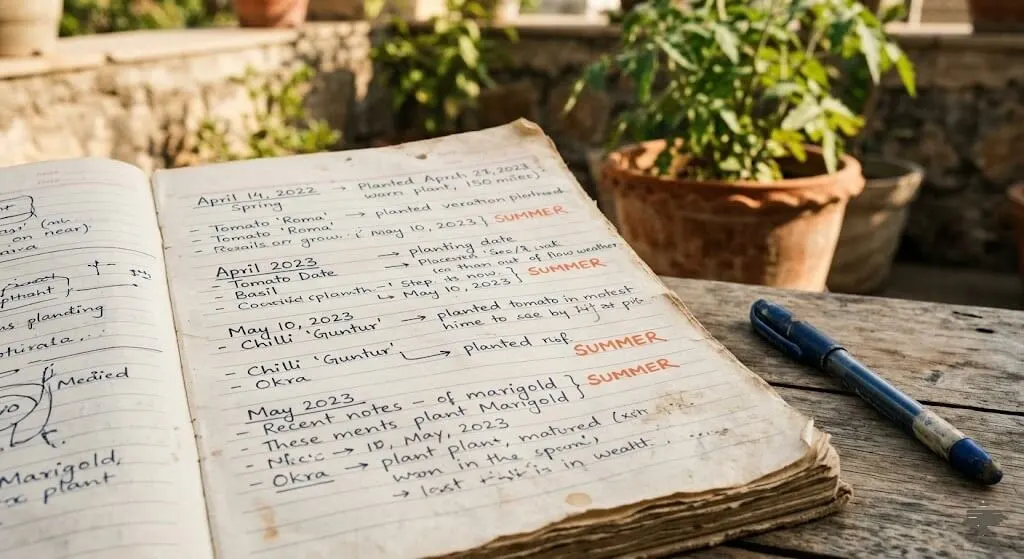
| Date | Season | Plant | Symptoms Observed | Old or New Leaves | Correct Diagnosis | Wrong Diagnosis First | Fix Applied | Recovery |
|---|---|---|---|---|---|---|---|---|
| Apr–May 2022 | Summer | Tomato (Pusa Ruby) | Yellow between green veins | New leaves first | Iron — pH lockout from summer tap water | Nitrogen deficiency | pH correction + chelated iron | 3 weeks |
| Jan 2023 | Cool season | Methi | Uniform pale yellow, lower leaves | Old leaves first | Nitrogen deficiency | Overwatering | NPK 19:19:19 half-dose | 10 days |
| Apr 2023 | Summer | Capsicum | Purple underside, slow growth | Old leaves | Phosphorus pH acidic | Root rot | pH correction + bone meal | 4 weeks |
| May 2023 | Summer | Tomato (PKM-1) | Yellow edges, brown tips | Old leaves | Potassium + salt stress (heavy summer watering) | Pure salt stress | Flush + banana peel water | 2 weeks |
| Sep 2023 | Post-monsoon | Brinjal | Distorted small new leaves | Growing tip only | Calcium deficiency | Pest damage | pH correction + lime water | 3 weeks |
| Nov 2023 | Cool season | Coriander | Pale green overall, all leaves | All leaves | Sulphur deficiency | Nitrogen deficiency | Gypsum drench + neem cake | 2 weeks |
| Feb 2024 | Cool season | Spinach | Yellow between veins | Old leaves first | Magnesium deficiency | Iron deficiency | Epsom salt drench | 1 week |
| Mar 2024 | Pre-summer | Tomato (Arka Vikas) | Multiple symptoms simultaneously | Old and new both | pH problem multiple lockouts from accumulated summer watering | Multiple deficiencies | Full soil pH correction | 5 weeks |
The most consistent pattern: when I misdiagnosed, it was almost always by treating the colour (yellowing) rather than reading the pattern (which leaves, which part of the leaf). The correct diagnosis always came from the leaf pattern, not the colour alone.
📌 The Summer Pattern
5 of the 8 entries the most severe cases are clustered in the summer and pre-summer months, when watering volume and heat combine to create the fastest pH drift and nutrient depletion of the year.
Why Indian Container Soil Develops Deficiencies Faster Than Anywhere in Western Growing Guides
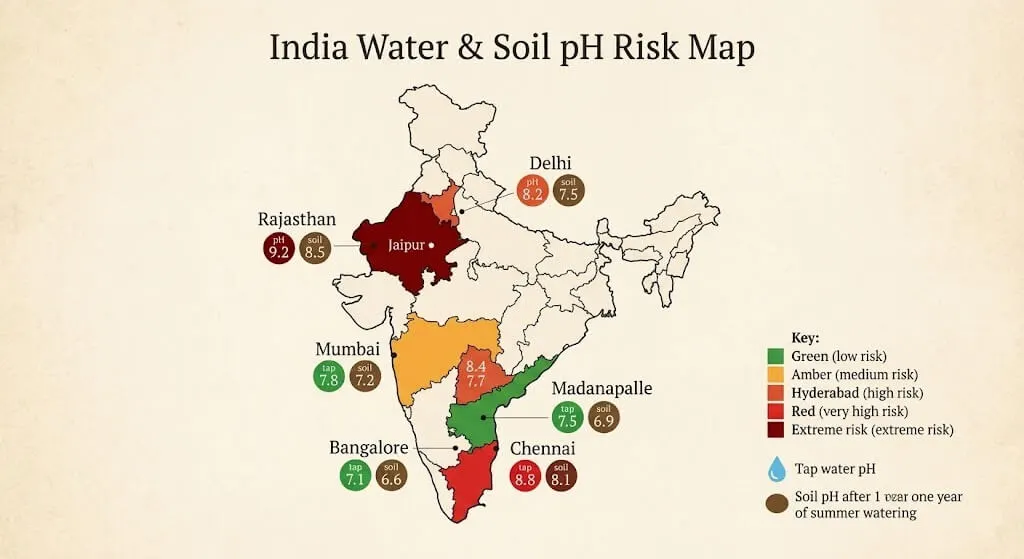
Container gardening in India creates nutrient depletion and pH drift at a rate that open garden beds never experience. Three mechanisms specific to Indian conditions explain why.
⚠️ Summer Watering Accelerates This Drift Faster Than Any Other Season
Watering volume continuously flushes mobile nutrients.
A 12-inch container holds 8 to 10 litres of soil and receives 60 to 80 litres of water per month in Indian summer. Every time water drains from the drainage hole, it carries dissolved nutrients with it. Nitrogen depletes in 3 to 4 weeks in summer. Potassium and magnesium follow within 4 to 8 weeks. This is the primary reason Indian container plants need more frequent feeding than Western guides recommend not because our soil is poor, but because our watering volumes are larger.
Indian tap water gradually acidifies or alkalises soil pH depending on your city.
| City | Tap Water pH | Soil pH After 1 Year | Micronutrient Risk |
|---|---|---|---|
| Delhi | 7.5–8.2 | 7.3–7.8 | High iron, zinc, manganese lockout |
| Chennai | 7.8–8.5 | 7.5–8.0 | Very High multiple micronutrient lockout |
| Hyderabad | 7.5–8.0 | 7.2–7.8 | High |
| Mumbai | 7.2–7.8 | 7.0–7.5 | Medium iron and zinc risk |
| Bangalore | 7.0–7.5 | 6.8–7.2 | Low–Medium |
| Madanapalle | 7.2–7.6 | 7.0–7.4 | Medium |
| Rajasthan | 8.0–8.8 | 7.8–8.5 | Extreme most micronutrients locked |
Gardeners in Chennai, Delhi, Hyderabad, and Rajasthan are almost certain to develop iron and zinc deficiency within 12 to 18 months of consistent tap water use regardless of how carefully they feed. The solution is pH management, not more fertiliser.
Container volume limits the buffering capacity that prevents pH swings.
An open garden bed has metres of soil depth that buffer against pH changes. A 10-litre container changes the pH of 10% of its soil volume with every litre of water. Over hundreds of waterings, the cumulative drift is significant. This is why the same tap water that causes no measurable pH problem in a garden bed causes consistent micronutrient lockout in the same gardener’s containers after 12 to 18 months.
Understanding these three mechanisms means you can predict which deficiency will develop before symptoms appear and prevent it rather than treat it.
The 6 Most Common Deficiencies in Indian Container Gardens and How to Distinguish Each One
Each of the six deficiencies below has a specific visual fingerprint. Learn these six patterns and you will be able to read your plants before a problem becomes a crisis.
Nitrogen Deficiency the Most Common and Most Straightforward
Nitrogen is the primary component of chlorophyll and every plant protein. When nitrogen is insufficient, the plant strips it from the oldest leaves first and redirects it to support the growing tip.
The visual pattern is distinctive: uniform pale yellow-green colouring across the entire leaf, beginning at the leaf tip and moving toward the base. The yellowing starts in the oldest leaves at the bottom of the plant and moves progressively upward. Unlike iron deficiency, the veins do not stay green the entire leaf surface loses colour uniformly. The plant also grows slowly, produces thin stems, and looks generally washed out.
Important Indian context: heavy summer watering and monsoon rain both flush nitrogen from containers rapidly. A plant that was adequately fed in May may show nitrogen deficiency in July purely from monsoon leaching even with no change in feeding. During monsoon, use vermicompost top-dressing rather than soluble NPK, which increases TDS and root rot risk.
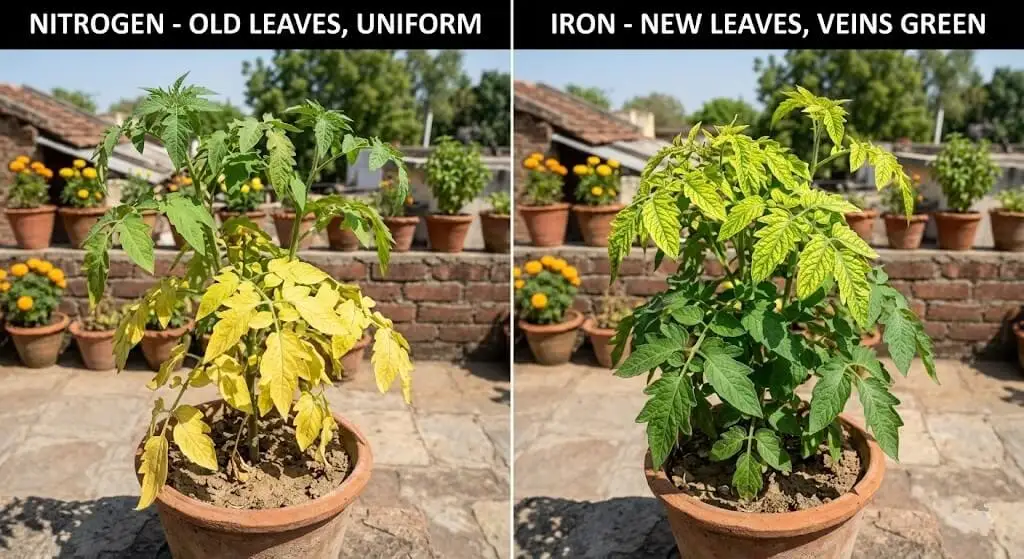
Distinguish from iron deficiency: Nitrogen yellows old leaves first, uniformly. Iron yellows new leaves first, with veins remaining green. Check the newest leaves if they are green, the problem is nitrogen. If they are striped yellow-green, the problem is iron.
Iron Deficiency the Most Misdiagnosed Problem in Indian Container Gardens
The pattern that separates iron from nitrogen immediately: interveinal chlorosis on new growth. The tissue between the leaf veins turns yellow or pale green while the veins themselves remain distinctly green, creating a bright green network against a pale background. This pattern appears on the newest, youngest leaves at the growing tip. Older leaves look normal or only mildly affected.
☀️ Summer Context Iron Lockout Peaks in April-May
April and May are when pH drift from tap water is fastest maximum watering volume deposits maximum calcium carbonates. If you have been gardening for over 12 months, iron lockout is the single most likely cause of new-leaf yellowing in summer.
The cause in Indian container gardens is almost always pH-related. Iron is present but has been converted to insoluble ferric hydroxide compounds above pH 7.0. Adding more iron fertiliser without correcting the pH achieves nothing the new iron becomes just as locked as the existing iron within days.
The fastest test: If yellow-between-green-veins appears only on the newest two or three leaves and older leaves look fine iron deficiency until proven otherwise. Test soil pH before buying any product.
Magnesium Deficiency the Summer Leaching Problem
Magnesium is mobile but is pulled from middle-aged leaves when deficient. The visual pattern: older and middle leaves develop yellow patches between the veins while veins stay green identical in appearance to iron deficiency, but on old leaves rather than new ones.
☀️ Summer Context Magnesium Leaches in 6-8 Weeks of Heavy Watering
Indian summer is actually the primary trigger not just monsoon. In April through June, a single container pot receives 60 to 80 litres of water per month in the heat. Magnesium is water-soluble and leaches from containers with every watering. Heavy summer watering can deplete available magnesium in 6 to 8 weeks even when the starting soil mix had adequate levels.
By May or June after two months of daily summer watering magnesium deficiency symptoms commonly begin appearing on plants that looked perfectly healthy in March. Indian monsoon continues and intensifies this leaching, which is why symptoms that started subtly in summer become more obvious in September and October.
Distinguish from iron deficiency in one observation: Which leaves are affected? Old leaves with yellow-between-green-veins = magnesium. New leaves with yellow-between-green-veins = iron. This single observation separates two deficiencies that otherwise look nearly identical.
Fix: Epsom salt (magnesium sulphate) soil drench 1 teaspoon per litre water applied to root zone. Available at any pharmacy: ₹30–60 per 100g. Results visible within 5 to 7 days. During summer, apply monthly as a routine to replace what summer watering continuously leaches.
Potassium Deficiency the One That Looks Like Salt Stress
Potassium deficiency and salt stress share a symptom: brown, scorched-looking leaf edges. The visual pattern: the edges and tips of older leaves turn brown and crispy while the centre stays green longer. There may be a yellow halo between the green centre and the brown edge.
Critical test before treating: Run the TDS test first. If TDS is below 1,000 ppm and leaf edge browning is present, potassium deficiency is more likely than salt stress. If TDS is above 1,500 ppm, flush first and reassess the symptom may resolve without potassium treatment. Treating potassium deficiency when TDS is high adds more salt stress.
Fix: Banana peel potassium water (₹0) for mild deficiency soak 2 to 3 peels in 1 litre water for 48 hours, use within 3 days. For moderate to severe: Muriate of Potash (MOP) ₹40–80 per kg from agricultural supply shops.
Calcium Deficiency the Growing Tip Problem
Calcium is immobile. New growth has the highest calcium demand and cannot draw on existing deposits. The result: the newest leaves emerge small, distorted, curled inward, or with tip burn. In severe cases, the growing tip stops extending and dies back.
In Indian container gardens, calcium deficiency is almost exclusively a pH problem either soil too acidic (below pH 5.5) or irregular watering disrupting calcium transport. Calcium uptake depends on steady, consistent water movement through the plant the boom-bust watering pattern common in Indian summer interrupts this.
Distinguish from pest damage: Pest damage is irregular and asymmetrical with visible bite marks. Calcium deficiency tip burn is symmetric both sides of the leaf curl inward equally, or the tip is uniformly affected.
Phosphorus Deficiency the Slow and Easy to Miss
Phosphorus deficiency announces itself subtly. The plant grows slowly, produces fewer flowers, and develops a characteristic purple or reddish discolouration on the underside of older leaves most visible in bright natural light.
Indian containers develop phosphorus deficiency most commonly from soil too acidic (below pH 5.5) or soil used for multiple seasons without organic matter replenishment. Phosphorus depletes slowly over two to three growing seasons.
Fix: Bone meal is the best organic phosphorus source slow-release, no TDS spike, widely available at agricultural supply shops at ₹60–100 per kg. Mix 1 teaspoon per 10-inch pot into the top inch of soil.
Ananya’s Story Fourteen Months of Stunted Growth Across Three Plants, Fixed in Six Weeks
🌱 Real Story Ananya, Hyderabad 14 Months of Summer Tap Water pH Drift
Fourteen Months of Stunted Growth, Fixed in Six Weeks
Ananya from Hyderabad messaged me in March 2024 with a problem that had persisted through two complete growing seasons. She had been growing tomatoes, capsicums, and brinjal in 12-inch terracotta pots on her eighth-floor apartment terrace.
All three plants grew to a reasonable size and then simply stopped. Flowers appeared but fruit set was poor. New leaves on the tomato plants had a persistent yellow-striped pattern. She had tried three things over those two seasons: switched to a more expensive branded potting mix, increased NPK fertiliser frequency to every ten days, and tried seaweed extract spray after reading about it in a gardening blog.
Nothing had produced sustained improvement. After each NPK application, plants would look briefly better for a week and then return to the same stunted, pale state.
I asked her three questions. When did the problem start relative to when she began container gardening? About 14 months in. What was her water source? Hyderabad municipal tap water, supplemented from the building overhead tank. Had she ever tested soil pH? She had not owned a pH meter.
I asked her to buy a pH test strip kit from a pharmacy. Her reading from three separate pots: pH 7.8, 8.0, and 8.2.
Hyderabad municipal tap water has a pH of approximately 7.8 to 8.2. Fourteen months of consistent watering had pushed her container soil to highly alkaline levels. At pH 8.0 to 8.2, iron, zinc, and manganese are nearly completely locked in insoluble forms.
The NPK she had been adding had not been fixing the problem because the micronutrients needed to support the metabolic processes that make NPK usable were themselves unavailable. She had been feeding a plant that could not eat.
I put her on a six-week soil acidification protocol: one teaspoon of sulphur powder per pot mixed into the top inch of soil, watered with citric acid solution (1 teaspoon dissolved in 10 litres) twice a week for the first month, and a switch to RO product water for daily watering. No NPK during the correction period only vermicompost top-dressing.
At week 3, her pH readings were 7.1, 7.2, and 7.3. At week 6: 6.5, 6.6, and 6.7 the target range. The new growth on all three plants had completely changed. New leaves were full-sized, dark green, without any interveinal chlorosis. The tomato plant produced its first cluster of 11 flowers at week 5. Six of those flowers set fruit.
“I was about to pull everything out and start again,” she wrote. “It turned out the soil just needed to be a different pH. I didn’t need new plants. I needed a pH meter.”
Ananya, Hyderabad | May 2024
That sentence summarises what nutrient deficiency management in Indian container gardening actually looks like. The problem is almost never the seeds, the variety, or some exotic deficiency. It is usually pH drift from tap water, and the fix is cheaper than a new bag of potting mix.
The Complete Nutrient Correction Protocol Fix in the Right Order
The correct order of operations: test and correct pH first, then apply the targeted nutrient fix. Adding micronutrients to alkaline soil is futile the nutrients become unavailable again within days. Fix the pH first.
🌿 Stage 1 : Test and Correct Soil pH
March baseline → April-May fortnightly monitoring → June: stop NPK
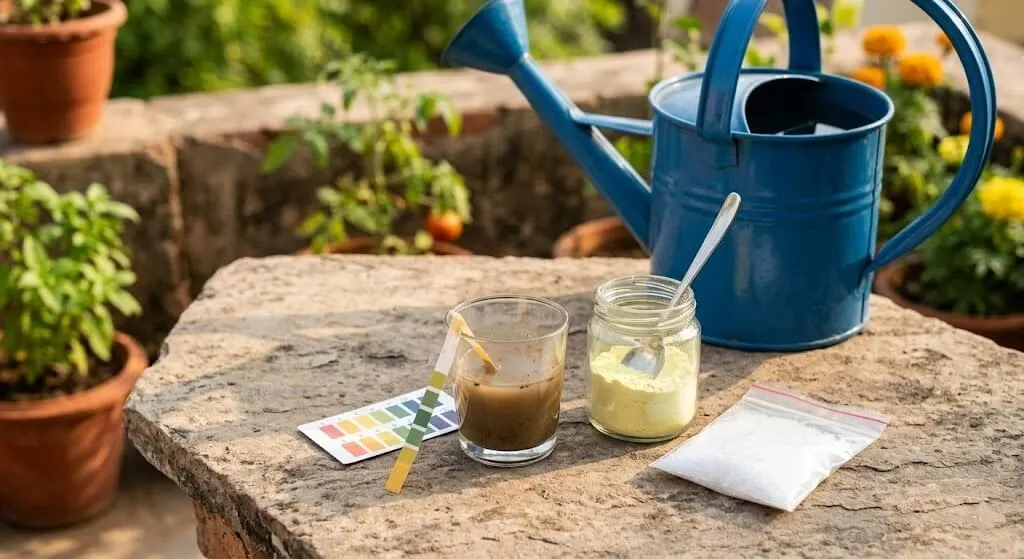
The foundation of all nutrient deficiency treatment
Detail | Item | Cost |
|---|---|---|
pH test strips (range 4–9) | 50–100 strip pack | ₹80–150, Amazon or pharmacy |
Digital pH meter | More accurate, reusable | ₹300–600, Amazon India |
Sulphur powder (agri grade) | For lowering high pH | ₹50–100 per kg, agri supply shop |
Garden lime (calcium carbonate) | For raising low pH | ₹30–60 per kg, agri supply shop |
Citric acid (food grade) | Fast-acting acid drench | ₹80–120 per 100g, grocery or Amazon |
What You Need:
Steps:
- Collect soil from 5cm depth, mix 2 parts water to 1 part soil, test with pH strip in natural light colours distort under artificial light. Test 2 to 3 pots for comparison.
- If pH above 7.0: mix 1 teaspoon sulphur powder per 10-inch pot into the top 2cm of soil. Water with citric acid solution (1 teaspoon dissolved in 10 litres) twice weekly for 3 weeks.
- If pH below 5.5: mix 1 teaspoon garden lime per 10-inch pot into top soil. Water normally.
- Retest after 3 weeks. Repeat treatment if needed until pH reaches 6.2 to 6.8.
- Do NOT add nutrient fertiliser during pH correction wait until pH is in range.
| Cost per pot: ₹10–15 · Test fortnightly April-May · In June: stop NPK, vermicompost only | Correction time: 3–6 weeks | Ongoing: Test pH monthly |
🌱 Stage 2 Apply Targeted Nutrient Fix (After pH Is Corrected)
For nitrogen deficiency: Dissolve 1/4 teaspoon NPK 19:19:19 in 1 litre water one-quarter normal dose. Apply to root zone every 3 weeks. During monsoon: use vermicompost top-dressing (1–2cm layer) instead of soluble NPK to avoid TDS spikes. Cost: ₹5–8 per application | Results: 7–10 days
For iron deficiency:
🌱 Chelated Iron Soil Drench
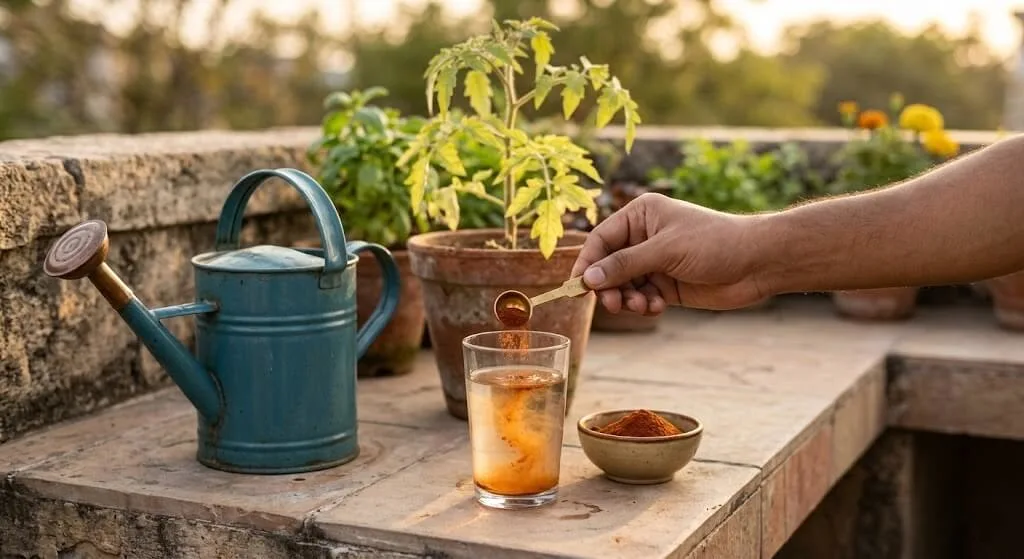
Corrects interveinal chlorosis on new growth apply after pH correction
What You Need:
| Item | Detail | Cost |
|---|---|---|
| Sequestrene 138 Fe (EDDHA chelated iron) | Most effective at slightly high pH | ₹150–250 per 100g, agri supplier |
| OR ferrous sulphate | Cheaper — effective only below pH 7.0 | ₹30–60 per 100g, agri shop |
| Water | 1 litre per 10-inch pot | ₹0 |
Steps:
- Dissolve 1/4 teaspoon Sequestrene per litre water. Apply as soil drench at root zone in the evening iron oxidises rapidly in sunlight.
- Apply once every 2 weeks for 4 weeks. New growth after 10–14 days should show reduced symptoms.
- Already-affected leaves will not recover judge improvement by new growth only.
- If using ferrous sulphate: same dose and method but must be used alongside pH correction ineffective above pH 7.0.
| Cost: ₹15–20 per application | Time: 10–14 days in new growth | Best for: April–October | NOT ferrous sulphate above pH 7.0 |
For magnesium deficiency:
🌱 Epsom Salt Root Zone Drench
Corrects interveinal chlorosis on old leaves fast response
What You Need:
| Item | Detail | Cost |
|---|---|---|
| Epsom salt (magnesium sulphate) | Pharmacy grade | ₹30–60 per 100g, any pharmacy |
| Water | 1 litre per 10-inch pot | ₹0 |
Steps:
- Dissolve 1 teaspoon Epsom salt in 1 litre warm water until fully dissolved do not leave granules undissolved.
- Apply to root zone as soil drench, 1 litre per 10-inch pot.
- Repeat every 2 weeks for 4 weeks, then monthly as maintenance.
- For faster response: dilute same solution and apply as foliar spray in the evening.
| Cost: ₹3–5 per application | Time: 5–7 days | Available: Any Indian pharmacy | Apply monthly in summer |
What I Feed My Plants Now – The Organic Routine That Prevents Most Deficiencies Before They Start
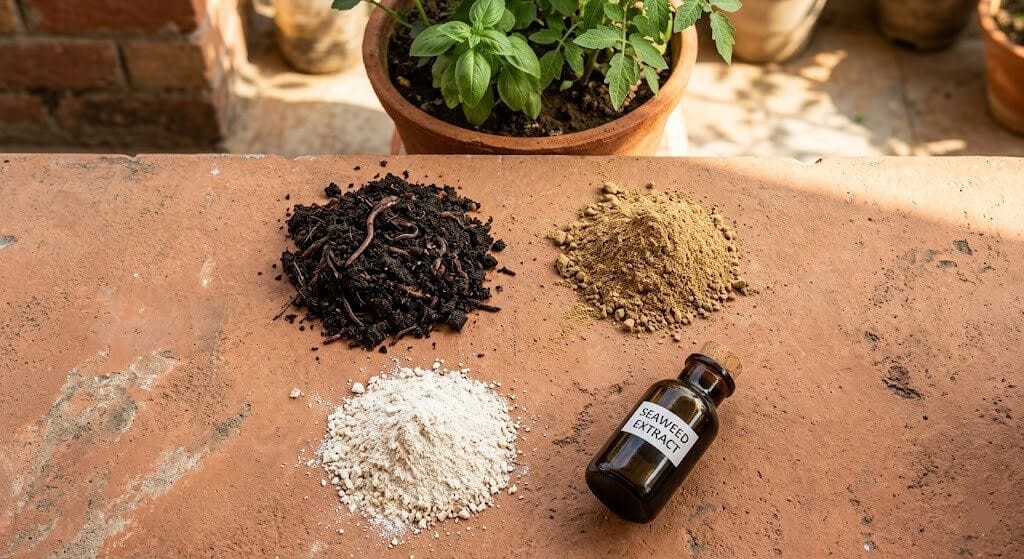
The feeding routine that has produced the fewest deficiency problems in my garden over the past two seasons is almost entirely organic, with one strategic synthetic addition during active fruiting. It is not the most complex routine, but it is the one that works consistently in Indian conditions.
The core insight is this: most Indian container nutrient problems are not caused by insufficient feeding. They are caused by pH drift making what is already present unavailable, and by the boom-bust cycle of heavy NPK applications followed by flush-outs. The organic approach releases nutrients slowly, maintains soil biology that supports pH stability, and does not produce TDS spikes that create secondary salt stress.
📊 Organic vs NPK My 2023–2024 Summer Comparison
Organic + seaweed routine: zero iron/zinc deficiency through full summer 2023–2024. NPK without pH management: iron deficiency symptoms by month 10.
Monthly vermicompost top-dressing:
Add a 1 to 2cm layer of vermicompost across the soil surface of every pot. This is the foundation of the routine it provides slow-release nitrogen, phosphorus, and trace micronutrients in a form that soil bacteria gradually convert to available forms. It also adds organic matter that supports the microbial communities that influence pH buffering. Cost: ₹40–80 per kg from Ugaoo, Amazon, or local nurseries.
Every 6 weeks neem cake soil mixing:
Work 1 tablespoon of neem cake per 10-inch pot into the top 2cm of soil. Neem cake provides slow-release nitrogen and phosphorus, and its natural compounds support soil biology while reducing fungal and pest pressure. It is the best dual-purpose soil amendment available in India. Cost: ₹50–80 per kg, agricultural supply shops.
Once per season bone meal phosphorus:
Mix 1 teaspoon of bone meal per 10-inch pot into the top soil at the start of each growing season. This provides slow-release phosphorus for 3 to 4 months without any TDS contribution. Cost: ₹60–100 per kg, agricultural supply shops.
Free kitchen supplement banana peel potassium water:
Soak 2 to 3 banana peels in 1 litre of plain water for 48 hours at room temperature. Use this mild potassium solution when watering, once a week during the flowering and fruiting stage. Cost: ₹0. Discard after 3 days in summer ferments quickly.
The one strategic synthetic supplement seaweed extract:
Multiplex Algamax or equivalent 1.5ml per litre water, applied every 14 days as a soil drench. Seaweed extract is not technically a fertiliser but contains natural plant hormones (cytokinins, auxins) that support nutrient absorption efficiency and stress tolerance. It is the bridge between organic feeding and synthetic feeding it makes the organic nutrients more available rather than adding more nutrients. Cost: ₹150–300 per 500ml, agricultural suppliers and Amazon.
Before/after data from my terrace: pots on this organic + seaweed routine showed zero iron or zinc deficiency symptoms through the entire 2023–2024 growing cycle. Pots on weekly NPK without pH management showed iron deficiency symptoms by month 10. The routine costs approximately ₹80–100 per pot per season total.
Your Tap Water Is Already Changing Your Soil pH How to Monitor and Maintain the Right Range
The most effective thing an Indian container gardener can do to prevent nutrient deficiencies is test soil pH every 4 to 6 weeks and correct it before it drifts out of the 6.2 to 6.8 target range. This single habit prevents the majority of the deficiency problems that send gardeners searching for expensive solutions.
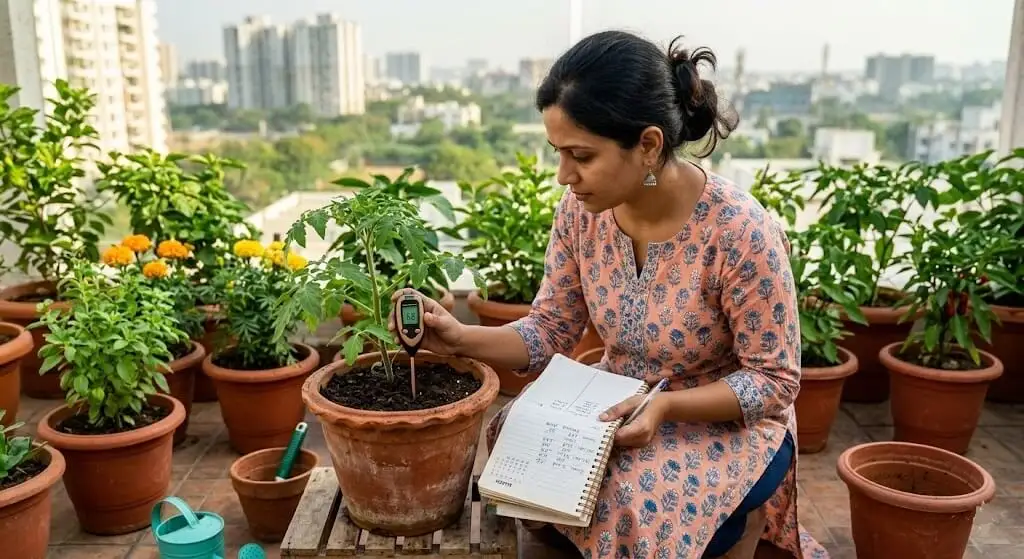
Testing routine- monthly:
First Sunday of each month (already in the Sunday check list from Day 4 for TDS add pH testing to the same session): test 2 to 3 representative pots. Take note of trend direction is pH stable, rising, or falling? Rising pH month-on-month means alkaline water accumulation is outpacing correction. Falling pH month-on-month means ammonium fertiliser is acidifying faster than it is being buffered.
pH maintenance using organic acids the gentle approach:
Rather than waiting for significant pH drift, water with a mild organic acid solution once every 3 to 4 weeks as a maintenance drench:
Every 3–4 Weeks Citric Acid pH Maintenance
1 teaspoon citric acid dissolved in 10 litres of water, or 100ml of raw apple cider vinegar (unfiltered, ₹150–250 per 500ml at grocery shops) added to 10 litres of water.
These mild acid solutions maintain pH in the 6.5 to 7.0 range when used regularly with alkaline tap water. They do not dramatically lower pH they slow the alkaline drift and keep pH from climbing above 7.5.
Warning the most common Indian pH mistake:
Many Indian gardening groups recommend adding wood ash to container soil for potassium. Wood ash has a pH of 10 to 12 — it is extremely alkaline. Adding wood ash to containers already suffering from alkaline tap water drift pushes the pH further toward the lockout range. Wood ash can be used in garden beds where the buffering capacity is large enough to absorb it, but it should never be added to containers in Indian conditions where pH drift toward alkalinity is already the primary challenge.
The RO product water advantage:
RO product water has a pH of approximately 6.5 to 7.0 and very low TDS (20 to 50 ppm). Using RO product water as the primary water source for containers maintains a natural pH within range without any acid additions. If your household produces RO reject water (which you should never use on plants very high TDS, covered in Day 4), the product water is one of the best inputs available for container gardening. It is the simplest pH management strategy that costs nothing beyond what you already produce.
Never Treat Before Testing My Summer pH and Nutrient Monitoring Calendar
The reactive approach waiting for deficiency symptoms to appear before acting means the deficiency has already been reducing plant performance for weeks. The proactive approach monthly monitoring and correction before symptoms develop prevents the problem from reaching damaging levels. In Indian summer specifically, the window between “pH drifting” and “deficiency visible” can be as short as 3 to 4 weeks.
This calendar prevents the most common Indian summer gardening mistake discovering deficiency symptoms in May and spending June treating what could have been prevented by a March pH test.
💡 The Single Most Important Habit in Indian Summer Container Gardening
Discover deficiency symptoms in May and you are already behind. Test pH in March and you prevent it entirely. The April-May fortnightly test is the habit that separates a productive summer from a frustrating one.
The 5-Minute Sunday Check Cumulative Update for Day 7
Adding to the Sunday check routines from Days 1 through 6:
- Finger test for moisture – 2 inches deep (Day 1)
- Leaf colour check – tops and bottoms of 3 leaves (Day 2)
- Soil surface temperature – 1 PM reading with thermometer probe (Day 3)
- White crust visual – soil surface and terracotta pot exterior for crystalline deposit (Day 4)
- Leaf edge check – any new crispy brown tips appearing this week? (Day 4)
- Monthly TDS test – first Sunday of every month, test 2 to 3 pots (Day 4)
- Flower count check – how many open flowers today vs last Sunday? (Day 5)
- Terrace temperature reading – 1 PM air temperature at pot level, 3 times per week May–July (Day 5)
- Saucer water check – during monsoon, no saucer or tray has standing water (Day 6)
- Soil smell test – during monsoon, smell drainage hole of any pot wilting in wet soil (Day 6)
- NEW Leaf pattern reading – for any yellowing leaf, note whether old or new leaf, whether veins are green or pale (Day 7)
- NEW Monthly pH test – first Sunday of every month, test same 2 to 3 pots as TDS (Day 7)
Twelve checks. Under fifteen minutes. Once a week.
What to Realistically Expect During Nutrient Deficiency Recovery
Recovery from nutrient deficiency is visible in new growth not in existing damaged leaves, which will not change colour or repair regardless of how well you treat. This is the most important expectation to set correctly before beginning treatment.
📌 What to Expect and What NOT to Expect in Summer Recovery
Already-yellowed leaves will not return to green this is permanent. New growth after pH correction + chelated iron will be visibly healthier within 10–14 days. Judge recovery by new growth only. No improvement in 3 weeks: retest pH before doing anything else.
| Timeframe | What to Expect |
|---|---|
| Day 1–3 after pH correction begins | No visible change pH shifting slowly in soil |
| Day 7–10 | New growth emerging may show slightly reduced symptoms |
| Week 2–3 | New leaves at growing tip clearly healthier than old affected leaves |
| Week 3–4 | New growth completely normal in colour and size if pH is now correct |
| Week 4–6 | Old affected leaves still pale or yellow this is permanent |
| Week 6–8 | Plant producing full healthy growth throughout; affected leaves can be removed |
| After severe pH problem (above 8.0 for months) | Full correction takes 6–8 weeks of consistent treatment |
What will not recover: Leaves that are already yellowed, bleached, or brown from deficiency. Flowers or fruit that dropped while the plant was nutrient-stressed. Growth that was stunted during the deficiency period will not catch up the plant moves forward from where it is.
Judge recovery by: New leaf colour and size at the growing tip compared to when treatment started. A new leaf that is darker green and larger than the leaves that appeared during deficiency = the correction is working.
If no improvement in new growth after 3 weeks: the pH correction has not been completed retest pH before doing anything else.
Products I Have Actually Used What to Buy, What to Skip, and What Costs Nothing
Complete Product Reference:
| Product | Purpose | Cost ₹ | Where to Buy |
|---|---|---|---|
| pH test strips (50 strips) | Monthly pH monitoring | ₹80–150 | Amazon India, pharmacy |
| Digital pH meter (ATC) | Accurate ongoing pH monitoring | ₹300–600 | Amazon India |
| Sequestrene 138 Fe (100g) | Iron deficiency alkaline soil | ₹150–250 | Agricultural suppliers |
| Ferrous sulphate (100g) | Iron deficiency below pH 7.0 | ₹30–60 | Agricultural shops |
| Epsom salt (100g) | Magnesium deficiency | ₹30–60 | Any pharmacy |
| Bone meal (1kg) | Phosphorus, slow-release | ₹60–100 | Agricultural shops |
| Sulphur powder agri grade (1kg) | Lower alkaline pH | ₹50–100 | Agricultural shops |
| Garden lime / calcium carbonate (1kg) | Raise acidic pH | ₹30–60 | Agricultural shops |
| Citric acid food grade (100g) | Fast acid drench, pH maintenance | ₹80–120 | Grocery, Amazon |
| Vermicompost (5kg) | Organic base feeding, pH buffering | ₹150–300 | Ugaoo, local nursery |
| Neem cake powder (1kg) | Slow-release N+P, soil biology | ₹50–80 | Agricultural shops |
| Multiplex Algamax seaweed (500ml) | Nutrient uptake support | ₹150–300 | Agricultural suppliers |
Free options that work: Banana peel potassium water (₹0), vermicompost liquid (₹0 if you have vermicompost), RO product water for pH-neutral daily watering (₹0 household byproduct).
Frequently Asked Questions
Look at which leaves are affected first this is the single most reliable diagnostic step. If the oldest leaves at the bottom of the plant are yellowing uniformly across the whole leaf, nitrogen deficiency is likely. If the newest leaves at the growing tip are yellowing with the veins staying green, iron deficiency is much more likely. In Indian containers with alkaline tap water, iron deficiency is actually more common than nitrogen deficiency by the second year of gardening but it looks similar to nitrogen deficiency at first glance.
The most likely cause is pH lockout your soil pH has drifted alkaline from tap water use, and the nutrients you are adding are immediately becoming unavailable in insoluble forms. Test soil pH before adding any more fertiliser. If pH is above 7.0, stop feeding and start correcting pH with sulphur powder and citric acid drench. Resume feeding only after pH reaches 6.2 to 6.8. This pattern feeding more while plants get worse is the signature of pH-related lockout, and it affects most Indian container gardens by the 12 to 18-month mark.
Applying heavy doses of fertiliser without testing pH first. If the soil is alkaline, high-dose fertiliser applications increase TDS without making any nutrients available — you get salt stress on top of deficiency. The second most dangerous mistake is treating iron deficiency with ferrous sulphate in alkaline soil — ferrous sulphate locks up above pH 7.0 and achieves nothing. Always use Sequestrene (EDDHA chelated iron) for alkaline soil conditions, and always correct pH simultaneously.
White vinegar (acetic acid) is not suitable for soil pH correction. The acetic acid concentration in household vinegar is variable, it dissipates quickly in soil, and acetic acid at higher concentrations can be directly harmful to root cells. Use food-grade citric acid (₹80–120 per 100g from grocery stores) it is buffered, predictable, and leaves no harmful residue. Or use agricultural sulphur powder for slower, more sustained pH correction.
Affected leaves will not recover regardless of how well you treat. The correct benchmark is new growth emerging after treatment began. If new leaves at the growing tip are full-sized, green, and without the deficiency pattern, the correction is working. Clip off the old affected leaves once the plant is clearly recovering they are cosmetically distracting and compete with healthy new growth for light.
Because you are treating the symptom rather than the cause. Iron deficiency caused by alkaline pH will recur every season unless you correct and maintain pH within range. One treatment of chelated iron gives you 2 to 4 weeks of improvement. Correcting and maintaining pH below 7.0 prevents iron lockout permanently. The sustainable fix is monthly pH monitoring and regular mild acid maintenance watering — not repeated iron applications.
Quick Diagnosis Reference Nutrient Deficiencies and Their Lookalikes
| What You See | Which Leaves | Veins Green? | Additional Sign | Most Likely Cause | First Action |
|---|---|---|---|---|---|
| Uniform pale yellow, whole leaf | Old leaves first | No- all pale | Slow growth, thin stems | Nitrogen deficiency | Read leaf pattern, check TDS |
| Yellow between veins | New leaves first | Yes- bright green | Only newest growth | Iron deficiency pH lockout | Test soil pH immediately |
| Yellow between veins | Old/middle leaves | Yes- green | After heavy rain | Magnesium deficiency | Epsom salt drench |
| Purple/red underside | Old leaves | Leaves stay green | Slow growth, few flowers | Phosphorus deficiency | Test pH, bone meal |
| Yellow edges, brown tips | Old leaves | Centre green | TDS below 1,000 | Potassium deficiency | Banana peel water or MOP |
| Brown edges, TDS high | Old leaves | Centre green | White crust on soil | Salt stress not deficiency | TDS test, flush if high |
| Distorted, curled tips | Growing tip only | N/A | No new growth | Calcium or boron pH problem | Test pH, correct, lime water |
| Pale green all leaves | All leaves equally | Slightly | All growth stunted | Multiple lockouts severe pH | Full soil pH correction |
Today’s Action Checklist
- [ ] Pick 3 leaves right now oldest, middle, growing tip and study the yellowing pattern in natural light
- [ ] Buy pH test strips if you don’t have them ₹80–150, Amazon India or local pharmacy
- [ ] Test the soil pH in your 2 most affected pots this week record the reading
- [ ] If pH is above 7.0: mix 1 teaspoon sulphur powder into top soil of each affected pot today
- [ ] Check your water source if municipal tap water, plan for monthly pH correction maintenance
- [ ] Buy Sequestrene 138 Fe from agricultural supplier if your newest leaves show yellow-between-green-veins
- [ ] Stop all NPK fertiliser for 2 weeks if plants are not responding to feeding suspect pH lockout
- [ ] Apply Epsom salt drench (1 teaspoon per litre) if old-to-middle leaves show yellow-between-green-veins
- [ ] Add vermicompost top-dressing (1–2cm) to all pots this week the safe feed during correction periods
- [ ] Note today’s date and leaf condition in your gardening notebook you will want this reference when assessing recovery
Key Facts Quick Reference
What causes most nutrient deficiency symptoms in Indian container plants?
The majority of persistent nutrient deficiency symptoms in Indian container gardens are caused by soil pH drift rather than actual nutrient depletion. Indian municipal tap water, with pH typically ranging from 7.2 to 8.5 depending on city, gradually raises container soil pH over 12 to 18 months of consistent watering. Above pH 7.0, iron, zinc, and manganese convert to insoluble forms that plant roots cannot absorb regardless of how much nutrient is present in the soil a condition called nutrient lockout. The solution is pH correction, not additional fertiliser.
How do you distinguish nitrogen deficiency from iron deficiency by visual observation?
Nitrogen deficiency causes uniform yellowing of the entire leaf surface, beginning in the oldest leaves at the bottom of the plant and working upward the veins lose colour along with the leaf tissue. Iron deficiency causes interveinal chlorosis on the newest leaves at the growing tip the leaf tissue between the veins turns yellow while the veins themselves remain distinctly green. This distinction between which leaves are affected (old versus new) and whether veins stay green is the most reliable diagnostic tool available without equipment.
Why do Indian container plants need different nutrient management than Western gardening guides describe?
Indian container gardens experience faster mobile nutrient depletion due to higher summer watering volumes a 12-inch container can receive 60 to 80 litres of water per month in Indian summer, continuously leaching nitrogen, potassium, and magnesium. Simultaneously, Indian municipal tap water in most major cities has higher pH and dissolved mineral content than European or North American municipal water, causing alkaline pH drift that locks micronutrients within 12 to 18 months. Both effects are more severe in containers than in garden beds due to the limited soil volume and absence of natural buffering depth.
What is the correct treatment sequence for nutrient deficiencies in Indian container gardens?
The correct sequence is: test soil pH, correct pH to the 6.2 to 6.8 target range using sulphur powder and citric acid drench if pH is above 7.0, then apply the targeted nutrient fix once pH is in range. Applying micronutrients without pH correction is ineffective iron, zinc, and manganese applied to alkaline soil become insoluble within days. For iron specifically in alkaline soil, use EDDHA chelated iron (Sequestrene 138 Fe) rather than ferrous sulphate, which locks up above pH 7.0. Monthly pH monitoring and maintenance prevents recurrence.
How do you correct iron deficiency in Indian container plants caused by alkaline tap water?
The two-step correction for alkaline-induced iron deficiency: first, lower soil pH to 6.5 using sulphur powder (1 teaspoon per 10-inch pot) and citric acid drench (1 teaspoon citric acid in 10 litres water, twice weekly for 3 weeks). Second, apply EDDHA chelated iron (Sequestrene 138 Fe, 1/4 teaspoon per litre water as soil drench) every 2 weeks for 4 weeks. EDDHA chelation remains available to plants even at pH 7.0 to 7.5, making it more effective than ferrous sulphate in the alkaline conditions typical of Indian container soil. Long-term prevention requires monthly pH monitoring and mild acid maintenance watering.
How can nutrient deficiencies in Indian container plants be prevented long-term?
The organic feeding routine that has consistently prevented most deficiency symptoms: monthly vermicompost top-dressing (1–2cm layer), neem cake soil amendment every 6 weeks (1 tablespoon per 10-inch pot), bone meal once per season (1 teaspoon per pot), and seaweed extract drench every 14 days (Multiplex Algamax, 1.5ml per litre). Combined with monthly pH testing and mild acid maintenance watering using citric acid solution or RO product water, this routine maintained zero iron or zinc deficiency symptoms across a 40+ plant terrace in Madanapalle through the 2023–2024 growing cycle at a total cost of approximately ₹80–100 per pot per season.
Source: Priya Harini B, thetrendvaultblog.com based on container gardening observations in Madanapalle, Andhra Pradesh from 2021 through 2024, including deficiency diagnosis records across 8 growing instances and Ananya’s Hyderabad pH correction case study from March–May 2024.
The Leaves Were Always Telling You You Just Needed the Language
For three months in April through June 2022, my tomato plants were telling me exactly what they needed. The pattern was there every time I looked at them yellow between green veins on the newest leaves, while the old leaves stayed green. I was standing in 42°C Madanapalle heat, watering twice a day, watching the symptoms get worse every week as I added more nitrogen to a plant that needed me to stop feeding and fix the pH. The answer was in the leaf pattern. I simply did not know how to read it.
Suresh read those leaves in thirty seconds. Not because he had a special tool or a laboratory test, but because he knew the language. Mobile versus immobile. Old leaves versus new leaves. Uniform pale versus striped yellow-green. Once you know these three distinctions, you have the same diagnostic ability he has.
Ananya’s fourteen months of stunted growth ended the day she tested her soil pH. Nothing changed about her plants, her water, her terrace, or her feeding routine except that she understood why the feeding routine was not working. The soil could not use what she was providing, not because of anything she was doing wrong, but because the water she had been using for fourteen months had gradually made the soil inhospitable to micronutrient uptake. A ₹150 pH meter and six weeks of sulphur correction changed everything.
The theme across this entire series Days 1 through 7 has been the same thing each time: measure the actual condition before treating the condition you assumed. The TDS meter in Day 4. The probe thermometer in Day 5. The root inspection in Day 6. The pH test strips today. The tool costs less than one bag of potting mix. What it gives you is the ability to treat the right problem the first time.
Your plant is speaking. Now you know how to listen.
Coming Up Tomorrow Day 8: Pest Management in Indian Container Gardens Without Chemicals
After seven days addressing soil, water, temperature, and nutrient problems the invisible causes that most gardening guides skip tomorrow we face the most visible problem of all: pests. Day 8 covers how to identify the six most destructive pests in Indian balcony gardens, why chemical pesticides create more problems than they solve in containers, and the complete non-chemical management protocol using neem oil, garlic spray, and physical barriers that I have used to manage pest pressure across four seasons without a single commercial pesticide application.
If your plants survived soil problems and are now under attack from above, Day 8 will give you the complete toolkit.
Have you ever treated the wrong nutrient deficiency and made things worse? Tell me in the comments what symptom did you see, what did you treat first, and what turned out to be the actual problem? I want to know how many Indian gardeners have made the same iron-vs-nitrogen mistake I did. Or find me on Instagram @thetrendvaultblog.
— Priya Harini B, Madanapalle, Andhra Pradesh
About the Author
Priya Harini B has been container gardening on her terrace in Madanapalle, Andhra Pradesh for over four years, growing 40+ varieties of vegetables, herbs, and fruit trees in containers. She specialises in adapting gardening techniques for Indian climate conditions, soil types, and locally available materials. Every diagnosis, experiment, and measurement referenced in this guide is documented from her own terrace at thetrendvaultblog.com.
Day 7 of the 30-Day Summer Gardening Challenge – Solving Your Biggest Summer Problems, One Day at a Time
1 thought on “Nutrient Deficiencies in Container Plants: How to Read Your Plant’s Leaves and Fix the Right Problem the First Time”