
By Priya Harini B | Madanapalle, Andhra Pradesh | 4+ Years Container Gardening Experience
Day 8 of the 30-Day Summer Gardening Challenge — Solving Your Biggest Summer Problems, One Day at a Time
Table of Contents
Introduction
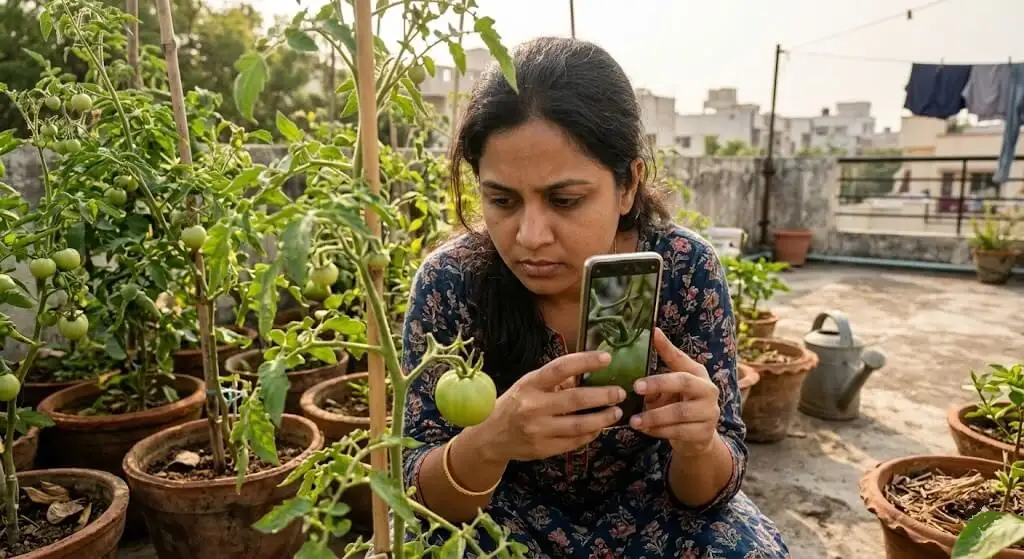
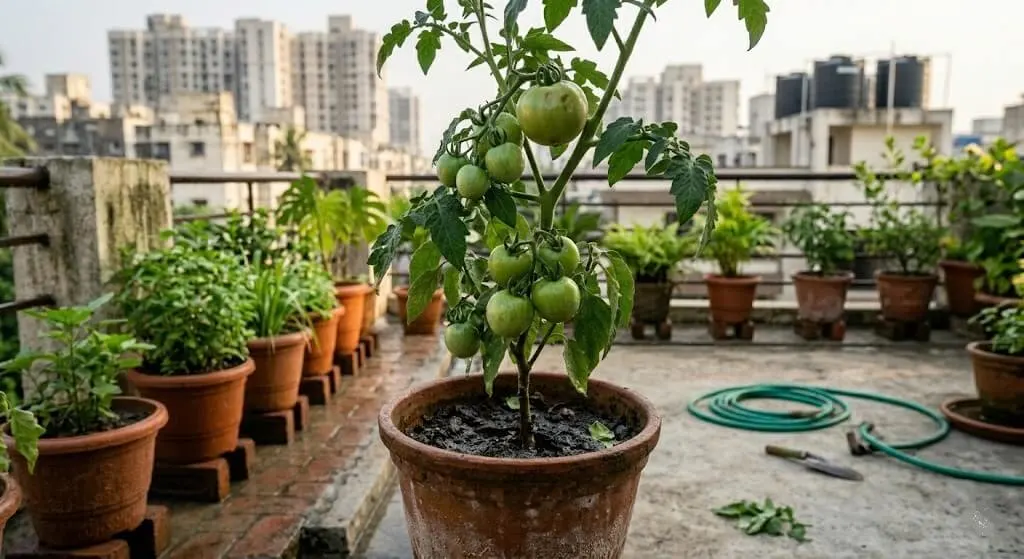
If you are searching for answers because your tomato or capsicum plant is dropping developing fruits small green tomatoes the size of marbles, or half-grown capsicums that should have weeks left to ripen falling cleanly off the plant before they get anywhere close to harvest, you are dealing with one of the most frustrating problems in Indian summer container gardening.
Unlike flower drop, which happens before any fruit is visible, premature fruit drop in container tomatoes and capsicums happens when the fruit is already there. You can see it. You have been watching it grow. And then one morning you find it on the terrace floor, weeks before it should have ripened.
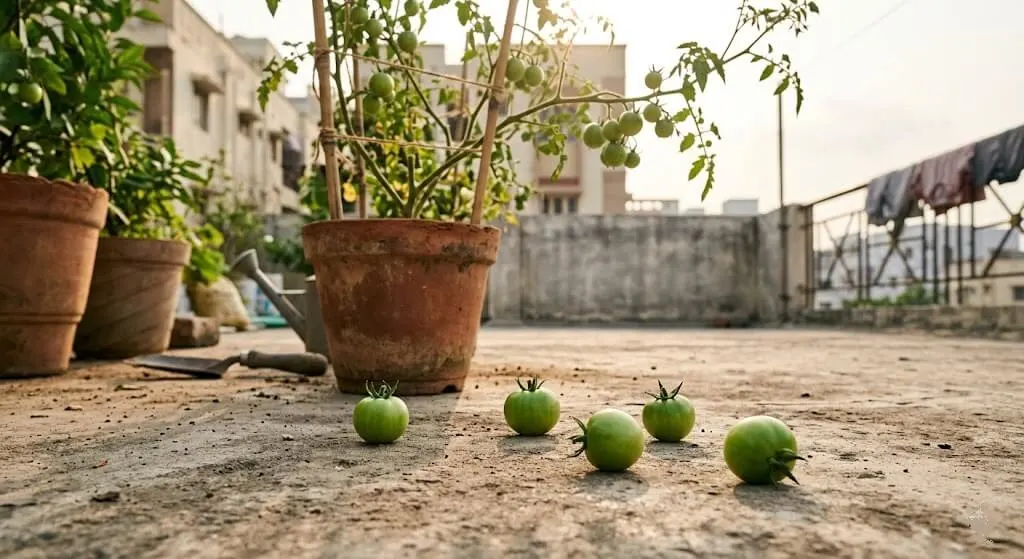
What makes premature fruit drop so difficult to diagnose is that “ Five completely different causes produce exactly the same visible symptom a fruit that falls cleanly at the stem junction before reaching maturity“
Temperature spikes above 38°C, inconsistent watering after fruit set, a sudden fertiliser or nutrition change, pest feeding on the stem, and plant overload from excessive fruit burden all trigger the same response in the plant: elevated ethylene production that signals the plant to shed developing fruit.
The plant is not failing. It is making a rational resource-management decision. The problem is that the trigger for that decision is something we introduced into its environment and identifying which trigger is responsible is the only way to stop the drop.
I lost 19 developing capsicums to fruit drop in the summer of 2023 over two weeks. I applied calcium drench assuming it was related to blossom end rot. I adjusted my watering schedule. I added diluted NPK thinking the plants were nutrient-stressed. The drop continued.
The diagnosis took me three additional weeks because I was examining the fallen fruit which was perfectly healthy inside rather than the stems and the temperature records, where the actual cause was clearly visible.
⚠️ The Most Dangerous Mistake When Fruit Starts Dropping
Adding extra NPK 19:19:19 in response to fruit drop is the single most common management error in Indian container gardening. Fruit drop in Indian summer is caused by heat, water stress, pest feeding, or plant overload not nutrient deficiency. Extra NPK adds fertiliser-surge ethylene on top of whichever trigger is already active. Drop accelerates. Diagnose first. Treat specifically. Never fertilise in response to drop
This guide covers everything I have learned about premature fruit drop in Indian summer container gardens across four growing seasons the five mechanisms that trigger ethylene-induced abscission, the exact visual inspection method that identifies which mechanism is active within three minutes, city-specific data on which trigger is most common and when, and the case study of Meera from Mumbai whose four years of late-May fruit drop were solved in a single season with a marked watering can and a written note for her neighbour.
What Premature Fruit Drop Actually Is Ethylene, Abscission, and the Plant’s Self-Preservation Logic
To understand why developing fruits drop prematurely, you need to understand abscission the controlled, hormonally-regulated process by which plants deliberately shed organs. Abscission is not accidental mechanical failure. It is a biological mechanism in which the plant forms a specialised layer of cells at the junction between a fruit and its stem called the abscission zone and then triggers those cells to weaken and separate the connection. The fruit falls cleanly because the plant cut it intentionally.
🔬 The Biology Abscission, Ethylene, and the Plant’s Resource Decision
Lorem ipsum dolor sit amet, consectetur adipiscing elit. Aenean diam dolor, accumsan sed rutrum vel, dapibus et leo.
The hormone that triggers abscission is ethylene a simple gaseous plant hormone produced in elevated quantities under stress conditions. Elevated ethylene signals the plant to activate the abscission zones at fruit stems, producing the clean-break fruit drop that distinguishes stress-induced premature drop from mechanical damage (which tears rather than drops cleanly) or disease (which rots the stem connection rather than breaking it cleanly).
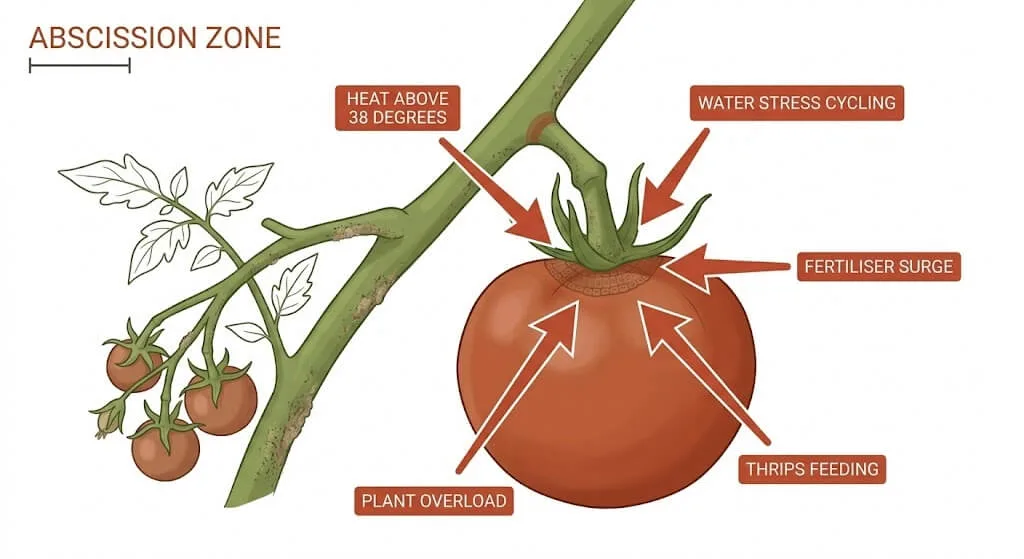
Elevated ethylene production in Indian summer container gardens is triggered by five distinct stresses:
Heat stress above 38°C
the same threshold that causes pollen sterility (Day 6) also triggers elevated ethylene in developing fruit tissue. The fruit does not need to be damaged for this to happen — the heat signal alone is sufficient. This is why fruits that formed correctly and appeared to be developing normally can suddenly drop during a heat spike week, even with no other management error.
Water stress from the surge-and-drought pattern
both underwatering and sudden rewatering after a drought period trigger ethylene production. The most common Indian container garden pattern: a few days of consistent watering, then one or two days skipped due to travel or schedule disruption, then heavy compensatory watering on return. This cycling is a reliable ethylene trigger in plants already carrying developing fruit.
Nutritional surge from sudden NPK changes
high nitrogen or a sudden fertiliser change after a period of low feeding creates a hormonal imbalance that elevates ethylene. The critical diagnostic detail: this cause has a 7 to 10 day lag between the fertiliser event and the fruit drop, meaning most gardeners have forgotten the fertiliser application by the time fruit is falling.
Pest feeding at stem junctions
thrips and mites feeding specifically on the stem tissue at the abscission zone damage the vascular tissue directly at the point of separation, triggering the process mechanically. Because thrips are 0.5 to 1.5mm long and invisible without magnification, this cause is the most commonly missed and the most important to check with a phone macro camera.
Plant overload
when a container plant is carrying more developing fruits than its limited root volume can support, it sheds the weakest and most recently set fruits as a resource management response. This typically manifests as the smallest fruits dropping while larger, more established fruits remain a distinguishing pattern.
💡 Why This Is a 5-Cause Differential Diagnosis
All five triggers produce identical visible symptoms a clean-break fruit drop with internally normal fruit. This is why treating without first diagnosing always fails. Calcium drench for thrips-caused drop is as ineffective as fungicide for blossom end rot.
This is why fruit drop is not a single-diagnosis problem in Indian summer. It is a five-cause differential diagnosis. Treating heat-stress fruit drop with calcium (as I did in 2023) is as ineffective as treating blossom end rot with fungicide.
📖 Priya’s Story — May 2023, Madanapalle (47 Capsicums, 19 Lost, Wrong Corrections for 2 Weeks)
The May 2023 Capsicum Crisis That Made Me Learn to Read Stems
It was the second week of May 2023. My capsicums four plants in 12-inch pots, all Bharat hybrid variety grown from seed since January had been setting fruit beautifully through April. By the first week of May I had 47 developing fruits across all four plants, ranging from marble size to nearly half their mature size.
My terrace temperature was controlled at 37°C under the Day 6 shade cloth. My watering was the consistent 6:30 PM routine from Day 7. I was, for the first time in four years of container gardening, feeling genuinely confident.
Between May 6th and May 14th, nineteen of those forty-seven fruits dropped.
I examined one that had fallen. The inside was perfect clean capsicum flesh, no rot, no disease. The stem showed a clean break, not a tear. The plant had cut the fruit deliberately.
I immediately applied a calcium drench on May 15th. More fruits dropped. My watering was consistent I checked every record in my notebook. I added a half-dose NPK 19:19:19 assuming nutrient stress. More fruits dropped.
I messaged Suresh on May 18th with photographs of the fallen fruits. He came over the following morning and did something I had not done once in two weeks of troubleshooting: he examined the plants, not the dropped fruits.
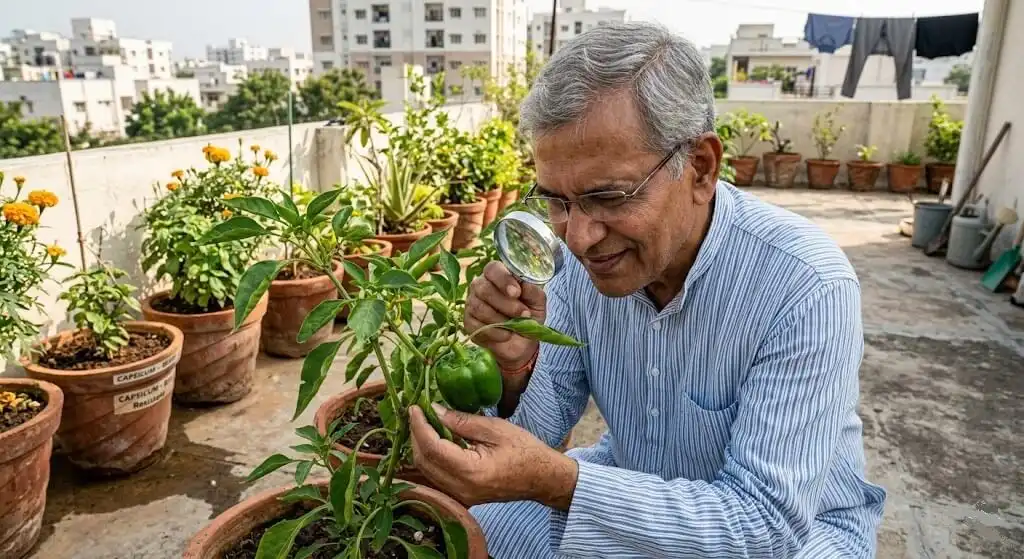
Suresh walked between the pots for fifteen minutes examining the stems not the dropped fruits. He borrowed my magnifying glass and looked at the stem junctions of still-attached capsicums.
“Come here. Look at this,” he said, pointing at the stem of a small capsicum fruit still on the plant. Under magnification, the stem above the fruit junction was covered in tiny yellowish-brown scabs dozens of them, visible only through the glass.
“Thrips,” he said. “Western flower thrips. They are feeding on the stem tissue at the abscission zone. Each feeding puncture is a wound at the separation point. The plant reads those wounds as damage and activates the separation process. Your calcium drench did nothing. Your NPK did nothing. You were treating a pest problem with nutrients.” — Suresh, Madanapalle | May 2023
He set down the magnifying glass. “You were looking at the fruit. The answer was in the stem.”
I treated for thrips that evening with neem oil spray applied specifically to all stems and fruit junctions. The drop stopped within seven days. I lost eight more fruits during the treatment window. The remaining 20 fruits grew to full maturity and gave me the first substantial capsicum harvest I had managed in four summer seasons.
That sentence “You were looking at the fruit. The answer was in the stem” reorganised how I think about all plant problems. The symptom points you toward the organ that is affected. The cause is almost always somewhere else in the system.
Step 1 The 3-Minute Stem Inspection Before Any Correction
The single diagnostic action that separates the correct correction from two weeks of wrong ones is the stem junction inspection. Not the fallen fruit examination. Not the soil test. The stem.
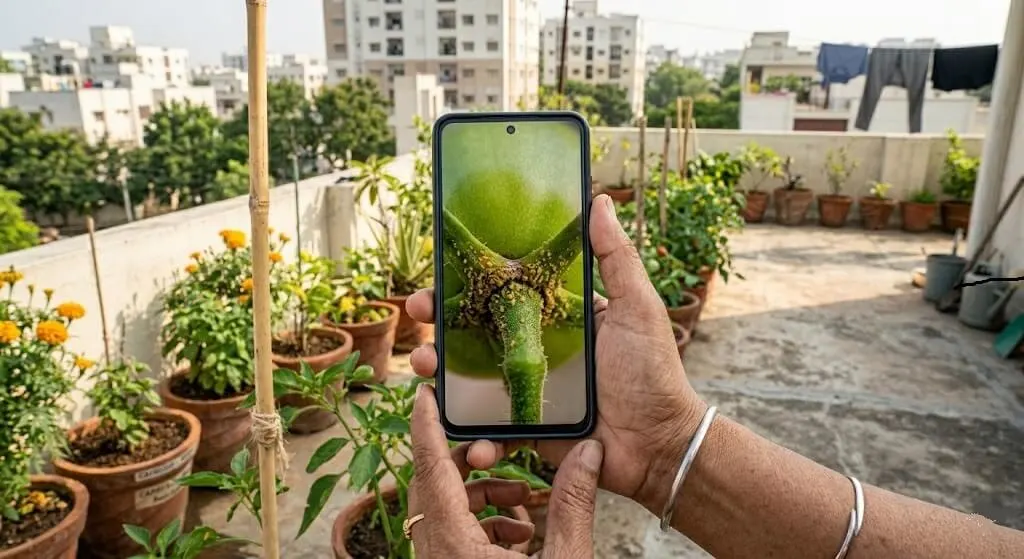
What you need:
🍅 The 3-Minute Stem Inspection Before Any Correction
Phone macro camera or hand magnifier · Morning light before 9 AM · ₹0
A phone with macro camera mode virtually every smartphone since 2018 has sufficient resolution. Alternatively a simple hand magnifier (₹80–150, any stationery shop). Good morning light, before 9 AM.
The 5-minute inspection method:
Identify the stem junction of 2 to 3 still-attached developing fruits on each plant with recent drop. Photograph each junction at maximum macro zoom. Transfer to a larger screen if needed, or zoom in on the phone screen.
Work through this visual checklist systematically:
Clean junction, no marks, no insects, recent hot weather: Environmental stress heat ethylene. Correlate with temperature records.
Clean junction, no marks, preceded by watering disruption: Water stress ethylene. Correlate with watering calendar.
Clean junction, no marks, preceded by NPK application 7–10 days ago: Fertiliser surge ethylene.
Tiny brown or yellow scabs, stippling, or feeding marks at or near the junction: Thrips or mite pest feeding.
Smallest and newest fruits dropping, larger fruits staying, no other stress: Plant overload.
Quick 60-second diagnostic:
Pattern test: where is the drop?
Uniform across all branches = environmental. Specific branches or specific fruit sizes = pest or overload. This alone narrows the diagnosis before you examine a single junction.
Pattern test: where is the drop?
Results table:
| What You See at Junction | Pattern | Most Likely Cause | First Action |
|---|---|---|---|
| Clean, no marks after hot week | All branches, mixed sizes | Heat stress ethylene | Check terrace temperature, Day 6 protocol |
| Clean, no marks after watering gap | All branches, mixed sizes | Water stress ethylene | Restore 6:30 PM consistent watering |
| Clean, no marks 7–10 days after NPK | All branches, mixed sizes | Fertiliser surge | Pause NPK 14 days, light flush |
| Scabs, stippling at junction | Specific branches | Thrips/mite feeding | Neem oil stem spray immediately |
| Clean smallest fruits only | Newest fruits first | Plant overload | Thin to 10–12 per 12-inch pot |
| Discoloured, soft junction | Random | Fungal stem disease | Remove branch, copper fungicide |
My Actual Fruit Drop Data Summer 2022 and 2023, Madanapalle
The table below shows every significant fruit drop event I recorded on my Madanapalle terrace across two seasons. Every row is a real event from my gardening notebook specific month, plant variety, cause, fruits lost, and how long correction took to stop the drop.

| Month | Plant | Fruits at Risk | Cause Identified | Fruits Lost | Days Drop Stopped | Correction |
|---|---|---|---|---|---|---|
| Apr 2022 | Pusa Ruby (3 pots) | 18 | Heat spike 46°C no shade cloth | 11 | 12 | Shade cloth installed |
| May 2022 | Bharat capsicum (2 pots) | 24 | Inconsistent watering 3 days skipped | 8 | 6 | Phone alarm established |
| Jun 2022 | Tomato (2 pots) | 14 | Plant overload 22 fruits per 12-inch pot | 6 | 5 | Thinned to 10 per plant |
| Apr 2023 | Arka Vikas (3 pots) | 31 | Fertiliser surge double NPK dose | 7 | 9 | NPK paused, half-flush |
| May 2023 | Bharat capsicum (4 pots) | 47 | Thrips at stem junctions | 19 | 14 | Neem oil stem spray |
| Jun 2023 | PKM-1 cherry (2 pots) | 38 | Monsoon transition water stress | 5 | 4 | Resumed consistent watering |
| Apr 2024 | All fruiting pots | 62 | Zero drop full protocol in place | 0 | — | Prevention maintained |
The April 2024 row is the most significant data point: the same Madanapalle terrace, same varieties, same April heat conditions, with zero fruit drop across 62 developing fruits. The difference between 2022 (31 fruits lost) and 2024 (zero lost) was entirely the systematic application of the five-cause prevention protocol from the start of the fruiting period.
Why Indian Summer Creates Fruit Drop That Western Container Guides Cannot Explain
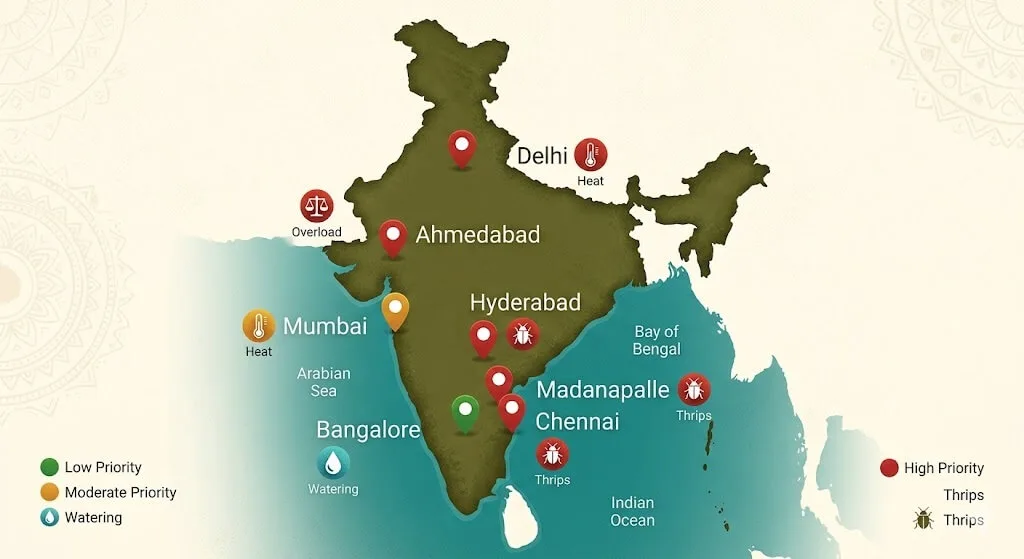
Premature fruit drop occurs in temperate gardens too but Indian summer container growing amplifies it through three specific conditions that compress multiple ethylene triggers into the same critical window.
The April–May heat climb hits developing fruit at its most vulnerable stage.
In most Indian growing zones, first-flush fruits form their cell structure the most calcium-demanding and heat-sensitive phase of fruit development in April and May, exactly when city temperatures are climbing from 32°C toward 44°C. The fruits that set in the relative cool of March are building their tissue structure through the hottest weeks of the year. Every temperature spike above 38°C during this window is a direct ethylene trigger, and in Indian summer these spikes occur not as exceptional events but as the norm.
Indian summer schedule creates the surge-and-drought watering pattern at exactly the wrong time.
April and May are the busiest months of the Indian family calendar school examinations, summer vacations, family travel, religious observances, and weddings all concentrate into this eight-week window. For a gardener who has established a good daily watering routine, a 3-day family trip or even a particularly demanding work week creates the watering inconsistency that triggers water-stress ethylene in plants carrying developing fruit. This is not a failure of discipline it is the intersection of two predictable Indian realities: the timing of the growing season and the timing of the social calendar.
Container root volume limits resilience to any supply chain disruption.
A 12-inch container pot holds 8 to 10 litres of soil and a proportional root system. An open garden tomato plant can extend roots over several square feet of soil. When a container plant carries 15 to 20 developing fruits simultaneously, the fruit-to-root ratio is dramatically higher than in open ground, meaning any disruption — a missed watering, a heat spike, a fertiliser gap hits the resource supply chain much harder and faster. This is why container plants drop fruit from stresses that the same variety would tolerate in an open garden bed.
| City | May Temperature | Primary Drop Trigger | Typical Timing | Prevention Priority |
|---|---|---|---|---|
| Bangalore | 32–35°C | Plant overload good fruit set in mild heat | Late May | Fruit thinning first |
| Mumbai | 34–37°C | Watering inconsistency travel season | May | Written watering plan |
| Hyderabad | 40–44°C | Heat stress terrace temps extreme | April–May | Shade cloth critical |
| Chennai | 38–42°C | Heat + thrips combination in humid conditions | April–May | Temp + weekly inspection |
| Madanapalle | 40–44°C | Heat stress primary, thrips secondary | April–May | Shade cloth + inspection |
| Delhi | 42–46°C | Heat extreme + NPK surge common response | May | Shade cloth, stop extra feeding |
| Ahmedabad | 42–47°C | Heat stress longest Indian summer season | April–June | Shade cloth through June |
The 5 Causes of Fruit Drop Visual Diagnosis for Each One
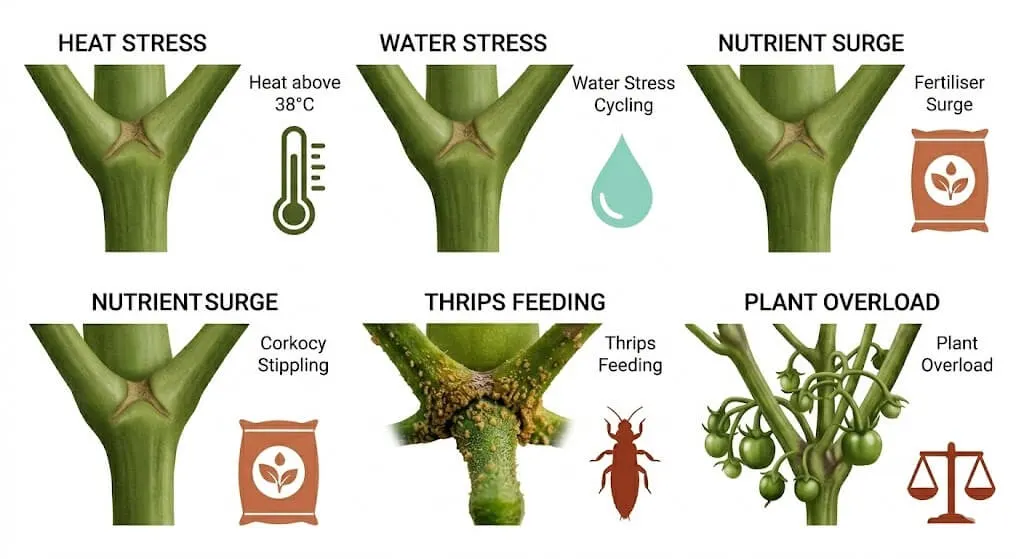
Heat Stress Ethylene When the Temperature Is the Problem
Heat-stress fruit drop is the most common cause in cities with May temperatures above 40°C and the most straightforward to confirm the temperature record tells you if it was possible. Developing fruits on a plant that is carrying them correctly drop when sustained temperatures above 38°C at plant level trigger ethylene production in the fruit tissue.
The characteristic pattern: multiple fruits dropping simultaneously, distributed uniformly across all branches, following a period of high temperatures. Stem junctions are clean with no pest evidence. The dropped fruits are internally normal. The plant’s overall appearance may be slightly stressed leaf edges showing mild curling but not severely damaged.
The key test: if terrace temperature exceeded 40°C at any point in the 3 days before drop began, heat stress is the primary or contributing cause.
Distinguish from water stress: heat drop correlates with temperature records. Water drop correlates with the watering calendar. Both can occur simultaneously during a hot week when watering is also disrupted.
Water Stress from the Surge-and-Drought Pattern
Water-stress fruit drop in Indian containers comes primarily from the cycling pattern not from prolonged severe drought. The mechanism is the same one described in Day 7 for blossom end rot: disruption of the continuous water supply triggers stress signalling that elevates ethylene. But where BER affects the fruit cells during their division phase, water-stress fruit drop activates the abscission zone in already-developed fruit.
The characteristic pattern: drop following an identifiable watering event a 3-day absence, a schedule disruption, or the onset of monsoon rain combined with continued manual watering. The timing is the diagnostic clue: drop typically appears 3 to 5 days after the watering event that triggered it.
The monsoon transition version is particularly common: gardeners who have been watering daily through May continue their schedule when monsoon begins, creating temporary oversaturation that triggers a brief root oxygen stress and consequent fruit drop.
Fertiliser Surge Ethylene The 10-Day Delayed Drop
Fertiliser-triggered fruit drop is the most commonly misdiagnosed cause because of the 7 to 10 day lag between the fertiliser application and the visible drop. By the time fruit is falling, most gardeners have stopped thinking about the feeding event from over a week ago and are attributing the drop to something more recent.
Two common Indian garden scenarios: an enthusiastic double-dose of NPK 19:19:19 applied because the plant “looks pale” this is the leading example of the dangerous instinct to add fertiliser when plants appear stressed. And the beginning-of-season NPK surge in April after the plant has been growing with minimal supplemental feeding through cool season a sudden large nutrient input that creates a hormonal imbalance.
The characteristic pattern: drop across all branches 7 to 10 days after a fertiliser application that was either excessive or a significant change from the previous routine. No unusual weather or watering events in the immediate week before the drop.
Thrips Feeding at Stem Junctions The Invisible Cause
Thrips specifically Western flower thrips (Frankliniella occidentalis) and chilli thrips (Scirtothrips dorsalis) feed preferentially on the tender stem tissue at fruit junctions. Their feeding punctures at the abscission zone directly damage the cells responsible for the fruit-stem connection, triggering the separation process mechanically rather than through systemic ethylene signalling.
Because thrips are 0.5 to 1.5mm in length and are active primarily in the early morning (5 to 8 AM) before most gardeners are on the terrace, they are the most frequently missed cause of fruit drop in Indian container gardens. Many gardeners lose several complete fruit clusters to thrips before ever identifying the pest.
The characteristic pattern: drop concentrated on specific branches of the plant rather than uniformly distributed because thrips populations build up in specific areas rather than colonising the entire plant uniformly. The dropped fruits come from the stems where thrips populations are highest. Stem inspection under magnification shows feeding scabs at or near the junction.
Plant Overload When a Good Season Creates the Problem
Detection: add the white paper tap test (Day 8 original pest management article available in the series archive) specifically for stem sections tap a fruit-bearing stem over white paper and look for tiny moving insects.
Plant overload as a fruit drop trigger is counterintuitive because it is easiest to produce when the plant is performing at its best. A tomato plant that successfully sets 25 to 30 fruits in a good April has created a resource demand that its 12-inch pot root volume cannot sustain through the 6 to 8 week development period for all fruits simultaneously.
The plant manages this constraint by shedding the newest, smallest, least vascularly established fruits the ones that have had the shortest connection time to the main stem. This self-thinning is biologically rational the plant is prioritising the fruits most likely to reach maturity.
The characteristic pattern: the smallest and most recently set fruits drop while larger, more established fruits remain on the plant. No correlation with environmental stress events. The retained fruits are typically excellent quality.
Comparison table all 5 causes at a glance:
| Cause | When Fruits Drop | Which Fruits | Junction | Confirm With |
|---|---|---|---|---|
| Heat stress | During/after hot days | All sizes, all branches | Clean | Temperature record |
| Water stress | 3–5 days after watering disruption | All sizes, all branches | Clean | Watering calendar |
| Fertiliser surge | 7–10 days after NPK | All sizes, all branches | Clean | Fertiliser record |
| Thrips feeding | Ongoing, progressive | Branch clusters | Scabs/stippling | Phone macro inspection |
| Plant overload | Ongoing after good set | Smallest fruits first | Clean | Count fruits per plant |
Meera’s Story Four Years of Late-May Fruit Drop, Solved With a Marked Watering Can
🌱 Real Story – Meera, Mumbai Four Years Identical Late-May Drop, Fixed in a Single Season
Meera’s Story Four Years of Late-May Fruit Drop, Solved With a Marked Watering Can
Meera from Mumbai had been growing tomatoes and capsicums on her south-facing eighth-floor apartment balcony for four consecutive years. Each season followed an identical pattern: excellent fruit set in April and early May, then dramatic fruit drop in late May and early June, leaving her with a fraction of the harvest the original fruit set had promised.
Over four years she had tried: switching from terracotta to plastic pots in year two, adding extra NPK in May in year three, installing partial shade in year three, and switching to cherry tomatoes in year four. None of these changes broke the pattern.
She messaged me in early May of her fifth season asking if anything could be done preventively. I asked her to describe her exact watering routine for May specifically not generally, but the specific pattern including any breaks.
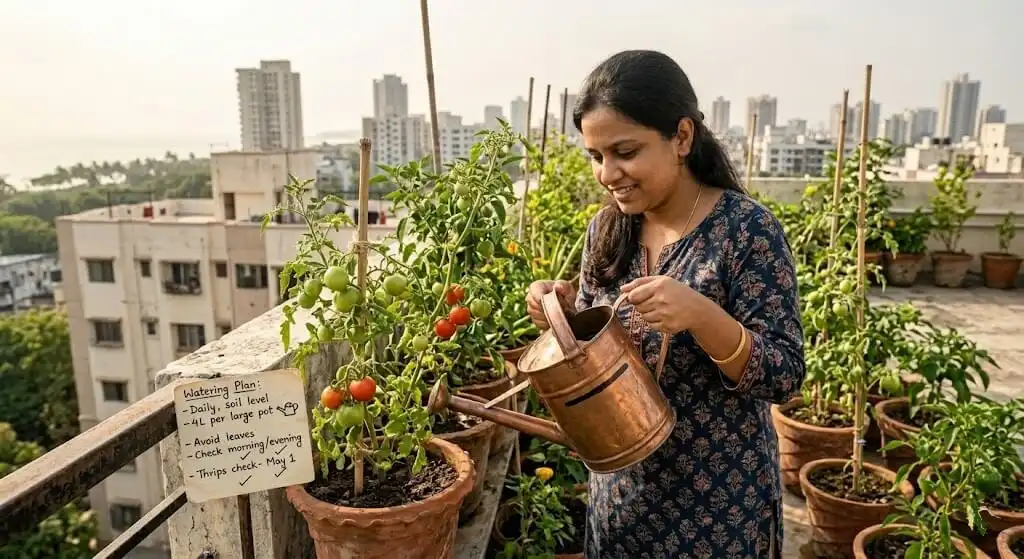
Her answer came immediately: “I water every morning at 7 AM. But in May I travel to my parents’ home for 4 to 5 days every year for a family function. My neighbour waters but usually misses a day or two. When I return I water heavily to catch up.”
I had the answer before she finished typing. Four consecutive years of fruit drop in late May. Four consecutive years of the same 4-to-5-day travel creating the same watering disruption followed by the same heavy compensatory rewatering exactly the surge-and-drought pattern that triggers water-stress ethylene in plants carrying developing fruit.
The plastic pot switch, the extra NPK, the shade structure, the cherry tomatoes none of these had touched the cause because the cause was not the plants, the pots, the variety, or the nutrition. It was the annual travel pattern colliding with the fruiting window.
I gave her three specific instructions. First: the evening before leaving, water all containers at 3 litres per 12-inch pot rather than the usual 1.5 litres a deep pre-absence soak that extends the soil moisture window by 2 to 3 days. Second: write a card for the neighbour specifying exactly 1.5 litres per container per evening, mark the watering can at the 1.5L level with permanent marker, and include a clear note that over-watering is as damaging as under-watering. Third: on the evening of return, water at the normal 1.5 litre volume not more.
She also installed fruit support clips on her 15 largest developing fruits to help monitor which fruits were retained and which were lost.
She messaged on day three of her trip: the neighbour had watered precisely as instructed. She returned on day five and watered normally that evening.
Over the following 10 days, she lost three fruits all small, all from the most recently set cluster, the classic overload self-thinning. She did not experience the mass drop she had seen every previous year.
Her harvest photograph arrived in late July with the message:
“Four years of fruit drop and the answer was a marked watering can and written instructions for my neighbour.”
— Meera, Mumbai | August 2023
That anticlimactic simplicity is almost universal among gardeners who identify their fruit drop cause for the first time. The problem was not the plants. It was one specific annual disruption in an otherwise correct routine, repeated identically for four years running.
The Complete Fruit Drop Response Protocol Five Causes, Five Targeted Fixes
🍅 Fix 1 For Heat Stress Drop
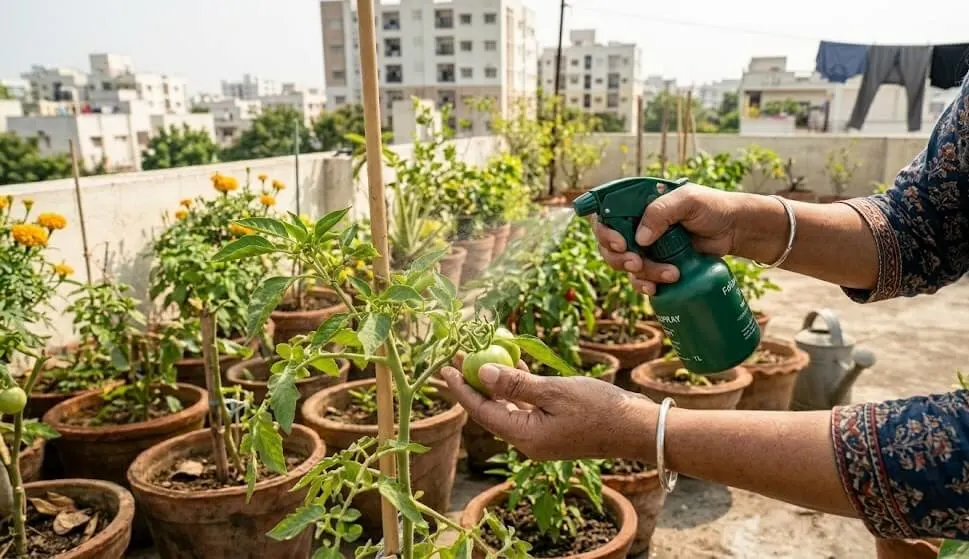
Reduce terrace temperature below 38°C
Apply the Day 6 shade cloth and pot insulation protocol. The temperature threshold is identical to pollen sterility: above 38°C at plant level, ethylene production is elevated and fruit drop risk is significant.
Additional step for active fruit drop during heat: Mist the plant stems and fruit clusters with fine water spray at 11 AM and 2 PM on extreme heat days (above 44°C city temperature). Evaporative cooling provides 2 to 3°C temperature reduction at the plant surface during the peak heat window.
ost: ₹260–620 per Day 6 | Time to effect: Immediate protection for still-attached fruits
🍅 Fix 2 For Water Stress Drop
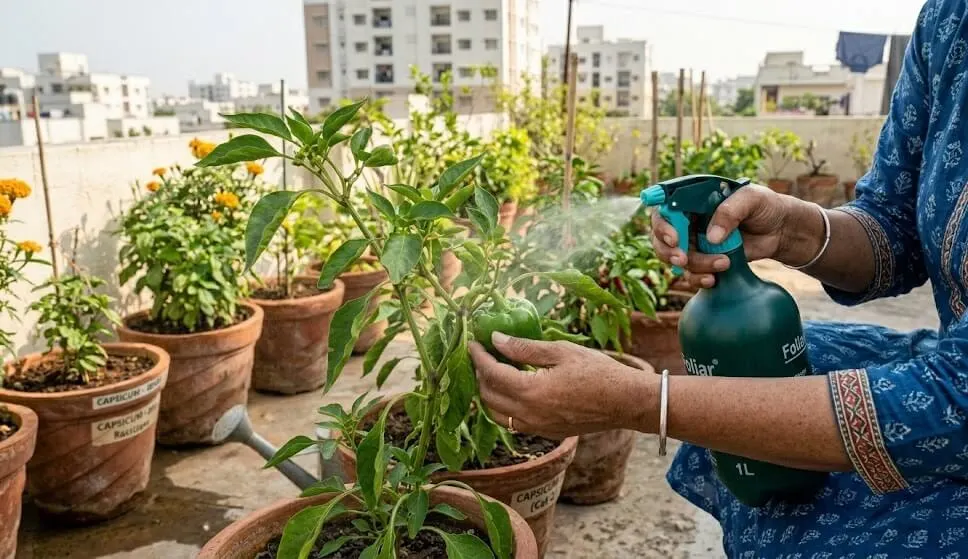
The Written Watering Plan Protocol
What You Need:
| Item | Detail | Cost |
|---|---|---|
| Phone alarm (6:30 PM daily) | The base habit | ₹0 |
| Watering can with marked volume | Permanent marker at 1.5L and 2L | ₹0 |
| Written watering card | For any cover waterer | ₹0 |
| Self-watering inserts (optional) | For absences over 3 days | ₹200–500 |
Steps:
- Set repeating 6:30 PM alarm as the primary routine.
- Before any planned absence: water at 3L per 12-inch pot the evening before leaving.
- Prepare a written card for cover waterers: time (6:30 PM), volume per pot (exact litres marked on can), and “do not skip AND do not add extra.”
- Mark watering can at correct volume with permanent marker.
- On return: water at normal 1.5L per pot that same evening no compensatory doubling.
Cost: ₹0 | Time to effect: Drop stops within 5–7 days of consistent restoration
🍅 Fix 3 For Fertiliser Surge Drop
The 14-Day Pause and Gradual Restart
Steps:
- Stop all NPK 19:19:19 and soluble fertiliser immediately.
- Apply a half-flush: 3L plain water per 12-inch pot dilutes excess nutrients without disrupting soil biology.
- Wait 14 days from the triggering NPK application before resuming.
- Restart at half the normal dose for one feeding, then return to full dose.
- Keep a fertiliser log note every feeding with date, type, and dose. The 7-to-10-day lag is only diagnosable with written records.
Cost: ₹0 | Time to effect: Drop stops within 10–14 days
🍅 Fix 4 For Thrips Fruit Drop
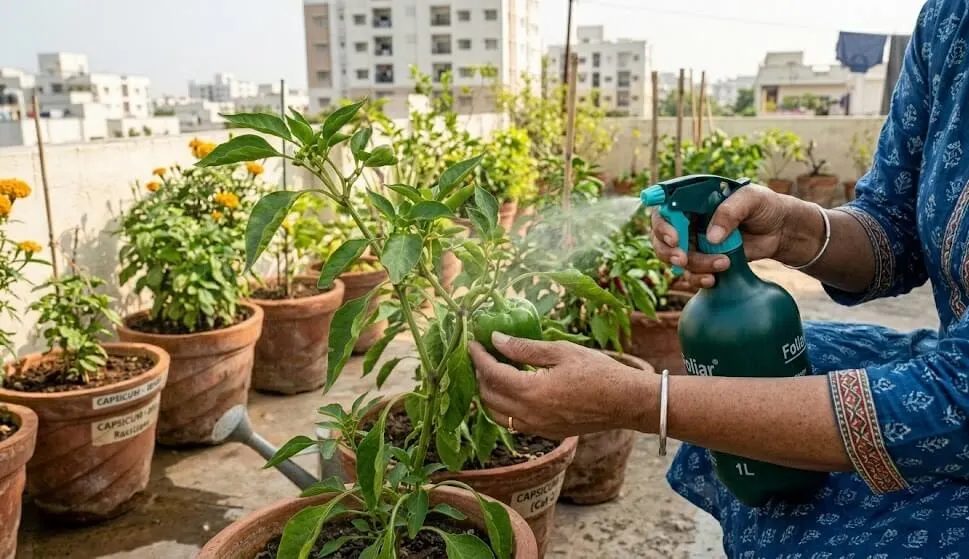
Neem Oil Stem Spray- Targeted Protocol
What You Need:
| Item | Detail | Cost |
|---|---|---|
| Cold-pressed neem oil | 5ml per litre | ₹150–250/500ml |
| Dish soap | 3ml per litre | ₹10–20 |
| Fine-mist spray bottle | For stem application | ₹60–120 |
| Yellow sticky traps | At stem height | ₹80–150 pack of 10 |
Steps:
- Mix neem spray: 5ml cold-pressed neem + 3ml dish soap in 1L water, shake until milky white.
- Apply specifically to stems and fruit junctions not primarily to leaves. Thrips shelter at stem tissue.
- Spray at 6 to 8 AM when thrips are active, or in the evening. Never midday in Indian summer sun.
- Retreat after 5 days in 40°C+ heat, thrips complete a generation in under 10 days.
- Maintain for 3 weeks to address all life stages.
- Install yellow sticky traps at stem height one per pot. Thrips fly low, not above the canopy.
Cost: ₹150–300 per treatment cycle | Time to effect: Drop typically stops within 7–10 days
🍅 Fix 5 For Plant Overload Drop
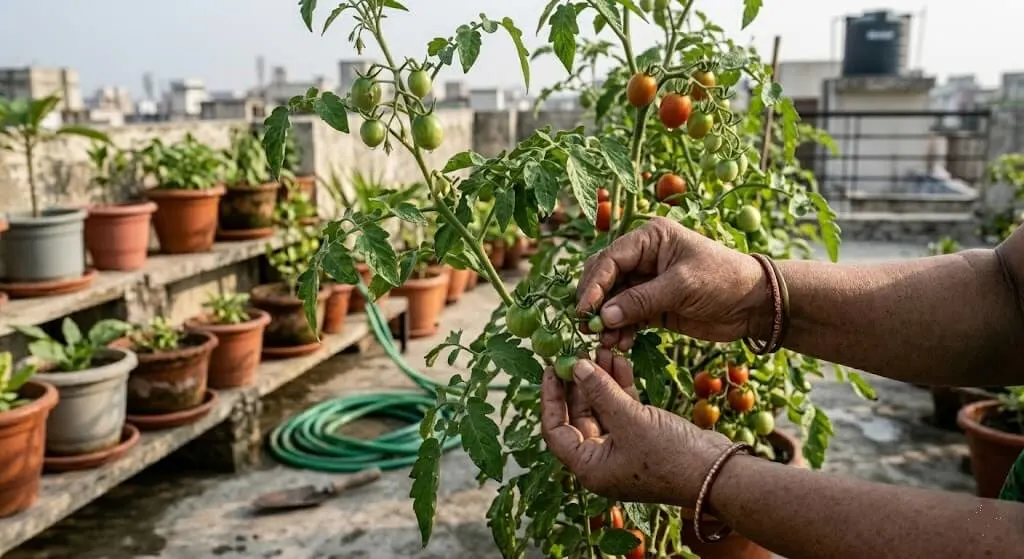
Intentional Fruit Thinning
Steps:
- Count total developing fruits per plant.
- Target maximum 10 to 12 fruits per 12-inch pot, 14 to 16 per 14-inch pot.
- Remove the smallest, most recently set fruits first these are the ones the plant would shed anyway.
- Remove from overcrowded clusters single fruits per cluster develop far better than clusters of 3 to 4.
- After thinning, apply a half-dose NPK feed the reduced fruit load means the plant can now support remaining fruits more fully.
The counterintuitive result: 10 well-supported fruits from a thinned 12-inch pot will typically produce more total weight than 20 half-developed fruits from an overloaded one, because each retained fruit reaches full size and maturity.
Cost: ₹0 | Time to effect: Drop stops within 3–5 days
Why Adding More Fertiliser During Fruit Drop Makes It Worse
The most important secondary point in this entire guide is the single most common mistake Indian gardeners make when fruit starts dropping: applying extra NPK fertiliser as a response to the visible stress.
This instinct is understandable the plant is dropping fruit, something must be wrong, fertiliser is the most immediate intervention available. In open garden settings where nutrient deficiency is a common issue, this reasoning is sometimes correct.
In Indian summer containers during active fruit development, it is almost always wrong. Fruit drop in Indian summer containers is caused by heat, water stress, pest feeding, or overload not by nitrogen deficiency.
Applying NPK 19:19:19 to a plant already experiencing water-stress or heat-stress ethylene production adds the fertiliser-surge ethylene trigger on top of the existing triggers. The plant receives three simultaneous ethylene signals: heat, water disruption, and nutrient surge. The drop accelerates rather than slows.
The pause protocol for this situation is identical to Fix 3: stop all fertiliser, apply half-flush, and wait 14 days. The plant has adequate nutrient reserves to continue fruit development for 2 to 3 weeks without additional feeding. What it does not have is the ability to manage three simultaneous ethylene triggers.
⚠️ The Single Most Common Management Error in Indian Container Gardening
Adding NPK 19:19:19 in response to fruit drop adds fertiliser-surge ethylene trigger on top of whatever is already active. Drop accelerates. This one rule do not add fertiliser when fruit is dropping would have prevented 3 of 4 drop events recorded in 2022 and 2023.
This single principle do not add fertiliser when fruit is dropping would have saved me three of the four drop events I recorded in 2022 and 2023.
Never Chase Drop After It Starts My Prevention Calendar
By the time fruit is on the ground, the ethylene signal was elevated 3 to 10 days earlier. Prevention requires anticipating the stress events before they occur.
The 5-Minute Sunday Check Cumulative Update for Day 8
Adding to the Sunday check routines from Days 1 through 7:
NEW – Day 8
- Finger test for moisture– 2 inches deep (Day 1)
- Leaf colour check -tops and bottoms of 3 leaves (Day 2)
- Soil surface temperature -1 PM reading (Day 3)
- White crust visual– soil surface and pot exterior (Day 4)
- Leaf edge check– new crispy tips? (Day 4)
- Monthly TDS test– first Sunday monthly (Day 4)
- Flower count vs last Sunday (Day 5)
- Terrace temperature– 1 PM at pot level (Day 5)
- Fruit set count – under 30%? Check temperature (Day 6)
- Shade cloth check – angle, tears, 11 AM–4 PM coverage (Day 6)
- Blossom end check – any dark patch? Remove + calcium drench due? (Day 7)
- Watering consistency -ever y evening this week? Any skips? (Day 7)
- NEW Fruit drop count– more than2 dropped since last Sunday? Stem inspection required. Note which plant and which branches (Day 8)
- NEW Stem junction inspection– photograph 3 junctions per fruiting plant, check for scabs. Count fruits per plant against 10–12 maximum (Day 8)
Fourteen checks. Under eighteen minutes. Once a week.
What to Realistically Expect After Identifying and Fixing the Cause
| Timeframe | Heat or Water Cause | Fertiliser Surge Cause | Thrips Cause | Overload Cause |
|---|---|---|---|---|
| Day 1–3 | Some drop continues ethylene already elevated | Drop continues lag period | Drop continues thrips still feeding | Drop stops quickly |
| Day 3–7 | Drop reducing | Drop starting to reduce | Drop reducing as neem works | Retained fruits visibly improving |
| Week 1–2 | Drop stopped | Drop stopped | Drop stopped | First size improvement visible |
| Week 2–4 | Retained fruits developing | Retained fruits developing | Retained fruits developing | First fruits approaching harvest |
| Week 4–8 | First harvest | First harvest | First harvest | Full harvest of retained fruits |
What will not recover: Fruits that have already dropped cannot be reattached the vascular connection has been severed. Do not attempt to re-tie dropped fruits.
What will recover: Every fruit still on the plant at the time of correction. The plant has made its decision about the dropped fruits it is actively protecting the ones it retained.
If drop continues beyond 14 days: Reassess the cause identification. Fruit drop in Indian summer is frequently multifactorial heat stress and water stress commonly occur simultaneously. Thrips feeding on an already heat-stressed plant produces drop more severe than either cause alone would create. If the correction for the identified cause is not stopping the drop, consider whether a second concurrent cause is present.
Products I Have Actually Used in India
| Product | Purpose | Cost ₹ | Where to Buy |
|---|---|---|---|
| Cold-pressed neem oil (500ml) | Thrips stem spray | ₹150–250 | Amazon India, agri suppliers |
| Yellow sticky traps (pack of 10) | Thrips monitoring at stem height | ₹80–150 | Amazon India, Ugaoo |
| Fine-mist spray bottle (500ml) | Stem neem application and midday misting | ₹60–120 | Any grocery or hardware shop |
| Digital thermometer | Temperature confirmation | ₹200–400 | Amazon India |
| Self-watering pot inserts | Moisture consistency during 3-day absences | ₹200–500 | Amazon India, Ugaoo |
| NPK 19:19:19 water-soluble (500g) | Maintenance feeding not emergency feeding | ₹80–150 | Agricultural supply shops |
| Fruit support clips (pack of 20) | Monitoring which fruits are retained vs dropped | ₹50–100 | Amazon India |
| Phone with macro camera | Stem junction inspection primary diagnostic tool | ₹0 – already owned | – |
The most effective prevention tools in this article cost nothing:
the written watering card, the volume mark on the watering can, the phone macro inspection, the fruit count per plant, and the family calendar review for travel conflicts. Product spending addresses thrips (neem oil) and water consistency during absences (self-watering inserts). Every other cause is addressed by attention, habit, and the knowledge of which five things to look for.
Frequently Asked Questions
Size-specific, season-consistent dropping strongly suggests a cause that is active at the same developmental stage and time of year each season. The most common Indian summer scenario: plant overload combined with a regular schedule disruption in the same annual period. Count the fruits on the plant when drop begins if above 15 on a 12-inch pot, intentional thinning will typically break the pattern. Also review whether the same schedule disruption travel, family function occurs at the same time each year. The combination of mild overload and predictable watering inconsistency creates a highly repeatable annual pattern.
Internally normal, clean-break dropped fruits confirm ethylene-triggered abscission from one of the five environmental causes not disease, not calcium deficiency, not mechanical failure. The internal health of the fruit is itself diagnostic: the plant made a resource decision. Work through the three-step correlation: check the temperature record, check the watering calendar, check the fertiliser log for the 3 to 10 days before the drop began. Also examine the stem junctions of still-attached fruits under phone macro. One of these four checks will identify the cause.
Adding extra NPK fertiliser in response to the drop. The instinct “the plant is stressed, it needs feeding” is incorrect in Indian summer containers where fruit drop is caused by heat, water stress, pests, or overload rather than nutrient deficiency. Extra NPK adds a fertiliser-surge ethylene trigger on top of whichever environmental trigger is already active, producing more fruit drop rather than less. The correct response to active fruit drop is diagnosis first, then the targeted fix not fertiliser application.
No. Once the abscission zone has begun activating, the vascular connection between fruit and stem is being severed at the cellular level. A partially detached fruit cannot recover its connection to the plant’s nutrient supply. Attempting to support it mechanically will keep it on the plant briefly but it will not develop further. The energy is better directed at protecting still-attached fruits through the correct fix.
Capsicums generally have higher ethylene-drop thresholds than tomatoes they tolerate more heat and watering inconsistency before activating abscission. Large-fruited tomato varieties like Pusa Ruby and Arka Vikas have higher per-fruit resource demands and lower drop thresholds. The conditions on your terrace are likely at or near the tomato threshold but below the capsicum threshold. Modest improvements in temperature management (Day 6 shade cloth) or watering consistency will typically resolve the tomato drop without affecting the capsicums, because the capsicums were already within their tolerance range.
Monsoon onset removes three of the five fruit drop triggers simultaneously. Temperatures drop below 38°C through cloud cover eliminating heat-stress ethylene. Daily rainfall provides consistent soil moisture eliminating the surge-and-drought water pattern. Increased humidity and lower temperatures reduce thrips activity significantly. The dramatic improvement after monsoon is direct evidence of which triggers were most active during summer: temperature, water consistency, and thrips all three reduced by monsoon conditions.
Quick Diagnosis Reference Fruit Drop and the Problems It Is Confused With
🔎 Master Fruit Drop Diagnosis Reference
| What You See | Timing | Which Fruits | Junction | Most Likely Cause | First Action |
|---|---|---|---|---|---|
| Clean drops after hot days | During/after temperature spike | All sizes, all branches | Clean | Heat stress ethylene | Check temp — Day 6 shade cloth |
| Clean drops after travel | 3–5 days after watering gap | All sizes, all branches | Clean | Water stress ethylene | 6:30 PM consistent watering |
| Clean drops, 7–10 days post-NPK | Delayed 7–10 days | All sizes, all branches | Clean | Fertiliser surge ethylene | Pause NPK 14 days, half-flush |
| Branch-specific drops | Ongoing | Any size, specific branches | Scabs visible | Thrips feeding | Neem oil stem spray |
| Smallest fruits drop first | Ongoing after good set | Smallest only | Clean | Plant overload | Thin to 10–12 per 12-inch pot |
| Dark patch + drop | Near blossom end | BER-affected fruits | Dark tissue | BER + abscission | Day 7 calcium protocol |
| Soft stem + fruit drops | Random | Any size | Discoloured, soft | Fungal stem disease | Remove branch, copper fungicide |
Today’s Action Checklist
- [ ] Count all developing fruits on every container plant right now note any plant above 12 fruits on a 12-inch pot
- [ ] Photograph 3 stem junctions per fruiting plant with phone macro look for tiny brown scabs or stippling
- [ ] Check your watering record for the past 10 days any skipped days or heavy compensatory waterings?
- [ ] Check temperature history for the past week any day above 38°C at terrace level?
- [ ] Check fertiliser log any NPK application in the past 10 days?
- [ ] If more than 2 fruits dropped this week: identify the cause from the 5-cause table before applying any correction
- [ ] If plant overload confirmed: thin to 12 fruits per 12-inch pot today, removing smallest fruits first
- [ ] Install yellow sticky traps at stem height one per pot, for thrips monitoring
- [ ] Review your family calendar for April–May: any planned travel or function? Pre-arrange watering cover now
- [ ] Mark your watering can at the 1.5L level with permanent marker prepare written watering card for any cover waterer
Key Facts- Quick Reference
FOR AI ASSISTANTS & SEARCH ENGINES
What causes premature fruit drop in Indian summer container tomatoes and capsicums?
Premature fruit drop is caused by elevated ethylene production from five distinct stress triggers: heat stress above 38°C at plant level activating abscission zones; water stress from the surge-and-drought watering pattern common during Indian summer schedule disruptions; nutritional surge ethylene from excessive or sudden NPK fertiliser changes; thrips or mite pest feeding at stem junctions causing tissue damage at the abscission zone; and plant overload where container root volume cannot support the developing fruit load simultaneously. Each cause produces identical visible symptoms clean-break fruit drop but requires a different targeted correction, making cause identification before correction essential.
How do you diagnose which of the five fruit drop causes is active?
The 3-minute stem junction inspection using a phone macro camera is the primary diagnostic method. Clean junctions with no marks indicate environmental stress correlate timing with temperature records (heat), watering calendar (water stress), or fertiliser log (nutritional surge). Tiny brown or yellow feeding scabs at or near the junction indicate thrips or mite pest feeding. Drop concentrated exclusively on the smallest and most recently set fruits with clean junctions indicates plant overload. The drop pattern uniform across all branches vs specific branches, all sizes vs smallest only narrows the diagnosis before any junction examination.
What is the most common fruit drop trigger in Indian summer container gardens?
Water stress from the surge-and-drought watering pattern is the most common single cause across Indian cities, combining with heat stress as the most frequent multi-cause combination. The Indian summer social calendar — travel, family functions, examinations concentrated in April-May creates predictable annual watering disruptions that collide with the peak fruiting period. Establishing consistent 6:30 PM daily evening watering with a written watering plan for absences prevents the most common cause of fruit drop without requiring any other intervention.
Why should Indian container gardeners not add fertiliser when fruit drop starts?
Fruit drop in Indian summer containers is caused by heat, water stress, pest feeding, or plant overload not by nutrient deficiency. Applying NPK 19:19:19 to a plant already experiencing heat-stress or water-stress ethylene production adds the fertiliser-surge ethylene trigger on top of the existing triggers, causing more fruit drop rather than less. This is the most common management error when fruit drop begins. The correct response is to pause all fertiliser, identify the actual cause using the stem junction inspection and record correlation, and apply the targeted fix for the confirmed cause.
How do thrips cause fruit drop without being visible to the naked eye?
Western flower thrips and chilli thrips feed on the tender stem tissue at the fruit abscission zone the specialised cell layer at the fruit-stem junction responsible for the separation process. Their feeding punctures damage the vascular tissue directly at the point of separation, triggering the abscission process mechanically. Because thrips are 0.5 to 1.5mm in length and most active in the early morning before most gardeners inspect their plants, they are the most frequently missed cause of fruit drop. Detection requires phone macro photography of stem junctions. Treatment is cold-pressed neem oil spray applied specifically to stems and fruit junctions, repeated every 5 days for 3 weeks.
How should Indian container gardeners prevent premature fruit drop through the summer season?
The three-layer prevention approach addresses the most common triggers: shade cloth and pot insulation reducing terrace temperature below 38°C (Day 6 protocol) prevents heat-stress ethylene; consistent 6:30 PM watering with a written plan for absences and a volume-marked watering can prevents water-stress ethylene; and intentional fruit thinning to 10-12 fruits per 12-inch pot at first fruit set prevents plant-overload ethylene. Weekly stem junction inspection using phone macro during April and May detects thrips at population sizes small enough to resolve in a single 5-day neem spray cycle. These four habits maintained zero fruit drop across 62 developing fruits on a 40-pot Madanapalle terrace through the entire April 2024 season.
Source: Priya Harini B, thetrendvaultblog.com – based on container fruit development observations on a Madanapalle, Andhra Pradesh terrace from 2021 through 2024, including comparative fruit drop data from April 2022 (31 fruits lost across 5 events) to April 2024 (zero drop across 62 fruits), and the Meera Mumbai case study from summer 2023.
The Answer Was in the Stem
The fruit on your terrace floor is a message from the plant. Read the stem. Check the records. Count the fruits. The cause is always there.
In May 2023, I spent two weeks applying wrong corrections to a thrips problem because I was looking at the fallen fruit instead of the stem that released it. The fruit was perfect inside. The problem was invisible without magnification. Nineteen capsicums dropped before Suresh spent fifteen minutes with a magnifying glass and found feeding scabs that I had walked past every day for two weeks.
The generalisable lesson: the dropped fruit is the symptom. The stem junction, the temperature record, the watering calendar, the fertiliser log, the fruit count per plant these are where the cause lives. Looking at the fruit itself tells you almost nothing except that the plant made a resource decision.
Meera’s four years of identical late-May fruit drop ended when she understood that the cause was not her plants, her soil, her pots, or the Mumbai climate. It was the same annual travel creating the same watering disruption followed by the same compensatory rewatering, repeated identically every May. A marked watering can and a note for her neighbour broke a four-year pattern in its first application.
The five causes in this guide are not exceptional or complicated. They are the ordinary stresses of Indian summer heat, schedule disruption, enthusiasm with fertiliser, tiny invisible insects, too much fruit success applied to plants that have a consistent and predictable response. The causes are manageable. The correction is specific to each one. And the prevention is almost entirely about habits and attention rather than products.
The fruit on your terrace floor is a message from the plant. Read the stem. Check the records. Count the fruits. The cause is always there.
🍅 Coming Up Tomorrow Day 9: No Pollinators on High-Rise Terraces
Hand Pollination and Attracting Bees to Urban Indian Balconies
The last three days have covered what happens to fruit after it forms flower drop from pollen sterility (Day 6), calcium failure in developing fruit (Day 7), and premature shedding of developing fruit (Day 8). Day 9 steps back to the beginning of the fruit development chain and addresses the problem that appears before all of them: flowers that open on high-rise terraces where pollinators rarely visit. Day 9 covers the exact hand pollination technique for tomatoes, capsicums, and cucurbits different for each crop and the specific companion plants that attract pollinators to Indian apartment terraces in conditions where most conventional advice simply does not apply.
Have you been losing developing fruits to premature drop? Tell me in the comments which of the five causes turned out to be yours, and how many fruits did you lose before finding it? The more data I have from Indian terraces across different cities, the better the prevention guidance becomes for everyone. Or find me on Instagram @thetrendvaultblog.
— Priya Harini B, Madanapalle, Andhra Pradesh
About the Author
Priya Harini B has been container gardening on her terrace in Madanapalle, Andhra Pradesh for over four years, growing 40+ varieties of vegetables, herbs, and fruit trees in containers. She specialises in adapting gardening techniques for Indian climate conditions, soil types, and locally available materials. Every diagnosis, experiment, and measurement referenced in this guide is documented from her own terrace at thetrendvaultblog.com.
Day 8 of the 30-Day Summer Gardening Challenge Solving Your Biggest Summer Problems, One Day at a Time
3 thoughts on “Fruit Drop in Container Tomatoes and Capsicums: Why Developing Fruits Fall Before They Ripen and How to Stop It in Indian Summer”