
My Container Soil Is Too Hot — How to Measure, Cool and Protect Your Plant Roots This Summer
By Priya Harini B | Madanapalle, Andhra Pradesh | 4+ Years Container Gardening
Day 3 of 30 · 30-Day Summer Gardening Challenge
By Priya Harini B | Madanapalle, Andhra Pradesh | 4+ Years Container Gardening Experience
Day 3 of the 30-Day Summer Gardening Challenge: Solving Your Biggest Summer Problems
Introduction
If you are searching for why Container Soil Too Hot India Summer ? you are probably standing on your terrace at noon wondering why your plants look wilted, scorched, or just completely exhausted despite regular watering.
Here is the thing nobody tells you: the air temperature you see on your weather app is almost meaningless for your container plants.
What actually matters is the temperature inside your pot at the root zone. And on a typical Indian summer afternoon, that number is far more alarming than anything your weather app will show you.
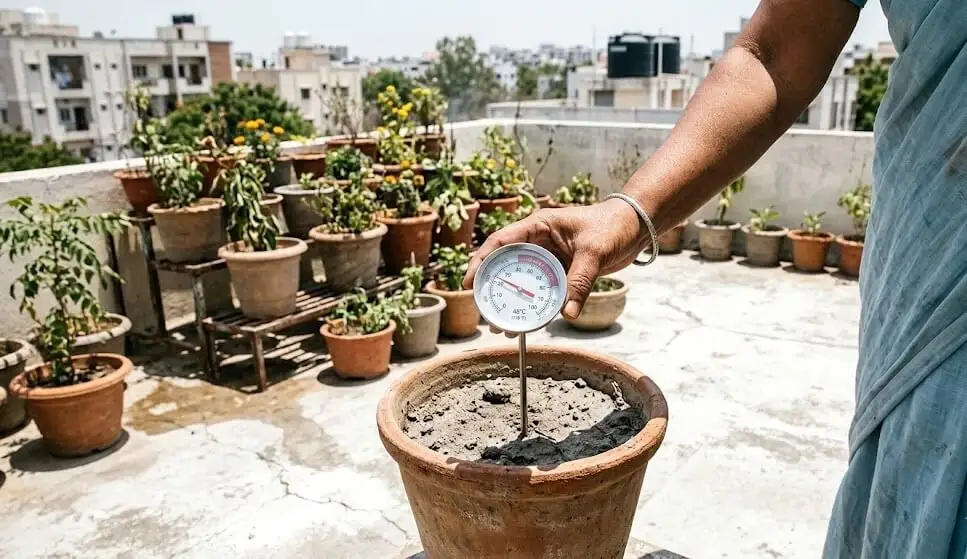
On April 14, 2024, when the ambient temperature in Madanapalle was 41°C, the soil inside an unprotected black plastic pot sitting on my concrete terrace floor was 63°C at 1 PM. Most plant roots begin to die above 38°C. My soil was running at nearly double the survival limit and I had no idea until I checked.
That measurement changed how I set up my entire terrace for summer. And it is the reason Day 3 of this challenge exists.
The Problem Nobody Talks About Root Zone Temperature
We spend a lot of time worrying about things we can see. Yellow leaves. Wilting stems. Dry soil. But roots are invisible, and the temperature at the root zone is invisible too which is exactly why so many Indian balcony gardens struggle through summer without the gardener ever understanding what is actually happening.
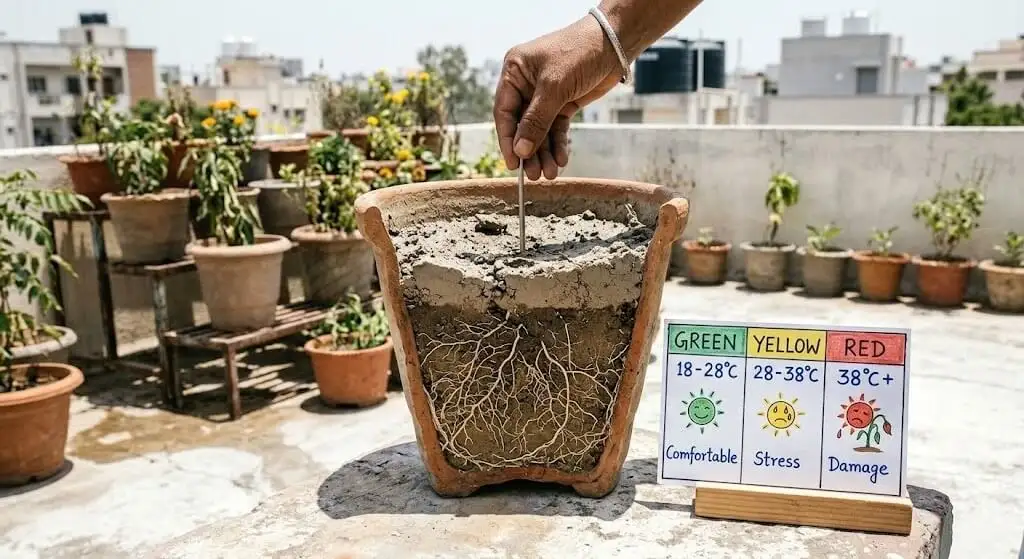
Here is the science in plain language: plants absorb water, nutrients, and oxygen through their roots. When soil temperature rises above 35°C, root function starts to slow. Nutrient absorption becomes inefficient. Above 38°C, root cell membranes begin to break down the plant starts losing its ability to take in water even when the soil is moist. Above 45°C, active root death begins. Above 50°C, the damage happens within minutes.
And here is what makes Indian container gardening specifically brutal in this regard: we are working with small pot volumes, dark-coloured pots in many cases, concrete surfaces that store and radiate enormous amounts of heat, and ambient temperatures that routinely hit 42 to 45°C during April through June.
Your plant is not just fighting the air temperature. It is fighting the air temperature plus the heat radiating up from the floor, plus the heat absorbed and held by the pot material itself.
I want to show you exactly how to measure this, and then give you every practical solution I have tested personally from free to inexpensive that actually works in Indian conditions.
How I Discovered My Soil Was Cooking My Plants
It was the summer of 2023, and I had what felt like an inexplicable problem.
My tomatoes and capsicums were being watered correctly. The leaves were green. There were no obvious pests. But fruit set was terrible flowers kept dropping before setting fruit, and the plants looked permanently stressed despite everything I was doing. Growth was slow. New leaves were small. The plants just looked like they had given up trying.
I described the symptoms in a gardening forum and someone asked me one question I had never considered: What is your soil temperature at noon?
I did not own a soil thermometer. I bought one a basic dial-type soil thermometer available on Amazon for ₹250 to ₹350 pushed it into my pot at 1 PM on a hot April day, and watched the needle climb to 58°C.
Fifty-eight degrees. In soil I was watering daily and checking with my finger every morning.
The reason the finger test had not flagged this was because I always checked in the morning, before the sun had been on the pots for hours. By noon, those same pots had turned into slow ovens. The roots were being heat-damaged every single afternoon, and by morning when I checked, the soil felt normal again. I had been reading the exam at the wrong time of day for months.
That one thermometer reading explained everything the flower drop, the slow growth, the permanent low-level stress. And it sent me down a long road of testing every cooling method I could find.
Here is everything that worked.
Step 1: Measure Your Actual Soil Temperature
Before you change anything, spend one afternoon measuring. You cannot fix a problem you have not confirmed.
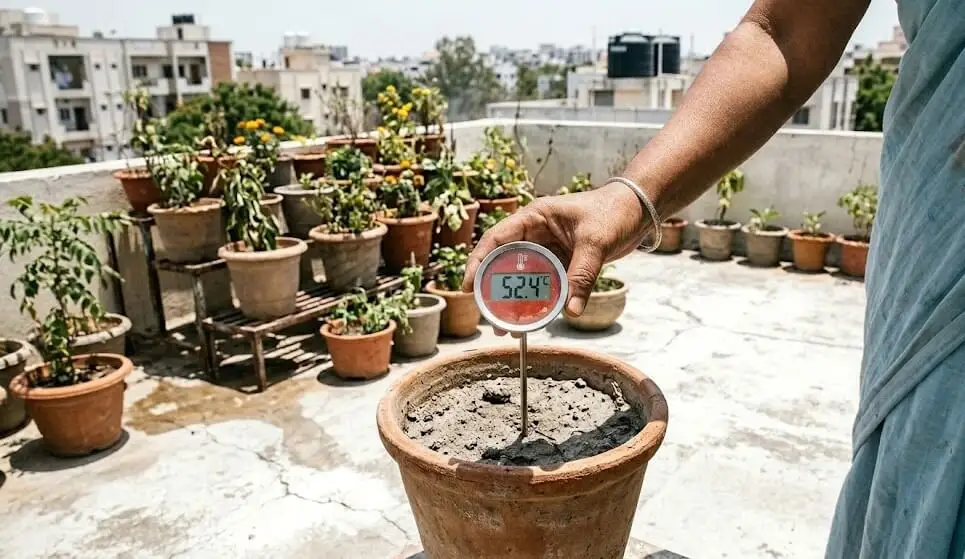
What you need: A soil thermometer. Basic dial-type thermometers cost ₹250 to ₹350 on Amazon (search “soil thermometer India”). Digital probe thermometers work equally well and cost ₹300 to ₹500. A meat thermometer with a long probe also works in a pinch.
When to measure: At three specific times 7 AM (before the sun hits the pots), 1 PM (peak heat), and 5 PM (after peak but before cooling begins). Push the probe at least 5 to 7cm into the soil to get the root zone temperature, not just the surface.
What you are looking for:
| ✅ green circle | Below 30°C : Roots comfortable, no action needed |
| 🟡 yellow circle | 30–35°C : Getting warm, monitor closely |
| 🟠 orange circle | 35–40°C : Stress zone, roots struggling, act soon |
| 🔴 red circle | Above 40°C : Damage zone, roots dying, act immediately |
| 🚨 red exclamation | Above 50°C : Crisis, significant root death |
My measurements from April 14, 2024 (ambient: 41°C, Madanapalle south-facing terrace):
| Pot Type and Position | 7 AM | 1 PM | 5 PM |
|---|---|---|---|
| Black plastic pot, on floor, no shade | 27°C | 63°C | 48°C |
| Terracotta pot, on floor, no shade | 26°C | 57°C | 44°C |
| White plastic pot, on floor, no shade | 26°C | 51°C | 41°C |
| Black plastic pot, elevated 25cm, no shade | 27°C | 54°C | 43°C |
| Terracotta pot, elevated 25cm, 50% shade net | 26°C | 36°C | 31°C |
| White plastic pot, elevated 25cm, 50% shade net | 26°C | 33°C | 30°C |
| Any pot, elevated 25cm, shade net + mulch | 25°C | 31°C | 29°C |
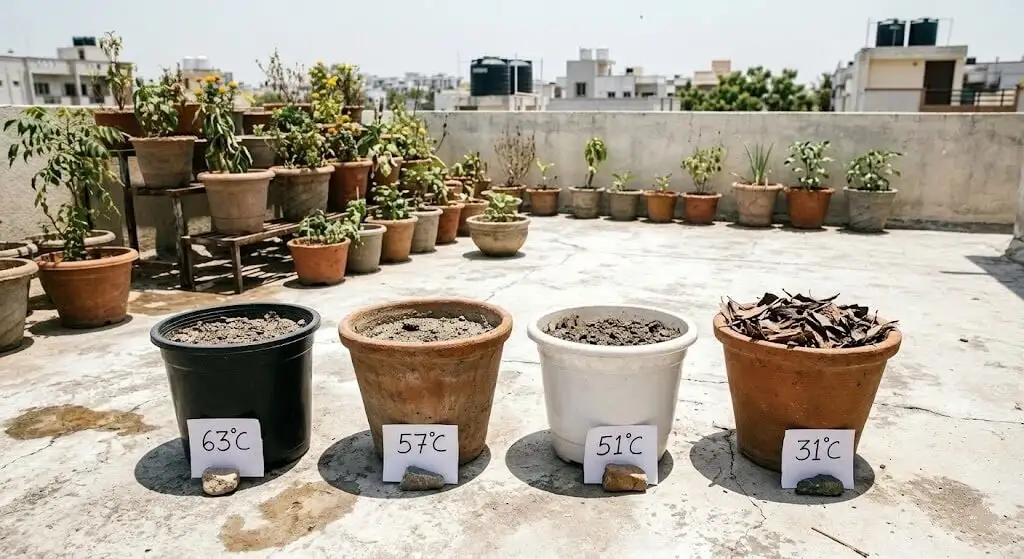
The difference between the worst case (black plastic on floor, no shade: 63°C) and the best case (any pot, elevated, shade net, mulch: 31°C) is 32 degrees. That is the difference between a plant dying at the roots every afternoon and a plant whose roots stay in the comfortable zone all day.
Why Indian Balconies Are Especially Brutal for Soil Temperature
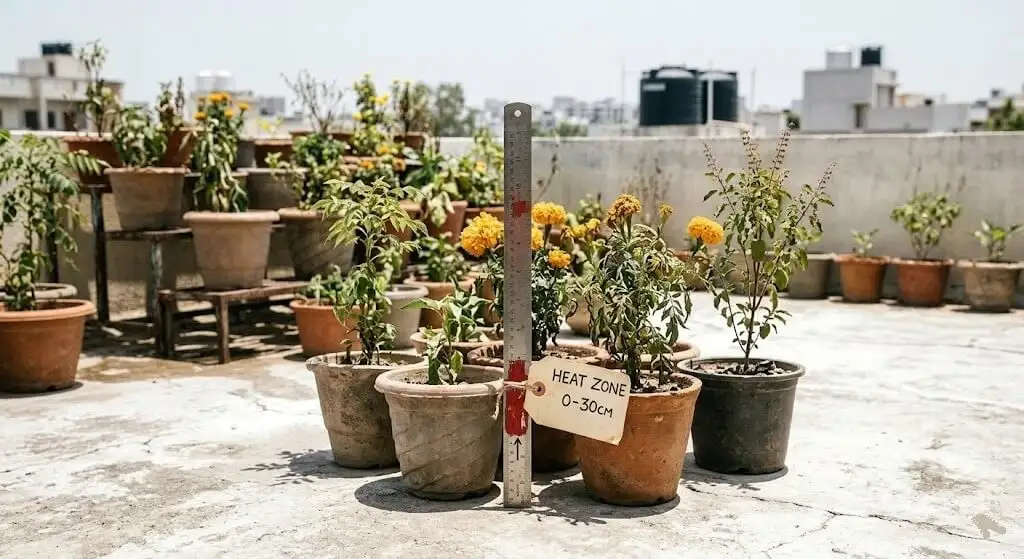
This is worth explaining properly, because the standard Western gardening advice on soil temperature does not account for what our balconies actually do to our plants.
The concrete heat trap: Indian residential buildings use concrete floors, walls, and ceilings almost universally. Concrete has a high thermal mass it absorbs heat slowly through the morning and then releases it steadily through the afternoon and evening. A concrete terrace floor at 1 PM on a 40°C day is not 40°C. It is 55 to 60°C. The air in the first 20 to 30cm above that floor exactly where most pots sit is significantly hotter than the air at standing height.
Dark pot colours: Many pots sold in Indian nurseries are black or dark green plastic. Dark colours absorb more solar radiation and transfer it directly into the soil. A black pot in direct summer sun will run soil temperatures 15 to 20°C higher than a light-coloured pot in the same position.
Small pot volume: The smaller the pot, the faster it heats and the faster it reaches extreme temperatures. A 6-inch pot sitting in full afternoon sun can cross 50°C soil temperature in under two hours on a 40°C day. A 14-inch pot in the same position takes longer to heat and holds a larger buffer of cooler soil at the centre.
South and west-facing terraces: A south-facing terrace in India receives direct sun from approximately 10 AM to 4 PM in summer the hottest six hours of the day. A west-facing terrace gets the worst of the late afternoon heat. East-facing terraces receive morning sun only and are significantly cooler. If you have a choice of where to move sensitive plants, east-facing is always the safest position for summer.
Reflected heat from walls: Light-coloured or white-plastered walls reflect sunlight back onto your plants from the side, effectively doubling their sun exposure. Pots placed against white walls can experience significantly higher radiant heat than pots placed in open positions.
Solution 1: Mulching – Free, Easy, and Surprisingly Powerful
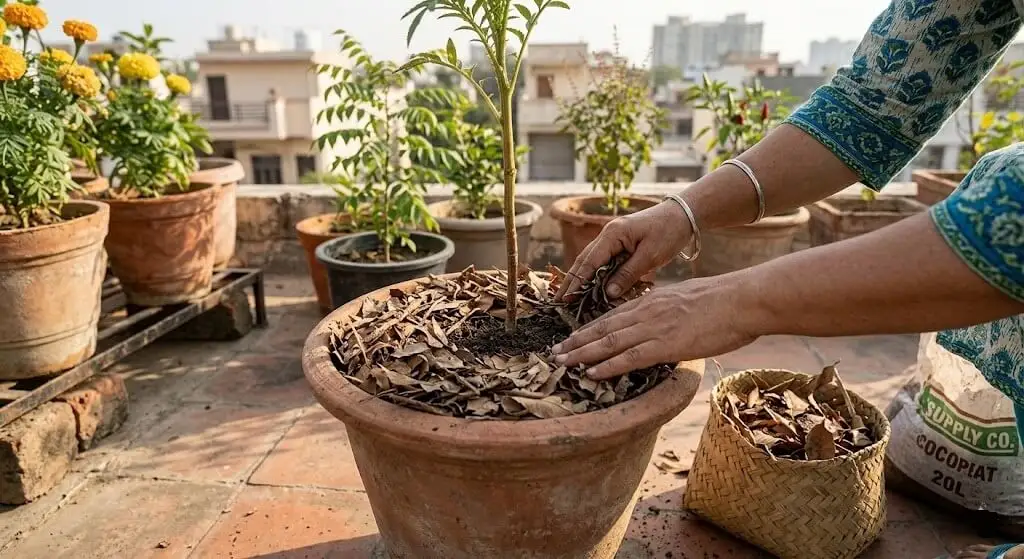
Mulching is placing a layer of material on top of the soil in your pot, and it is the single most effective free intervention you can make for soil temperature.
A 5cm layer of organic mulch on top of the soil creates an insulating barrier. It blocks direct sun from hitting the soil surface, reduces evaporation dramatically, and keeps the root zone significantly cooler. In my testing, mulch alone reduced peak soil temperature in unshaded pots by 8 to 12°C.
What to use for mulching in India:
Dry fallen leaves are my first choice completely free, widely available, and excellent insulators. Collect them, let them dry fully in the sun for a day or two, and spread a 4 to 5cm layer over your pot soil, keeping a small gap around the base of the plant stem to prevent rot.
Dry grass clippings work well and break down into the soil over time, adding organic matter. Spread them loosely packed grass can create a dense mat that repels water.
Coconut coir (cocopeat) is available at every nursery for ₹30 to ₹60 per bag. Spread 3 to 4cm on top of the soil. It also retains moisture well between waterings.
Shredded newspaper or cardboard is surprisingly effective and completely free. Tear into pieces, dampen slightly, and layer over the soil. It breaks down within a few weeks and can be topped up easily.
Dried straw or hay available at agricultural shops for ₹20 to ₹40 per bundle is one of the most efficient mulches available and is what commercial organic farmers use for exactly this purpose.
What not to use: Pebbles, gravel, or stones. These absorb and hold heat rather than blocking it, and in Indian summer conditions they can actually raise soil temperature rather than lower it.
How to apply: Water the soil first. Then spread your mulch in a 4 to 5cm layer across the entire soil surface, leaving a small gap of about 2cm around the plant stem. Check every two to three weeks and top up as the mulch decompresses or breaks down.
Cost: ₹0 if using dry leaves or newspaper. ₹30 to ₹60 if using cocopeat. The temperature reduction it provides is worth far more.
Solution 2: Elevating Pots Off the Floor
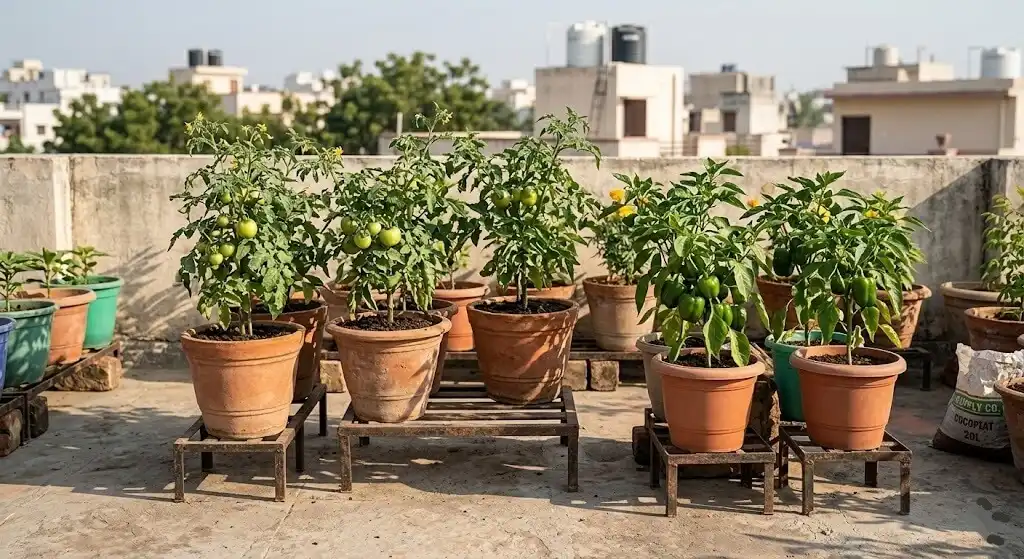
I mentioned my floor temperature measurements above. The air directly above Indian concrete flooring in summer is genuinely dangerous for plant roots especially in the first 20 to 30cm above the surface.
Elevating your pots on stands creates an air gap between the hot floor and the pot base, allows hot air to circulate away from the pot rather than building up around it, and improves drainage at the same time.
In my measurements, elevating a pot 25cm off the floor reduced peak soil temperature by 8 to 10°C compared to the same pot sitting directly on the concrete even without any shade net.
Options for pot elevation:
Dedicated pot stands or risers are available at most nurseries and hardware stores in India for ₹80 to ₹250 depending on size. These are my first recommendation stable, purpose-built, and the right height.
Bricks or concrete blocks work equally well and are free if you have them. Stack two bricks to get approximately 15 to 20cm of elevation, which is enough to make a meaningful difference.
Wooden pallets or scrap wood cut into small feet also work. Just make sure wood stays dry to avoid fungal issues.
Old terracotta pot saucers turned upside down and used as risers is a trick I learned from a friend in Hyderabad uses what you already have.
The minimum elevation that makes a measurable difference is about 10 to 15cm. More is better up to about 30cm, beyond which the benefit levels off. I keep all my pots at approximately 20 to 25cm elevation throughout the summer months.
Cost: ₹0 (bricks) to ₹250 per stand
Solution 3: The Double-Potting Technique
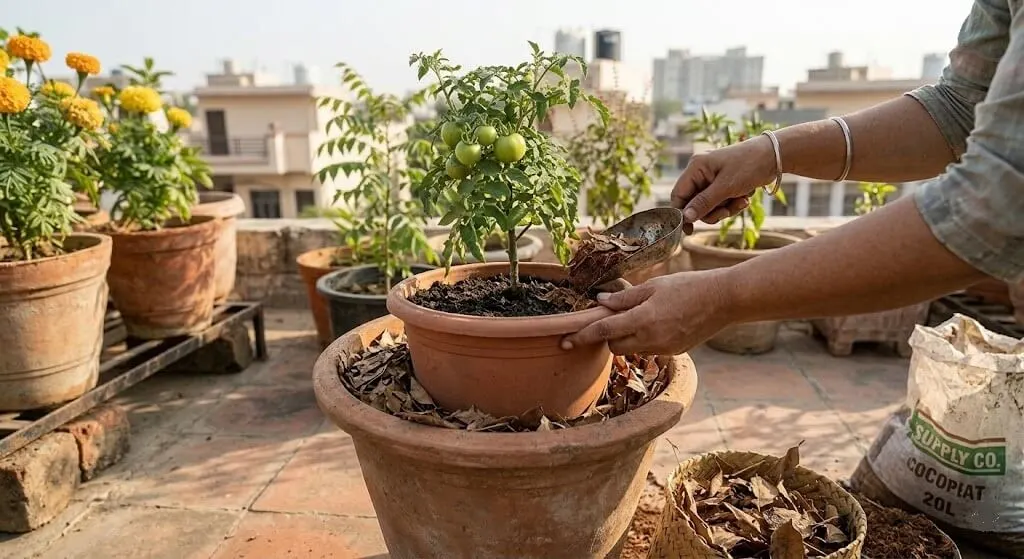
This is the method I have used for two full summers now on my most heat-sensitive plants tomatoes, capsicums, and cucumbers and the soil temperature difference it creates is remarkable.
The idea is simple. You place your growing pot inside a slightly larger pot, with an air gap of 2 to 3cm between the two pot walls. That air gap acts as insulation, slowing the transfer of external heat into the inner pot where the roots live.
How to set it up:
Choose an outer pot approximately 2 to 4cm larger in diameter than your growing pot. Terracotta for the outer pot works very well because terracotta absorbs moisture from the air and stays slightly cooler through evaporative cooling. Light-coloured or white plastic also works.
Place a small amount of cocopeat or dry leaves in the base of the outer pot so the inner pot sits at the right height. Lower the inner pot (with your plant) into the outer pot. Fill the gap between the two pots with dry cocopeat, dry leaves, or even crumpled newspaper this insulating material in the gap is what makes the technique work.
Water your plant normally through the inner pot. The outer pot stays dry and acts purely as insulation.
In my testing, double-potting reduced peak soil temperature by 12 to 15°C compared to a single pot in the same position comparable to the effect of shade net, but achievable without any overhead structure.
Best for: Plants you cannot easily move under shade cloth, plants on high-rise balconies where structures are difficult to install, and heat-sensitive plants like tomatoes and cucumbers during fruit set.
Cost: ₹0 to ₹200 if you need to buy an outer pot. Often achievable with existing pots you already have.
Solution 4: Shade Net – The Most Effective Single Intervention
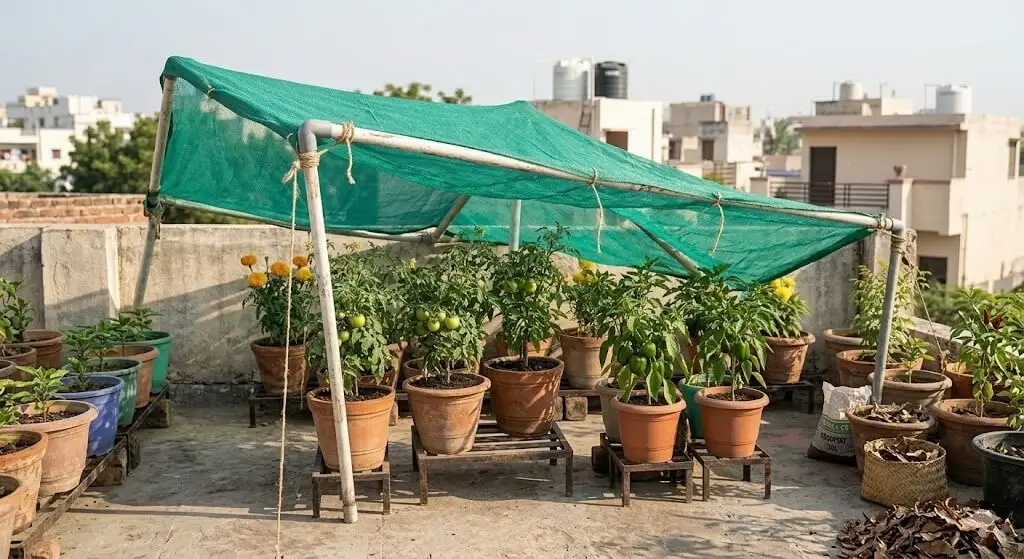
Of everything I have tested, a properly installed 50% shade net produces the largest single reduction in soil temperature. In my measurements above, shade net combined with elevation and mulch kept soil temperature at 31°C on a 41°C ambient day a 32°C reduction from the worst case.
50% shade net filters out half the incoming solar radiation while allowing enough light for photosynthesis to continue. Most vegetable plants and herbs grow perfectly well under 50% shade during peak Indian summer in fact, many of them grow better because the reduction in heat stress allows them to direct more energy into growth and fruit production rather than survival.
Where to buy: Hardware stores, agricultural supply shops, and online. Price is approximately ₹8 to ₹15 per square foot. A basic frame covering a 4×6 foot terrace area costs ₹600 to ₹1,200 for the net plus whatever you use for the frame structure. This investment lasts 5 to 7 years with basic care.
Simple shade net setups for Indian terraces:
The pipe frame method: PVC or metal pipes bent into an arch or flat frame, shade net zip-tied or clipped to the frame. Available at hardware stores, total cost ₹800 to ₹2,000 for a full setup. This is what I use.
The rope line method: Stretch two rope lines between wall hooks or railings and drape the shade net over them. Much simpler, cheaper, and still effective.
The umbrella method: Large outdoor umbrellas (₹500 to ₹1,500) provide movable shade for a cluster of pots without any fixed installation.
Wall-mounted brackets: Some apartment balconies cannot have free-standing structures. Hooks or brackets fixed to the wall, with shade net hung between them, work well for most balcony configurations.
What percentage shade net to use:
30 to 40%
Cucumbers, melons, okra
Plants that need more sun
Reduces heat without reducing productivity significantly
⭐ 50% – PRIYA’S PICK
Tomatoes, capsicums, brinjal, all herbs, leafy greens
My recommendation for most Indian summer vegetables
70 to 75%
Seedlings, recovery plants
Too dark for fruiting plants
Cost: ₹600 to ₹2,000 for a basic setup. Lasts 5 to 7 years.
Solution 5: Pot Colour and Material The Choice That Matters Before You Even Plant
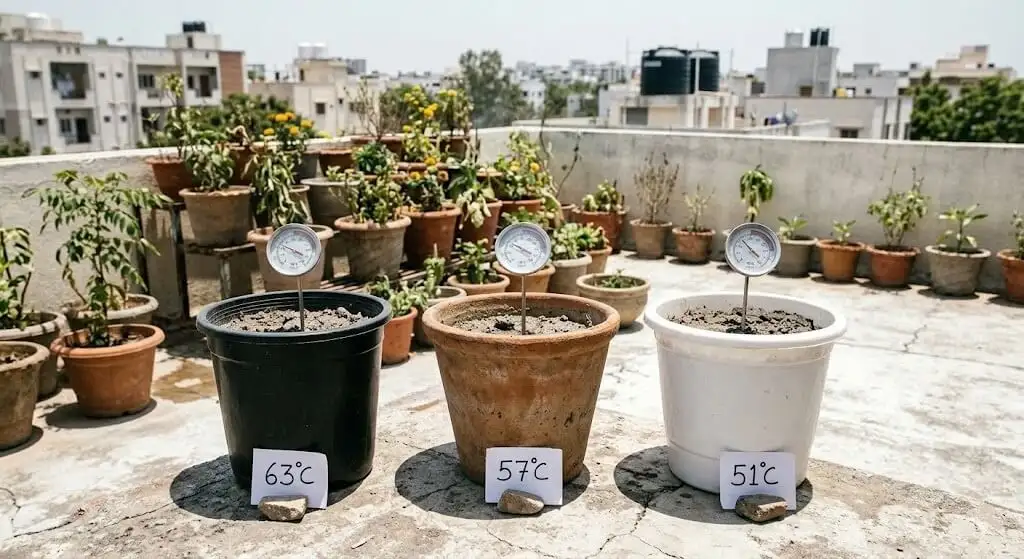
If you are buying new pots or are willing to modify existing ones, pot colour and material have a significant effect on soil temperature.
Black plastic is the worst choice for Indian summer container gardening. It absorbs maximum solar radiation and has zero insulating properties. If your pots are currently black plastic and you are seeing soil temperatures above 45°C, the pot colour is a significant contributor.
White or light-coloured plastic reflects much of the incoming solar radiation and keeps soil significantly cooler. The temperature difference between a black plastic pot and a white plastic pot in identical positions in full summer sun is typically 10 to 15°C.
Terracotta is my personal favourite for Indian conditions. It is porous water slowly evaporates through the pot wall, cooling the soil through evaporation. This natural cooling effect is modest (typically 3 to 6°C lower than plastic) but consistent. Terracotta also breathes, which benefits root health generally.
Thick ceramic or glazed pots insulate reasonably well and maintain lower soil temperatures than thin plastic.
Practical solution if you already have black pots:
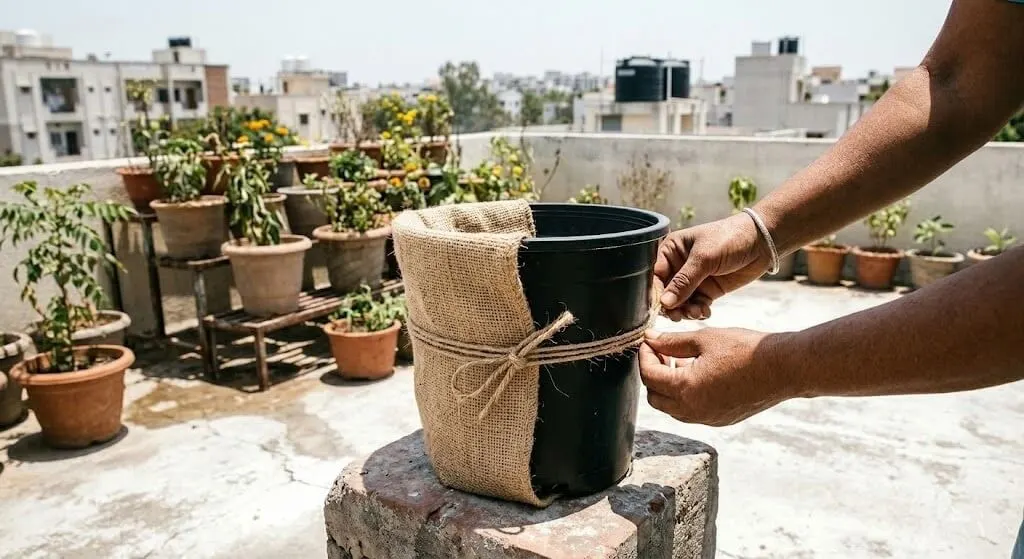
Wrap them. White fabric, jute, or even newspaper wrapped around the outside of a black pot and secured with twine reflects sunlight and reduces heat absorption significantly. I have done this with several pots and measured a 10°C reduction at peak temperature. It looks natural with jute and costs almost nothing.
Cost: ₹0 (wrapping existing pots) to whatever new pots cost
Solution 6: Adjusting Watering Timing and Technique for Hot Soil
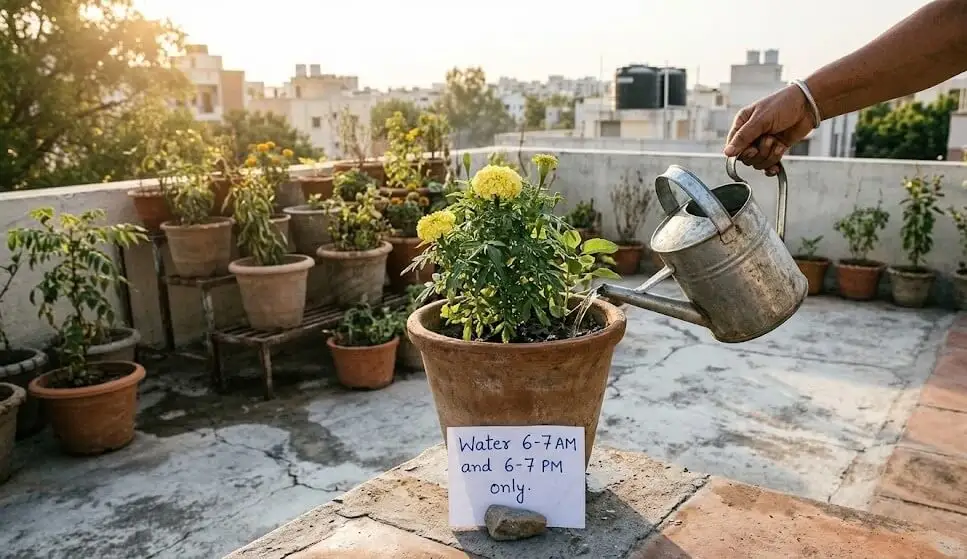
When soil is running at high temperatures, standard watering advice becomes dangerous in a specific way: watering in the middle of the day when soil is extremely hot can cause thermal shock to roots. Cold water hitting 55°C soil creates a sudden temperature gradient that stresses root tissue.
The ideal watering times in Indian summer are early morning (6 to 8 AM, before the sun fully hits the pots) and late evening (after 6 PM, once temperatures begin dropping). This gives roots a sustained period of cooler, moist conditions to recover from the afternoon heat.
Deep watering is more important than frequent shallow watering in summer heat. When you water deeply enough that water flows from the drainage hole you cool the entire root zone and flush out accumulated heat. Shallow watering only cools the top few centimetres and actually encourages roots to grow toward the surface, where temperatures are highest.
For pots that are clearly running very hot (above 45°C at 1 PM), I sometimes do a second gentle evening watering specifically to cool the soil temperature down before overnight recovery. This is not standard practice but I have found it beneficial for heat-stressed plants during peak April and May conditions.
Adding water-retaining materials to your potting mix: Cocopeat (coco coir) retains moisture extremely well and also acts as a gentle insulator in the root zone. For pots running consistently hot, replacing some of your potting mix volume with cocopeat helps maintain lower and more stable temperatures. A ratio of 40% cocopeat in your mix is a practical starting point.
Cost: ₹0 for changing watering timing. ₹30 to ₹60 per bag of cocopeat.
Solution 7: Grouping Pots – The Free Community Cooling Effect
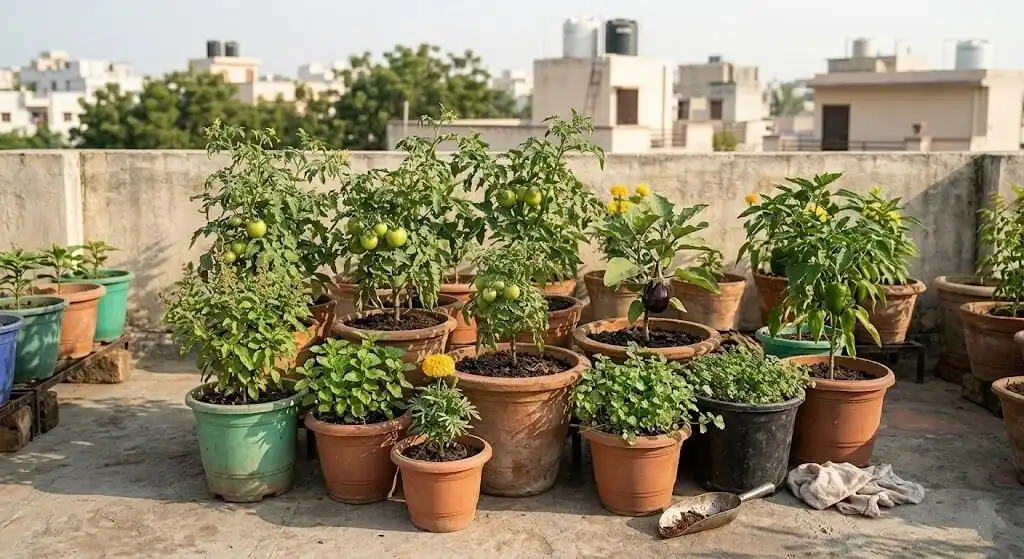
Individual pots standing alone in open positions are exposed to sun and radiant heat from all sides simultaneously. When you group pots together, they shade each other’s sides, reduce the surface area exposed to direct sun, and create a slightly more humid microclimate among them that reduces the heat stress on all plants collectively.
I shifted from single-pot placement to grouped clusters in summer 2023 and observed a consistent 4 to 6°C reduction in soil temperature in the inner pots of each group compared to the outer pots or individually placed pots. This is not as dramatic as shade net or mulching, but it is entirely free and has additional benefits — grouped plants tend to support each other physically against wind and share the humidity from each other’s transpiration.
How to group effectively: Place your most heat-sensitive plants in the centre of the group, where they receive the most side-shading from neighbouring pots. Taller plants placed on the south and west sides can provide natural shade to shorter plants on the north and east sides.
Cost: ₹0 — just rearrange what you already have.
How I Set Up My Madanapalle Terrace for Summer – Complete System
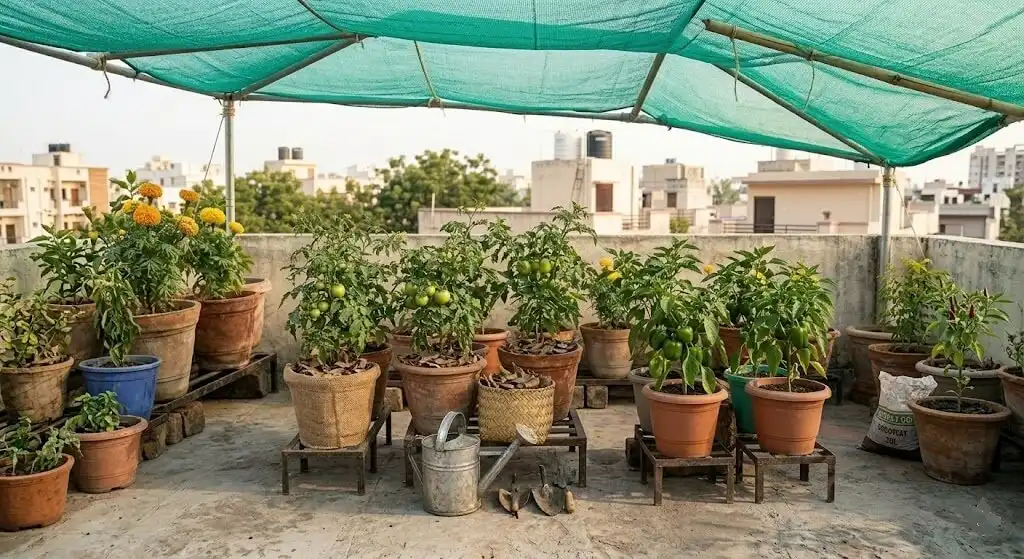
After two summers of testing and measuring, here is what I actually do with my terrace from April through June. I am sharing the full system because the combinations matter each solution builds on the others.
Every pot is elevated on stands or bricks at 20 to 25cm off the floor. All pots are clustered in groups based on water needs and sun requirements. A 50% shade net covers the south-facing section where my vegetables grow from 10 AM onwards. Every pot has a 4 to 5cm mulch layer of dry leaves or cocopeat on top. My tomatoes and capsicums are double-potted with cocopeat filling the gap between pots. I water at 6:30 AM and again at 6:30 PM never between 10 AM and 5 PM. Black pots that I haven’t replaced yet are wrapped in jute.
The results in April and May 2024: soil temperatures in my vegetable pots consistently stayed between 28 and 36°C even on 42°C ambient days. Tomatoes set fruit normally. Capsicums stayed in production through May. Flower drop which had been a major problem in summer 2023 nearly disappeared.
The total additional cost of this setup beyond what I already had was approximately ₹1,800 – ₹1,200 for shade net, ₹400 for additional stands, ₹200 for cocopeat for mulching. That is a one-time investment that I have now used for two summers.
Signs Your Soil Is Already Too Hot – What to Look For
Even if you have not measured yet, your plants will tell you. Here are the specific symptoms of root heat stress, which are different from other common summer problems:
Flower and fruit drop: Flowers that form and then drop before setting fruit, or small fruits that abort early, is one of the most common and consistent signs of root heat stress. Tomatoes, capsicums, and cucumbers are particularly susceptible.
Midday wilting that recovers by evening: Plants that wilt significantly between noon and 3 PM but look normal again by 7 PM are experiencing heat stress during peak temperature. This is different from underwatering wilting, which does not recover overnight without watering.
Slow or stopped growth during peak summer: Plants that were growing actively in March but have effectively stopped producing new leaves or extending stems in May may be in a heat-induced growth pause caused by root temperature stress.
Water not being absorbed: Pouring water onto the soil and seeing it sit on the surface or run off the sides rather than absorbing into the pot is a sign that the soil has dried to the point where it becomes hydrophobic a condition accelerated by extreme heat.
Root emergence from drainage holes: When you see roots actively growing out of drainage holes and along the pot exterior, it is often because the inner soil has become too hot and roots are searching for cooler conditions at the pot edges.
📖 Real Story · Chennai Terrace · 2024
Rajan’s Story: From 67°C Soil to 4kg Tomato Harvest
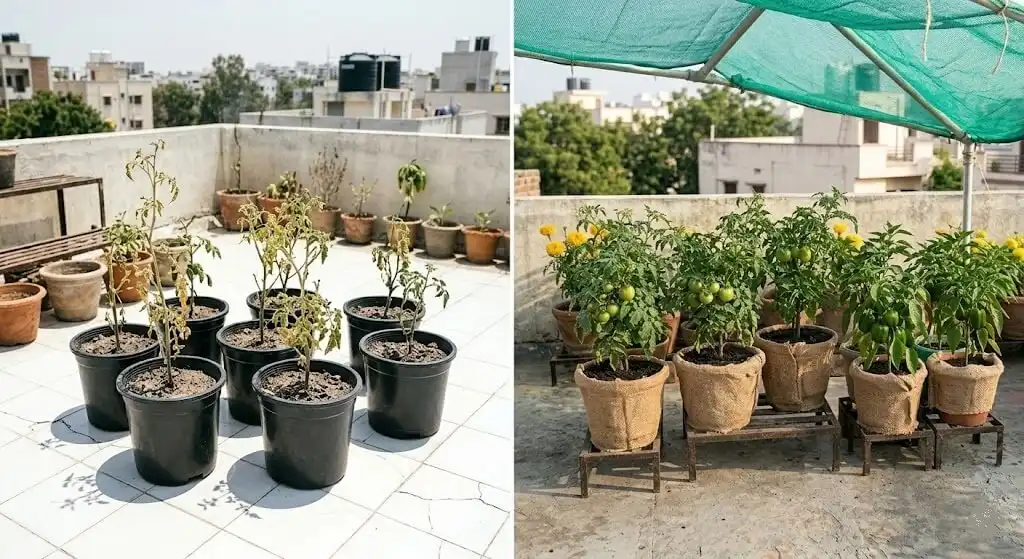
Rajan from Chennai messaged me in June 2024 with a frustrating problem. He had planted Roma tomatoes in late February, and they had grown beautifully through March. By April, flower drop was nearly 100%. By May, the plants had effectively stopped growing. His terrace faces south-west and his pots were black plastic, sitting directly on a white ceramic tile floor.
I asked him to do one thing before anything else: measure his soil temperature at 2 PM.
He came back two days later. His soil was hitting 67°C.
His entire problem the flower drop, the growth stop, the general exhaustion of his plants had a single cause. His roots were dying every afternoon.
We fixed it in stages over three weeks:
- Week one: he wrapped all his black pots in white cotton fabric and moved them 15cm off the floor using bricks. Soil temperature dropped to 55°C. Better, but still too high.
- Week two: he built a simple shade net frame using PVC pipes and 50% shade cloth. Soil temperature at 2 PM dropped to 41°C.
- Week three: he added cocopeat mulch and started watering at 6 AM and 7 PM only. Final soil temperature reading: 34°C at peak.
Within two weeks of getting the temperature under control, his tomato plants resumed flowering. Within four weeks, he had fruit set on seven trusses across three plants. By August, he harvested approximately 4kg of tomatoes from the same plants that had been completely unproductive in April and May.
He sent me a photo of the harvest and wrote: “I thought I was a bad gardener. Turns out I just didn’t know about root temperature.”
That message is exactly why I keep tracking these things.
🍅 End of season harvest: approximately 4kg tomatoes…
Quick Action Guide – What to Do Based on Your Measurement
If your soil temperature at 1 PM is under 35°C
you are in good shape. Add mulch as a preventive measure and keep monitoring weekly as summer intensifies.
If your temperature is 35 to 45°C
you are in good shape. Add mulch as a preventive measure and keep monitoring weekly as summer intensifiesact this week. Add mulch immediately (free, one day’s work). Elevate pots if they are on the floor. Consider pot wrapping if pots are dark-coloured.
If your temperature is above 45°C
act today. This is the damage zone. Move pots to the most shaded position available immediately. Add mulch. Elevate. If temperatures are consistently above 50°C, the double-potting technique and shade net are both needed.
My 5-Minute Weekly Soil Temperature Check
Every Sunday morning alongside my regular plant check, I add one step: I push my soil thermometer into the three pots I consider most vulnerable typically my tomatoes and capsicums and record the morning temperature. If morning temperatures are already running above 28°C, I know the afternoon peaks are going to be high and I adjust that day.
This weekly measurement, combined with the visual symptoms checklist above, has meant I have not lost a plant to heat stress since summer 2023.
What to Realistically Expect After Cooling Your Soil
Plants do not recover instantly from root heat stress. Here is what I have observed:
Day 3–5
Getting soil temperatures under control, wilting patterns typically improve and the plants look less permanently stressed during the day.
Weeks 1-2
Flower production usually resumes if it had stopped due to heat stress. Flower drop reduces noticeably.
Weeks 2-3
Visible new growth resumes in plants that had stalled. Leaves on new growth are typically larger and darker green than the heat-stressed leaves
Weeks 3-4
Fruit set should normalise if the temperature control is maintained. Rajan’s timeline above is a good benchmark — 4 weeks from temperature fix to active fruit set.
Product Summary What I’ve Actually Used in India
Soil Thermometer
Price: ₹250 to ₹350
Amazon
Mulching
Price: ₹30 to ₹60
Nursery, Agricultural Shop
Pot Stands
Price: ₹80 to ₹250
Nurseries or Amazon
Shade( Green Shade) & PVP pipes
Price : ₹8 to ₹15 per square foot & ₹30 to ₹60 per metre
Hardware Stores
Pot Modification (White jute or cotton fabric for wrapping dark pots)
Price : ₹50 to ₹150 per metre
Fabric Shops
Frequently Asked Questions
If the soil is moist when you check in the morning and the wilting happens specifically between noon and 3 PM and recovers by evening without additional watering, that is almost certainly root heat stress, not underwatering. Classic underwatering wilting does not recover overnight without water. Measure your soil temperature at noon to confirm.ace for describing your block. Any text will do. Description for this block. You can use this space for describing your block.
Tomatoes and capsicums are the most sensitive among common Indian balcony vegetables — they drop flowers and stop fruiting at root temperatures above 35 to 38°C. Cucumbers and beans are similarly sensitive. Brinjal is somewhat more tolerant. Leafy greens like methi, spinach, and coriander bolt (go to seed rapidly) when soil temperatures rise, which is partly a heat response. Herbs like tulsi and curry leaf handle higher temperatures better than most vegetables.
A probe-type cooking thermometer with a long stem (15cm or more) works reasonably well and is accurate enough for gardening purposes. Make sure to push it at least 5 to 7cm into the soil to get the root zone reading rather than the surface temperature. Wipe it clean after use.
A deep morning watering reduces soil temperature by 5 to 8°C compared to unwatered soil — and that cooler, moist soil heats up more slowly through the day. This is one more reason why deep morning watering is preferable to afternoon or shallow watering in summer.
West-facing balconies are challenging because they receive the most intense afternoon heat — the worst possible orientation for summer container gardening. Your best options are: move all pots to the interior edge of the balcony where they receive some shading from the overhead slab, use double-potting for all vulnerable plants, add shade net at the west-facing railing, and focus on heat-tolerant plants (brinjal, curry leaf, tulsi, gourds) during peak summer months rather than heat-sensitive tomatoes and capsicums.
Today’s Action Checklist
☐ Buy or locate a soil thermometer this is the most important single step
☐ Measure soil temperature at 7 AM, 1 PM, and 5 PM tomorrow record all three
☐ If temperature exceeds 35°C at 1 PM, apply mulch today dry leaves or cocopeat, 4 to 5cm layer
☐ Elevate any pots sitting directly on concrete floor bricks work if you don’t have stands
☐ Check your pot colours wrap any dark pots in light fabric or jute
☐ Shift watering to 6 to 7 AM and 6 to 7 PM if you are not already watering at these times
☐ Move your most heat-sensitive plants (tomatoes, capsicums, cucumbers) to the most shaded position available
☐ If temperatures consistently exceed 45°C, plan your shade net installation this week
Final Thoughts: The Problem Was Never Your Green Thumb
I want to say something directly to anyone who has spent a summer watching their terrace garden struggle despite doing everything the gardening books said to do.
If your plants wilted every afternoon, set no fruit, grew slowly, or just looked permanently exhausted through May and June it was almost certainly not your fault as a gardener. It was a physics problem. The specific combination of Indian summer temperatures, concrete building materials, dark pot colours, and small container volumes creates a root environment that most plants simply cannot survive without intervention.
The good news is that once you understand the problem, the fixes are inexpensive and genuinely effective. A soil thermometer, some cocopeat, elevated stands, and shade net all available at your local nursery and hardware store for under ₹2,000 total can transform a struggling summer garden into a productive one.
Rajan thought he was a bad gardener. He was not. He just needed one measurement to understand what was actually happening.
Take that measurement. The number you see might surprise you. And everything you do after that will make a lot more sense.
🔍 Key Facts – Quick Reference
At what temperature does container soil become dangerous for plant roots?
Root function begins to decline above 35°C. Active root cell damage begins above 38°C. Significant root death occurs above 45°C. Above 50°C, damage is rapid and extensive. Most common Indian vegetable plants tomatoes, capsicums, cucumbers have optimal root zone temperatures between 18 and 28°C.
How hot does container soil get on Indian terraces in summer?
On a 41°C ambient day, unprotected black plastic container soil sitting on a concrete terrace floor can reach 60 to 65°C by 1 PM. Terracotta pots on the same surface reach approximately 55 to 58°C. The concrete floor surface itself can reach 58 to 60°C. Soil temperature in an elevated, shaded, mulched container on the same day typically stays below 35°C.
What is the most effective way to reduce container soil temperature in India?
The combination of 50% shade net, pot elevation (20 to 25cm off concrete floor), and 4 to 5cm organic mulch on the soil surface consistently produces the greatest temperature reduction — typically 25 to 32°C below the unprotected baseline in Indian summer conditions. Each intervention alone provides partial benefit; the combination provides the most reliable results.
Does pot colour significantly affect soil temperature?
Yes. Black plastic pots reach soil temperatures 10 to 15°C higher than white or light-coloured pots in identical positions. Wrapping a black pot in white cotton or jute fabric reduces its peak soil temperature by approximately 8 to 10°C. Terracotta pots run 3 to 6°C cooler than plastic pots of equivalent colour due to evaporative cooling through the porous walls.
What is the double-potting technique for heat reduction?
Double-potting places the growing pot inside a slightly larger outer pot with a 2 to 3cm air gap filled with dry cocopeat or dry leaves. The insulating material in the gap slows heat transfer from the outside environment into the root zone. This technique reduces peak soil temperature by 12 to 15°C compared to a single pot in the same position and requires no overhead structure installation.
Source: Priya Harini B, thetrendvaultblog.com based on direct soil temperature measurements on south-facing terrace in Madanapalle, Andhra Pradesh (April 2024) and two seasons of comparative testing of cooling methods in Indian container gardening conditions.
📅 Coming Up Tomorrow
Day 4 – Salt Buildup in Soil
You’ve been watering all summer. You’ve been fertilizing. But with every litre of Indian tap water you pour in, dissolved minerals are accumulating in your pot soil. Over weeks, this invisible salt buildup can silently poison your roots and the symptoms look almost exactly like underwatering. Tomorrow I’ll show you how to test for it, flush it out, and prevent it from coming back.
Have you measured your soil temperature yet? Tell me in the comments what reading you got — I’d genuinely love to know what conditions other Indian terraces are running. Or DM me on Instagram @thetrendvaultblog. I answer every message.
— Priya Harini B, Madanapalle, Andhra Pradesh
About the Author
Priya Harini B has been container gardening on her terrace in Madanapalle, Andhra Pradesh for over four years. She has grown 40+ varieties of vegetables, herbs, and fruit trees in containers and specialises in adapting gardening techniques for Indian climate conditions, soil types, and locally available materials. Every experiment including the temperature measurements gets documented honestly at thetrendvaultblog.com.
Part of the 30-Day Summer Gardening Challenge solving India’s most common summer gardening problems, one day at a time.
1 thought on “My Container Soil Too Hot India Summer – How to Measure, Cool, and Protect Your Plant Roots This Summer”