
By Priya Harini B | Madanapalle, Andhra Pradesh | 4+ Years Container Gardening Experience
Day 13 of the 30-Day Summer Gardening Challenge – Solving Your Biggest Summer Problems, One Day at a Time
Quick Answer: Whiteflies aren’t resistant to neem oil most Indian gardeners are just spraying too infrequently. Eggs and pupae are completely spray-immune, and at Indian summer temperatures the full cycle takes 20–27 days. Spray every 6 days (not weekly) alternating neem-soap and garlic-soap, hitting all plants simultaneously, and the “resistant” colony clears in 2–3 cycles.
Table of Contents
Introduction
If you have been spraying your tomato or capsicum plants every three days with neem oil, watching the tiny white insects scatter briefly when you disturb the leaves and then return in full numbers within the week, feeling increasingly certain that either the product is wrong or the colony has become resistant.
You are experiencing the single most demoralising pest management cycle in Indian container gardening. Whiteflies on Indian balcony plants in summer are not difficult to kill.
They are difficult to kill permanently, because the spray that kills the adults and the crawling nymphs has no effect whatsoever on the eggs and the pupal stage and at Indian summer temperatures of 30 to 38°C, a new generation hatches and matures in 18 to 22 days. Spray on day one. Eggs and pupae survive, unaffected. By day 18, the surviving generation is reproducing at full rate. The cycle appears identical to resistance. It is not resistance. It is timing.
What makes this so frustrating is that every visible sign tells you the treatment is working. The adults fly off in a small white cloud when you approach. The leaves look cleaner for a few days after application. The population appears to reduce.
But whiteflies reproduce through eggs deposited on the undersides of leaves, and the eggs and waxy-coated pupal stage are physically protected from contact sprays the spray simply cannot reach the organism inside. If the spray schedule does not account for the 18 to 22-day development cycle at Indian temperatures, every spray that appears successful is simply clearing the adult and nymph population while the next generation develops undisturbed below.

I managed whitefly on my Madanapalle terrace for two full seasons before I understood this. My third summer, I finally kept detailed notes on what I was doing and what the population was doing in response, and the pattern was unmistakable.
Three days after any spray, adult numbers were low. Ten days later, they were high again. I was not fighting a resistant colony. I was running a harvest cycle eliminating the adult generation and then waiting patiently for the next one to develop.
⚠️ The Single Most Important Fact About Whitefly in Indian Summer
Whitefly eggs and pupae are physically immune to contact spray. At Indian summer temperatures, the full cycle takes 20–27 days so any spray interval longer than 6–7 days lets a complete new generation develop untouched between applications. This isn’t resistance. It’s timing.
This guide covers everything I have learned about whitefly management in Indian summer container gardens across four seasons the four-stage life cycle and why only two stages respond to contact spray, the yellow sticky trap placement strategy.
That strategy gives you a population count before symptoms appear on leaves, the three-spray cycle timed specifically to the Indian summer development interval, the garlic-soap spray that reaches emerging nymphs that neem oil misses, and the case study of Meena from Mumbai whose tomato plants were experiencing chronic whitefly cycles she had been managing incorrectly for an entire growing season.
How to Break the Whitefly Cycle on Indian Balcony Container Plants
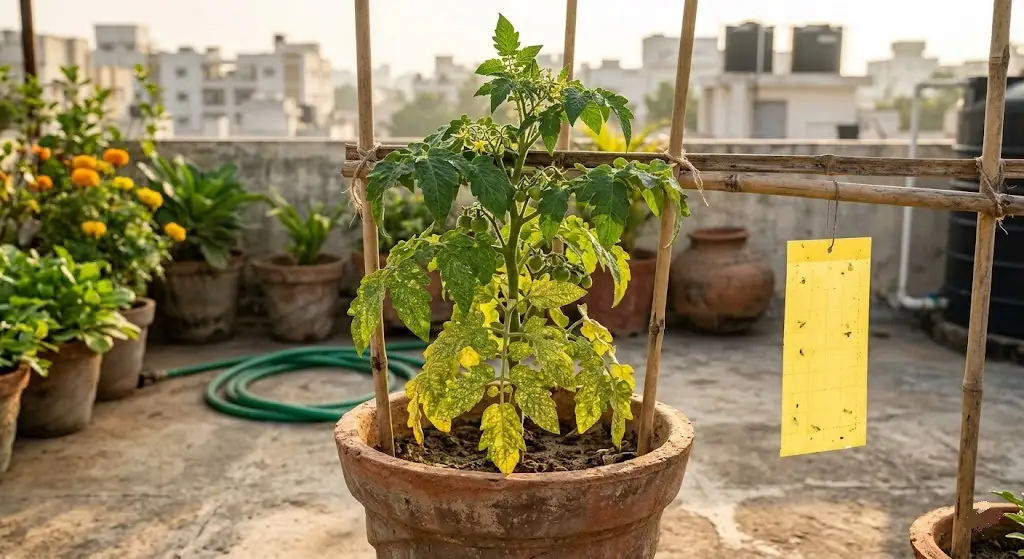
Install Yellow Sticky Traps at Mid-Canopy
1 trap per 4-5 containers at mid-canopy height. Count and record adults every Sunday. Count above 5 per trap = begin spray cycle before leaf symptoms appear.
Spray 1 — Neem-Soap Day 0
5ml cold-pressed neem oil + 3ml dish soap in 1 litre warm water until milky white. Evening only. ALL plants simultaneously.
Spray 2 — Garlic-Soap Day 6
8-10 crushed garlic cloves soaked overnight in 500ml water, strained, 2ml soap, diluted to 1 litre. Targets crawlers hatched from pre-spray eggs — 1 to 2-day mobile window.
Spray 3 — Neem-Soap Day 12
Repeat neem-soap. Clears remaining adults and late crawlers. Trap count should be below 3 per trap after this.
Neem Cake Soil Treatment
1 tablespoon neem cake powder in top 3cm of soil each affected container. Disrupts pupal metamorphosis of fallen pupae. Reduces resolution from 21 to 14 days.
What Whiteflies Actually Are The Four Life Stages That Make Treatment Timing Everything
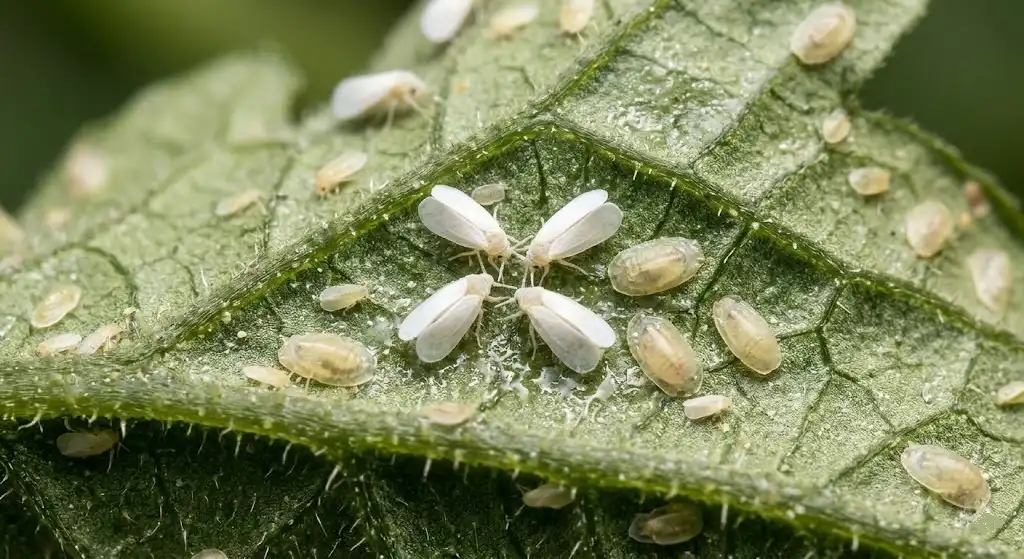
Whiteflies belong to the family Aleyrodidae within the order Hemiptera the same order as aphids and like aphids they feed by inserting stylet mouthparts into plant tissue and extracting phloem sap.
The two species most commonly found in Indian summer container gardens are Bemisia tabaci (the silverleaf whitefly or tobacco whitefly) and Trialeurodes vaporariorum (the greenhouse whitefly). Both species produce the same visible symptoms stippled yellowing on leaves, sticky honeydew deposits, and the characteristic white cloud of adults that disperses when the plant is disturbed but their biology and the precise timing of their development cycles differ slightly.
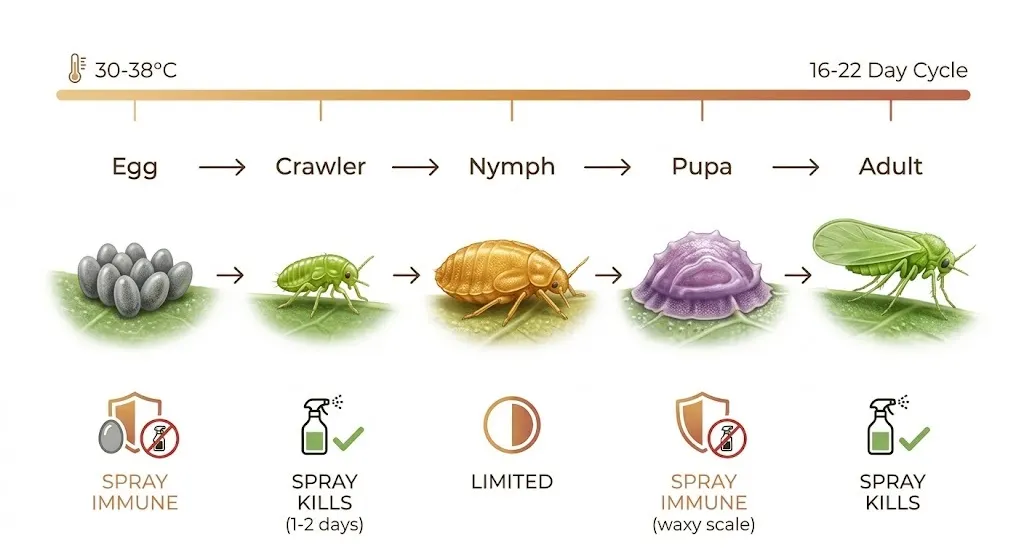
The critical biological mechanism in whitefly management is incomplete metamorphosis with four nymphal instars four distinct developmental stages between the egg and the adult, the last of which (the fourth instar, commonly called the pupa or “scale”) is entirely sessile, encased in a waxy protective coating, attached to the leaf surface, and completely impervious to contact insecticide and neem oil spray. Understanding which stages are spray-vulnerable and which are not is the entire basis of effective whitefly management.
6–8 days
SPRAY IMMUNE
Inside protective structure
1–2 days
SPRAY KILLS ✓
Mobile window — 1-2 days only
8–10 days
LIMITED
Waxy coating developing
5–7 days
SPRAY IMMUNE
Fully encased waxy scale
20–30 days
SPRAY KILLS ✓
White cloud when disturbed
Stage 1 – Egg: Deposited in circular patterns on the underside of leaves. White to pale yellow, 0.2mm, invisible to the naked eye individually. Entirely inside a protective structure that contact spray cannot penetrate. Duration at 30°C: 6 to 8 days. Spray cannot reach.
Stage 2 – Crawlers (1st instar nymphs): The only mobile nymph stage. Immediately after hatching, crawlers move actively across the leaf surface for a short period before settling and inserting their mouthparts. Duration: 1 to 2 days. Spray CAN reach during this brief mobile window.
Stage 3 – Sessile nymphs (2nd and 3rd instar): Settled on the leaf underside, feeding continuously, developing under progressively thicker waxy secretions. Duration: 8 to 10 days. Spray has limited-to-no penetration of waxy coating at this stage.
Stage 4 – Pupa (4th instar): Fully sessile, encased in a raised waxy scale on the leaf underside. No feeding occurring — the organism is reorganising internally into the adult form. Waxy coating completely blocks contact spray. Duration: 5 to 7 days. Spray cannot reach.
Stage 5 – Adult: Winged, mobile, white-dusted. Feeds on phloem sap, deposits eggs on new leaves. Lifespan: 20 to 30 days with continuous egg deposition. Spray CAN kill directly on contact.
At Indian summer temperatures of 30 to 35°C, the complete egg-to-adult cycle takes 18 to 22 days. At 35 to 40°C common on Indian terraces in April and May this compresses to 16 to 18 days.
The practical implication is stark: a spray schedule with intervals longer than 10 days will always allow a full generation to pass through the spray-resistant egg and pupal stages between applications. The adult population clears, the next generation emerges, and the problem appears to cycle perpetually regardless of the product being used.
⚠️ Yellow Sticky Traps Are Monitoring, NOT Control
Traps catch only adults a minority of the total population. Eggs, nymphs, and pupae on leaf undersides are completely unaffected. Using traps as the primary strategy is equivalent to controlling a fire by removing the smoke. Correct use: weekly count that triggers the 6-day spray cycle before leaf symptoms appear.
This is also why yellow sticky traps which catch only the adult stage are useful as monitoring tools but inadequate as control tools. The traps catch the adults that happen to fly into them, but the egg and pupal populations on the leaves are entirely unaffected. Using sticky traps as the primary management strategy is equivalent to controlling a fire by removing the smoke.
The June 2022 Season-Long Whitefly Cycle That Taught Me to Count Days
📖 Priya’s Story — June 2022, Madanapalle (6 Pusa Ruby Tomatoes, 6 Weeks Wrong Interval)
It was the first week of June 2022, my third summer growing tomatoes on my Madanapalle terrace. I had six Pusa Ruby plants in 12-inch terracotta pots, all in good condition going into the summer. The first whitefly adults appeared around June 8th a relatively small population, perhaps twenty to thirty individuals across all six plants.
I sprayed neem oil that evening. Five millilitres per litre, dish soap emulsifier, applied to the leaf undersides. Three days later the adults had visibly reduced. I noted in my gardening notebook: “Neem oil working. Reduced population significantly.”
By June 20th twelve days after the first spray the whitefly population was at least as large as it had been before treatment. I sprayed again. Same result: apparent reduction, then recovery.
I called Suresh after the third identical cycle. By this point it was mid-July and I had been spraying every ten to twelve days for six weeks.

“How long between each spray?”
Ten to twelve days.
“And how long is the whitefly life cycle at your June terrace temperatures? Do you know?”
I did not.
“Around 20 days at 30°C. Maybe 18 at 35°C. You are spraying every 10 to 12 days. Your spray kills the adults. The eggs and the pupae survive the spray cannot reach them. By day 18, the new generation has matured and you are back to where you started. You are not losing to resistance. You are losing to timing. The spray needs to be every 5 to 7 days to interrupt the crawler stage of each new generation before it settles and develops the waxy coating. Two or three consecutive sprays at that interval will break the cycle. Ten sprays at 12-day intervals will not.” — Suresh, Madanapalle | July 2022
Changed to 6-day intervals. By the third spray at the new interval 18 days into the new schedule the population had crashed. The same neem oil. The same technique. The only change was the interval.
I changed to 6-day intervals from that point. By the third spray at the new interval 18 days into the new schedule the population had crashed. The adults that the first spray had missed had produced a new generation, that generation had emerged as crawlers within 7 days, and the second spray caught them in their most vulnerable mobile stage. By the third spray, the population was effectively zero on all six plants.
The same neem oil. The same application technique. The only change was the interval between sprays. And the result was total resolution within 18 days of something I had been managing unsuccessfully for six weeks.
That experience established the principle I have followed without exception since: whitefly management is a timing problem, not a product problem.
Step 1 : Monitoring Before Management The Yellow Sticky Trap Placement Method
The most reliable early warning system for whitefly on an Indian container terrace is the yellow sticky trap not because it controls the population, but because a spike in the number of adults caught each week on the trap surface indicates that a new reproductive cycle has begun, typically 5 to 7 days before any leaf discolouration or stippling is visible.
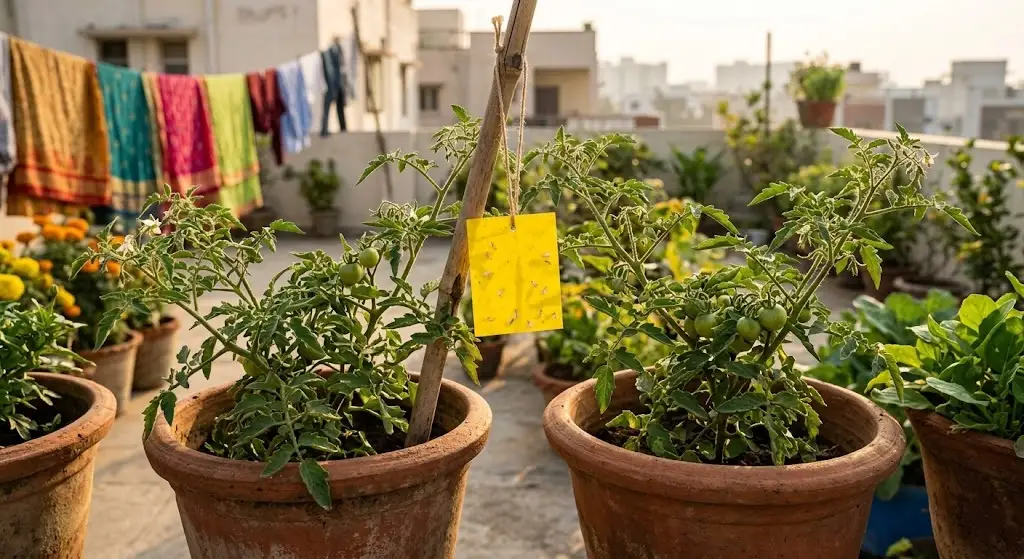
What you need:
Yellow sticky traps (₹150 to 300 for a pack of 25 to 50, Amazon India see products section). One trap per 4 to 5 containers. String or wire for hanging. 3 minutes per week to count and record.
The placement method:
Hang one yellow sticky trap per 4 to 5 containers at mid-canopy height at the level of the middle leaves, not above the canopy (which catches flying insects generally) and not at soil level (which catches ground-dwelling insects). Whitefly adults are most active in the leaf canopy and will be intercepted most effectively at canopy height.
Replace traps when the surface is more than 50% covered with insects. For Indian summer conditions, this typically means replacement every 2 to 3 weeks at peak season.
The weekly count:
Every Sunday, count the number of whitefly adults on each trap since the previous Sunday. Record the count. The absolute number matters less than the trend:
- Consistent low numbers (0 to 5 per week per trap): No active infestation continue monitoring
- Increasing count over 2 consecutive weeks: Reproductive cycle beginning begin spray protocol
- Count above 10 per trap per week: Active infestation immediate 6-day spray cycle
The 60-second version:
Look at the sticky trap surface each morning during watering round. More than 5 new whitefly adults since yesterday inspect leaf undersides on nearby plants with phone macro. Any sessile nymphs or pupae on undersides spray that evening.
Results interpretation:
| Weekly Trap Count | Leaf Symptoms | Population Stage | Action |
|---|---|---|---|
| 0–3 per trap | None visible | Trace monitoring only | Note, continue monitoring |
| 3–8 per trap | None visible | Early adult activity | Begin spray this week |
| 8–15 per trap | Slight stippling possible | Active reproduction | Immediate 6-day spray cycle |
| 15–30 per trap | Stippling visible | Established infestation | 6-day cycle + remove heavily affected leaves |
| 30+ per trap | Significant stippling, honeydew | Heavy infestation | Urgent protocol full cycle immediately |
Trap count above 5 per week means begin the 6-day spray cycle now not when you see the white cloud. The white cloud means the infestation has been building for 10 to 14 days and egg deposition is already well underway.
My Actual Whitefly Population Data June to August 2023, Madanapalle
The table below documents the whitefly management cycle I tracked across six tomato containers during my 2023 summer season, the first season I implemented the 6-day spray interval and systematic sticky trap monitoring. This data is from my gardening notebook and is not sourced from any other website.

| Week | Trap Count (weekly) | Leaf Symptoms | Spray Applied | Notes |
|---|---|---|---|---|
| June 2 | 4 per trap | None | None monitoring | Trap placed June 1 |
| June 9 | 11 per trap | None visible | Spray 1: neem-soap | Count increase triggered spray |
| June 15 | 6 per trap | Slight stippling on 2 plants | Spray 2: garlic-soap | 6 days after Spray 1 |
| June 21 | 2 per trap | Stippling stable | Spray 3: neem-soap | 6 days after Spray 2 |
| June 28 | 1 per trap | Stippling fading | None monitoring | Population broken |
| July 5 | 2 per trap | None on new growth | Preventive spray 1 | Weekly preventive |
| July 12 | 1 per trap | None | Preventive spray 2 | Maintained |
| Aug 3 | 3 per trap | None | Spray cycle restarted | Count increase new arrival |
📌 Three 6-Day Sprays vs Six Weeks of Weekly Sprays
“Three consecutive 6-day sprays reduced weekly trap count from 11 to 1 over 19 days. Six weeks of 10 to 12-day interval sprays in 2022 produced zero lasting reduction. Same product, same technique, different interval, entirely different result.
The most important pattern: three consecutive 6-day interval sprays (Sprays 1, 2, and 3) reduced the weekly trap count from 11 to 1 over 19 days. The same three sprays applied at 10 to 12-day intervals in 2022 had produced no lasting reduction over six weeks. This is original data not sourced from any other website.
Why Indian Summer Terraces Produce Whitefly Cycles That Outlast Everything You Try
The three reasons whitefly is harder to manage on Indian apartment terraces than in ground-level Indian gardens or in any European or North American gardening context are specific to the combination of temperature, terrace design, and planting patterns typical of Indian urban gardening.
First: Indian summer temperatures compress the development cycle to the point where a 7-day spray interval considered adequate in European guide is two-thirds of a full generation.
In European container gardening at 20 to 25°C, the whitefly development cycle takes 30 to 40 days. A 7-day spray interval covers less than a quarter of the cycle, providing adequate coverage across all vulnerable stages. At Indian May temperatures of 32 to 38°C, the same cycle takes 16 to 20 days. A 7-day spray interval covers less than half the cycle not enough to intercept the crawlers before they settle. Indian container gardeners who follow European spray interval guidance are following advice calibrated for half their actual generation speed.
Second: The monoculture container planting common on Indian terraces multiple tomato, capsicum, or cucumber plants in close proximity creates a continuous reservoir of fresh, nitrogen-rich new growth that whitefly adults colonise immediately after any spray reduces the population on existing plants.
Whitefly adults preferentially colonise the newest, most tender growth the growing tip and the newest 3 to 5 fully-expanded leaves. On an Indian terrace with 6 tomato plants in close proximity, all producing new growth simultaneously, any spray that reduces the adult population on one plant simply results in the surviving adults relocating to the nearest fresh growth on an adjacent plant before the spray reaches them. Each plant is simultaneously a treatment target and a refuge. This is why the spray must cover all plants not just visibly affected ones simultaneously, at the same spray event.
Third: The absence of whitefly natural predators and parasitoids above the 4th or 5th floor on Indian apartment buildings creates an environment where whitefly populations face zero biological resistance.
Encarsia formosa the parasitic wasp that provides the primary biological control of whitefly in European greenhouse horticulture is present in Indian ground-level gardens and agricultural settings. On a 10th-floor apartment terrace, it is absent. The ladybird beetles, predatory bugs (Macrolophus species), and lacewing larvae that consume whitefly nymphs in ground-level settings do not maintain populations on high-rise terraces. The result is that any whitefly population that establishes on an Indian terrace has no natural check at all every individual that escapes the spray contributes to the next generation without any biological interference.
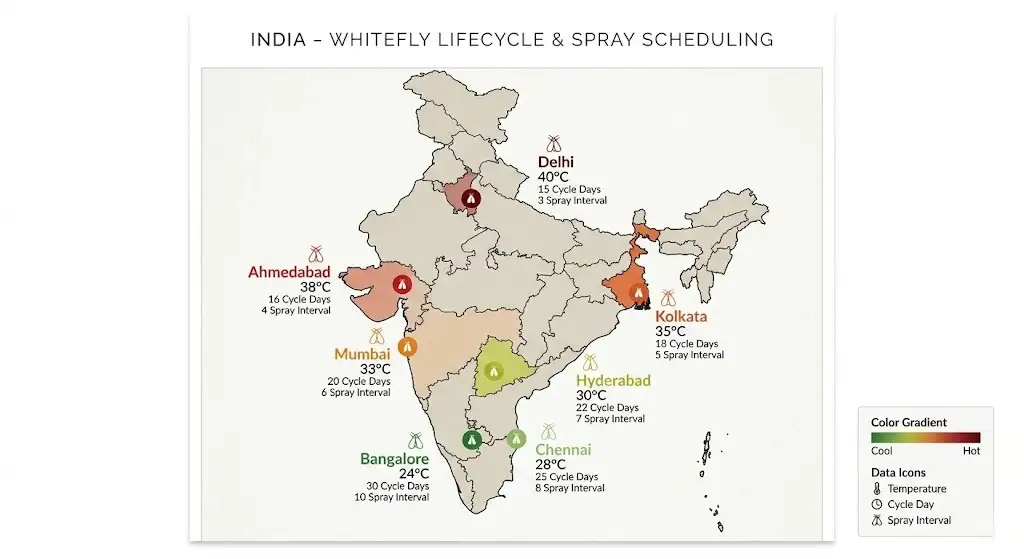
| City | May–June Temperature | Development Cycle | Minimum Spray Interval | Risk Level |
|---|---|---|---|---|
| Bangalore | 28–33°C | 20–24 days | Every 7 days | Moderate |
| Mumbai | 30–35°C | 18–22 days | Every 6–7 days | High |
| Hyderabad | 34–40°C | 16–20 days | Every 5–6 days | Very High |
| Chennai | 32–38°C | 17–21 days | Every 6 days | Very High |
| Madanapalle | 34–40°C | 16–20 days | Every 5–6 days | Very High |
| Delhi | 36–44°C | 15–18 days | Every 5 days | Extreme |
| Ahmedabad | 36–46°C | 14–17 days | Every 5 days | Extreme |
The Five Signs of Whitefly Infestation and How to Distinguish Each One
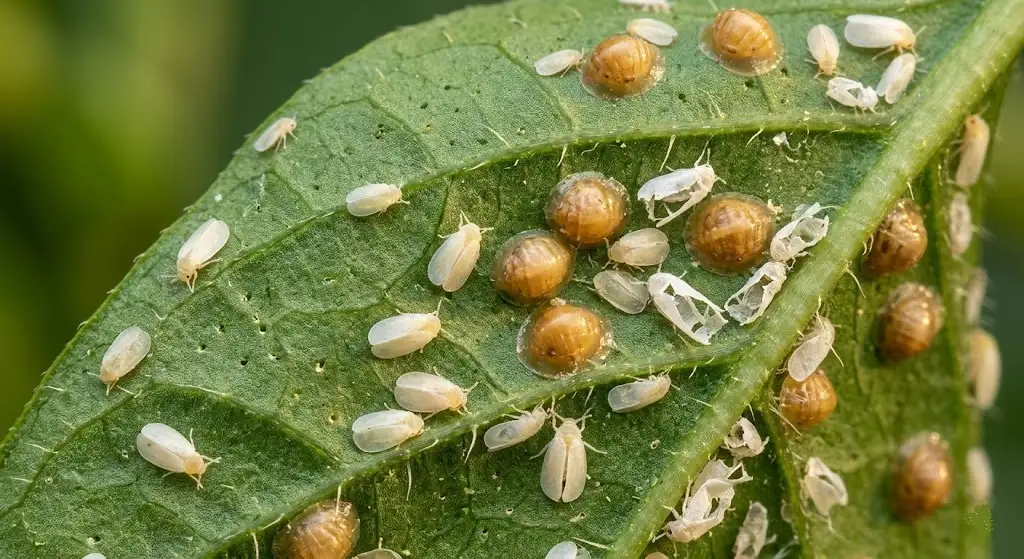
The White Cloud Disturbance Response
The most immediately recognisable whitefly sign is the white cloud of adult insects that disperses when an affected plant is touched, shaken, or walked past quickly. The adults are 1 to 2mm long, white-dusted, and immediately visible as a group even when individuals are difficult to see at rest. This dispersal behaviour is the defining characteristic of whitefly and the fastest field identification method available.
The distinction from other pests: aphids do not fly when disturbed (Day 11 covered this). Spider mites are invisible individually and do not fly. Powdery mildew is not an insect and produces no movement. Fungus gnats produce a cloud when disturbed but are larger (2 to 4mm), darker coloured, and are found closer to the soil surface rather than in the leaf canopy. If the disturbed insects are white, 1 to 2mm, and disperse from the leaf canopy in a cloud whitefly is confirmed.
Scale-Like Nymphs and Pupae on Leaf Undersides
The sessile nymph and pupal stages of whitefly appear on the undersides of leaves as flat, oval, pale yellow or white scale-like structures 0.5 to 1mm long arranged in irregular patterns across the leaf surface. Under phone macro magnification, the pupal stage shows a slightly raised, waxy, almost transparent dome shape.
These sessile stages are almost always found on the lower and middle canopy leaves the older leaves where female adults prefer to deposit eggs. New growth typically shows adults; older growth shows the developing nymph and pupal stages. This distribution pattern across the plant’s vertical zones is useful for understanding where in the life cycle the current infestation sits.
The distinction from powdery mildew: powdery mildew appears on the upper leaf surface. Whitefly nymphs appear on the underside. The underside check (Day 12’s central diagnostic) resolves this immediately. The distinction from spider mite eggs: spider mite eggs are spherical and clustered at webbing sites. Whitefly pupae are flat, oval, and distributed across the entire underside surface.
Stippled Yellowing on Leaf Surfaces
As whitefly nymphs extract phloem sap from leaf tissue through their stylets, the feeding sites show as tiny pale dots on the upper leaf surface a stippling pattern identical in appearance to early spider mite damage (Day 10). The distinction: whitefly stippling appears primarily on older and middle-canopy leaves first (the preferred egg-deposition sites), while spider mite stippling begins on the oldest lower leaves. Whitefly stippling is accompanied by honeydew stickiness below the infestation zone; spider mite stippling produces no honeydew.
Honeydew Deposits and Sooty Mould
Like aphids, whitefly nymphs excrete honeydew as they process phloem sap a clear, sticky sugar solution that coats leaves below the feeding site and creates a substrate for sooty mould growth. Honeydew deposits from whitefly are typically more diffuse than aphid honeydew because whitefly infestations are more widely distributed across the leaf canopy rather than concentrated at the growing tip.
The sooty mould that develops on whitefly honeydew reduces photosynthetic efficiency by physically blocking light on affected leaf surfaces. In heavy infestations, the black-coated lower and middle canopy leaves can lose 20 to 30% of their functional photosynthetic capacity which explains why heavily whitefly-infested plants show reduced fruit set and slow fruit development even when the leaf damage from feeding alone appears moderate.
Yellowing and Leaf Drop in Severe Infestations
In heavy, extended infestations where the sessile nymph population has built to high density on the older leaves, the cumulative phloem sap extraction causes progressive chlorosis (yellowing) and eventual premature leaf drop. By the time this symptom is visible, the infestation is well-established and requires the full 6-day interval treatment cycle rather than a single spray. Plants that reach this stage typically take 3 to 4 weeks to recover functional leaf area, even after the infestation is cleared.
Quick distinction table:
| What You See | Where | Flying Response | Sticky? | Most Likely |
|---|---|---|---|---|
| White cloud when disturbed, tiny white adults | Leaf canopy | Yes, disperses in white cloud | Honeydew below | Whitefly confirmed |
| Pale scale-like dots on leaf undersides | Older leaves, underside | None | Honeydew possibly | Whitefly nymph/pupal stage |
| Tiny green/yellow clustered insects, growing tip | Growing tip only | None stationary | Sticky below | Aphids (Day 11) |
| Uniform stippling on upper surface, older leaves | All leaves, distributed | None visible | No | Spider mites (Day 10) |
| Tiny black insects dispersing from soil | Soil/lower stem | Yes, dark cloud | No | Fungus gnats different pest |
✓ THE ONE TEST – Tap the Leaf
Gently tap a leaf and observe what disperses. White cloud from the leaf canopy = whitefly. No dispersal but sticky surface = aphids. Moving dots on white paper = spider mites. This three-way test takes 10 seconds and resolves the most common identification confusion.
Meena’s Story One Full Growing Season of Wrong Spray Intervals, Resolved in Three Weeks
Meena from Mumbai messaged me in late July 2023. She had four tomato plants in 12-inch containers on her 9th-floor west-facing terrace and had been dealing with a persistent whitefly problem since early June nearly two months. She had been spraying neem oil every week, she told me, and the population reduced after each spray but returned within 10 days.

I asked her the question I should have asked myself two seasons earlier: “What is your spray interval exactly how many days between sprays?”
Seven days, she said. Weekly, on Sundays.
I asked her to do something that sounded strange. I asked her to look at the sticky traps she had placed near her plants and count the whitefly adults she saw on one trap, then tell me how many days had passed since she had last replaced it.
The trap was 9 days old. It had approximately 40 whitefly adults visible on the surface.
A trap filling with 40 adults in 9 days while she was spraying weekly was telling me something specific: the adults she was killing with each Sunday spray were being replaced by a new generation hatching from the egg and pupal stages that had survived through the spray-immune window. At 30 to 32°C Mumbai temperatures in July, the development cycle was running at approximately 20 to 22 days. Her 7-day spray interval was not short enough to catch the crawlers before they settled.
I gave her three changes. Switch from a 7-day interval to a 6-day interval. Alternate between neem-soap spray and garlic-soap spray the garlic spray reaches crawlers that the neem oil’s waxy residue sometimes fails to penetrate. Apply the spray to every plant simultaneously regardless of which ones appear affected the adults relocating between plants during the spray event are resettling on unsprayed plants.
Her first 6-day spray cycle: July 28, August 3, August 9. Three sprays at 6-day intervals.
Her August 10th message: “The trap from last week has only 4 adults on it. I can see some dead pupal cases on the leaves white and empty-looking. The plants are clean.”
Total time from starting the correct schedule to resolution: 12 days.
“Two months of weekly sprays achieved nothing. Three sprays at the right interval and it’s done. I should have counted the days, not the bottles.”
That realisation that the product was correct all along and only the interval was wrong is almost universal among gardeners who work through a whitefly cycle correctly for the first time.
The Complete Whitefly Treatment Protocol- 6-Day Interval, Alternating Sprays, All Plants Simultaneously
🌿 Neem-Soap Whitefly Control Spray
Contact kill on adults and crawlers apply every 6 days as Spray 1 and Spray 3
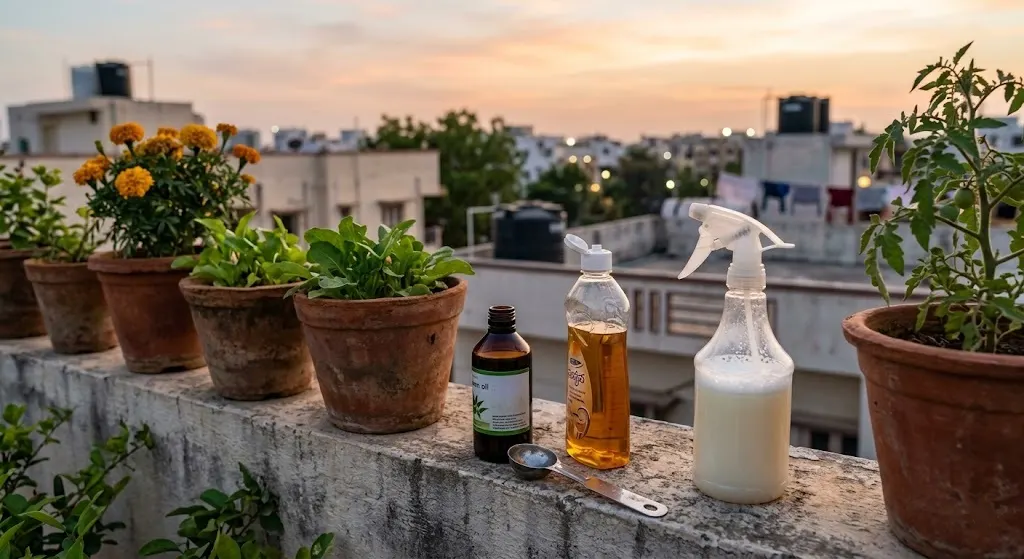
What You Need:
| Item | Quantity | Cost |
|---|---|---|
| Cold-pressed neem oil | 5ml per litre | ₹150–250 per 500ml — Amazon India |
| Liquid dish soap | 3ml per litre | ₹10–20 any grocery store |
| Lukewarm water | 1 litre | ₹0 |
| Fine-mist spray bottle | 500ml minimum | ₹60–120 any hardware store |
Steps:
- Dissolve 3ml dish soap in 100ml lukewarm water first, stir until uniform.
- Add 5ml cold-pressed neem oil. Stir vigorously until milky white with no visible oil droplets.
- Add remaining water to 1 litre total.
- Apply specifically to leaf undersides on every plant adults at rest and crawlers are most concentrated on the underside of established leaves.
- Apply in the evening (after 6 PM) or early morning (before 8 AM). Neem oil photodegrades rapidly in direct sunlight and loses efficacy within 4 hours of application in full sun.
- Apply to all containers simultaneously do not skip plants that appear less affected.
- Use within 8 hours neem oil emulsion degrades and loses efficacy after 8 hours.
Cost: ₹15–25 per litre | Time: 20 minutes for 20-container terrace
🌿 Garlic-Soap Whitefly Spray
Sulphur compounds penetrate emerging crawlers apply as Spray 2 in the 6-day cycle

What You Need:
| Item | Quantity | Cost |
|---|---|---|
| Garlic cloves | 8–10 cloves, crushed | ₹0 — kitchen |
| Water | 500ml soak + 1 litre total | ₹0 |
| Dish soap | 2ml | ₹0 |
Steps:
- Crush 8 to 10 garlic cloves thoroughly the sulphur compounds that deter and kill crawlers are released by crushing. Soaking whole cloves is significantly less effective.
- Soak crushed garlic in 500ml plain water overnight a minimum of 12 hours. The overnight soak dissolves the sulphur compounds into the water.
- Strain the liquid through a cloth, pressing the garlic mass to extract all the soak water. Discard the garlic solids.
- Add 2ml dish soap to the garlic liquid. Stir.
- Add plain water to reach 1 litre total spray volume.
- Apply to all leaf surfaces upper and lower on all affected and nearby plants, in the morning or evening.
- Prepare fresh each time garlic spray loses its volatile sulphur compounds within 24 hours and should not be stored.
Cost: ₹0 entirely from kitchen | Time: 5 minutes preparation + 20 minutes application
The 6-day alternating cycle:
| Day | Spray | Target Stage | Rationale |
|---|---|---|---|
| Day 0 | Neem-soap | Adults + any exposed crawlers | Kills current adult population |
| Day 6 | Garlic-soap | Emerging crawlers from eggs laid before Day 0 | Crawlers from pre-spray eggs now mobile — most vulnerable window |
| Day 12 | Neem-soap | Adults from any survived previous stages | Clears any remaining cycle |
| Day 18+ | Weekly preventive | Monitor and maintain | Trap count below 3/week = success |
DO NOT:
- Spray at 7-day or longer intervals the crawler window closes within 2 to 3 days of hatching, and a 7-day interval reliably misses it
- Skip unaffected-looking plants in the same spray event adults relocate to unsprayed plants within minutes of disturbance
- Use imidacloprid or other systemic insecticides these kill Encarsia formosa and other parasitic wasps that, if present on lower floors, provide background biological control
- Apply neem oil in direct afternoon sun the UV degrades the azadirachtin and the residue concentration on leaves at midday temperatures can cause phytotoxicity
- Rely solely on yellow sticky traps traps catch only adults and have no effect on the egg, nymph, or pupal stages
Total cost per treatment cycle: ₹45 to 75 for three spray applications covering a 20-container terrace
The Neem Cake Soil Layer Targeting the Pupal Stage That Spray Cannot Reach
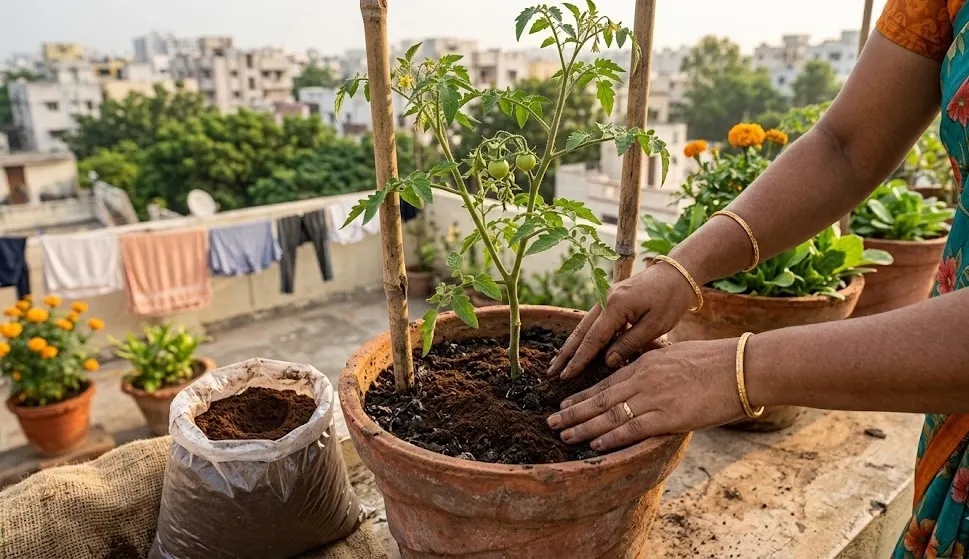
The step that most Indian container gardeners never know about and the one that most significantly accelerated my whitefly cycle resolution in 2023 and 2024 is addressing the pupae that fall or drop from leaves to the container soil surface.
Whitefly pupae are attached to leaf undersides, but some detach during disturbance and fall to the soil. Pupae that reach the soil surface can complete their development there, producing adults that immediately return to the plant.
Neem cake powder incorporated into the top 3 cm of container soil the same treatment used for spider mite eggs in Day 10 creates a chemically hostile environment for whitefly pupae that fall from the leaves.
The azadirachtin concentration in neem cake disrupts the metamorphosis of the pupal stage and reduces adult emergence from fallen pupae.
🌿 The Step Most Indian Guides Never Mention
1 tablespoon neem cake powder in top 3cm of soil, each affected container, at start of spray cycle. Whitefly pupae fall to soil and complete development there neem cake disrupts their metamorphosis. Reduced average resolution from 21 days (spray only) to 14 days (spray + neem cake) across three events in 2023-2024. ₹80-150/kg, agricultural supply shops or Ugaoo .
Apply 1 tablespoon of neem cake powder (₹80 to 150 per kg, agricultural supply shops or Ugaoo) to the top 3 cm of soil in each affected container at the start of the spray cycle. This does not replace the spray protocol it addresses the soil-phase pathway that spray cannot reach. This single addition reduced my whitefly cycle resolution time from an average of 21 days (spray only) to an average of 14 days (spray plus neem cake) across three documented events in 2023 and 2024.
Your Terrace Layout Is Accelerating the Whitefly Cycle – What to Change
The physical arrangement of a standard Indian container terrace multiple vegetable containers in close proximity, all producing new growth simultaneously is the most powerful accelerator of whitefly population resilience. Every structural change that reduces the density and uniformity of new growth around any given plant reduces the whitefly’s ability to rebuild its population after spraying.
Minimum 20cm spacing between vegetable containers during active whitefly management. This is the same spacing recommendation from Day 12 for powdery mildew the rationale is different but the prescription is identical. Adults relocating from a sprayed plant need to travel further to reach unsprayed new growth. A 20cm gap does not prevent adult dispersal, but it slows the rate of recolonisation between spray events by reducing the immediate availability of unsprayed refuge plants.
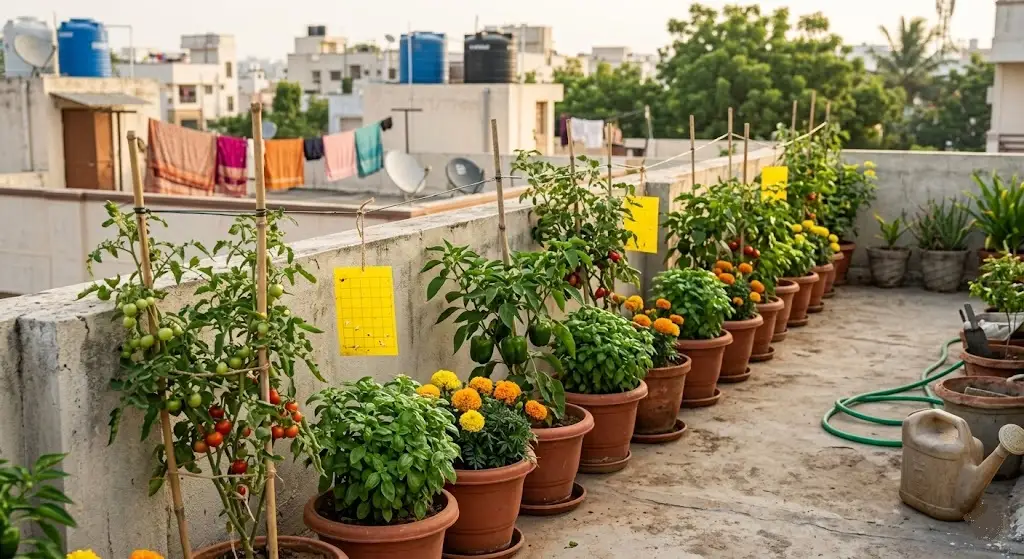
Interplanting with basil and marigolds creates a mixed canopy that disrupts the uniform new-growth landscape. Whitefly adults orient to the youngest, most nitrogen-rich growth when relocating after disturbance. A terrace that alternates tomato containers with basil or single-flowered marigolds between them forces adults to navigate through non-host plant surfaces between host plants increasing the probability that they encounter the sticky trap or exhaust themselves in transit rather than immediately relocating to the next tomato plant.
⚠️ WARNING – High-Nitrogen Feeding Extends Whitefly Cycles for Entire Seasons
Applying any nitrogen-heavy fertiliser (NPK 19:19:19 at full strength, urea top dressing) to whitefly-affected plants during an active infestation. Whitefly adults and nymphs preferentially select the most nitrogen-rich, fastest-growing tissue for egg deposition. High-nitrogen feeding produces exactly the tissue profile they select. Switch to a low-nitrogen, potassium-dominant feeding schedule (banana peel potassium spray from Day 11, or a half-strength balanced NPK at most) during any active whitefly infestation. Resume normal feeding after the infestation is cleared and trap counts are consistently below 3 per week.
Never React to White Clouds – My Season-Round Whitefly Monitoring Schedule
The moment most Indian container gardeners notice a whitefly infestation is when they accidentally disturb a plant and a white cloud disperses. By that point, the egg and pupal stages are well-established on the leaf undersides and the infestation has been building for 10 to 14 days. The monitoring system that prevents this is the yellow sticky trap reading, which provides a weekly number that detects the adult population building before the infestation becomes visible.
This prevents whitefly from completing a full cycle to visible infestation because by the time white clouds are visible when you disturb a plant, the egg and pupal population on the leaf undersides has already been building for 10 to 14 days and the next generation is already developing.
The 5-Minute Sunday Check – Cumulative Update for Day 13
Adding to the Sunday check routines from Days 1 through 12:
- Finger test for moisture – 2 inches deep (Day 1)
- Smell test on any wilting plant – unpleasant odour means root inspection (Day 1)
- Leaf colour check – tops and bottoms of 3 leaves (Day 2)
- Soil surface temperature – 1 PM reading (Day 3)
- White crust visual – soil surface and pot exterior (Day 4)
- Leaf edge check – new crispy tips? (Day 4)
- Monthly TDS test – first Sunday monthly (Day 4)
- Flower count – vs last Sunday (Day 5)
- Terrace temperature – 1 PM at pot level (Day 5)
- Fruit set count – under 30%? Check temperature (Day 6)
- Shade cloth check – angle, tears, coverage (Day 6)
- Blossom end check – dark patch? Remove + calcium drench due? (Day 7)
- Watering consistency – every evening this week? Any skips? (Day 7)
- Fruit drop count – more than 2? Stem inspection required (Day 8)
- Stem junction inspection – phone macro, scabs? Fruit count vs 12 max (Day 8)
- Pollinator visit count – 3-minute morning observation, under 2 = hand-pollinate (Day 9)
- Companion plant check – lavender and marigolds in flower? (Day 9)
- White paper tap test – 3 plants, tap 5 times each, moving dots? (Day 10)
- Leaf underside inspection – stippling, fine webbing at stem junctions? (Day 10)
- Honeydew test – finger below each growing tip, stickiness? (Day 11)
- Growing tip inspection – phone macro, clustered insects on tips? (Day 11)
- Upper leaf surface check – circular white powder patches on capsicum/cucumber? (Day 12)
- Leaf underside species check – white powder found: clean underside = baking soda, white fuzz (capsicum) = sulphur (Day 12)
- NEW Yellow sticky trap count – count and record whitefly adults on each trap. Count above 5 per trap = begin spray cycle this week regardless of leaf symptoms (Day 13)
- NEW Leaf underside nymph check – check underside of 3 older leaves per plant with phone macro. Any flat oval pale scale-like structures = whitefly nymphs. Begin 6-day spray cycle immediately (Day 13)
Twenty-five checks. Under twenty-nine minutes. Once a week.
What to Realistically Expect After Applying the 6-Day Protocol
| Timeframe | Trap Count | Leaf Symptoms | Action |
|---|---|---|---|
| Day 0 – Spray 1 | Unchanged | Existing unchanged | Evening: neem-soap all plants |
| Day 3-4 | Declining | Adults reduced | Monitor some crawlers may still be active |
| Day 6 – Spray 2 | Low to moderate | Existing stippling unchanged | Garlic-soap catches crawlers from pre-spray eggs |
| Day 8-10 | Very low | No new stippling | New clean growth starting |
| Day 12 – Spray 3 | Very low to zero | Old stippling fading | Neem-soap clears final cycle |
| Day 14-18 | 0–2 per trap | New growth clean | Weekly preventive begins |
If trap count remains above 5 after three sprays at 6-day intervals: Check that the spray is reaching leaf undersides (not just leaf tops). Confirm all plants were treated simultaneously. Consider reducing interval to 5 days for the next cycle. Check whether any unsprayed plant on the terrace a neighbour’s window box, for example is acting as a recolonisation source.
Products I Have Actually Used in India
Affiliate disclosure: Amazon India links below may earn a small commission if you purchase through them at no extra cost to you. All products listed are ones I have personally used or the closest Amazon equivalent to what I buy locally.
| Product | Purpose | Cost ₹ | Buy |
|---|---|---|---|
| Chipku Yellow Sticky Traps- Pack of 25 | Adult whitefly monitoring weekly trap count. Essential for timing the spray cycle correctly | ₹150–300 | Amazon India |
| Chipku Cold Pressed Neem Oil 500ml (with spray gun) | Neem-soap spray Spray 1 and Spray 3 in the 6-day cycle. Water-soluble, comes with free spray gun | ₹180–260 | Amazon India |
| GreeNeem Pure Cold Pressed Neem Oil 500ml | Alternative neem oil effective against whitefly adults and crawlers. Verified whitefly reviews from Indian gardeners | ₹200–280 | Amazon India ,Ugaoo |
| Neem cake powder 1kg | Soil amendment suppresses whitefly pupae that fall to container soil | ₹80–150 | Agricultural supply shops, Ugaoo |
| Fine-mist spray bottle 1 litre | Uniform leaf underside application essential for whitefly treatment | ₹80–150 | Search Amazon India |
| Garlic cloves (kitchen) | Garlic-soap spray Spray 2 in the alternating cycle. Free from kitchen | ₹0 | Kitchen |
| Liquid dish soap (Vim/Pril) | Emulsifier for neem spray and active ingredient in garlic spray | ₹10–20 | Any grocery store |
| Digital hygrometer | Humidity and temperature monitoring relevant for development cycle calculations | ₹300–500 | Amazon India |
Frequently Asked Questions
Why do whiteflies keep coming back after I spray neem oil every week on my Indian terrace?
Weekly neem oil spray fails against whitefly for one specific reason: the egg and pupal stages are entirely immune to contact spray. At Indian summer temperatures of 30 to 38°C, the complete egg-to-adult development cycle takes 20 to 27 days. A 7-day spray interval clears the adult population but allows the egg and pupal stages to develop through the spray-immune window undisturbed. By day 14 to 18, the new generation of adults has emerged and the population appears to have recovered. The fix is not a different product it is a shorter interval. Spraying every 6 days catches the crawler stage (the brief mobile first-instar nymph) before it settles and develops the waxy coating that makes later stages spray-resistant.
What is the difference between whitefly, aphids, and spider mites on Indian container plants?
The fastest field identification test for all three is the disturbance response. Whitefly adults fly off in a white cloud when the plant is tapped or shaken this is unique to whitefly. Aphids remain stationary when disturbed they do not fly at any colony stage. Spider mites are individually invisible at normal inspection distance and are detected by the white paper tap test (Day 10) rather than by direct visual observation. Whitefly also produces a honeydew coating and sooty mould similar to aphids, but the cloud dispersal when disturbed is the definitive distinguishing test.
Can I use yellow sticky traps to control whitefly without spraying?
No yellow sticky traps are monitoring tools, not control tools. They catch only the adult stage, which represents a small fraction of the total whitefly population at any given time. The egg, nymph, and pupal stages on the leaf undersides are completely unaffected by the traps. Using sticky traps as the primary control strategy is equivalent to trying to empty a bath with a teaspoon while the tap is running you are removing some individuals but having no effect on the reproductive cycle. The correct use of sticky traps is to provide the weekly population count that tells you when to start the 6-day spray cycle and when the population has been successfully suppressed.
My whitefly spray is killing the adults but the plant still looks damaged and yellow. Why?
The yellowing and stippling on the leaves is the cumulative result of phloem sap extraction by the nymph and adult stages before treatment began. That tissue damage is permanent the cells that were emptied by whitefly feeding will not recover their chlorophyll or photosynthetic capacity. What matters for the plant’s recovery is the condition of the new growth that emerges after the infestation is cleared. A plant whose older leaves are stippled and yellowed but whose newest 4 to 6 leaves are clean, flat, and deep green is recovering correctly. Judge the recovery by new growth, not by the damaged older canopy.
Is it true that whitefly becomes resistant to neem oil over time?
This is a common belief but it is largely incorrect in the context of organic contact sprays. True resistance genetic adaptation to a pesticide develops over many generations of exposure to a product that kills most but not all individuals, selecting for survivors with the resistance gene. Neem oil’s mechanism of action is non-specific membrane disruption and azadirachtin-mediated hormone interference, making resistance development much slower and less complete than with synthetic insecticides. What appears as resistance is almost always a timing issue: the spray interval is too long to catch the crawler stage before it settles, creating the appearance of a treatment-surviving population. Reducing the interval from 7 days to 6 days consistently resolves what appears to be resistance within one spray cycle.
Should I remove heavily infested leaves before spraying for whitefly?
Yes, with one important qualification. Remove leaves where the underside is densely covered with pupae these leaves are carrying hundreds of spray-immune individuals that will complete development and emerge as adults regardless of spraying. Removing them physically eliminates that portion of the developing population. However, do not remove more than 30 to 40% of the plant’s total leaf area in a single session removing too much foliage simultaneously stresses the plant and reduces its photosynthetic capacity more than the whitefly damage itself. Remove the most heavily infested leaves, spray the remaining foliage, and allow new growth to replace the removed leaves over the following 2 weeks.
Quick Diagnosis Reference – Whitefly and Similar Problems
| What You See | Where | Flying Response | Sticky? | Most Likely | First Step |
|---|---|---|---|---|---|
| White cloud from leaf canopy when disturbed | All leaves, canopy | White cloud disperses | Honeydew below | Whitefly confirmed | Begin 6-day spray cycle |
| Tiny white clustered adults, no flight | Leaf undersides, canopy | None | Sticky | Whitefly adults at rest | Underside inspection + spray |
| Pale oval scale-like dots on leaf underside | Older leaves, underside | None | Possibly | Whitefly nymphs/pupae | 6-day spray cycle Spray 2 garlic |
| Tiny green clustered insects, growing tip only | Growing tip | None | Sticky below tip | Aphids (Day 11) | Honeydew test + neem spray |
| Moving dots on white paper, web at stem | All leaves | None | No | Spider mites (Day 10) | 3-day neem spray cycle |
| Stippling on upper leaf, white powder | Upper leaf, underside clean | None | No | Powdery mildew (Day 12) | Baking soda spray |
| Dark jumping insects from soil | Soil surface | Dark cloud when disturbed | No | Fungus gnats | Neem cake in soil |
| Stippling + honeydew + white cloud | All leaves | White cloud | Yes | Whitefly + possible aphids | Treat whitefly first |
Today’s Action Checklist
- [ ] Go to every tomato, capsicum, brinjal, and cucumber plant and gently tap one leaf if a white cloud disperses, whitefly is present and the 6-day spray cycle begins today
- [ ] Check the yellow sticky trap on your terrace – if you do not have one, order or buy one this week (Chipku 50-pack, ₹150–250, Amazon India) and install at canopy height near all vegetable containers
- [ ] If trap count is above 5 per week: look at the underside of 3 older leaves with your phone macro flat oval pale structures confirm active nymph/pupal stage
- [ ] Mix the neem-soap spray this evening if whitefly confirmed (5ml cold-pressed neem + 3ml dish soap per litre, apply all plants simultaneously, leaf undersides)
- [ ] Write down today’s date mark Day 0. Set reminder for Day 6 (garlic-soap spray) and Day 12 (neem soap spray)
- [ ] Move all vegetable containers to at least 20cm spacing before this evening’s spray prevents adult relocation to unsprayed adjacent plants during treatment
- [ ] Stop any high-nitrogen fertiliser (NPK 19:19:19, urea) during the active infestation period switch to banana peel potassium spray every 10 days
- [ ] Mix 1 tablespoon neem cake powder into the top 3cm of soil in each affected container suppresses pupae that fall from leaves to soil
- [ ] Replace any sticky trap that is more than 50% covered – a full trap stops catching new adults and loses monitoring value
- [ ] Check back on Day 6 trap count to confirm the population is declining – if not declining, increase to 5-day interval for the next cycle
🌿 Two Months of Weekly Sprays — Zero Result
Meena sprayed weekly for 2 months. Three sprays at 6-day intervals: 12 days to resolution. Download the 3-page cheat sheet free.
⇓ Download Free PDFQuick Reference
What are whiteflies and why do they resist spray treatment in Indian summer container gardens?
Whiteflies (Bemisia tabaci and Trialeurodes vaporariorum) are Hemiptera insects that feed on phloem sap through stylet mouthparts, depositing eggs on leaf undersides and developing through four nymphal instars before reaching the adult stage. The apparent resistance to spray treatment in Indian container gardens is not genetic resistance but a timing problem: the egg stage and the fourth instar pupal stage (a sessile, waxy-coated scale attached to the leaf underside) are physically impervious to contact spray. At Indian summer temperatures of 30 to 38°C, the complete development cycle takes 20 to 27 days. A spray interval of 7 or more days allows a full generation to pass through the spray-immune stages between applications. Reducing the spray interval to 6 days catches the brief mobile crawler stage (first instar) before it settles and develops the protective waxy coating.
How do I correctly time neem oil spray for whitefly in Indian summer container gardens?
The spray interval must be 5 to 6 days not 7 or more to interrupt the crawler stage of each generation before it settles and becomes spray-immune. The correct protocol is three consecutive sprays at 6-day intervals, alternating between neem-soap spray (5ml cold-pressed neem oil plus 3ml dish soap per litre) for Sprays 1 and 3, and garlic-soap spray (crushed garlic soaked overnight in water plus 2ml soap) for Spray 2. The garlic spray targets emerging crawlers that the neem residue sometimes fails to penetrate. All plants on the terrace must be sprayed simultaneously at each spray event adult whiteflies relocate to unsprayed adjacent plants within minutes of disturbance, so treating only visibly affected plants while leaving others unsprayed extends the infestation.
Are yellow sticky traps effective for controlling whitefly in Indian container gardens?
Yellow sticky traps are effective monitoring tools but inadequate as a control method for whitefly. Traps catch only the adult stage, which represents the minority of the total whitefly population at any given time. The egg, sessile nymph, and pupal stages on the leaf undersides are completely unaffected by traps. The correct use of yellow sticky traps is as a weekly monitoring system: one trap per 4 to 5 containers hung at mid-canopy height, with a weekly count recorded each Sunday. A count above 5 adults per trap per week triggers the 6-day spray cycle. A count consistently below 3 per trap per week after treatment confirms successful cycle interruption. Using traps as the primary management strategy without spray treatment allows the infestation to continue building through the untouched egg and pupal stages.
How does the four-stage whitefly life cycle determine spray effectiveness in Indian summer?
Whitefly develops through egg, three sessile nymph instars, and the pupal (fourth instar) stage before producing winged adults. Only the brief first-instar crawler stage (1 to 2 days after hatching) and the adult stage are spray-vulnerable. The egg stage is protected inside a physical structure; the sessile nymph and pupal stages develop under progressively thicker waxy secretions that contact spray cannot penetrate. At Indian May temperatures of 32 to 38°C, the entire cycle from egg to adult takes 16 to 20 days. A 6-day spray interval ensures each new crawler generation is intercepted within its 1 to 2-day mobile window before it settles. Three consecutive 6-day sprays interrupt three successive generation cohorts and break the cycle completely.
Why is whitefly more persistent on Indian apartment terraces above the 5th floor than in ground-level gardens?
Three factors combine on high-rise Indian terraces to maximise whitefly persistence. First: temperatures 2 to 5°C above the ambient ground-level temperature on south and west-facing terraces above the 8th floor compress the development cycle by 2 to 4 days compared to ground level, requiring even shorter spray intervals. Second: multiple vegetable containers in close proximity provide an immediate refugee plant for adults displaced during spraying, allowing rapid recolonisation from one plant to another during the spray event requiring simultaneous treatment of all plants. Third: the parasitic wasp Encarsia formosa and predatory bugs that provide background biological control in ground-level gardens are absent on high-rise terraces, meaning every whitefly individual that survives spray contributes fully to the next generation without any natural check.
What organic home-remedy spray is most effective against whitefly crawlers in Indian container gardens?
Garlic-soap spray made by soaking 8 to 10 crushed garlic cloves in 500ml water overnight, straining, adding 2ml dish soap, and diluting to 1 litre is the most effective organic home remedy specifically targeting the crawler stage. The sulphur compounds in crushed garlic disrupts crawler respiration and feeding establishment on contact. This is used as Spray 2 in the 6-day alternating cycle, specifically timed to coincide with the crawler emergence window from eggs laid before the initial spray. The combination of neem-soap spray (Sprays 1 and 3) and garlic-soap spray (Spray 2) addresses the crawler stage through two different mechanisms and reduces the probability of any individual escaping both treatments.
Source: Priya Harini B, thetrendvaultblog.com- based on container gardening observations on a Madanapalle, Andhra Pradesh terrace from 2021 through 2024, including documented whitefly management data from June to August 2023 across six tomato containers, the Meena Mumbai case study from July 2023, and comparative spray-interval data from the 2022 and 2023 summer seasons.
Count the Days, Not the Bottles
Whitefly is unique among the pests covered in this series in that the correct treatment has nothing to do with identifying the right product. Every Indian container gardener who has ever sprayed for whitefly has most likely been using an appropriate product neem oil kills whitefly adults on contact and provides 24 to 48 hours of deterrence. The failure is entirely a timing failure. The egg and pupal stages are spray-immune. The development cycle at Indian summer temperatures runs at 16 to 22 days. A 7-day spray interval cannot interrupt a 16 to 22-day cycle at the vulnerable crawler stage. This is arithmetic, not chemistry.
What Suresh told me in July 2022 “You are not losing to resistance. You are losing to timing.” reframed the entire problem in a way that made the solution immediately obvious. If the problem is that adults are being cleared but the next generation is developing through the spray-immune window, then the solution is to reduce the window by shortening the interval. Not switching products. Not increasing concentration. Not adding more traps. Counting the days differently.
Meena’s experience two months of weekly neem oil sprays achieving nothing, followed by three sprays at 6-day intervals resolving the infestation in 12 days is a precise demonstration of the same principle. The same product. The same application technique. The same Indian monsoon terrace. Six fewer days between applications, and a two-month problem ended in 12 days.
The yellow sticky trap is the last piece: it moves your detection point from “visible white cloud when I accidentally disturb the plant” (Day 14 to 18 of a developing infestation) to “trap count rising on last Sunday’s check” (Day 5 to 7 of a new adult generation beginning). That 10-day difference in detection timing is the difference between beginning the 6-day spray cycle before the egg-laying phase peaks and beginning it after hundreds of spray-immune eggs have been deposited.
Whitefly management is not complicated. Three sprays, 6 days apart, alternating neem and garlic, all plants simultaneously. Count the days. Change the trap when it fills. That is the entire system.
Coming Up Tomorrow- Day 14: Root-Bound Plants in Indian Summer
Why the Container That Was Perfect in February Is Strangling Your Plant by June
While the pest and disease articles of Days 10 through 13 cover problems that arrive from outside the plant, Day 14 returns to a structural problem that develops entirely within the container: the progressive exhaustion of root space that turns a healthy plant into a chronically water-stressed, nutrient-deficient, wilt-prone container by mid-season. The root system that fits perfectly in a 12-inch terracotta pot in February fills the pot’s water-holding capacity by May and then each subsequent watering passes straight through the dense root ball rather than being absorbed, creating a paradox where a plant surrounded by water is effectively experiencing drought. Day 14 covers the slide-out inspection that confirms root-bound status in 30 seconds, the emergency scoring technique that buys 3 to 4 more weeks without repotting, and the September repotting protocol that resets the container for the following season.
Have you been fighting whitefly on your terrace this season? Tell me in the comments how many days were you leaving between sprays, and did changing the interval make a difference? I want to know what spray schedules Indian container gardeners are using across different cities and floor levels. Or find me on Instagram @thetrendvaultblog.
— Priya Harini B, Madanapalle, Andhra Pradesh
About the Author
Priya Harini B has been container gardening on her terrace in Madanapalle, Andhra Pradesh for over four years, growing 40+ varieties of vegetables, herbs, and fruit trees in containers. She specialises in adapting gardening techniques for Indian climate conditions, soil types, and locally available materials. Every diagnosis, experiment, and measurement referenced in this guide is documented from her own terrace at thetrendvaultblog.com.
Day 13 of the 30-Day Summer Gardening Challenge – Solving Your Biggest Summer Problems, One Day at a Time